
Robin S Webber
This transcript was generated by AI and may contain errors. It is provided to assist those who may not be able to listen to the message.
I know we all appreciate the hymn choir when they do sing in beautiful praises to God here on the Sabbath day. For those of you that are joining us, we are moving into the second part of a three-part series. Allow me to give you the title of that series. It is simply called, Not Without Blood.
I'd like to review just for a few moments where we were a fortnight ago, so that all of us can begin on the same page, and then move forward into the rest of the story. In the first message, we came to see a powerful connection between God, His people, and the element of blood. And it started right from the very beginning. Blood. You know, when we talk about blood, we just don't say blood. Normally when we sight it, normally when it begins flowing from us, what do we do? We say, blood! Blood! Or in whatever tone you might do it, but I'm sure it's not too passive.
We're talking over this course of Sabbath about the subject of blood. The red fluid that's pumped by our hearts throughout our bodies, sending forth life-giving nutrients to every extremity, every part of our whole, without this red, warm fluid that spreads, covers, and yes, if it spills, stains, we would all, those that are living, simply die. Moses nearly 3,500 years ago wrote in the book, wrote in the book of Leviticus, that the life of the flesh is in the blood. And that is why if you'll turn with me for just a second, let's anchor ourselves in the Bible.
Join me if you would as we open up our Bibles on this, the Sabbath day, to Hebrews 9 and verse 7. And let's look at our anchor scripture that we are utilizing throughout the course of this series. From whence comes the title? Hebrews 9, verse 7. But into the second part, the high priest went alone, once a year, speaking of Yom Kippur, speaking of the day of atonement, not without blood, which he offered for himself and for the people's sin, committed in ignorance.
But we find that the blood that the high priest took into the Holy of Holies on that festival was not a singular event. We began to move it back right to the Garden of Eden and outside the borders of Eden, and to recognize the story of blood. We began to systematically cover the trail of blood leading from within the Garden of Eden to Abel, to Noah, to Abraham, and Isaac. We discussed the trail of blood through the Bible of that evening of Passover in Egypt. We also discussed about the blood that was sprinkled in Sinai. And we came to discover, and the reason why I'm bringing this message to you for these three weeks, we came to discover that the subject, the issue, the topic of blood is not marginal.
The Scripture. It is not something that you have to go find. It is central. It is central to what the Bible is discussing. What is it discussing? It takes us on a trail of blood from Genesis to the book of Revelation. But blood is not an end in itself. The reason why God deals with the subject of blood from Genesis to Revelation is not because of blood for blood's sake, but because of the impact that blood has on life, the impact that it has even on death.
God wanted us to understand not how powerful blood is, first and foremost, but the magnitude, the magnitude of what sin is. To shock us, to jolt us, as it were, into reality. That sin cuts us off from our Father above. That when we sin, we are separated from His holiness. When we sin, we are distanced because of our choices and our actions and our decisions. And thus, a plan had to begin to go into play.
With that said, last time, we came to understand a very powerful principle. And if you want to be a student of the Scripture and you want to jot this word down to stay into the message, just write this word down. We discussed the powerful principle of substitution. Just like the teacher that showed up at school sometimes when your regular teacher is gone, you had a substitute, didn't you? This is the principle of substitution. What is that principle when it comes to the Bible?
The principle of substitution is simply this, that something must die. That something may live. Something must die. Blood must be shed. That something can live. In all of this, we also came to appreciate God's increasingly personalized teaching method, as He moved from, when you think about the Old Testament, that He moved from blood on altars to blood on doorposts.
Remember last time I was here, we went over to the doorpost. Ultimately, as the Old Covenant came into play, blood that was literally sprinkled on the people as they accepted the covenant. Remember as we went through that? Can you imagine? We talk about today how people crave an interactive education. There can't be anything more interactive, as it were, than to literally have blood being sprayed on you.
That covenant must be accompanied by blood. As the book of Hebrews says what? Not without blood. And thus, that was left off last week. We came to remember this, that to approach holiness must be with blood. No other way, no one excluded. No way, no how, nobody. To approach holiness, of being humans, it cannot be without blood. Now, in all of this, this continued for 1500 years, from Sinai forward, without a break, until Jesus Christ came.
And Jesus Christ, the Son of God, came to this earth, Messiah. And everything changed. Everything was thrown out that had been before, right? No, not at all. But people will think that because after all, the substance has come. Thus, the shadows must hasten away and be shelved or put away. After all, Paul says in Corinthians that we're a new creation, a new way. Old things have passed away. Thus, we enter a new world, a new world where is it fellowship alone that equates for relationship with God?
These are questions that we want to talk about today. There are answers in the Bible. We want to look at that and understand that. And I suggest to you that as a student of the Bible, as we go through the Bible, that Hebrews 9, verse 7 tells us that under the new covenant, we do not simply have fellowship in the Spirit. Oh, yes we do. Yes, indeed we do. But not without blood. That that trail of red continues to move from Genesis to Revelation, and we are discussed today and to understand it.
So let's investigate it a little bit more today. Let's look at the words of Jesus Christ. Let's look at the words of those that were His immediate followers, the disciples, and appreciate the scope of His sacrifice as we move towards the Passover of the new covenant. We're going to talk about blood and a few other things. The Gospels open up in the book of John. Come with me, if you would, to the Gospel of John in John 1.
And the beginning of John is magnificent. And we come to verse 29 in chapter 1, John 1 and verse 29. And it's interesting that John authors this through the inspiration of the Spirit, and here he moves into, in a sense, a heraldry. He is trumpeting. An announcement is coming forth, and it's coming forth from John the Baptist. But starting in verse 20, the next day, John saw Jesus coming towards him and said, Behold the Lamb of God who takes away the sin of the world. This is he of whom I said, After me comes a man who is preferred before me, for he was before me.
I did not know him, but that he should be revealed to Israel. Therefore I came baptizing with water. In the heraldry, in the trumpeting of he who is coming, Messiah, Savior, Yeshua, Salvation, and I'm sure we could add many other terms. This heraldry goes out, and the heraldry, the first thing that comes from John is the Lamb of God. People in that time knew what lambs were for. They were for sacrifice.
They were for offering. They were for the blood. For indeed we could not approach the holiness of God without blood. Let's continue the thought here as we go down. John bore a witness saying, I saw the Spirit descending from heaven like a dove, and he remained upon him. And I did not know him, but he who sent me to baptize with water said to me, upon whom you see the Spirit descending and remaining on him. This is he who baptizes with the Holy Spirit. And I have seen and testified that this is the Son of God. I bring you through this set of scriptures for a very important reason.
There is basically what we might call a one-two punch. First of all, the heraldry, the introduction of Jesus in John, starts with him being the Lamb of God. The Lamb of God. The sacrifice is in play. All those that would have the revelation come to them, and the understanding of what was going on, recognized that the trail of blood would be there.
And the sacrifice and the blood must come before being baptized with the Holy Spirit. This is essential. Let's understand it. Note the order. The blood would have to be in place. All that had been performed in the New Old Testament had to be summed up in and through Christ's ultimate sacrifice. Before the giving. Before the giving of the Holy Spirit. And this sets the stage for all that follows. Jesus is simply introduced as the Lamb of God. As we move towards the season of Passover, brethren, here in Los Angeles, with heraldry and with reading from the Scriptures, let us remember that we approach the festival of Passover.
That is about the Lamb of God. The one who was sacrificed and the one who gave his blood. That allows any possible relationship at all with our Father above. The Lamb must be in place for fellowship, for worship, for an intimacy with God. Let's fully appreciate that from the very beginning of his earthly ministry and throughout, Christ clearly showed he came into this world to give his life and thus die, and that the shedding of his blood was fundamental towards redemption and receiving the life he had to offer.
Join me if you would in John. Again, in the book of John, you're right there. Let's just come over a couple of chapters. What I want to share, the reason why I'm going to be moving through some of these verses, let's understand that I share this with you as your pastor to bolster your faith, to allow you to recognize that we do not have an accidental Savior, that as the Son of Man, when he came, somehow he was on a journey of self-discovery.
Some of us are like that. Some of us live that way, moment by moment, hour by hour. We don't know where we're going because we don't know where we've been and we don't know what the future holds. We don't know the day, we don't know tomorrow, we don't know next week. Jesus was not on a journey of self-discovery. He was the gift of the Father sent to this earth. He was the one that was slain from the foundation of the world.
He knew his destiny. He wasn't trying to find it. He was moving through it and towards it. At the very beginning of the earth, we read in verse 14, as Moses set up the sin in his nest. Moses did that rod of the serpent. Israel had once become disgruntled. Guess what? All the serpents came out and started biting them and they were dying. God told Moses to raise up this emblem of the serpent, that all that fixed their eyes on it would be spared. And as Moses lifted up the serpent in the wilderness, even so must the Son of Man be lifted up.
It's interesting, out of the New Living Bible translation, it puts it this way. And as Moses lifted up a bronze snake on a pole in the wilderness, so I, the Son of Man, must be lifted up on a pole.
When Jesus said that, my friends and fellow brethren, Jesus was a Jew of Judea and Galilea and Galilee. He was a part of a conquered people. The Romans were present. I would suggest that Jesus had seen more than one man crucified, roadside, following some prophet, following somebody that would be a Messiah, that oftentimes the Romans would line people up, as a stark example of what rebellion against the empire meant. And on that pole would be some poor Jew.
But he would not be alone, because we recognize by the crucifixion style that there would be blood dropping on the ground. There would be blood coming down a pole. So when Jesus talked about that pole, and as the New Living Bible translation puts it, he would also be on the pole, he knew where he was headed. He knew what was expected about him.
And he knew that it had to be done to reconcile and redeem us, and justify us, and bring us into approval with God that blood had to be shed. And you'll notice what it says here in verse 15, that whoever believes in him should not perish, but have eternal life.
The result of all of this would create an effect. We'll talk about that a little bit down the line. But now with all of this in play, let's proceed and build on this. And note statements offered by early on in his ministry to confirm that man can live only through the death of another, and then only obtain life through the resurrection to become eternal. Again, if you'd load us your notes, you might have put it down. If you didn't, that's okay. Substitution. That's very important to understand. Simple term, long word, it's your life, it's what happened, it's how God planned it from the very beginning.
That which was alive had to die, had to bleed, so that others might be able to live. In John 6, in verse 53, we come of the early teaching of Jesus Christ. And again, this is profound because as we move through the trail of red through the Bible, we begin to see different aspects and at different junctures, new revelations are brought out. In John 6, in verse 53, Then Jesus said to them most assuredly, I say to you, unless you eat the flesh of the Son of Man and drink His blood, you have no life in you.
You can imagine the impact that it had on the audience that was listening. Without drinking His blood, He is saying that there would be no life, no existence. To not drink that blood, to understand what the blood is, would render judgment. There would be no life, there would be no existence. Whoever eats my flesh and drinks my blood has eternal life. And I will raise him up on that last day. Interesting how two verses side by side can have two totally different outcomes.
Without the blood, there is no relationship. There is no life. There is no approachment to holiness. No existence. But with blood, a different existence. There is a promise. There is eternal life. Incredible. For my flesh is food indeed, and my blood is drink indeed. Now, all of us have read this at one time or another, and that is well and that is fine. But perhaps we have not had this journey together where we take the trail of red from Genesis to Revelation, because this now becomes profound. Are you with me? This begins to become profound.
Let's remember that early on, even with Abel, that the blood would go on what? The altar. We know that later on through Noah, the blood would go on the altar. We know that with Moses, that not only on the altar, but that the blood would go on door frames. It would even be sprinkled on people. But now something totally unique, totally different, that makes Christianity, Christianity. Let me say, well, what is that? I don't know if I saw that in the verse. Well, that's why I have to go back to the verse.
Let's look at it. He says, for my flesh is food indeed, and my blood is drink indeed. He who eats my flesh and drinks my blood abides in me and I in him. For the first time in Scripture, symbolically, blood is internalized.
Now, we do not drink blood. I know there's twilight out there and things about vampires and old movies about Bela Lugosi. This was a bad rap on Christians from the very first century. They were thought to literally be blood drinkers. And that got them into trouble with a lot of the pagans that are in their area. That that was even too much for them. We're not talking about that. We are talking about the literality of blood being shed, but now he's symbolically speaking of internalizing that blood.
What does that mean? It is no longer just simply on the altar. It's not on the door frames. It's not being sprinkled on you. We begin to recognize something profound, if you'll be with my friends, that Christianity, as considered by the head of the church, as he was moving through his earthly ministry, is simply this.
That Christianity is not external. It's not what you're doing on the outside. Adam didn't get it. Eve didn't get it to be gender neutral. We know that others didn't get it down the line. Even the covenant people of God, Israel, under the old covenant were working from the outside in. And God was showing through Jesus Christ that is no longer going to be the way or the play of how it is going to be accomplished.
Something else is expected to internalize. Something deeper is going on here. John 3 again, and let's pick up in verse 56. John 3 and verse 56. Excuse me, not John 3, excuse me. John 6 verse 56. Pardon me. John 6 verse 56. He who eats my flesh and drinks my blood abides in me, and I in him abides. This is incredible. Friends, this is what is offered to us under the new covenant. A relationship not experienced before. Something internal. Something beautiful. Something intimate. You know, when we use the word abide, it sounds very trite. It sounds very passive. When you go to the Greek root of the word abide, it is a word of strength to abide, to hold on.
Staying power, I will not leave, that he that drinks my blood will abide in me, will be hedged about by my life, by my death, by my exalted resurrection to the right hand of the Father. He will not be alone. She will not be alone. In the darkest moment, in the coldest thought, they will not be alone. I in them, they in me, we will abide. There will be relationship. The spirit of the Father in them.
And it will no longer be an altar in a temple. Some of you saw the Herodian temple today, and last week we saw the tabernacle in the wilderness.
That I will abide with them, relationship, totally. That no longer do we go to sacrifice. Jesus Christ is the sacrifice. Oh, we sacrifice ourselves. The temple of God is in us, as Paul says. And thus our heart is contained with that presence that is in us. It's incredible. What a wonderful that God is giving us. It is of note that as we follow this through the centuries, it moves from animals to the Son of God, from the altar to the framework, onto the people. But now look at what it says here again in verse 56 and 57. Actually, I'm looking for the verse... Pardon me, just a second here.
Yeah, and as the living Father sent me, I live because of the Father, so He who feeds on me will live because of me. This is the bread which came down from heaven, not as your fathers ate the manna, and our dead, He who eats this bread, will live forever. And he was talking about this in Capernaum. Notice verse 60. Therefore, many of His disciples, when they heard this, said, this is a hard saying, and who can understand it? And it is a hard saying. Absolutely. And I would suggest... May I? I would suggest that it continues to be a challenging statement for we that are in these earthly tents, that are in this human form. And that's why each year we come back to God's festivals, that He has set apart, to rehearse the flow and the story of salvation that begins with blood, begins with the Lamb, the Lamb's blood, and each year that we come back, we learn more.
When we go deeper, we come to appreciate the love that God has given us. It's incredible. Christ further defined this later on at the end of His ministry, Matthew 26. Join me there, please. Matthew 26.
In Matthew 26... And let's pick up the thought in verse 27.
Then He took the cup, gave thanks, and He gave it to them. Here they were at that time of the year. They were there the evening before, as we know through the scriptural count. And this cup is being passed. And He takes the cup and He gives thanks. Amazing when you think about it.
Jesus, being the Christ, knowing what was going to transpire over the next 24 hours. You think about this. Are you with me? Think about this for a moment. Recognizing He knew what that wine in the cup would symbolize. Nonetheless, He gave thanks over that cup.
Yes, indeed, He was the Son of God. But indeed, He was also the Son of Man at the same time. And He knew what He was going to go through as a man and in the flesh.
And yet for the joy that was set before Him, as the author of Hebrews says, here He is with His associates and He gives thanks.
Take and eat and drink. No, excuse me. Where it says here, where He gives thanks.
And it says, drink from it, all of you. For this is my blood, verse 28, of the new covenant which is shed for many for the remission of sins.
That's a fancy three-syllable Greek word that maybe we don't understand always.
Remission means forgive. It means to pardon.
In the Greek, it literally means the dismissal and or the release.
I'm sure at one time or another, we've gotten something in the mail that has released us from a very heavy burden that is over us, perhaps legally, perhaps financially.
And we're jumping up and down.
And yet here we're talking about a much greater release, a much greater pardon, from something that we could never of and by ourselves accomplish or pay back.
The thought that is mentioned here when you're speaking of redeem, the redemption that is being talked about is the releasing to freedom of one that had no means of and by himself or herself to release themselves.
It's speaking of a criminal. It's speaking of perhaps a gladiator.
It's speaking of a slave that had no possible means. No way, no how, no where, no money, no buddy to release them.
And yet this intervention by God's grace, through his purpose, through his sovereignty, through his promises, through his provisions, released...
Yeah, I'm talking to you. And I'm talking to me.
Released each and every one of us from the slavery of sin, from a life not repented of that would be death, and that without that blood in place, we had no hope.
We had no future. And yet God gives us a future.
Join me, though, in Matthew 20 and verse 28, to look at another incredible feature here.
Matthew 20.
On the trail of red, as we go through the Scriptures, and again we're about to hit a juncture that maybe we've never fully appreciated, and that's why we begin to prepare the congregation as we come to these important festivals of God in the springtime.
It is here now, we're going to note a key element in the flow of blood.
And it is at this juncture that the sacrifice, the substitution, is forever transformed.
In Matthew 20 and verse 28, if we're all there, I will read it. Just as the Son of Man did not come to be served, but to serve.
And then notice.
And to give His life a ransom for many.
What do we learn as we go through this? It is of note, unlike all the completed sacrifices that had gone on before since the time of Adam and Eve when God took the animal, the blood was shed, the tunic was given, and outside the garden with Cain and Abel, and all of the sacrifices at that time forward, all of those sacrifices, all of those lives were taken. They did not offer it of and by themselves.
The little lamb didn't raise his little paw and say, hey me, I'm ready to go.
No lamb, no bullock, no goat, no turtledove offered and gave their life willingly.
In one sense, if we want to be honest, their life, right, was taken away from them. Matthew 2028 tells us something completely different.
In the trail of red that goes to the Bible, something incredible has happened.
This life is sacrificial substitution. That is voluntary. It's voluntary.
It is given as a gift for each and every one of us that are in this room. What have you learned so far today? Number one, as the trail of red moves through the Bible, it moves off the altars and now through the symbolism of the wine and the blood, we come to realize that it's now inside of us. That's very important to understand as we come to the Passover of the New Covenant.
We also understand now that the sacrifice that is in front of us is one whose life was not taken away, but he gave it.
Sometimes we're so far away from this that we don't fully understand, so allow me to share a story, because sometimes stories are best to gain a point.
I'd like to tell you a story, if I might, for a moment about two young kids.
Their names were John and Mary, and were a brother and sister.
And I'm sure like brothers and sisters, they would fight and they would squabble, but also brothers and sisters for.
Mr. Darden's message, get more vitamin in.
But beyond all that squabbling, John and Mary, they loved one another.
And it came to be known that Mary had a very, very grave life-threatening illness.
And it was determined that the only way to help Mary was to be able to have a blood transfusion.
But the blood transfusion had to come from somebody that had had the disease themselves.
Well, as the story goes, John had had the disease just two years before.
And so he was the prime candidate to be able to offer his blood for his sister.
So the doctor called little Johnny into the room and said, Johnny, I would like you to do something for your sister.
And Johnny said, well, what is that, doc?
And that is that I would like you to give your blood in a transfusion for her.
And the doctor was quite surprised at first because Johnny didn't just answer, oh, yeah, I'll do that.
There was no answer. There was a hesitation for a moment, even as his little lip was trembling, in a sense, out of fear.
And then finally, Johnny said, no, doc, I'll do it.
Immediately they got Johnny and Mary prepared, and they began to wheel them down the hospital hallway, in the bed, side by side.
And there was Mary, looking so white and looking so frail, so weak.
And Johnny, a robust boy, looking over, he looked at his sister and he just simply gave her a smile.
It was then that they were in the operation room and Mary was even fading while they were in that room, and Johnny again looked over.
He smiled. And then the operation began and the transfusion began to occur.
And you could see very shortly that Mary was beginning to get more vigor.
Life was coming into her, and Johnny was smiling. And then he looked up at the doctor, and Johnny said, okay, doc, when do I die?
It is then that the doctor recognized why Johnny had hesitated and why there had been the trembling of his lip.
For you see, Johnny had thought that by giving his blood for his sister, that it meant his death, the true substitution of love for a brother to his sister.
And it was in that hesitation, and it was with the trembling of that lip, that Johnny made the great decision.
You know, and I know, that Johnny didn't die.
And Johnny and Mary would once again play together as a brother and a sister.
But you see, about two thousand years ago, there was another individual that was willing to give his life and give his blood for we that he considers his brothers and his sisters.
We that have been introduced and invited into the family of God. But there was no mistake, there was no miscomprehension what would be needed.
There was nobody saying, no, you've made a mistake, you're not going to die.
The same one that had been the Word, the one that had been with God as they looked down from their sovereign heights and had even seen Abraham and had seen Isaac go to the very, very hilt of sacrifice, only to be held back. Only to know that they themselves would have to go through that which, what? That they spared Abraham and Sarah from.
I bring that story to you because sometimes Scripture and the Bible is best made by stories.
But the one I told is a story, the other is reality.
That Jesus Christ did not hesitate. He did not hesitate. He willingly, joyfully gave his life as a ransom for many, many others.
For sake of time, I'm going to skip over about two pages of my notes.
And you are so happy, but I can try. I've read.
Because I want to share something with you that's very important. That'll save us for another sermon, another time, another festival.
But so often we think of the sacrifice of Christ as that which has been and that which has indeed been accomplished.
But I want to set into you a reality that maybe you have never thought about before.
We know that Jesus did die. We know that he was crucified.
And we know that he was resurrected. Sometimes in our mind we look at that as all past tense in a chapter way back in the book.
Rather than how God looks at things now.
And that's what I'd like to share with you in conclusion.
What does heaven above have to say about the sacrifice and the blood of Jesus Christ today?
When we go to the book of Revelation, we step into an ageless time setting.
It's future in sense, but it's also our present reality. And when we go into the book of Revelation, it's like a portal is opened up and we can see actually how God the Father and Jesus Christ and the kingdom of God in heaven are now relating and now preparing for you and myself to be a part of that family.
I'd like to rehearse something with you. If you've written down the word substitution and that's all the notes that you've taken today, that is well and good.
I'm going to give you one more that you can just jot down on your note, or if you want to, you can put it right on the palm of your hand and wake yourself up.
Did you realize, friends, that the term lamb, L-A-M-B, is mentioned 27 times in the book of Revelation?
I want to discuss why it is mentioned 27 times. Join me if you would. Join me in Revelation 5 for a moment. In Revelation 5.
In Revelation 5, and let's pick up the thought in verse 1, And I saw in the right hand of him, who sat on the throne, a scroll written inside and on the back, sealed with seven seals. Everything in the book of Revelation up to this point has been basically introduction.
Now we're moving into the seals. Then I saw a strong angel proclaiming with a loud voice, Who is worthy to open the scroll and to loosen its seals?
And no one in heaven, or on the earth, or under the earth, was able to open the scroll or to look at it.
Notice, John breaks down, I wept much. Here was the moment, the clincher, the biggie, the big story, and nobody could open up those seals. John breaks down. I don't know if you've ever seen this before. He breaks down. He's weeping. For it is about the salvation of man until that is open.
The story cannot unfold and be told.
But one of the elders said to me, Do not weep. Behold the Lion of the tribe of Judah.
The root of David has prevailed to open the scroll and to loosen its seven seals.
Verse 6, And I looked, and behold in the midst of the throne and of the four living creatures, and in the midst of the elders stood a lamb, stood a lamb as though it had been slain, having seven horns, seven eyes, which are the seven spirits of God sent out into all the earth. And then he came, and he took the scroll out of the right hymn of him who sat on the throne.
And when he had taken the scroll and it goes on from there. Did you notice, friends, the lamb is mentioned as if it had been slain.
And it speaks of seven horns and seven eyes, a symbolic of complete and full and total power, symbolic of the eyes of complete and total and full insight of what the Father and he were to accomplish.
But the only one that was worthy to be able to do this at this tremendous juncture of prophetic revelation was the lamb, slain.
Now, I have not been invited into that realm at this point.
Neither have you.
But I think Scripture powerfully suggests that Jesus Christ is forever the Lamb of God.
And I would suggest that in some way, his sacrifice is always there, always, for the angels above and those that will enter the family of God to understand the love of God the Father.
And sometimes that's tough for us that are down here below.
For we that are Christians, I'm not talking about the world. I'm talking about us.
I'm talking about us that have a belief in God. A way that believe in the testimony of Jesus Christ and keep the commandments. It can just be plain tough.
And sometimes when life gets tough and really hard that we want to throw in the towel and we wonder if anybody loves us.
We know our eighth cousin doesn't love us anymore. For those that have an eighth cousin.
Not even our third or our second. Nobody's coming our way.
And then we sometimes wonder, has the journey been worth it? Has coming out of this world really been worth it? Is this all really what it's been cracked up to be?
See, you can keep the commandments. You can keep the Sabbath. You can abide in the festivals.
You can never taste a piece of pork. You can tithe just as tithing ought to be.
And you know what, friends? I'm going to share something with you. Are you with me?
You can still have a crisis of faith.
You can still really be concerned as to whether or not the journey has been worth it.
Is there anybody up there? Hello? Is there anybody up there? Do you love me?
And that's the message of Paul in his epistles in the book of Romans.
And it's the message, not just simply to those that are being called, but those that are called and those that are redeemed now.
Yes, God loves you. Well, where's the proof? The proof is not in the pudding. The proof is in the blood.
For God so loved the world that He gave His only begotten Son. That giving involves crucifixion, sacrifice, and blood being spilled.
For it is the only way that we could come into the presence of holiness. The only way that we could have relationship.
The only way that we could have intimacy with the Father and abide within that family is through the blood.
And God says, don't you ever doubt me.
Humanly, I know you will, but get beyond that comma and recognize I love you.
How do I know that you love me? Because I gave my Son.
And I looked at it, and I watched it, and I was there. You weren't. I was. Not me. God the Father.
And I let it occur. And my Son voluntarily gave Himself that you and I, speaking God the Father to you and us as His children, might have a relationship. Revelation 7.14 And I said to Him, Sir, you know, so He said to me, These are the ones who come out of the great tribulation. And they are and washed their robes and notice made them white with the blood of the Lamb.
Normally, when we have blood on our clothing, we think of it staining. But this is transformative.
The blood that was on them, in that sense, figuratively changed their robes to white.
Revelation 12.11, again, another verse, and there's about 20 more, but I just want to show you one more to bring us to point, which is the third big point that I want to bring to you today.
The first point, the big point on this trail of red was that the blood goes from altars and we take it internally, symbolically, to have relationship with God under the New Covenant.
The second big point was what? That the sacrifice of substitution is now voluntary. Jesus gave it and His Father allowed it.
The third point now comes in Revelation 12, verse 11. Notice what it says.
And they overcame Him by the blood of the Lamb and by the word of their testimony, and they did not love their life, and to death.
This is amazing. Let's talk about it for a moment. So often we think in our mindset or in our heart-set of blood being a redemptive ingredient.
We think of it especially as we come to this festival of Passover. We think of it with the wine and the partaking of it, and thus our sins are forgiven.
But what I want to share with you in this Revelation 12, 11 is simply this. The blood of the Lamb, and believing in it gives us strength, gives us power.
Not by our own might, nor by our own power, but because of faith.
Let's appreciate that the book of Revelation was not only written for our generation, but was written at a time when real people were going through real challenges, and they had a real God that was reminding them of what they were going through.
The book of Revelation was written during the time of the Emperor Domitian, a man that considered himself a God, and thus really went after the Christians at that time.
And people were literally being slaughtered. They were being murdered. They were being tortured.
And again, this was a shadow of that which is yet to come under the great tribulation that is yet ahead of us. But notice what it says. They overcame him.
They overcame the dragon. They overcame Satan. They would overcome the beast. They would overcome the false prophet. And may I say also, they overcome what is lying before them on Monday and Tuesday and Wednesday and Thursday and Friday and Saturday by the blood of the Lamb.
Having faith that God the Father sent His Son to this earth out of the greatest love statement ever made, and that that blood was not just simply human, but was also divine in essence, unlike any turtle dove, unlike any bullock, unlike any goat, unlike any lamb.
When we understand that and we have faith, real living faith, let me share a story with you.
I'll go five minutes here. Share a story with you. I remember years ago, I would often have the honor of being on stage with Mr. Armstrong when we would do the Passover service.
Some of you were there. We'd already be Mr. Armstrong, Mr. DeCotch, Mr. Arabia, and myself. We'd be on stage.
And we would have it all crafted out who was going to do what and this and that. Well, one thing you have to learn with Mr. Armstrong, he didn't always go by the notes.
And our custom was that not to say a prayer before the Passover service. Well, don't tell that to Mr. Armstrong.
Mr. Armstrong got up. Some of you were probably there, and I'm watching him. Oh, what's he going to do?
He gets up, and so we all rise. So when Mr. Armstrong rose, we all rose. You know, it's kind of a good thing to do. And we all rose, and there are about 1,500 people out there.
And Mr. Armstrong just went into a prayer, and it went on and on.
It was one of the most beautiful prayers that I have ever heard.
And he said, Father above, help those that are assembled to have real and living and dynamic faith in the symbols that they are going to partake of. Father, help them to have faith. Help them to have confidence.
Help them to know what you have done.
Wow. Everybody said, Amen. I'll tell you something. I felt power.
Not my power. Not the power of Herbert W. Armstrong's voice, but the power of the blood.
The power of what Jesus Christ gave through his sacrifice, symbolized by the bread and by the wine.
When we look at these people in Revelation, we're able to overcome. It reminds us simply this.
There's a great purpose here. What is the power that comes by the blood?
We understand the wondrous love of the Son. We understand the power of redemption.
And may I say, we understand the faithful joy above right now at the throne of God the Father and Jesus Christ as they bring their purposes to completion.
You know, while all this is going on down on earth with nuclear meltdowns over in Japan and with North Africa and the Middle East going haywire and the economic meltdown of America, we can get sidetracked, friends. We can get sidetracked.
We've got to remember what Jesus Christ, the head of the church, said, My Father works and so do I.
They are working with their purpose. They are working with their plan. They are working with their promises to bring them to fulfillment and provisions thereof. They never stop. There is no hesitation. There is no reservation that they are coming back to this earth.
But it's not without blood.
Revelation 22, verse 1.
At the very end of the book, notice what it says. And He showed me a pure river of water, of life.
Clara's crystal proceeding from the throne of God and of the Lamb.
Right there. Verse 3. And there shall be no more curse, but the throne of God and of the Lamb shall be in it, and His servants shall serve Him.
The same Lamb mentioned earlier on in the chapters of Revelation. The Lamb as if it were slain.
There is something in the spiritual imagery of He who is above now. The one that was the Word, the one that came as Christ, and now exalted.
That forever portrays, personifies the Lamb.
Why do I share this with you?
What I'm trying to do in a sense is your friend and fellow Christian, and as your pastor, is to give you a sense of, you know, sometimes you talk about, what is it, surround sound vision?
You're hearing it from all parts of the room?
I'm trying to create a hope and a love and a power and an appreciation of what God has done for us by offering a surround sound vision in your heart and your mind. That Jesus sacrifices, not just something that was in the past, that sacrifices ever before us. It's not done again and again, that's what the book of Revelation tells us. It says that when He went and sacrificed, it says that He sat down. That means, in that sense, that part of the job was done once and forever. But that doesn't mean that that Lamb is not ever, always, before us to worship and to appreciate.
Next time, when we gather together, we have one more in this series to complete. Next time, when I'm with you, along with Susie, we will be discussing dwelling in the holiness of God with blood. Dwelling in the holiness of God with blood. To understand, not only as we come up to Passover, the role of blood, but to understand then what that new and that living way of being sacred vessels in the kingdom of holiness means. And to recognize that blood continues to be a part of it. Look forward to seeing each and every one of you after services, and that will be very soon.
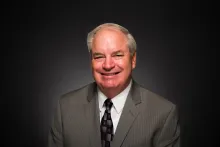
Robin Webber was born in Chicago, Illinois, in 1951, but has lived most of his life in California. He has been a part of the Church of God community since 1963. He attended Ambassador College in Pasadena from 1969-1973. He majored in theology and history.
Mr. Webber's interest remains in the study of history, socio-economics and literature. Over the years, he has offered his services to museums as a docent to share his enthusiasm and passions regarding these areas of expertise.
When time permits, he loves to go mountain biking on nearby ranch land and meet his wife as she hikes toward him.
