
Robin S Webber
This message given on Father's Day Weekend speaks to the incredible love that our Heavenly Father has for His spiritually-led children ("born from Above") here below. A father who will always be there for us! A Heavenly Father whose eternal nature and attributes are breathtaking and exhilarating to explore which this message endeavors to do. The ultimate father, who loved us first", in whom we can turn our devotion to as did Christ when he uttered, "Into Your hands I commit My spirit".
This transcript was generated by AI and may contain errors. It is provided to assist those who may not be able to listen to the message.
We'll look forward to bringing this message to you today, and it will, as Mr. Seavers already gave us an introduction to Father's Day tomorrow. It will speak to the theme of fatherhood, but in a unique and magnificent way that I want to present to you this afternoon. The children of Israel, the sons of Jacob, when they came out of the land of famine and went to Egypt, they met the big guy, the second in charge of Egypt under the Pharaoh.
Little did they know that he was actually their brother, and you know the story, and it was Joseph. It's very interesting, as they came and met this viceroy, this agent of Pharaoh, to introduce themselves. The first thing that came out of their mouth out of Genesis 44 and verse 20 was simply this. We have a father. Magnificent in meaning. To recognize no matter how unique, how stable, sometimes how crazy a family might be, there is this glue. And yes, of course, along with the mother.
But they were speaking of their older father that needed their help, especially in this time of famine, and it was that bond that brought them together. Families are families. Can we all agree with that? They all go from A to Z and sometimes off the charts, depending upon their closeness, depending upon their history, depending upon their involvement with one another. But what drew them together was having a father. You know, it's often been said that blood is thicker than water.
But there's also something thicker than blood that we will come to by the end of this message to be able to share it with you. With that said, spoken of something happening almost 3,000 years ago, we all here today, we have fathers. And that rhyme that comes out of Scripture, we have fathers, is also our story as well. Let's talk about that for a moment. Go down deep. As we say, can we talk, especially about dads, especially about fathers?
When we go back, maybe in our own personal history, and I don't want to pull out any hurtful spots, but realistic spots that sometimes God asks us to grow from. Some of our dads were there for us. Some were not, for one reason or another. Some we simply, even we didn't know them. We never knew them. Perhaps we were orphaned. Perhaps there was divorce that separated us from the man at the head of our family.
Some were, perhaps, whether here or those that are listening, or those that will be listening to this message for months and sometimes years ahead. Perhaps you were abandoned as a child. There are so many things to think about. Some were there in our lives, but perhaps we're emotionally distant. Always busy. Few words. Few dad hugs that sometimes we all need.
Sometimes we think of our ladies with their hugs and the nurturing that mothers bring. But you know dads also have hugs. I'm even looking at some of the ladies down here, perhaps thinking of your own father. That you needed to have that arm around you sometimes for assurance. Some were, shall we say, while human, and we're all human. Men, you can take, unless you want your ladies to do it right now, we can take the human test. Go for the rest. See if anybody goes ouch. We're all human. But some were remarkable dads. At times we often spend, you know, but with the other situation, I'm going to share this with you as a counselor and as a pastor and as a minister for now 50 years, is to recognize that sometimes we never get over our dads.
And then it's hard for us to relate with God the Father, our Heavenly Father. And by the end of this message, I hope that all of you will recognize that we, in plurality, we too have a Heavenly Father. And that's going to be the goal of this message. You know, it's been said that, to a degree, we are mother-made. And that's true. Also, we are father-made. And so there's a man and there's a woman that's nurturing young children, just like we have here in the back row.
And to recognize what we have over here on the other side, that's going to happen real soon with the birth of a baby. So get ready and put your seatbelts on, because that's going to be your new best friend and your family. So that's going to be great.
But to recognize that, you know, sometimes when we talk about our parents and their impact on us, sometimes we think that, you know, the teenage years is a vacation from humanity. But we do come back. And then we kind of, as we get older, we kind of take on family ways, personal ways, father ways. And, you know, you think of the old expression, you know, an acorn doesn't fall far from the oak tree.
And or you can sometimes say somebody will see you and they'll say, you know, you are the spitting image of your dad. And that can go for our ladies as well as our men, not that you're your ladies. But I'm just saying, as family looks come down, you get this, you get that, you get an eyeball out of one side of the family, and maybe a chin from another.
So that way, just like most Americans, we're much as far as people. So we get a little bit of everything. But an acorn doesn't fall far from the oak tree, neither by physicality and or by how we treat our fellow people by what we've learned from our our childhood upbringing by parents. I'd like to also, though, mention, though, again, that dads are human. All humans are complex to one degree or another. Dads can be uniquely complex, even the simplest of men. I'd like to share a line from Shakespeare. I love Shakespeare, and I'm just going to quote out of Hamlet for a moment. You've heard of Hamlet, but this is a line that I think will fit with this situation.
Horatio, Hamlet's friend, has come back to the castle. He's been away, and he's catching up with his friend Hamlet. And Horatio says this, speaking of Hamlet's father, where's my lord? And Hamlet said back, in my mind's eye. And that's sometimes how we also see our parents now, perhaps because they're deceased, but in my mind's eye. There remains a vision. There remains an image. There remains a story that is in the mind's eye. Then Horatio came back and said, I saw him once, and he was a goodly king. Hamlet then returned, and this is what I want to focus on. He was a man. Take him for all in all, and I shall not look upon his like again.
Dads are unique. Become one to a child. Now, why do I share these opening thoughts with you again?
Relationships with our fathers often establish our relatability with our Heavenly Father.
And or not? Probably over the years, thinking back, especially probably dealing with ladies that had challenges with their physical father, if this is dadhood, if this is fatherhood, how do I approach this Heavenly Father, and what is he about? So today I'd like to address this to all of you listening, because we are family. We are family, and we have a father. We have a dad in heaven, if I can use that colloquialism for a moment, creating the intimacy and the being able to connect with him. And hopefully after this message, you will be able to understand that more than ever, that we share a common Heavenly Father. Remember what I just said a couple minutes ago that it's said that blood is thicker than water? Well, there's something thicker than blood. Spirit, spirit is heavier than blood. That's heavier than water. And all of us with all of our backgrounds from around the nation, sometimes from around the world, different races, different ethnic groups, living in different neighborhoods, etc. We all have one Heavenly Father. I want to introduce him to you again. Maybe you were introduced to him 50, 60 years ago, as Susan and I were when we were tweens growing up in the church. One of the things that impacted me when I came into the Church of God community was the focus on the Father. As much as I love to talk about Christ, talk about Jesus, I'm kind of known for that around the world in what I write, in the columns that I write, the way I express myself. But it's the Father that when I came out of Protestantism and came into the Church of God community, I understood more than ever the aspect of having the role of the Father and to recognize that even Jesus Christ reports to him. Jesus Christ, the same one that God said, this is my son in whom I am well pleased. There's a remarkable passage in 1 Corinthians 15, 23, speaking that in the end times, that when it is all done and that this world has come into alignment with God the Father. And God the Father is about to come down, as it says in Revelation 21, and he's going to descend. It says that Jesus hands over everything, turns it over to his Father. How often have you seen that in human history? By a human being giving away all power. And yet that's why the Father and the Son have such a bond. The Father trusts the Son, the Father loves the Son, and his Son, capital A-H, his Son loves him, and the Father is well pleased in him. So today allow me to give you a title. Our Father, which art in heaven. Our Father, which art in heaven. Now recognize something here, and we'll build on that for a moment.
Just like the children of Israel meeting Joseph, not knowing it was Joseph, said, we have a Father. God the Father is big enough and expansive enough to have all of us as his children. Yes, he is my Father with the capital M being the Godhead. But we also have that commonality between us, and the more we understand that, the more than we also remain united. We have a Heavenly Father. And in the words of Hamlet, take him for all and all, we shall never in that sense see him again. And what we want to talk about, I want to share a few minutes with you. We're going to take the Father all in all, just as Shakespeare wrote, and explore then what that all is all about. And when we do, we will understand that we are called to be his children, and that we are linked not only by blood, but by spirit. Now, let me warn you ahead.
The message will be slightly theological. I'm going to use a little Greek, but we're going to break it down so that we can all understand it a little, just a little bit. You know what Homer said about the Greeks? Be where the Greeks bearing gifts, and sometimes words. But it's all going to make sense once we get this done. And this message, so here we go. How can we describe our Heavenly Father? Now, by the way, don't worry about taking notes today. I'm just going to send out my notes because I don't want to spell all the Greek words. There's about three or four, and I want you to relax. If you want to take notes and you need a little motion so you don't fall asleep on me during the message, then take a few notes to keep yourself awake. And if you start nodding off, I know that you're only going to be nodding in agreement. Okay? All set to go. So how can we describe our Heavenly Father? We describe our earthly fathers, but what about Him? Let's create then and define a clearer picture that the scriptures themselves, we're going to go to the Bible, we're going to open it up, that illustrates what our Father is like. And so then these Greek words are going to come down to us. But then after all the few Greek words, not all the Greek words, the one point I'm going to share with you at the end is the best. And that's why I'm going to save it for the very end, because it makes everything that you and I are going through, it makes it worth it. Number one, God has life inherent. God the Father has life inherent. Join me if you would in John. Let's open up our Bibles in the book of John and picking up the thought if we could in verse 26. Let's notice something. John five and verse 26. It simply says that very simple.
And let's take him at his word, Holy Scripture. For as the Father has life in himself, so he has granted the Son to have life in himself.
What is this telling us? God has life inherent. Simply put, when you go back to Genesis 1.1, what does it say? In the beginning God. Then it goes on to the story about the creation. In the beginning God. When you understand the Hebrew text of it, you go back and the first word actually should be God. God is before a beginning. God has no beginning. God has no end. The best way of describing God is, and this kind of funny phraseology is simply this. He is.
He is. And that's why when you think of the family name of God at times, either with God the Father, you see that in the book of Revelation, or of course you see the I.M.s of Jesus Christ, in the book of John especially, the seven great I.M.s and the other I.M.s that are in the book of Revelation. They are. They've always been. They are eternal. There is no beginning. There is no end. There is no sense of measurement other than if you want to measure the love of God that comes through eternity to us. And so therefore we take a look at this. Join me if you would in Isaiah 57-15. Isaiah 57-15. In picking up the thought in verse 15, one that you'll be familiar with, I believe, for thus says the high and the lofty one, who now notice inhabits eternity, whose name is holy, and I dwell in the high and the holy place with him who has a contrite and humble spirit.
He inhabits eternity. I've shared this with some of you before that as a younger minister at times, especially during on the eighth day festival, I would try to describe eternity.
And I actually smile back thinking about this at times. I would use physical terms to describe eternity. Because again, I used to talk about if you take a piece of wire, take a piece of string, and just start having it go this way and this way and this way and this way and then, you know, just out and never connecting the ends. And I just use different things. And I thought, I'm not using the right measurements for eternity. It is. Just accept it. That's why he says, I am. When Moses met the word at Mount Sinai, the one that he said, what did he say? I am that I am. So see here again, you could say, well, God occupies an entire different space than we do. But God doesn't occupy space. He is. And you're going to find out something here in a moment that's interesting about that, which goes to I'm going to go to number two. He is omnipotent. Now there's that fancy Greek word. He is omnipotent. What does that mean? That means our Father in heaven is all powerful. He is able to bring to pass whatever he chooses to do.
Join me if you would in Job 42. In Job 42, and picking up the thought in verse two.
Here we understand that Job is on a crash course of understanding more than ever the God that he worships in a lot of challenges, as we know with Job.
Job 42, and picking up the thought if we could in verse two.
For you asked, who is this who hides counsel without knowledge?
Therefore I've understood what I did not understand things too wonderful for me, which I did not know.
Somewhere my verse is off here, and I apologize. But anyway, I'll continue another one.
What I want to share with you is simply this, that God the Father has no external limitations than where he chooses to place himself. Let's go to Isaiah 46 verse nine. I know that one. Okay, let's go to Isaiah 46. And picking up the thought in verse nine.
Remember the former things, for I am, there's that phraseology, I am, not I were, or I may be, I am. And that's hard for us because in our humanness we want to measure everything.
And at the end of this, the one thing that you're going to measure more than anything, just to keep you on the hook here with me, is the love of God towards you. And what made that possible? Remember the former things of old, for I am God, and there is none other. I am God, and there is none like me. Declaring the end from the beginning and from ancient times, the things that are not yet done, saying, my counsel shall stand and I will, I will do all of my pleasure. Maybe not in your time, maybe not in my time, maybe not in other people's times, but in his time, which will be the perfect time. He knows what he is doing. And calling a bird of prey from the east, the man who executes my counsel from a far country. Indeed, I have spoken it and I will also bring it to pass.
I have purposed it and I also will do it. God is omnipotent. He is above all. He is all powerful.
This is what allows him total liberty and flexibility with divine wisdom, again, underlined with love, to do what is ultimately best for those made in his image towards his desired end.
And that's his goal. I remember as a young lad, the first time I heard our radio cast at the time, and maybe some of you were the same way, some of you were younger, some of you were older.
But I remember the voice coming over the radio saying, there is a purpose that is being worked out here below. Never underestimate Joel Aubrey with the girls they're getting. They're listening.
And that stuck with me from age 11 forward. I remember the radio broadcast, you know, talking about Winston Churchill, the greatest man of the first half century of the 20th century. And he said, there is a purpose being worked out here below, but I'm going to tell you what that purpose really is about. We were created with purpose. We were not created to be accidental. We were created to respond to the call of God and yield ourselves to Him, hand our schedule, hand our agenda over to Him, and allow Him to work the fruit of His Spirit in us that one day we might be with Him as we enter that eternity as the immortal children of God. Let's go to another one. He is omnipresent. Okay. He's all-powerful. That means omnipotent. What does omnipresent? There's one of those Greek words, omnipresent. That means He is ever-present. I'm reading your lips. Okay. She's down here. Go. Yeah, you got it. Okay. You get an A. Okay. Omnipresent means He's ever-present. God's omnipresent speaks to the fact that He's present in all places at all times. You know, sometimes we'll slip in our language and say, where has God gone? He had gone anywhere.
Maybe He's not laying His hands on us right now. Maybe He's creating another purpose over here.
Maybe His hands are actually through trial putting pressure on us. Because as it says in Isaiah 64 and verse 8, He is the potter. And we have willingly, for some of you that are thinking about baptism, we are willingly the clay. And He will fashion us in His way and His time.
And the bottom line is that He will never be late. Sometimes in humanity, we spell late as D-E-A-T-H.
God doesn't think of things that way. He thinks of things from an eternal perspective.
And He knows what each and every one of us are going through.
Join me if you would in Psalms 139 verse 7 to make the point.
Psalms 139. And picking up the thought, if I can get over there.
Notice verse 7. David has a question here. The psalmist. He says, pot of line, he says, where can I go from your spirit? Or where can I flee from your presence? If I send into heaven, guess what? You're there. If I make my bed in the grave, behold, you are there. If I take the wings of the morning and dwell in the uttermost parts of the sea, even there your hand shall lead me.
I love this. And your right hand shall hold me. We will feel the embrace of our heavenly Father.
And if I say, surely the darkness shall fall on me, even the night shall be light about me.
Indeed, the darkness shall not hide from you. He's not subject to physicality, as we are.
But the night shines as the day, and the darkness and the light are both alike to you.
So, we look at this, and I have other verses, but I'll pass those out on my notes. He's ever present.
Another fixture is simply this. He is immutable. Immutable by nature. What does that mean?
God is absolutely unchanging. God is absolutely unchanging towards His long-time purpose, not only for we that are in this room today and have subjected ourselves to the grace of God and the mercy of God and that we're here. It's not just about us. God one day wants everyone that will bend not only the knee, but bend their hearts to Him, either in this lifetime or in the future, as we'll be discussing as the festival days continue. God is not Thor.
He's not throwing down lightning bolts. He wants us, and His purpose is that in His time and in His way, He is going to give everybody the same opportunity that you and I have and also the opportunity that Adam and Eve had, that choice between the degree of good and evil and the tree of life. He's not done with humanity. Some of these people of recently in these wars that are going on, whether in the Eurasian landmass with Ukraine and Russia, or we see what's happening in the Middle East, is to recognize that one day, one day, God is going to give them an opportunity.
They will have to make a decision, but God will give them an opportunity one day.
Otherwise, what do we do with the young black child down in Africa, 14th, 1400s AD?
There's been no explorers that have come in there from the Portuguese or the Spanish or the Dutch or this or that. What do you do with that? What do you do with somebody that's made in God's image and after his likeness? Genesis 1, 26 through 28. God has a plan. God has a purpose. That will be then, but here we are. And I'm just wanting to share with you today that we have a Father which art in heaven. He's a mutabyte by nature. Join me if you would in Malachi 3 verse 6.
If you can't find Malachi, it's the last book in the Old Testament. Okay? Malachi 3 verse 6. Notice what it says about God's God being here. Verse 6, For I am the Lord, and I do not change. Therefore you are not consumed, O sons of Jacob. God's purpose does not change. He knows what he's doing. He's the master of timing.
He is our Father, and Jesus is his Son. When you read the Gospels, you recognize that in Jesus' timing, as he would be in Jerusalem or in Samaria or maybe up in the Galilee, he never wasted a miracle. He never wasted a miracle and its impact on the believer or the person that was coming to believe and or the audience that was watching. That's the God the Father that you and I have to serve and love and be loved by him. So he's immutable by nature. Doesn't change. And as I read in Isaiah 46 earlier, that I declare the end from the beginning and the beginning from the end, and he says, and I will do it. I've used this analogy before, and when I mention this, for some of you that are younger, I'm not that old. Babe Ruth, back in the 1920s or in the 1930s, I was not born. Some of you that are about my age, whatever that might be, I often tell people, well, I remember Jack Benny, but I didn't listen to him on radio like Bob did. Jack Benny, I watched him on television as a kid. I'm not that old. But to recognize that back in the 30s that the babe, as he was called, the Bambino, Babe Ruth of the Yankees, he went to the home plate. And having the chutzpah that he did, he just went like this. He went, ladies know what that means. The babe, he said, basically was saying with his figure, it's going to go out right there. And then he got up, you guys, you know the story?
Wham! He delivered. And that's exactly how our father is. He knows exactly what he's doing. And he says, and I will do it. You can take that more than the bank. You put that in the deposit of your heart in whatever comes our way in the days, the weeks, the years ahead, that when we walk, like the song, we will not walk alone. Christ, his son, will be up by us and will be following that son who is the way, who is the truth, who is the life. But his father is watching. His father is watching. And that's the father that we can celebrate and love, not just on one day of a 365-day calendar, but every day is Father's Day when it comes to the life and in the heart of a believer and a child of God.
Now, with all of these definitions that I've used, what do we do? What do we do about it?
And that is to remember what Psalm 46 and verse 10 says, Be still and know that I am God. So we've described God a little bit more, and I don't see anybody moving out of their seats right now yet. So you're pretty good and pretty still, but we're going to continue this for a moment. How did God use his Son and sent him to this earth? And the word that we now know as the Son came. What was he doing? He came to this earth. Christ came to this earth to make God more real to us, because no man has ever seen God in person.
So Jesus came to this earth to make him real. The bottom line about the ministry of Jesus Christ was that God, and he is the Son of God, he was no less than the Word. And he came to this earth, and he took on human flesh. But he did that that God might literally touch humanity.
Here's the Son of God. Emmanuel, what's it? Can somebody help me? I've never been in a church before. What does it maybe? What does Emmanuel mean? Thank you very much. Dwayne is on it. Yeah.
God with us. Emmanuel. Jesus was the Word. John 1 says, and the Word was God, and the Word was with God, and ba-ba-ba, and boom-boom-boom. That's Hebrew for boom-boom-boom. But then you see in John 1 and verse 14 where it says, and he came and he dwelt with us. He dwelt with us. When you go to John 1, for those of you who want to figure out John, when you go to John 1, 1 through 4, that expresses divinity. That expresses beginning. Not beginning. There we go again. But expresses where it all started, and that Jesus was no less than God. Jesus was not a, in that sense, created. He came down by the Spirit and was in Mary.
And as the Bible says, he came and dwelt amongst us. The Greek word there is sch-nu, not to be mixed up with scooby-doo, but sch-nu, S-K-E-E-N-O. And that means he came to dwell. That means he came to tent. He tinted with us. God tinted in this human fabric that God might not only touch man through Jesus as he laid hands and healed people throughout the land, but that in turn Jesus later on as our mediator, our advocate, as we find in the book of Hebrews, that the Father himself might be touched by what his son had gone through. He says, Father, I've been down there. I've been with them. I know what it's like to be in a human framework. I know the challenges that are coming. I've been there. And remember, remember that afternoon at 3 p.m. on the altar of Golgotha when the people were going towards the temple, but the real sacrifice was happening on that altar of Golgotha. Do you remember that? Do you remember what we did together? Do you know what you allowed that humanity might kill me, but for a greater purpose that moves beyond the moment? That's our elder brother. And we share the same our Father as Jesus Christ does. And that's the marvel and that's the beauty of the gospel and the encouragement and the whatever to move forward in the days ahead of no matter what comes to recognize that omnipotent, that omnipresent, that immutable God who changes not is on your side and looking down. And that when all is going crazy around you, you can either bow your heart or be on your knees and say, our Father, which art in heaven. Let's talk a little bit more about this again and go a little bit deeper. When Jesus came, as he said, I came to reveal the Father. That was one of his responses. How do we know then? What do you mean reveal? Because Jesus, in human form, responded the way God the Father would in spiritual form. You know what? He was a chip off the old block. He was the spitting image of his Father by the way he expressed himself, by the love and concern that he had for others, and by always, always staying in touch with his dad up above. And that it wasn't about him. You know, when Mary and Joseph went back to Jerusalem, and of course he was a kid, and he could have been a little cocky, but he wasn't, you know, because he was Emmanuel, God in the flesh. And they said, where have you been? I'm sure we've all done that to 12-year-olds before. Where have you been? You know, they thought that, you know, is everybody just wandering back to Nazareth, and you know, everybody's related to one another. Maybe he's with this person or that person, or maybe he's running around with his cousins, James and John. I don't know. I'm not that old, but wasn't the fly on the wall. But they thought, he's all right. Then they're always, where are you? And what did he say when he, when they came back and said, where have you been? And he said, I have been about my own thing. Is that what he said? I have been about my business. No. Guess what? Third one. I have been about my father's business.
I have a question for all of you because we share the same father as Jesus.
This past week, have you been about your father's business? Question. Don't have to show your hands. We're not having revival here.
Have you been about your father's business? Now, I grew up in the sixties, like most baby boomers did, and there's this phrase that came out of the sixties, and that simply did what, what, what was the phrase? Doing your own thing. Are we doing our own thing apart from the will and the purpose of our calling and our rescue by God's Spirit coming and leading us towards him?
Are we as thirsty for his ways as we were when we were baptized, when we went down into the water and said, I'm tired of doing my own thing. It's going nowhere. And you went into that watery grave. And seeing that you're all here, the minister ultimately brought you out. You didn't drown. It was just a type of death. Okay. A type of funeral. And then you had the laying on of hands being consecrated and sanctified and set apart that the Holy Spirit might be inside of you.
And to recognize that God has decided to set up shop in your heart, as it says in 1 Corinthians 3 1 Corinthians 3, 19, 20. And there it says, know you not that you are the temple of the Holy Spirit.
See, so often we're reaching out here for our Father. We're reaching out here when we need to go within God, the Spirit of God, which is the essence of God, which is the essence of Jesus Christ, is in our heart. The term there is N-A-O-S, which is synonymous with the holy place that was in the temple. Remember how the cloud used to come down over the Shekinah cloud would come over the tabernacle in the wilderness. And the last spot was with the Solomonic temple when the cloud came down. And that sends the Holy Spirit, which is the essence of the Father and the Son, come into us at Lodges here. So sometimes we're reaching out here and reaching out there when what we need to do is we as Christians need to work from the inside out. Got that? Try that one. Assignment. We work from the inside out. God's already claimed us as his child. Now we just need to respond to him and go to him where he is, and it follows suit.
With everything that I've shared up to this point, while all the names of God are important in many ways, there is one name that I want to conclude with. And it's utterly significant as to how our Heavenly Father relates with us. And the word is it's a four-letter word. I hope I can mention this in church. You don't have to plug your ears. You can spell it if you want to. A-B-B-A.
The word Abba. The word Abba is an Aramaic word. Aramaic was the lingua franca of that time. It's what everybody spoke from Syria down to Judea and in parts of the Jewish diaspora at that time.
The word Abba is an Aramaic word meaning father. It was a common term expressing affection and confidence and trust. Abba, number one, it expresses the close and intimate relationship of a father and his child. It'd be like this that your father might have said this, and I know, and I've got BJ here, some of the terms out of the south are very near and dear when you use the southern terms, right? And there's just this beautiful part of it, but it's like saying daddy.
Now please, you don't have to get up. I've heard this before. Sometimes it gives the closing prayer and they open with daddy. We're not going there right now, okay? That's all right. But that for you and your own personal life, you know, there's an affection, there's a bond that cannot be broken no matter what comes. And number two, as well as it expresses the childlike trust that a young child will exhibit. You know, we've got a couple of great-grandson's now. They're great. That's why they come great. No, great-grandson's. And before that, of course, the girls, the ones that have had children, but that you know how a child is. You know, normally when we get together with what I call them the tribe, there'll be about 14 to 17 people in any one family reunion. But that little baby will be passed around and passed around and be put on the floor. And you know what that little baby does? You know, you've seen it all. Get ready back there. They'll go for the mother. Trent, sorry, but they'll go for the mother. Okay, but they'll like you too. But they spot that mother. That baby always knows where the mother is, but also knows where the father is if mom isn't around. And you'll just see this, you know, kind of looking and all of a sudden tired with grandma, tired with grandma and grandpa, aunts and uncles and cousins. That little baby just starts, you know, and I mean, it's got its eye on the ball, you know.
That's where Abba comes in from. It's about being near and dear to the one that has given us life, and God has given us spiritual life. With that said, let's see how Christ uses in his relationship with his father. Abba is always followed by the word father. Interesting in Scripture. And the phrase is found in three passages. Join me if you would in Mark 14. Let's go to Mark 14. Mark 14.
And picking up the thought in verse 36.
And he, speaking of Jesus, said, Abba, Father, all things are possible for you.
Take this cup away from me, nevertheless, not what I will, but what you will.
So, this is where—and I've written a column on this before—it's called The Great Decision.
Here, Jesus, after 33 and a half years, he's in the Garden of Gethsemane, probably early morning hours, maybe late, late, late evening hours. This is after the Passover.
And the decision is now—the time has now arrived. The three and a half years of his ministry is over.
And he knows—he knows what is happening and what might be happening.
Crucifixion. Brutal. Horrible.
He was there as the word, back in Israel, when they raised that pole up with the serpent on it, and he alludes to that, as an analogy and a typology that one day to stop death, to stop the spread of disease, that something, someone, would be raised up on a pole. To stop.
To save you and to save me from the death penalty that we have brought upon ourselves as sinners.
He's there in that moment. He knows what he needs to do, but he needs a nudge from above. One more time. If at all possible, can this be removed from my shoulders? But he's not going to relent. You're going to do it. But it's father time.
It's talking to daddy. It's talking in that sense of bondedness. Join me if you wouldn't join me if you wouldn't. Romans 8 15. In Romans 8 15.
Notice what it says here.
In Romans 8 and verse 15, Paul speaking, explaining the role of Christ with the father, Now Paul is using the term of adoption, being a Roman citizen, and basically speaking to a Gentile world. We would also know that in other spots in the scripture as far as being born from above, being born again, they really all in a sense mean the same thing. The adoption part is simply this, that in that sense we didn't have a father. And I always go back, how many of you have seen the movie Ben Hur? Can they see a show of hands? Have you seen Ben Hur? Remember when the admiral is trying to hit, commit Harry Carey on the raft because he thinks that the fleet is lost and he was in charge of that to the pirates that attacked? And guess who pops up on the raft with him? No, who is drug up by who on the raft? It's none other than, yes, Charlton Heston, Moses, now Ben Hur, who is the galley slave. And he rescues the Roman general that has put him into chains. But they're both on this raft and then the guy is still going to try to kill himself.
And I think I forget what he does. There was a Holy slap. Stop it. Only to find out later on that the general, they were, a Roman ship was coming. A Roman ship was coming. He said, what kind of a ship is that? You'll remember what? And then Charlton Heston says, it's Roman. It's Roman.
He was hoping it was another fleet, another empires, not Rome. Rome had put him in chains.
But that admiral, after that, after they went on board, began to introduce him. And he made, he made Judah Ben Hur, a Roman citizen. He made him his son. He adopted him. In the time of Rome, in the time of Rome, they had less and less children and they would adopt a child. And once that child, stay with me now, once that child was adopted, everything in the past was forgotten.
The name was forgotten. What status of life they had been was forgotten. And much like the prodigal son in Scripture, the son was given a new name. Not so much the prodigal son. He was given the cloak and he was given the shoes, etc. But that in Rome, you were given a new name. And everything about you before that was off the records and taken away. And you had status. And if you remember the story in Ben Hur, where, he's back there in Jerusalem with his Roman buddy in there, like this.
And Judah Ben Hur has the ring of his adopted father that gives him authority. And he goes, boom, like that, and stamps something. See, that's what happens when we are baptized. And we, when we have in that sense, given our life to God. Some might say, away, I'll say to God.
And our past is forgiven. And we're given a new name to God the Father in Christ. And he knows what that name is. And we have a new life with nothing behind us. All is forgiven. All is taken away. And just like Judah Ben Hur was given the different instruments of office, we're given the Holy Spirit. Not to look back, but to move forward, to be different, to recognize that we no longer walk alone, to follow the same admonition that that Jesus gave for three and a half years when he would say, follow me. Follow me. And that takes faith. And I'm trying today as your friend, I'm trying to help build up your faith that you do have a father. And as wonderful as some of our human dads are, I think of my own father, who, as some of you that are older here, remember Jack Weber? He was an original for anybody that knew my dad. But you know what? He was a great dad. He was a good dad.
And he's an example in many, many ways. And I look back with him in my mind's eye, just like Hamlet. And take him for what he is, we shall not see his like again. But it's in my mind's eye.
The third one. And then we're going to begin concluding Galatians 4 and verse 6. Join me in Galatians 4 and verse 6. In Galatians 4 and verse 6, and again, Paul, speaking of this aspect of adoption. And because you are sons, God has sent forth the spirit of his son into your hearts. And what's that spirit teaching us to say and or at least to express as we live life forward, Abba, father, and therefore you're no longer a slave like Judah been her.
And if a son, then an heir of God through Christ and with Christ. I'm going to pass on about a page and a half of my notes. I'm going to go right for the end.
I'm going to tell you two stories. One, I maybe have shared here once over the years.
And we'll finish with the other one.
I want to give this sermon to you to, in a sense, if I can use it a spiritual instrumental burn this into your heart today in love that you are not alone. You're not a spiritual orphan.
Maybe some of us have been like that or those that are listening online today. Maybe we've been like that, that prodigal son. Maybe we have gone off and we're still off, but somehow we come and fill time and space. We know that the Sabbath is on the seventh day. We know that we are to assemble. So we come, we go, we come, we go, but there's nothing changing in our lives.
That's not what you have been called for. And maybe today is for us to really think about how perhaps some of us are distanced from God the Father, but He's always open. One thing about, when I think of that, and I've shared this before you, but that little clip I have of the prodigal son that somebody put out, the Father's arms are always open. Isn't that wonderful about our parents? Our parents are always going to be there for us. Their mother over here, Susie, her arms will always be there for them to hug. She's a good hugger. A lot of you know that.
I will always be there. If one of the girls did something dumb and they went over a cliff, guess what dad's going to do? I'm going to go over the cliff and I'm going to get him.
That's what dads do. That's when moms say, you first, honey, you take care of—no, just joking about the cliff. But that's what dads do. Are our children perfect?
Just checking. No. Are you, as a child of God, perfect? No. But gods, I want you to, while we don't do images in our way of life, God is God, but that when we picture, picture the arms of God, outreached. The other story I'll share with you is that we have a father in heaven. Susan knows the story. Some of you knew my mother, Thomasina Weber, Tommy.
My mother lived at just about 88 years of age, but the last couple of years she had Alzheimer's. And my mother was an orphan at age six in depression-era Chicago. She and her sister, two sisters, and they were tossed around amongst relatives. Actually very well to do relatives, but that my great-grandmother and her name was affectionately called Derry. Derry didn't want the sisters separated, so they came and lived with Derry, and Derry herself had cancer, so this was a very challenging depression-era Chicago.
Derry sat down with my mother one time, and she said, honey, I want you to realize something. Even though your mommy and daddy are no longer alive, you will always have a father, and that'll be your heavenly father.
About 82 years later, after she was told that by my grandmother, I'd gone to drop off my mother at the facility, which is very nearby, what we call a six-pack where there's, you know, taking care of people, registered nurse in there. But I would take her out for drives, and we'd listen to 1940 music, and we'd do this and that, and when you're at that stage, you can eat whatever you want to that you shouldn't have eaten, you know, and I'd take her out through the country. Sometimes Susie would be with me too. One time she said, my mother had a wonderful, beautiful, beautiful smile, and she could open that and just smile, and she said, excuse, as I'm driving her through the country out in Riverside, she says, excuse me, can I ask you a question? Can you tell me again who you are?
And I said, thank you for asking that. She said, I said, I'm your chauffeur, I'm your banker, I'm your lawyer, but most importantly, I'm your son.
She says, oh, I knew that with a smile, but she didn't. So she even forgot me as her son.
I'm not saying that negatively, just reality when you deal with this kind of thing.
One of the last times I had to drive with her, I was taking her back to the facility, and you have to understand, she thought I was taking her back to her grandmother. Because when you have Alzheimer's, you actually go back to when you're young. And right before I would turn the corner, I would say a prayer and just bless her and just ask for God's guidance. It was very difficult, though, when she saw the place that she would sometimes say that, you betrayed me. You did this to me. I didn't, you know, I did. It was what it was.
And so I would have to go into the driveway, and I would open the door, and then I would knock on the other door about 24 feet away because we needed to exit my mother from the car to the door so nothing happened on the outside. This is one of the things that I'll take to my grave that have shaped me because we're both father-made and we're mother-made. And you know what? There is one person she didn't forget. She thought my father, maybe I'm getting older looking, was my brother.
One time I took over to visit my father, and as I'm driving her off, she says, I didn't know I had another son.
But as I return from that door and I go back to pick up my mother and the door is open, there is my mother. And you know what she is saying?
She's praying, but she's scared like a child. And I hear her say, Heavenly Father, what a legacy that in that moment that happened that I might be able to share that with you and that I might forever remember that we always have a father. Amazing story. Amazing story. All those many scores of years, three score plus, that she'll remember that. Can I make a comment? Susan has a terminology for this. It's called a God thing. For me then, hearing that and to be able to share that as a witness that we have a father. And that you may you, as we go out this week, keep that in you and remember to have that confidence in our Heavenly Father that He loves us so much that He gave His Son.
And like that son that was on that altar of Golcotha, what were His last words? It is finished and I commit my spirit to you. Allow that to be the confidence of our Savior in us towards His Father and our Father because I've got some news, the good news of the Gospel, to conclude with on this day. We have a Father, our Father, which art in heaven.
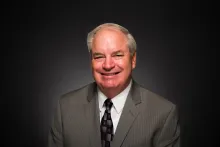
Robin Webber was born in Chicago, Illinois, in 1951, but has lived most of his life in California. He has been a part of the Church of God community since 1963. He attended Ambassador College in Pasadena from 1969-1973. He majored in theology and history.
Mr. Webber's interest remains in the study of history, socio-economics and literature. Over the years, he has offered his services to museums as a docent to share his enthusiasm and passions regarding these areas of expertise.
When time permits, he loves to go mountain biking on nearby ranch land and meet his wife as she hikes toward him.
