
Robin S Webber
This transcript was generated by AI and may contain errors. It is provided to assist those who may not be able to listen to the message.
I know all of us are, to one degree, another looking forward to next week. Certainly a very, very special time in the United States of America called Thanksgiving. And in a sense, we have a Thanksgiving season. What I want to share with you this afternoon is that being thankful in Thanksgiving is not just an event, it's an existence, and to understand that we can grow in Thanksgiving.
And I think that's very, very important as Christians because thankful people are growing people. And it's not always easy to be thankful. And so all the more that, and why we need to have this message, because life has its seasons, a day has its events, its surprises. There are things that come at us that is very easy to be able to say, thank you. Thank you, God. Thank you to the person next to you.
It's a beautiful, wonderful day in the neighborhood. There are other times when it's more challenging to give Thanksgiving. But it is in those moments that are the most important moments of knowing how to give Thanksgiving. I'd like to begin this message by sharing a story authored by Defoe. You say who? Defoe. And Defoe is the one that wrote Robinson Crusoe. And understand that that story is almost 300, 350 years old now. But I'd like to share some glimpses and some excerpts out of the story of Robinson Crusoe.
I think most of us realize that Robinson Crusoe was washed up on shore after a shipwreck. And he was all alone on that island, and I think we know the rest of the story. I'd like to share a few thoughts here that are very important when it comes to Robinson Crusoe, because he could have been a very bitter man. Very bitter. But he wasn't. So allow me to share the story of Robinson Crusoe and Bruce. When Robinson Crusoe was wrecked on the lonely island, he drew up two columns.
Two columns of what one he called the good, and on the other he called the evil. Two columns, the good and the evil. And he began to think about it. And on one sense he was cast on a desolate island, but he was alive. He wasn't drowned, as the rest of the company on the ship were. He was apart from human society, but he wasn't starving. He had no clothes, but guess what? He'd been shipwrecked on a tropical island.
He didn't need a lot of clothing. He was without a means of defense. But there wasn't too much else stirring on the island. To his knowledge, there were no inhabitants at that time. There were no fearsome animals like he had seen on the West African coast. He had no one to speak to. But God had sent the ship so near, and yes, so shipwrecked, but that he had the means of having a raft, to being going out to the ship, and gaining and getting whatever he needed to survive on that island.
So he concluded that there was not any condition in the world so miserable, but that one could find something for which to be grateful. Interesting. But here's the bottom line. Before he could be thankful, he had to think about it. And it's very interesting how those two words almost sound alike. There's only one letter that separates them, but to be thankful, you have to think. Our challenge today is that we're not on a little island like Robinson Crusoe away from everything. The challenge is that we have today the society that we live in, and there are blessings to good and the evil, just as with every society.
But with this particular society, we have the crush of society coming at us with so many voices, and so many things happening, and so many demands, and so many cars on the freeway, and so many people to stay in touch with. And at the same time, we have the complexity of this integrated global community that really doesn't allow us time to meditate, to contemplate, and to think. And so we see that. And what can happen is that can create a poverty in our minds.
We can be, of all people, especially as Christians, we can be poor in giving thanks. I'd like to share a thought from Shakespeare, and using the voice of Hamlet in it, when it was said that, Beggar that I am, I am even poor in thanks. Now, in all of the messages that I'm about to continue to share with you, entitled, A Thankful Heart, is to recognize I am not here to shame anybody into Thanksgiving, but to explain the power and the purpose and the wonderment of what Thanksgiving can do in your life. I'd like you to join with me, please, if you would.
Let's go to the New Testament, and we'll go to the book of Colossians. Now, let's remember a little bit of background about Colossians. We realize that Paul was imprisoned. He was the prisoner of the Lord. The vessel, so, was the Roman Empire that had put him into prison for his beliefs. So, let's understand the background. A little Robinson Crusoe going on here in the New Testament, because Paul is in a prison. He might have been housed imprisonment. He might have been in a cell at the time.
There's just different thoughts about it. That's why there's different books, different commentaries. But let's pick up the thought, if we could, in Colossians 3 and verse 12. If you're there, I'm ready to read. Not that I've... No, I'm in Philippians. Pardon me, that's wrong. Colossians 3. Here we go. Verse 12. Looks better. It says, Therefore, as the elect of God, holy and beloved, put on tender mercies, kindness, humility, meekness, long suffering, bearing with one another, and forgiving one another, even as anyone has a complaint against another, even as Christ forgave you, so also you must do.
So Paul has given quite a homework assignment here, isn't he? For we that are Christians. But above all things, put on love, which is the bond of perfection. Now, notice verse 15. Let's begin to center. And let the peace of God... It's different than human peace. Human peace would be the absence of conflict. Godly peace is different than that. And let the peace of God rule and have sovereignty in your hearts, to which you also were called in one body. And notice what it says, and be thankful.
With all of this said, and recognizing that Paul was imploring them that, you know, frankly, folks, you need to love more. You need to have mercy. You need to have humility. You're bumping into some folks here, so I'm telling you how to come out of it.
And then let's notice what it says here. And let the word of Christ dwell. That means to just live and exist in you richly in all wisdom. Teaching and admonishing one another in psalms and hymns and spiritual songs. Singing with grace in your hearts to the Lord. In other words, praising God, no matter what we're going through. And then notice what it says. And whatever you do in word or deed, do all in the name of the Lord Jesus.
And then again, as a double exclamation point, giving thanks to God the Father through Him. So here we have what we might call a thank-thank section. Or session coming from Paul. And he emphasizes this part of being thankful and giving praise no matter what we're going through. And obviously what he's sharing here, you know, when you read the Epistles of Paul, it's like hearing one part of the phone conversation. And you recognize what he is saying here is because of what we're not hearing coming from the other side. So it's like you're getting the result over here.
And so he's encouraging people, look, we're not going to be in a perfect world right now. You are going to go through adversity. But give thanks, continue praising God no matter what you are going through. And so what I want to do is build upon this verse this afternoon. And I want to share basically about the peace and the purpose, and to understand then how peace and thankfulness go hand in hand. You want to have peace? You want to have godly peace? We hear about that sometimes. The peace of passeth understanding. To use the Old King James English. You have to be thankful.
But I don't know if I can do that. But it works. And it's important to understand what God is performing down here below. Now, you know, and I know that here we are, we're looking forward to next Thursday, going to be Thanksgiving Day, families coming together, a lot of family traditions, a lot of different family ways.
Different people have different things on their plates, etc., etc., and it's family time. Different things will be going on. All families kind of meet on the same day, but they do different things with Thanksgiving Day. There'll be normally a meal of abundance.
There'll be, perhaps, the men will be watching the television. The ladies will be talking. The kids will be running around. The dog will still be chasing the cat. You know, just things don't, you know, just always the same thing. Maybe taking some family walks. Everybody looks forward to Thanksgiving Day, especially our ladies when it's over, because they made the meal. But Thanksgiving Day is more than just a national holiday. What I want to share with all of you is to recognize that Thanksgiving and what we do as Americans came out of adversity.
The very thought of Thanksgiving and praise did not come out when everything was going well, but was really going miserable and bad. Let's go back a moment, 400 years, almost now, which is amazing. Let's talk a little bit what was going on. Let's talk about what we call the forefathers. They were not called the Pilgrims at that time. That was a later terminology. Amongst themselves, they called themselves the Saints. These were a Pilgrim people that had gone from England, gone to Holland, gone back to England.
They were known as Separatists, which was a little bit different branch of Puritanism. They felt that they had to leave. They came across an ocean looking literally in their mind for a Promised Land. That was a very biblical experience that they were going through. But again, we always think of the Pilgrims being in Massachusetts, right? But to recognize that they were not headed to Massachusetts to begin with.
They were actually moving where every Englishman would go, and that would be Virginia, because that is where the English had first settled down. They were not interested at that time in New England. But the autumn storms, the late autumn storms, had blown them off course. So they had to come into what we now know as Massachusetts, and came into Massachusetts Bay. What they did is they finally landed at the very tip of Cape Cod up here. They landed, and they were so thankful to God.
They felt that he had blessed them a little bit like Ramentson Crusoe. Do you know what they called the town? Provincetown. It is still called Provincetown, because it had been Providence. Today, if you are in Massachusetts, they call it Peatown, just to make it short. That is where they first landed, but that is not where they stayed, because then they began to build the Plymouth Plantation, in what we commonly call Plymouth, which was on the other side of the bay, on the southwest side over the bay.
Now, let's understand something, though. When they landed in storms, there they were in the autumn, and they had to start building towards the winter, and to recognize that the men were on shore, there were no buildings. By the way, there were no Motel 6s. No lights were left on for them.
There was nobody to be at the pier, to throw out the rope, because there was no rope. There was no pier to stand on. There was nothing. And there they were, and the men began building Plymouth Plantation. So where did the women stay? The women stayed out in Massachusetts Bay on a small boat. This was not the QE2. They were on a small boat in wintertime in Massachusetts Bay.
Many, many, many, and I used to know the numbers, but many of the wives died. Many of the children, I believe up to 20 to 23 of the children, died. The winter cold stuck on the Mayflower. We all know the Mayflower. And we always enshrine it in our minds as Americans, but it was not a happy place in December and in January of that year. There were saints, there were strangers.
The saints were the religious people. The strangers were the people that were the ship hands. Those that come along to guard the saints. The very authoritative book on this is called The Saints and the Strangers. But what happened is they made it through that year. I think God was behind that to be very frank. They had a lot of help from the indigenous people, the Native Americans at that time, to help them.
They weren't mad at one another yet. It's kind of nice. To recognize that they finally, the Mayflower, went over the horizon back to England. They were cut off. There was no internet. There was no Facebook to see how everybody was doing over in England. They were there. And that was it. The nearest English colony was down in Jamestown, Virginia. That was a long haul back then. But through all of that adversity, they gathered together for a harvest festival.
And they gave God thanks. They gave Him praise in the midst of adversity. We've got to always remember that the great lesson of thanksgiving in America came through adversity. Not prosperity. Not abundance. But looking to God. Looking to God for His deliverance and for His rescue.
Very interesting when you look at that story and you consider it. There was another time and another way, in another century, when America was once again, or our forefathers were in trial. It was during the Civil War. And Susan and I were just talking about that the other day about the Civil War. It's such a sad situation in our country's history.
Brother against brother, cousin against cousin, neighbor against neighbor. And recognizing that the technology had rapidly moved ahead of the strategy on the battlefield. And how many thousands of men would be mowed down within an hour or in a day. Sometimes 15, 20, 30,000 people.
It is during that time that Abraham Lincoln gave a message and offered a proclamation which was presidential. There was no yet fixed holiday for Thanksgiving, so presidents would make a proclamation. Washington had started it, Lincoln continued it. But I want you to hear the words of Lincoln's proclamation during the Civil War. Not when things were going well, but when things were going bad. Let me share it with you for just a second.
This was Lincoln's sober warning. We find ourselves, Lincoln said, in the peaceful possession of the fairest portion of the earth, as regards fertility of soil, extent of territory, and salubrity of climate. We find ourselves the legal inheritors of these fundamental blessings. We toiled not in the acquirement or the establishment of them. On April 30, 1863. Now, this is a little bit right before Gettysburg.
The Battle of Gettysburg was fought right around July 2, 3, or 4. And things were not looking well right then for the Union. On April 30, 1863, President Lincoln proclaimed a national notice day of fasting and prayer. Not of feasting and prayer, but fasting and prayer. In making this proclamation, he said, It is the duty of nations as well as of men to own their dependents upon the overruling power of God, and to recognize the sublime truth announced in the Holy Scriptures and proven by all history that those nations only are blessed whose God is the Lord.
We have been the recipients of the Choices Blessings of Heaven. We have been preserved these many years in peace and prosperity. We have grown in number and wealth and power as no other nation ever has grown. But we have forgotten our God. We've forgotten the gracious hand which preserved us in peace and multiplied and enriched and strengthened us.
And we have vainly imagined in the deceitfulness of our hearts that all of these blessings were somehow produced by some superior wisdom and virtue of our own. Like Yankee ingenuity. Like the best and the brightest. No. We have become too self-sufficient to feel the necessity of redeeming and preserving grace. Too proud to pray to the God that made us. It has seemed to me fit and proper that God should be solemnly, reverently, and gratefully acknowledged as with one heart and one voice by the whole American people.
I do therefore invite my fellow citizens in every part of the United States and also those that are at sea and those who are so journeying abroad to set apart and observe the last Thursday of November as a day of thanksgiving and praise to our beneficent Father who dwells in the heavens.
Interesting. A day of fasting and prayer. What does this tell us as we read the stories, hear the story of the first thanksgiving in 1621 or this story of Lincoln's proclamation? It's simply this, friends. Remember how I said that the crush and the complexity of society can just keep us so reeling that we just don't take time to think. Because if you're going to think, you've got to think. You've got to meditate. And thanksgiving, to properly praise God and to give God thanks, takes introspection. Sometimes repentance is a part of thanksgiving. Investigation of our own motives and indeed repentance. When we do this, this is what creates the peace. Remember what I told you earlier?
Peace and thanksgiving go hand in hand. You can't be at peace if you're not a grateful person. Remember, many years ago, Calvin Coolidge said that a thankful nation is a growing nation. Well, let's just bring that down to home to us this afternoon, okay? A thankful Christian is a growing Christian. If you are not thankful, and if we are not praising God, and please hear me because I'm going to explain it a little bit later.
In every chapter that comes our way, you think of the 23rd Psalm. You think of the green pastures. You think of the still waters. You think of the valley of death. You think of the enemies that surround us, whatever those enemies might be. It is in all those chapters of life that we have to be willing to thank God.
How important is thankfulness? Would you join me, please? Let's open up our Bibles. And let's go over to 1 Chronicles. We're going to go over to the Old Testament for a second. 1 Chronicles 16. 1 Chronicles 16. Let's pick up the thought in verse 4. He appointed some of the Levites. That was the tribe that took care of the temple and the holy things, assisting the house of Aaron. 1 Chronicles 16. To minister before the ark of the Lord, to commemorate, to thank, and to praise the Lord God of Israel. That was their job. What was your job?
What did he do? A lot of people say, well, I work at Starbucks. I know some of us work. What do you do? I build and remodel trucks. What do you do? I'm a professor at a college. What do you do? I'm a homemaker.
What do you do? My employment is praising God. That's what the Levites were. And it just kind of reminds you a little bit, remember, of the seraphim and Ezekiel? Their full-time eternal job is just to be around the throne of God. Holy, holy, holy, and just praising them.
And you know what? I don't think they've walked off the job yet. It's just an incredible job to praise and to give God thanksgiving. Now, let's define that a little bit more. Let's break it down. Join me if you would over to chapter 23, then. Same book, 1 Chronicles. And in chapter 23, notice what it says here. In picking up the thought in verse 28.
Speaking of the Levites, because their duty was to help the sons of Aaron in the service of the house of the Lord, in the courts, and in the chambers. Let's go down. They had all sorts of different technical responsibilities. Had to take this instrument from point A to point B, make sure the sacrifices were ready for the priests, etc., etc. But let me get down to verse 30. This is really interesting.
Part of their job was to stand every morning. Remember, they had to stand. They had to stand every morning, not every other morning, or when you had time, to stand every morning to thank and to praise the Lord. And likewise, at the evening. Isn't that interesting? In other words, they began their day with thanksgiving, saying that, God, I know that you will be our partner.
And thank you for that which is going to come my way, of that which I am about to receive. And I didn't say, hear me folks, that everything is going to be pretty during the day.
But to give thanks, recognizing that it's a part of a process that God is using to mold and to shape us. And then, at the end of the day, thank Him for the care that He has given during that day. In other words, here's the way to think about it. It is a bookend. The bookend of our lives, holding us together to praise God and to give Him thanks in the morning, and to praise God and to give Him thanks in the afternoon and in the evening. And we don't quite understand it. Keep on giving thanks because it says that He that keeps God's Word has a wise and a good understanding. So that's kind of interesting when you look at that, isn't it, to understand that? I'd like to take you to another thought here about thanksgiving. Join me if you would in Psalm 116, would you please, right in the middle of your Bible. Right in the middle of your Bible. Just open your Bible and there's Psalms, okay? Psalms 116. Psalms is a lot easier to find. Have you ever noticed that, friends? Just open your Bible in the middle and you'll usually hit it nine times out of ten. Have you ever tried to do that with Habakkuk or Obadiah? Doesn't work as well, does it? So let's look at Psalms 116 and see what God says about thanksgiving. Psalm 116, verse 17, says, I will offer to you the sacrifice of thanksgiving, not of turtledoves, not of bullocks, not of lambs or goats, but here's a sacrifice of thanksgiving and will call upon the name of the Lord. And I will pay my vows to the Lord now in the presence of all of His people. Thanksgiving is not something necessarily that stays private. If you're a thankful person, it's going to be something that is shared with others. Not in a funny way, not in a prideful way, but you can't hold it in a cup. It's going to spill over onto other people. And in the courts of the Lord's house, in the midst of you, O Jerusalem. Now, why is it a sacrifice? Because it is so opposite human nature. Giving another one, thanksgiving and praise, is the opposite of the Disney character, of the Queen with the mirror, mirror, mirror on the wall, who is the most and you fill in the rest of the blank. So often we just see ourselves in a mirror, rather than looking up through the window of the universe and saying, Thank you, God. It's a sacrifice of your role, as the ruler of your life, to the true sovereign of this universe. What happens when we give thanksgiving? I'm going to give you three quick points. You're going to be real quick, so be ready to write if you really want to grow, or are we just spending time together? I'm going to give you three really quick points. You're going to go really quick here. Number one, when we offer this sacrifice of thanksgiving, we remember what God has done. We remember what God has done. That's powerful. Isn't that such a whole part of the Bible? When you think of the Sabbath, it's a memorial of creation, creation that was, creation that is the body of Christ, and the creation that is yet to occur in all of its fullness. The biblical festivals, what are they about? The commandments, what are they about? Remember the Sabbath day. It's always about remembering what God has done, not what we did. That it was by His hand, the first commandment, not by our hand. Number two, another sacrifice is telling others what God has done. Telling God, that's a form of thanksgiving.
Let people know what God has done in your life. I know I've shared this with you before, and I hope it's not ad nauseam, but when somebody is going through illness or sickness, I love to tell people of what God has done in my life with healing. Having had spinal meningitis as a youngster, and knowing that I was divinely healed. Now, when I say that, I recognize that there are others that were not divinely healed, maybe at that same time, but I know I was divinely healed. I have faith and confidence, and when I share that faith and confidence with other people, I'm still giving God praise and thanksgiving for saving that 16-year-old boy back in the 1960s. I will not forget it. I continue to give God thanks, and I'm sharing that thanksgiving with you right now to bolster your faith and confidence that sometimes God allows adversity in our life to draw us closer to Him. The last boy I want to share with you is offering gifts of time, self, and resources. If you're a thankful person, and God has given to you, you're going to want to give to others. I'd like to share a story with you in that regard. It reminds me of the story of the old man and the little boy. The old man was out in the front yard, and the old man was digging and digging and digging. He was digging this hole. He's 80 years old. He's digging this hole, and this little boy is watching him. Then the old man takes an apple tree sapling, and he begins to plant it and begins to nurture it and make it nice. The little boy, you know how children will say the most unbelievable things at all the most unbelievable times. He said, old man, why are you planting that tree? You're not going to be around to taste its fruit. Nice kid, right? The old man said, but I remember that when I was a boy, somebody else had planted a tree for me to enjoy its fruit. Time, sacrifice, serving, and giving, moving beyond yourself. When you are a thankful person, you will be thinking of others. Very much so. Now, with all that said, friends, let's talk about coming up to this Thanksgiving. Again, this is not just a day. It's not just an event. This should be our existence.
I want to share some things with you to make you think. You can add to this list. This is my list of where I'm at right now that I'm thankful for. Hopefully, I, like that Levite of old, can stand up and thank God in the morning and the evening for all of these things. Let me just share a few things. Maybe right now you don't think you have a lot to be thankful about. I can understand that you might just be in a human stew.
I'm just stewed today. I'm just cooked. Things aren't going well for me. At the human level, at the present level, it might not be going well. But let's talk. Point number one, I want to share with you. Point number one that should make us so incredibly thankful as a Christian. Number one, we have a Heavenly Father. All of us together are pilgrims, and we have a Heavenly Father.
You know, when the children of Israel, the sons of Jacob, came before the throne of Pharaoh. Those rascals, those dirty dozen, as we might say. The way that they introduced themselves to Pharaoh was simply this. We have a Father.
No matter our backgrounds, no matter where we come from, no matter our ups and downs, we're joined at the hip, we're joined at the heart, because we do have one Heavenly Father who has bestowed His grace, His outflowing, outgoing concern to us in a time in our life when we did, for you that are going through baptismal class, and it's always good to have a good reminder, when we did not deserve it. When we did not even know what's going on in our life, and He tapped us on our heart and said, I want you, I have chosen you, and I will be your God, and you will be my people. You know how incredible it is to have a Father? I'd like to share a story with you that I shared this morning. And most of you, you know, many of you here remember my mother, Thomasina, and most of you know that she had Alzheimer's at the end of her life. It was very, very challenging. But she had always told me that when she was a young girl, what happened is my mother had grown up, and she became an orphan at age six. And both were parents, my grandparents, who I never knew died at around age 40. They both had cancer, and they died. And my mother and her sisters, two sisters, kind of bounced back and forth between good and loving family members, but were bouncing kind of back and forth. And then finally, her grandmother, Derry, did not want the girls separated, so she took them. She took them. But Derry also had cancer. And Derry would eventually die when my mother was about 16. The one thing that allowed my mother to get through all of those circumstances in Depression-era Chicago, and basically being on her own at age 17, is that even though she didn't have a physical father, she always knew, and she always taught me that no matter what is happening down here, she always knew in her heart of hearts that she had a Heavenly Father. That was the strongest driving force in her life, that she knew that she was not alone, that there was a good God, and he called himself a father, her Heavenly Father.
Just a little bit before she died, I would take her out for rides, or she'd come over and see Susie and me. And I took her back one day, and I had to get her into the facility, and it was only about maybe 30, 35 feet. I'd open up her door, so I thought that she knew that she would not be alone. And I would go in to open up the other door, so that our transitions could be very quick, because when you have Alzheimer's, it's kind of challenging to know where you're at, because you get frightened. So as a son, a loving son, hopefully, I was trying to do the best that I could. And I looked back, and Susan knows this story, and I looked back, and I saw my mother, because she felt that she was so very, very alone. And she thought that I had perhaps abandoned her. Nice mom. I had abandoned her. And there she was, looking up, looking up. And the one word that I could remember, she's saying, Heavenly Father. And she was talking to God, because she was a child again, and she needed to know that she was not alone. It's a beautiful story. And to recognize the importance that I'm sharing this with you is that, you see, she didn't know any of us. She didn't know I was her son any longer.
She didn't know she had forgotten most of you.
But the one thing that stuck in her head was her Heavenly Father. How grateful are you and I, as we come to Thanksgiving, friends, that we have a Heavenly Father. And He is always there, in whom there is no shadow of turning, as the book of James says. Number two, we have the Son. We have His Son, Jesus Christ.
As the Hebrew goes, how cool is that? That we have Jesus Christ, no less than God, divorced Himself with His divinity, came and became human like we were, so that as we were touched by Him, we might one day be touched by God.
And that He would die for a day that we might live forever with Him and with the Heavenly Father that He came to reveal. And to recognize that when you have Jesus Christ in your life, it is so multifaceted. You have a Savior, you have a Lord, you have a King, you have a Shepherd in whom He shall not want, you've got a constant companion.
And you know, you ever sometimes wonder whether or not you can talk to somebody because they haven't gone through what you've gone through? And so there's kind of that wall of separation. And it's to recognize that whatever we have gone through, He has gone through. If we're lonely today, to recognize He knows what it's like to be lonely, nailed to a cross with people jeering at Him, and everybody abandoning Him when He needed them the most. And that's why God sent Him to this earth so that He could be that Spirit of experience. How appreciative are we of that, brethren, as we come up to this Thanksgiving? Another thing that point number three would be simply this. We have the Holy Spirit. How thankful are we that we literally have God in us? Not another person, but the very essence of God, the very essence of Christ, that which is holy, that which is Spirit. How thankful are we that it says in John 14 that Jesus said to those early disciples and to all of us, I will not leave you alone. I will send you another comforter. That Spirit that is inside of us so that we don't make the mistakes, and we will make our mistakes, but as many mistakes as Adam and Eve did, that Spirit that continually defines before us what is the tree of life versus the tree of good and evil, and gives us, won't push us, but it will nudge us towards the tree of life and make things clear to us. Brother, let's never diminish what the Holy Spirit is. It's just utterly incredible. It is not just a screwdriver, a hammer, or a wrench. It is no less than God in us. That's why we can call Him Father. That's why we call Jesus our elder brother. That's why we're called the children of God. That's because we have that Holy Spirit. Point number four. We have God's Holy Word. We have God's Holy Word. That's why, as a pastor over the years, if you noticed, how important I believe it is to open up the Bible and services, and for you to turn to the Bible when a scripture is read, and for our men and our ladies and even our children to come up and to be able to share the Word of God, to open this book, brethren, to open this book, and to be able to read it in our own tongue. I am so very thankful for the men over the years, the people over the years that gave their lives that we might be able to have this. You think of the Jewish scribe of old in the wilderness of Judea, writing down line by line... No, they're writing this way. That's right. They're going back. It's like being left-handed. No, it's just teasing at you. And you know what? If you had some kind of a stain, or you did a wrong diddle or chot or whatever it is, you had to start all over again. There was no word in those days where you can just back on. Think of those Greek monks with those big beards up on the cliffs of Mount Athos, those cliffs that were either on the Adriatic or the Aegean, copying in Greek, copying in Greek. And then those individuals that would bring those Greek manuscripts as the Turks were taking over Asia Minor and parts of Europe, and how those Greek manuscripts came into Europe.
Brave souls! I'm so very thankful that God used those people, that I can be able to read the wonderful things of God today. I'm very thankful for John Tyndale, incredible individual. Already knew Greek through Erasmus, but later on he did not know Hebrew. And so when he had to flee England and go over to Europe, he was within Jewish communities over there in the middle of Europe, and he learned Hebrew. Why did he ever try to just learn a language? But he learned Hebrew so that he could take, as it were, see what the early people were doing as they moved from the Vulgate and the Latin. It's like when you strip a wall. Have you ever seen some of these old, old beautiful craftsman-style houses, but they plaster all this paint that didn't... wasn't really the idea in the beginning? And that's what these people were doing during the Renaissance. They were wanting to strip everything down to the original material, whether it was in the Hebrew or whether it was in the Greek, so that you could really understand what God was saying rather than what man thought God was saying. For all of that, for all of that, Tyndale was burnt at the stake and strangled. What you and I have today, which we call the authorized version of the King James, was basically based on the work of Tyndale, fifty-six years later. I have a question for you. How thankful are we for God's Word and how it was preserved and how it came down to us? And not only that, but as on the other point, because we have God's Spirit, we can understand that revelation.
And that it is always a source of encouragement. It's a staff of strength and it's a weapon against the devil and worldliness and these things that are around us. How grateful are we for this? To recognize when you think of the stories in Ezra and Nehemiah that when the law was read, people stood up. They were just in awe and respect of God. Brethren here in Redlands, we need to be a thankful people for the Word of God. And that's very important.
Let me share just a couple more points and we'll begin to conclude.
Another point that I want to share with you. Point number five is that we have examples of spiritual family members in the Bible to encourage us. Obviously, we have the love of God the Father. We have the example of Jesus Christ. But sometimes it's nice to be around people that are a little bit like you, human beings, as Paul said, people of like persuasion, human element. How thankful are we to read the examples of people that God dealt with? Pillars of the faith, strong in the faith, and also characters like you and like me. You know, sometimes people say, well, I just took a test in my blood and I found out that I'm this and I'm that.
A lot of people in past years would say, well, you know, I was looking down at my family tree and I have blue blood.
My ancestors were royalty. Well, I hate to break it to you, but if your ancestors were royalty, you don't know half the time who your daddy was. And so that all goes off the charts.
No, the Bible is made up of common people. It's made up of a young Jewish girl that the angel Gabriel came to and said, you're going to be the mother of the Messiah. The word of God is about a prostitute, Rahab, who in a moment when everybody else was going one way in her village decided to stand up for the people of God.
And she's in the family line of Christ. It's the story of Samson, a man who'd been a clown, not using the gifts of God correctly. And so at the end of his life, God said, you want to be a clown? You'll be a clown for the Philistines. But in his last moment of life, he gave himself to God and he said, God, if you will one more time strengthen me. Just one more time. If you ever had that prayer of God, if you will just strengthen me one more time, just put me in the right place and I'll do your work.
How thankful can we be? How thankful can we be with another character like Peter, who is always thinking he was doing God a favor but kidding, the way of Christ's ministry half the time. And then when Jesus says, you know what, Peter, you're going to go down. Satan's asked to sift you like so much wheat. But I'm going to tell you what, when you return, when you come back, feed my sheep. How thankful are we for that example that if God does that for Peter, that God will do that for us today in the 21st century. How thankful are we for this spiritual family scrapbook called the Bible? That reminds us that God will never leave us nor forsake us. He'll work with our human weaknesses. He has started this work in us and he will finish it at the end. Let's go to another point to be thankful for.
We have the gift of the Sabbath and the Holy Days. Remember what I said, that we have the crush of the world, the complexity of the world. How thankful are we that God says, rest, take off time, and think about me so that you can be thankful.
I know it's interesting that some people in the world look at the Sabbath and they think it's a burden. If this is a burden, make the most of it. Long live the burden. This is a wonderful thing because it reminds us that we're not our own God. That there was a creation and a creation demands a creator. And that God is still creating his image in us today as Christians. And that God ultimately is going to put his stamp on this entire world. How thankful are we, brethren? Let's go to another point here, and that is point seven. We have a church. I'm not talking about a building. I'm not talking about an organization.
The church is the people. It's the ecclesia. And as this ecclesia gathers wherever God's name is, it's a sanctuary. It's an oasis. It's a love shop. It's a workshop. It's an encouraging shop. I just dealt with a lady down in San Diego. Actually, one of the ushers came up to me. We had a lady that had at one time been with us 20-25 years ago, came back to the San Diego congregation, and she said, This is like an oasis. This is a sanctuary. Remember, I just recently saw what is it? The Hunchback of Notre Dame.
I think it was AMC or whatever. Charles Lottin. And, you know, sanctuary, you know, if you know the story of Charles... It's going to say Charles Lottin. Hunchback. Sanctuary. Sanctuary. The Church is a sanctuary from this world. And it's also a workshop for growing in the grace and the knowledge of Jesus Christ. Because, you know what? We come into a church, and there is no perfect church.
There is no perfect organization, and also there is no perfect gathering of people, because we're not perfect. Even in that, God says to be thankful. Because you've got work to do, just like we covered in the book of Colossians. To have tender mercies, to have humility, to have the love of God, to be for bearing with one another.
How thankful are we for our Redlands congregation? I picked up Susie today. I'm going to get in trouble now. What's she going to say? She was so thankful that she was going to come to Redlands today. It's been a busy week. It's going to be a busy week next week. And she said, Redlands is the spot today to be. It'll be Los Angeles next week to the Shemitz. But that, it was just your family, your home. God's Spirit is here. Your love. Your warmth. How thankful are we for that? Let's be a thankful people.
Point number eight, let's be thankful that we live in this fantastic country, even with the challenges that we're undergoing right now. I just feel thrilled when I see the red, white, and blue on a flagpole. And to recognize that this is an exceptional country, not because of Yankee ingenuity, but because of God's blessings and the prophecies that he spoke about long ago. You and I know, though, that America is less and less a grateful country, and it's going apart from God. Blessed is the nation God is for, but also beware the nation that turns its back on God. Join me if you would in the book of Romans for a second.
The book of Romans. We're just going to go about five more minutes. The book of Romans. And let's pick up the thought in chapter one. Romans one. Romans one. This is God's spirit inspiring Paul talking about the state of the world that day, about the Hellenic community that had intellectual truth and had squandered it, and the Jewish community that had biblical truth but had squandered it. But it's very interesting if you'll notice, and this is going to apply to us, friends, here in a moment, verse 21.
Speaking of the world at large. Because although they knew God, they did not glorify Him as God. Neither were they thankful, but became futile in their thoughts, and their foolish hearts were darkened. I want to share a thought with you. It's a word of encouragement and a word of warning. The word of encouragement is, be a thankful person. The word of admonition is to recognize that being ungrateful, not being thankful, is the first step of moving away from God and having a confused outlook on life.
Because we're not a grateful people. You might want to go back and study that on your own, but that's what the Bible says. Even though they knew God, and even though we know God, we here today, not then, but now, if we are not a thankful and a grateful people, we are stepping away from God. We are moving away from the tree of life. We're not moving towards that very important concept. There are others that I could share with you. You add your list in the week to come as we come up to Thanksgiving.
Allow me just to share one last thought. That is simply recognizing that so often, God is not concerned about what we're doing when times are good and well, but what's happening when times are challenging. Join me if you would in Acts 16. It's the story of Paul and Sylvanus, otherwise known as Silas.
The new King James. And they've been thrown into prison. For what? Preaching the Gospel. Taking care of a young psychotic girl that ruined the local trade. The city got upset, got the Roman authorities involved, got them thrown in the clink. And that's what happened. And they're in prison. This is not one of Paul's house imprisonments.
This is probably in a dank, dark jail with water coming down the walls, with rats running around. And you know what's on rats? And it's cold and it's probably dark down there. And the worst that they've done here at this point is doing God's work. But notice what they are doing. Notice what they are doing in the midst of adversity.
Verse 25, But at midnight Paul and Silas were praying and singing hymns to God, and the prisoners were listening to them. And suddenly there was a great earthquake, so that the foundations of the prison were shaken, and immediately all the doors were opened, and everyone's chains were loosed. What occurred here was like an angelic jailbreak. But just notice what they were doing. They were praising God and singing hymns.
Now, I have a question for you. This is the interactive time. If two Jews were in a jail, and these were Jewish Christians, and they were singing hymns, what do you think they were probably singing the most of? What would a Jew in the first century basically notice, sing or de-chant?
This is not hard, folks. They would have been, yeah, they would have been, there might have been certain creeds that had already developed, or songs in Christianity, but most likely they were dealing with Psalms, weren't they? They were dealing with the Psalms. Have you ever read the Psalms that are really interesting? You know, sometimes they start really good, and then you kind of go deep into the valley.
You know, David goes, you know, it's like, Ahhh, you know, the bulls of Bashan, and my enemies surround me, and, Oh, life is horrible. You know, you could join Jonah and the big fish, oh, like Eeyore, oh. But did you always notice at the end that it crescendos to praise and thanksgiving? Most of the Psalms, there's a couple clinkers in there. Sorry, God. There's a couple clinkers in there, but almost 90% of the time.
Up, up, up. Even all of this is happening. Lord, I know that You are my God. There is no God like You, and You will rescue me, and You will take me out of the pits. That's why we hymns sing in church. Get used to it. Christians sing in good times and bad times.
They praise God. A part of the praise in that is simply this, you know, and from that praise and from that thanksgiving. If they had not done that, I don't know if they would have had the angelic jailbreak. Okay? I don't know if the Philippian church would have been founded.
The church that was founded, the first three members. You're looking around this group, and you're saying, I don't know. The first three members of the Philippian church was a psychotic gal, a traveling saleswoman, and the jailkeeper. Welcome to the church. But it became one of what? Paul's favorite churches. How much of us have drawn comfort over the years out of reading the book of what? Philippians. The book about joy. Joy is not when things are going well, but joy is having the assurance and the confidence that no matter what, that all things work together for good. That's so incredible. See, what happens when we are in these predicaments, we must be thankful in this process.
And this is where I'm going to conclude where thanksgiving and peace come together. That peace that passeth all understanding that's better than the facts on the ground. And that is to recognize that we must be thankful for the process we're going through. Now, I understand when I say this, friends, I'm looking at all of you. Some of you have financial problems. Some of you have family problems. Some of you have marriage problems. Some of you have life-threatening problems.
I have age problems. Getting older. But we must be as thankful. Hear me, please, as I begin to conclude. We must be as thankful for the process as the product at the end. And that is the really spiritual part. We must be thankful for God's chiseling and molding and shaping us to completion. That's the hard part. But that is where the sacrifice of thanksgiving comes in.
We must be as thankful for allowing patience to have its perfect work even when we don't see the end in sight. As when we sit down in the green pastures. That is what makes our Christianity complete. And sometimes we just simply don't know what God is working out. Let me share a story with you to conclude with.
Back down south. Always a good place to be in the Bible Belt. Back down south. In southern Alabama is the town of Enterprise and Coffee County. There they have erected a monument to an insect honoring the Mexican bull weevil. In 1895 the bull weevil began to destroy the major crop of the county, cotton. In desperation to survive, the farmers had to diversify.
And by 1919 the county's peanut crop was many times what cotton had been at its height. In that year of prosperity a fountain and a monument were built in 1919. The inscription reads, In profound appreciation of the bull weevil, and what it has done as the herald of prosperity, this monument was erected by the citizens of Enterprise Coffee County, Alabama. Out of that struggle and that crisis came growth, came success. Out of adversity came blessing. Whatever you're going through right now, let's allow the peace of God that passeth all understanding and be ours.
To recognize that He moves, He is, He loves, He lives. He doesn't have to think because He's God, He's always thinking about us. We are the apple of His eye. And yes, and with that apple He's whittling us in a day or a month or a year to prepare us for eternity.
And with that thought, then, let's not just look at thanksgiving as an event, but let's be about our Father's business and make it our full-time work in Christ, this existence, to be grateful, to be thankful, to be praiseworthy. Happy Thanksgiving.
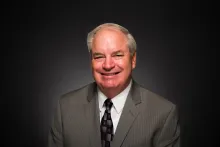
Robin Webber was born in Chicago, Illinois, in 1951, but has lived most of his life in California. He has been a part of the Church of God community since 1963. He attended Ambassador College in Pasadena from 1969-1973. He majored in theology and history.
Mr. Webber's interest remains in the study of history, socio-economics and literature. Over the years, he has offered his services to museums as a docent to share his enthusiasm and passions regarding these areas of expertise.
When time permits, he loves to go mountain biking on nearby ranch land and meet his wife as she hikes toward him.
