
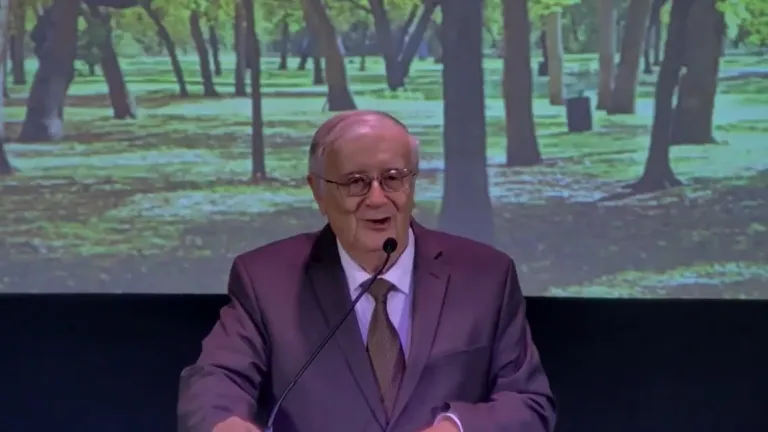

Jorge de Campos
This transcript was generated by AI and may contain errors. It is provided to assist those who may not be able to listen to the message.
As you read Colossians, you see there was a leader from Colossae that went to Rome while Paul was in prison, and made Paul aware of a dangerous heresy that we now call Gnosticism, and therefore Paul wrote the epistle of the Colossians to address that issue. But as he closed that letter, Paul emphasized three important Christian principles as an appeal to the brethren. They are positive Christian principles that are applicable for any age, and therefore are applicable to us as well. I'm just summarizing those three principles with just basically three words. That's prayer, wisdom, and words. Or, more specifically, prayer, wisdom, and our words. And so, I want to analyze that little section of Colossians in chapter 4.
I want to analyze that in a little bit more detail today. So, we're going to look at today just a few verses in Colossians from verse 2 through verse 6. And so, let's read those verses just to get the context of what we're addressing, or what we're going to be talking today. And, Paul reads in Colossians, starting in verse 2, Meanwhile, praying also for us, that God would open to us a door for the word to speak the mystery of Christ, for which I am also in chains, that I may make it manifest as I ought to speak.
Walking with them towards those who are outside, redeeming the time, lest let your speech always be with grace, seasoned with salt, that you may know how you ought to answer each one. So, having said that, I can close the Bible and say that the sermon is finished. Well, not quite. We just want to go into that in a little bit more detail. Starting in verse 2, it says, Continue earnestly in prayer. Continue is from the word proscartero, 43-42, which means we need to be steadfastly attentive and persevere and not faint. In other words, have that perseverance to always continue in prayer. Very similar to what we read in Luke 18, verse 1.
So, if you turn to Luke 18, verse 1, it says, Then he spoke a parable to them that men ought to pray and not to lose heart. And so we see Christ here in Luke 18, verse 1, gave a parable that we should continue in prayer, persist in prayer. And you know the story, which is the story of this widow that was persistent. There was a situation out there, as an example, that Christ used as a parable an example. For instance, there is this widow struggling and keeps asking, keeps asking from this judge in intervention. And then the judge, because she kept quote-unquote nagging him, said, All right, fine, I'll do something for you.
And the principle is here is that we need to keep being persistent in our prayers to God. So we need to watch for opportunities when God has given us opportunities to pray. Make sure we are praying. We must make sure that our attitude of mind is correct. We need to be watching that we don't neglect prayer. It's easy to, oh well, I'll do it later. So we need to be careful, lest, through remission or indolence or whatever the reason may be, that we neglect it and then we have some problems. And so the other thing is we need to be continuing prayer because if you are not thinking about what you're praying in detail, it can create a kind of a sense of apathy, of listlessness, of indifference.
And we must not allow that to happen. We are human beings and we need to be careful, always. So let's also look at 1 Thessalonians 5 and verse 17. Pray without ceasing. That's what we need to do. Pray without ceasing. In everything, give thanks. So we need to mingle, as we heard in our sermon, we need to mingle prayer with thanksgiving.
No matter the trial, no matter the health situation, no matter the needs that you and I may have, there's always something to be grateful. There's always something to be thankful. We could be thankful for the protection we've received. We could be thankful for health, maybe even previous health that we've had and were able to achieve or do certain things while we were healthy.
We need to be thankful for God's forgiveness, because He does forgive us, if we forgive others, as we'll talk a little bit more about it in a moment. So we need to be, at all times, mingling prayer with thanksgiving. So if we go back to Colossians 4, verse 2, it says, continue earnestly in prayer, being vigilant in it.
You know, being always aware of it with thanksgiving. It's got to be mingled with thanksgiving. In the sermonette, we went to Philippians 4, verse 6. I want to go through it again, because it is important for us to keep in mind.
And in chapter 4, verse 6, it reads, be anxious for nothing, but in everything by prayer and supplications, with thanksgiving. So the focus I'm doing is we've got to mix prayer with thanksgiving. Let your requests be made known to God. So we can't just say, well, I don't have this, please give me that. We've got to mingle it with thanksgiving. And then we were also reading 1 Thessalonians 5, verse 17 and 18, you know, prayer ways without seizing with thanksgiving. I want to just remind you of something that maybe you have not noticed. Did you know that in the book of Leviticus, there are basically five types of sacrifices?
Let's just look at them very briefly. In Leviticus chapter 1 through 5, let's just look at them very briefly. Leviticus chapter 1 talks about a burnt offering. And you see that at the end of that section of Leviticus chapter 1 says, it's a sweet aroma to the Lord. It's pleasing to God. Then the second offering is a grain offering. All right. And then you can read in verse 2, at the end of chapter 2, verse 2, the second offering, which is a grain offering, is made by fire, also a sweet aroma to God.
So it's also pleasing to God. And then in chapter 3, we get to what is called a peace offering. And the peace offering is the one that we're going to look in a little bit more detail in a moment.
But if you look at chapter 3, the peace offering, at the end of verse 5, it's also a sweet aroma to God. So these offerings are well pleasing to God. And there is a lot of meaning behind these offerings, and I don't intend today to divert from the key message to explain the spiritual meaning of these offerings, which is very important. But the point I wanted to mention is that the peace offering is a sweet aroma.
In fact, it mentions it twice, also in verse 16. And then there are two other offerings in chapter 4, which is a sin offering, which is our sinful nature, which basically represents what we are. And when I go through baptism counseling, I make sure people understand that we need to repent of what we are, not just what we do.
And that's a whole different subject. But it is important for us to understand this fourth offering, a sin offering, is a sin offering that represents our sinful nature. That is not a sweet-smelling offering. And then we've got, in chapter 5, what is called a trespass offering, and that represents what we do. We've got to repent of what we do. So, part of the examination in baptism counseling, we go through very clearly that we need to repent of what we do, symbolized by the trespass offering, and we've got to repent of what we are, symbolized by human nature.
We are repent of both. So, and those two lost ones, chapter 4 and chapter 5, are not sweet-smelling to the Lord. But, going back to chapter 3, which is the peace offering, is a sweet aroma to God. Now, this offering is described in more detail in Leviticus chapter 7. And in Leviticus chapter 7, from verses 11 through 15, describes one of the possibilities of this offering, which is a thanksgiving offering.
A little later, in Leviticus chapter 7, talks about as an offering if you make a vow or a promise and things like that. But, the focus here is that one of the offerings, which is sweet-smelling to God, which is pleasing to God, is a peace offering for thanksgiving. And so, we need to understand that giving God thanks is well-pleasing to Him. And we need to mingle that with prayer. Now, another thing about praying is that the disciples came to Christ and asked Him, teachers, how to pray.
And you read that in Matthew, but we will focus today in Luke chapter 11. In Luke chapter 11, we can see at the beginning here, in verse 1, right at the end of verse 1, is the disciples said to Christ, Lord, teach us to pray, as John also taught his disciples.
And so, in verse 2 of Luke 11 says, and when you pray, say. So, we can see, yeah, that Christ then gave them an instruction of how to pray. And we know this prayer, which we call it a model prayer. Other people call it the Lord's Prayer. But it is a model prayer because it's a guideline for us to pray. As we can see, it first addresses God, and it says, our Father.
In some versions, the word hour is omitted, but it is our Father when you compare it also with Matthew. Basically, it's our Dad. It's a family relationship. We are approaching Him in a spirit of love as a Dad, which is in heaven. Because it's not talking about our physical Dad, but it's our spiritual Dad. And so, we are born into that family. Again, we are His. We are born into that family.
We are begotten into that family. We will be finally turned into spirit beings as full, let's call it, mature, into that family. And so, in the first place, He is saying, we need to address our prayers to our Father. And then, He, Christ, gives us seven requests. And then, if you ever thought that it's seven, seven requests. The first one is, Hallowed be thy name. And that means that God's name is to be treated as holy, as revealed. And now, I want you to understand the point is, when you say, well, that individual has got a good name.
Right? It's not that the name, the words of that name, is good. It's that He's got a good reputation. Right? He's got a good name. Hallowed be thy name. Hallowed be God for what He is, for His character, for His type of being that He is, is holy. And so, our actions and our deeds should always be, as a result of that, to honor Him and to glorify God. And that maybe is the point of introspection. Are we behaving and acting in a way that we're always honoring and doing things for God's glory and honor?
I'm sure we all can find many times that we don't do that, particularly to other people out in the world, but particularly to even amongst ourselves in our families, spiritual family, the Church. So, our words and our actions can sometimes dishonor God. We need to think about that very carefully. And then He talks about, thy kingdom come. That's the second request. And we have a time period during the feast when we think about the world tomorrow, the kingdom of God, the millennium, and we desire for that kingdom to come.
But you know, brethren, God's rules and laws and principles have to be part of us. We need to write, we need to have, through the power of God's early spirit, God's laws and principles written in our minds and in our hearts. And that, in the end, is the new covenant. Are we allowing that rulership of God in our lives? And the eye is, for instance, in this model prayer, a good time to pray for the success of God's work, because God's work on earth, the preaching of the Gospel, the unity of the Church, is important as a preparation phase for the kingdom. And it's a good time to pray also for Christ's coming, for Satan to be put away, and for man's rule to be ended.
So, in our model prayer, this is a good time to think about situations and things that are happening around us in a society. And we say, God, how do I look forward for Christ's coming and a time to pray for God's work as well? And then the third request is, you will be done.
In other words, God's laws and principles to be done on earth. The whole plan of God for humanity is that God's will will be done on earth as it is in heaven. And that is a time also for us to consider the ultimate purpose, the whole plan of God for humanity, our destiny, and His wisdom of how He rolls out this plan to us. His wisdom, even as I mentioned last week, when we heal or we suffer, we need to think about God's wisdom in this, because He knows better. And so it's a time also to show gratitude for what He has done for us and what He will do for us. Because He will do for us, He will change us, so that we will be part of that Kingdom. And His will is also being done in us and will be on earth as we will share with Him the opportunity to roll in the world tomorrow.
Then we move on to the fourth petition, which is daily bread. And daily bread obviously applies to our physical needs, but brethren, never forget that it applies to our spiritual needs of the bread from heaven. And if you read the section from verse 9 through verse 13 of Luke 11, you'll see very clearly when it uses that analogy or that example, Ask and it will be given to you, Seek and it will be given to you, Knock and it will be open to you. It is actually talking about receiving God's Holy Spirit, but it gives it the analogy is talking about giving bread. So our daily bread clearly has a spiritual meaning as well. You and I need to pray daily and ask in our daily prayers for God's Holy Spirit today.
Brethren, God's Spirit is in us after baptism through the laying of hands. But God's Spirit has got many attributes, and besides that, God's Spirit is also at the same time with us. And we need to ask daily for more of God's Holy Spirit so that God's Holy Spirit may be with us. So, as we move on now to the fifth petition, which is forgiveness of debts. It's interesting, brethren. That sin is a debt for us to pay back. And when you think about it at first, how come it's a debt? Well, YAH is God's system of justice. God is full of goodness and grace towards you and I. God only wants the best for you and I. He wants to give you the best. And He's given us an amazing lot of things. I mean, for instance, think about when we're children, when we're young, we're full of energy, full of health, full of this, that. And quite often I say, and you probably say, youth is wasted in the youth because you wish that you would have that youth as you get older.
God has given us all these blessings. How grateful are we? You see, lack of gratitude for what God has given us is a sin. And lack of gratitude or rebellion leads to acts of sin. Therefore, we are indebted to God for what He's given us and all He asks from us is to do what's good for us.
And so, when you look back, after we have been ungrateful or we've rebelled and you think about it, what was Satan's sin? Oh yeah, we can say it was pride, but you could also say maybe it was ingratitude because he had everything and he wasn't grateful and he wanted more. And so he sinned. So ingratitude or rebellion could be kind of tied together. And you and I have nothing to pay back God for what He's doing for us. Nothing.
And the only way we have is God's mercy through Christ. That's the only way we have. And so He's going to give us that mercy. He's going to forgive us on the condition that He'll forgive others. Others, sometimes there's no way they can pay us back. If they said something bad about us, once that word has gone out, there's no way you can erase it. It's gone out. But you have to forgive. And if you don't forgive, how can God forgive you? Because that's the condition in His system. He says justice, mercy, will prevail over judgment. And so, if you and I want mercy, we better think about being merciful to others as well. There is such a profound statement or way of thinking. I need, you need, we all need mercy from God. You and I will get it if we show mercy to others. That's it. Simple. Can we show mercy to others? Or are we hard? We can't be hard, brethren. We gotta show mercy. And then, the sixth petition is, do not lead us into temptation. In Matthew 26, 41, puts it in another way, it says, pray that you're not entered into temptation. And basically, it means, do not let us being led by our carnal minds into temptation. We're asking God to help us to not be led by our own carnal minds to sin. And the last petition, the seventh, is deliver us from evil. It could be also translated as deliver us from the evil one. In other words, from any kind of evil. Deliver us from Satan. Deliver us from these evil things around us.
And as we go back to Colossians chapter 4, Colossians chapter 4, in verse 4 says, at the end of verse 3 and 4, I beg your pardon, it says, meanwhile, pray for us as well. Pray for God's ministry. Pray for the work.
So that an opportunity, an open door is available to preach the gospel. Then it says that I may be able to speak the mystery of Christ. Well, make a note to study in Ephesians chapter 3 verse 3 to 6. The mystery is that we all can be part of Christ's body, which is the church or of his family. So that we need to pray that we may, as ministers, that the church may preach effectively these messages.
And therefore, we need to pray continuously with perseverance. And then it says in verse 4 that I may make it manifest, so that I may preach the gospel effectively, that the ministers may give sermons that are effective, that our men that give sermonettes and sermons, that God may inspire them so that the messages are effective to all of us. So brethren, we need to do that. So continue now in verse 5. Now we get on to the second point. And the second point is walking wisdom towards those that are outside, redeeming the time. Walk. In other words, how's our behavior? How's our conduct? Is it upright with integrity? How are we walking?
So brethren, that is very important. Look at Proverbs 10. Proverbs 10. verse 9. He who walks with integrity walks securely, but he who perverts his ways will become known. You know, we've got to be careful how we walk.
And then we'll not be caught up, because we're honest between that integrity and God who blesses. And it says here, in Colossians, it's talking about with wisdom to those outside. In other words, so that unbelievers don't have an unfavorable opinion of the church, or of the gospel, or of the good news. So we need to be on guard of what we do and what we say. We need to act wisely. Look at Proverbs 4. verse 7. Proverbs 4. verse 7. Wisdom is the principal thing. Now, think about it. Think about it. God says, through His Spirit, the new covenant, He writes His law in our minds and in our hearts. The minds is wisdom. It's thinking, right? Wisdom. The hearts is love. The Old Testament basically focuses on wisdom. The New Testament basically focuses on love. The two go hand in hand. And it says, the principal thing is wisdom. Therefore, get wisdom. And in all you're getting, get understanding. Those of you that have been attending the parental classes, the last one we had, there was quite a long discussion about understanding. You see, this wall is full of knowledge. You know? Yeah. It says, at the end time, it will increase in knowledge. You can just, you want to find out something, just Google it and you get knowledge. But knowledge is not wisdom.
Knowledge is only knowledge. But then, when you deal with people, you need to have understanding. Where do they come from? Even if they said something wrong, and sometimes people say things wrong, me included, probably you as well, sometimes we say things wrong. But sometimes, if you look at, for instance, others, why did they say something wrong? You see, maybe you and I don't know their background from youth. Maybe they had a traumatic youth, whether they were beaten or where their parents wanted to kill them.
What? Well, I've come across people like that in Brazil. They in the church, and when they were small, their parents wanted to kill them. Can you imagine what type of trauma that leaves for the rest of your life?
And sometimes, what it is, they create, people like this create a huge barrier to any other small thing that anybody says, bang! You're trying to kill me, quote-unquote, because you've created this barrier. You can only overcome that over a long period of time with God's Holy Spirit.
But you and I look at those people, and we can be critical, and say, he's in the church, how come he's acting this way? You see, we've got to have understanding, and then with understanding, we then act with wisdom.
Can you see how understanding is important, so that you act with wisdom? You see, quite often, we as human beings say, they don't understand me! They've got to understand me, and here's my point! You need to understand my point! We should be about understanding the other person's point, because that's loving your neighbor as yourself. In fact, Christ said, love your neighbor as I have loved you, which is even more. So, brethren, when we look at scriptures, like in James chapter 3, in James chapter 3, and I'm not going to go into it, but you read verses 13 through 16. It talks about the meekness of wisdom. That is a profound statement, the meekness of wisdom.
You see, because there's the wisdom of the world, which has no meekness, which is envy and self-seeking. You see, for it to be God's wisdom, it needs to be meekness, which is, it's got to have an attitude of humility and love for the other person, and being teachable and moldable with meekness. That is the meekness of God's wisdom. Really think about that and meditate about that.
As you read in James, then, in chapter 4, it talks about why are there wars and arguments amongst you? And you means us in the church. Why are there?
Because our carnal mind, the spirit of man in man, as it says in James 4 verse 5, dwells in us for jealousy, for self-seeking. And then what it says, submit to God, and then Satan will leave. And then it says, do not backbite. Do not speak evil of the other person. You read that in verses 7 through 11. And then it says, don't backbite. Don't speak bad of other people. Why? Because if you're speaking bad of other people, and you say, I'm a Christian, you have now made yourself a law. Which is different than God's law, because God's law is love towards your neighbor. And that means now you are a law maker instead of being obedient to God's law. And that's why it says in James 4 verse 11, you now become a law maker instead of a servant. And the only law maker is God. So if we backbite and talk bad of other people, we are really not in a good position. That's why we get back to be wise. Think about it. And it says, redeem the time. Which means take every opportunity that you and I have to do the right things.
You know, in Psalm 90 verse 12 says, teach us to number our days.
Brethren, our life is like a little hourglass, and you know of sand. And that sand is going.
And the little grains of sand are getting less and less. Our days are counted. There will be a time when for you, and there will be a time when for me, the sand has run down.
So you don't know when your time is going to come. So teach us to number our days. Redeem the time. Make sure you use every opportunity to do good.
And then in verse 6 of Colossians chapter 4, Colossians chapter 4 says, Let your speech always be with grace, seasoned with salt, that you may know how to answer each one. Speech, our words, our words, with grace. What is grace? Is that our words may impart joy to others. Is it what I say or what you say? Bringing joy to others? Or is bringing problems and division and sadness?
We really need to think about these things, brethren. Grace. Are our words delightful to others? A pleasure to others? A sweetness? A charm? A loveliness? Are our words with grace? Do we have grace of speech?
And that includes things like grace, like good will, loving kindness, favor, thanks for the benefits and services that we've received, and things like that. So we need to be careful with what we say. And so wisdom deals with the thinking process, and then we get to the next one, which is the action, which is our words.
You don't have to turn. You know James chapter 3, you know, it talks about the tongue is like a fire, remember that? You know, the tongue is like a fire, you read that? It's a very small little thing, but it can cause a fire. You know, you've seen, like in California, quite often you get a little spark. A little spark. Sometimes on different spots, somebody left a little log, just a little bit warm, do not kill it. And that little log, a little warm, starts getting warmer because it's hot, and then you have a huge forest fire that spreads for months and takes days and days and days to extinguish. And sometimes they can't extinguish until there is some rain or the wind comes down and things like that.
You see, the tongue is the same thing. You read that in verse 6 of James chapter 3. It says, a tongue can destroy the whole body. What do you mean body?
We, you and I, are part of the body of Christ. The church, the tongue, can cause the vision in the church. But you know what? The tongue can cause the vision in the family.
Once it's out, it's out. You can't fish it out and pull it back. It's out.
Once that fire is ignited, you can't stop that forest fire. Therefore, in James chapter 3, it talks about the tongue. And then it says, Therefore, work on the meekness of wisdom. James chapter 3 verse 8, the meekness of wisdom. And then when we read it on Colossians, it says, Let your speech always, always be with grace, seasoned with salt. You know, salt does two things. Number one, it gives taste to certain food, you know. It gives a nice little bit of salt. You know, sometimes, Ah, this food's a little bland, you know. It needs a bit of salt, you know. It can give taste, but salt is also preservative. You know, the Portuguese have a thing called bacalao, which is codfish. And in Portugal, wherever you go, you buy these big slabs of codfish, which is being basically preserved with salt. And you don't have to put it in a fridge. They use the silas, and it's a tradition now in Portugal. The silas would carry this because they'll have some food in the boats for months. And then you have this. All you need now is to soak it in water for a day, and then boil it, or whatever it is, and you have a nice bacalao dish. That's very much of a Portuguese type of tradition, codfish, based on this preserved fish with salt. So salt is a preservative. And then Christ say, you and I are the salt of the earth.
We are to provide a good taste to God in this wicked earth. You are just a little grain of salty iron there, and when God looks at the earth, well, there's a little bit of salt. Are you the salt?
Is our speech pleasant to others?
Look at Proverbs 15, verse 26. Proverbs 15, verse 26. This is a beautiful proverb that maybe you haven't noticed, but look at it. Proverbs 15, verse 26.
The thoughts of the wicked are an abomination to the Lord. The words of the pure are pleasant.
There is some poetry in Yah, which is Hebrew poetry, which is very fascinating, because you can swap the words and thoughts around. For instance, the words of the wicked are an abomination to the Lord, and the thoughts of the pure are pleasant.
You see, out of the abundance of the heart, the mouth speaks. You know that? That's what Christ said in Matthew 12, verse 34.
Is our heart and our thinking positive things, pure, pleasant? Because then, that's what's going to come out through our mouths.
You see, brethren, in Colossians 4, verses 2-6, this little message, or this little appeal from Paul to the Colossians, after they have had all these problems of Gnosticism, it kind of is a little diamond, a little jewel at the end of this letter, with some very positive instruction, which is applicable to you and I today. We need to continue to be steadfast, attentive to prayer, not neglecting prayer, being grateful, and we need to walk with integrity, with wisdom, seeking understanding and humility, and being careful about what we say and how we say it, because we know that our tongue is like a fire. We need to be the salt of the earth. We need to evaluate our hearts. We need to control our thoughts. Paul's appeal is so true for us today, so please consider your prayer, wisdom, and our words.

Jorge and his wife Kathy serve the Dallas (TX) and Lawton (OK) congregations. Jorge was born in Portuguese East Africa, now Mozambique, and also lived and served the Church in South Africa. He is also responsible for God’s Work in the Portuguese language, and has been visiting Portugal, Brazil and Angola at least once a year. Kathy was born in Pennsylvania and also served for a number of years in South Africa. They are the proud parents of five children, with 12 grandchildren and live in Allen, north of Dallas (TX).
