
Don Ward
This sermon was given at the Galveston, Texas 2023 Feast site.
This transcript was generated by AI and may contain errors. It is provided to assist those who may not be able to listen to the message.
Well, greetings, everybody. Good to be with you here in beautiful Galveston and see so many familiar faces. Thanks very much for the rousing special music. It's one of my favorite all-time pieces. Well, we don't have much light up here and I didn't bring my glasses, so we're gonna guess at it.
No, thanks very much once again for the special music. Thanks to Mr. Welch for his kind introduction and for Mr. Welch and Mr. Smith and their wives getting everything ready for the feast here. We have a beautiful display of flowers here on the stage. White orchids go with a white sport coat, but I guess it's out of style since Marty died, so we don't have one. Well, it's great, brethren, to once again sit back and relax and let's just everyone take a deep breath and relax. It's good to be at the Feast of Tabernacles again and we thank God so much for being here.
While the world is upset in so many different ways and morals are collapsing around the necks of the people of the Western world, especially, we're here from different backgrounds and God has so generously called us together. We have the spirit of truth to bind us together. So, brethren, we are so grateful to you for your faithfulness, for you being here, for you paying the price to be here. Christ has commanded us to grow in grace and knowledge. Are we growing in grace and knowledge? So, with that in view, let's title today, So Why Are We Here? We've heard that for some 70 years, I suppose, or more, so why are we here? So, let's think back to last year when we attended the Feast of Tabernacles. What one thing can you name that you changed in your life as a result of attending the Feast last year?
Can you name one thing that you learned that provided you with deeper insight into the Word of God? I imagine that all of you would be hard pressed to provide clear answers to those questions. You might ask, what is the point of the question? The point is that we have come to the Feast for spiritual reasons, first of all, and physical, secondly. And hopefully, we will be able to enjoy both. We can always say that we're here because God commands us to be here, and so that is, of course, a valid reason.
But to go and not listen and take heed to what God is expecting of us would be a grave mistake on the part of each one of us. God expects us to go with and to come with a perfectly teachable heart. In James 1 and verses 19 through 22, if you turn there to James 1, God tells us here in James chapter 1, and we'll begin in verse 19. In James 1 and verse 19, we are to receive the Word of God with a perfectly teachable heart. So in James 1 and verse 19, Wherefore, beloved brethren, let everyone be swift to hear and slow to speak, and slow to wrath, for the wrath of man works not the righteousness of God.
Wherefore lay aside filthiness and superfluity and naughtiness, and receive the engrafted Word which is able to save your souls. It says to receive with meekness. That word meekness in the Greek is parutes, p-r-a-u-t-e-s, and it means a perfectly teachable heart. It's almost impossible to translate the word into English from the Greek, but that's what it means. It means a perfectly teachable heart. So are we here with a perfectly teachable heart, that we are here with earnest expectation and willing to participate and do whatever we can to make this feast a success.
We should ask ourselves, especially at this critical, crucial juncture in human history, am I seeking first the kingdom of God and His righteousness, or am I just going through the motions? Have you come to the feast with the right mindset and for the right reasons? There's nothing wrong with having a good time if having a good time does not take precedence over the spiritual reasons that you're here. So many people in the past would go to the feast and they would anticipate hearing some new thing. Well, what have the ministers learned about prophecy during the past year?
What are they going to share with us? What about the future? How close are we to the end of the age and those kind of things? And they would go expecting to hear something along those lines. I guess you could call this the itching ear syndrome. That's what the Apostle Paul addresses in 2 Timothy 4, verses 3 and 4, which we will read later. But why are you here? Is it to know something that the rest of the world doesn't know?
Nearly all of us, one degree or another, have been on a knowledge trip instead of a conversion trip during the past several decades. Now is the time to really focus on a conversion trip. The Apostle Paul writes in 1 Corinthians 8 and verse 1, knowledge puffs up, but charity edifies. For a long time, church members thought that knowledge of future events would somehow ensure their interest in the Kingdom of God, or if you were loyal and followed a man, you would be in the Kingdom of God.
And I think God has shown us dramatically that that is not the case. In a lot of cases, we thought that we had an edge on everyone when it came to understanding prophecy. And in some ways, we do. But is that really where it rests? The Apostle Paul, writing to the Corinthians, which we'll come back to this later, writes in 1 Corinthians 13, though I have faith so that I can remove mountains, and though I have the gift of prophecy and understand all mysteries, if I have not charity, it profits me nothing.
So what the church does understand, that the rest of the world doesn't understand, is our raison d'etre. That is the reason why we exist, is because we understand what the world doesn't understand, and it doesn't reside in prophecy necessary, though prophecy is important. Those who are converted understand the great questions of life. In teaching various classes, especially fundamentals of theology, I came to what I consider the seven greatest questions of life. Number one, does God exist? And there are so many proofs of the existence of God, and if I had only one thing to say, nothing else makes sense at all other than a great creator God.
So these great questions of life, does God exist? Who is God? God is our Father. He is our Creator. What is God? God is Spirit. It says in John 4 and verse 24 that God is Spirit, and those who worship Him must worship Him in Spirit and in truth. And so those who are truly converted will do that. And then what is God's great purpose? God's great purpose is to bring sons and daughters to glory in His eternal family. And the corollary to that can be said of man.
Who is man? Well, man is made in the image of God with certain faculties akin to God. He can think, he can reason, and he can even think about eternity and think about eternal life. What is man? Man is made from the dust to the ground. But he was made with a great transcendental purpose. That is to become sons and daughters of God, not only in this life as begotten sons and daughters, but eternal spirit beings in the kingdom of God. So man's great purpose is to become sons and daughters born of the Spirit at the resurrection. In short, what the Church understands and the world does not is to plan the purpose and the providence of God.
That's why we're here because we understand that. It's not because of something we might understand about prophecy or current events. As I quoted from the Apostle Paul in 1 Corinthians 13, though I have faith I could move mountains and doa. I have the gift of prophecy and though I have the gift of prophecy and understand all mysteries, if I have not charity, if I have not love, which Mr.
Welch has said we should focus on this first day, if I'm not becoming as God is, it profits me nothing. Now, in short, here are some of the things that the Church understands which the world and the religious and secular leaders do not understand.
Brother and I hope we come to understand what is important and what is not important. One, the nature of God. God is not a Trinity. They did not understand that the Holy Spirit is not a person.
For a long time in the Church, we would say, the Holy Spirit is the power of God. The Holy Spirit is the power of God. Well, the Holy Spirit is the essence of God. God is Spirit, just as you're composed of flesh. God is composed of Spirit. God is Spirit. He is not a Trinity. Now, Zachariah 4 and verse 6 bears witness to what I've just said. Zachariah 4 and verse 6, and the background of Haggai and Zachariah is that Judah had returned from captivity in Babylon, and they were building a temple. And God says to them, not by power nor by might, but through my Spirit, says the Eternal of Hosts, that he will build the temple. So God is Spirit, and he does works of power through his Spirit, and God is Spirit. They do not understand that the Father and the Son and those who are born into the family of God through the resurrection of the dead will be literal sons of God, Spirit-born beings. They do not understand that man does not have an immortal soul. Do you think it would make any sense at all for God to create human beings with an immortal soul, and then turn around and say, you've got to save your immortal soul. And by the way, I'm going to give my only begotten Son so that you can save what's already saved. Immortal soul. Doesn't make sense at all. So man does not have an immortal soul upon death. Man does not go to heaven or to hell.
Brethren, these are things that we must understand, and we must understand clearly.
Believers shall be in the kingdom of God at the resurrection of the just. The spiritual law has not been done away with.
Now, keeping the law in and of itself will not save you, but the spiritual law of God will not save you. You could perfectly obey the spiritual law of God, but it would not pay the penalty for sin. The wages of sin is death, according to Romans 6, 20-3. The wages of sin is death, but the gift of God is eternal life through Jesus Christ our Lord.
They don't understand that the seventh-day Sabbath and the holy days are to be observed through all ages. Zacharias 14 makes it very clear that the nations will be observing the Feast of Tabernacles in the wonderful world tomorrow. They do not understand that faith and obedience are inextricably linked together. You cannot have faith without obedience.
And obedience, to a large degree, hinges upon knowing and knowing that you know that God is faithful, who is promised. The conversion process of begatling and birth, they do not understand. Brethren, these are just some of the highlights of what you understand, but we tend to focus oftentimes on prophetic knowledge. I did a Google search using the term, Revived Roman Empire, and it returned 99,400 hits. I did a Bing search and it returned 476,000 hits. I did a Google search using the words, Pope False Prophet. It returned 139,000 hits.
I did a Bing search and it returned 564,000 hits. I did respective searches with two search engines with the keywords, European Union and the Beast. It received 2,780,000 hits.
And a Google search returned 1,950,000 hits. All of these hits are, of course, not prophetically oriented, but the point is that just about every Christian denomination on earth and some secular sources are writing about end-time events, and people know that something is up. Some people know that things have to change or humanity is not going to survive.
Many of them have written in a lot of times in far greater detail than we have, but they don't understand those great questions of life. They don't understand what separates us from the rest of the world. Brethren, we need to focus on conversion.
I believe that God has shown us a lot of things in the past 25 years, but most of the lessons can go right over our heads if we're not careful. He has shown us that you or I cannot enter the kingdom of God just on knowledge. You and I cannot enter the kingdom of God by following a man.
He has tried to show us individually and personally that we stand daily before the judgment seat of Christ and that we are being judged now and the world will be judged later, but you have the opportunity to live as it were the kingdom of God, the millennium in the flesh now. Others, when those who have never heard are resurrected and have their opportunity, they will come up later. He has shown us that we must work out our salvation with fear and trembling, but yet at the same time, He has tried to show us and to appreciate the role of the ministry. Now, a lot of things have changed since United began some in 1995. That's 28 years ago.
It's hard to believe that United has been going 28 years.
It's hard to believe that Mr. Armstrong died in 1986, so 14 and 23. I think that's about 37 years ago.
More and more people have become their own ministers. We cannot become our own ministers.
Some have formed little concaves and they get together and they discuss through group discussion, thinking they will come to greater knowledge of the truth. You know how they began to have any knowledge of the truth? It's because of their contact with the Church of God.
And then, after that, they tend to think they will learn more, no more, if they go over and do something else. Brethren, that is not so. Turn to Romans chapter 10. Romans chapter 10, we have a movement in the Church of God that some are falling prey to, called the Messianic Movement, in which, oh, we have this great teaching. If you just had this knowledge, you would understand more clearly about the Word of God.
You know, I was at a Friends of the Sabbath Seminar back in the 90s when things were so rough, and United was being formed. And we had there a person from the Church of God's seventh day. We had a minister there from the seventh day Adventist. In fact, his name is Samuel Bacchiolki, who wrote the book from Sabbath to Sunday. We had there a Jewish rabbi who had divinity degrees from Harvard and Yale. I've never heard anyone any more fluent than he was when he spoke. And I spoke on the nature of God and talked about how that in the Kingdom of God, what we shall be. And he came up to me and said, I would like to hear more about that.
And I said, well, let me ask you a question. Have you ever considered the resurrected Christ? He said, well, frankly, I've never thought about it.
What we shall be in the Kingdom of God. You don't go to heaven or hell immediately.
You're born again at the resurrection. You are on the God plane in the Kingdom of God. So, brethren, we are here to learn the great questions of life and to understand what we are and what we must do. We must not become dull of hearing. We're still oftentimes more involved in churchianity than in Christianity. And so now is the time, as never before, that we become Christians in every sense of the word.
Of course, we have heard several times that we're to come to the place to rejoice. In fact, that is a commandment to come to rejoice. Why should we rejoice? Because we have this knowledge. We have this understanding. We have been called into God's marvelous light. There is no greater calling. There is no greater purpose in life than to understand those great questions.
So we are here to be taught and spiritually fed and worship God and rejoice before Him.
We are here to offer spiritual sacrifices. You would now turn to 1 Peter chapter 2 and verse 4. In 1 Peter chapter 2 and verse 4, 1 Peter chapter 2, verse 4, to whom calling unto a living stone, disallowed indeed of man, but chosen of God and precious.
You also are living stones, are built up a spiritual house, a holy priesthood, to offer up spiritual sacrifices acceptable to God by Jesus Christ. And of course, praise and rejoicing is one of the ways that you offer up the spiritual sacrifice. Now, you turn back a few pages to Hebrews 13. You'll see more about spiritual sacrifices in Hebrews chapter 13 and verse 14. For you have not a continuing city, but we seek one to come. By him therefore let us offer the sacrifice of praise to God continually, that is, the fruit of our lips, giving thanks to his name. But to do good and to communicate, forget not, for with such sacrifices God is well pleased.
So, brethren, the Bible is quite clear on offering up spiritual sacrifices, and prayer is one of the great things. If you would, look at Revelation chapter 8. We talk about what is to come, and during the day of the Lord there will be these trumpet plagues. We heard in the special music how great it will be when the sound of the trumpet and the seventh trumpet sounds and the dead and Christ shall rise first. And we look at Revelation chapter 1, I mean chapter 8, and we see where the seven angels began to pour out the seven trumpets. And we look at verse 4, and the smoke of the incense which came with the prayers of the saints ascended up to God out of the angel's hand.
So it seems like that the prayers of God, the prayers of the saints to God, have a role in God saying, I've had enough. I'm going to intervene. I am going to bring this world into judgment, and we have the opportunity to offer up spiritual sacrifices. So, brethren, we're here also to learn God's great faithfulness. In the first three verses of Titus, Paul's epistle to Titus, we can read there where it says, God has promised God who cannot lie, has promised. So we have the absolute assurance that God who cannot lie has promised.
He is great in his faithfulness. In fact, we're seeing the hymn, great is your faithfulness.
God who cannot lie has promised us that if we remain faithful, we will be in the kingdom of God.
And brethren, we are here to be comforted with those words. There will be many words spoken that are of great comfort to understand. Beginning with last evening and continuing through the feast, the various ministers will bring you great words of comfort about the wonderful world tomorrow.
Now look at, I don't know what I said, but I want 2 Corinthians 1 and verse 3.
Blessed be God, even the Father of our Lord Jesus Christ, the Father of mercies, and the God of all comfort. Comfort ye, comfort ye, my people. As the prophet Isaiah cries out in his handle, wrote his great Messiah peace, how God and his word is so comforting to us. And you'll hear those comforting words during the feast. We're here to thank God for his mercy.
If we turn back to Lamentations, Lamentations comes just after the book of Jeremiah. Jeremiah, the author of Lamentations, lamented over the great destruction of Jerusalem and Judah, and them going into captivity at that time in Lamentations chapter 3 and beginning in verse 22.
You know, some nights you might go to bed and you think, how can I face tomorrow? I've gone to bed in that case many times. How am I possibly going to face tomorrow? How am I going to to be able to function? And then you pray, and the next day something happens. And what happens?
Look at Lamentations 3, beginning in verse 22. It is for the Lord's mercies that we are not consumed because his compassion fail not, and he is a compassionate God. They are new every morning. Great is your faithfulness. The Lord is my portion, says my life essence and what your soul means.
We have a great problem with the word soul. It is used so often in the Bible, but what it means is your life potential with everything that you have within you. Jesus Christ's soul, his life essence was not left in the grave, as it talks about in Peter's sermon on the day of Pentecost in 31 A.D., but he was resurrected. God was faithful to his promise and his life essence.
Just before he died, Jesus Christ prayed, Father, into your hands, command I you my spirit, and he was trusting in God. It would resurrect him that his life essence would not be destroyed, and it lives now eternally sitting at the right hand of the Father making intercession for us. The Lord is good unto them that wait for him for the soul, the very essence, the very life being of those who seek him. So God is so faithful. He is so merciful. And brethren, we have to claim those great promises that God has given to us. As we noted at the beginning, we must we come to the heart, we come to the feast with a perfectly teachable heart, hopefully.
This is Isaiah writes. This is Isaiah 64 in verse 8. I'm going to quote now, Doubtless you are the Father, you are the Potter, we are the clay, mold me, shape me after your way. You have a perfectly teachable heart. There's no resistance.
You're focusing on the message and not the messenger, and you want to know what God expects of you.
So what is the greatest weakness over the last 80 years in the church? It is my greatest weakness.
It is your greatest weakness. What is it? It is the gap between what we know and what we do. The gap between what we know and what we do. We must come to understand that we must close that gap between what we know and what we do.
I've already quoted 1 Corinthians 8.1, which Paul says, knowledge puffs up, charity edifies, and we have to become as God is. We must become four C persons.
And those of you who have had classes with me understand what the three C's are.
At least you've been exposed to it. You may not remember it, but you must be convicted, committed, and act with courage. Now, what is the greatest? What are the convicting agents? The convicting agents will always be, though current events might play a role, though prophecy might play a role.
But what convicts a person is the Word and the Spirit of God. If you turn to John 16 and verse 13, the Gospel of John, 16 and verse 13, first part of John 16, Christ talks about, if I go not away, I won't send the company. You will not receive the compender. It's needful for you that I go away.
And then here's one of the things. How be it? So this is John 16, 13. How be it when it the Spirit of Truth, and in this case, the word is Spirit of Truth is talnuma, and it should be it, not he. It will guide you into all truth, for it shall not speak of itself, or what shall it speak?
It shall speak the truth of God. Your Word is truth. John 17, 17. Sanctify them through your Word.
Your Word is truth. So we are sanctified, we're set apart by the Word of God. Christ says in John 6, 63, the words I speak, they are Spirit and they are life. So the Word of God and the Spirit of God are equated. The words I speak, they are Spirit and they are life. So when the Holy Spirit comes unto a person, it comes not speaking of itself, it speaks the truth, the Word of God.
So it shall not speak of itself, or whatsoever it shall hear. What is it hear?
Well, the Spirit hears the truth of God, for it shall not speak of itself.
It shall and He will show you things to come. Now we look at Romans 10 and verse 14. One of the great reasons why God raised up the church. Where would people be without the church of God? What hope would the world have without the church of God? What hope would the world have if they didn't understand the great questions of life? What hope would the world understand if they didn't understand what you understand already? There would be without hope. So in Romans chapter 10 and verse 14, How then shall they call on Him of whom they have not believed, and how shall they believe on Him of whom they have not heard? And how shall they preach or hear without a preacher? They can't. So God raised up the church, go ye therefore and all the world, disciple all nations, teach them to observe all things whatsoever I have commanded you. So where would we be? Where would the world be without the church of God?
Well, it would be in darkness where most of the people are. You know, they say there's about eight billion people on the face of the earth today. I figured that there are less than one percent of eight billion, I would say it's far less than one percent, of people who really understand the great questions of life and who really understand what separates the church of God from the rest of the world. That is our reason for being. Go ye therefore and all the world.
Do these things. Close that gap between what we know and what we do. The Word of God is the great convicting agent along with the Holy Spirit. And God then in turn, if you'll go now to 2 Timothy 2. In 2 Timothy 2, Paul here writing to the young evangelist Timothy, 2 Timothy 2, 1, You therefore my son be strong in the grace which is in Christ Jesus.
And the things which you have heard of me among many witnesses, the same commit you to faithful men. What does that word commit mean? It means to place in sacred trust. You have been given, as it were, the same thing that you might take one of your valuables and you put it in some safe place. You might put it in a lockbox or whatever you do, but you put it in trust. See, God has committed to us, He has placed in sacred trust, the sacred Word of God. Commit you that place in sacred trust to other men, to faithful men, who shall be able to teach others also.
Of course, as you have heard and as you know, you will be teachers in the wonderful world tomorrow.
If we make it in the kingdom of God, we will be kings and priests in the kingdom of God.
The nations will go up to Jerusalem to keep the feast. They will not learn war anymore, as we heard last night when the president read Isaiah 2 verses 1 through 4. The law will go out from Jerusalem and from Zion. To be taught of God, and one of the great understandings that we have, is the law is spiritual. Now, let's look at that for just a moment in Romans 7, and we'll begin in verse 8.
Romans 7 and verse 8.
But sin, taking occasion by the commandment, wrought in me all manner of concupiscence.
For without the law, we, I'm sorry, I can't see that, but without the law, we, without the law, sin was dead. So, of course, sin highlights, the law highlights sin and tells us what it is.
For I was alive without the law once, but when the commandment came and sin revived, I died.
Why did he die? Because the wages of sin is death, and all have come short of the glory of God. That's Romans 3.23. All have come short of the glory of God, and therefore, the death penalty is on the head of every person who has ever lived or ever will live. And the commandment, which was ordained to life. Now, keeping the Ten Commandments will not give you life. It is only through faith in Jesus Christ, repentance and sin, being baptized, receiving the laying on of hands, entering into judgment with God and Christ, that you can be saved. And the commandment, which was ordained for life, I found to be unto death. Why? Because I broke it. Wages of sin is death.
For sin, taken in Ephesians by the commandment, deceived me, and by it slew me.
That wherefore the law is holy, and the commandment holy, and just and good. The Psalmist writes in Psalm 19 verse 7 that the law is perfect, converting the soul. So the law is spiritual, spiritual things that come from God are not easily done away with, and that speaks, of course, includes the law of God. So we must understand that we have had committed to us the great and wonderful Word of God.
And then we are to become converted. As it says in Acts 3.19, repent the days come, the restoration of all things.
And that time is, for us, it is now. We are to be convicted, committed, and converted.
And we are to act with courage. Now courage is a product of conviction and commitment.
Let me say that again. Courage is a product of conviction and commitment. To the degree you are convicted, and to the degree you are committed, you will act courageously.
And there are many stories in the Bible, of course, of men and women who acted courageously and stood in the gap in a critical, crucial time in the history of God's people.
So, brethren, we have to become convicted, committed. We have to act courageously. We have to become converted. And we must close that gap between knowledge and action. So, are you here to learn, to think about eternal life, or to learn about something new? If we make it into the kingdom of God, as we've already said, we're going to be kings and priests. We are going to teach the word of God. To be taught, we must be weaned from the milk and drawn from the breast. You look at Isaiah 28 verse 9, and it says, to whom will he teach knowledge? Those who are weaned from the milk and drawn from the breast. That's who he's going to teach knowledge. Now, what does that mean? If you look at Hebrews chapter 5 and verse 13, Hebrews 5 and verse 13, you'll come to understand what it means to be weaned from the milk and drawn from the breast. Sometimes I get those reversed, but whichever one it is. In Hebrews chapter 5 and verse 13, neither is there any creature that is not manifest in his sight, but all things are naked and open under the eyes of him, which we have to do, seeing that we have a great high priest that is passed into the heavens. I'm reading chapter 4 and 9, 5, by 1, 5, verse 8. Though we were sons, we learned obedience by the things he learned, that is, Christ learned the things, learned obedience through the things which he suffered. So how did he learn obedience through the things he suffered? Just the same way we are. He was tested and tried at every point.
At one point he said, think not that I could call for legions of angels to deliver me at this time, but he knew that what he had agreed with the Father, he was slain from the foundation of the world.
He knew that he had to go through with it, and for the joy set before him, as it says in Hebrews in another place, he endured the cross. What was the joy that was set before him to see you and I in the kingdom of God? At any point he could have said, no, I'm not going through with this, but he didn't. He was obedient even unto death as we must be. And being made perfect, he became the author of eternal salvation unto all those that obey him, called of God a high priest after the order of Melchizedek. Without father, without mother, without the beginning or the end of days, no descent. We are the Father, and Jesus Christ are co-eternal, co-essential, meaning they are of the same essence. They are both spirit. For when the time you ought to be teachers, you have need that one teach you again, which be the first principles of the oracles of God, and we become such as need milk instead of meat, strong meat. You see, in order for God to teach you some new thing, you have to be obeying what you already know. We have people who have all kinds of problems, who spend a lot of time trying to figure out exactly when Christ is going to come again. And once again, we remind you to first read in 13. Though we have faith to remove mountains, gift of prophecy, understand all mysteries, and we're not becoming as God is, it profits nothing. For every verse 13, for everyone that uses milk is unskillful in the word of righteousness, for he is a babe.
But strong meat belongs to those that are of full age, a maturity, those who by reason of exercise are able to discern both good and evil. In other words, they are living what they know to do, and therefore they are teachable. But as long as you are not living what you know to do, you're not teachable because you're not obeying what you already know. This is from the word of God. To whom will he teach knowledge? Those that are drawn from the breast and weaned from the milk, from the word of God. So, brother, we are here to learn to be drawn from the breast and weaned from the milk and to practice what we know. In listening to a sermon, we must focus on the message and not on the messenger. We've already mentioned that once. Don't fall into the trap of people through the ages who judge the person and discounted the message. They could point out some flaw in the messenger. I'm a deeply flawed person. Every person is deeply flawed. There's not one who has not sinned and come short of the glory of God. But the word of God is true. And so, like Isaiah 8.20 says, if they speak not according to the law and the testimony, it's because there is no truth in them.
Brother, we must speak according to the law and the testimony. Now, as we have already mentioned, we are here to learn the more excellent way. Let's spend just a couple of minutes on this.
In 1 Corinthians 12, in the last couple of verses there, in 1 Corinthians 12, Paul talks about spiritual gifts. 1 Corinthians 12. 1 Corinthians 12.
Start in verse 30. Have all the gifts of healing. Do all speak with tongues.
Do all interpret. But covet earnestly the best gifts, and yet show I unto you a more excellent way. Now, chapter 13 is the more excellent way.
Chapter 13 is the more excellent way. Paul says, I'm going to show you the more excellent way, which is chapter 13, which we have referred to three or four times.
Though I speak with the tongues of men and of angels, and have not charity, agape, which is spiritual love, I become a sounding brass or a tinkling cymbal.
In other words, it is just noise. It doesn't amount to anything.
See, God is love. It would not be doing violence to the Scripture and say that though I speak with these tongues and all of that, if I'm not becoming as God is, it profits me nothing.
Though I have the guilt of prophecy, understand all mystery, all knowledge, and though I have faith that I can remove mountains and not becoming as God is, I am nothing. You talk about self-sacrifice.
And though I bestow all my goods to the poor, and though I give my body to be burned, and not becoming as God is, it profits me nothing.
There'll be a lot of people, as it says in Matthew 7, who will come in that day and say, Lord, Lord, have we not done all these wonderful works? Have we not even cast out demons in your name? And he will say unto them, Depart from me, you workers of iniquities. I never knew you.
That must not be ever said of any of us.
So we are here to learn the more excellent way.
If you notice in the last verse here of 1 Corinthians 13 verse 13, and now abides faith, hope, charity. These three, but the greatest of these is charity, to become as God is.
Faith is the springboard to all things spiritual. I'm going to quote Hebrews 11 to 6.
And if you're not familiar with Hebrews 11 to 6, you're memorizing today, and from this point on, it says, For those who come to God must, first of all, believe that he is, in other words, that he exists, and that he is a rewarder of those who diligently seek him.
So the springboard to all things spiritual is faith. Faith.
And though we turn to Romans 10 one time, the first part of Romans 10 talks about the Jews have a zeal for God, but not according to knowledge. They don't understand the great questions of life. As I told you about the story of the Jewish rabbi who had degrees from Harvard and Yale in divinity and had not really ever considered the resurrected Christ. What is he? Who is he? What will we be as resurrected spirit beings? So faith, why do I have hope? Because God, who is faithful, has promise. Therefore, I have hope.
He will never leave you. He will never forsake you. So faith and hope work hand in glove.
And the product of faith and hope is charity. It is love. And we are here to learn that more excellent way. And we all have different gifts that we can use to edify one another in the more excellent way. Now we look at chapter 14 verse 1. It says, follow after charity and desire spiritual gifts. There's nothing wrong with spiritual gifts.
But the most important is that you prophesy, that you speak the truth. For he that speaks in an unknown tongue is speaking to himself.
But he who interprets is helping everybody else. You see, the purpose of spiritual gifts is to verse 3. But he that prophesies speaks unto men to edification and to exhortation and comfort. See, these are the three things that spiritual gifts should do.
To edify, to exhort, and to comfort. If whatever you do with the gifts that you have, those are the three purposes of spiritual gifts. You see, faith is a springboard to all things spiritual. Through faith, you can defeat the four enemies of faith, anxious care, what's going to happen to me tomorrow? If you have faith, you're not worried.
What about fear? Are you fearful? What about doubt? Do you doubt that God loves you?
Do you doubt the Word of God? And human reasoning. So human reasoning feeds off anxious care, fear, and doubt. All of those, coupled with human reason, are enemies of faith. So, brother, we are here to learn how to use spiritual gifts. And first and foremost, charity begins at home with wife and with children. We have people who have neglected wife and family to serve in the church. The Bible says that charity begins at home if a man care not for his own, he is worse than an infidel, that is an unbeliever, and has denied the faith. So we must not become guilty of that. And, brother, we are here to follow that great spiritual rock, Jesus Christ, as it says in 1 Corinthians 10.4. Let me just paraphrase the first four verses there of 1 Corinthians 10. See, the children of Israel all passed through the sea and under the cloud. That was their baptism.
That marked their final demarcation from sin and death in Egypt to their march to the promised land.
And they had one who was leading them. The angel of God's presence was with them.
And making sure the angel of God's presence was none other than Jesus Christ, as it says in the rock that they followed was Christ. 1 Corinthians 10 and verse 4.
So we have not come here to follow any man, but we have come here to hear and to heed the word of God.
We have come here to learn how to heal the brokenhearted. While the world suffers, we are at peace. We're bound together by what I mentioned at the first. All different backgrounds, different places, different stages of life, but bound together by these precious promises.
And that we have the truth of God to bind us together. The whole creation yearns for the manifestation of the sons of God. Oh, they don't know how much they yearn for it. Even those who are atheists. I doubt that an atheist can conceive of his non-existence or her non-existence.
I just think that just about everybody thinks, well, I may die, but I'm going to be there some way, somehow. And we were watching ballgames or whatever, and the announcer says, well, take comfort. He knows that his father is now watching him. No, his father's not watching him.
He may score 10 touchdowns a game, but his father is not watching. He's dead. He's in the grave.
So we understand that. And we are here to picture the fruits of God's way of life, the fruits of the Spirit. And I'm glad Mr. Welch has said, let's focus on each one of the gifts of the Spirit during the feast. We're here to show forth the virtues of him who has called us out of darkness into his marvelous light. Though my wife and I had the opportunity to go abroad and visit the various projects, I had the opportunity twice, and she once, that we were carrying on from Ambassador College in different parts of the world, in Thailand, in Jordan, in Israel, in Sri Lanka. And I was riding one time in an airplane with the defense minister of Sri Lanka, and we had projects going on there. And people thought we were trying to buy favor.
And this person said to me, his name was Gemini Disanica. He was later assassinated when he ran for president. He said, we don't need your money, we need your knowledge, we need your know-how on how to lead and guide people. That's what we need. And, brethren, in the wonderful world, tomorrow you're going to have that opportunity from Sri Lanka to China to Burma to whatever god-forsaken place on the face of the earth that you might name, you will have that opportunity to lead and to guide. And we're here at the present time to show forth the praises of him who has called us into his marvelous life. So, brethren, as we're here, let us keep in mind that we're here first and foremost for spiritual purposes to show God's awesome love and mercy for humankind. And we're here as ambassadors of the great holy nation, the Israel of God. I've written a little poem that I've given through the years, changed it, tailored it. Sometimes I gave a message sort of like this. I've never given one like I've given today on opening night or on opening day, but this little poem, which I wrote, will to some degree sum up what I've said here today and will conclude the sermon.
We have come to God's great feast in 2023 to learn to fear God and rejoice while thanking him that we have life and that he has set us free, to praise him with one voice. We're here to worship the eternal king who feeds the sheep of his flock, our sacrifices of thanks and offerings we bring as we drink of the living rock. We're here to feast on the word of God. We're here to relieve the world of sorrow. With the gospel of peace, we are thoroughly shod as we experience a foretaste of the wonderful world tomorrow. So come, let us be glad and rejoice, and let our spirits soar.
As we enjoy the good things of our choice, let us be mindful that we are Christ ambassadors.
Have a great feast. You're going to hear a lot of great messages. You'll have a chance to learn how to close this gap that we talked about today. So we'll see you along the way. Hopefully we'll be able to meet many of you that we have not met, and some of you that we have met and have pastored or taught or whatever. So it's a wonderful privilege to be here, and I hope you have a great evening and a great feast.
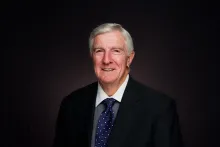
Before his retirement in 2021, Dr. Donald Ward pastored churches in Texas and Louisiana, and taught at Ambassador Bible College in Cincinnati, Ohio. He has also served as chairman of the Council of Elders of the United Church of God. He holds a BS degree; a BA in theology; a MS degree; a doctor’s degree in education from East Texas State University; and has completed 18 hours of graduate theology from SMU.

