

Robin S Webber
This transcript was generated by AI and may contain errors. It is provided to assist those who may not be able to listen to the message.
First Sabbath with you after a long time. I like to really go into a message that is constructive, that we might call Christianity 101, but it is needed more than ever. Allow me to give you the title of my message so that we can all be on the same page from the very beginning. The title of my message is, Sowing Seeds of Peace.
Sowing seeds of peace in times of peace.
For many days now, back in Cincinnati, Ohio, the general conference, then later on the Council of Elders, of which I am apart, and then even when we were in retreat together for a day and a half afterwards, if you want to know what we were talking about, I know there will be sometimes people that think they know what we were talking about or would like to know what we were talking about. This is what we were discussing, sowing seeds of peace in times of peace. Join me if you would for a scriptural anchor. Let's turn to Ephesians 4, and let's understand some of the words of God through the pen of the apostle Paul. In Ephesians 4, which is a message to the body of Christ as far as that structure whose head is the Christ, he says in verse 1, I therefore the prisoner of the Lord beseech you to walk worthy of the calling with which you were called. We did not simply sign up. We did not just simply join. We have been drafted by none other than God the Father through Jesus Christ into His body. And there is a calling with all holiness and gentleness, with long suffering, bearing with one another in love. That means we have to take on the weight of our neighbor, just as Mr. Aguiano was bringing out in his message, endeavoring to keep the unity of the Spirit in the bond of peace, endeavoring to keep the unity of the Spirit. That's just all being in the same room, not just all being in the same boat. I've come to learn something over the years. There's one thing to be in the same boat. We often use that as an expression. Well, we're in the same boat. Well, there's a difference between being in the same boat and having everybody row the same direction by the guidance of the Spirit. So we've got to endeavor to keep that bond, that tightness, as it were, in the bond of peace. There is one body, one Spirit, just as you were called in one hope of your calling, one Lord, one faith, one baptism, one God and Father of all who is above all and through all and in you all. Then notice verse 7, But to each one of us grace was given according to the measure of Christ's gift. Grace has been given to each and every one of us. All of us have had the opportunity to experience God's calling and God's favor and receive God's Spirit. All has been a gift of Christ. What we talked about in this regard over this past week is that we believe very much so that it is the desire of God that we have a whole church effort to sow seeds of peace in times of peace. For those of you that are members of the United Church of God, we recognize that we have been through challenging years, but there is simply no letting up. Now we have to go to work more than ever to be vigilant, to recognize that now is the time to plan. Not tomorrow, not next month, not when a trial comes upon us in the future, but right now to sow the seeds of peace. And that's very important. Join me, if you would, in Psalm 34, verse 14.
We sing these words at times in one of the Psalms put to melody in our hymnal. But again, let's notice Psalm 34 in verse 14. Depart from evil. Do good. And then notice what it says. Seek peace and pursue it. Hunt for it. Track it down. Some of you gentlemen, maybe some of you ladies, are hunters. Hunters with bows or hunters with rifles. And you know that the game does not always come to you. You have to go after the prey. You have to go after the game. There's a action on your part. Peace is not something that is just simply created by fiat. That's why Jesus said in the Sermon on the Mount, blessed are the peacemakers. Peace has got to be made. If we're going to be like Christ, we need to be peacemakers. We need to be now sowing seeds of peace in this time of peace. Jesus Christ is called the Prince of Peace out of the book of Isaiah. We all know that magnificent anthem that comes out of the oratorio about the names of the one that would be the Messiah. When we talk about being Christ-like as Christians in what we're responsible for in the body of Christ, let's go to 1 Corinthians 3 and verse 13 and remind ourselves of this important verse. This is not just lip service. This is a way of life. 1 Corinthians 3 and verse 13.
Actually, I want verse 11, pardon me, for no other foundation can anyone lay than that which is laid, which is Jesus Christ. Jesus Christ is the Prince of Peace, and he's the same one that said that peace has got to be made. Allow me to be blunt and allow me to tell you how it works so that we're not just dealing with theory. Looking back to where we have been over the last three or four years and where we are at this moment, what we are going to be striving to do in making this an entire church effort, and we recognize that it begins with the Council of Elders.
That is that we are going to sow seeds of peace among ourselves. We realize that in one sense that God, excuse me, that the adversary does not want the United Church of God to succeed. Therefore, we have to be vigilant and not allow any crack, any division, in any manner to develop, to grow, to put a taproot down between us. What we're looking at right now is, in that sense, that the Council will be a whole.
That there are going to be 12. That when we go to breakfast, there's going to be 12 at a table. When we eat dinner at night, there's going to be 12 at the dinner table. Wherever we go, we are going to, in that sense, be known as we ought as the 12. That we don't want to be divided into factions or fractures or numbers.
And to realize that we're dedicating ourselves to God Almighty, that we are going to be united and go to one another with love, with directness, but also not for ourselves, but to maintain the bonds of peace so that God can use this instrument. But it does not just revolve around the Council to the Council. It's also how we now will work with the Administration. How the Administration works with the Council.
How the Ministry works with the members. How the members work within their families. How families work within their communities. In other words, it's in an integrated Christ-like manner of working together to establish peace and not allow any division to occur between us. Allow me to say this. As a person who is a pastor, as a person who's a Council member, and first and foremost as a Christian, I take this really, really seriously.
It's going to take heart work, it's going to take homework, and it's going to have to take that you take God at His Word. This is how the body of Christ is to be prepared, and that is to remain united. But being united doesn't just happen. When I say united, I don't mean being yellow pencils.
I don't mean about being people that don't have opinions and dreams and hopes and aspirations, and you bring something to the table, or you bring something to the church, or you bring something to a local church council meeting, as Mr. Star Wars has invited you. But we bring it in the atmosphere of love, we bring it in the atmosphere of humility, we do it to bring about peace in our church. Why is this so important for the San Diego congregation?
Let's bring it local. The times, the distance, and the very essence of our calling are going to demand that we are on the same page, that we are a church of humility, a church that practices love, a church that will, and or a congregation that will not allow seeds of discontentment, seeds of unfair criticism, or wrongfully placed criticism to grow and to develop and to begin to separate brethren. We not only need to be on the same page, we need to be of the same spirit. Now, when I'm talking to you, I want to share something with you, friends. This is not just a pastor up here speaking to you as the church members.
This is the heart work. This is the homework that each and every one of us need to be about in being about our Father's business. I'd like to, the remainder of this message, give you three keys that I want to bring to you that will allow us to sow the seeds of peace in times of peace.
The first point I'd like to share is this. Let's understand the world around us. Point number one is let's understand the world around us and the world inside of us apart from Christ. Let's understand that world. Let's face it head on. I think all of us can appreciate that negativity and fault-finding have been there since time immemorial. But let's also be frank, in today's society, negativity and criticism has reached a toxic level.
We see it all around us. We are an increasingly picky society. We're a divided society. We see that in our nation. We talk about red and we talk about blue. We talk about division. More than ever, barbed comments are a common way of talking to one another. People talking over one another. All you have to do is go to any cable news station.
It's interesting that at times we've said, you know, we pull back sometimes and say, well, you know, I should have thought about it before I spoke. The real challenge today is that people are speaking and it really is what they are thinking. So this is the world that is around us and we need to be very careful about that. Also, we turn to the Bible itself. Second Timothy has said that this would be the world that would surround the church, the world that is around us.
Second Timothy 3. Let's pick up the thought if we could in verse 1. 1. Know this, Paul prophesies, that in the last days perilous times will come. Now, we don't have to set a date of destruction or whatever that some are setting for this weekend. We don't have to set dates, but this is very clear, speaking of the end-time age of attitudes and approaches, what the DNA of society would be like. For men will be lovers of themselves, lovers of money, boasters, proud blasphemers, disobedient to parents. They are unthankful, they are unholy, they are unloving, they are unforgiving. They slander. They trespass into a person's reputation without even asking permission and do great damage.
Without self-control, brutal, despisers of good, traitors, headstrong, haughty, lovers of pleasure, rather than lovers of God. Oh yeah, when you look around, we live more and more in what you might call a complaint-oriented society. And that's the world that we live in. That's the world that's around us. But let's see how God addresses the world that is also the world of the church. Journey, if you would, in James 4. Let's take a look here for a moment.
Because we can say, well, look at that big bad world out there and what's going out there. But the epistle of James also says something about people that ought to know better.
James 4, where do wars and fights come from among you?
He's not addressing the world at this point, but he's speaking to the saints, those that have that calling, those that are supposed to be endeavoring to keep the bond of peace. Where do wars and fights come from among you? Do they not come from your desires for pleasure that war in your members you lost and do not have, you murder, you covet and cannot obtain, you fight in war, yet you do not have because you do not ask.
So we look at all of this and to recognize even as ancient Israel in the land of Goshen was affected by Egypt that was around it. Here today in modern-day Egypt, we in spiritual Israel can also be affected very easily from this world that we've been called out of and also the world that is around us. So we need to understand that. It's not just the world that is around us, but the world that is around us, but the world that is here. The church world, the congregation world, that we as Christians inhabit. And we need to be very, very careful. The comment that came up the other day by Mr. Luker was that he put it this way, the next time that we are persecuted, let's make sure that we are persecuted externally for righteousness sake and not internally.
That means then that we have to keep the bonds of peace going between us. You know, when we talk about this world around us where we look at the book of James, we understand that there is that something inside of us that wants to lift ourselves up and make our comments and create a judgment on much of what's around us, whether it be an event or whether it be a person. In other words, it doesn't... it's not too hard to be a fault finder. It's not too hard to be a fault finder. Let's talk about fault finders for a moment. When I say this, I'm not preaching down at you, brethren. I'm talking to myself. It comes with the human territory, doesn't it, if we want to be honest? This message is for me as well. If I'm going to at this moment be a leader before you as your pastor and also a leader for the church as a whole, that I've got some real serious homework and hard work to do my own and recognize that all of us at times want to be a judge, want to be a critic, want to be a fault finder. But finding fault, let's remember something, it takes no talent. It demands no self-respect. Sometimes it does not require any brains. Being a fault finder does not require character to set yourself up, to set myself up in the grumbling business. Ben Franklin, one of our forefathers, this country said this, any fool can criticize, complain, and condemn. And he said, and most do. Most do. Even people who know God. And that's why we need to take this seriously.
As we strive in the United Church of God to integrate every layer of the church with Christ-like service. That is simply not going to be a platitude. It is not just simply a bumper sticker. It takes full heart transformation. Because of the world that is around us and the world that is inside of us, we need to understand that. People in the Bible have been complainers and fault finders. Join me if you would in Numbers 12 for a moment. Numbers 12. And let's look at a classic example. Not just simply of the world, but of people of God. Leaders. Leaders within that community. Here we find Miriam and Aaron. A priest and a prophetess. And we find that world inside of them. Not Egypt. It's so easy always to point outward to the world that is around us rather than dealing with our own world and our own problems. Here we're Aaron and Miriam, the very family of Moses. And they were jealous over his position and his increasing influence with the people. And they couldn't fault his leadership, which is interesting. So they used the smokescreen of his Ethiopian wife. Notice what it says, And Miriam and Aaron spoke against Moses because of an Ethiopian woman, whom he had married. For he had married an Ethiopian woman. And so they said, As the Lord indeed spoken only through Moses, has he not spoken through us also? And the Lord heard it. Now the man Moses is very humble, more than all the men who were on the face of the earth. And suddenly the Lord said to Moses, Aaron and Miriam come out you three to the tabernacle of the meeting. So the three came out and then the Lord came down in the pillar of the cloud and stood in the door of the tabernacle and called Aaron and Miriam and they both went forward. And then he said, Hear now my words, if there is a prophet among you, I the Lord will make myself known to him in a vision.
I speak to him in a dream. Not so with my servant Moses. He is faithful in all of my house. I speak with him face to face and even plainly and not in dark sayings and he sees the form of the Lord. Why then were you not afraid to speak against my servant Moses? We know the rest of the story. We know that Miriam was smitten with leprosy. There was a reason for that.
Because God wanted to bring out into plain day what was in the dark side of her heart, that she was being eaten up and her pride and her unthoughtfulness of bringing up something old business like something that had occurred 40 years before as to whom Moses had been married to. God made it very clear that they wanted to bring Moses down. In all of this, I want to share a thought with you and I think you know me well enough as a person. We are not talking about a time and a place for facing issues and coming to an individual. We're going to be getting to that in a moment. But we recognize the reason why God did do something here is that they did not come to keep the bonds of peace. They did not come to develop unity in Israel. There was something lacking, lacking in what they were doing. And that lesson is there for us forever. Sometimes we, as family members in the church, because we are so close, we pick upon those that are closest to us. Join me if you would in Galatians 5 and verse 15. Galatians 5 and verse 15.
Again, Paul's writings on this subject. Christianity 101. Sometimes it's just time to go back to basics. Galatians 5 and verse 15. It says, But if you bite and devour one another, be where lest you be consumed by one another. It's interesting how this is brought out in the new international version. It says this, If you keep on biting and devouring each other, watch out, or you will be destroyed by one another. Again, in the Living Paraphrase, it puts it this way. If instead of showing love one to another, you're always critical. And Caddy, watch out. Beware of ruining each other. Let's just put it this way before we move to the next point. Destructive complaining indicates a lack of love, and God is love. Why do I bring this up, friends? Why have I been away from you for 10 days in all the congregations in California? Because we worship a God of love. And He's asking each and every one of us, commissioning each and every one of us, who's been given the gift of grace, to keep the bonds of peace. I'm looking at the front row, the second row. I'm going through like corn. I'm looking at the third row, the fourth row, the back rows out in the lobby. Every one of us, to allow our congregation, to allow the United Church of God to be an instrument that glorifies God, has got to take part in this commission. It's got to be a whole church effort. And when you see something beginning, deal with it. I'm talking to you that are elders, that we do not want to have any division or any unrest between our elders and our deacons. We've got to work as an ordained family. And when something is coming about, we deal with it. We don't allow it to fester. We don't allow it to grow. And there are biblical principles that we'll talk about in a few minutes, but we deal with it. We don't ignore it. May I be blunt? I'm known to be so at times. At times in our Church of God history, we have put things on ignore. We pushed the ignore button. Pretended things don't exist. Thinking that one day, somehow, someone, somewhere, sometime, we'll deal with it, rather than recognizing we have a Christian responsibility, first and foremost, to keep the bonds of peace. To keep the bonds of peace. If we do not learn from these past years, we are, of all people, most miserable. Well, we can say, yeah, but we're in this congregation today. We remained in this instrument of the body of Christ. Wonderful. But let's understand something. We have homework. We have heart work. We come as human beings out of a culture, a human nature culture, and also a church culture. And I say, unfortunately, at times, to where we're always waiting for somebody else to deal with it, rather than recognizing that we are agents of change. And each and every one of us are commissioned by none other than Jesus Christ to keep the bonds of peace and not let things slide. How is this important for us? Let's talk about this realistically. You know, and I know, Susie knows this, because she's with me in this church and that church and this church and that church. And we're moving from the Mexican border up to the hinder lands.
God's Spirit has got to be equipping you and working with you and challenging us to recognize how important it is amongst yourselves as elders, as elders and deacons, as ordained members, members to members, all working on this together, recognizing that this is in God's Word, a God who is love, a God who says that he will exalt the humble, but for the proud he has a different reward. And I really believe, brethren, that this really can work when we recognize that Jesus Christ is the head of our life and the head of our congregation, and that while a pastor may come and go, there is not an absentee of leadership because Jesus Christ is the head of the congregation and his Spirit is alive and well in each and every one of us. And if you want peace, the Psalms say, pursue it and earnestly seek it out, make it happen, stand up for nothing less, and then know that God will help us. Point number two that I'd like to share with you in this regards.
When I find it here on my notes, I'm going to come here in a second. Point number two is this. Remain open, remain open as to whom God uses to mold you.
Remain open to whom God uses to mold you. We need to understand that at times we have difficulty in understanding who God is using to tool and die us spiritually. It doesn't always come from the person or in the timing that we expect. And the big question is not, will we be tooled and died by God? Yes, that will come. The big question is, will we recognize it when it is occurring? Allow me to share a story with you which is really interesting. Two taxidermists stopped for a while before a window, and in that window there was an owl that was on display. They immediately began to criticize the way that that owl looked. I mean, they just tore that bird apart. They said its eyes were not natural, said that its wings were not neatly arranged, and that frankly its feet could be improved. When they had finished with all of that criticism and they were just about to walk away, the old owl turned its head and winked at him the way that an owl can.
Oh, that we could be like that owl and take it for a while and take it for a while and then wink. But that's easier said than done, isn't it? When people begin to criticize us for all the right reasons and in all the right way, what do we do? We're like Baghdad at night, back in the early 90s. Up go the anti-missile defenses. It's all nighttime over Baghdad. All the flares go up, the moats are filled, the alligators are let out. Who? Me?
Now, you ever had somebody come and say, do you mind if I tell you something? This is a famous thing. Do you mind if I tell you something? You brace yourself. You say, sure. Yeah, you do mind that somebody's about to tell you something. It's surprise time. And then they begin to do it in the best way. They probably prayed and fasted about it and thought about it. And you go, what? Who? Me? We're not like that owl. We come to pieces. Let's understand that this coming year, maybe today, maybe tomorrow, maybe tonight, God is going to use people and places and circumstances that you least expect to keep you in oneness with God and in the bond of peace. Allow me to use an example. 2 Samuel, join me if you would, 2 Samuel. And let's pick up the thought in verse 4. 2 Samuel 16 in verse 4. 2 Samuel 16 in verse 4. 2 Samuel 16 in verse 4.
I mean, okay, here we go. This is the famous story of Shimei. Actually, it's picking up in verse 5. Now, when King David came to Beshurim, there was a man from the family, the house of Saul, whose name was Shimei, the son of Gira, coming from there. And he came out and cursing continuously as he came. And he threw stones at David and all the servants of King David and all the people and all the mighty men were on his right hand and on his left. And also Shimei said, thus, when he cursed, come out, come out, you bloodthirsty man, you rogue! Perhaps when he spoke it in the language of that day, it was even more coarse and tougher. And the Lord has brought upon you all the blood of the house of Saul, in whose place you have reigned, and the Lord has delivered the kingdom into the hand of Absalom, your son. So now you are caught in your own evil because you're a bloodthirsty man. Then Abishai, the son of Zuriai, said to the king, why should this dead dog curse my Lord the king? Please let me go over and take off his head. But the king said, what have I to do with you, you son of Zuriai? So let him curse, because the Lord has said to him, curse David. Who then shall say, why have you done so? And David said to Abishai and all of the servants, see how my son, who came from my own body, seeks my life. But for now may this Benjamite let him alone and let him curse, for the Lord has ordered him. And it may be that the Lord will look on my affliction, and that the Lord will repay me with good for his cursing this day. What a marvelous attitude! Here's a man who is a king. Here's a gentleman criticizing him, carping, complaining. And David puts God right in the middle of this equation, says, this isn't really about him. It's really all about me. God is trying to teach me something. And David had not been a perfect king. He had not been a perfect covenant individual, as we all know. He said, while he's doing it wrong, I can learn something out of this. But then notice something else. And as David and his men went along the road, Shimei went along the hillside opposite him, and cursed as he went, threw stones at him, and kicked up the dust. Have you ever done that before? You think you've done it all the right way? God, I know this one's for me. Thank you, Lord. And you know I've been criticized, and somebody's come at me, and you know what? I've been a good boy for three days. And now, because I've done that, I know this will go away. But it only got worse. Did you read? The Bible is very graphic. I mean, can you imagine somebody kind of going alongside of you on a ridge? He's throwing stones. You think this is a trifactor. He's throwing stones at you. The guy is cursing, and he's whipping up a dust storm all at the same time. And you are the center of his attention. Just because, at times, we do it, as God does, doesn't mean that he's going to lift the burden, but he's going to give us the strength and the wherewithal. I know over the years, allow me to share a thought with you. I've, as an individual, that's been in the Church of God community for many, many years. I've had an opportunity over the years to be trained and to be corrected by many an individual. You would know some of them.
And at times, they've come at me, and perhaps they did not have all the facts. But there was something that God was telling me to look at about myself. I remember many, many years ago, I was a younger minister, and I had an opportunity to spend an afternoon with somebody. And I came home, of all people that are going to see it my way, would be my dear wife, after quite an experience. And I went home, and I said, you can't believe this. This is incredible. This is what I, I, this is what I did. This is how I responded. And she said, what did you learn from it? What did you learn from it?
She was basically saying, how available was my heart to receive God's direction and correction even beyond some of the facts that perhaps were not exactly right. Maybe what I'm saying is, brethren, to keep the bonds of unity and be prepared for wherever it comes from. And it may never come perfectly, but God is asking you to respond to that challenge just as a man after God's own heart, David, did. And that will be very, very important. That leads me to my third point that I want to share with you this afternoon, and that is this. There is a time, I've talked about the world of criticism that you and I have been called out of, there's also a time to learn how to come to point and to help a brother in the church come into the bonds of peace. And this is important as well, because if we do not address things, brethren, a little leaveneth the whole lump just does. A little leavened leavens the whole lump. And a stitch in time saves nine, just like the old Amish saying. How and what should we do about this? Well, first of all, let's go to Galatians 6. Very important, first.
May I say something squarely and put it on table before you? If over the years we had practiced what I'm about to bring out, as persons, we would be glorifying God. As congregations in the body of Christ, we would have strengthened the body of Christ. But maybe God has brought us to this point to, once again, rehearse these verses. And it's no shame to do so. It's only a shame if we will not hear what it says. Galatians 6 and verse 1, Brethren, if any man is overtaken in a trespass, you who are spiritual restore such a one in the spirit of gentleness, considering yourself lest you also be tempted. Before we go to somebody, and we are at times going to go need to talk to somebody, because there are times if we do not address issues, they will fester into hurts. If we do not address the hurts, they will fester into anger. If we do not address the anger, it will fester into bitterness. We will not be keeping the bonds of peace. We will no longer be able to bear one another's burdens. So we must deal with it at the elementary stage. I'm sharing with all of you that this is an assignment for our congregation. We need to deal with things at the elementary stage. Now, when I say that, it doesn't mean somebody is all of a sudden going to be in a spectra on everybody else's attitude. That's not what I'm saying. Because Galatians 6 says, first of all, you've got to look at yourself through the mirror of the Bible. It says, you which are spiritual. Now we're talking about humility. We're talking about love. We're talking about kindness. We're talking about how to move a brother, how to move a sister, to come somebody to somebody in a family manner, not an adversarial manner. Notice what it says, therefore then bear one another's burdens and so fulfill the law of Christ. Let's go to Matthew 18. Matthew 18.
Now, there's a principle here, and there are many principles that would bear out an entire sermon to fully get down into every issue that is involved here. But there's a principle that I want to draw out of it. Verse 15, Moreover, if your brother sins against you, go and tell him his fault between you and him alone. And if he hears you, you will have gained your brother. If he doesn't hear you, take with you one or two more witnesses. And if he refuses, then take it to the church. My point at this point is not to go down into every aspect of this. This would be a whole sermon. But here's the point I want to bring to you. The shortest distance between two points is a straight line, person to person, getting involved early on. Now, why am I saying this? Am I just up here reading some notes? No, I plan to practice this.
I plan to practice this as your pastor. I plan to practice this as a council member on the board of the church. I plan to practice this just simply first and foremost as a Christian.
When I view the history and analyze the challenge that has been before the church, it's all been about godly relationships. Godly relationships. And it's not biblical rocket science. It's how to work with us.
If you check yourself at the door of your heart, it says, you which are spiritual, go and deal with the brother. It says, and go the shortest distance. What we have unfortunately done because of the world that is around us and the world that is inside of us, too often, frankly, we're talking about other people rather than talking to them and with them. Now, I see we have some dear friends from Tucson today, and we're really glad to have you with us. This is not just a San Diego issue. This is not just a Guadalajara issue. This is not just a Tallahassee, Florida issue. This is an issue in front of each and every one of us to keep the bond at peace. Brethren, we have been given an opportunity by God's grace, and I say this with the utmost sincerity. When I look at how God has delivered us over this past year and blessed us in spite of ourselves, blessed us in spite of at times our human nature and our human machinations and our own wills to recognize nonetheless that He still is striving to do a work in us individually and collectively. He's given us an opportunity to learn this lesson of striving to secure the bond of peace. Mr. Rhodes can't do that by himself. Mr. Luker can't do that by himself. Jesus Christ, who is the Prince of Peace, cannot do that with a spirit here down below that is going to be resistant and not understand their role and what is to be accomplished. Each and every one of us are agents of that peace because we love our God, because we love His word, and because we love the brethren, God is truth. And we must be willing and courageous enough, and I speak to where we are in the United Church of God, not about any other organization or any other people, but where we are. The lesson of where we have been short, not somebody else. If we keep on looking just simply at the world, or we look at another church group, or we look at another individual, we are not looking at the individual that God wants us to work on the most, and that's ourselves.
So please understand that this year, here's the assignment, I'm going to strive to be a proper example of Jesus Christ living in me, that I will deal with issues when I see them and not allow them to fester, so that we can keep the bonds of peace. I also ask that all of you will be your brother's keeper, be your sister's keeper, in a family manner, to go to one another before things do develop, before things do divide. And let's understand something. There is an adversary out there. There is a devil, and there is a Satan, and there are wolves.
Paul calls them ravaging, savage wolves, that would want to tear the bond of peace. I say this not to scare you, but just to advise you, because I'm not afraid. I'm an optimist. When I read this Bible, and I put my heart and I put my finger in it, how do you not become optimistic, brethren, as we come off this conference? That the head of our church is one who lived and died and was raised from the tomb, and now sits at the right hand of glory. Somebody asked me at the conference, Robin, why are you so optimistic? Why do you think there's a future? Why do you think there's any hope that God can use us? I said, because I'm an optimist. I read the book. I believe the story. I know that the tomb is empty. What part of this story don't you understand? And their response told me that they did not understand.
I look around. I see people that understand. I see people that want to develop that bond of peace. Let's move forward in that bond of peace, San Diego congregation. Let's do it together. The United Church of God is not about simply one individual and or a collection of people. It is every member of the body doing their part. My part was to say that I would conclude about right now. So I'm going to. I think you got the point. We know the story. We know our responsibility. Let's sow the seeds of peace now during these times of peace.
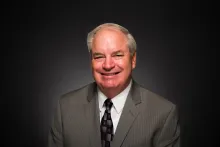
Robin Webber was born in Chicago, Illinois, in 1951, but has lived most of his life in California. He has been a part of the Church of God community since 1963. He attended Ambassador College in Pasadena from 1969-1973. He majored in theology and history.
Mr. Webber's interest remains in the study of history, socio-economics and literature. Over the years, he has offered his services to museums as a docent to share his enthusiasm and passions regarding these areas of expertise.
When time permits, he loves to go mountain biking on nearby ranch land and meet his wife as she hikes toward him.
