


Robin S Webber
This transcript was generated by AI and may contain errors. It is provided to assist those who may not be able to listen to the message.
Over the years, we as speakers are sometimes tagged with different phrases that people might associate with one of us. I probably have two or three that are associated with me, and when I do give them, it's basically I'm just simply preaching to myself, but maybe the one that I am perhaps best known for, no, it's not blessed are the flexible, for they shall not be been out of shape.
There you go. But the other one is simply this. It is to feel the joy. To feel the joy. I'd like to give you some background about that, because there's always a background to everything that we do. Many, many, many years ago, I started mentioning that to different individuals that were about to go up on stage during church, whether it was behind a curtain in an auditorium or whether at a feast site. When I would do that, I would often give it to people that were frankly quite versed in speaking or quite accomplished in speaking or playing an instrument.
But somehow they were so focused and, do I dare say, a little scared about what the audience might think or what the audience might do or that they might blow it, that they had forgotten that for that moment and for that time before God's people, they were God's tool. They would be God's instrument to share His message. I remember sometimes, whether it be man or woman, as they were about to go out, I just kind of go, feel the joy, and they go, what? As if perhaps joy was not a part of the encounter that they were intending to experience in those moments.
Sometimes we might say, well, to feel the joy, oh boy, I've seen that one on the 210 freeway in a traffic jam right in front of me. And there's no joy. Maybe that's why that bumper sticker there is in front of me. We were coming home last night from Bakersfield as I was sharing in the message. No, Robin, you don't want to go there.
It was bumper to bumper at 10 o'clock at night on our freeways. So anyway, it was a long night, so I probably needed to have feel the joy in front of me, but couldn't read it because it was dark anyway. So anyway, the feel the joy. But let's take it back. It's more than a bumper sticker, and that's why I'm bringing this message. And I do believe it is so relevant, especially to the aspect of coming up to the festivals that we're about to experience, even to feel the joy of what the New Testament Passover, that Christian Passover is all about.
I'd like to share it with you because it's amazing that how far back some of these things go that affect us. And so bear with me if you would for a moment, allow me to share the story of how that first came into my life. Some of you have been in this community for many, many years, up to 40 or 50 years.
So the name I'm going to mention to you, you may be familiar with, and that's Mrs. Mary Ann Hoag. I don't know if any of you remember Mrs. Hoag out of the Los Angeles congregation.
Well, I certainly do. Mary Ann was a very near and a very dear friend of my mother, Thomasina. When I was 16, 16 years of age, I came down to spinal meningitis. I was anointed. I was divinely healed. God placed His hand and He placed His seal on me to be able to share that with everybody. That we worship a God who is a healer in His time and in His way. Mary Ann Hoag was very involved in that. Nursing afterwards. God will do what He will do, but then He expects us to do our part.
And Mary Ann was right there with my mother, intending to me after things began to get better, and even when things were pretty dire. There was a time when I went to bed, not knowing if I was going to wake up the next day. I've shared that story with you, and I don't want to go down that path right now.
But before that, Mrs. Hoag had always been known to say, feel the joy. Do you feel it? That was her favorite verse. Anytime she came over, and Susan got to know Mrs. Hoag later on when we were dating in college and in church and when we were married. But that Mrs. Hoag's favorite verse was Philippians 4 and verse 4. You might want to jot that down, and if not on paper, kind of think about that and bed that one in your heart.
And Philippians 4 and 4 says, rejoice! And again, I say rejoice. Now, what is rejoice versus joy? Rejoicing is just outward expression of joy, and it is joy on steroids that you're sharing with others, because joy is never intended to be singular. It's never intended to be boxed up. It is to be transmitted up to God and to one another as we are in this room.
Well, Mrs. Hoag was there for me when I was 16 and a half. Years went by. College. Elder in a service. Later on, a pastor. And I think the last time I saw Mrs. Hoag, I was probably about 39 or 40 years of age. We knew that she had cancer, and this was on top of a life that was challenged. I'll just leave it there. Challenged to the hilt. Not a lot of, do we call, happy things happening to Mrs. Hoag from the outside. A number of us in Pasadena went down to the Good Samaritan Hospital on Wilshire Boulevard. Mrs. Hoag had, was riddled with cancer out of the back. A number of us went in and visited her. And I was the last one to go. Everybody else had gone out the door for a moment. Mrs. Hoag and I, I was like one of her adopted sons, always had a special relationship. I said my goodbyes. I started walking out the door. I was probably maybe about 21 feet from Mrs. Hoag. I was about to go out into the hallway. And she said, Robert. She said, do you remember? And I turned around and I looked at Mrs. Hoag, knowing it would be the last time that I would ever see her in this lifetime. I said, yes, Mrs. Hoag, I do remember. Rejoice. And again, I say rejoice. She smiled. She said, you got it. I left. I never saw her again. That was the background of why I, as one believer to others, share the thought of feeling the joy. Because joy is much more than simply a feeling. That's kind of a high level. It's deep. It is embedded.
It is something that you carry down deep into your heart that neither circumstance, unplanned activity, Satan, culture, the world can get ahold of because God has placed it into your hearts.
It's amazing how joy can be transmitted from one person to another if we allow God to do that in our lives. That's part of the purpose of this message today.
I'd like to contrast Mrs. Hoag for a moment with a historical figure that many of us are familiar with, and that is Martin Luther, the reformer.
If you studied history, Martin Luther was, do I dare say, a medieval man? Late medieval man? A little glum, a little unique if you study into the history of Martin Luther.
It's a good thing I'm not speaking in a Lutheran church today, but they would tell you the same thing. I was raised Lutheran before I came into this way of life, so we know about it. Okay? But Martin Luther in his latter years was even gloomier than his natural nature. And one day, his wife came into the study, and she was all dressed in black like she was mourning. And Martin asked, who's dead? And she said, well, God is. And then Martin balled out his wife, saying, my soul, why should you talk like that? And Mrs. Luther answered back, because of your gloom.
Because of what he was transmitting, as if he was a Christian living without his God.
I don't want any of that to happen to any of us here today in Los Angeles. We're Christians. We're members of the body of Christ. And the loneliest thing is for a Christian to live without his God. So here's the big question I want to ask you today. How important is it for you as a member of the body of Christ to understand joy? How important is it for you to understand joy? I'm going to kind of build a little foundation, and I'm going to give you the title of my message. Join me, if you would, in Galatians 5 and verse 20. I'm going to go through just a couple of verses, then I'm going to give you the title so that we can take this one home for you. Okay? Galatians 5. And if we go to Galatians 5, we notice there that we find the fruits of God's Spirit. It's known as verse 22. But the fruit of the Spirit, capitalized, that's the Holy Spirit, is love, is joy, is peace, long suffering, kindness, goodness, faithfulness, gentleness, self-control. And against this, there is just absolutely no law, because it is of the Spirit.
It is a—God's Holy Spirit is a gift from God. It is literally His essence.
It's not something from the outside that you grab. It's not a screwdriver. It's not a hammer.
It's not a wrench. It's God dwelling in us. Immanuel, God with us, dwelling in us, the Spirit of the Father, the Spirit of the Son, literally dwelling in us. It's placed in us. It's a gift.
That Spirit indwells in us as the temple of God, as Paul explains throughout the epistles.
But what is the fruit of God's Spirit? Allow me to put this down. Let's go to another—you might want to jot this down. It is evidence. It is living proof that the Spirit of the Father and the Spirit of the Son are alive and well and living in us. It's evidence.
That's why joy is a part of that evidence. Now, let me give you some working tools here, some working definitions, so we can all be on the same page. It's always good.
Don't want to end up on different pages at the end of this message. What is joy? If you go through all the different Greek factions of what joy is, I'm going to give you some words. It is to delight. Joy is to delight, and we'll define that later. It is to exalt.
Joy is gladness, and sometimes you'll see that Greek word defined as gladness in newer translations.
It is to benefit. It is to benefit. Ultimately, allow me to share this with you.
Joy is the knowing. It is the knowing beyond the facts that are on the ground at the time.
Now, with all that stated, we've got some working definitions. Can we proceed?
That's when you're all supposed to nod. We can proceed. If not, I'll go back and give you this whole part of the sermon and it'll go over time. No. Okay. Here we go. Allow me to share a very important anchor verse for us. And it's really the anchor verse for this message and the title that I'll draw from it. I'd like to quote from Colossians 1 and verse 11. You may turn to that, but I'm actually going to read it out of the New Living Translation. So, you may just want to jot that down, and I will read it for you out of the New Living Translation. Paul speaking. We also pray that you will be strengthened with His glorious power so that you will have all of the patience and the endurance. Other translations say long suffering. That means that when you think you've suffered enough humanly, there is even an extension of that long suffering that you need. And then it says, may you be filled with joy.
Now, notice that comes after the patience and the endurance and or the long suffering.
May you be filled with joy always thanking the Father who has enabled you to share the inheritance that belongs to God's holy people, who live in the light. For He has rescued us from the one who rules the kingdom of darkness and has brought us into the kingdom of His dear Son.
And as Mr. Velasquez was sharing with us in the first message, God has purchased our freedom with His blood and has forgiven our sins. So, we look at all of this. How prepared are you to experience God's joy? A gift of the Holy Spirit?
I'd like you to go to Psalm 51 for a moment before we proceed. Psalm 51. We often say or use that Psalm 51 as the prayer of repentance that David offered up after the encounter with Bathsheba. But I want to just focus on one verse in here, Psalm 51, and in verse 12. Psalm 51 and verse 12. How important is joy? I want to get that across to you. How important is it to, as a follower of God and a follower of Jesus of Nazareth, how important is it?
Notice verse 12. Restore to me the joy of your salvation. Restore to me. That means that it can become languished. That means it can almost be on life support, even with a person elected and chosen by God, and uphold me by your generous spirit. But why restore that joy to me? Why restore that purpose that you have given me in my life? Why? Just for me? God never calls us just simply for personal salvation. That's what it starts with. And thank you, Lord. Thank you, God.
But it always transmits out to others. Then I will teach transgressors their ways, and sinners shall be converted to you. As you restore me, hmm. This is telling us that even a person set apart by God, anointed by God, and in that sense, we have been set apart as members of the body of Christ, and had in that sense an anointing, and are gone through that watery grave, and then risen in the type of resurrection, and then had the laying on of hands, that even individuals that have gone through that can have their joy, have their purpose, get too stuck on what they are doing rather than what God has called them to do, that God says to us, David, restore to me the joy of your salvation. So allow me to give you the title of this message with that now. Because maybe today, as you've come in, you're moving towards the spring festivals, maybe, okay, we do this, we do that, routine, and routine, and routine. I've been doing this three years, 30 years, 40 years, 55 years. There's nothing routine about God, there's nothing routine about God's Spirit, there's nothing routine about joy. It is just exciting, and it is wonderful. So today, I want to share with you, let's learn how to strengthen the spiritual muscle of joy. And if there's anything that you get out of this message today, friends, it's simply this. Joy is not just a feeling. Joy is a gift of God that must be exercised. It must be exercised continually, not just when the festivals come up, oh, time to, time to be a joy bunny, time to be, you know, a joy energizer. No, no, no, no. And I'll share a little bit about that in a few minutes, about how to do that. See, joy is a muscle. It's a body, what is a muscle? A muscle is body tissue that contracts. And when stimulated produces motion.
You and I have been called to be in motion. We have been called to walk the walk of faith, right? That's motion. We've been called to run the race of endurance, and you don't do that as a twinkie.
You don't do that without going through the exercises and going through the routines.
So let's, for the rest of this message, we're going to unpack, bit by bit, what I mean when I share with you what it means to feel the joy, what it means to exercise and to strengthen the muscle of joy. It's going to be very short, very simple. I'm going to give you some points. I'm going to expand on them a little bit. So if you're one that happens to be a note-taker, this will be a note-taker's delight. So be ready. Here we go. I'm going to tell you what joy is and how to strengthen that muscle. Number one, joy is a godly product. It comes from above. It cannot be manufactured down here below. It is not earth-grown. It is not earth-born. It is heaven-sent.
It is of God. It is God's spirit. Joy cannot be manufactured by whim or just simply on demand.
Today, over the last two or three years, there's a very common phraseology that is developed in the media, developed in politics. It's called fake news. Fake news from the left, fake news from the right. Here a little, there a little. Fake news. How apolitical is that? Okay.
They can have their fake news, but as a believer, as a member of the body of Christ, God has not called you to experience fake joy. And I want to describe that for a moment. Show me if you would in Psalms 137. In Psalms 137, it's a song that we actually sing here. In Psalm 137, let's take a look here. Verse 1, By the rivers of Babylon, there we sat down, yes, and we wept. And when we remembered Zion, we hung our harps upon the willows in the midst of it. For there are those who carried us away captive, asked us of us to sing a song. And those who plundered us requested mirth, saying, sing us one of the songs of Zion. And then notice what it says here.
How shall we sing the Lord's song in a foreign land? They're saying, we've been taken out, we've been put into exile. And now they're, in a sense, almost taunting us to sing this song of joy and this song of gladness. How do you do it? Now, we can look back and see the experience of the Jews on the river Kbar. And we sing, it used to be Psalm, not Psalm, it used to be page 103 in the hymnbook. It led songs for a lot of years. Let's now turn to page 103. Sing a song of Zion. And we can become challenging on others, as is brought up in our Bible study day, we can get challenged with the disciples, who will look at what they did or where they were at, or we can get challenged, we can really get challenged with the children of Israel, murmur murmur murmur, how could they do that? I'm talking to you about joy today, and to restore that joy or to expand the joy that you have. And yet sometimes say, really? Are you kidding me? You know, I know I read Paul, and it says that, you know, when it comes to the challenge, I know the moment is fleeting, the tribulation is light, you know, I go, and when you're going through, you go, really? You know, I don't feel it's too light.
I think this thing's just gone on long enough. Whether it be a health crisis, whether it be a marriage situation, whether it be an employee situation, whether it be dealing with family members.
Lord, Mr. Weber has a watch, but why don't you have a watch? This puppy should be over by now. I got the lesson. Why does it go on and on? I read Paul, burdened light, burdened momentary, and of course he goes on to say, in comparison to what lies ahead of us, and that's a part of the joy. So what we need to understand is simply this. Joy doesn't happen after, just immediately.
Talk about strengthening a muscle. I've had experience in that in the last five months, as we say, big time. Having had my right knee operated on.
Larry Darden's here. Others of you have had knee operations. Larry was so bold and having so much fun, but he had both knees operated at the same time.
Having a knee that functions, and mine is probably about 80 to 85 percent there right now, and it's coming along very, very nicely. It doesn't happen by wishful thinking.
It comes to going through exercises. It comes through dedication. It comes through doing exercises that make you very uncomfortable. They not only make you uncomfortable, but when you're in the clinic, they make you want to scream. Sometimes as a grown man, they might make you want to cry. It is painful to get from this point to that point. But when you've gotten to the mountain top, when you start hitting those marks, you look back and you say, you know what, it was all worth it. But it just doesn't happen when you feel like it. Joy is a muscle that must be continually exercised, not on your schedule, but with what God puts into your life. Joy doesn't happen at four in the morning or eight o'clock in the morning when I'm doing my exercises or nine o'clock tonight when I get home. During the interval of the message, I went outside and I did some exercises. You don't know that. I did some exercises. I've got to stay stimulated. I've got to keep this leg fluid. That's exactly what joy is as a muscle. It's got to be exercised, not just every so often when you feel like about when the situation comes upon you to exercise it and live in it. Let's go to the next point. Genuine joy does not live in the moment. It does not live in the moment. And that is probably, as Beth told in Hebrews 12, if you'll join me over there, in Hebrews 12, join me. Joy does not live in the moment. And I know this verse will probably be used many a time as we come up to the Christian Passover, but notice what it says here in Hebrews 12 and verse 1. Therefore, we also, since we are surrounded by so great a cloud of witness, let us lay aside every weight and the sin which so easily ensnares us and let us run with endurance. That means we have to exercise that muscle of joy that the race that is set before us, looking unto Jesus, who is that Lamb of God, the author and the finisher of our faith. Who, notice, are you ready? Let's eyeball this together. Who for the joy that was set before Him endured the cross, despising the shame and has now been exalted. That's another part of joy, exaltation at the right hand of the throne of God.
I'm not here to discuss all the ins and outs of crucifixion. Are you with me? And yet it says, Scripture speaking, the author of Hebrews says, for the joy. Not what was coming from the outside, but what God had placed inside of Him as His beloved Son, as God in the flesh and as the Son of man. He knew that death was for a purpose, that His life was for a purpose, that He had a calling, that He had been called to finish His Father's work, that He had been sent to this earth for. He's our example, dear brethren. Okay? He's our example. You have been called for a purpose. You have been called to be a witness that God the Father literally sent His Son to this earth for you and for me and for all humanity.
Read it in John 17, one of the last things that Jesus said in that very special prayer on that night of nights. He said, keep those that actually believe that you, speaking to His Father, as He addressed Him with the disciples listening, that you sent Me. A person that is full of joy is a person of that belief, with that faith, with that confidence, with that assurance, that has a smile on their heart and there's nothing to smile about in this world that is around us.
And that comes by exercising that muscle of joy. Know that it's there. Know that it's important.
Know that it is the secret weapon that God the Father and Jesus Christ have given us through the Spirit to move and to handle that which comes in this earth. Know when I do my exercises at the clinic, after a while, I've got to do a leg flap and I have to... I'm going to give you some anatomical term. I'm Dr. Weber now, after all of this, okay. But I have to squeeze my knee. Quads, right, Larry? Quads, quads, quads, quads. I have to squeeze my knee down. I'm squeezing my knee down to get all my nerves and muscles right again. And if I do it right, after a while, didn't come to the first day, didn't even come to the first month, there's a smile. There's actually... because it's a wrinkle, the leg is working again. And there's a smile about two weeks ago because... are you with me? The quads were not working too well. But everybody stayed with me, including my wife, Captain Crunch, over here. She loves that. I had to put it on. Sorry.
Good staff there, but Susan has been wonderful through all of this.
And all of a sudden, they were... we have one that is there, one of the coaches, Dr. Two, kind of built like a Valkyrie and like room Hilda.
Ugh! But got it down and everything went like this. Everybody, you know, all the staff, come over here. Look at Robin. He's got a smile. How embarrassing. I'm flat on my back. I'm not going anywhere. It got me down and they're looking at myself. But the smile came through exercise. It came through pressure. It came through being diligent. It didn't come because it was fun. It was hard. It continues to be hard. I have to do it in the morning. I have to do it in the night, even when I'm not in the clinic. I'm not the first one that's done it. I will not be the last. Get ready, folks. Put on your seat belts and safety bags deployed. But the smile came.
That's what joy does. As the Psalms say, joy comes in the morning after the darkness of night.
Let's take another one here. Joy comes when we... when we have our confidence in God.
When we have our confidence in God, Psalm 4, verse 6, Psalm 4.
Let's go back to Psalm. Psalms are just full of joy.
Beginning of the book of Psalm, Psalm 4.
Psalm 4, verse 6. There are many who say, Who will show us any good? Lord, lift up the light of your countenance upon us.
You have put glad... see, gladness and joy are similar. You have put joy or you have put gladness in my heart. Remember, brethren, the joy that I speak about, about feeling the joy, that's just the first step. It is to internalize God's gift. It is to activate it. It is to use it as a muscle. It is to experience it when it's time that patients go out the window, when it's time when long suffering, you want to throw it out the window like a clock, like an alarm clock, that woke you up. But God here says, you have put glad... David says, you have put gladness in my heart more than in the season that their grain and wine increase, more than the harvest of those that are around me. You are reaping something incredible inside of me. Your spirit is developing and it is expanding. It is empowering me, just like it empowered Jesus on the cross to move beyond a life that happens when bad things are happening. It's internal. It's that smile that is on our heart. I will both lie down in peace and sleep, for you alone, O Lord, make me dwell in safety. You notice that verse up here where it says, Lord, lift up the light of your countenance upon me. Countenance is just another word. And sometimes in some translations, they will translate countenance for a smile. A smile. Smile. Not here. Here. A smile that is embedded in your heart, because you know that God is at work. God has promised that He would never leave us nor forsake us. God said that He will be with us. God says that He will lay down in the green pastures. He will guide us by the still waters. He will help us through and walk through those paths of righteousness.
And even as I communicated with one of our dear brethren yesterday, that in the valley of death, the valley of the shadow of death, it is not that our God departs from us, but it is there that the good shepherd does his most sensitive and intimate work with us if we will allow him to. You see, that's what joy is. Sometimes we're looking for joy in all the wrong places, because we think it's external. It's where God is placed in us as a spirit to grow and to develop and to expand, to be a witness that we believe. That's what joy is. It says, and let your countenance. As I was saying, other translations say, allow your smile, the smile. When God informed Moses to tell Aaron how the priests were to bless his people, it was allow your smile to shine upon them.
And when God sees that joy in us, maybe from his holy eyes, he has a tear of sadness, knowing what you're going through, but I would also suggest a tear of joy.
That you've got it down here, and you know what he's about.
Joy comes when our confidence is God.
Let's go to another point here.
Joy is not the absence of trouble. Joy is not the absence of trouble, but it is the literal presence of Jesus Christ living in us. It's interesting that, if you remember, we're going to take you back to the beginning of this, like the beginning of a movie. Remember when I said that joy cannot be boxed in? Can't box in joy. It's impossible. It's impossible. Remember as a kid, in the 50s and 60s, we used to have the jumping jack. Not jumping back, jack in the box. It was metal. And did you ever have a jack in the box that was not cooperating? You push it down and pop back up. Push it down, pop back up.
Maybe I just wasn't coordinated. I'm not sure. I just couldn't get all that rhythm going.
That jack did not want to be boxed in. Joy was designed not to be boxed in by a believer and by a Christian. The Apostle Paul wrote the book of Philippians, which is often called the Epistle of Joy. And in that, you can go and see if I'm correct, but I believe that joy and or rejoice, because remember, rejoice is just joy on steroids, is mentioned 16 times. Did you know that? 16 times.
Well, he must have had a cushy, easy life. No, no, no, no, no, no, no. Philippians is a prison epistle. He was either down deep in a dungeon. That was not nice back then. And minimally, he was in a house imprisonment. He did not have freedom of movement. But in all of that, Paul never said that he didn't have joy. He experienced it. How do I know that? How can you know that? Because in another epistle, another prison epistle, that's what they're called, because he was writing them. He, when he talked about his incarceration, when he talked about his incarceration, he never said that I'm a prisoner of Rome. Did you know that? He never gave it to Caesar. He never gave it to the Romans. He said, I am a prisoner of the Lord.
My captivity is God created, that his mission might be spread. He never blamed anybody. He knew his life was for a purpose, was not happy, whether it be house imprisonment or whether it be down in a dungeon. He was always calling himself the prisoner of the Lord. He identified himself with God.
He didn't identify himself with what's happening from the outside in. He understood that his position before the throne of God, with Jesus Christ at his right hand, surmounted and surpassed the condition that was on the ground. Are you with me? Do you understand that? Our position that we can come before the throne of God surpasses any condition that's down here on the ground. Please, I am not minimizing the human conditions, but again recognizing what we've been called to express, to bolster one another in faith.
I had a lady, older lady, 50 years ago that shared God's joy with me, and I have never lost it. Never lost it. Thank you, God. Joy is to be transmitted from one person to another. It is to be transmitted like Mrs. Hoag did to me from one generation to another, to pass down, to live and to experience. That was Paul. Why was Paul able to do that? Let's go to Philippians 3. Talk about Philippians. Philippians 3.
What created that smile that was in Paul's heart?
Philippians 3 verse 7. But what things were gained in me, these I have counted lost for Christ. Yet indeed I also count on all things lost for the excellence of the knowledge of Christ Jesus, my Lord, for whom I have suffered the loss of everything. Everything! He was an up-and-coming Jewish scholar, sitting at the feet of Gamaliel. He was the point man for the religious authorities of Jerusalem to stomp out this budding element called Christianity. Had it all gone for me, and yet now I count them as rubbish that I might gain Christ. And notice, and being found in Him, and the power, excuse me, and being found in Him not having my own righteousness, which is from the law, but that which is through faith in Christ, the righteousness which is from God by faith, that I might know Him and the power of His resurrection and the fellowship of His sufferings, being conformed to His death, if by any means that I might attain to the resurrection from the dead.
It is because of this that Paul with that knowledge could say over here, when we look at it, in Philippians, that he says that here in verse 12, I know how to be abased in chapter 4, and I know how to abound. Everywhere and all things I have learned both to be full and to be hungry, both to abound and to suffer need, and I can do all things through Christ who strengthens me. We're going to baptize a young lady next week, and she's going to be asked the same thing that each and every one of us that ever been baptized in the Church of God community are asked.
Have you accepted... no, excuse me, reverse. Have you repented of all of your sins? And have you accepted Jesus Christ as your Lord and Savior? Yes. This is after discussing, in a sense, the ceremony of baptism, which is an outward expression of an inward intent. Are you with me? It's an outward expression of an inward intent that you confess and are prepared to profess that, as it says in the Philippians, Jesus Christ is Lord. That's why God sent him to this earth, so that we could do that. Both working together. We know that, and we study baptism. We know that baptism is to be the death of the old man. That's why we go down into the water. Then we know that as we come up out of the water, it's what? It's a type of resurrection. I didn't say you got the glorified body, yet. I said it's a type of resurrection. And we nod. And we're ready at that moment to commit ourselves as much as possible. But baptism is not an end. It is but a commencement. Have you ever thought about it? It's just the beginning of the journey, isn't it?
It's just the beginning of the journey. It's just like we say, high school graduate, oh, young high school, ah, it's all over. I'm my own man now. I'm my own whoop. No, no, no. It's just beginning. Then you go to college graduate. It's just beginning. First day on the job. You wish it would end. It's horrible. Okay, so anyway, that's what baptism is because the rest of it is going to be to walk the faith, walk of faith, to run the race of endurance. And that's going to take for you and me to exercise, to exercise the muscle of faith, the muscle of joy. Join me through Matthew 6, 33. In Matthew 6 and verse 33, I'm going to leave you with this point.
In Matthew 6 and verse 33, joy comes very clear when we have a clear direction in a purpose-filled life. Clear direction. Yours and my goal.
In a sense, our Christian duty, because it's in that great manifesto. It is in the constitution of the New Covenant Christian found in the Sermon on the Mount, Matthew 6 and verse 33. Let's notice what it says here in Matthew 6 and in verse 33. But seek you first, the kingdom of God. We know that. We often say that. Seek ye first, the kingdom of God. We know the promises of God. We know that Jesus Christ is going to return to this earth. We know that the kingdom of God is going to be set up on this earth. We know that. We often use that as a target. But notice what the rest of the verse says. It's not just seeking the kingdom of God and His righteousness.
And all of these things shall be added to you.
Here's what I want to share with you as you and I come up through the New Testament Passover.
Understanding the gospel message and the good news is to know that this world is not going to be left to itself. God the Father is sending His Son, Jesus Christ, back to rescue humanity from itself. At least that's what I think the good book said the last time I read it through thoroughly.
But the kingdom of God is not just simply a destination.
It's a way of traveling. And that's why God gives us the muscle of joy to flex, to develop, to have that... are you with me? That inward assurance in us. That is so embedded in us. In that, as Paul phrases, in that temple of God, within that holy of holies, our heart in which the Spirit of God has come. That we don't work from the outside in, but we work from the inside out to give God glory and to be a blessing to other people. When we do that, when we seek first the kingdom of God and His righteousness, hmm, we then recognize that again, again, what our purpose has been to be called to. Is it easy? No. That's why it's of the Spirit. Is it natural? No. It is supernatural. Is it earth-grown? No. It is heaven-sent. But aren't... isn't our citizenship in heaven? And we are ambassadors down here that with us that we can spread it. I feel... do I dare say this? I'll be very clear. I think we have... this is an area within the body of Christ. The body of Christ, at least that I come into contact with, that we need to really experience more and more. That we need to flex, develop, and share that joy. That there is a knowing that is so far down deep inside of us that nothing can take it away from us. Don't take my joy. Don't take God's joy away from me. Don't take that happiness that He shared with me. Don't take the aspect that Jesus Christ came and lived a designed life for you and for me that was holy and perfect. And He calls us as best as possible in this flesh to emulate that example. Not to live a life accidentally, but to live a life by design. I don't believe in evolution. Sorry. Hope I didn't trigger anybody. Not yet. We're a creation.
We were created by God Almighty. We were made in His image in part and in a greater total image as He calls us by design in His time in His way to be a new creation and not to live life accidentally, but with purpose. With purpose. I believe that God brings people into our lives. I believe that 50 years ago that God brought a lady who had a very, very tough life, named Mary Ann Hogue, into my life.
As a strapping, I didn't always look like this. I was 16 at one time. Sorry.
Ballplayer, boy, all-boy, all-American boy. And Ralph Proffitt, I used to play on every basketball court over here in Pasadena. I thought I was supposed to go to school, but I was always on, you know, there's the heavenly courts, then there's the basketball courts. And so maybe I got them mixed up. I'm not sure. I know some of you that are older, not Ingrid, but Ralph will remember me. Ralph, I don't want to create too much of a word picture, but just the basketball shorts.
My dad just, I used to give every day, I go over to take care of my dad. He says, Robin, I still remember you running up and down that court. He's 97 and still can't forget it. It's kind of the one thing that he does remember. Remember you running up and down that court.
But, brethren, we haven't been called to the basketball courts of life. That was fun, I mean, just shooting those hoops and knocking them down. No, we've been called to the heavenly court. We've been called to be in the presence of God Almighty. And what greater joy is there that, as we begin these spring festivals, that you and I, as it says in the book of Hebrews, can come before God's throne with boldness, with confidence, with assurance that He has stamped in us and in our heart because of His Spirit and because of the revelation that He has bequeathed to us, that He is ours and we are His, that we can have that smile and that assurance that no matter what happens on the outside, that He will never leave us nor forsake us. That's what covenant is all about.
That's what covenant is all about. He pours out to us, and in our ways we offer up Him living sacrifices and joy that we say we understand we're not alone. Allow me to finish by going to one verse to conclude Philippians. Again, there's that book, that epistle of joy, Philippians 1 verse 4. Very interesting what it says.
Philippians 1. Actually, let's start in verse 2.
Grace and peace. Always the intro to the epistles. The two great welcomeings of the ancient world, one being Greek, one being Hebrew. Grace being karas. Blessings, gifts unto you, and peace. Shalom. A blessing.
That God will be with you no matter what comes your way and give you that which you will need. Give you that joy as Jesus had that joy on the cross. For the joy that was set before Him.
Peace from God our Father and the Lord Jesus Christ. I thank my God upon every remembrance of you. See, the Philippians brought Him joy. There's a joy connection here.
Then He says this, always in every prayer of mine, making request for you with all joy.
So what am I supposed to get out of this?
Joy is a spiritual muscle that God will continue to put pressure on us in this life or allow pressure to be upon us to show that we truly do believe beyond the moment, beyond the challenge, beyond the trial.
Well, why is He doing that to me? Well, He allowed His own Son to experience the cross.
And our Master, our Lord, our Savior, our High Priest, it says that for the joy that was set before Him. So joy is a spiritual muscle.
It must be flexed. And lastly, in everything, to ask in prayer, underline to the joy. It's amazing how God puts people into our lives, if we'll recognize it.
I want to share a, I want to share closing something that somebody told me over 50 years ago that got so down deep in my heart that I can't get rid of it.
An older lady just went through incredible challenges in her own life.
And yet at the very end, she said, Robin, do you remember? And I turned around to Mrs. Hogue and I said, I knew it was coming. I said, yeah, Mrs. Hogue, I remember. Rejoice.
And again, I say rejoice. I walked out the door then. You're going to walk out the door of this facility today. And what will you remember? And what will you take with you? I hope it's the same that I took with me many a year ago. That you, as a believer, as the elect of God, as members of the body of Christ, will always remember to rejoice. And again, I say rejoice. And it just doesn't happen.
You got to flex that muscle and give it to God.
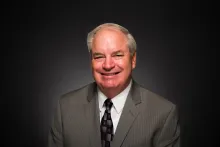
Robin Webber was born in Chicago, Illinois, in 1951, but has lived most of his life in California. He has been a part of the Church of God community since 1963. He attended Ambassador College in Pasadena from 1969-1973. He majored in theology and history.
Mr. Webber's interest remains in the study of history, socio-economics and literature. Over the years, he has offered his services to museums as a docent to share his enthusiasm and passions regarding these areas of expertise.
When time permits, he loves to go mountain biking on nearby ranch land and meet his wife as she hikes toward him.
