
Robin S Webber
This transcript was generated by AI and may contain errors. It is provided to assist those who may not be able to listen to the message.
Good to be with you once again. This is the second coming during the feast for me to speak to you. I have to warn you, it will not be the last coming. But anyway, Susie and I are just delighted to be here. We are bursting out with joy and learning, and it's just been wonderful. Our second year to be here in a row. We'd like to make it a third, but we're not going to be able to push it. A lot can happen in a year, is what everybody keeps on telling us. So anyway, we'll see what happens. I want to mention that if you're keeping track, what I told you the other day, that every day of the feast represents 143.6 years. Every hour is six years. So, just a rough estimate right now, you are all about 360 years into the Feast of Tabernacles time schedule. And I've got to admit, you're a pretty good-looking crowd for being that old.
And if you haven't really gotten into it yet with the feast fever and the flavor, just recognize you've got about another five, six hundred years to go. When Susie and I used to take out young people from L.A. and we breathed in a lot of smog in Los Angeles, unfortunately. This is about 30 years ago. We take out about 30 teenagers out into the great interior of the U.S. We'd visit Grand Canyon and Zion and Yellowstone, and we'd go out for a couple of weeks. It was always interesting. I always used to say it would take about three days to get the smog out of their ears. And that's kind of just like the Feast of Tabernacles as well. Sometimes it just takes some of us more time to settle because of the world that we're coming out of. So if I see some steam beginning to go out of your ears, I'll just see that smog, and you're trying to get into the festival flavor. Okay? That's important. But I hope each and every one of you are really having, experiencing a wonderful feast. And again, I can't say enough for what Mr. and Mrs. Miller and their entire staff are doing for us, and it's just wonderful.
After the American Civil War, the U.S. Federal Army made it a goal to subdue and to rein in the indigenous people of the western United States. One such tribe was the Nespierce Tribe up in the eastern tier of Oregon and Idaho and in that area. It's amazing what the years can do, and sometimes people forget. The Nespierce Tribe were one of those tribes that had actually been very friendly and helpful to Lewis and Clark as they went forward on the moon expedition of their time and their age as they crossed the United States from the Mississippi to the Pacific Ocean. They were friends. They helped. These two men in the Corps of Expedition as they went up the waters of middle America. But time goes by. People are people, and human nature sets in. After America had settled its scenario with the Civil War, the federal troops began to look upon the indigenous people to subdue them, to rein them in, and to put them on a reservation. Unfortunately, America is wonderful and as great as it is. At times, if we're going to be candid and realistic, we recognize even this blessed nation has, at times, broken its promises with people. And thus, they did this with the Nespierce Tribe, and they put them on a reservation. But after a while, Chief Joseph of the Nespierce led his people off that reservation, because everybody wants freedom. Everybody wants to fly. Nobody wants to be caged in. And so, for a time, he and his tribe, and along with another tribe, began to move around Oregon and Washington and Idaho. And they would come into contact with the federal troops, and they would battle, and they would war. Chief Joseph was known as a tactical genius. It was amazing what he was doing in 1876. But the bottom line is that, as much as he was trying to make it up to Canada, he kept on going in circles, and circles, and circles. The government troops would catch up with him. He'd battle them. He'd outfox them. He was almost the Napoleon of the Northwest. Then, finally, he knew that he had to make a run for Canada. He had to get over that border. So, he gave it his all. He gave it his entire energy after these months of going around in circles and circles. But finally, about 40 miles from the Canadian border, he stopped. He stopped. And he is quoted as saying this as he looked around, and he saw the futility. It just wasn't going to the end work. It wasn't going to happen. After winning all those many battles, he knew in his heart of hearts that the war for him at that time was lost. So, he laid down his arms. There was a reporter later on that was able to gain this quote. He said, my people, my people, we have no blankets. We have no food. Perhaps now many are even at this moment freezing to death. I want to look upon my children just as much as each and every one of us would want to. Absolutely. To see how many I can find. And then he said, hear my chiefs. I'm tired. My heart is sick. It's so very sad. From where the sun stands, I shall fight no more, forever.
What might we today in this tabernacle learn from Chief Joseph's words?
Humanity like Chief Joseph has tended to go around in circles for millennia, taking every one with them. In nearly 6,000 years, it's been thought that there were only 370 years out of those 6,000 years of recorded history that have been determined somewhat peaceful. We therefore find, and this is what I would offer to you on this morn, is simply this, that war and conflict and death that follows is not marginal.
But central to our collective experience. To we that have initially, and were given the blessing of being made in the image of God. When you think about it and you put it all together, I'm kind of a simple person, simple math. Math was not my edge in academia. I tend to move towards the arts, not the quantitatos.
It's simply this. Humanity, at its best, has traveled 7 feet. One foot backwards and 6 feet down. Add it up. As we draw on the past today with this intro, and as we will be touching on the future, please understand, audience and friends and dear brethren, that we are going to be dealing with our present and how we deal with conflict. How we deal with the wars that are even amongst the people of God at times, and what God has called us to be on his behalf.
So, a question that I have then is simply this. What can we gain from this quote from an Indian chief past history, but also look to simply ask you a personal question as we start out? Because the best form of communication is two ways, not me just up here, but I'm going to try to draw some answers that are going around in your mind right now, so that we don't waste your time. So, here we go. Are we personally winning the battles that are in our life today?
And we're going to get personal in the course of this message. See, the best kind of preaching and teaching is when you begin to meddle. And I don't want to just be up here wasting your time. I don't want to just simply meddle and tickle your brain. Anybody can do that. But a servant of God, hopefully in humility, will meddle with your heart.
Will meddle with your heart. Because where the heart goes, the body will actually, ultimately, travel. The mind will go to the grave. The heart goes up to God. And as Christians, we do not simply want to be mind Christians. We want to be heart Christians. Because the heart is the engine of everything that we do. God doesn't want what we know. He wants what we do in reverence and worship to Him because of what He's given us to know. Even the aspect of being here during the Feast of Tabernacles.
It's not just a matter about showing up, but growing up in the stature of our Lord and Savior, Jesus Christ, who is, after all, the Prince of Peace. So we're going to kind of talk about this. Allow me to give you the title of my message as we begin to enter to the message itself.
The title of my message is simply this. They shall learn war no more. How do we do that? Sometimes God just has to grab ahold of us, settle us down, and He says in Psalms 46 and verse 10, Stand still. Just stand still. Isn't it the hardest thing to do in the 21st century? With everything that is coming at us, coming our way, taking our time, robbing our time, and we allow this world to rob God's goodness and still His Spirit in us. And thank God Almighty that He says, Time out, halt, you are going to give me seven days plus one.
To really get it. And like a brahm, one of the great pilgrims of the Bible, to get up, to get out, to get going, to pull the stake, to move around. John, they're kind of being pilgrims during this. They're moving around even as you speak up here sometimes, changing seats. So we're practicing pilgrimhood here. Pilgrims don't stay settled.
Pilgrims are on the move. Just like our gentleman friend yesterday that was actually out of a pilgrim's progress. I loved the analogy. And the pilgrims said, there's a pilgrim in pilgrims that built, wrote, and he said, and he kept on going up to people. He says, Where are you going? Where are you going? And he said, I'm going to the celestial kingdom.
Do you want to follow me? How many of you out here want to follow Jesus Christ into the celestial kingdom? Can I see His show of hands? Are you sure? Let's raise them high. Let's get up there. Stretch those fingers. Just wanted to make sure I'm talking to the right crowd. You know, there's something about speaking. You know, it's not so bad, you know, that if they are moving out and leaving the building, but it's when the audience starts moving towards you that you get worried that they might not like you.
I'm Robin. I'm your friend. And what I speak to you today is it's coming right back at me because we all need this. So we're going to gain some perspective to stop on our tracks, straighten our course. Remember, out of Isaiah, it says, The way will be straight. God's not complicated. He gives us cause and He gives us effect. He gives us the tree of life and He gives us the tree of good and evil. So you've got to make sure and know where you're going to connect the dots during these six or seven days that are yet ahead of us.
So the purpose of today's message is to direct our attention to the world tomorrow and show you a time when all of humanity will lay down its arms and will fight no more forever under the direction of Jesus Christ, our Lord, our champion. We're going to be dealing with a lot of cause and effect here in the course of the minutes ahead.
Then we're going to direct our attention to where God wants it today because we're in the moment. It's going to be about you and about me, whether we're at war or whether we're at peace. Whether we're a soldier of Jesus Christ to allow His victory to reign in us, or we're fighting battles that He's saying, why are you still doing this when I have called you to be an agent of peace?
And to recognize then that rather than to wait on the sun as a marker like Chief Joseph, which was a wonderful start, that when we say, with the Son of God in place, not a solar body, not that sun, but the Son of God, when He's come into our lives, that we say that I shall fight no more forever. That's the goal. Shall we proceed? And let us say, let's talk.
I'd like to invite you to Isaiah 2 to begin with. Let's turn to Scripture. That's why we're here in Isaiah 2.
And picking up the thought in verse 1.
Let's notice the cause and effect. For every cause there is an effect. The word that Isaiah, the son of Amos, saw concerning Judah and Jerusalem, the people of God. Now it shall come to pass, and the latter days, that the mountain of the Lord's house shall be established on the top of the mountains, and shall be exalted above the hills, and all the nations shall flow to it. That's not happening today. All the nations are not flowing to Jerusalem. If there's any flow, it's to Tel Aviv. It's only in the last four or five years that even the United States had the daring to put its embassy in Jerusalem.
And so this is not talking about now. It's talking about a time in the future when all the nations are going to flow to it. And many people shall come and say, come and let us go up to the mountain of the Lord, to the house of the God of Jacob. And He will teach us His ways, and we shall walk in His path. So there's three things that happen here. This is very simple. One, two, three. Number one, we are to go up to the mountain of the Lord. And Rachel, if you're out there today, I met you last night with Mr. Miller. You've come up along with this flock to the mountain of the Lord. And it says that he, number two, then, first assignment is to appear, to come in faith and in confidence and to receive. And then number two is we will receive. It says, and he will teach us his ways. And then, number three, uh-oh, now there's a responsibility once he's invited us. Number two, we've come and he has taught us his ways. And number three, now, this is going to be the biggest thing, not just for the next four or five days remaining in this festival period, but as we go back out into the world and it says, and we shall walk in His ways.
The proof will be in the pudding. You see, during a festival period, there are three things that we, as servants of God, try to deal with the audience and ourselves in front. Number one, we come to gain information. Very important. Information, the words of God in print before us, incredibly important. Number two, hopefully by God's grace, that we can motivate you. Number two, to inspire you, to lift you up, to recognize that there is something that is out there. But number three, information and inspiration, which might spark up like a flame for a moment, is of no value. No value at all unless there is, number three, transformation. Growth, movement, dynamism, even through humility before our God, that we are a growing, living, breathing, new creation. That God has not wasted His sacrifice of His Son on us, but that we have grabbed a hold of the things that they want us to learn about as we were grabbed a hold by them in the beginning. Notice what it then says here. Once we've gone up, once we've learned that then we're going to walk in His ways, then notice this incredibly good news. For out of Zion shall go forth the law, and the word of the Lord from Jerusalem, and he shall judge between the nations, and yes, rebuke people. Now, and they shall beat their swords into plowshares, and their spears into pruning hooks. Nation shall not lift up sword against nation, and neither shall they learn war anymore.
I want you to think about that a moment, brethren. That is startling.
There is a time coming when swords are going to be turned into plowshares. Swords that were used to take life are going to be turned into plowshares. Rather than to plow dirt, rather than swords to kill people, they will be used as plows to help people. Spears into pruning hooks, spears that you jab. Rather than jabbing them into others that are made in the image of God, they will be used as farm tools to pick fruit. Something peaceful, something wonderful. Think about that for a moment. Tolstoy, Russian novelist, put it this way in his classic novel of War and Peace. Drain the blood from men's veins and put water in, and there will be no more war. Drain the blood. It's in the blood that human nature in humanity flows down, and we have war. Drain the blood from men's veins and put water in, and there will be no more war. So we look at this to recognize that we've got to deal with the very essence, not just simply on the outside, but on the inside. That's why I passed out, if you have this now, if you want to take a look at this for a moment. This is a picture, and the picture is worth a thousand words. This is the statue that is in front of the United Nations. It's a statue showing a man, notice this, bending that sword into a... just take a really good look into a plowshare. And he's going to hammer on it. He's taking an instrument, and all instruments, whether it be swords or whether it be a computer, can either be a tool or a weapon, depending upon how you use it. What do we note about this statue? What do we sense by the... just looking at it? Does it just happen? Or do we see every fiber, every muscle in that torso, in those legs, in those arms, lifting up that hammer with all of his might about to come down? Peace does not just happen. It takes every bit of all we have. We've got to be, as we say today, all in. God wants us to do what we can do. And what he can't... and what we cannot do, of and by ourselves, he will do what only he can do. But it's being co-workers. I wanted to give this to you so that what I'm saying to you today does just not rub off the top of your head and go out the door. I hope you'll take this home. I hope you'll put it down. And sometimes, when things aren't working out, to recognize God is ready to go back to work with you again and again. We'll come back to that a little bit later. The bottom line is that Jesus said in the Beatitudes, blessed are the peacemakers. He didn't say blessed are the peace-hopers. And so there's something to do. Let's think about civilization for a moment. The start that God gave humanity in paradise, that's what Eden means, to have a relationship with God Almighty, to walk, to talk with Him. Just imagine to be intimate with God in paradise here on earth, to have that intimacy, to have that relationship. Of course, we know what Adam and Eve did, but it didn't take long after Adam and Eve that we had the first warfare on earth, not so much against God, but against one another. And that was what we find in Genesis 4 without turning there. In Genesis 4, it was the first battle between two parties, Cain and Abel. And what happened there was Cain's self-interest was threatened. He could not control his own emotions and or aggression.
And just like the terrorists that we have experienced over the last 20 to 50 years, going back to other countries, not just the Middle East, what is the definition of a terrorist? A terrorist is one who is willing to give your all for their cause, and you are the collateral damage. You are the target. Not their life, your life. And they take, he was the first terrorist. In Judah 11, just jot that down, it talks about the way of Cain in the book of Jude, Judah 11, the way of Cain and Balaam, etc.
There was a way, and the way of Cain was the way of murder. It was the way of killing another human being. War broke out. Now, you say, but I'm not like Cain. Stay with me a second. Cain knew about God. Cain knew about God.
Cain actually had brought to his altar an offering. What was Cain doing that sometimes what we call, quote-unquote, good religious people do? They go through the motions. They show up. They think they're doing God a favor by being there, and they offer what they will rather than what God truly desires. That just doesn't cut it. Other than, either with Cain or later on, Israel and Judah, when God would say, I hate your face, you show up.
You give me an offering. You seal the envelope. You put it in the basket. You go through the motions. You know you ought to be here, but your mind's out there, and you go home. You didn't even collect the information. You didn't receive the inspiration, and transformation is not something that's on your mind. You can go now until next time. Remember what Mr. Miller mentioned. Make this feast count. Live it out now as if it is the last time you're going to be able to keep the Feast of Tabernacles and come into alignment with the Prince of Peace and not be an agent of war, but be a minister of love, a messenger of love, a messenger of reconciliation.
That is going to take every fiber out of you. And then when you have no more to give, and it doesn't look like it's going anywhere, to recognize that it is not by our might, it is not by our power, but it is by God's Spirit. And as Paul says in Philippians 4 and verse 13, I can do all things through Jesus Christ in me.
We'll talk about that a little bit more. Since the beginning of humanity, humanity has walked the walk of Cain. There is a way which seems right unto a man, but the end thereof is the way of death. Let's think about, since the time of Cain, what has happened. There have been wars and resultant upheavals that have served to retard the progress that God would want his children to have.
One of the reasons that technological progress did not really blossom, I say technological progress, except over the last 200 years, is because wars, killing off entire civilizations, killing off empires, bringing havoc to cities, destroying resources. Remember this, please. The most important resource that has been knocked off is the human resource.
Let me just draw a couple of analogies from history. In the 13th century, we have what is called the very famous, in that sense, Mongolian horde that swept from the east to the west, swept from the Pacific Ocean all the way to the Danube River. They made it to the past. Buddha was across the river, and the only thing that stopped the Mongol horde from going into Europe was the death of the Khan, the ruler.
The leadership all had to go back to Mongolia. That's the only thing that, at that time, saved Europe. In that time, it has been estimated that somewhere between 25 and 50 million people died at the hands of the Mongols. Imagine how that retired at civilization throughout Asia. It's actually thought that there were probably 35 to 40 million Chinese alone that died under the Mongols.
As the Mongols swept through the lower part of Asia and came into the world of Islam, they came up against Baghdad, the Great Cradle, one of the civilization points of the Islamic world. They decimated it, and they put 300,000 skulls on top of one another in one big pile to make a statement.
Later on, they would go through Kiev, which is in the headlines today, which is one of the two great cities of Europe back in the 13th century. The other one, not London, not Rome, not Paris, those were backwaters to a degree, was Cordova in Spain, which was Islamic, and Kiev, which was Orthodox in Ukraine today.
They decimated that city of a thousand churches and brought it down to rubble. That's why the energy of the Slavic people then, at that time, went up to Russia, because there was nothing left of Ukraine. But if we do not want to pick on Asia alone, if we think in the first century BC, many of us have often heard of Julius Caesar in writing that all of Gaul is divided into three parts. We learned that sometimes in high school.
But when Julius Caesar, who is trying to make a name for himself over other men's bodies, he committed genocide on the Gallic population of what is today France and Belgium. One million Gauls died under Julius Caesar, that he might have a triumph. That's the history that we look at. In near history, we think of the war in the beginning of the 20th century, 1914 to 1918. We have World War I. The war that was supposed to end all wars, how that worked out, did not work out.
Then we had the travesty, the sadness of World War II, in which somewhere up to 60 to 70 million people died. Some of you may be out there that were children at that time, or young adults. That's still in our living memory, especially with many of us that have our fathers that were veterans in World War II. This is the world that we do. Now, with that sadness, allow me to make... Can I switch gears a moment? That's when you're supposed to nod. Happy news? This is good news, because the Gospel is about good news, isn't it?
Now, let's consider a world without war. When they learn war, no more. Think about what it's going to be like when there's no Pentagon. There's going to be no West Point. There's going to be no Annapolis. There's going to be no more B-1 bombers. There's going to be no more aircraft carriers. There's going to be no more nuclear weapons.
There's going to be no more military cemeteries. My wife and I had the honor and privilege to be on that ground in Virginia just in April, and to be able to walk through Arlington Cemetery and see all of those graves. Growing up in San Diego, California, you kind of know about the military, because there was so much of it, and I grew up there. Susan was asking me yesterday, saying, Are you all right? She doesn't ask me that every minute. She said, Are you all right? You seem kind of like Terry.
It just came to me because San Diego Harbor is formed by what is called Point Loma. Point Loma is a large point that goes out. It's very dominant. At the top of Point Loma, I've been going through that area since I was six years old.
The ocean on both sides is a very narrow point, and all you see are the white markers. It's a national cemetery. All you do is see the white markers, the crosses, the stars of David, and markers without it. But it just goes, and it goes, and it goes, and it goes. Then you take in thoughts sometimes when we have public ceremonies about Normandy, Omaha, the beaches that were on France, that the Allies went up. All of them went up, but not all of them came down.
Sometimes the magnitude of that, when you think about it, it should shock us and grip us to our very toes. Don't we all want a better world than that? Better than that. We're going to live in a world where, when you mention the word mushroom, you're not going to think about a big cloud like a lot of us that are baby boomers when we grow up.
Remember the nuclear drills that we used to have as kids in 5th or 6th grade? Okay, now, if there's a nuclear blast, just make sure you get underneath your desk. See what you missed? Down here? See what you missed?
Listen, when you live 9 miles outside of San Diego Harbor during the Cuban Missile Crisis, that just isn't really going to do it. But even then, we were coming into this way of life, we were listening to this man with his big voice coming over the radio, and he told us that there was going to be a better world to come, that the world was not going to wind up in oblivion, and that there was going to be a strong arm that the Son of God was going to come back to this earth. For we that lived during the Cuban Missile Crisis, three days of wondering what was next.
Was it going to happen? Was the Soviet Union going to break the blockade around? Remember, how many of you remember that? Or am I the only one? Oh, boy, I'm getting older. This is not looking good. You're still alive. You've just lost your memory. Just joking.
But that confidence and that faith, given it to the heart of a young lad of 11 and 12 at that time, and that's what we have today. We recognize with the craziness, even what's happening over in the Ukraine and Russia, in this modern-day Verdun battlefield. We might as well be back in World War I in Belgium, where there's no movement, but men die. Hundreds of thousands of Slavic cousins, the Ukrainians and the Russians, have killed one another while we're here in the land of the free and the home of the brave. War is not marginal to the human experience. It's central. And there's a day when that's going to stop. There's going to be a day when there's going to be no more post-traumatic stress disorder. See, with post-traumatic stress disorder, it's not what's wrong with you. It's what happened to you that God never intended His creation to go through.
There's going to be no more PTSD. There's going to be no more, what did your daddy do in the war? What branch of the service was he in?
We're going to have a total redistribution of how time and activity and funding is spent. Join me, if you would, in Isaiah 32.
Let's let God speak here. Isaiah 32. And picking up the thought, if we could, in verse 15.
Peace and the effect of righteousness, quietness, and assurance forever. And my people will dwell in a peaceful habitation, in secure buildings, and in quiet, resting places. This is the world that God promises to bring to us. What a wonderful world it is going to be. In Isaiah 11, join me if you would there for a moment, please, Isaiah 11. Isaiah 11. And pick up the thought in verse 6, please.
The wolf also shall dwell with the lamb. The leopard shall lie down with a young goat. The calf and the young lion and the fatling together. And the little child shall lead them. The cow, the bear, shall graze. Their young one shall lie down together, and the lion shall eat straw like the ox. The nursing child shall play by the cobra's hole. And the weaned child shall put his hand in the viper's den. Now notice verse 9. Build up. Then they shall not hurt nor destroy in all my holy mountain. For the earth shall be full of the knowledge of the Lord as the waters cover the sea. Cause and effect. Cause and effect. For 60 to 70 years now, we have been marginalizing God in a nation that says in God we trust.
The motto is still on the coin. But we are squeezing every day God out of our education system. Starting 60 years ago, with rules by a government, by the supported times of people that have received the blessings of God through Israel, through Manasseh and Ephraim. Isaiah 1 says, Isaiah 1 says, stay with me, it says that the ox knows its owner, but my people do not know me. Remember years ago in Pasadena, Mr. Armstrong was talking, he'd been over in India, and you know, over in India, being Hindu, they have all the cattle running, going through all these great cities of India. He says, for some reason, as many as there are, and all those, they don't look at the green lights or anything, but they just kind of, they find their master at nighttime. They all go home. They have like a directional. They have a natural GPS inside of them. He was amazed at that, and I just share this with you because it's amazing what Isaiah says, the ox knows its owner, but my people do not know me. They're lost. They're not coming back. Amazing. And to recognize that he goes on further than Isaiah 1, stay with me, please. He makes this indictment through the Word of God. It is not the head that is sick, but the entire body. The entire body. So often we want to blame our leaders, but those leaders are put there because of the people that put them there. And if that leader did not exist, the people would create that leader because of what they want to do today, as we go further and further from God's way. I'm just saying this. This is in my notes. Hopefully this is part of the prayer, the blessing. We need to recognize that today we've got to gird up. We've got to be ready. Young people, you need to be ready down here. I'm not saying this because this is your time in life. This is your time to bloom. You want this life like each and every one of us had. And you can have that in Christ. You can have that in this way of life. That even as challenging as it is, that there is a blessing. There is a blessing of commitment to God and commitment to man and woman and marriage and commitment to love your neighbor as yourself. But to recognize that all of us, we are in the world. It's changed. It's changed. Now, it's always been since Eden, but we've had a new gear, especially over this last decade. And more than ever, you and I need to recognize that we do not fight against flesh and blood, but we fight against high places and dominions that are opposite God, that want to tear His image down, want to make Him extinct in 21st century society.
This is not going to go away, brethren. We've talked about this time since I was a kittler. It's here. It's developing. That's why we need this kingdom huddle during the Feast of Tabernacles. Not to move out of that world in fear, but with respect of what we're facing, but in faith that at the end, God is going to come back to this world and rescue it from itself. Now, we've talked about all of this, but now allow me to return focus. What about us? What about we that are the saints of God? Join me, if you would, in Romans 8, 18. In Romans 8 and verse 18, it says this, In futility, not willingly, but because of Him who subjected it in hope, because the creation itself also will be delivered from the bondage of corruption into the glorious liberty of the children of God. For we know that the whole creation groans and labors with birth pangs together until now. And not only that, but we also who have the first fruits of the Spirit, even ourselves, groan within ourselves eagerly waiting for the adoption of the redemption of our body. As we say, there's a whole lot of groaning going on here in these verses, right? But I'm going to share something with you, and why I'm giving this message to myself, and I hope you're listening in, is that there is a difference between groaning and growing. You can groan all you want.
God, our Father, and His Christ, our Lord, the ruler of our hearts, the King, the Prince of Peace, wants us to groan. I have a question with that in all of this. We can talk about Jerusalem, we can talk about Kiev, we can talk about Baghdad, we can talk about Cordova, and all of that stuff. Bottom line, let's get personal. There's always the most important transmitter that goes out in any message is simply this, and you're out there listening.
WIIFM. Have you ever tuned into that radio station? WIIFM. What's in it for me? So if you think I've left you out, get ready. Buckle up. How about us? What about our mountain? What about our personal kingdom today? Our kingdom? Us. Me. Just bring it down to me. Robin, you fill in your name. What about our mountain? What about our personal kingdom? What about our sphere of influence, which is supposed to be yielded to Jesus Christ? If we ourselves are not at peace, but rather we are on a war footing, why is that? Are we dealing? I ask you a question using metaphors. Are we dealing with swords? Or are we dealing with plowshares?
Are we dealing with spears? Are we dealing with pruning hooks in our relationships? What have we been slashing at? Poking at? Maybe simply ignoring to where we're not at peace. And those that are around us are not at peace. Perhaps family? Spouse to spouse? Mate to mate? We can come into a church hall, and we can be dressed up, and we can have our best church smile on, and we can have our best step, like everything's going okay.
I got that. You do, too. But as Mr. Miller brought out, there is a very famous pastor in Boston back at the end of the 19th century. His name was Phillips Brooks. He didn't face a Feast of Tabernacles crowd, but he faced an up-up-up-up Boston crowd on a Sunday morning. And he began to preach, and he began to talk, but he was very animated that day. And he looked at all of his audience out there, and he said, You that are the Brahmins of Boston, You that sit in those pews named after You, You that come every Sunday in Your Sunday Best, You're in Your Feast Best today, Your Sunday Best, You that if something might happen in the future, Oh, that You would want to have been there, but You do not.
You hold your grudges. You hold your hurts to yourself. In that sense, you make war against one another, and sometimes war is not what you're doing, but holding out and doing nothing. He said, The time is short. Just like Mr. Miller's mentioning, the time is short. You can guess what the title of that message was. The time is short. Today, it is still short amongst us. After that message, people gathered together. People were in the midst of the pews.
People were hugging one another for the first time. That had been at odds with one another. That had had adversity against one another. That spit out the names of the other person, like with the pat. I hope I didn't get anybody. Brethren, this is our calling to be holy as God is holy. Not to be at war, but to be at peace with one another.
Our adult children. Our adult children. Perhaps our employer. Perhaps our living parent. Perhaps a sibling that you have not spoken to for years, because somehow you are having your own World War Five. You've backed away. Your actions reflect where you're at. When we are at war, whether as a kingdom, a nation, or as a person, or as a family, maybe with another family, think of the Hatfields and the McCoys, there is no victimless crime.
Animosity, struggle against one another. Hate-filled thoughts. I'm done with them. That kind of feeling always brings collateral damage. Some of us that are older, our children are watching us. Our grandchildren are watching us as to how we handle our relationships.
Are we at war with people? Or are we agents of peace? Try to make peace. Try to do what we can. In James 4 and verse 1, lest you think I'm taking this not out of the Bible, but it is in the Bible, James 4 tells us this.
James. Good old James. James the Just. James the half-brother of Jesus Christ says this. Where do wars and fights come from among you? Do they not come from your desires for pleasure that war in your memories? You lost and do not have. You murder and covet and cannot obtain. You fight and war. You do not have because you do not ask.
I want to ask you again for a moment. How committed are you during this Feast of Tabernacles to allow God to interrupt your life? Campfires are nice. John's telling us to fish your big up at his pond. You brought in a few killer whales from SeaWorld, so be careful what you catch. You can have a wonderful hayride. And all of these are the byproducts, because when you seek God's righteousness first, it says that then these things will be added to you. These are the add-ons for you honoring God and being here. I have a question for you. On this day, and I realize this may not affect everybody, but it may have affected you in the past, and you're a survivor, and you've come out on the other side by God's grace, and or just get ready in this lifetime you may go to war with somebody. You may have at odds with somebody. Might be a mate. Might be an adult child. Might be children that grew up in this way of life, and for the moment they've chosen another way. What kind of a road are we building between them and us? I speak personally. Susan and I, we have three wonderful, wonderful daughters. Laura Beth, Julianne, and Amy Jo. They are the greatest joy of our life, and they're great, all-American girls. Couldn't have better. But I want, and their mother does, we want them all in for the kingdom of God one day. They grew up in this way of life. They had every blessing and opportunity that some children in the church have not had. But for the moment, they've elected to go another way. We want them to be in this way of life with all of our heart. And if they're precious to us, all the more precious to God. We've got to make sure that we do not get in the way, that we do not become adverse, that we are agents of peace and love, that we will always be there like that father I talked about, and that mother that I talked about the other night, that we will be always on the front porch with the light on, waiting for them to come home to God. Many of you have that same situation. Some of you have mates that way. Some of you have children or grandchildren that way. But if we're at war, if I'm at war with my wife, or if she's at war with me, so we have double war going. If we're at war, some of us can act... Can we talk? Perhaps we're battling God today. We're wrestling with God. And God likes a good wrestle. Just ask Jacob. God likes a good wrestle. We can wrestle with God. But bring it down a level. Would you please do yourself? Bring it down a level. Have some conflict, but don't go to war. Have questions. They will not come all at once, but don't go to war. Don't go to war against the one that gave his son for us.
Be a uniter. Don't be a divider. Our history in the Church of God, of which I've at times been in the middle of it, a lot of it, over the last thirty years, we recognize today that we need to have a focus of peace. We need to have a focus of unity. We need to recognize who the real enemy is. The enemy are not all the others that are in this way of life that may not be in the United Church of God. We're not at war. We are to be agents of peace. We are to offer the open hand. We are to offer the hug. We need to be that. What signal of peace are we sending out to the world? One thing I can only mention, being a child of the Church, having been in Pasadena, having been in the boardroom of the United Church of God, is simply this. Live today. Live today and step into tomorrow. God has allowed to happen what has happened for his purposes. Are you with me? But he doesn't want us to stay back there in wonderment. He wants us to stand in awe today of his grace, of the majesty of his son, of the beauty of his law, and make this a new day, and move into the future rather than being war prisoners of the past. Not only to come out of her, my people, but to come out of the past. Live for today.
One thing that we go back to is to think about Tolstoy. Tolstoy said that it's in the blood. It's in the blood of man. But I have a question for you. How did that all change when you were baptized? This is called the interactive part of church. I'm going to ask a question. How did that change when you were baptized? If Tolstoy, who is an incredible writer, a very religious man as well, incredible stories, he says it's in the blood. Therefore, it's going to go on and on. If you don't want that, put the water in. How does that change with we that have been called to the new creation? What happened to that baptism? I've got to make a comment. You've got to answer this, or we're going to be here until the fishing trip tomorrow. Go ahead. Somebody help me. The Spirit of God? I'm like that teacher. You always just have to have the right answer. You're on the path. Water's good. Here we go. Let's make it simple because... Is that clock on? Did you change it? Okay. Anyway. No. What makes the difference is the blood of Jesus Christ. That is the blood. That is what we came under. And in Revelation 1 and verse 5, it says, we are washed in that blood. We are washed, and when we are washed, we become saturated. That blood not only covers, but as you were mentioning, with the Spirit of God, with the indwelling of the Father, the indwelling of the Son, Romans 8, 10 through 14. That we become that repository. We become that depot of a rival, of God the Father and Jesus Christ living in us, literally. That we are that temple of God, 1 Corinthians 3, 16 through 17. The word temple there is actually Greek for the same word that is used for the Holy of Holies. That in other words, God, by His grace, at baptism, as we accept that new blood that is from above, that was given here below, and we accept that in faith, that it becomes a part of us. That is what covers us. That is what washes us. That is what saturates us. Peter was asked by Jesus to come and walk on water. But in this day and in this age, our Father above asked us to walk forward on the blood of Jesus Christ, step by step, as a living sacrifice, following His image, following His model. That's the call. That's the reality. And when we get into that reality, following the Prince of Peace, then we begin not only to know, but to grow. We not only deal with rules, but we allow them to come to their natural spiritual conclusion of a relationship, a relationship with God the Father and Jesus Christ. We begin to do something that was asked and mentioned in the book of Philippians. Join me if you would for a moment. In Philippians.
In Philippians 3.
Probably one of my favorite verses. We're going to wind up maybe one more verse after this. Last verse is Psalm 119. We're going to read the whole thing, so we're going to be here. No, just joking. Just keeping you awake till the end.
Are you at war today? Are you in conflict with your own Father in heaven? Might we be upset with Jesus Christ?
Are we at war with...and you fill in the blank.
The Apostle James said, we've got some problems here. Why are there wars amongst us? This is probably when I kind of go to verse. It just puts sails underneath me to know what my calling and your calling is.
You might be at odds with somebody today. You might have had a...we talked about the 30 year war, the 100 year war between the English and the French. We can talk about this war, that war, everywhere. A war war. You've seen the history of mankind. Today. Today is the day that you face that instrument in front of you. Today you make the decision, whether you use it as a sword against your brother, or by God's grace and his umph coming behind you, that you make that a tool of peace. And maybe you have to give a part of yourself away to do so. But God makes up the difference. But he's only going to do what he will do and what only he can do as you do what you do on his behalf. Notice what it says here. That I might be found in him, not having my own righteousness, which is from the law, but that which is through faith in Christ, the righteousness which is from God. By faith. That I might know him. And the power of his resurrection, the power of the new life, that which was dead, now alive, for God's handling. Sometimes we can be the walking dead because of what we hold in our heart. On this day, on this day, is the day of new beginnings for you to change that and allow God to be your in his instrument. And the fellowship of his sufferings, being conformed to his death, if by any means I may attain to the resurrection from the dead, not that I've already attained or am already perfected, but I press on which I may lay hold of that, that I may lay hold of that which Jesus Christ has also laid hold on me. If you want to jot down a note, this is a Weberism. This is a double hold. A double hold. God the Father through Jesus Christ grabbed a hold of us at a time in our life, whether 60 years ago, 50 years ago, do I hear 40, 30, whatever it was, he grabbed a hold of us and said, I want you. Now is the time. Now the kingdom has come. See, wherever Jesus Christ is, it has come. It has come. I've grabbed a hold of you. Then Paul says that we then are to grab a hold of the things that Christ has given us. So it's the double hold. Christ holds us. God holds us. And picks us up out of death into life. And then we are to grab a hold. Grab! Not fiddle your thumbs, but hold on to it like it's dear life. The Word of God. You know, we talked about the blood of Christ, and many of you were talking about the Word, or the water. The water of the Word. The water of the Word gives us life. It puts nourishment on all the rest as we go through the water of the Word. So this is what God wants us to do. Assignment. He said, well, the last guy gave us an assignment. I don't know if I'm going to show up tomorrow. Got an assignment for you, okay? Here's what I want. Do you want to change, or do you just kind of want to walk through this tabernacle, go back home to Virginia or Ohio, or do you really want to change? Tonight. Don't wait till tomorrow. In California we call that manana. Tonight, I want you, and I will too, I want you to write down your major battlefield, your major battlefield, that you have not yet walked on and dared to tackle with the help of God the Father and Jesus Christ and their Holy Spirit dwelling in us.
I'm dead serious.
That's what I would like you to do, so that you might live. Sometimes some of us have been on this pilgrimage a long time, haven't we? And just like a tire, we can get road-worn, the treads go down. We get bumped up against Satan's world. Sometimes we get bumped up against people in religion. And we say, if that's it, I don't want any more.
If you look at people, and you stick with people, you're going to be a goner, of and by itself. You're going to be a goner. People will come, people will go. Many are called, few are chosen, narrow is the way. There's a lot of nice people. There's a lot of nice people out there. But remember the week of creation? The first five days, God said it was good. On the sixth day, what did He say? Very good. But it was only on the seventh day that He put His presence into it and made it holy. There is good. There are some very good people out in this world. There are people of faith today that do not believe like us, that are standing up in the boards of education, in other situations. And I applaud them. And I leave that to God.
But you have been called to be the holy people of God. Be you holy, therefore as I am holy. As you do that, and you work on that, there's one verse, Zachariah 8.23. I told you to be one more. Join me even Zachariah. Where are we in Zachariah?
And let's turn to verse 23. Thus says the Lord of Hosts, In those days ten men from every language of the nation shall grasp the sleeve of a Jewish man. Let's say, grasp the sleeve of a member of spiritual Israel, the body of Christ, saying, Let us go up with you, for we have heard that God is with you. This is actually the triple grab. Stay with me. Number one, God grabs hold of us now and has. Then we, I'm over here, then we grab the things of God. Because we're learning now to become teachers for the wonderful world tomorrow. By God's grace, He's going to allow us to teach and train under that great heavenly exalted High Priest, Jesus Christ. And then as He grabbed us, and as we grab being agents of peace in the wonderful world tomorrow, ten men are going to grab a hold of you. Because you have been an agent of peace.
Dear brethren, two things. Remember this. Number one, list your battle. List your challenge. Write it down and recognize we read to know that we are not alone. And from where the Son of God stands in your heart today, make this commitment. Make it to God Almighty above. I shall fight no more forever. Look forward to seeing you after services.
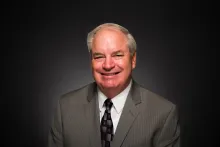
Robin Webber was born in Chicago, Illinois, in 1951, but has lived most of his life in California. He has been a part of the Church of God community since 1963. He attended Ambassador College in Pasadena from 1969-1973. He majored in theology and history.
Mr. Webber's interest remains in the study of history, socio-economics and literature. Over the years, he has offered his services to museums as a docent to share his enthusiasm and passions regarding these areas of expertise.
When time permits, he loves to go mountain biking on nearby ranch land and meet his wife as she hikes toward him.
