
Robin S Webber
This transcript was generated by AI and may contain errors. It is provided to assist those who may not be able to listen to the message.
A couple of weeks ago, I considered what I might speak on as we came off the Feast of Tabernacles. And it came to my mind that there's nothing more poignant than to speak upon that which is relevant, whether it be the biblical festivals or whether it be some of the holidays that we observe as a people in this nation, and in, for that matter, around the world. And so, to that, that I would speak to today, and that is regarding one of the great national holidays that we observe here in the United States of America.
But where it began was not here, but across the seas. And I think it's important to discuss it because we have young people here, and I realize that sometimes with young people, when my generation was growing up and you mentioned Vietnam, well, that in itself is now ancient history. And so it's important to go beyond that, always to go to the foundation, to go to the roots to understand why things are.
So especially for some of our young people, I hope that you'll stay tuned in a little bit during the course of this message and to understand certain items that I'll be bringing to the fore. It was nearly a hundred years ago. A hundred years ago, and let's break that down just for a second. It's always good to break. A hundred years ago would have meant four human generations. In other words, for us, you that are the youngest, go back to your great grandfather's time or youth. But nearly a hundred years ago, on the eleventh hour of the eleventh day of the eleventh month, what was called the Great War, the war to end all wars, came to an end.
And that was the hope. That was the trust that what had occurred in those years in Europe, and as the empires that spanned the continents, and it was taken to those continents, was so horrible, and so much, and beyond human imagination, that it might never happen again. Bring to fore what had happened, perhaps, sixty, seventy years before that, after the Battle of Fredericksburg in 1862, that Robert E.
Lee said that it is well that war is so horrible, lest we grow too fond of it. But let's go back to that eleventh hour of the eleventh day of the eleventh month. What occurred at that time? At that time, the monstrous guns that roared over the mud-drenched, barbed-wired, infested plains and mud-fields of Belgium and France were silenced. Silenced for the first time in many, many, many years. And as given picture in all quiet on the western front, it was the first time that the soldiers could even hear the songbirds, once again, after many years.
For after all, the guns, the roar, had come silent, and they had stopped. And certainly this would be the war to end all wars. At that time, Armistice Day was born. Armistice Day. Armistice Day. Today, on November 11th, we celebrate and we observe in this nation, we call it Veterans Day. Veterans Day is different than Memorial Day. Memorial Day, in the spring of the year, is to honor those that have fallen, those that have died in service to their country. Veterans Day is to, in that sense, celebrate and to honor all of those that have served their country in military service.
And I'm always very aware of that with my own father being a World War II Marine who is still on this side of the soil. And once a Marine, always a Marine, and many of you know my father, Jack Weber. It's known as Veterans Day, but here I want to go back a second, if you're with me. Words have meaning. And sometimes when we change words, we lose the meaning of where they first started.
And it did start as Armistice Day. Allow me to give you a definition of armistice, because you are going to be involved in this by the end of the message. So you need to know what armistice means. Armistice means a temporary cessation of hostilities or fighting based upon mutual consent. It's a temporary cessation. It's a temporary time out from fighting based upon mutual consent. Why did that cessation of fighting occur? And why was that mutual consent? Allow me to give you some of the figures for a moment.
They are staggering. And sometimes figures are just figures unless you personalize them with a face, with a family name. Some of you may have, in that sense, lost, which is a term that could be expanded and defined more based upon what we know. Those that may have lost grandfathers or great-grandfathers or uncles or family members during World War I, may not just jot this down. I'm not going to ask you to take notes a lot, but just jot these figures down.
During World War I, 18 million people died. 18 million. 11 million were military personnel. And seven were civilian losses. Now please understand, nobody thought it was going to come to this. Everybody thought that this was going to be a brief and gallant and glorious war. And then everything would be alright just after everybody had done a little bit of battlefield action, and that we could all go back and realign the alignments and realign the alliances. Germany would tame itself and we could go on.
But individuals and families and nations never exit a war the way that they enter. People change. Families change. Nations change. Cultures change. But through all of this, as the Allies came together, there was the greatest hope that this would be the war to end all wars. But such great hope was quickly dissipated. By the arrival it came to be known as the Second World War, in which more people died in six years than any time in human history.
And with that, perhaps, combined. And that is still in the living memory of many of us that were alive at that time. No, Mr. Helgi was there. Others were there. Others were stateside watching all of that. But allow me again to give you some statistics. Just jot these down to stay in the message. Because I don't want to lose you, because there's a purpose behind all of this. The totals of World War II have actually been upped over the years, basically based upon the openness and the freedom of information that is now coming from Eastern Europe and the former Soviet Union. It is estimated, you think about it, that between 50 and 80 million, 15, 80, because nobody will ever know, 50 or 80 million people died during World War II.
Between 1939 and 1945, the United States only entered the war, basically, at the very end of 1941 and really got involved in 1942. But 50 to 80 million people, 50 to 55 million people were civilians. 50 to 55 million civilian losses, 20 to 25 million losses of the military, 5 million people died in prisoner camps. I live in the Inland Empire, some of you do, too. Inland Empire is Riverside and San Bernardino County, combined. That means that's how many people have you ever been, east of here, that's how many people died just in prison camps.
The former Soviet Union that many of our younger people now know as Russia is surrounded by different other republics, but the former Soviet Union actually lost, are you ready, 26 million people. When that happens, that affects the way that you look at the rest of the world, whether you ought to look at the world that way or not. 26 million died. Since then, there have been many wars, many conflicts. Some of you served in Korea, others of you served in Vietnam. Some of you have served in the Gulf wars from 1990 forward. Even as you and I sit here in the comfort of air conditioning on cushioned seats, we realize that we have our soldiers from this country fighting over in Afghanistan, fighting over in Iraq, or supervising the fighting in Iraq.
We realize that there are world heritage class cities such as Aleppo in Syria that are decimated, that were listed as world heritage sites, decimated, looked like moon craters. People are still there. People are in Mosul in Iraq right now as we speak.
World War I, that armistice day, was not the event, that was not the war that ended all wars. Here's my simple question to you as I invite you to come further into the message with me, and it's simply this, a simple question, but that which each of us must answer, why won't war simply die a death?
Why won't war simply die a death and go away? It's a very interesting Tolstoy. Russian author put it this way. In one of his characters who made an astute observation, drain the blood from men's veins and put water instead, and there will be no more war. There is something in the blood. As we move further into this message, we're also going to find that there is actually something that is in the air, and we'll go to a verse to show that that's happening. Now, the Russian novelist, even though not completely realistic, I would suggest was on to something. He understood something incredibly essential had to occur for world peace to break out.
There had to be an abrupt fundamental change regarding what lies within and drives man. And it just simply can't be done by hacking around the edges. We've found that out in this last century. You just can't hack around the edges like you would a bush or a small tree. There needs to be a transfusion of something entirely new. Now, brethren, you say, why is Mr. Weber bringing this all to you? That is why we are here today to understand that.
You might say, well, this sounds like a Feast of Trumpets message. And in that, you might be right. But this is a message for us to contemplate and consider every day, especially on the weekly Sabbath day that God gives us. From the very beginning of the early church, the early church looked at the week as, in one sense, a portion of it being that which is of man. But then with the seventh day's Sabbath coming, at the end, God's time, a time in which points to us not only resting now in 2016 and being able to remove ourselves from work and to come to church.
But it points to a grander plan, a greater plan, that when you and I understand—are you with me? When you and I understand that the Sabbath is about not doing our human works, not being about our own efforts to save ourselves, but we drop that and we give ourselves to God—also shows a time in the future when humanity is going to drop all of its bad solutions and bad answers and rest and give themselves to God. And God is going to have a solution to Tolstoy's equation. And that's why we're here today.
The title of my message is simply this. And I want you to start maybe jotting down some thoughts as we're going through this. This will be kind of interactive. This is the title of my message, The Peace Dividend of the Ultimate War to End All Wars. I'm going to repeat it again. The peace dividend of the ultimate war to end all wars. Now, as I say that, to bring us into something that is relevant, many of us that are older remembering what happened in the late 1880s— only Mr. Helgi would know that, no, just teasing Ralph—is that what happened back in the 1980s, and we remember with the dissolution of the Soviet Union, we remember the dissolution of its allied countries in Eastern Europe, here in America we talked about that there was going to be a peace dividend, that all of that which we had put forward towards the Cold War could now be exercised and used for other resources other than war. That was the hope in 1990. Not only the hope in 1918, but the hope in 1990. Oh, that now that human society could re-alter itself, we no longer had to have the war split like an apple and a half between the West and the East, America leading the West and the Soviet Union leading the East, but now everybody could just relax and kumbaya, and life was going to be better. Think of all the wars that have occurred since then. Think of all the challenges that we have right now with what is now Russia, what is now China, what is now happening in the Middle East, even as we speak here. So let's talk about that. To further understand the need for God's intervention, let's put history into context. I think that's important. We're going to kind of suck it all into one little thought here for a moment, which is going to be very important. In over 6,000 years, 6,000 years of basic human history that is recorded, I want you to think about this for a moment. There have only been 300 years, 300 years that historians, I'm not sure because none of them are that old, but they kind of figured that out. There's only been 300 years of that, 6,000 years, that was devoid of major wars. That means then, to bring it down to a common denominator to stay with me, that means 5% of human history has been devoid of major wars. That means the other 95% have experienced warfare to one degree or another. Now, why am I giving you these equations and why am I giving you these numbers? And the numbers are going to cease in a moment. That is given to you to help you to understand that war, killing, murder, is not marginal to the human experience, but it is central to the human experience. And one reason why you and I are here today is of a great hope that in the future there is going to be a war that is going to end all war. It's not something that can be reserved for just one day of the year or one festival of God's biblical festivals. It's something that you and I need to wake up to and stumble into and bang into and be refreshed and be encouraged and know that there is going to be an intervention that's going to come above. But it's not only going to be an intervention in human history. Are you with me? It's not only going to be an intervention in human history, but there is going to be an intervention in humanity as to how they think and what flows through them.
And that's going to be so important. It's going to break the cycle of human history. It's going to break the cycle of human misery. Some of you have probably lost, again, family in war. Parents, grandparents, siblings, perhaps even a son. It's interesting what Herodotus said about 2,600 years ago. He said that in peace, fathers bury their sons. War violates that order of nature. War violates that order of nature. For in war, fathers bury their sons. The big question, then, that we need to answer as we go back into the Bible and open up the Scriptures to simply this. Where did the battle begin? Let's go to the source. Let's go to the foundation. Join me, if you would, in Revelation 12. As we open up our Bibles together as a congregation, whoever you are and wherever you're sitting, let's go to Revelation 12. In Revelation 12, let's notice the source of war. In Revelation 12, verse 7, it says, and war broke out in heaven. Yes, indeed, even above us, even in the spiritual world, war has occurred. And Michael and his angels fought with the dragon and the dragon, and his angels fought, but they did not prevail, nor was a place found for them in heaven any longer. So that great dragon was cast out, that serpent of old called the devil and Satan, who deceived the entire world. And he was cast to the earth, and his angels were cast with him. So we recognize that war is not just simply the domain of what is happening here on earth, but to recognize that the big headlines, the great activity, is that which occurs beyond sometimes what we think about, because we're just looking down at earth, or we're looking around at people, rather than recognizing that the headlines, the heart lines, are actually occurring up above. This is given definition. Join me, if you would, in Isaiah 14. In the prophet of Isaiah, Isaiah 14, join me if you would, please. And let's take a look at this as it is further defined what happened up there, and why. Isaiah 14, verse 25.
No, not 14, 1412. 1412. And there's an exclamation, a statement that is made of wonderment. How you are fallen from heaven, O Lucifer, Son of the Morning. How you are cut down to the ground, you who weakened the nations. For you have said in your heart, and that is where war begins. War begins. It doesn't begin with a gun. It doesn't begin by what you hold in your hand. It begins by what you hold in your heart.
For you have said in your heart, I will ascend into heaven. I will exalt my throne above the stars of God. And I will also sit on the mount of the congregation on the farther side of the north. And I will ascend above the heights of the clouds. And I will be like the Most High. And yet you shall be brought down to Sheol, to the lowest depths of the pit.
It's very interesting when you go from verse 13 to verse 14. You notice the first part of each sentence, I, I, I, I, and I. You might say that's an eye fall. Those names down through the history could be a Hitler, could be a Stalin, could be a Genghis Khan, could be a Julius Caesar, could be an Alexander the Great.
Could even be, do I dare say, you and I, when we are not in harmony with the humility of Jesus Christ and the harmony of what God our Father wants us to be a part of. That's where it started. But now let's go into human history a second. Genesis 4. Join me if you would there for a moment. Genesis 4. And this is after Adam and Eve are, in a sense, removed from the Garden of Eden.
And we notice in Genesis 4 the story of Cain and we notice the story of Abel. And it says that in verse 2, Then she bore again this time his brother Abel. Now Abel was the keeper of the sheep, but Cain was the tiller of the ground. And in the process of time it came to pass that Cain brought an offering of the fruit of the ground to the Lord. And Abel also brought the firstborn of his flock and of their fat. And the Lord respected Abel and his offering. But he did not respect Cain and his offering.
And Cain was very angry and his countenance fell. And so the Lord said to Cain, Why are you angry and why has your countenance fallen? If you do well, will you not be accepted? And if you do not do well, sin lies at the door. And its desire is for you, but you shall rule over it. Now Cain talked with Abel, his brother, and it came to pass when they were in the field that Cain rose up against Abel, his brother, and killed him. The first war between two individuals.
And how often down through the ages have we had a brother fighting brother, cousin fighting cousin, neighbor fighting neighbor. But this was, in a sense, up close and personal. The first battle was one-sided, it was lopsided, and it often is when it comes to war. Cain's self-interest was threatened. The scary reality is that he felt justified to take life, to give someone else for his cause. And he was willing to sacrifice others other than himself.
And he did it wholeheartedly. He did it with gusto. He rose up, he killed his brother Abel. He couldn't control his aggression. And that's what happens with bullies. That's what happens with dictators. That's what happens with men whose blood flows through them, who have not yet had that taken out of them, who need something else. It's interesting, the Jewish historian Josephus indicates that Cain was the first to build a fortress city.
And it is thought that it was near Jericho, where it now stands. Cain would then be the first man to build fortifications and walls to defend himself against others. Jude 11 is interesting because...we won't turn there right now, but in Jude 11, and you won't miss it because Jude only has one chapter, it speaks of the way of Cain, the way of Cain. The way of Cain, and I'm sure there are many straws that go into that drink, as any verse is given to multiple interpretations, but the way of Cain is that of slaughter, of self-seeking, of self-interest, of building walls, building armaments rather than bridges to people.
And the scary reality, the way of Cain is that he felt justified to take another human life. This ultimately led to a state, led to a state where God looked down during the days of Noah and, in a sense, wept. And he said, what is this world coming to?
What is happening with my special creation that I made in my image and after my likeness? And God, in a sense, was even, as the Scriptures say, was, in a sense, sorry for what he had done. And he said he had to go. It had to start all over again. And thus there was that noation flood. But I want to draw your attention then to after the flood in Genesis 9.
Join me if you would there. In Genesis 9, it's very interesting for those of you that are just becoming versed in the Bible. This is called the noation covenant. There are many covenants that are mentioned in the Old Testament. But it's very interesting what is mentioned here. And the reason I'm bringing you to this, because sometimes what occurred before is defined by that which occurs after. You have to hear God's answer or God's emphasis to understand what must have happened before the flood. In Genesis 9 and verse 4 it says, But you shall not eat flesh with its life that is its blood. Surely for your life, blood, I will demand a reckoning.
From the hand of every beast I will require it. And from the hand of man, from the hand of every man's brother, I will require, notice, the life of a man. Life for life, eye for eye, tooth for tooth. Notice verse 6 now. Let's spotlight it. Pause for a moment. Whosoever sheds man's blood, by man his blood shall be shed. For in the image of God, see now we're going back to Eden. This is the extension of what God's revelation was there.
In the image of God, he made man. And as for you, then, be fruitful and multiply. Don't go to war. Don't go to battle. Live before me. Bring forth abundantly in the earth and multiply it.
This gives us an indication of why God had to eliminate that world before and begin to work through Noah and his family again after the war. After the flood, excuse me. But, just like what happened in 1918, as Tolstoy said, it must be in the blood because we come to the story of Nimrod. In Nimrod, in Genesis, it defines Nimrod.
Let's go over there just for a second to outline it in the Bible, Genesis 10. And let's pick up the thought if we could. It kind of goes through the different lines of Noah. Then we come to verse 8, And Cush begat Nimrod, and he began to notice, Be a mighty one on the earth. And he was a mighty hunter before the Lord. And therefore it is said like Nimrod, The mighty hunter before the Lord. And the beginning of his kingdom was Babel, and Erek, and Echad, and Kalnah, and the land of Shinar.
Now, it's very interesting. You just see this statement here in verse 9 that says he was a mighty hunter before the Lord. But when you go back to the root Hebrew, and you understand the sense, it was not just that, well, here's God behind him, but that's the one before the Lord leading the parade.
No, it was really speaking of an adversarial relationship. It was speaking of one of confrontation. It's sometimes been surmised, and I'll put it over here just surmised, or supposed that Nimrod was basically drawing people to him saying, Well, maybe God is going to, once again, flood the earth, and therefore perhaps we need to build a power.
We'll outthink, we'll outdo, we'll outshine God. But he started this system called Babel. And he was a warrior who founded cities that fought back and forth, and it was Nimrod that set the pattern for nearly 1800 years that followed as you go through the history of the Middle East, whether it was Babylon, Babylon to Persia, Persia to the Greco-Macedonian Empire, and that to Rome. But with all of that now, with all of that now, it's during the course of these civilizations that started with Nimrod, who took on that spirit of that which was confrontational in heaven, the spirit of Lucifer, now Satan, an adversary to God, battling God, confronting God, that basically came down to at the time of Daniel, and that which the Chaldean Babylonian Empire.
And it was during that time that God revealed the blueprint that you and I, your brother, here in Los Angeles, hold, internalize, and embrace. That, and even in calamity, even in all of that which surrounds us today, we know that God is going to intervene in human history.
But stay with me. It's not only in human history, but it's going to be in every human being that is alive at that time that God is going to intervene. And there's going to be a transfusion, a transfusion that is going to create tremendous results, because for every cause there is an effect. It's during the time of the sixth century that Daniel is inspired to offer definition to a dream by King Nebuchadnezzar that actually outlines the course of human history from Daniel's time, from Nebuchadnezzar's time, to our time today.
That basically follows the thought of the Babylonian system. Join me now in Daniel 2 and verse 40. Let's take a peek here. Daniel 2, verse 40, as he goes on to explain Nebuchadnezzar's dream. This is, to me, always one of the most exciting and dynamic verses that are actually in the Bible that kind of just give you a spot of what God is going to be doing. In Daniel 2 and verse 40, notice what it says here. And the fourth kingdom shall be as strong as iron, as much as iron breaks in peace and shatters everything.
And like iron that crushes, that kingdom will break in pieces and crush all others. Not only we, but others that study the Scriptures have come to the conclusion and the realization that this is talking basically about the Roman Empire. That Roman Empire that was extant from the early centuries of before Christ to up to 486 AD. And so often called the Roman boot. I'd like to share a thought with you, if I can, for a moment about history for a second. And draw your attention to the Romans.
We often today talk about Pax Americana. That's a Latin phrase in America's thrown in. But Pax Americana is just simply the inner... before it was Pax Britannica. And really going back to what we called Pax... PAX, not a pox on your house, but PAX, which means peace.
Pax Romana, which means the Roman peace. But the Roman peace came at such a cost. It was not with an open hand. It was not with the loving heart. It was with the heart of war, recognizing that one of the great Roman gods was Mars, the God of War. And I'd like to share with you just for a moment what they did to just one city that was in their way. To make an example of that great city of antiquity that was known as Carthage.
On the North African coast, during the Third Punic War, it took three wars for Rome and Carthage to decide who was going to be the master of antiquity. And there was a senator in Rome that got up after every speech and said simply this. It'd be like President Obama or those before President Bush. This must be destroyed. This must be destroyed. Carthage... I can't say it in Latin. I'm sorry. I don't have the gift of tongues today. Carthage must be destroyed. This is what they did in Carthage. And what they did was it defeated its arch-rival, Carthage, in 146 BC, just about 150 years before Christ.
And the way that they did this is they literally obliterated the city. Obliterated. It was like a nuclear bomb. It had a population then of about 300,000 people. Think about another 100,000 more people than are in Glendale, California today. And those 300,000 people were killed or sold into slavery. All the buildings were burned. All the records were burned. There's very little that we can gain out of the records of the Punic culture.
That's Phoenician Punic culture that is in Carthage today. It was all burned. It was all obliterated. Blasted. And then after that, for the final indignity, salt was sown into the soil so that no crops could be grown. Basically, when you discuss the Third Punic War, you discuss the devastation of Carthage, you come to understand that this was the nuclear winter of antiquity. The way that the Romans kept the peace was to brutalize completely. War. War with no prisoners that would bring everybody else into the Roman system. Daniel 4 and verse 16. Let's take a look at it here for a second. Daniel 4 and verse 16.
Speaking of Nebuchadnezzar later on, who was that first beast? Let his heart be changed from that of a man, and let him be given the heart of a beast. And let seven times pass over him.
This is where the terminology first is used. Not everything that glitters is gold, because God looks at the heart. And while Nebuchadnezzar could build palaces, he could build the ziggurat, he could build the hanging gardens, he could build the beautiful gates that went into Babylon in ceremonial parade, he was a beast, because God looks at the heart, and God looks at our heart. We can't fool him. We can't fake it. He knows exactly what is going on.
So God's observing all of this, but let's get a point here. By this time, I'm sure all of you could use some good news, and that's why we are here, to hear the good news. The promises, the prophecies, the intervention of God's strong arm from above. Let's notice Daniel 2 and verse 44. This verse basically tells it all. So exciting.
With all of this that is interpreted up to this point, then notice what is mentioned here. In Daniel 2, verse 44, in the days of these kings, the God of heaven will set up a kingdom which shall never be destroyed, and the kingdom shall not be left to other people. It shall break in pieces, this kingdom that is coming, break in pieces and consume all these other kingdoms, those that are on earth. And notice, and it shall stand forever.
What this is suggesting is that this kingdom that comes from afar is going to break the cycle of human history. It is no longer going to be a passing of the baton from bully to bully, king to king, dictator to dictator, military conglomeration to military conglomeration.
It's not going to go from Babylon to Persia to Macedon to Rome to the Byzantines to the Arabs to the Franks to the Seljuk Turks to the Ottoman Turks. And then, as we move up to history that you might be familiar with, there's going to be a break. There's going to be a just...it's over! Man is no longer going to pass on its bad habits to the next generation. Because it says that. It's not going to be left to other people. People are going to be left out of this. This is of God, and it's going to consume all things, and it shall stand forever. And in as much, verse 45, as you saw the stone that was cut out of the mountain without hands, that had broken pieces that ironed the bronze to clay, the silver and the gold, the great God has made known to the king what will come to pass after this. The dream is certain, and its interpretation is sure.
What happens here is that stone that breaks this. It's the stone that, as it says in the book of Psalms, and in Peter, was disallowed of man. The stone that breaks it is the stone that comes from heaven. It is that of Jesus Christ that is going to return to this earth. You may be here for the very first time in this congregation, and maybe you're just waking up for the first time, and you've been coming to this congregation for years.
I believe as your pastor, and I know that most of you in this room believe that the return of Jesus Christ is not just something that is encapsulated on some ceiling in some cathedral over in Europe with a bunch of watercoloring, painted by some Italian or some Spaniard. You and I believe that even as we see the challenges that are in this world right now, challenges that we've heard all during this electoral season, which is thankfully coming to an end, to recognize that on November 9th, no matter what happens here in America, no matter what happens around the world, November 9th, God Almighty, His purpose, His plan, His promises, His provisions are going to be carried out. And that's a great hope, to recognize that humanity is not moving towards disaster, but there is a design that God is going to intervene through His Son, Jesus Christ. You know, we look at this, if we can for a moment, join me if you would, in Revelation 19. In Revelation 19, just giving a little feel of what it's like when that stone comes down to earth, that stone represented of Jesus Christ, who indeed is the rock, but we get a little picture of this for a moment. And it says in chapter 19, verse 11, Now I saw heaven open, and behold a white horse, and he who sat on him was called Faithful and True, and in righteousness he judges and makes war. That almost, dear friends, that almost sounds incongruous. That here is the one that the Gospel of Peace is about, the one that Isaiah calls the Prince of Peace, but it says here that he is going to make war. His eyes were like a flame of fire, and on his head were many crowns, and he had a name written that no one knew except himself, and he was clothed with a robe, dipped in blood, and his name is called the Word of God. And after all of this occurs, and just imagine the insanity of man, and that future beast power, and those that will ally themselves to him, to think that you, and or I, can fight against God. And yet it's in the blood. It's in the blood. And notice what it says in verse 16, and it says, And he has a robe on his thigh, and the name is written, King of King and Lord of Lords. What is the powerful message for you and I to ascertain as we go through the covers, from one cover to the other cover of the Scripture? The powerful message of Scripture is simply this. Jesus Christ does his own living. He sheds, unlike Cain, unlike Nimrod, his own blood. He also does his own dying. And Scripture makes it very plain, very clear, that he leads the armies of heaven and does his own fighting. At this pivotal juncture of history that has yet to come about, it is not delegated to anybody else.
For indeed, he is the one that holds the keys of life and death. It is he that the Father has given that power and that responsibility to. And it's not going to be delegated to a St. George as it was St. George and the Dragon. It's not even going to be delegated to Michael, the great archangel, who defends the covenant people both in the Old Testament and the New Testament. It's going to be none other than Jesus Christ. And he's going to impose his perfect society on humanity. First, you might want to jot this down. Jesus Christ is going to impose God's society on this earth. Number one, by overwhelming force. Number two, by education. And number three, by a marvelous transfusion of life's basic substance, a la Tolstoy. That blood that you and I have and our ancestors had for 6,000 years is going to be changed and motivated by something else. You know, when you think about it, the great story of the Bible, the story of the Bible, it's a story about life, it's a story about blood. It's the story of spilled blood of man for naught, whether it be Cain and Abel, whether it be the people of Nimrod's time, whether it be all of those that have been pillaged around this world for 6,000 years. But it's also about the spilled blood of Jesus Christ for a new society, ageless in scope, peaceful in nature. And that's why we're here. Join me if you would in Isaiah 2. Let's consider the peace dividend, the peace dividend that is going to come about when Jesus Christ brings the kingdom of God to this earth. In Isaiah 2, and picking up the thought if we could, in verse 2. Isaiah 2 and verse 2. Now it shall come to pass in the latter days, that the mountain of the Lord's house shall be established from the top of the mountains, and shall be exalted above the hills, and all nations shall flow to it. That's not happening today. Many nations, many of the nations that are in the United Nations, boycott the thought of Jerusalem being the undivided capital of Israel. Most nations do not have their embassy in Jerusalem. They have it in Tel Aviv. But there's going to be a day when all the people are going to flow up to Jerusalem. And many people shall come and say, Come, and let us go up to the mountain of the Lord, to the house of the God of Jacob. And He will teach us His ways. And notice, And we will walk in His path, for out of Zion shall go forth the law, and the word of the Lord from Jerusalem. And notice, verse 4, And he shall judge between the nations, and rebuke many people. And they shall beat their swords into plowshares, and their spears into pruning hooks. And they shall beat their swords into pruning hooks. Nations shall not lift up sword against nation, neither shall they learn war anymore.
I think many of us are familiar with that very famous statue that's in front of the United Nations, where you see the man. This is the PowerPoint. I'm not going to flex my muscles here. But you see the man, he's like this, and he's bending the sword and making it into a plowshare. I know I'm a bad symbol, and so I think you've got the picture. Maybe too much information up here. But he's bending it. And the point is this, that as he's bending that sword into plowshare, you see every fiber, every muscle, every part of tissue under strain to do that. See, God is going to do His part, but then He's going to expect those that are alive to do their part. And that's why God says, blessed are the peacemakers. We just don't sit down and let God do all of it. You and I, even today, and we're going to talk about that as we begin to conclude, we also have a part in this. Join me, if you would, for a moment in Isaiah 11. In Isaiah 11 and verse 6, let's take a look here for a moment. It talks about how the wolf was going to lie down with the lamb, the calf, the young lion, the cow and the bear, verse 7. The lion shall eat straw like the ox. I don't think they've taught the lion to do that at the San Diego Zoo yet. And even talking about a nursing child is going to be around the whole of a cobra. But now, let's center on verse 9. And they shall not hurt nor destroy in all of my holy mountain, for the earth shall be full of the knowledge of the Lord as the waters cover the sea. There shall be no more hurt. There will no longer be Germans in one ditch during World War I, fighting their cousins that are over in America, German Americans, in another ditch, dead. There will no longer be the boy from Alabama in one ditch, fighting the Yankee from Maine in another ditch. There will be no more harm. There will be no more war. There will be no more death.
But there's a reason for every cause there is an effect, because notice what it says here. And it says, for the earth shall be full of the knowledge of the Lord as the waters cover the sea. I think about this verse every time. I don't know if any of you have had the opportunity to go to Point Loma, Fort Rosecrans, National Cemetery. How many have been there before, going up to the old lighthouse? Well, you now know what you have to do this year. It's kind of where I grew up. But as you go out to the old Spanish lighthouse, you go through Fort Rosecrans, which is a green carpet over the point. And there are thousands and thousands and thousands of gravestones, white gravestones, with crosses on them, with stars of David on them. Then you go to the other side of the road and thousands and thousands and thousands of these white tombs over this carpet of green. And I always think about it, though, because those men, so many of them, died for their country, thinking they were doing the right thing. And yet, surrounded is that water. You see San Diego Harbor on one side, you see the Pacific Ocean on the other side. And it says that as the waters cover the sea, so, so the Word of God is going to be spread abroad on this earth. And there's going to be a tremendous transfusion. That water of God is going to swallow up those graves eventually by the power of God Almighty. And people are no longer going to fight. There's going to be a piece of it. And I'd like to share that with you for a second. I've got a few thoughts down here as my eye spots it. There's going to be a piece of it. Just think about it for a moment. When the Word of God spreads around this world like the waters of the sea, imagine. It's very interesting, during the feast site, many of you were there at the special education seminar by Mr. Gary Petty, he said, the most powerful word that is used in advertising is imagine. Imagine. Frank, remember that. No, he already knows that. Imagine. Imagine yourself there. Imagine yourself being a part of the team under Jesus Christ that is going to have an opportunity to serve Him and to teach others. We that have come out of a world surrounded by war, imagine a world without war. No West Point. No Pentagon. No Annapolis. No B1s. No B2s. No stealth bombers. No aircraft carriers. No more Fort Rosecrans National Cemeteries or the cemeteries that are in Normandy or the cemetery that is outside of Anzio. Or the cemetery where nobody knows where it exists. And that's why each of the great countries has a tomb to the unknown soldier.
That only God knows who they are. And yet God is going to have a purpose and a plan for every one of them. There's going to be no more mushroom clouds that many of us that are older grew up with the thought. And actually that has been used in an ad during this political season. Mushrooms are going to go back to being thought as being something that's on your plate. Mushrooms are going to go back to being something that you grow in caves and doesn't grow in size and girth above the earth and destroy everything else underneath it. Brethren, what's going to happen, though, and I've got to come to this verse here, join me if you would in Ezekiel 36. In Ezekiel 36, for every cause there is an effect. And it is in Ezekiel 36.
In Ezekiel 36, verse 26, that we see the answer that God is going to supply. Tolstoy said it's in the blood. God is going to put something else in there. And in verse 26, notice what it says, I will give you a new heart, and I will put a new spirit within you, and I will take the heart of stone out of your flesh and give you a heart of flesh.
And I'll put my spirit within you, and I'm going to cause you to walk in my statutes, and you will keep my judgments and do them. And then you shall dwell on the land I gave to your fathers, and you, one of the great themes of the Bible, you shall be my people, and I will be your God. Tolstoy said over a hundred years ago, it's in the blood. Well, God is not only intervening in human history. He's going to intervene in every human life and create a miracle. Now, I know when you read this, you look at Ezekiel. Yes, it's written to the house of Israel.
Indeed. It's written to the house of Israel. But the house of Israel is a model of what God is going to do, but it does not have a monopoly on God's attention. Israel was, and is, a first fruit nation or people. And what God has in store for Israel, God has in store for every human being.
For indeed, our Father above is not a respecter of persons. And thus, consider for a moment, consider for a moment the glorious future that's ahead of us. Brethren, we cannot just simply reserve this message for the Feast of Tabernacles or when we talk about the Feast of Trumpets. This is our hope every day. This is a hope that I first experienced at age 11 during the Cuban Missile Crisis. When I did live in San Diego, and recognizing that there's probably about four different places that would be nuked in the United States if the United States had been nuked in that October of 1962.
It probably wouldn't have been Norfolk, Virginia. It probably would have been San Francisco, up in Bremerton, in Washington, and San Diego. And the world held its breath for three days. The stores were emptied, as many of us remember, and we waited and we watched as the Soviet Union's warships were headed towards Cuba. And what would President Kennedy do? Even at that time, because of the promises that are in the Bible, that man would have a future in spite of himself, in spite of what's in the blood. Even as an 11-year-old boy, and I know some of you 11-year-olds out there and 13-year-olds are listening here, the promises of God are not that humanity is headed for annihilation, but for a future, for a destiny, for a rendezvous of having that blood turned into the spirit of God and a new future.
I'd like to share a story. I've shared it over the last 30 years, but it always means a lot to me. Because this kind of situation, whether it be making war or making peace, or being realistic with yourself, is not confined to one person or one ethnic group, one race or one nation. I'd like to share the story in conclusion of Chief Joseph, Chief Joseph of the Nez Perce Tribe. Chief Joseph, and this is unfortunate because at times of what our nation has done with the indigenous people, put them on reservation. Finally, Chief Joseph and a part of his tribe had had enough, and they left the reservation.
And they were out in the frontier. This is 1877. And Chief Joseph of the Nez Perce Tribe led his band of Nez Perce through Oregon, through Washington, and Idaho, winning many battles against federal troops, greatly outnumbering them. In fact, some of his decisions and his tactics are still studied in military institutes. But at the Canadian border, with freedom and reach, he recognized the futility of his effort. While winning many battles, it would only be time before they lost the war.
Basically, when you see what Chief Joseph did with his people, they basically were moving, but they were going around in circles. Just going around in circles, going around in circles. And even as he was about, and could have made it into Canada, he recognized eventually he would be going around in circles there as well.
So Chief Joseph laid down his arms. And as he did, and as he came to surrender his arms to the federal officer, he said simply this, I want time to look for my children. I want to find time to look for my children, to see how many I can find. Me and my chiefs were tired. My heart is sick. It's dead. From where the sun now stands, I will fight no more forever.
I will fight no more forever. Isn't that what we said at baptism? That when we decided to no longer be at war with God, to have skirmishes with God, to fight with God, to fight against God's way? You see, God has called us to more than being an armistice with Him, of mutually deciding for a few minutes to cease hostilities. As Christians, as members of the Body of Christ, we've not been called to armistice.
A member of the Body of Christ unconditionally surrenders Himself to the love, power, and the wisdom of God. We make a decision whether it was in the ocean, as Eva Velázquez was baptized in the ocean. I don't know how many knew that about Eva, one of our own. Whether it was in an ocean, whether it was in some deacon's basement in a trough, whether it was in a jacuzzi here in Southern California, whether it was a stream in the Midwest, whether it was a pond in the Northeast, wherever we were.
We said simply this, I accept Jesus Christ as my Lord and my Savior, and I repent of all of my sins. And not only all of my sins, but that from which it stems my human nature. And from this time forward, and maybe you didn't know where the Son was, but proverbially, from where the Son now stands, and more so from where the Son of God now stands at the right hand of God.
I accept Him as my Savior, as my High Priest, as the one that now, one day, yes, will come to this earth and stand on it. But now I turn the throne of my heart to allow Him to sit on, to guide my actions, my thoughts, my deeds. That's what it's all about, so that we'll be there when God brings about the answer to Tolstoy's inquiry and His answer. It's in the blood. No, it'll be in a new heart. It'll be in a new spirit. And I do sincerely believe that Jesus Christ is going to allow you and me to be a part of that, to be a part of that peace dividend.
When it comes to that day, when the war that ends all wars will occur, and peace will break out all over the earth. That's what you and I live for, long for, hope for, train for. Brethren, it's coming. It's coming. Get ready.
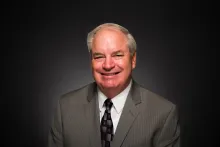
Robin Webber was born in Chicago, Illinois, in 1951, but has lived most of his life in California. He has been a part of the Church of God community since 1963. He attended Ambassador College in Pasadena from 1969-1973. He majored in theology and history.
Mr. Webber's interest remains in the study of history, socio-economics and literature. Over the years, he has offered his services to museums as a docent to share his enthusiasm and passions regarding these areas of expertise.
When time permits, he loves to go mountain biking on nearby ranch land and meet his wife as she hikes toward him.
