
Robin S Webber
This transcript was generated by AI and may contain errors. It is provided to assist those who may not be able to listen to the message.
Actually, I thought Fernando was going to speak. I always like to learn from other people. Mr. Barriga and I have worked many, many years together there in Pasadena. I know he can do it. Desiree, thank you very, very much. Appreciate it. You're beautiful, special music. Aren't we going to be blessed in San Diego hearing from Desiree every Sabbath singing? I don't think she heard that. No, for those of you that don't know, Dave and Desiree were recently married, and her mother was out, and they sang a, I believe, a beautiful duet there, and we missed that. So that's been Susan's and my first opportunity to hear Desiree, but hopefully won't be the last time.
I want to say thank you very much for coming back, all of you that did, for the second service. Appreciate that. I know that many of you travel long miles, long distances, and thank you very, very much for being here this afternoon. I do want to mention again, thank you for the very generous offering that you were able to give this morning, and that is greatly appreciated. It was the 11th hour of the 11th day of the 11th month. Ninety-two years ago, nearly three human generations, when the great guns of Europe were silenced.
Many a man had been in the mud-drenched, barbed-wired, infested fields of Belgium and France. Millions had died. And then came the armistice, the suspension of all hostilities, for the first time in those fields of Belgium and those planes of Egypt, of France, you could hear the song of the Sparrow. Armistice was declared. The peace brokers went to work. But it didn't last very long.
Within just a couple of decades after that, again, another major war occurred. And in this war, a war that only lasted six years, from 1939 to 1945, more people were killed in that war than any other war that had ever been. Since that time, since the end of not the hostilities of what was then called the Great War, or the war to end all wars, or even the Second World War to follow, you know, I know, in our lifetime, there have been many conflicts. There have been hostilities. America right now is still involved in two wars overseas. We still have soldiers over in Korea, soldiers that have been there since I was a baby, but in diapers. There have been people in uniform on the 36th parallel for all these many, many years. We are two days away from the 9-11 attack on America, in which extremist jihadists brought war to America's shores for the first time in 186 years. In a couple of days, we'll be, again, watching the videos, watching the news on television, viewing the commemoration as if it had just occurred all over again with those horrible pictures of the Twin Towers coming down because people made war on America. I have a simple question with all of this said, so it does not go for naught, and just simply words in vain. It leads to a question that I pose to you on this in the afternoon of the Feast of Trumpets, 2010. It's a simple question, but one that this day does answer. Why won't war simply die a death and go away? Why will not war die a death? For it has taken many deaths, but why will it not die a death, and why does it not simply go away? Perhaps the question is given answer, if but in part, if but in brief, by Tolstoy, a famous Russian author, wrote one of the classics of all time called War and Peace. In it, one of Tolstoy's characters utters this astute observation. Drain the blood from men's veins and put water inside instead, and there will be no more war. Heard of heart transplants, heard of other organ transplants, but to transplant blood for water. Tolstoy's thoughts a century ago. The great Russian novelist, even though not completely realistic, because I don't think any of us are ready to do that this afternoon unless I can have a show of volunteers, was on to something. He understood that something incredibly essential had to occur for world peace to break out. There had to be an abrupt, there had to be an incredible change impacting humanity once and forever. It had to not only be external, but with Tolstoy's thoughts lingering in our mind about changing blood for water, it also had to be an internal change. There had to be something going on inside of humanity that would allow war to die a death and to eventually go away. Which leads us to why are we here today?
Why observe this biblical festival called the Feast of Trumpets? While everyone else is out and about, they are working and they are playing. You and I are here today celebrating one of the solemn festivals of God Almighty. Why do we do it? Allow me to remind you to bolster you, to encourage you of why you and I are here this afternoon. We do so in faith. We do so in faith to come into alignment with God's purpose and saving plan for all of humanity. Which depicts a divine interventionism that touches on Tolstoy's theory. Interventionism is a term that you will often hear in geopolitical gabble-gook these days. It's often thought that our movement into Iraq as a country was what we would call a classic case of military adventurism. Some would even argue that in Afghanistan that it is a matter of interventionism. Sometimes, in some circles, the term interventionism can be looked upon as a negative. What I'd like to share with you, if you'd like to jot that word down, because we'll probably come back to it before the end of this day, the Feast of Trumpets pictures divine interventionism in the affairs of humanity. The Feast of Trumpets, purely and simply, is about an interruption, an intervention in human history, once and forever. We'll talk about that. We also come together to stir up one another's faith on this day, as we look forward to a time ahead when Trumpets will dynamically crescendo the announcement of the return of the Son of God, none other than Jesus Christ.
We stir up one another's faith to understand that that understanding of the perusia, that understanding of Christ coming back to this earth, is more than just simply looking up on a ceiling in a cathedral in Europe and seeing the stained glass image of the Christ with angels. That's good for stained glass. That's good to bring light into a dark cathedral. But we stand here today. We sit here. We rejoice together today with the reality that Jesus Christ, none other than the Son of God, is coming back to this earth as Lord of Lords and King of Kings. I often have the opportunity to travel through the United States and through Canada on prophecy seminars.
And I often like to share with people in dealing with the subject of prophecy as I'm given to do and have that opportunity because of our publication, World News and Prophecy. I often mention to people that there is but one doctrine in the body of Christ for 2,000 years regarding the subject of prophecy.
Everybody goes, that's when everybody leans forward and everybody says, just one? I say, yes, just one. There are many understandings and there are many teachings that surround that doctrine. But there is only one loud and clear and dynamic thrust out of the divine inspired scriptures that we can hang our hat on with all of surety. That is loud. That is vibrant. And why we are here today to stir one another up in faith. And that simply is this. The doctrine of the body of Christ for 2,000 years is simply this. Jesus Christ, the Son of God, Messiah incarnate and now glorified and at the right hand of the Father is coming back to this earth as King of Kings and Lord of Lords and is going to set up His millennial rule as we heard this morning. That is loud. That is clear. That never changes. The understanding of that never changes. Teachings, understandings that lead to that will come and go as we view the scriptures and we see them in this generation or another generation. But one thing stands for sure that the Son of God is coming back to this earth. We are here today to stir up one another's faith in that regards. And we also recognize that it is introduced with the sound of trumpets. And that is the best news that I can tell you this afternoon. You've already heard it once and twice, but sometimes they say thrice is better because then you know it's not an accident. The good news, the news of the Feast of Trumpets, is Jesus Christ is returning to this earth. And it's at that time that I'd like to borrow the title of Tolstoy's book, War and Peace. For it is at the Feast of Trumpets and what it portrays, that which comes about in the future, where war and peace come together.
On this Feast of Trumpets, 2010, we need to understand how war and peace come together and how war will finally die a death and be put away. For it will not simply go away, it must be put away. So there are three questions that we need to answer this afternoon. You might want to jot them down. They are very short. They are personal. They will impact your life. Number one, who makes the war? Number two, why does it have to be fought? And number three, who brings the peace? With that stated, the title of my message is War and Peace, the Message of Trumpets. As we contemplate the magnitude of what this day portrays, when the trumpets of God do sound and Christ does return, let's grasp and fully appreciate the landscape of the times. We've already gone over there a couple times today, but that's fine. We'll build upon that. Join me, if you would, in the Olivet Prophecy of Matthew 24. Join me, if you would, Matthew 24. Let's open up our Bibles. Come with me, if you would, to verse 21 of the same chapter. The followers of Jesus had come to him and said, well, when is the kingdom going to come about? When is that kingdom going to come about? And Jesus began to give a panorama of what would occur from the time of his ascension until the time of his return. We come to Matthew 24 and verse 21, giving us the landscape, giving us the atmosphere of what is occurring before that trumpet sounds. For then there will be great tribulation, such as has not been since the beginning of the world, until this time. Neither ever shall be ever after. This is an incredible dynamic time in human history. There is an escalation above simply what we call the first four seals that are mentioned in the Bible. The course of human history, apart from God, left to itself of a religious deception, of war, of famine, of pestilence. There is now an escalation. This is a dynamic set of verses. And it says, And unless those days were shortened, no flesh would be saved, but for the elect's sake, those in the body of Christ, those days will be shortened. Drop down with me to verse 29. And immediately after the tribulation of those days, the sun will be darkened and the moon will not give its light. The stars will fall from heaven, and the powers of the heavens will be shaken. This is an allusion to the sixth seal, the time of the heaven signs. And then notice verse 31. And he will send his angels with a great sound of a trumpet, and they will then gather together his elect from the four winds, from one end of heaven to another.
It is interesting that this occurs during the time of the trumpets, plural. Mr. Smith alluded to that some this morning. I will add a little bit this afternoon. But let's put this down in our notes so that you follow along with me and that you don't start nodding off an agreement out there. And that is simply this. It speaks of a great trumpet. Now, I know in this day and age, some of us in our neighborhoods have been exposed to a great noise. It's called rap music with a heavy bass beat. It just literally comes and throbs into your household. The greatest decibel nightmare of rap music is nothing compared to the majesty and the alarm of that great trumpet that is going to sound across the entire world. Let's ask ourselves a basic question. As Christ ascends, what does he do as he intervenes in human history? As he comes back. As not just simply the local rabbi of Nazareth and Capernaum. Not just simply a local champion of the Jewish Christians of the first century AD. But now the universal Christ, the one that is exalted, the one that's at the right hand of God in total glory and total splendor. As he comes down through the clouds, as the trumpet sounds, what is it that he brings and what will he say to humanity? A humanity that has gone off course, as we see in verse 21. Does he come down just simply as a referee? That might be a good question. Does he just simply come down and say, now gentlemen, to your corners. Let's get us right.
Or maybe some of you that are school teachers that have a disciplinarian problem in your classroom, you send perhaps a student to their corner, okay? You go over to your corner until you deal with your anger issues. Is that what he's going to tell the nations? He's going to tell the nations what we've heard up in Los Angeles, from one of our own, from Altadena. Why can't we just all get along? What is it that Jesus Christ will do when he comes back to this earth? In the true sense, the Bible is not quiet on this matter. In fact, it's very loud. For those who care to read and believe, and that's why we are here, because in the Church of God we read the Bible and we come because we believe in it. Join me, if you would, in the book of Jude. Jude's way back in the New Testament. It's a little book that we don't often look at, but I want you to look at it with me this afternoon. Because Jude was not only written for the community back in 60 to 70 AD, when it was written by the half-brother of Christ, but it takes out of antiquity and puts within its midst a message that had been given thousands of years before. Let's notice Jude 14. Now Enoch, the seventh from Adam, prophesied about these men also saying, Behold, the Lord comes with ten thousand of his saints to execute judgment on all, to convict all who are ungodly among of all their ungodly deeds, which they have committed in an ungodly way, and of all the harsh things which ungodly sinners have spoken against him.
It is interesting at that time that Jude, an apostle, in an ever-darkening society where the light of apostolic Christianity was being dimmed, where new thoughts, new ideas, adverse ideas were challenging the church.
Not only that, but the Roman boot was coming its way, making its way towards Judea, for the Judeo-Roman wars that were about to occur. And Jude draws back upon antiquity, with all that is going on, with civilization in a sense coming down around in that part of the world, and draws this little hope that was given in the pre-Noatian times, that God was going to come back, and He was going to execute judgment upon this earth. That was given as a hope to pre-Noatian people. It was given as hope to the apostolic church. It's given hope to us today in the body of Christ, that God truly does view what's going on down here.
And He gives us hope that it will not always remain this way. It's amazing that the Apostle Paul also speaks of this. Join me if you would in Romans 16. We often think of Romans as a book, a treatise about the doctrines of salvation, but also Paul picks up a point of prophecy here in Romans 16 in verse 20. Join me.
It's a very dynamic, very graphic verse. And the God of peace. It's interesting. Now, stay with me for a second. Notice how he introduces and tags God. He says, And the God of peace will crush Satan under your feet shortly. Did you notice in one verse, the God of peace, and is going to crush Satan under your feet shortly? Paul was hearkening back to the first prophecy that was ever given in Scripture.
That as humanity was being ushered out of the Garden of Eden, God, in speaking to the serpent, said that your seed, that which springs from your spirit and your way, will nip at the heels of her son, speaking of the Christ, but that the seed of her, speaking ultimately of the Christ, will crush your head. That while Christ would suffer, and even while the body of Christ down through the millennia would suffer and would be persecuted, that at the end of what is spoken is there is a victory, and God wins.
And if He wins, we win. Again, the Feast of Trumpets is all about hope, and the meaning of Trumpets is underlined with hope. It's underlined with triumph. It's underlined with the aspect of total victory. I want to share something with you to get this in your mind. It's hard for an American audience of my age or younger to understand what total victory is. Some of you that are a little bit older, who are there in World War II, will understand total victory. When the good guy wins and the bad guy loses, and you know that you've won, and you've known that the other guy loses, at the end of World War II, whether it was with the Third Reich, or whether it was with the Japanese Empire, they were crushed.
They had nowhere to go. There was unconditional surrender, period. They were at the mercy and the grace and the judgment. I think I heard that this morning. Of the victor. Since then, we've had the Korean conflict. We've had the Vietnamese War. We've had Iraq, which perhaps or perhaps not silently was quieted a week or two ago, where there was no sure victory, no flag planted, no unconditional surrender. I want to share something with you if you want to jot it down in your notes. The Bible is about unconditional surrender, not only of this world, but of our own personal world before Jesus Christ, the Son of God. Let's ask ourselves from what does that great trumpet that is mentioned in the Olivet prophecy bring?
Let's carefully examine Revelation 19 for a moment. Come with me in Revelation 19. Let's pick up the thought in verse 11. This just allowed the Bible to speak for the Bible. And now I saw heaven opened. When does heaven open? At that great trumpet. And behold, a white horse.
And he who sat on him was called Faithful and True. And in righteousness he judges and he makes war. His eyes were like a flame of fire, and on his head were many crowns. He had a name written that no one knew except himself. And he was clothed with a robe dipped in blood, and his name is called the Word of God. And the armies in heaven, clothed in fine linen, white and clean, followed him on white horses.
We'll talk about those armies and who composes them later on. Now, verse 15, out of his mouth goes a sharp sword. That with it he should strike the nations, and he himself will rule them with a rod of iron. He himself treads the winepress of the fierceness and the wrath of Almighty God. And he has on his robe and on his thigh a name written, King of Kings, Lord of Lords. Thus says your Bible. The one the same Bible calls the Prince of Peace. Comes, and one of his first acts is to wage and make, that's what the Scripture says, complete and total war.
That only and does in complete unconditional surrender and destruction of the enemies of God. What does this bring to you and me? What do we take away with it? Where do we lodge this in our mind and our heart? Allow me to share some thoughts with you, please. The Feast of Trumpets, perhaps more than any other of the annual Holy Days, brings us into a reality check.
The Feast of Trumpets brings us into a reality check that Christ is not an absentee landlord. He does not have someone else collect the rent. His kingdom does not rest merely in our hearts, alone. He is not simply the first cause. I know that there are many fine people, many dedicated people, many sincere people, that can have the same conversation that I have. That they look at what the science community has brought up, and they recognize that we are not an accident.
That we are not here alone. That there had to be, as we call, a first cause. They and me, we and thee, we can agree on that. There are people that have a Bible background. They have a church background. Maybe Grandma or Grandpa went to church. Maybe the parents went to church. They would never fall that we are just simply the accident of a couple of lovesick amoeba in a slimy pond, bit by the sunlight. And all of a sudden, you have life.
We would have an agreement in that story. Many people look at God as being a first cause. But do they look at God as being the sovereign of their life? Do they look at the rule of Jesus Christ in every facet, in every fashion of their life? With their heart, with their mind, and with their soul? With their eyes, with their hearts, and their arms, and the reach of their hands? Do they allow Christ to rule them? You see, the Feast of Trumpets brings us into a reality check, my friends.
That Jesus the Christ is not just simply a distant cosmic force. He is to be the ruler of this world, given it to by His Father, and He is to rule our lives. For some, when you read the book of Revelation, it creates what we might call a bewilderment. Such words, as Paul uses about crushing the serpent, or the revelation of John, John seems to be out of alignment with the more smooth sayings of Jesus Christ.
There are many people that look and think of the Christ being in the manger. And if they do, that is well and that is good, for that's a part of the story. There are others that think of the Christ as the one that wanders amongst the lepers and the thousands that are on the hills of the Galilee. And He reaches out and touches someone, and they are hailed.
And that is well and that is good, and that's a part of the story. There are others that think of Christ. Many churches have crucifixes in them. They'll have the picture, or the imprint, or the statue of a man nailed to a stake, a human being nailed to a stake by nails. And to them, that's a part of the story. And to them, that is the reach of Christ.
But the Feast of Trumpets tells us that Jesus the Christ reaches for more than just simply straw and a manger, or stretched out and reached out by nails in His hand, or to reach out and to touch the sick. Here's the bottom line, friends. Are you with me? The Feast of Trumpets reminds us that Christ reaches into human history once and forever, and all things change.
All life cycles, life thoughts, life patterns, repetitive historical episodes, sequential kingdoms of man, end, natta, no more. God has landed on earth. The powerful message of Scripture is simply this, that Christ does His own living, He shed His own blood, He did His own dying, and now we add one, and He will do His own fighting. Isn't that kind of odd to think about that for a moment? But that is the facet of the ministry of Jesus Christ. He fights on behalf of His Father. He makes war. I did not make that phrase up.
I'm sorry. I did not do that. It is the revelation of Christ through John, and Jesus says that He comes to make war. We must wrap our minds and our hearts around the phrase, He makes war and to ask ourselves why. People often, in today's age, speak of the social gospel. How many of you have heard of that phrase? Social gospel. With tenets that come out of what we call the Sermon on the Mount, and that's well and there's good, there's a social aspect to the gospel.
And there are elements that are worthwhile and good. But the Feast of Trumpets, and maybe you've never thought about it this way, the Feast of Trumpets portrays the ultimate social gospel. Christ is personally intervening once and forever because human society is hemorrhaging, as He shows in the Olivet prophecy, that if He did not intervene, there would be no flesh alive. The social gospel that Christ ultimately gives to humanity is that society is not only going to be turned upside down, the socialness of humanity, it is going to be sidelined, taken away. A new society is going to merge. How does that begin? Join me if you wouldn't have 1 Thessalonians 4. 1 Thessalonians 4. Let's take a look here.
Again with the aspect of Christ as He begins to descend on behalf of His Father above. 1 Thessalonians 4, verse 16, For the Lord Himself will descend from heaven with a shout, and with the voice of an archangel, and with the trumpet of God, and the dead in Christ will rise first. Let's notice what this verse tells us.
It tells us that there is a time that when Christ Himself is going to descend. This is not ethereal. This is very graphic. Paul was trying to share with the Thessalonian community what it was going to be like when Christ comes back because they thought that they had already missed it. And the Greeks did not have this understanding, so he wanted to make it painstakingly clear. He says, Have you ever noticed, friends? This is kind of exciting. It kind of lets you know that Christ is kind of excited about the Father's plan. That when Christ does descend, who is doing the shouting? Is that just assigned to the angels? Is that just assigned to the armies that follow Him?
No, it says that He descends with a shout. Can you begin to even imagine what the roar and the majesty and the dynamism of the exalted, glorified Christ must sound like?
When you hear it, you will have an aha moment. You will know it when you hear it.
And it is accompanied by the trumpet of God. It's often been said that the commentaries, especially Jameson and Fawson and Brown, brings a highlight in this, that speaking of that shout, it is not only the voice that awakens the dead, but it is also given in the sense of a war shout. There is a dualism to what Christ is going to project as He comes down through the clouds. How exciting, how incredible, and how wonderful. But why the ultimate fight that He's going to fight? Why does Christ make war? Why the need? Why the seemingly piling on? Why couldn't He just say, Okay, Russia, over to your corner.
Okay, Europe, over to your corner. Okay, China, over to your corner. Going to square around a few things down here.
Why doesn't He do that? Why the seemingly piling on where what we read in Revelation 19 is going to be quite startling? Well, let's place it in full context for a moment. Let's not talk about God. Let's talk about us, humanity. Many of you have heard this figure before. Others will be hearing it for the first time. In over 6,000 years of recorded human experience, it has been calculated by some historian, and there is always one that is out there, like a fifth cousin, doing the family genealogy. But they figured it out that over 6,000 years of recorded human history, only 300 years have been termed what might be called peaceful. No major conflicts. No major wars. Now, I'm not as good at math as Mr. Sharp is. You already knew that because I've told you about my great Una Love affair with geometry. But I deduce that only 5% of human history has been without major conflict. What does that grand statistical analysis, which is simple, bring to light? Simply this. It brings to us a realization that war is not marginal to the human experience. It is central to human history. Marx described history as simply about economics. I think I could basically say that history is also simply about war based upon those figures. But where did the battles begin? Where did it all start? How far back does it go? How endemic is it in our human model? Consider we don't need to turn there for a moment. Most of us know the story. We know the story of two brothers. Their names were Cain and Abel. We recognize that the first battle was not between that Legion and that Legion, but simply that man and that man. The first battle was one-sided. It was lopsided, as have been most of the battles ever since, whether it be in ones or in thousands. We know that Cain won. Cain had a self-interest. He felt that his self-interest was threatened. That's why so often nations do go to war, is it not? Because of self-interest. He could not control his aggression. Interesting that the Jewish Roman historian Josephus indicates that it was Cain that built the first fortress, pre-flood. Tradition is that it stands or stood where Jericho stands today. Think about this for a moment. Cain, the murderer, was also Cain, the first man to build fortifications, to build walls. When you think about all of this, about Cain, that simple one-on-one war that he had with his brother, the scary reality is that he felt justified to take life, to give someone else's all for their cause. He was willing to sacrifice others rather than himself, and he did it. It's interesting, we were in the book of Jude 11, speaks of the way of Cain. It has never really departed outside of the shadow of the Garden of Eden, of self-seeking, of self-interest, of self-preservation, of developing bigger, greater, more sophisticated weapons than the other guy. Cain's world was, as Josephus tells us, was not a world of bridge-building, but putting up walls.
What's interesting is that story progresses pre-noation. It led to a state of collective being that, join me if you would in Genesis 6 for a moment. I do want to turn there. In Genesis 6, there's a description of that society in which God remembered Noah. And the Lord was sorry that he had made man on the earth, and he was grieved in his heart. So the Lord said, I will destroy man whom I have created from the face of the earth, war man and beast, both man and beast, creeping things and birds through the air, for I am sorry that I have made them.
Further up in verse 4, it speaks about that there were giants on the earth in those days, and also afterwards. It speaks of a world of chaos and confusion and violence. You say, well, how do I know that? How do you know that, Mr.
Weber? All you have to do is go after the flood, and you notice the noatian covenant that God makes with the patriarch on the mountains of Ararat. He says that a man will not take the life of another man, and if he does, then his blood will be given.
I think that is a direct correlation as to how bloody and how warlike, how violent, and how many human beings were slaughtered before the flood, that God looked down and just changed his mind and said, we have to start all over again. After that flood, after that beautiful covenant that God made with Noah, it kind of reminds me of the armistice that was made in 1918. You wish that it could have gone on and on, but it did not. And the same after Noah came down off the mountain with his descendants, there was a man named Nimrod. You can find a mention in Genesis 10.
I don't mean to go there for a long time, but we'll just talk about it. Nimrod is a figure out of the Bible. He was a mighty man. It says that he was a mighty hunter before the Lord. When you understand the root of that word, that means actually he was apart from the Lord. He was confronting the Lord. He was basically a champion of the people apart from God. And he set up his own society apart from God, in confrontation from God. He did not want to be a part of the society of God. He did things his own way. He had self-will and self-preservation so much that he challenged the people.
He misled them. He made them think that God was going to once again do something with them, perhaps even flood them out. And so they built that great ziggurat. They built that great tower as a means of protection. Now Nimrod came and went, but his system was cemented into what is now known as Mesopotamia. And we saw the rise of kingdoms that were apart from God.
It was like Babylon and Assyria and Chaldea and Persia. In the midst of all of that time and all of that confusion and all of that empire building, a vision came to Daniel. Join me over in Daniel 2, for it is there that I would like to lead you. In Daniel 2. And he was talking about one of the last of the empires that were going to come up. And he describes it in a very scary way, because it was unlike any of the other empires that had preceded it. Daniel 2. In verse 40, notice what it says here. And the fourth kingdom, and all scholars will normally tell you that that was the kingdom that had the legions, the kingdom of Rome.
And the fourth kingdom shall be as strong as iron, as much as iron breaks in pieces and shatters everything. And like iron that crushes, that kingdom will break in pieces and crush all others. He speaks of the Roman boot, the Roman Empire, a warlike people who worshipped Mars, the god of war, who swept all that was before them.
In 146 B.C., which was at the end of the Third Punic War, which had been a centuries-long war between Rome and Encarthenge, that finally the Romans held this way. They conquered Carthage. They took 300,000 people of one of the great cities of antiquity, 300,000 people. They either killed them or they sold them into slavery. Then what they did is, in the soil of Carthage, all around Carthage, they planted salt into the soil. They planted it deep so nothing would ever grow again in that city of antiquity. That was, in a sense, a parallel to a nuclear winter of antiquity.
Complete, undeniable devastation. One civilization trumping another, truly the heart of a beast. That system is yet to be resurrected again and will be in its final form in the future. But notice the encouragement that God gives Daniel here. And in the days, in verse 40, of the kings of the God of heaven, he is going to set up a kingdom which shall never be destroyed.
And the kingdom shall not be left to other people. It shall break in pieces, consume all these kingdoms, and it shall stand forever. Now, there are two things. This is one of the great verses of prophecy. There are two specific elements that I'd like to share with you.
Number one, it says that the God of heaven will set up a kingdom which will never be destroyed. It is ageless. It does not have the same rise and ascendancy and plateau and decidency of all world powers, all world civilizations. Be it Rome, be it the Byzantine Empire that lasted a thousand years, be it the Turkish realm that lasted 500 years under the Ottomans, whether it be Pax Britannica or what we are now under in our time in our age, Pax Americana.
It speaks of a kingdom that will never diminish. There will no longer be the sequence that was laid out in Daniel, a sequence of from Calle dea to Persia to Macedonia to Rome. And you can continue that forward to the Byzantines, to the Franks, and go on and on and on. There is no more sequence. All is interrupted. Society will be overturned by the war that the Christ will make and bring and visit upon humanity.
Not only that, but notice the second omen. And it shall not be left to other people. You say, say what? It will not be left to other people. What started with humanity now moves into a spiritual world. It is no longer flesh. It is no longer human blood that reigns in the ageless kingdom to come.
Something has happened here. We need to ask ourselves, what? What happens here? What is going on? Notice verse 45. And as much as you saw that the stone was cut out of the mountain without hands, and that it broke in pieces, the iron, the bronze, the clay, the silver, and the gold, the great God has made known to his king what will come to pass after this. The dream is certain, and its interpretation is sure. It speaks of a stone that is not cut by human hands. Let's go forward into the book of Revelation now.
Revelation 6. Just skipped over a page of notes, but we'll try to make this sequential. Revelation 6. Let's pick up the thought in verse 12. Maybe just allow the Bible to speak for itself. In Revelation 6 and verse 12. I looked, and when I opened up the sixth seal, let's remember what's happening here. The first four seals that are revealed in Revelation depict human history apart from God, man on his own course.
Then we come to the fifth seal. The fifth seal is now different. It's now like human history on steroids. Something occurs. Wars are different. Sickness is different. Rulers are different. There's something happening down here. Satan is working behind the scenes with the rulers of this world. It is the fifth seal that we call the Great Tribulation. But now we move into what is the sixth seal.
I looked, and when he opened the sixth seal, behold, there was a great earthquake, and the sun became black as sackcloth of hair, and the moon became like blood, and the stars of heaven fell to the earth, as a fig tree drops its late figs when it is shaken by a mighty wind. And then the sky receded as a scroll when it rolled up, and every mountain and island was moved out of its place. In the kings of the earth, the great men, the rich men, the commanders, the mighty men, every slave and every free man hid themselves in the caves and in the rocks of the mountains, and said to the mountains, Fall on us, hide us from the face of him who sits on the throne and from the wrath of the Lamb.
For the great day of his wrath has come and who is able to stand. Now, when I say this again, friends, are you with me? We must notice the multifaceted dimensions of the ministry of Christ. This is one that is not usually partial on our minds. We think of the Good Shepherd. We think of the Healer. We think of the Savior.
We think of the individual that loved to feast, and it was amazing who might be around his table. Publicans, tax collectors, perhaps even former women of the street, that he didn't think, or they didn't think, that he should dine with. We think of that Good Shepherd that goes out away from the ninety and nine and will pick up the one that is lost and bring it back home. We all love those pictures that are in our mind.
If they are in your mind, please keep them right where they are, because those are beautiful postcards to keep and to treasure. But this too is a part of the role of Christ. This is depicting the sixth seal. I've often in my own terminology said that the sixth seal is God Almighty ringing the doorbell of heaven and saying, Prepare to meet your Maker. I am returning. You may not realize that you need me, but you do. For if I do not come, you will not survive. We pick up the thought in Revelation 11 to see what transpires after that.
Revelation 11 and verse 15. I say Revelation 11. Yeah, 11, 15. And then the seventh angel sounded, and there were loud voices in heaven, saying, The kingdoms of this world have become the kingdoms of our Lord and of His Christ, and He shall reign forever and ever. And the twenty-four elders who sat before God on their thrones fell on their face, worshipped God, saying, We give you thanks, O Lord God Almighty, the one who is and who was and who is to come, because you have taken your great power and reigned. It says that the nations were angry and your wrath is common, the time of the dead, that they should be judged, and that you should reward your servants, the prophets, and the saints, and those who fear your name, small and great.
And notice at the end of this verse, And should destroy those who destroy the earth.
Just allowing the Bible to speak for itself. Zechariah 14. We may not know the time of this, for Jesus in His wisdom always just simply said, It is near. But we can know the bullseye of biblical prophecy. Zechariah 14. Verse 1. Behold, the day of the Lord is coming. Now let's understand something for you that are just becoming acquainted with prophecy. Maybe just beginning, look at the Scriptures.
The day of the Lord is different than the Tribulation. The Tribulation, the fifth seal, is the time of Satan's wrath. Different story, different time. Humanly, that's scary too. But when prophecy unfolds in crescendos, you've got to know who's coming from which direction. Satan comes helter-skelter. He comes because he knows his time is short and inspires and dominates the beast, the false prophet, that man of perdition, in its ultimate form.
Then you have the sixth seal. God is on His way. He knows He must save humanity from itself. Now we enter the seventh seal, which is known as the day of the Lord. When you see the term that day, that doesn't mean today. Remember when I was first told that when I was 12 years old and I'm still using it? That day is referring to the future. It refers to the time of the seven seals, the seven trumpets. It says, Behold, the day of the Lord is coming, and your spoil will be divided in your midst.
For I will gather all the nations to battle against Jerusalem. God is in control. God is in charge. He's not being forced into a corner to retreat to Jerusalem with His back up against the Temple Mount. He brings the nations to Him to be judged. For I will gather all the nations to battle against Jerusalem. The city shall be taken. The house is rifled and the women ravished. Half the city shall go into captivity, but the remnant of the people shall not be cut off from the city. Then the Lord will go forth and fight against those nations.
And He fights in the day of battle. And in that day His feet will stand on the Mount of Olives, which faces Jerusalem on the east. And the Mount of Olives shall be split in two from east to west, making a very large valley.
And half of the mountain shall move towards the south, and then you shall flee from my mountain valley. For the mountain valley shall reach to Azal. Yes, you shall flee as you flood from the earthquake in the days of Uzziah, King of Judah. And it goes on. Remember this for those of you that are studying Bible prophecy. Jerusalem is the spot. X marks the spot. God is coming back to Jerusalem to start His new society from there.
Now, why is God doing all of this, as we begin to conclude? Proverbs 14 and verse 12 lends us an answer. Christ is indeed coming back to make war, really against human nature, against that blood that has not been changed to water and or the Spirit. The Prince of Peace comes back to make war. And there's a reason. We find it in Proverbs 14 and verse 12.
There is a way. That seems right to a man. But the end is the way of death. How often does Isaiah say in his words, peace, peace? But they don't know the way of peace. Now, as I conclude, I've shared with you today how war and peace are going to come together. I want to share something very personal with you, and it's very sincere. Do I take some voyeuristic joy in stating such news about the future at face value?
Recognizing the devastation that is going to be visited upon humanity by the Prince of Peace? No, I don't. It does not give me joy. No, it does not give me happiness reading these verses. It gives me great joy, though, to know what will transpire afterwards. For in the result of this war that will indeed end all wars, peace can be born. Joy can be had. True love can be given birth. It's interesting that, going back to Tolstoy, he said that, what is it about war? He says that it can only be changed in that day when blood is changed for water, and then you'll see it go away.
God has a different solution than Tolstoy. You might have gathered that by now. Would you please join me in Ezekiel 36? For these are the days that we look forward to, to experience the grace that we heard about this morning. In Ezekiel 36 and verse 25. You see, it cannot only be external as Christ makes war upon humanity. It's got to be an internal solution. Ezekiel 36 and verse 25. This is, well, as that unconditional surrender of humanity comes about, and they need a new constitution, they need a new way of being, because it has not worked for 6,000 years.
God isn't going to say, oh, go figure it out yourselves, guys, scowls. No. He says, verse 25, then I will sprinkle clean water on you, and you shall be clean, and I will cleanse you from all your filthiness, from all of your idols. There's going to be a tremendous cleanup effort. After that war to end all wars by the divine over the mortal is accomplished.
Oh, there's going to be a tremendous cleanup effort. And notice verse 26, and I will give you a new heart, not cold water, not that kind of transfusion, but a new heart and a new spirit within you. And I'm going to take that heart of stone out of your flesh, and I'm going to give you a heart of flesh. And I'll put my spirit within you and cause you to walk in my statutes, and you will keep my judgments, and you will do them.
And then you're going to dwell in the land that I gave your fathers, and you shall be my people, and I will be your God. We will move from a world of walls to a society of bridges that begins with the Maker with the creation. And when that new heart, that new spirit is fully developed, notice a part of the social gospel, the change of society that Christ brings, Isaiah 2. And we'll conclude right here. Isaiah 2. I have a question that I want to ask because maybe this is always pertinent. How many of you know the names or individuals that fought during the Civil War?
A family member that comes to mind or that you have read about, you have a name, but not a face, a name that fought during the Civil War. Can I see a show of hands? I can lift my hand. I had an uncle that fought at Chickamawkwa. I won't say which side, because I'm not sure which side. No, I'm just teasing.
Okay. Chickamawkwa. How many of you have a grandfather or a great... Keep your hands up. How many of you have... For those... You have to exercise the most. How many of you have a father or a grandfather or great-grandfather that fought during the war to end all wars, World War I? Can I see a show of hands? How many of you have a spouse or yourself that fought during World War II?
Keep your hands up, everybody. Keep your hands... Keep on going up. Had a spouse or a family that fought during World War II? Korean War. How many of you are in the service during Vietnam? Raise your hand. Everybody, keep your hands up. They've been touched by war.
Iraq. Afghanistan.
War has touched many of us. We are here today to bring war and peace together. The Prince of Peace comes from above the clouds to the earth below. He does make war, but it is a war to end all wars.
Notice what it says in verse 4 of Isaiah 2.
He shall judge between the nations and rebuke many people, and they shall beat their swords into plowshares, their spears into pruning hooks, and nations shall not lift up sword against nation. And I conclude simply with the last statement. Neither shall they learn war anymore. We're about to go to the Feast of Atonement, Feast of Tabernacles, to further experience a society at peace, not affected by war, not affected by violence, not changed by simply cold water versus blood, but a new heart and a new spirit brought by the Prince of Peace, whose personality, whose mission on behalf of our Heavenly Father, is central to this day.
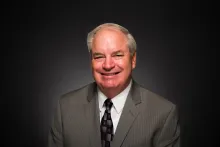
Robin Webber was born in Chicago, Illinois, in 1951, but has lived most of his life in California. He has been a part of the Church of God community since 1963. He attended Ambassador College in Pasadena from 1969-1973. He majored in theology and history.
Mr. Webber's interest remains in the study of history, socio-economics and literature. Over the years, he has offered his services to museums as a docent to share his enthusiasm and passions regarding these areas of expertise.
When time permits, he loves to go mountain biking on nearby ranch land and meet his wife as she hikes toward him.
