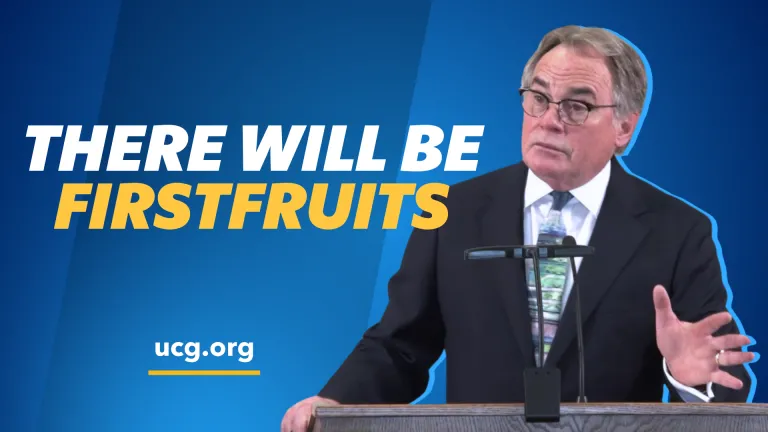

Darris McNeely
This transcript was generated by AI and may contain errors. It is provided to assist those who may not be able to listen to the message.
How many of you have ever traveled first class on an airline? You see your hands? Okay, you lucky souls.
I have never traveled first class on an airline. First of all, I'm too cheap, don't have the money to pay for the ticket. I've always hoped that somewhere I would capture the sympathy of a ticket agent and be bumped up to first class, but that's never happened to me. Some of my friends that have traveled have been bumped up to first class, but those of you that I've never had that. So those of you who have traveled first class on an airline, you know it is a different experience from the peanut gallery back in economy. You have bigger seats and whiter aisles and you're pampered from the moment you enter that first class cabin with drinks and a personalized menu. You order whatever you want off of it and stretch out to sleep. It's a whole different experience than back in the cattle car of economy class where I always travel and the rest of us that are out there.
Traveling first class. How many of you ever traveled first class on some other means? A cruise line or some other type of first what you would call first class treatment beyond that. You didn't have the first class airline. A few of us had. A couple of times I've been to the Indianapolis 500 and had first class treatment with a motorcycle escorted limousine ride to the track right to the elevator and you're waiting at all the poor souls who are lugging their coolers in and parking five miles out and you take the elevator right up to a air conditioned suite where there are chocolate covered strawberries, champagne, and you know every amenity that you could want to watch the race.
But I've also carried the cooler into the track too so I know both sides of it. Believe me, the limousine is a whole lot better for that particular venue. But anytime you go first class, it's always better. In so many different ways, if you can pay for it or let somebody else pay for it or whatever. There's one little perk that I allow myself that is first class and that's not with an airline but with a car rental agency. I have a gold card here. Those of you who can see, it's the Hertz number one gold club. Somehow I lucked into a free membership of this with Hertz rental car a few years ago and I've kept it.
You get a little bit of a discount on the cars, but what is nice about it is when you rent at a major airport from Hertz as a gold club number one member, the bus that you take from the air terminal to the Hertz parking lot drops you right at your car under a gold canopy. You get off and you see they have a board up there with all the names of the people who are coming in at that particular time with cars and you see your name up there, Macnelee, and the stall number where your car is located.
Now you bypass the lines at the tick at the counter. You don't have to show any ID because all that's already on the information when you make your booking and they have your credit card, insurance, everything, and all you do is you go right to that stall.
Your car is there, keys in it, you get in, and you drive off. Now that's first class. And I allow myself a little bit, actually with discounts and everything, it really doesn't cost that much more as I've compared it with the other Alamo and budget. Last year we were up in Vancouver for a world news seminar and I let Robert Weber book the booking through budget. And the rigmarole you had to go through and they had to check every little scratch and dent on the car as it went out to make sure that you didn't bring any more back on the car when you came back and I'm sitting there just kind of doing a little slow burn and I'm saying there's a reason Hertz is number one.
So I don't, I don't, every time I have a chance I go Hertz number one. Anyway, that's what I kind of allow myself that little perk. I'm glad for it and it is different in that particular way. But I'm not necessarily here to talk about first class today.
What we want to talk about this morning are the first fruits. Not first class, but first fruits. This is the day for first fruits. A very unique group. A very unique group in God's plan and in God's purpose from what we can see in the scriptures. By the time we finish here in the next few minutes, I want to give us all a better appreciation for this class of people God describes as first fruits because, you know, first class ends when that 747 touches down at the destination. Your first class treatment ends when you walk out of that apartment and you have to fend for yourself.
When the event is over and you've been treated first class, you have to go back to real life. Your ranch in the suburbs. You know, your ranch house, not your ranch.
Let's go back to the reality of life. First class ends unless you just, you know, happen to live that lifestyle, which I don't know too many of us in this room that do. But first fruits doesn't end. What God has called us to, where God has placed us as first fruits, doesn't come to an end at the end of a temporary journey or an event. It is something forever. Forever. Let's turn back to Leviticus 23 to make sure we have touched base on this verse on this day where we find the Feast of Weeks, the Feast of Pentecost is mentioned as it describes the offering of the first fruits. 50 days later, from the time of a wave sheaf offering, which began during the barley harvest of the early harvest during the days of Unleavened Bread, 50 days later we come to the point of, from that point of the wave sheaf offering in verse 15 of Leviticus 23, the count that brings us to this day, from the day that you brought the sheaf of the wave offering, seven Sabbaths or seven weeks will be completed. Count 50 days to the day after the seventh Sabbath, which is this day. And it's been a few years since I've taken all of us through the way by which we come to this day.
And in past sermons we've shown very clearly this is the right day, this is the right week, this is the 50th day. We're on the right day here when we are to bring a new grain offering to the Lord. You shall bring from your dwellings two loaves, two wave loaves, a two-tenths of an ephah. There'll be a fine flower baked with leaven. They are the first fruits to the Lord. Two loaves, one to represent, if you will, the Old Covenant, the other the New Covenant.
One Israel, the other the Church. These are the representations of these two loaves. And they are offered as well with a young bull and seven lambs in the first year. And a burnt offering is made to God. You shall sacrifice a kit of goats in verse 19. The priests will wave them with the bread of the first fruits as a wave offering before the Lord with the two lambs. They shall be holy to the Lord for the priest.
You shall proclaim on the same day that it is a holy convocation to you, no customary work. It will be a statute throughout your generations and your dwellings throughout your generations. And so we are here on this day that has a first fruits flavor, meaning, that is given here on this day as an offering. The first fruits of the day of Pentecost reoccur throughout other references in the Scripture, primarily in the New Testament, to give an added dimension. We know we're not doing any animal sacrifices. And 50 days ago, we didn't actually wave a chief of grain.
We don't we understand that we don't need to do that. What is unique to God's church in the time of the end, the end of the age, is that God's people, Revelation 12 shows, understand how to understand the Old Testament and the New Testament and what works, what is brought into the New Testament, what has the full meaning and application under the New Covenant, and what we are to do and how to handle the Old and the New Testament.
That is a unique aspect of the Church of God, as we find from the book of Revelation, where they keep the commandments of Christ and the testimony of Jesus and the law of God. The marriage of those two is unique. So we know that we don't give an offering by an animal, but we also understand the deep spiritual significance of the first fruits. In 1 Corinthians chapter 15, the apostle talks of this spiritual significance of this first harvest, that this Holy Day pictures, as it falls within the plan, worked out through the Holy Days.
In 1 Corinthians chapter 15 and verse 20, Paul writes, Now Christ is risen from the dead and has become the firstfruits of those who have fallen asleep. For since by man came death, by man also came the resurrection of the dead through Christ. For as an Adam all die, even so in Christ shall all be made alive, but each one in his own order. Christ the firstfruits afterward those who are Christ's at his coming. Every man, each in his own order. It's a remarkable statement that we're told here in verse 22.
All will be made alive, each in his own order. Just as Christ was resurrected, so will God ultimately resurrect all into an opportunity for life. God is doing this in a specific order. First, there was Christ who was resurrected as the firstfruits of those who have fallen asleep, followed by others at Christ's return. Paul states here that at the resurrection of the saints at Christ's coming, this resurrection will be to immortal bodies, spiritual bodies, will take place in an instant.
We're told in 1 Thessalonians 4, it will be done at the last trumpet, an almighty, supernatural, clarion call that will announce the return of Christ to rule the earth at that particular point in time. God will resurrect the dead who have been previously faithful to Christ, and he will change to immortal spirit being the children of God, raising them to meet Jesus in the air, and those who are alive and remain at that time will likewise be with those faithful who will come out of the grave.
This miraculous event of the resurrection is described as the first resurrection in Revelation 20, verse 6, where it says, Blessed and holy is he who has part in that first resurrection.
Over such the second death has no power, but they shall be priests of God and of Christ, and shall reign with him for a thousand years. So we see described a first resurrection at that particular time, which is appropriate as it involves firstfruits who are the firstfruits of God's plan, of God's harvest, and of God's timing. This is not a full sermon on all the full meaning of the resurrections from the Scriptures, but the other holy days will walk us through that. But this particular day has a very strong application and meaning for the Church, for the people of God who are the firstfruits of God's plan, those that are called now, those who have that understanding, have had their minds and their attitudes changed to become like Christ through God's Holy Spirit, working within them. The Apostle James noted this group of people in the first chapter of James, where he referred to the firstfruits. James 1 and verse 18. Let's begin in verse 16. It says, Do not be deceived, my beloved brethren. Every good gift and every perfect gift is from above, and comes down from the Father of lights, with whom there is no variation or shadow of turning. Of his own will, he brought us forth by the word of truth that we might be a kind of firstfruits of his creatures. By his own will, he brought us forth by the word of truth to be firstfruits. A kind of firstfruits, chosen by God's word to give us birth, if you will. The new international version puts it, chosen to give birth through the word of truth. Paul, James well understood that those who are called and converted now, in this age, called the firstfruits of God's plan of salvation. They're referred to in the Scriptures by Paul, several individuals that he had knowledge and understanding of in the Bible. He looked upon them and called them, in a sense, as people who are among the first in their calling and their planting and their timing. Back in 1 Corinthians 16, we have Paul winding up this long book of the Bible. He begins to name members. 1 Corinthians 16.
1 Corinthians 16.
In verse 13, he says, Watch and stand fast in the faith, be brave and be strong. Let all that you do be done with love.
I urge you, brethren, you know the house of Stephanus, that it is the firstfruits of Achaia. Achaia was a region there in the area of Corinth. And he says, they are the firstfruits of Achaia, that they have devoted themselves to the ministry of the saints, serving the members, serving the church. He singles out a family of people, the house of Stephanus. And he says, that is the firstfruits of Achaia. Now, the way I read that is that this particular family was the first ones called, if you will, first members of the church in this area to be so-called. However, they responded first in baptism, first in terms of attendance or contacted in whatever way in this particular area, they were the firstfruits. Over the years, I've known members and families, and you have as well, who could be recognized as, in a sense, the firstfruits or the first called of a particular area. For years, my mother was the only member of the Church of God in our hometown of Cape Girardeau, Missouri. There was no other person there for a number of years. Now, eventually, some moved into the town, one of them sitting out here in the middle of the crowd, but she wasn't, you were in a native to Cape. But my mom was the first one. In fact, she used to say when she first asked for a minister to come to our event visitor, she thought that she was the only one outside of California that was listening to this radio preacher called Armstrong.
None of her Methodist friends were taking any of the literature, knew what she was talking about. She thought she was the only one. Now, she wasn't, as it turned out. There were many others, and as the Church developed in that area, we found there were other people. But you could say the same for here in Indianapolis, and certain families, which some of you have descended from, were among the first fruits of a region to be a part of the Church, in a sense, founding members. There's something about being the first, isn't there? If you're second, that's second. I was reading the Drudge Report today, and poor Susan Boyle, she came in second. I'm sorry.
There was some techno-street rap group called Diversity that got number one, Britain's got talent, and I can't relate to that. I'm sorry, some of you can't, I can't. But poor Susan Boyle came in second. Second? Second! It's not first. $100,000 less is second place. And her hundred thousand pounds, I should say, is less in her case. She'll do all right. I think she's got a record contract with one of the judges, so look for her album in Walmart, from what I understand. So she'll still do all right better than what she was doing in that little village, and wherever there she was. But second is not the first. First is, the first is a unique position in many different ways, not only to win the cash prize, but just to have that distinction to be the first. I see Greg Pennington is back here. Greg Pennington, I'm going to embarrass him. He's visiting with us today. Greg was in the first ABC class back in 2000, weren't you Greg? Correct. First class to go to ABC. Now, what were there, about 20 or 25 students in that particular class? It was a small one. But he was the first class at ABC. There will only be one first class to go to ABC. Dave Evans was in a class. Ryan and Stephanie were in a class, and Zunita and a few others of you here. You were in second, third, fourth, fifth, or whatever, but you were in the first. Greg was in the first. Now, that doesn't make Greg any better, more biblically knowledgeable, or anything else like that. But he, along with a unique group, will be always forever among the first ABC attendees. They got that bragging right. Whatever it's worth, that's what they've got. I'm trying to illustrate that to be among the first of a grouping is unique. When we bring that into God's working and God's plan, we should understand that that is something very special to God. Something that is very, very special. We are here today on the Feast of First Fruits, and we should not take it for granted. We should not just slough this off as a holy day we kind of work through to get into our summer months. It's not as exciting and glamorous as the Feast of Tabernacles. Perhaps it's not the same as the Passover in other ways. We miss the meaning of this day because we would be missing a great deal. This is the day, if you will, for the church and for the church now in this age. We need to focus on it, and we need to understand it because of all that we are told. In Romans 8 and verse 23, we are pointed to the faithfulness of this calling.
Romans 8 and verse 23. Paul writes, not only that, talking about the creation laboring toward birth, but we also who have the first fruits of the Spirit, even we ourselves, grown within ourselves, eagerly awaiting for the adoption, the redemption of our body.
We look forward to that time of the resurrection. God looks forward to that time of the resurrection.
When the first fruits and we, or that group of people, go through a time where we grown within ourselves as we wait for the redemption of our body, already been described within 1 Corinthians 15 through the resurrection.
As first fruits of God's plan, those who have been a part of that group have always found themselves in a vastly different situation than those who will follow in the later, greater harvest, pictured by the fall Holy Days. Jesus said to his followers in John 17 in his last prayer, he said to the Father that those who would follow him in this age are not to be of the world just as I am not of the world.
But he said, protect him from the evil one. And in that prayer, Christ indicated that his followers would be within the world, but would have to be apart from the world. Expected to develop a different path, expected to develop character while the rest of the world is deceived, and while the rest of the world follows values that are abhorrent to Christ.
And he prayed for those who would be a part of that group of people. And so the first fruits have a different path to go. That's why in Romans it says we groan within ourselves. Because sometimes you and I get to the point in life where we groan.
Because we've told a bad joke, but because of what we have to deal with about ourselves, with others, from this life. Something physical, something spiritual, something emotional, something relational. And life at times is full of groans, trials.
There is a measure of suffering that we have to walk through. And it is a different walk of life than those who will come at the later, greater harvest.
We understand that, I think, but do we really, really know what we have been placed within?
We're part of a difficult challenge in this present evil age. We're called to strive to obey God while we live in what Paul later describes as this present evil world in which Satan is the actual ruler of this world.
I could turn to the scriptures, but you should know those. Where it says that Satan is the God of this world, and Satan has deceived the world.
And it is called an evil age. The harvest of first fruits is small because at this time, relatively few will accept that calling, will respond to that calling by repentance, by conversion, and remain faithful to God's way of life.
We are living that. We should understand that.
It is one of the most amazing, humbling, bewildering matters for us to consider. Those of us who work in the media of the church and work with the message of the gospel to try to figure out how to present the gospel in today's world. With the distractions, with the mindset, how to do that in an effective way that will be blessed of God. Not that we're the whizkit geniuses that will figure out the golden key of doing it.
Sometimes you just have to put it out there and let God bless it and do His thing because it's God who calls. It's not us. It's not our genius that comes up with the right words and the right article or the right program or the right magazine or this or the right that. It's God who by His Spirit, we have to do our best. We have to understand our times and the audience.
But at some point, you just have to cut bait and fish, as they say, and put it out there and let God do His thing. But it is a challenging time to accomplish that. Christ talked about narrow is the gate and difficult is the way which leads to life. And few there be who find it. Few. The first fruits have always been a very, very tiny group of people.
The first fruits have to wait until after Christ's return, at which time a new world will be ushered in based on God's laws, based on God's values. In that time and in that age, God will bind Satan. He will not allow the nations to be deceived. And without that influence, everyone will come to know the Lord, as Hebrews 8, 11 tells us. But we know by the other holy days that that's in the future. And we have to deal with a very difficult challenge that is before us at this particular time, as we are in the process of sowing and planting. Those who have not conformed to the world will be those who will assist Christ in bringing all nations to His truth. They will overcome the world just as Jesus overcame the world. And Christ will use the first fruits in bringing other people to serve Him, to serve God, and to accomplish His purpose. There are two scriptures in Revelation that we should know in the message to the churches. Revelation 2, verse 26.
To the church at Thyatira, when it comes down to the end of that message, Revelation 2, 26, Christ says to hold fast what you have till I come. And keep in mind that this letter was written to a group of people who were among those called the first fruits. Sometimes it's useful just to read Revelation 2 and 3 from that point of view and don't try to figure out historically, prophetically, the message. Just read it as a message to first fruits then and first fruits now.
He says, Hold fast what you have till I come. And he who overcomes and keeps my works until the end, to him I will give power over the nations. Hold fast to the end and you will receive power. The very thing we always want isn't it? Power, authority, rulership, but raw power.
Not that it's something for us to abuse or to wrongfully accomplish, but it is power. Power to get something done. You know what most CEOs, presidents who lose their titles and their jobs over a big company miss the most? It's not the jet. It's not the big salary because many of them can land in other jobs and still be making a ton of money. But when they lose that top spot, they lose power to do something with the company, with the resources of the company, the people, the product. And that is what drives a lot of men at that level. Sure, the money is great and the perks are good, too. But those can be found other places in lesser or greater degrees. But what is really the rush is the power. And when that's used well for the benefit of the company, for people, that's good. Christ talks about power over the nations to do good in His kingdom as His rulers. And that's where that is taking us. Chapter 3 and verse 21 to the message at the church at Laodicea, essentially the same. To Him who overcomes, I'll grant to sit with Me on My throne, as I also overcame and sat down with My Father on His throne. This is why we are called now to prepare for that inevitability. God is going to prepare and has been working and putting together a group of people from the first day of Pentecost to now who will fit into this slot called firstfruits. This is what we are reading in the Scriptures. James referred to them in his day. Paul talked about them projecting them through the resurrection at the time of the first resurrection. Jesus is talking about it here.
God has been putting together a group of firstfruits.
Many of them have died in the faith and they are sealed until that day when they will accomplish what these and other Scriptures say they will be prepared for. That's going to happen. Whether you believe it or not, whether you live it or not, whether you and I endure and overcome to the end, it's going to happen. Understand that. It is going to happen because God's Word says that it is going to happen. That group of firstfruits will be a part of that first resurrection and will set with Jesus Christ on His throne and have power over the nations. The only question for me, for you, and any others to come is, will we be there too?
Will we be there too?
Will we choose to continue to travel the way of the firstfruits and be a part of that? That's why we are here on this day. That's why we are called. This is how we prepare for our high calling of a firstfruit. Scripture shows, in many ways, God is going to set His hand to save this world through a very carefully laid out plan. It's being done in stages. Every man in his own order, remember? The rest of the Holy Days show us that. This present stage right now, during the time of the firstfruits, is a one-time special, unique period in the plan of God. Right now. And there is one parable that shows us this in Luke chapter 19.
If there is one parable that is specifically for the church and that you and I should write on the tablets of our heart, maybe it's Luke 19. If we don't write too much on the tablets of our heart, we're supposed to be writing God's law, according to the Scripture, on our heart. But if there's one parable that we get, that we think about regularly, maybe it should be Luke 19, because this particular parable is most important for the church.
Most important for the church. Here Christ shows a time of stewardship. As He was approaching Jerusalem, verse 11, and they thought that the kingdom of God would appear immediately, He sensed that He better give some instruction, and so He said, verse 12, and He launches off into this parable, and He says, a certain nobleman went into a far country to receive for himself a kingdom and to return. Boom! Christ is the nobleman. He leaves and goes into a far country. If you think you're reading the Lord of the Rings, where do you think they got the idea?
A far country. And He's going to return. But He went to get a kingdom for Himself. So He called His ten servants, delivered to them ten minas, and said to them, do business till I come. And right there, that statement, the end of verse 13, is where we are right now. And have been since the day Jesus ascended, and if you want to tie in the day of Pentecost and Acts 2, this is what the church has been doing, doing business since that time. TCB. Taking care of business. We're in the business of preaching the gospel. We're in the business of preparing a people, training disciples, all the things that the Scriptures tell us to do. But right at the end of verse 13, that's where we have been since the day of Pentecost to this very day in the parable and in the flow of God's time. Now, He said, of this nobleman, He said the citizens hated Him. They didn't like Him. They didn't like His message. They sent a delegation after Him saying, we'll not have this man to reign over us. And so for this entire period of time, there have been false Christs with false messages.
Because the people didn't want that message, and they didn't want that nobleman. So they created another nobleman in their own image, and they've been worshiping a false Jesus and a false God and a false gospel, the false message ever since. Because they didn't want that nobleman to rule over them. We'll not have Him reign over us. And then He returned. And two of the citizens or servants come before Him, and they've done business well. They've increased what was given to them. They were good stewards. There was one that we read about down in verse 20, who came and had put whatever amount He was given in a handkerchief. And He said, I feared you because you're an austere man. You collect what you do not deposit and reap what you don't sow. Margin says, a severe man. You know, there is a severity to Christ.
When you read some of his statements, there is a severity to what he says.
He says, I've come to bring a sword, to pit father against mother, brother against brother. There are certain statements that are pretty severe from Jesus. And even at the end of this parable, when it comes down to these, he says, bring those, verse 27, bring here those enemies of mine who did not want me to reign over them and slay them before me. How that plays out is another issue. But there is a severity to God that we have to understand for the complete picture of God and His judgment and the penalties of sin, what it brings, and rejecting God's plan and purpose.
This is perhaps the most important of parables for the church because it describes the time of the first fruit's harvest and what we should be doing, which is advancing, multiplying our talents, using what we have been given in knowledge and in understanding, becoming better Christian servants, and all the different ways that which that spirit is multiplied and used within us. Because there's going to come a time when there will be a return of the king. And there will be the real king.
And here's the reality. You and I are living each day in that story, whether we realize it or not. We get caught up in the fantasy stories that build off of biblical themes, and they are exciting and they can expand your imagination and whatever. But they're all based on a theme. And the reality is you and I are living in this story right now.
That this parable talks about. We are waiting for the return of the king.
And we live in a present age that is working its hardest to destroy and to rip from our heart and soul that knowledge, that passion, that understanding for God's truth, for the knowledge of the kingdom that the nobleman left us. And it is being eroded, and it is being challenged, and you and I are groaning and working against that every morning when we get up. And with the thoughts of our lives, the challenges that we face, with the successes that we have, we are working within that story. We live this parable every single day. Our present calling is connected to the preaching of the Gospel of the coming kingdom of God and preparing to rule with Christ. We're called to a very special calling. Hebrews 11 verse 35 calls that resurrection a better resurrection. Let's go back and read Hebrews 11 verse 35 at the end of that chronicle of the faithful. Firstfruits, by the way, which is what Hebrews 11 is describing.
People of faith who will be a part of that firstfruits harvest. And down in verse 35, Hebrews 11, it says, women received their dead raised to life again. Others were tortured, not accepting deliverance that they might obtain a better resurrection.
Those are the words that describe that resurrection of the firstfruits. It is a better resurrection. One that is worth the groaning, the sacrifice, the commitment, the successes, the highs and yes, the lows, because it is a group of people who are unique in the whole eternal plan of God. A group of people called firstfruits. A one-off group that will not exist again. There's only one group of firstfruits. Think about that for a minute. Only one.
Just like I said, there was only one first class at Ambassador Bible Center.
Only one person could be the firstfruits of Achaia or Indianapolis or Missouri or Oregon or wherever it might be. It can only be, in a sense, at a time, one first person. There's a reason for that. There's a lesson there. Not that second or third or anyone who comes behind are losers. That's not the point. That's the world's way of thinking.
Because we want to endure to the end. But God has set up a group of people called the firstfruits. In Revelation 14, this group of people have a very unique description.
Revelation 14.
You've read this before, but you know what so many do when they read Revelation 14 verse 1? They get hung up.
They get hung up. You know why? Read Revelation 14 verse 1.
That's where a lot of people...do you see? 144th...in my Bible there's a comma right there. How many of you have a period right after a thousand? Any of you have a period? Is there a period? No. No. You know why? Because that's not the end of the thought. But you know what happens?
People stop right there. Hmm, 144,000. Who are the 144,000?
Who are the 144,000? And then they go way off into a lot of gibberish, trying to figure out who the 144,000 are.
I've been in this man's church for a long time. You know what? I've not heard one satisfactory explanation of the 144,000. That completely wraps it all up. Oh, I've heard what people used to think. Time has shattered some of those theories.
God knows who they are, and they are a group of people. But that's not the point. Read on. There's a comma there.
And so with so many other speculative points about things in the Bible, especially Revelation, you read on. Don't get hung up on things that are not that clear because the next three verses are pretty clear with information that's very, really more important to us than trying to figure out who in the... I won't say it... are the 144,000. I don't care!
I do, but I really don't because they'll be manifested at an appropriate time. I've never lost any sleep over who the 144,000 are. Except on this one point.
They do have their father's name written on their forehead.
This group of people, God is foremost in their mind and in their thoughts.
That's what's important. You want to be a part of that group? Then I think I'd like to be a part of that group if that's what's going to happen. Then make God first and foremost in your mind. Make sure that His name is written on your forehead.
They've not been seduced by a false religious system.
That's what it tells us about this group of people. And I heard a voice from heaven, like the voice of many waters, and like the voice of loud thunder. And I heard the sound of harpists playing their harps.
They sang, as it were, a new song before the throne. Now, I would like to get that song on my iPod.
But I don't know it. Maybe I'm not part of the 144,000. I guess if you know the song, maybe that's a sign you're one of the 144,000. But it's a new song before the throne and before the living creatures and the elders. And no one could learn that song except the 144,000 who were redeemed from the earth. And then verse 4, these are the ones who were not defiled with women.
This is speaking of spiritual seduction. Read the rest of the book of Revelation. It's a clear application of either a Jezebel or a harlot called Babylon. They're not seduced with false religion. They're not caught up in that. They have come out and avoided the political and religious system that dominates the world at this time or at any given time when they are being formed.
These are the ones who were not defiled by women, for they are virgins spiritually. These are the ones who follow the Lamb wherever He goes. These were redeemed from among men being firstfruits to God and to the Lamb.
Firstfruits, whoever and whenever and whatever the 144,000 are, perhaps at least for today, it's most important that we understand that they are firstfruits redeemed from among men, firstfruits to God and to the Lamb. We are told that they follow the Lamb wherever He goes, which means that they are faithfully devoted to Jesus. They don't allow anyone or anything to entice them from their personal loyalty to Christ. Christ is going to use them to assist them to bring this knowledge to the world. It is vital that this group of people called firstfruits will be forever true to their Lord and Savior, Jesus Christ. They follow Him wherever He goes. It says that they have been redeemed from among men, which means they've been purchased by God with that blood of Christ. They've been bought by God. They know that their lives no longer belong to them. And then in verse 5 it says, In their mouth was found no deceit, for they are without fault before the throne of God.
Now the translation puts it, in their mouth was found no guile. They've learned to deal with the malice that's commonly found in the hearts of men.
There's no deception, dishonesty. There's no plotting, no feigning of words or actions. What you see is what you get with these people. They're honest, true blue, fine, upstanding people. They do it the cowboy way. However you want to describe, good guys, good people, they are without guile. There's no deception found in them. They have learned to be genuine, sincere, and enjoying the simplicity of Christ. They have in short come to grips with the deceit of their own heart and have fully submitted to the pure, unspotted life of Jesus Christ dwelling within them. That's what they have done. And for all of those things, then they are without fault before the throne of God. As I say, don't waste any time trying to figure out who they are in terms of a distinctive group class or with the name and grouping or whatever that you might try to put on the 144,000. Just read through and put it all in context and understand that the spiritual qualities of this group and then live up to that. The rest will take care of itself.
That's what is most important. And for this day, on this day of firstfruits, it's important that we understand how that applies to us. The firstfruits are a special class. That's what I've been trying to bring out to us here today. A special class of people. A once for all eternity, not to be repeated, group of people. And when I say that, don't mistake me to say that I'm saying that that's going to be a class of people in the plan of God that's higher or better than anybody else. That's not what I'm saying. That's not what I'm saying. That's not what I'm saying. That reads into the Scripture.
But it is a unique group of people. A one-off group for all eternity.
It's a group that's, in a sense, better than first class. It's not going to end.
Eternal life is going to be good for everyone. No matter if you're part of the first resurrection or in the second resurrection, to get to the glorified life of called eternal life is better than anything we have with us today. It is better than the flesh.
To get there by the grace of God will be eternal. But there will only be one group of those people who are called firstfruits. Not any better. Not necessarily any higher. So get that out of your head. Erase that from our 60-year tradition of Church of God speak. Just focus on what the Bible tells us. Focus today on the fact of this group of firstfruits. That God has called us to be a part of a group, a very special group in the eternity of His plan that will not be repeated. There will be other groups. And far beyond what even the Bible reveals to us, no doubt. But there will be one group of firstfruits in the family of God. And that's why we're here today. That's what we're talking about. The firstfruit. A once in eternity group. And brethren, we have the opportunity, as we endure and overcome and endure to the end, to be a part of that group.

Darris McNeely is a retired elder in the United Church of God. He and his wife, Debbie, have served in the ministry for more than 53 years. They have two sons, who are both married, and four grandchildren. Darris continues teaching at Ambassador Bible Center and is a member of the Council of Elders. Darris and Debbie continue to travel and keep up with the many friends and relationships around the world.
