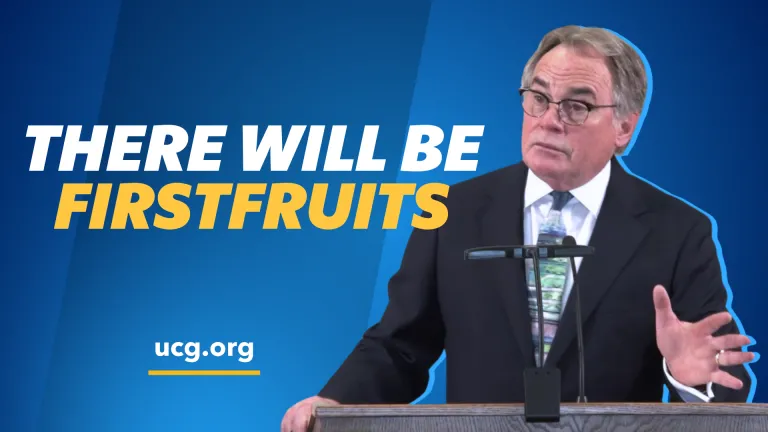

Darris McNeely
This transcript was generated by AI and may contain errors. It is provided to assist those who may not be able to listen to the message.
Thank you, Cynthia, very much. You handled that with grace and class. Every presenter's nightmare that the electronics will fail at some point, what do you do now? You start over way through my sermon. I guess I'll just have to start all over. So you folks better pray the sound stays on.
It's a beautiful Sabbath morning, isn't it? Absolutely gorgeous. We had some company in last night, overnight, and we stayed up late. It was a little bit warmer when we went to bed than it had been than we got up this morning and just acted.
All of us in this room, for all of God's people, assembled on this day of Pentecost to observe this holy day. Why are we here after all these years, after all of these experiences in the Church of God, after all the experiences that each of us have had in our lives? Growing up in the Church, marrying into faith, having children, seeing our children come and go. People divorcing, people dying, people coming, people going, people coming in, people leaving, people coming back. Why are we here today? Why are you here on the Feast of Pentecost? Why are you here on any Sabbath?
Why are you here before God in this unique and special occasion? We need to understand that because the Feast of Pentecost is really a story for the Church. It is a story for the Church of God. It has always been that way. And in my experience of keeping and observing this day in the multiple decades that I've been doing it, I have seen this to be a remarkable experience in many ways, one filled with controversy, one filled with great meaning, one filled with great joy, as we observe this day, as well as all the days, but this one in particular because of its meaning for the Church.
And for us to reflect about that and on that is extremely important. That's the story. That's the story of this day that we need to focus on. Why are we here? Christ told the disciples prior to His final ascension to heaven, wait and you will be imbued with power from on high. And they waited. And on the day of Pentecost, we're told in Acts 2, they were assembled wherever they were, possibly quite likely in some room near the temple or within the temple confines.
When God poured out His Holy Spirit upon the Church on this day of Pentecost and we know what happened there. I won't read it this morning. I plan to read it this afternoon because it I think will fit a little bit better with the message I want to bring this afternoon, a shorter message, and backing up Mr.
Booth's, Aaron Booth's presentation that I'd ask him to come and make to you to explain and to show some of the advances that God has blessed us with in the Church to preach the Gospel and the message that there is in that also for this Feast of Pentecost as well. But God poured out His Holy Spirit. They were there according to a command because of the law to be assembled on that festival. Pentecost was one of the great festival pilgrimages of the Jews during that period of time of the Second Temple. They went up three times a year to keep the festivals and this was the second.
They were gathered, many multiple thousands within the city, but this unique group of small people that would form the basis of the Church were there and God performed a very miraculous event that helped them to fully grasp and understand why they were there and why they had gone through all the events of the previous weeks. The death, beating, suffering of Jesus Christ and His resurrection and what had been revealed to them in the subsequent meetings, discussions as Christ, the resurrected Christ, had actually appeared to them. They were primed for this day because it was a day for the Church.
It was a day for the Church to start. But they were here because of the command. And let's go back and review just quickly the instruction back in Leviticus 23 regarding this day.
Leviticus 23, where all the holy days are listed, verse 15. This day is a unique one in the holy days because it is not on an appointed day of the calendar. It is a day that has to be counted. And in verse 15, the instruction is given here. You shall count for yourselves from the day after the Sabbath, from the day that you brought the sheaf of the wave offering, seven Sabbaths shall be completed. Count fifty Sabbaths to the day after the seventh Sabbath, then you shall offer a new grain offering to the Lord. Sounds kind of like a maze to a treasure, doesn't it? When you look at it just initially, count fifty days and seven Sabbaths and all. On Pentecost, you will find groups meeting on different days other than today. There will be some meeting tomorrow of the church of God tradition. There will be some meeting next week, next Sunday, all because of their differences in the methods and the way it is counted. I was explaining to the congregation here yesterday briefly about the Jews and their tradition. This day, Pentecost or the Feast of Weeks, Shavuot, is almost a cipher. It's not even really in the mainstream of Judaism today. It's been a forgotten festival compared to Yom Kippur, Rosh Hashanah, Passover. They kind of gloss over this one for many reasons. But within our own church tradition, you will find people, because of the way it is counted. It's not my intent to get into all of that today. I think we have that very well documented and covered in our study paper and in our literature. I'm fully convinced that we are here on the right day, the day that we understand it as it should be counted within the church. You know, until 1974, we did keep it on a Monday. And it was a misunderstanding of the translations and what exactly was being said here. We know that this counting begins from the morning after the Sabbath that falls during the days of Unleavened Bread. It begins to be counted from that day, seven complete Sabbaths, unto the fiftieth day. Seven times seven is 49, and fiftieth brings us to today. And so, this became a controversy back in 1974, my first year in the ministry.
And some had concluded that it needed to... we were wrong keeping it on Monday, that Sunday was the day that it should be keeping it. And it went through... we didn't have anything like a doctrinal review committee or process at that time. Basically, our doctrinal review process was one man. And that had its limitations. It had its strengths as well. I don't diminish that. But bottom line, Mr. Armstrong, when he was shown that he was wrong, he made a change. And we began to keep it on Sunday. What was really interesting about that time is a festival, a holy day, and a controversy was used to split the church. It was used to split the church. And it did. And I was right in the middle of it. In fact, I was one who was distributing documents, papers that showed that it should have been on Sunday, and a naive exercise that we went through.
But after the dust settled, it was all sorted through. You begin to see motives and understand why certain things happen. And it takes a bit of time for the dust to settle for you to also understand the motives of human beings when it comes to church politics and church splits. And that was my first experience with that, and I learned a great deal. One of the initial things that I learned, one of the biggest experiences, was to certainly look to Jesus Christ. And that was a significant lesson to come on the day of Pentecost, because Christ is the head of the church, and this is the day when the church began. And so it was not insignificant and unusual that an effort to split the church was even engineered around a holy day and holy time. Satan has as many different devices to do that, but after the dust was settled and you look at human beings in the cold light of day, you always find human beings coming up short. But Jesus Christ is the head of the church, and He always guides us through safely out of the storm into calm waters, into a safe report, ready to go and to keep the ship sailing on a true course toward the Kingdom of God.
It's interesting that it centered around Pentecost at that time, because Pentecost is a holy day for the church. Now, in this instruction here in Leviticus 23, within the temple precincts, they were to bring out, in verse 17, two loaves of measured flour.
And at the end of verse 17, it says, they are the first fruits of the Lord. And they were to be offered along with animal offerings as well as part of the sacrifice. In verse 20, the priest was to wave them with the bread of their first fruits as a wave offering before the Lord with the two lambs. They shall be holy to the Lord for the priests. Those two loaves of bread bear deep significance, because as we overlay the New Testament church to the experience of Old Testament Israel, we recognize that these two loaves, one represented the Old Testament church or the state and nation of Israel. The other loaf represented the New Testament church, which began on this day as we read in Acts 2. And so these two loaves were symbolic of the church. The first fruits. The first fruits. This is a phrase that continues to roll through the scriptures and is applied to the people of God in the New Testament in a very direct and very important way. As I said, this day falling, as it does in its right smack dab in the middle of the Holy Day sequence, points backwards to the Passover and points forward to the fall festivals. This is kind of a hinge festival in one sense, around which all of them revolve. But it's a message that represents exactly where and what the church is all about at this particular point in time.
And the two loaves that were represented here were to represent both the Old and the New, and they were offered up as first fruits to God. Now, as we progress through the scriptures, we understand this application, this meaning of first fruits in a deeper, spiritual way. If you go to 1 Corinthians chapter 15, 1 Corinthians chapter 15, in this resurrection chapter, the Apostle Paul talks about the first fruits.
In verse 20, But now Christ is risen from the dead, and has become the first fruits of those who have fallen asleep of the dead, in a type of sleep. For since by man came death, by man also came the resurrection from the dead. As in Adam all die, even so in Christ, all shall be made alive. Christ was the second Adam. Adam, had he taken of the tree of life, it would have been a completely different story from that point on. But he set a course for mankind that had to be then, in a sense, course corrected by Jesus Christ, which is what Paul is really talking about here, and making it possible for man to live, because in Christ we will be made alive. Each one, in verse 23, in his own order, Christ, the first fruits, afterward, those who are Christ's, at his coming, his second coming, when he appears in the power and the glory of the universe.
And so, here we see the spiritual significance of this first harvest, celebrated here on the feast of Pentecost. It's made very, very clear. That wave sheaf offering, that offering that was made back during Unleavened Bread, began a harvest season that culminated in another barley harvest in that period of time and place 50 days later at Pentecost. That wave sheaf offering that was offered as part of that ceremony at the temple represented the resurrected Christ, ascending to his father. The offering of the first fruits on the day of Pentecost was then symbolic of the first fruits of God's harvest of all mankind in the resurrection. Paul here is beginning to show and bring forth that revelation and that understanding that is here from the Scriptures.
In Romans chapter 8, Paul talks about this as well. Romans chapter 8.
Let's begin in verse 22. For we know that the whole creation groans and labors with birth, pangs together until now. And in that one verse, he really summarizes a great deal of the story of the history of the world, of all nations and of all peoples, a creation that groans and labors with birth pangs, not able to bring forth wanting something better, wanting something different, wanting a utopia, a millennial experience, trying to find it through a political, religious, or philosophical idea, but never able to do it. Trying to find it through revolutions, through government, through humanly-devised systems that never bring about quite right.
And yet, even being able to see it. It's amazing how much even of the tree of the knowledge of good and evil, how much of the good, people can discern vaguely through a mist as they even read the scriptures and see certain elements of truth and understand various things, but never able to put the whole picture together. I've said many times in what I run across in the readings that I do, I find people today, modern writers, who see the elements of the holy days, who see certain things there about the various truths that we have, even the resurrection, even the fact that you're not going to heaven, that that's not the reward of the saved. And yet, they can't put it all together in a complete package to understand the plan of God. That's because God's calling is not there. That's because they are not part of the firstfruits. And yet, they yearn and they hope and work for something better, and they even achieve a measure of it. I just finished reading a book about a man named William Wilberforce. William Wilberforce lived in the 17 to 1800s in England. His story was told in a movie Amazing Grace a few years ago, if you ever saw that, and the book and the movie of the same title. William Wilberforce essentially was a one-man effort that abolished the slave trade in England during that period of time, went up against the powers of the king, parliament, and the established society. It took him several decades, but he got it done. What was interesting in reading about the man was that he had a religious conversion early on. He didn't know the full truth of God, but he had a conversion to the Bible and to becoming a seeker, if you will. And he was dedicated, and he saw in that one point of life and society that it was an evil that needed to be eradicated. That was his one life's ambition. And he got it done legally. It never really disappeared from the face of the earth. Even to this day, there's still slavery. But he worked very sincerely. He was one of those who, in a sense, Romans 8.22 talks about of groaning in pains and travail, wanting something better.
And glimpsing something through the Scriptures, but never seeing the full picture and the full story that God has given to his first fruits to you and to I today. And that's why we are here.
We should never forget that. We can look at other people, religious and spiritual people, good people in our world, and in past and present, and marvel. And quite frankly, I do marvel. When I was reading about a man like William Wilberforce, they called him Wilber, I had to marvel at his personal spirituality, his personal dedication to the Scriptures.
He didn't keep the Sabbath and he didn't keep the Holy Days, and he believed in other ideas that I don't believe in. But he had a dedication to something, and I had to realize, you know, sometimes he makes some of us look pretty pathetic. People like that. They're sincere, and they study the Bible more than you and I do.
But I don't want to believe in the Trinity, and I don't want to keep Sunday, and I don't want to go to the Church of England, and I don't want to go to the Methodist Church. I want to go to God's Church, I want to Sabbath, and I want to keep the Holy Days and the Feast of Tabernacles, because I know what I believe, and I know why I am here. Do you? Do all of us understand why we are here today? That's important. I understand that. And I can take a glean a little bit of chastisement, if you will, and say, I need to kick it up a notch. I need to step up my own personal life and learn. And to take the truth of God, and to take these precious truths that we have learned and make sure that they're kept bright and shiny before God's people.
Those of you that are here this morning, who want to learn, who want to be reminded of those things, and then as equally as important, to make sure that it is available to those whom God will call. As seed that is sown is brought out in the sermonette. As seed that is sown continues to go out, because, as I'll bring out this afternoon, that is another reason why we are called to preach the gospel and to make sure that those truths continue to be put out there. And God has given us some tools to do that. In one sense, bigger tools than we've ever had before.
And if we have to be smaller to use those tools, then that's to God's glory as well.
That's to God's glory as well. Because it's His work and the end result. And every one of us will bow down and thank God in humble obedience for His mercy and His grace when we finally get to that period of the kingdom and the resurrection. It will be by His power and His might and not by ours. So if we have to be smaller to do it, that's what will have to be done. But God will make sure that that work is done, as we will see. And so we as firstfruits must always keep this firm in our mind. In verse 23, He says, not only that, but we also who have the firstfruits of the Spirit, even we ourselves, grown within ourselves, eagerly waiting for the adoption, the redemption of our body. We wait for that time of the change as firstfruits, as we read about in 1 Corinthians chapter 15. We wait for that time. And in the process, just like the rest of creation, the rest of the world in our time and age, we grown within ourselves. And there's another verse, I won't read it here, but God helps us with that. Even as we've grown, we seek for understanding and we seek for help to get through each day or each season of our life.
And we move forward. God gives us that help by the power of His Spirit, because He is going to bring about His firstfruits. You know what is interesting, again, with what was mentioned in the Sermon at the Sowing of the Seed, the reference to Matthew 13 in that parable, many deep lessons there. But the big lesson out of Matthew 13, the parable of the sower and the seed, is that there will be a harvest. There will be a harvest. No matter where that seed falls, it falls on stony ground, it falls on ground that gives a little bit of fruit and, you know, snatched away, or it begins to bear fruit 30, 40, 60 fold. There will be a harvest. That's the point of that parable, I don't know, all of the parables. There will be a harvest of the Kingdom of God at this time, that time when we will be redeemed. And God is working today with a group of people He calls the firstfruits, called in this age, to have our minds and attitudes change to become like Christ through God's Spirit working within us. In James chapter 1, He writes of God's people in the same way.
James chapter 1, verse 18, of His own will He brought us forth by the word of truth, that we might be a kind of firstfruits of His creatures, a kind of firstfruits of His creatures.
The new international version says He chose to give us birth through the word of truth, that we might be a kind of firstfruits of all He created.
Which means that there will be secondfruits, or there will be those that will come after.
The firstfruits are those of God's plan called now. We find ourselves in a vastly different situation than those who will come in a time of a latter harvest. We're called now to not be a part of this world. Christ said that He was not of this world, and He said to us as His disciples don't be of this world. But He said don't be afraid as well. And yet at the same time, Jesus gave Himself, John 3, 16, the Father gave His Son because He loved the world. And yet we don't love the world to want to be a part of it, to be separate, but at the same time recognize why we are called now to develop the character of Christ while the rest of the world is held in the grips of the deception that Revelation 12 and verse 9 talks about. There is a deception that has gripped the world spiritually, even when there are glimmers of light as people see through a mist or through a fog at times and grasp certain aspects of truth, if you will, or understanding, but are never able to put together the whole picture. As I was saying yesterday, it's really obedience that helps us to continue to understand and to prove God. God says prove me now here with, when He was talking about tithing in the book of Malachi, prove me now. We prove God, we prove the Bible. Ultimately, we prove it by obedience, by doing it, by living it and seeing that it works.
How do you prove that this is the divinely inspired word of God? Because it either is or it isn't. This book has been rejected, debated, criticized, and critiqued ever since its first pages were formed by Moses. And Moses did write the first five books of this book. And it's been debated and critiqued ever since. How do you know it's the inspired word of God? Because it either is or it isn't. It can't be in between. It can't be looked at in any other way other than what it says to it is or it's a fraud. The only way you prove it, and I prove it, is by living it with God's help, by God's Spirit. You can read it. You can prove it.
You can see the beauty of its construction. You can see what it says about itself and about God and its self-revelation. But in the final analysis, after we prove that, yeah, Saturday is the Sabbath.
We should be keeping Pentecost rather than any other holiday, religiously speaking.
The only way you do it is learn it and prove it is then by doing it, keeping the Sabbath, proving God. That is what the job of a first fruit is for us in this time and in this age.
Ours is a unique calling. It has its challenges, its pressures to be called at this time and in this world. Frankly, trials and pressures that people called later in a different time will not have to endure to the end is a unique duty of a first fruit.
To overcome is a unique duty to a first fruit. If the church began on Pentecost, which it did, and if this holy day focuses upon a message for the church in this age, which it is, then there are some very direct statements from the Bible that tell us what that message is.
One of the most direct is what Jesus himself said in chapters 2 and 3 of Revelation, the messages to those seven churches from Ephesus all the way through to Laodicea. You look at every one of those messages and the final concluding part of the message, Christ urges the church to overcome. He who overcomes. It is the same to every one of those seven churches. So however you want to slice and dice what that is, prophetically, historically, a combination of both, whatever, it is for certain a message from Christ, the head of the church, to overcome. You know, what the church needs right now, the first fruits need more than probably anything else, it's just a good old-fashioned dose of overcoming.
Overcoming sin, overcoming ourselves, overcoming the world. Focus and an emphasis on overcoming, because that's what really Jesus says. He who overcomes, I will grant to sit with me in the temple, as a pillar in the temple, or I will change his name. And all the various promises that are listed there in Revelation to the churches are contingent upon overcoming.
Overcoming this world, which means we have to have a pretty cold, clear heart assessment of this world and ourselves. Overcoming is sometimes, I believe, in the church of God, even become a dirty word.
People want soft stuff. Do you?
You want a soft message? You want a safe message? You want a safe place?
Well, you know, sometimes my experience over the years, not even the church of God is a safe place, but that doesn't mean you walk out the door. That doesn't mean you stay away from it. That doesn't mean you put it in a rear-view mirror.
Because that world out there, and what it has to offer, is a whole lot more dangerous than anything we will find within the walls of the church of God and among the people of God.
You see, part of overcoming means to have the courage to face ourselves.
And if we find that we are weak, admit it. If we find that we have let down, we've sinned, we have Christ as our advocate, and we can be forgiven, and we can and should overcome.
One of the most remarkable verses in the book of Hebrews, in the story of the Lessons of Faith, of all those people of faith in Hebrews 11, it says of them that they, out of weakness, they were made strong.
Out of weakness, they were made strong. We don't become strong until we have to come face to face with our weakness, our inadequacies, and overcome them.
But overcoming sometimes can be a dirty word because it takes some admission, it takes some it takes some hard work, along with the grace of God and the spirit of God.
But it is perhaps what the church needs as much as anything else. And I don't say that on my authority. I say that on the authority of Jesus Christ and the message to the church.
Because it says, he who overcomes will I grant eternal life.
And that doesn't mean we beat each other up, that doesn't mean we beat ourselves up, but it means we take a good hard look at ourselves. And where we found we find that we have been weak, admit it, and try to help one another and work to be strong.
Because men and women of faith we're told were made strong out of weakness.
Made strong out of weakness. That's what builds faith.
Don't let your weakness or some other human being's weakness cause you to have a crisis of faith that throws out this word and throws out God in your life.
That's not what a first fruit does. That's not the job of a first fruit.
We are called right now in this age in a one-time special, unique period. Not later, but now. And it's to prepare for a very high calling.
That's why the first resurrection is called a better resurrection in Hebrews 11.
That's why that first resurrection is better and different because of what God puts the first fruits through. Christ very clearly showed that in the parable of the stewards and the noblemen in Luke 19.
Where He showed in that parable that there would be a time of stewardship when a nobleman would go into a far country to receive a kingdom. And upon his return he would call together those to whom he had granted a talent, a measure. And he would call them to account according to their works.
Ephesians 2 tells us, we are saved by grace. That not of ourselves, it is the gift of God.
Then a few verses down further it says we are then we also are called to good works. We are saved by grace, but we have works of righteousness that we are compelled to do based on the word of God and His law. And God will reward us accordingly.
This parable in Luke 19 describes the time of the first fruits harvest.
From the time of the beginning of the church to the return of Christ. The workers who were called, chosen, and faithful laborers are the members who were part of that spiritual body. Our calling presently is connected to the preaching of the gospel of the coming kingdom and to prepare to rule with Christ. And we are called to a special calling and to a better resurrection that Hebrews 11 verse 35 tells us. In Revelation chapter 14, there is a very special message that I think we should focus on here for a few minutes.
Revelation chapter 14 The whole story flow of the day of the Lord, which is the setting for the story and the message of the book of Revelation. We're told in verse 14 verse 1, John sees in his vision, I looked and behold a lamb standing on Mount Zion. This is in a vision as part of this period. And with him 144,000, having his father's name written on their foreheads.
And I heard a voice from heaven, like the voice of many waters and like the voice of God of loud thunder, and I heard the sound of harpists playing their harps.
They sang as it were a new song before the throne. Don't ask me what the song was. I can't tell you.
I like to imagine it had a little bit of country overtones to it.
But that's my personal preference. You may have something just a little bit different.
I can get a spiritual message out of a country song as well as a piece of Chopin or something a bit more spiritual, directly written to be more of a spiritual. I have no favorites necessarily. But anyway. But they sang a new song before the throne, before the four living creatures and the elders. And no one could learn that song except the 144,000 who were redeemed from the earth.
These are the ones who were not defiled with women for their virgins in a spiritual sense.
These are the ones who follow the Lamb wherever He goes.
These were redeemed from among men, being firstfruits to God and to the Lamb.
And in their mouth was found no deceit, for they are without fault before the throne of God.
So whoever these 144,000 are, and it's quite frankly a lot of vain searching to try to figure that out. So again, don't ask me who they are, exactly where they come from. They are what they are. And they're the firstfruits. Okay? So they're the people of God. And don't, you know, we can speculate from that point on, but what these five verses do tell us are some very specific and important things. And they are the firstfruits before God. It does provide us an insight, specifically here, into the character of those who are the firstfruits and why they accompany Jesus Christ. And that's what we should focus on. Don't worry about, you know, is the church going to be, does it, do you have to have 144,000 in the church or certain numbers and then ban Christ? No, don't go there. Don't study these prophetic scriptures from that point of view. Just look at what it tells you. There's a whole lifetime of study there. New truth does not mean that you figure out when Christ is going to return or who the 144,000 are. Okay? There's enough established truth just in this one section to look at it for you and I, frankly, to build a whole lifetime of study and growth spiritually upon. Why are they so valued before God? There are four things we can learn here. And I'll just point these out here in the remaining part of my sermon here.
And fortunately, the sound hasn't gone off, so I don't have to start all over again.
There are four things that we learn here about the first fruits. The first one is this. They're described as having the Father's name written in their foreheads in verse 1. God is foremost in their thoughts and in their mind. These people have not been seduced by false religious. They've come out of that. They are spiritual virgins, in that sense. But they have God's name in their foreheads, in their mind. They dwell on God. Their lives center around God. You know, when you keep the Sabbath, when you begin to obey God and to seek God and obey Him, your life will revolve around what He says for us to do. You and I know that. You know very well, folks, just how much your life is centered upon your faith. And that's why it is a special, unique calling. It must be a calling from God. It's why nobody can, in their most ingenious ability to explain the truth, can convert somebody else. It just can't be done. It takes a miracle of God to turn that human mind to a point of yielding your life around God. And if that's happened to us, there were firstfruits. And we are here today to remember that and not forget it, not lose sight of it. Because God is foremost in our minds. And we focus on that in our life and then in our study, in our thinking. We do see God acting in our lives. We do see God teaching us, leading us, helping us through the day, at school, in our jobs, in our home, in our relationships with our mates and our children. We see God in our lives, and we talk about that. And we are not ashamed to talk about that with our families, with our closest friends, with our fellow brothers in the church. God is in our foreheads. His name is written in our foreheads.
And we dwell upon His calling. The firstfruits have come out of and avoided this world and its domination. A second point of the firstfruit, it says in verse 4, they follow the Lamb wherever He goes. Not like Mary, who had a little lamb, but wherever the Lamb goes, the Lamb is Jesus Christ.
The firstfruits are faithfully devoted to Christ.
They will let nothing draw them away from their personal loyalty to Him. Christ is the head of the church. Christ is in the center of the church, in chapter 1 of Revelation tells us. He stands in the midst of the seven candlesticks.
He is the head of the body, in which we are a part. He guides it, and He leads it, and we go wherever He goes, which means we are attuned to His leadership, to His guidance, which means we're not afraid to mention the name of Jesus Christ. We're not afraid to acknowledge that He is the head of the church. We are not afraid to pray to Him and in His name to the Father, and recognize it through Him. We have access to the Father since He is our High Priest, and we recognize that role, and we look to Him in that way. And we are not afraid or ashamed to recognize that we, as an institution, as an organization, the United Church of God, need to be more Christ-like in our service, in our relations, because we want to follow the Lamb wherever He goes. But there will be nothing to detract from that loyalty to Him, since Christ is going to use the firstfruits to assist Him in bringing His knowledge to the world.
It's vital that the firstfruits be forever true to their Lord and Savior, Jesus Christ.
So there is a loyalty to Him and a focus upon Him. The third point that we are told here in these verses about the firstfruits is that they have been redeemed from among men.
Verse 4, the firstfruits are redeemed from among men, purchased by the blood of Christ, bought by God. The firstfruits know that their lives no longer belong to them, but rather to Jesus Christ. And the firstfruits seek to glorify God in body and in spirit, in all aspects of one's life. To know when to walk away from enticements, situations that lead to sin.
Scott Moss was bringing out in his sermon yesterday to know, to stay way back from that fence, from that point of no return that we might get to, whether it's in an area where we have a personal weakness with something in the flesh, an addiction, something sexual, or something spiritual. Now, we can do a good job of overcoming an addiction and staying away from a lot of the enticements of the flesh, but sometimes we might fall short on staying far back from the enticements of the spirit that can lead us to sin. Gossip, malice, accusation. We can't discern those and know when they're drawing us in to something very, very dangerous and very destructive spiritually.
Firstfruits know that their lives belong to God and glorify Him in that way. The fourth element is in verse 5. In their mouth was found no guile. In their mouth was found no guile.
And if it's not found in their mouth, it's probably not going to be found in their heart either.
Guile is deceit.
It's the malice of the human heart. It's saying one thing but really meaning something else. It's being duplicitous. It's not even speaking the truth of your own heart and your own mind.
It's leading a double life. It's claiming to be a Christian or to be a member of the Church of God, to be a Christian, and not doing it, really living it.
There's no deception in this type of an individual. There's no plotting.
There's no design or actions with words.
They've learned to identify it, recognize it, and stay completely back away from it because when you get caught up in it, and frankly, let's just be blunt, in the last year or more, in the last year or more, there has been a great deal of deceit, guile, deception, and outright lies within the Church of God, specifically the United Church of God.
And it has wrought its harvest. It has destroyed trust.
And I know some think that they can't trust the ministry anymore.
Folks, we all need to recognize that when trust is destroyed, it goes both ways.
It goes both ways.
We all need to trust one another.
We should let nothing destroy that. But there's been a lot of just frankly outright lies into which people have bought and believed, or even in the maybe disbelief of certain outlandish and truly blatant ones, couldn't bring themselves to distance themselves from.
Or the people spreading it, or the places where they could find it, and it did its work anyway.
And it did its work anyway.
And in the end, Satan wins. And even among those of us that are still standing, still here, we fight the lack of trust. We fight certain other doubts.
And you know what? Satan chuckles and he's still one. Even if he hasn't destroyed your faith, even if he hasn't enticed you to lack of trust or commitment, he's still one.
The firstfruits are those that have no guile.
There's no guile found in their mouth. We have to learn how to deal with the malice, the deceit that can be so carefully woven, because that is a problem that has just rife and always ready to be a seed that is planted and bears ill fruit among the people of God. I alluded at the beginning of my message about Pentecost controversy of 38 years ago, my first months in the ministry, and leading to a division. And quite frankly, among most of those people, just a complete shattering of faith.
Most of the people in the areas I worked who left the Church of God at that time left faith. They ultimately wound up leaving faith in God and in the truth and in themselves as firstfruits. Satan wins when those steps are taken, when those seeds are sown and they bear fruit. And so when we look at a section of Scripture like this in Revelation 14 that gives us some very specific instruction about the firstfruits. The people and all of us that this day typifies and represents, we are to learn from that. We need to have Jesus Christ in the forefront of our minds. We need to be following the Lamb wherever He goes. Recognize that we have been redeemed from among the men and the people in the world of this age.
And make sure there is no guile found in our mouth and even in our heart. To come to grips with the deceit of our own hearts and to be fully submitted to a pure and an unspotted life of Christ dwelling in us. It's time for us all to recognize where we will stand. Where we stand with the Lamb in this vision and in this image and accomplish what we have been called to do. It says about these firstfruits for all these things. At the end of verse 5, they are without fault before the throne of God. That's the picture that God holds out of the firstfruits and of those who are part of this scene. And He is bringing that to pass. That's the beautiful part of it, folks. That's the beautiful part of it. He is bringing it to pass.
Because this is a vision of where Jesus Christ is. And He's bringing His church to this point in time. And it will be prepared as a bride and it will meet Him at that moment, at that time, when all of this will be clarified and brought to full knowledge and full understanding.
And all the groaning and the paining of the creation will come to an end when these moments transpire at the time of the conclusion of the period of the firstfruits and the first resurrection. That's why we're here. That's the most important story for us to have and to be close to. That story that God is weaving together and bringing to this moment in time, when the firstfruits will recognize their inheritance.
Let's let that story be within us and let's also recognize that on this day we are going to be to rededicate ourselves to the work that is going to culminate in the harvest, pictured by the holy days in the fall. And this afternoon we'll have an opportunity to see exactly how our lives fit into that, a little bit more, and how that greater work is yet ahead of us.
God has called us to be a firstfruits. He has called us to be a part of His Kingdom. Let's let that story and not that time identify who we are and why we are here.

Darris McNeely is a retired elder in the United Church of God. He and his wife, Debbie, have served in the ministry for more than 53 years. They have two sons, who are both married, and four grandchildren. Darris continues teaching at Ambassador Bible Center and is a member of the Council of Elders. Darris and Debbie continue to travel and keep up with the many friends and relationships around the world.
