

Robin S Webber
This transcript was generated by AI and may contain errors. It is provided to assist those who may not be able to listen to the message.
Recently, Susie and I were able to take our grandsons on a little day trip. One of the mothers came along, too. And we came down, guess where, to San Diego. Where else would one go to do something very special and neat that you can't do anywhere else? And we were there at the foot of Broadway. We were there at the Embarcadero. And a lot of ships are there now. When I was young, and we were all young at one time, I was five or six, and I thought a big ship then was the Star of India.
All San Diegans know the Star of India. That's the mascot for San Diego, an old 1855 freighter ship. But we didn't go to the Star of India because our youngest grandson, Georgie, has this fascination right now with big, big ships. And seeing that he couldn't see the Titanic, because it sunk, we decided to take them down to San Diego to see a big, big, big ship. And so we had the opportunity to take them to the Midway.
Most of us in San Diego are familiar with the Midway, right there at the foot of Broadway, downtown. And it is now a museum, because most naval vessels after 40 years are put into retirement. And the Midway aircraft carrier came into San Diego, I think, about in the early 1990s, was retired, and has been a museum ever since.
Susan and I have actually been on the Midway a couple of times before we guessed out of town or other parts of our family. So I've always gone away impressed with that ship, not because it's necessarily an instrument of war, but because of just a lot of what I'm going to be able to share with you today, in regards to what you and I are about as the people of God and as the army of God and as soldiers of Jesus Christ.
I've always been impressed by it, but this time I went away and I'll just say I was triply impressed with some of the spiritual lessons that I came to grips with there, and that I want to share with you today. And I think it'll fall in line with Mr. Mike Grider's message about counting the cost as we go along. Allow me to share with you, you are San Diegans, but for some that may not know about the Midway. The Midway is an aircraft carrier, and it is now a museum piece sitting on the waters of San Diego Harbor.
The Midway is named after one of the great opening battles in the Pacific during World War II. America was on its heels. It had been had the surprise attack at Pearl Harbor. It was back on its heels, and all of a sudden, just like it came back. And the Battle of Midway with the Japanese Empire was the beginning of a turning point, and there would be no going back, as America and its allies would begin to move slowly through the island chains of the Pacific towards the heartland of the Japanese Empire.
The Midway did not fight in World War II, though. The Midway is named after the Battle of Midway. But it did see service for many, many, many years. From 1945 on, it was in service. It was an instrument during the Cold War. It fought in the Korean War. It was in the Vietnam War.
And its last course of action was in 1990-91, when we were with the Persian Gulf War, when Iraq had invaded Kuwait. We'll remember that. It's hard to believe that. It's now over 30 years ago. Sometimes that can just seem like yesterday. Allow me, though, to share a little bit about the Midway. You might want to jot this down. I'm an old teacher, so I'll give you a few facts. You can kind of figure out where we're going to go, because what I'm going to share is going to be important.
The Midway itself, when it was built, was the longest ship in the world. It's over 1,000 feet long. This is going to be very important to what we're going to be discussing. It's over 1,000 feet long. It's over from the sea upwards, up to the top tower, up above the flight deck.
It's over 200 feet high. Now, you think about that. It's as high as a 20-story building at its apex. Not only that, but there are multiple, multiple, multiple, multiple layers to the Midway. I've got a bad knee, so I remember going down those stairs one after another. There were a lot of stairs, and there were not a lot of levels going down. It's very interesting, too, to think about it. Get this. Are you ready? It had 4,100 Navy personnel on it. I just want you to think that through for a moment. We're talking about a city of people floating on a boat out at sea.
Those are a lot of people. What are aircraft carriers used for? You say, I don't know, I don't care. Well, you're going to know, and you're going to care by the end of this message. Because we're going to have a lot of similarities to that aircraft carrier. Aircraft carriers are for one purpose. Actually, two purposes. Number one is for projection. It is for projection of the interest of the nation that has built it to make communication around the world that it is present.
It is projection. Projection is important. And number two, with that projection, then comes influence. Comes influence. Basically, in a benign nation, its influence is to maintain the peace around the globe. It is to keep the sea lanes open. It is to keep the lines of communication open. And that's very important to understand.
Projection, influence. As you and I are here today, around this globe, 24,000 miles around, we have probably about 24 to 25 aircraft carrier groups moving through the seven seas to project and to influence. How important is that? If you go back to, I think, as Mathias and his major book on sea lanes, it is very, very important.
Very, very important. Another thing I'd like to share about that, though, is to recognize something. Maybe recently, some of us saw the movie with, what's his name? Oh, Tom Cruise. Just joking. Tom Cruise. I think it's the first movie that we, Susan and I, had seen, like, some years. We don't often see movies, and we got to watch that at home. So some of you might be a member with the first one that was made years ago, Top Gun, and or maybe even this recent one.
And so, so often what happens is we get glued into a personality. We get glued into the one guy that's in the jet and being catapulted off and doing all the machinations up in the sky. And he is the star. But here's what I took away when I was on the Midway. 4,100 people on all of those levels, 1,000 feet long, probably five or six, seven levels going down.
While there's one guy or a number of people maybe being catapulted off that plane at just mind-boggling speeds. It's like, it's just like a slingshot. The only thing faster and more dynamic would be going up from Cape Canaveral. It's awesome. But he's not alone. He may quote-unquote be the top gun. He may be the star of the moment. But it takes everybody on board that boat. Everybody on board? Everybody on that boat to make it happen.
When you go on there and you find out that here is this city of people sitting on water. And I recognize, yes, you have again the person going off, being catapulted off, going to war, battling. But also you have four different groups of men, all in different colors up there on that flight deck, knowing exactly what they're doing, when they're doing, how they're doing, why they're doing, what they are doing to get that jet off the deck. You have the people up in the control tower. You have people in the helicopters ready to do a sea-time rescue if need be. And then down below you have people that are working in two or three different kitchen areas. An army and, yes, a navy moves on its stomach. You have people that are in the medical department. You have dentists. You have chaplains. You have guys down, down, down in the boiler room, keeping it all going. Did I say you even have a dentist on board? And not only that, but you have custodians on board. You know, one of the greatest challenges to armies and navies, when they're like in a tin can, as it were, is health. You have to have a clean shop. You don't want to have epidemics spread throughout the ship. Now, while that man is up there, and he's about to be launched at just absolutely incredible speed, he recognizes that everybody on that boat, up to that point, has been working towards him going off. He is not alone. Everybody has a function. Everybody has a duty. Everybody is important on that ship. There is no one alone, really, when you're on an aircraft carrier. And each and every person has respect for all. Because they all have a job, and all those jobs may vary, but are you with me? But they all are a part of the same mission. And that's what I took away. I'd like to just share a couple of thoughts, terms that you've heard of over the years, but I'd like to just define them a little bit, and then build it into and move it into the message. We often hear of the term of esprit de corps. What is esprit de corps? It is a sense of unity of common interest and responsibilities, as developed among a group of persons closely associated in a task, a cause, or an enterprise. Now, when you just take the word esprit de corps, that's simply, you know, it's French, and what it means is the same spirit in the body. The body has a spirit. It has a common purpose. Allow me, then, to share another thought in all of this, a term that we often use in a military sense, or not only a military sense, but also a national sense. I plurpas unum. I plurpas unum. I think most of us are familiar with that at one degree or another. And what does that mean? That comes out of the Latin. And that means out of many, one. Out of many, one.
It can also be translated as one out of many, or one from many. I think you're going to begin to see where I'm going to be going with this in a moment. So, what are they on? They are trying to keep the peace, but to recognize also they are on a mission to where they might have to defend the peace. And sometimes the call of alarm comes. And on that ship that was 1100, 1100 feet long, all of those decks, 4000 men, when the red alert came on, they had to recognize that they were maybe a second away from calamity. And they all had to do their job, whatever it was. Now think about this for a moment. They were on that ship and they were on the flight deck, and that's what you usually see in the movies. But all those men at all the different levels, down in the boiler room, the mechanics, the men that are on the helicopters ready for rescue, are off the ocean. They had all been alert. Something could happen, and could and did. It's much like Schwarzkopf said during the Persian Gulf War, that death places the mind in a wondrous focus. And then the training takes over. That moment between stimulus and response. And for that moment, you band together as a band of brothers. And of course, today I believe we have women also serving in the Navy. So to update this, you are a family. You are bonded. And somebody's life could depend upon that.
I want to use one other term. And being the son of a Marine, my father always heard this, continued to hear this, because San Diego has so many military operations. That is simply Simparefidelis. Simparefidelis. Latin again. What does that mean? It means always faithful, always loyal. The Marines have a motto that to never leave any man behind. There is a bond. Out of all of this, just for time's sake, allow me to share something with you. And you might want to jot these down just so you can stay with me and maybe take it home and think about it. There are three words that have now lodged in my mind as I came off the midway. That is what I like to share. Number one was the immensity, the immensity of that ship. Number two was the complexity of that ship and all the elements that I've just described. But number three, what made it work at the end, was simplicity. And sometimes we can get tangled up in our own lives with immensity, a lot coming at us. We can get caught up with complexity, a lot of angles with everything that is coming our way. And how do we put it together? But number three, then, is simplicity. And I share with you today the words of the Apostle Paul in 2 Corinthians 11, verse 3. There is a simplicity which is in Christ Jesus, and I would speak to you about that today. Join me, if you would, in Romans 12, and we'll allow this set of verses to define my specific purpose statement.
In Romans 12, I beseech you therefore, brethren, by the mercies of God, that you present your bodies a living sacrifice, holy, acceptable to God, which is your reasonable service. And do not be conformed to the world, but be transformed by the renewing of your mind, that you may prove what is that good and acceptable and perfect will of God. Now, Paul says in the first person, For I say, through the grace given to me, to everyone who is among you, not to think of himself more highly than he ought to think of himself, but to think soberly, as God has dealt to each one a measure of faith.
Don't let vanity, don't let pride, don't allow look who I am, don't look at what I am doing to sweep you away and to be ineffective. For as we have many members in one body, but all the members do not have the same function.
So we, being many, are one body in Christ, and individually members of one another.
And thus, I share this message with you today. And the purpose of my message is to find simply this, and I'll give you the title, We being many are one. We being many are one.
And there are many different analogies that we can draw upon as soldiers of Jesus Christ, and being in his service with what I gave you as an intro and with the statement of Paul here. Let's understand a couple of things. We serve not the Department of War, but we do serve the Prince of Peace. That title that comes out of the Messianic prophecy in Isaiah. He is the Prince of Peace. He also is entitled as the captain of our salvation.
Now, when you look at the overall kingdom existence of God and what he has in store, we might say that at the end of the day, and yes, Jesus is God, as God is God. He came from uncreated. He is eternal in that scope. But just for analogy sake, for what I've been saying, you might say he is top gun. He was in the cockpit. And rather than taking somebody else's life, he gave his own life. But just like Tom Cruise and that jet aircraft and the many real Tom Cruises that don't have the name Tom Cruise, but are doing this all the time, every day, every week, every year in our lives, he has to have a lot of helpers. Join me if you would in John 1516. John 1516.
And John 15, and notice what it says here. Actually, I'm going to go up to verse 15. No longer do I call you servants, for a servant does not know what his master is doing. But I have called you friends, for all that I heard from my father I have made known to you. Now notice this, please. You did not choose me. But I chose you and appointed you that you should go and bear fruit, and that your fruit should remain, that whatever you ask the Father in my name, he may give it to you. What is Jesus saying here? Now he's talking to his original disciples at this point on the last night of his human life.
But when God the Father sent Jesus Christ to this earth and gave him that commission to anogorate the kingdom of God, for he said, indeed it is at a hand. Repent and believe. When you have a great task, you cannot do it by yourself. Even Jesus recognized that, again, he realized that he would not be here. He came for a purpose, and he would go. Again, for a purpose up above to be our intercessor. But he chose, anytime you have a task, that important to spread the gospel, you're going to want to have helpers. You realize you just can't do it by yourself. You're going to need help. Now, we could say that this was originally for the Twelve, and the Twelve do indeed hold a very special spot in the history of the church.
But to recognize, again, these words can come down to us today, in the 21st century, to recognize that we have been called for a purpose. Let's understand a few things that will actually fit in with what Mr. Mike Ryder said. Using the military senses, let's understand this. Let's just be blunt. You and I, as we understand it through Scripture, we were drafted by God.
We were drafted by God to be a part of His family in this time and in this age. Remember back in World War I, or was it World War II, where you had Uncle Sam in his get-up, and you know that the finger was pointing? I'm going to point at Bob. Bob, you don't have to go into the surface. I think you're over 21.
I want you. That's exactly what God did with all of us. In a sense, that divine finger came down and said, I want you to be a part of what I'm doing. I want you to be a part of this team. And, of course, then, that's merely by God's grace. It's by His favor. It's by His personal inclination that He invited us into this family. But then we voluntarily came on board. It was volunteered. We weren't dragged on board. We were called to come on board, but as we just heard in the first message, we had to count the cost. And a part of that cost was to recognize, as we counted the cost, as we heard in the first message, to recognize that, again, when we count the cost and recognize what God is offering us, that He is offering us to one day be a part of His family and to be with Him, to recognize that before we bear a crown, we've got to bear a cross. And that's the deal that each and every one of us have to make. God does not have favorites in this. Each and every one of us are going to have to bear a cross before we bear a crown. That's the example. Jesus said, if you're going to follow Me, then take up your cross, not His cross. That was special. That was unique, what He did. But then He said, then you'll have to bear your own cross. And, of course, though, to recognize that we don't bear it alone. What is unique? One thing that I thought about when I was on the Midway with all of this is simply this. It's amazing that you have people on that ship from all over the United States.
All together, different races, different ethnic groups, different ways of mangling the English language. Everybody does it. I'm a Californian. I'm still trying to learn how to speak English. But you might hear a little of Francis from a Cajun down out of East Texas or Louisiana. You might hear a little something out of Brooklyn.
You might have heard a little Spanish accent from somebody back then from New Mexico or maybe in South Texas, down there in the grapefruit area of Texas, down there by the Rio Grande. You would have heard maybe just that bland New York accent from upstate New York, or the accent from Chicago, Illinois, unless maybe you had a little Polish in your background. So maybe you might have a little Eastern thing going there as well. And all these people came together from all different parts of the United States and brought into this whole to serve and to hold a mission. One thing that is very important that I thought about when I was here, join me if you would in Acts 17.
And again, to just share something with you, the oneness of what we're talking about. We being many are one. And Paul alluded to this in that very famous message that he gave at Athens on Mars Hill. And we notice one thing that he mentioned here that is, can I just say something to you, please? How revolutionary the Bible is. People say, well, where's the science? The science is in the Scripture. It says here, notice when it says that, verse 25, of course he worships the men's hands as though he needed anything since he gives to all life breath and all things. Now notice verse 26, and he has made from one blood every nation of men to dwell on all the face of the earth and has determined their pre-appointed times and the boundaries of their dwellings.
I want to share something if you've never heard this amplified. Paul is stating something that just knocked the socks off the Greeks and the Romans. You have to understand that Aristotle, back in the fourth century, had basically categorized all natures. Nature of man, nature of geology. He was one of the first big scientists. But in that he also created that there were the Greeks and then the Romans came along.
And to the Greeks at least, anything that was not Greek, anything that was not touched by Hellenism was barbarian. Bar, bar, barbarian. It was the other. It was subhuman. And that's why you could have that kind of slavery back in the world of antiquity. That's why the Romans could put on gladiator fights and watch people die and not think anything of it. Because in Aristotle's mind there was slaves and others were animate tools.
They were living tools, but they weren't human beings. So therefore they must have been different. And here Paul just knocks it out of the park. He says, don't you know... and he's saying this on the Areopagus as the backdrop of the Acropolis behind him. And he says, all man is made of one blood. Christianity is not old-fashioned. It's ahead of its times. And so all these people came on. Let's just say whether it's the Midway or those that God is calling into his body today.
And to recognize that just at the human level that we are all of one blood. But now join me over and let's build upon this going to the book of Colossians. In the book of Colossians... And if you don't know where Colossians is, it's behind Philippians. If you don't know where Philippians is, I'll let you look at your index. Colossians 1 verse 17. Notice what it says here. And he is before... speaking of Jesus... And he is before all things, and in him all things consist. And he is the head of the body, the church, the called-out ones, the ecclesia, who is the beginning, the firstborn from the dead, that in all things he may have the preeminence.
For it please the Father, that in him all the fullness should dwell, and by him to reconcile all things to himself by him, whether things on earth or things in heaven, having made peace through the blood of his cross. And you who were once alienated and enemies in your mind by wicked works, yet now he has reconciled. So there's two things about blood. Number one, just the natural man, the natural woman, all of us, no matter what our last names are or our maiden names were or this or that, we are physically all of one blood.
But then, once we accept that draft call of God the Father, then we count the cost, then we hear the words of Jesus Christ, that I have chosen you, you have not chosen me. We count that cost, and then to recognize a part of that, then, is that we accept the blood of Jesus Christ. So you and I here that are today, or you that are listening to this message today, we are family. We are one blood as a human family, but now we are also one blood that covers us, covers our sins, has given us a new life, and as stated in 2 Corinthians 5 and verse 17, we are indeed a new creation and replaced into this body of Christ.
Now, what happens is when we baptize somebody, and we just recently baptized one of our members here, no, not here today, but that baptized out in the lobby, when we baptize somebody, we baptize somebody individually because we come to God individually. We lay our hands on their head, they receive the Holy Spirit, and they become, then, they are baptized individually, but then God puts them into the body of Christ, which is a spiritual organism.
It's a spiritual organism, no one but to God. God knows who are His. He does not lose track of His flock.
Just as much, then, what I'm drawing upon here is not only our local people here in this assembly, in this congregation, or just members of the United Church of God, but there's a body of Christ. It's a spiritual organism, no one but to God. How do I define that body? It's limited. God knows who are His. But I look at Revelation 14 and verse 12, and it says, those that keep the commandments of God and those that have the testimony of Jesus Christ, that's where I begin, that's where I end, and I leave that to God. But He incorporates all these people. I don't know them all. You do not know them all. God knows them all. And Jesus Christ died for them all, as He did for each and every one of us. So we look at this. So wherever that body of Christ is, and God knows who are His, they are locked onto the mission. What is the mission? Join me if you can, Matthew 6.33. Remember when I was speaking earlier, when that moment comes, everybody on the Midway was locked into the mission. Let's share what that mission is, Matthew 6.33. In Matthew 6 and verse 33, let's take a look here. The mission. But seek first the kingdom of God. Okay. Then what? Is that the mission?
God says how? And His righteousness.
And all these things shall be added to you. Now remember, He's saying this in the course of the Sermon on the Mount.
It's not just simply your way of seeking His kingdom and sliding in on your good looks. That keeps me out altogether.
And His righteousness. Not the righteousness of religiosity. Not just simply the righteousness of what you know. But God's righteousness imputed to us that we act upon, that we abide within, that goes below our skin and begins not from the outside but the inside, but what is laying in our heart that we act upon. This is the big step. This is what we do not see all the time in the world. When Jesus said in Matthew 6 and verse 8, do not be like them. The first time that is given in the book of Leviticus by God to Moses, He was talking about the Gentile pagan nations around Him. But when Jesus, that second Moses, that greater Moses, is sharing that from another mount, He says, do not be like them. It is not just merely speaking about the world that does not know God and has kicked them out of His life, but those that pretend to know God, give God half of their life, are not filled with the mission, are not concerned about the other people that are on the boat, and all they do is think of themselves. This is the mission. This is what we've been called to. Remember when we were talking about what... I'm going to quiz you now. Ready? See if you come back on me.
What are aircraft carriers for? Two things.
Why does an aircraft carrier... We still have a couple in San Diego Harbor right now, on the other side of North Island. What is the purpose of an aircraft carrier? Sorry? Thank you! Projection. And as you have projection, then what do you offer? This is the best you've ever done. This is wonderful. I'm going to have to stay here another 20 years. This is great. You did it. Projection and influence. What did Jesus say that when he called us? What did he say? You are going to be what? In the Sermon on the Mount? You are to become salt, and you are to become light. Both have projection. Both have influence. Both give flavor to circumstances that may not have been there before. For you, Mike, we'll throw that in. With all of this data, and with God being on our side, here's one thing that we need to recognize. In Ephesians 2, we need to recognize, as we are projecting, the world that is around us. In Ephesians 2, verse 1, notice it says here, that he has made us alive, who were dead in trespasses and sins, to which you once walked according to the course of this world, according to the prince of the power of the air, the spirit that now works in the sons of disobedience. So we have been called to operate in a hostile environment. And we must be able to operate in a hostile environment. And we must be ready, brethren. We must be after and mindful of being our brother's keeper and the family of God and the body of Christ around the world. Tom Cruise, up on the flight deck, may not have known the person at the sixth level, but he knew he was down there. He might not have known his name, but he knew he was down there. He knew there were people in the boiler room. He knew that there were people that were serving behind the kitchen lines. He knew that there was a medic. He knew this person. He knew that we need to be aware of our brethren and the family of God and to recognize that we are not alone. We need to know one another. We need to be about one another. We need to pray for one another. We need to love one another. We need to all be rowing together, pulling together, not pulling apart. Susan and I were talking as we were coming down, as we want to do, because we have lots of time to talk when we're coming down to 15 to you, that we need more than ever, even more unity of our calling and our purpose. For two thousand years, Christianity has been attacked by division. By division. We cannot afford division any longer in the body of Christ, in the United Church of God, as an organization within that body of Christ. Being a product of Pasadena and being in the middle of so much over the years, we do not need division. God's favorite math is addition and multiplication. Have you ever noticed that in the book of Acts? When the church was doing that, which is right, it says, then disciples were added, or the disciples multiplied. But what time happens is that we go into what I call Satan's math. Subtraction. Division. Have you ever thought about this for a moment? What is God's favorite number? Is it two? Seven? It could be. It's always like that teacher that just has the answer. Your answer is really good, but I was looking for another one April. Did you ever have a teacher like that growing up, just looking for this one answer? I'll tell you what, just for sake of time. Rosie, it was on your lips. It wasn't on your lips, okay? Uno, no. Yeah, it's uno, okay? One. He loves oneness. He loves oneness. He loves unity. We being many are one. That doesn't just happen. Join me, if you would, in Ephesians 1 and verse 10. Ephesians 1. Let's pick up the thought if you could in verse 10.
That we who first trusted in Christ should be to the praise of His glory. In Him you also trusted after you heard the word of truth, the gospel of your salvation, in whom also, notice, having believed, you were sealed with the Holy Spirit of promise, who in the guarantee of our inheritance until the redemption of the purchased possession, to the praise of His glory. Therefore, I also, after I heard of your faith, the Lord said, and said, your love for all the saints, for your love for all the saints.
It's very interesting that this term says that we are sealed. When I used that term e pluripus unum, that is on our national seal. We being many are one.
But it's not just simply on our national seal, but when we are sealed, when we gain God's shiragma, or His seal, and or His positive holy mark in our lives, we have said that we will be one, though we be many. That is so incredibly important to understand.
What I'd like to share with you is by going over to Ephesians 4. In Ephesians 4, and here's what I'd like to share with all of you when it comes to remaining together in the love of God, in the grace of the Father, in the example of the Son, and in the great understandings that He's given us.
I therefore, verse 1, chapter 4, the prisoner of the Lord beseech you to walk worthy of the calling with which you are called, with all lowliness and gentleness, with long suffering, bearing with one another in love, endeavoring to keep the unity, endeavoring to keep the unity. It does not just happen. Unity, even in the body of Christ, does not just happen. Let me share something with you. It's a simple twist of phrase. If we take unity for granted, you can take it for granted that we will not have unity. I'm going to repeat that. If we take it for granted that we will have unity, you can take it for granted that we will not have unity. Notice what it says here. To endeavor to keep the unity. There is one body, one Spirit, just as you were called in one hope of your calling, one Lord, one faith, one baptism, one God, and Father of all, who is above all and through all and in you all, one, one, one, one, and one.
This is screaming at us in a positive sense. As I say oftentimes, teaching homiletics, this is loud.
This is where we center. This is where we study. This is what we hold on to. This is the simplicity which is in Jesus Christ, not counting how many angels are on the top of a pen, or figuring out the future that sometimes we have not been allowed to fully grasp or understand yet. And yet, knowing in faith that God will allow us to comprehend fully when that time comes based upon His promises.
And why does He give us all of this? Join me in verse 12, for the equipping of the saints, for the work of the ministry, for the edifying of the body of Christ, till we all come to the unity of the faith and of the knowledge of the Son of God to a perfect man, to the measure of the stature of Jesus Christ.
Join me, if you would, in 1 Corinthians 12.
In 1 Corinthians 12.
And we can start passing out that handout that I mentioned to the gentleman to pass out, please. 1 Corinthians 12. I'm picking up the thought in verse 12.
For as the body is one, and has many members, again, think of the Midway.
But let's think about the ship of state of the kingdom that God has placed us on today. For as the body is one, and as many members, but all the members of that one body, being many, are one body.
And so also is Christ. He's a part of that body. He's the head of the body.
Amazing.
For by one Spirit, we were all baptized into one body, whether Jew or Greek, whether slave or free, and have all been made to drink into one Spirit. For in fact, the body is not one member but many.
Again, think of that analogy of the Midway. You've got the hotshot pilot up there. He's probably scared to death. He's about to be catapulted off the deck of an aircraft carrier at hundreds of miles per hour within 250 feet. Hello. Anybody want to join him? No.
For in fact, the body is not one member. It's not just one person but many.
If the foot should say, because I am not a hand, I'm not of the body, is it therefore not of the body? And if the ear should say, because I am not an eye, I am not of the body, is it therefore not of the body? If the whole body were an eye, where would it be its hearing? If the whole were hearing, where would be the smelling? But now God has set the members, each one of them, in the body, just as He pleased them. And if they were all one member, where would the body be? But now, indeed, there are many members, and yet one body. And if the eye cannot say to the hand, I have no need of you, nor again the head to the feet, I have no need for you, no much rather those members of the body, which seem to be weaker or necessary. And those members of the body, which we think to be less honorable, on these we bestow greater honor, and on our unpresentable parts have greater modesty. And it goes on and on. But notice verse 25, that there should be no schism in the body, but that the members should have the same care, one for another. I remember many, many years ago, as a boy, growing up in Pasadena, hearing an elderly gentleman, and it was kind of a rather shocking statement at the time, but he said in his own inimitable style, Brethren, we have not been called for personal salvation. Somehow, with that voice, it left an impression on me, fifty-five years later. I thought, well, what's that mean? Let's break that down. We have, in one sense, yes, been called for personal salvation, because God does call us one by one, and we have to enter that baptismal pool individually, as was mentioned.
But I think what Mr. Armstrong was saying at that time is that we've been called to a work and to a cause, to be a support to that cause, because sometimes company is better than one. But also, I take that beyond being called for personal salvation, is frankly to be caring for one another, praying for one another in the body of Christ. To love one another, and to recognize that God has a people across this earth that are near and dear to Him, that are striving in faith by His grace to yield themselves to His ways in a world that is increasingly becoming pre-Christian in environment, or in a pagan society. Think of the people that we're helping over in Bangladesh. They're having their first Feast of Tabernacles this year! I'm sorry, I'm excited. I've been in this way of life for 62 years, and I'm getting excited again, seeing what's happening. Imagine having a feast site in a 90% Muslim country that people are brethren who are striving to obey God. And we may never meet them in this lifetime, but we can pray for them. We can know they can exist. As much as that top gun knows the guy's existing, who's the custodian seven levels down in the Midway, because they're all a part of the same mission.
Why is it that the Apostle Peter in his epistle says, Honor the king, okay, keeps you alive? But then he said number two, and love the brethren. Love the brotherhood. Respect them. Why am I saying this? I'm talking to myself up here. If I keep on talking to myself after the Amen, come and cart me away. But anyway, because that's what we're to do. To respect and to love what God is doing around this world, whether we ever meet them or not.
To know that we're on the same boat. Headed for the kingdom. I sincerely believe that when we pray, in sincerity and in truth, and we are mindful of those people in the body, God does touch and reach down and give them peace and give them understanding. What I'm sharing here today with you is we begin to conclude simply this.
I'm asking you as my friends, asking you as my friends, whoever watches out there in the future, change your worldview. Change your church view. Because so often we just see ourselves in our box within the body of Christ. Recognize that there are people that we will never meet, that we will never run into, that we do not know their name. But God the Father knows their name. They were drafted like you. They count at the cost like we did. They are of one blood. They are human beings that desired the best in this lifetime for themselves and their families.
They are also under the blood as you and I are, looking forward to the actual final extent of the kingdom of God coming to this earth. Change your worldview. Have a God view. It's not all about you. It's not all about me. And yet God has given us a portion in this to do. So what do I do as being a member of the body of Christ? Perhaps that has been handed out to you now. Now everybody have this moment.
We'll conclude with this and finish. Got this? Have you had a chance to read this yet? This is called the value of one key. Think of the men and the women on the boat, on the midway. Guy down at the lowest level in the boiler room. The medic, the dentist, the custodian, the kitchen worker, the helicopter operator, the guy setting up the sling, the catapult to send off the jet, the mechanics at work morning, noon, and night to get those jets ready and get them on top of the flight deck to go.
You may not know their name. And just like them, you might not think that you count. Are you ready? Let's go through this together. It's called the value of one key. And I'm sharing with you that God has called each and every one of us to be a key individual. And we all have a verse to add to the story that continues until we are resurrected. Even though my typewriter is an old model, it works quite well, except for just one of the keys.
Anybody noticed yet? I have wished many times that it worked perfectly. It is true that through our 46 keys, that function will be enough, but just one key not working makes the difference. Sometimes it seems that our church is like my typewriter. Not all the keys are working properly. You may say to yourself, Well, I'm only one person. I won't make or break this church. But it does make a difference because a church to be effective needs the active participation of every person.
So next time you think you are only one person and that your efforts are not really needed, remember this little note about my typewriter. And say to yourself, I am a key person in this congregation, and I am needed very much. Amen. I mean, Amen. With an E. In this lesson that I take away from having visited the Midway, and it really sunk into me, is how important each and every individual is in the body of Christ.
And each and every one of us are here for a purpose. Sometimes we may not understand it. But I'd like to end by sharing a story that will make this point of an individual that did understand, and it's a story. You can say, Well, there's another one of your stories, but it'll make a point.
Okay? There was a person that was going through a cathedral back in, we'll say, the 14th or 15th century, and cathedrals just didn't go up overnight. It sometimes took hundreds of years to build some of those cathedrals that were back in Europe. And so the man was coming in to see how things were going in the cathedral, and he noticed a man was over there, and the man was pounding on some iron, some framework, some ornamental framework that was going to go up in some portion of the cathedral.
And the man said, Excuse me, sir, but what are you doing? And the man looked at him, kind of startled, and looked after him to him. It's almost like, Don't you know? He says, I'm building a cathedral for the glory of God. Oh, thank you. So I kept on going, and he ran into this individual that was working on this window to bring in the light from outside into this, but it would otherwise be a dark cathedral, and was working with all the different stained glass, the colors, the light, the different colors, etc.
And he said, Excuse me, sir, what are you doing? Oh, I am building, I am creating a stained window for the glory of God. Oh, thank you very much. Well, three is a charm. So he's about to leave, and then all of a sudden he hears this noise in the back.
It's in this dark spot around the corner. So he goes around the corner, and he sees a woman kneeling over with a broom and with a dustbin, and she's sweeping.
She's sweeping, and she's sweeping up glass chard and iron filings and everything that had gone on there before.
And the man said, Excuse me, man, but what are you doing here in the dark? And why are you on your knees and sweeping? He said, sir, don't you understand? I am building a cathedral for the glory of God.
What I want to share with you in all of this is simply this. Thinking of the Midway, but bringing into our own lives where we are today.
Whatever God has laid on your heart, wherever you are right now and however you are serving, never minimize God's calling and what He's granted us. And to recognize whatever job, whatever level you might be at in this body of Christ, because we've seen every member counts, always remember simply this. It is never the size of the job that counts.
Are you with me? But it's the size of the heart.
That's God's view of all of us working together.
And as we regularize then, as we finish this message, let us praise God that we being many might be one.
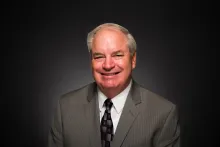
Robin Webber was born in Chicago, Illinois, in 1951, but has lived most of his life in California. He has been a part of the Church of God community since 1963. He attended Ambassador College in Pasadena from 1969-1973. He majored in theology and history.
Mr. Webber's interest remains in the study of history, socio-economics and literature. Over the years, he has offered his services to museums as a docent to share his enthusiasm and passions regarding these areas of expertise.
When time permits, he loves to go mountain biking on nearby ranch land and meet his wife as she hikes toward him.
