
Gary Petty
This sermon was given at the Oceanside, California 2016 Feast site.
This transcript was generated by AI and may contain errors. It is provided to assist those who may not be able to listen to the message.
Who owns Jerusalem? Jerusalem is the center of three of the world's largest religions. In Judaism, Jerusalem is where Abraham sacrificed, was willing to sacrifice Isaac. It is in Jerusalem that Solomon's temple was built, the very special dwelling place of God. To the people of Islam, it's special because it was there that Muhammad received...well, he was in another place, but his vision was he was in Jerusalem and Allah gave him special instructions. For the Christian, it's the center of where Jesus Christ was, the Savior of all mankind.
It's where He walked, where He died, for His sins, and where He was resurrected. And people have been fighting over who owns Jerusalem for thousands of years. Who does own it? We're going to talk about that today. Who owns Jerusalem? The Babylonians said it belonged to them. The Turks said it belonged to them. Which, Arabs say it belongs to them. Christian crusaders killed thousands of people saying, no, it belongs to us. One of the motivations for the crusades was that they had to take Jerusalem so Christ would come back because it had to be owned by Christians because they owned it.
It was theirs. And then Christ would come back. Today, there's even a question of who owns Jerusalem. If you're born in Jerusalem and you want to come into the United States, there's a question when you write down where you're coming from and you put Israel. There's some question. No, you come from Jerusalem. Because it's an international place. In Palestinian schools, they are taught that Solomon's Temple is a myth. It never existed there where they say it existed.
That it was a myth made up by Jews to pervert history. Unfortunately, Western people were too stupid to understand. And therefore, we don't really understand that Solomon's Temple never was where they say it was. It's all a myth to try to steal Jerusalem from them. Tens of thousands, hundreds of thousands of people have died over who owns Jerusalem. And before the Feast of Tabernacles, what it represents is fulfilled. Thousands, maybe millions of more will die over the question of who owns Jerusalem. Who owns Jerusalem has a lot to do with these Holy Days.
It has a lot to do with these Holy Days. And that's what we're going to talk about. We're going to talk about Jerusalem and the Fall Holy Days. And understanding that city and what it means, and understanding these Holy Days, go hand in hand with each other. Of course, Jerusalem, there's a lot of discussion over even what the name means and what the origin of the name is.
The most common belief is that it actually means the city of peace, or possession of peace. Salem being an English translation of a Hebrew word that means peace. So it is the city of peace. Isn't it ironic that the city of peace has probably been fought over more than any other piece of ground in history and awaits the greatest battle it has yet to face? It is the city of peace. It is generally accepted that the first mention of Jerusalem is in Genesis 14, where the king of Salem is talked about.
We won't go there. I want to take just a couple minutes to talk a little bit about the history of Jerusalem. Not too much. But when Joshua came into the Promised Land and led the Israelites into the Promised Land, Jerusalem was occupied by a group of people. It was a city-state. And the group of people who occupied it were known as the Jebusites. And Joshua came into the land and remembered the story where a group of people came and met the Israelites and told them they were from a far land and wanted to make a covenant with them.
And so they foolishly made this covenant only to find out as they marched a few days on that they came to Gibeon. And here the Gibeonites said, well, we made a covenant with you. You can't destroy our city. And so they all agreed to become the servants or the slaves of the Israelites. Well, the king of Jerusalem said, this isn't good. You know, we're afraid of the Israelites, but now they're allied with the Gibeonites, so we have to stop this. So he put together a coalition of five city-states, and they put an army together, and they marched on the Gibeonites to destroy them. They could take out the weak ally first. Of course, what happened is they asked Israel for help.
Israel went and God gave them the battle, and the Canaanite army was destroyed. And it says that the Israelites burned Jerusalem, but they never burned all of it. We know that because they occupied it very quickly. But they didn't occupy all of it. Part of Jerusalem was left to the Jebusites, and the reason why is that the Jebusites had a fortress. I'm going to show you a map here. It's not a map, it's an artist's rendering of old Jerusalem.
If we can just show that. It's on both sides here. I'm going to walk over here because I want to mark something on both of these. I'll be to the other side in just a moment. Can all of you over here see this part right here? I'm glad you said something, because I couldn't see you shake your hands. This is the fortress of the Jebusites. You can see very steep walls. Israelites took all of the city, but they didn't take that.
The Jebusites continued to live there. So you won't feel left out over here. You see this part here? You can see the valleys on both sides. Israelites took the whole city except for that. Just for that, the Jebusite fortress, Joshua did not take it. All during the time of Judges, the Jebusites occupied that fortress.
They never drove them out. The name of the fortress... Does anybody know? Zion. When you hear in the Bible Zion... This is the original Zion. The original Zion is the fortress of the Jebusites. Generation after generation of the Israelites never took that fortress. Until we find something... Let's go to 2 Samuel. We'll turn the lights back on in just a minute, but we don't want to look at something else in this drawing.
2 Samuel 5. Oh, thank you. Just read a couple verses. This is a fascinating story. I'm trying to give you about 3,000 years of history in 15 minutes. And the king and his men... This is David now. This is the time of David. So we've just jumped from Joshua to David because all during that time Zion was occupied by the Jebusites. And the king and his men went to Jerusalem against the Jebusites and the inhabitants of the land, who spoke to David, saying, You shall not come in here, but the blind and the lame will repel you.
In other words, nobody's taken our fortress in centuries. We can put the blind and lame people on the ramparts and defeat you, David. You have no chance here. So they taunted him. Nevertheless, David took the stronghold of Zion, that is the city of David. And so that citadel of Zion became also known as the city of David. Now just north of there, there's something else that's very, very important. If we can see the map again, or the picture again... Here's the city of David. See this part north of here? Anybody know what that is?
This is Mount Moriah. Just north of the city of David, which is Zion. These two areas are going to be called linked together throughout the scripture, as is the entire old city of Jerusalem.
Now I'll show you. This is the temple. Can you hear me in the back? This is the temple. This is the Temple Mount. It's known as Mount Moriah. It is just north of the city of David. As I said, those two areas become linked together in the scripture, not only in history, but they become linked together in prophecy. And they become linked together in the meaning of these days. Let's turn to 2 Chronicles.
We can turn that off now. Thank you. 2 Chronicles 3. Nothing new today. Just look at the scripture, and we rehearse, and we put it together, and we see what God is doing. We've now skipped ahead from the time of David to the time of Solomon. Now Solomon began to build the house of the Lord in Jerusalem on Mount Moriah, where the Lord had appeared to his father David, in the place that David had prepared on the threshing floor of Ornan, the Jebusite. You can look in 2 Samuel, and you can read all about how David went to Mount Uriah, and there he had to build a place to sacrifice to God to stop a plague that God was pouring out on the people of Israel.
And so we have this importance. He's building the temple at the place where David was told to build an altar. But that's not the only reason why this is a famous place. Let's go to Genesis 22. Genesis 22. Verse 1, God had a plan that was interacting with this area of the world from the very beginning.
And he was sending Abraham there, and he sent David there, and he sent Solomon there. And Zion and Moriah become linked together. Throughout the Scripture, you're going to see Jerusalem, Zion, and the Temple Mount all tied together in a very important way. So Solomon built the temple just north of the city of David. They're connected. And when he built the temple, something very important happened. Jerusalem is special, not just for all this biblical history. Jerusalem is special because God chose to do something at that spot that he never chose any other place in the world to do.
You know, God is everywhere, right? God's omnipresent. David talks about that. Wherever I go, you're there. I can't hide from you. Through God's Spirit, he interacts with his entire creation throughout the entire universe. But we know there are times where he, in a very special way, touches a place. And he's there in a very special way. People experience God in a special way.
When the Israelites carried that tabernacle for 40 years, they saw the presence of God in a special way. In a pillar of fire, in a pillar of smoke. It was amazing. No other place in the world were people seeing that. Let's look at 1 Kings 8. Solomon now finishes the temple.
1 Kings 8. Verse 1. So he finishes the temple, and he has to get the Ark of the Covenant. Now this is interesting, because where do you think the Ark of the Covenant was? At this point, it was in Zion. David had taken the Ark of the Covenant and taken it to the city of David. He said, go get it and bring it here, because this is where something special is going to happen. Now Solomon assembled the elders of Israel and all the heads of the tribes, the chief fathers of the children of Israel, to King Solomon and Jerusalem, that they may bring up the Ark of the Covenant of the Lord from the city of David, which is in Zion. He said, we have to go to Zion now. You have to get the priests prepared. They have to carry it on the poles. He had learned from David not to just pick this thing up and put it on a cart. It has to be carried in a very special way and taken care of in a very special way. But where is it? It's in David's city. It's in Zion. It's in that fortress. He said, bring it here to Mount Moriah, where I built this temple. And so they do. And look at verse 10. And it came to pass when the priests came out of the holy place. So they took it into the Holy of Holies, where it was supposed to be. There was an outer court and then an inner court. And then there was this Holy of Holies, a very small room, that the high priest could go into only once a year on the day of atonement. To make atonement. To cover the sins of all the people. The day of atonement was the most sacred day to the ancient Israelites. If the high priest went in and God did not accept his atonement, then he would kill the high priest and Israel would no longer be God's people. In fact, according to some ancient accounts, by the time of Jesus they actually had tied a little rope onto the priest's ankle. Just in case God killed him, they could pull him out. Because nobody was going in after him, okay?
And so they take it into the Holy of Holies. And look what happens here. That the cloud, remember God appeared in a pillar of fire. He appeared in a cloud. That the cloud filled the house of the Lord so that the priest could not continue. Ministering because of the cloud. For the glory of the Lord filled the house of the Lord. And Solomon spoke, the Lord said he would dwell in the dark cloud. I have surely built you an exalted house and a place for you to dwell in forever. There's only one place here on earth that God said, well that's my house. It was the temple. God owns everything. Everything is His house. But in a very special way, this temple was the house of the Lord. Israel did not exist unless it had land, unless it had laws of God, and unless it had the temple. That's what defined them. Those three things defined them.
Remove the temple, remove them from the land. They were lost people.
So this was the very special place of God. And so Zion and the Temple Mount become so connected that many times in the Scripture they're just called Zion.
So you'll see Jerusalem and Zion. Mr. Tuck talked about Jerusalem and Zion. In fact, I want to mention something he said a little bit later. So God was with them. He was there, and then they turned against God.
First Israel, God destroyed Israel. And then Judah. And when God destroyed Judah, the Babylonians came in and they sacked the temple. Eventually, when the Jews were allowed to come back out of the Babylonian captivity, they built another temple. Not near as extravagant as Solomon's, but they built another temple. And after a while, what happened to that one?
Well, it got remodeled by Herod, so it got to be really nice. And then the Romans sacked it, and they burned it. And there's been no temple there since. And so Mount Moriah is where everybody fights over that piece of ground.
Because it has to be special. Because that's where God touched people. Look at Isaiah 62, because there are many, many scriptures. And probably through the course of this piece of Tabernacles, there will be scriptures read about promises made of the restoration of Jerusalem. Isaiah 62. We'll just read a couple of verses. I'm just sort of cherry-picking. You know, it's hard to do 3,000 years of history in, like I said, 10 to 15 minutes.
But if you hit the highlights, we get the story flow. You all know this. We're just putting it in the context. We can all now think about the context. As we think about this history, we can begin to look at how it applies to the Holy Days and how it applies to the future.
We have to know the history first. Then we can really understand how it applies to the Holy Days and how it applies to the future. Verse 1 of Isaiah 62, The Spirit of the Lord is upon me. I'm sorry, I'm in verse 61, although that's a really good one too. Because it's about the Messiah. So we can read that during the Days of Unleavened Bread. I'm doing the Feast of Tabernacles. You can read during the Days of Unleavened Bread too. So you just get messed up and make it sound like you knew what you were talking about.
Being on TV teaches all kinds of things. Verse 1 of chapter 62, For Zion's sake I will not hold my peace. This is God talking. And for Jerusalem's sake I will not rest until her righteousness goes forth as brightness and her salvation is a lamp that burns.
The Gentiles, the nations, everyone, shall see your righteousness and all kings your glory. And you shall be called by a new name, which the mouth of the Lord will name. A new name. Jerusalem's going to receive a new name. The Romans tried to give it a new name. In 130 AD they finally kicked all the Jews out because the Jews had revolted against the Roman Empire.
They actually thought they could overthrow the Roman Empire. In 70 AD they thought they could kick them out of Judea. In 130 AD they thought they could overthrow the Empire. It was a revolt that happened in different places in the Empire. And so the Romans decided we'll kick them out, and they did. They threw all the Jews out of Jerusalem and they changed the name to a Roman name.
It was now a Roman city. That takes care of it. The Jewish God, he has no power here anymore because we've changed the name to a Roman name. It's back to Jerusalem. And there will come a time when we have a new name. When will that be? We'll look at that in a minute. He says... Let's skip down to verse 11 here. Verse 11 says, "...and then he remembered the days of old." He's talking about how God punishes them. Moses says, "...he's people saying, Where is he who brought them up out of the sea, with the shepherd of his flock?
Who led them by the right hand of Moses, and his glorious arm dividing the water before them." Wait a minute, another chapter. Let's go back to 11. Somebody must have needed that Scripture. "...Indeed, the Lord has proclaimed to the end of the world..." Now listen to this. "...say to the daughter of Zion, Surely your salvation is coming." The daughter of Zion. "...Surely your salvation is coming. Behold, his reward is with him, and his work before him.
They shall call them the holy people, the redeemed of the Lord. And you shall be called sought out, a city not forsaken." They saw it as a city forsaken. Read Jeremiah. Read what he went through as he walked through that city. And it had been devastated by the Babylonians. A guy had told him, I'm going to protect you. And then here he was with just a handful of people left, walking through a ruined city. And he was agonized. It's a city forsaken. And Isaiah says, no, there will come a time when you are not a city forsaken by God.
But he noticed he says, the daughters of Zion. See, Mr. Tuck was saying, it's interesting when you look through the Old Testament prophecies. Sometimes Jerusalem and Zion can mean the people. Well, that's not unusual. I mean, if you come from Canada, you're a Canadian, right? United States of America, you're an American. Wherever our citizenship is, we take that name on ourselves. So the people of Jerusalem, and then by extension Judah, and even Israel itself, became the children of Jerusalem.
The children of Zion. Because that's where God's special presence was. Why do you think in the Jewish world today, the desire to return to Jerusalem is so strong? It's where God's special presence is. It's their purpose that they cannot fulfill. It's interesting. In Europe, in the United States, there have been movements for hundreds of years to restore Jerusalem to a Jewish state.
Because somehow, that's what God wants. No one knows exactly why or how, but it's important to restore that. That's why in 1948, with the restoration of a Jewish state in Jerusalem, although at that point it wasn't in their hands, part of it is now, so many people said, this is the beginning of the end times. Because they realized this has to happen.
This is the place where God's coming to send the Messiah. The prophets tell us, to the physical city of Jerusalem, God is sending the Messiah. Now we've just jumped ahead to the future. Now we're looking at what the Feast of Trumpets, Day of Atonement, Feast of Tabernacles, is all about. And how Jerusalem is central to that. Look at Psalm 2. Psalm 2, one of the most famous of the Messianic Psalms, there has been some attempt by certain commentators to say, well, this is about David, it's not about the Messiah. Both in the book of Acts and the book of Hebrews, this chapter is quoted to say, this is about Jesus Christ.
So the New Testament writers said, no, this is about Jesus the Christ. He is the Messiah. But this part of it has not been fulfilled. So the prophecy is about Him, but it has not yet been fulfilled. Verse 1, why do the nations rage? And the people plot a vain thing. Nations are raging here.
Why? The kings of the earth set themselves and the rulers take counsel together against the Lord and against His anointed. Anointed is where we get the word Messiah. Saying, let us break their bonds in pieces and cast away their cords from us. He who sits in the heaven shall laugh, the Lord shall hold them in derision, and He shall speak to them in His wrath and distress them in His deep displeasure. Yet I have set my king on my holy hill of Zion.
That little patch of land with the Temple Mount in the city of David, in the old city of Jerusalem.
And He says, that is where I am going to set my king.
This is where Jesus Christ reigns on the earth.
He says, I will declare to the decree, the Lord has said to me, you are my son. And it is this verse, specifically, verse 7, that is mentioned three times in the New Testament, to say, this is Jesus Christ.
You are my son. Today I have begotten you. Ask of me, and I will give you the nations for your inheritance and the ends of the earth for your possession. You shall break them with a rod of iron. You shall dash them to pieces like a potter's will. Now therefore be wise, O kings. Be instructed, you judges of the earth. Serve the Lord with fear and rejoice with trembling. Kiss the sun, lest he be angry, and you perish in the way, when his wrath is kindled but a little. And bless are those who put their trust in him. We just went through the days of the Feast of Trumpets. When Jesus comes to the Mount of Olives, which is just across the little ways away from Zion.
And he comes there, not to stay there, but to go establish his headquarters for the Kingdom of God in Zion. A temple. He's going to build a temple on the Temple Mount.
And so here he comes to that area. And so this is the center.
This is why, by the way, Satan is so obsessed with Jerusalem. As long as Satan is the God of this world, people will fight over Jerusalem. He's obsessed with it. This is where Christ returns to set up God's Kingdom on this earth.
He talks about how the nations will rage against him. Probably, most every one of you at the Feast of Trumpets this year, someone read from Zechariah 14. Well, let's go there and just read a couple verses. Zechariah 14.
Behold, the day of the Lord is coming, verse 1, and your spoil shall be divided in your midst, for I will gather all the nations to battle against Jerusalem. The city shall be taken, the houses rifled, and the women ravished. Half the city shall go into captivity, but the remnant of the people shall not be cut off from the city. Then the Lord will go forth and fight against those nations as he fights in the day of battle. And in that day his feet will stand on the Mount of Olives, which is just outside that old city, which faces Jerusalem on the east. And the Mount of Olives shall be split in two from east to west, making a very large valley. Half of the mountain shall move towards the north and half towards the south.
When Jesus ascended after his resurrection, and he spent time with his disciples, he ascended from the Mount of Olives. And the disciples just sort of stood there, and they must have been thinking, what do we do now? He didn't set up the kingdom. He's supposed to come back to the Mount of Olives, and he just left. Remember, angels appeared and said, he'll come back this way. Go do what you're supposed to do. Which has been the same message for Christians for almost 2,000 years. He's coming back this way. Go do what you're supposed to do. If you read through the early part of the church, it appears that they all thought Jesus Christ was coming back in their lifetime. And as time went on, they started to realize, always not! But we have to go do what we're supposed to do. We have to live the way we're supposed to live. Remember I said that in the Old Testament, as Mr. Tuck said, that the Israelites could just be called Jerusalem or Zion, could be a symbol for all of them as people.
Because they were citizens of this capital city of God. Let's look at something in the New Testament that expands this concept in an amazing way. Hebrews 12.
This is written not to ancient Israel. This is written to the members of the church. The church is made up of people from all different backgrounds, all different ethnic groups.
People God is calling out of every kind of poverty, rich, smart, not so smart. Most of us aren't so smart. Because we're not the great of the world. We're not.
Most of us aren't so rich. But we come from all different backgrounds, all different ethnic groups.
Because he's creating a group of citizens.
Verse 18. For you have not come to the mountain, Mount Sinai, that may not be touched, and that burned with fire, and a blackness and darkness and tempest and the sound of a trumpet and the voice of words, so those who heard it begged that the words should not be spoken to them anymore.
Remember the Israelites stood before Mount Sinai, and the mountain shook, and they could see fire, it looked like it was on fire on top, and smoke bellowing out, and they could hear voice thundering out.
And the presence of God was there.
And it was too much. They said, Moses, you have to speak for us. This is too much. We cannot bear being in the presence of God.
But they could not endure, verse 20, what was commanded, and if so much as a beast touches the mountain, it shall be stoned or shot with an arrow. And so terrifying was this sight that Moses said, I am exceedingly afraid and trembling.
Now, the writer of Hebrews deliberately brings us to that setting. And he says, those were the people of ancient Israel.
But what about us?
Verse 22, But you have come to Mount Zion, and the city of the living God. I'm not in Jerusalem. I'm in Oceanside.
I'm not in Zion. Actually, you are before Zion. We are gathered here today, before Zion, to worship the living God.
He says, The city of the living God, the heavenly Jerusalem, to an innumerable company of angels, to the General Assembly, the Church of the First Board, who are registered in heaven, to God the Judge of all, to the spirits of men made perfect, to Jesus the Mediator of the New Covenant, and to the blood of sprinkling that speaks better than that of Abel.
You and I, we are before the heavenly Jerusalem.
On the Day of Atonement, we talk about how everything that was done in the Temple on the Day of Atonement, the high priest in his special clothing, the sacrifices, those were all types.
They're all symbols of what Jesus Christ is actually doing. Jesus Christ is the sacrifice that makes Atonement. Jesus Christ is the high priest. What's amazing about Atonement is the high priest sacrifices himself. He presents himself as a sacrifice.
Everything that we see here, everything that happens in Jerusalem, the Temple that Solomon built, that is just a symbol of the reality of Zion, the reality of Jerusalem, which is the very throne of God.
That is what you and I come before.
The Jerusalem on the earth is a symbol of the heavenly Jerusalem.
Isn't that interesting?
The right of Hebrews says, you come before Zion, speaking to the church, but it's a heavenly Zion. He wasn't talking about the ancient city of David. He's talking about the throne of God, the very throne of God. The power that they saw is the power that you and I go before every day. In fact, the power that they saw is the power that's available to us through the Holy Spirit. Now, wrap your mind around that one. The power that they saw that frightened them is the power that God has offered to us.
Now, we don't even know what to do with it. We don't even know how to respond to that.
Oh, to live in the days of ancient Israel when the power of God was shown at Mount Sinai. No, oh, to live in the days of now when the power of God, we go before, and we are before on this day, this Holy Day.
Worshiping and praising God and saying, we wish to serve you and serve the mediator of the new covenant, our Christ. We wish to serve Him because He is the high priest.
We've just gone through the Feast of Trumpets.
We've just gone through the Day of Atonement.
And we've just gone through the whole Feast of Tabernacles, where Jesus Christ reigns on the earth, creating a temple which is just still a symbol.
When Jesus Christ builds that symbol on this earth, that temple that Ezekiel talks about, that temple is a symbol of what's happening in heaven.
And He will be here on this earth, establishing God's Kingdom.
But that's not the end of it.
That's not the end of it. That's why we keep one day more.
One day more. Let's go to Revelation.
Revelation 21.
Verse 1.
Apostle John has this vision.
Now I saw a new heaven and a new earth. This is after the millennium. This is that eighth day, that last great day.
Now I saw a new heaven and a new earth. For the first heaven and the first earth had passed away, and there was no more sea than I, John, saw the holy city, new Jerusalem, coming down out of heaven from God, prepared as a bride adorned for her husband. And I heard a loud voice from heaven, saying, Behold, the tabernacle of God is with men, and He will dwell with them, and they shall be His people, and God Himself will be with them and be their God. God will wipe away every tear from their eyes. There shall be no more death, nor sorrow, nor crying. There shall be no more pain. The former things are passed away.
Just like Jerusalem has an important part to play in the fulfillment of these trumpets, in the Day of Atonement in the Feast of Tabernacles, the last great day or the eighth day. It's about Jerusalem.
A new Jerusalem. A Jerusalem with a new name. The very throne of God. Remember, everything that happened in that ancient tabernacle, in Solomon's Temple, and Herod's Temple, and everything that will be happening in the temple that Jesus sets up when He comes and reigns on this earth, are still all symbols of something, a reality that's happening in the heaven.
And that reality is coming to this earth, because God has a family. God's creating a family. That's what He's doing. And He's going to bring that Jerusalem here.
No one's going to fight over it anymore. No one's going to fight over it anymore. What's interesting is when you read the book of Revelation, there at the end of the millennium, there are people who try to take Jerusalem. There are armies who try to take Jerusalem at the end of the millennium.
Because Satan is loosed, and he's got to grab that piece of ground.
And of course he loses. See how the Holy Days and Jerusalem are all tied together? Because that's the special place where God's going to do all this stuff.
People think, well, where is He going to do it? Is it going to happen here? Is it going to happen there? That's why we're warned in the Scripture. When you hear people saying, Oh, Christ is here out in the desert. Christ is over there. Don't listen to that. Because we know where it's going to happen.
We don't know exactly when. We do know a lot of events that have to happen before that.
But we do know where. We know where to look.
So let's look at this.
Mr. Weber got all of you to say, what was it, fresh and easy. Fresh and easy. That's not spiritual enough.
Okay, I want all of you to fill in the blank here. On the Feast of Trumpets, it commemorates when Christ comes to Jerusalem. On atonement, Christ as High Priest serves God in the heavenly Feast of Tabernacles. Christ sets up and rules from Jerusalem.
And when the eighth day comes, God brings to this earth new... You learned a lesson. Who owns Jerusalem? God. That's right.
It always was His. Everybody else has been fighting over it for thousands of years. It's His. It always was His.
And He's coming to establish that Kingdom. He's going to send Christ to pave the way, and then the Father comes at the end.
And you are citizens of New Jerusalem.
Never forget that. We are citizens of New Jerusalem.
We are citizens of the heavenly Zion.
So keep this feast as citizens of Zion.
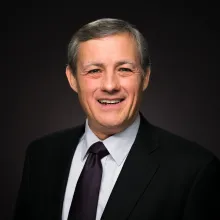
Gary Petty is a 1978 graduate of Ambassador College with a BS in mass communications. He worked for six years in radio in Pennsylvania and Texas. He was ordained a minister in 1984 and has served congregations in Longview and Houston Texas; Rockford, Illinois; Janesville and Beloit, Wisconsin; and San Antonio, Austin and Waco, Texas. He presently pastors United Church of God congregations in Nashville, Murfreesboro and Jackson, Tennessee.
Gary says he's "excited to be a part of preaching the good news of God's Kingdom over the airwaves," and "trusts the material presented will make a helpful difference in people's lives, bringing them closer to a relationship with their heavenly Father."
