
Don Ward
This sermon was given at the Panama City Beach, Florida 2013 Feast site.
This transcript was generated by AI and may contain errors. It is provided to assist those who may not be able to listen to the message.
The United Church of God presents Don Ward with a sermon titled, Why Are We Here? It was recorded in Panama City Beach, Florida. This is an answer to the fulfillment of what we are picturing here in these days, the Feast of Tabernacles. Some of you have paid a dear price to be here. We have families and individuals who are undergoing severe trials. Trials separate wheat from the chaff, sheep from the goats, and they make manifest what the foundation of our faith is really built upon. I know in our local area we've had some untimely deaths. We had a local elder during the summer this year, a barrel of cancer that came on. All of a sudden, and within a matter of a few weeks, he was gone. So all over the world, wherever you look today, we see so many trials. On behalf of the Council of Elders, the Home Office staff, all of the personnel there, and the ministry, I want to express our thanks to you for your faithfulness, for your sacrifices through this past year. You've made it through another year. You've been presented with a number of opportunities to grow and overcome during this past year. It's almost every year that I wonder, will we be able to do this another year in view of what we see going on in this world? So if you were not as successful this past year, you would hope to be in the spiritual sense. You can start right here, right now, reaffirming your commitment and determination to grow in the grace and knowledge of our Lord and Savior, Jesus Christ.
Before I go any farther here, I would like to say a little bit about note-taking. In taking notes, there's no way you can write down everything everybody says. What I would like to see people do, keywords and key concepts, write those down and pursue them, study them, do research on them yourself. You will never learn to really master the Bible by just listening to sermons and sermonettes and Bible studies and all of that. You have to get in there yourself and dig for the goal.
What we hope to do in the Feast and all of the sermons and sermonettes and Bible studies and all of the material throughout the course of the year is to provide you with help, to help you become disciples and learners throughout the rest of your life. So we are one year closer to the fulfillment of the time that we will be observing the next seven days.
Many events of the Olivet Prophecy are coming to pass right before our eyes. Luke's version of the Olivet Prophecy in Luke 21 and verse 28. Luke 21 and verse 28. Here's what Luke writes. First of all, he has recounted so many of the things that will be going on during the end of this age as we merge from this present evil age into the wonderful world tomorrow in Luke 21 and verse 28.
And when these things begin to come to pass, then look up and lift up your heads, for your redemption draws nigh. If we look at the world today, we might say, what is there to be excited about? It seems that there's gloom and doom on every end. And I'm going to talk about a little bit of the gloom and doom here to begin with. I guess you would say, but describing some of the things that we see happening in our world. And as we see these things happen, it should motivate us even more to earnestly pray, Thy kingdom come, Thy will be done on earth as it is in heaven.
And also to prepare with every ounce of our being, be able to lead to help bring all peoples into relationship with God and Christ in the wonderful world tomorrow. The social fabric of our nation continues to unravel. We're not only slouching toward Sodom and Gomorrah, as Justice Bort wrote several years ago.
We're now wallowing in the cesspools of Sodom and Gomorrah. Every institution on the face of the earth, social, economic, political, and religious, that is supposed to promote the common good, welfare and security of the people, has been disgraced in one way or the other. Spiritually, all of the zealots are on the wrong side. The jihadists, the terrorists, Taliban, Al Qaeda, Hezbollah, Hamas, and a host of others. They have a zeal, and what we're involved in is spiritual warfare, even on the international scene with the battles that are being fought.
It's not just military warfare or geopolitical maneuvering. Spiritual warfare is being fought in high places, and we need to be aware of that. Intellectually, there's a dumbing down of the population. More and more, we see that. People do not know who to trust, where to look for when it comes to hope and security. Couple all this with all the mind-boggling geopolitical events and natural disasters that have taken place the past several years. You can readily discern that these are some of the most critical crucial times in human history.
These are tough, transitional times. The United States is in a cultural transition. It is virtually complete. The transition is from a Judeo-Christian kind of culture and ethic into a totally secular morality. We're led to believe that this is the age of enlightenment, that science will soon discover the cure for diseases, and that being 100 years old will be considered young in the future. But the human misery index increases every day. So let's take a quick look at some of the more challenging problems that the seven billion peoples, just in the past few weeks, they have officially said the Earth's population has reached the seven billion mark.
The problems that the seven billion peoples of the world are facing at this critical, crucial juncture in human history. One billion plus people have no access to clean and safe water. Two point six billion lack toilet facilities. Four thousand children die every day from diarrhea, a waterborne disease. Fourteen hundred women a day died needlessly in pregnancy or childbirth. Four point two five million more health workers are needed globally, just to somewhat meet the needs.
There's a shortage of teachers all over the planet. We need a lot more money and a lot more personnel to be able to take care of the basic needs and build the infrastructure so that people can have a decent standard of living. It's incredible when you think about how well we have it here as opposed to what's going on in the rest of the world. It'd be so easy to encapsulate ourselves and isolate ourselves and bury our heads in the sand and pretend that these things are not going on and that this is one of the most trying times in human history.
One in thirty people in the United States is in prison. One in thirty, no other country on the face of the earth even approaches that number. One in thirty people in prison. War rages in many countries and scores of people are dying every day. A million people have fled the so-called civil war in Syria. Thousands upon thousands of them are innocent little children. They're living in tents and hubbles and the desert barely able to eke out subsistence. They get water and a little bit of food.
Will human leaders ever begin to solve this great crisis? It's not just in health care, it's everywhere. On the one hand, we hear of new medical breakthroughs almost every day. On the other hand, more and more people cannot afford health care even in the nations where it is available. And every day we hear about Obamacare and we hear about what the Republicans are going to try to do to defund Obamacare. And if necessary, even refuse to raise the debt ceiling and so on and so on.
We hear about it. And we hear that now the corporations have been given an extension with regard to implementing health care for their employees. Many corporations are putting those who are on retirement saying, No, we're no longer going to cover your retirement benefits. Lack of health care, education, and right, moral and spiritual training results in peoples. Falling prey to disease, to famine, and dictators. It is beyond words to describe the pain and despair in the faces of the people in the Third World. And more and more it's coming home to America, where more and more people are unemployed and more and more people are depending on the government for their subsistence.
Several reports describe the devastating drought belts in the United States. We're in a severe drought belt in the whole state of Texas. Only one county is not listed in some sort of drought condition, and that drought condition extends to many pockets throughout the U.S. More and more money is being poured into what is called the defense budget, although the defense budget has been cut in recent times with sequestration. And the Pentagon is crying out, saying, Oh, we have to cut back. X number of billion here and there. How are we going to keep our 135 military bases going around the world? That's what the U.S. has. Over 130 military bases around the world. Let's notice Joel 3, verse 9, in the Minor Prophets. Jose Joel 3, this is surely the time that we're in with regard to the nations and their procurement of weapons of destruction from the smallest nation that you can name to the largest. Everybody seems to be scrambling for weapons of mass destruction. In Joel 3, verse 9, I am strong. You can take a small nation like Syria, who has now procured deadly poison gas, sarin gas, just a little bit of it can lead to almost instant death. And you have heard about the row that is going on in the past several weeks with regard to the situation in Syria and the poisoning of over 3,000 people with 1,400-plus deaths. And now this so-called agreement that has been reached between Russia and the United States, that they will now surrender their chemical weapons, and Russia will be responsible for overseeing that and hopefully destroying it. Something unusual happened yesterday in that the Fox Network broadcast an interview between, well, there was an interview by Fox News reporter and the percentage of congressmen from Ohio, where they interviewed Bashar Assad in Syria. Now, Assad is saying it would be nice if the United States would give us a billion dollars to destroy our weapons of mass destruction. I mean, there's just no end to it. When God destroyed the world in Noah's day with a flood, only God had the power to destroy human life and all forms of life from the planet. Only God had that power at that time. Now humankind has power to destroy himself many times over. Did you ever think about that? In my view, it is only the restraining power of God that holding back events before the great and terrible day of the Lord. The world is now a powder keg ready to explode. Let's go to Matthew 24. Matthew 24, Matthew's account of the Olivet prophecy where the disciples came to Jesus and asked him, Master, what shall be the sign of your coming and the end of this age? And Matthew 24 and 25 addresses Jesus's response to those two questions. In Matthew 24 and verse 15, we see the placing of the abomination of desolation. The abomination of desolation in Matthew 24 and 15. And then you look at verse 21.
The abomination of desolation marks the beginning of the tribulation, for then after the abomination of desolation is placed in verse 15, shall be great tribulation. Such as was not since the beginning of the world to this time known, or ever shall be. Then if any man shall say unto you, Lo, here is Christ, for there, believe it not, for there shall arise false Christ and false prophets, shall show great signs and wonders in so much that if it were possible, they shall deceive the very elect. Brother and I hope that each one of us is among the very elect. And we could ask ourselves, am I one of the very elect? Let's note what John writes in Revelation 13, verse 8. Revelation 13, verse 8. We're here observing the Feast of Tabernacles, picturing the wonderful world tomorrow, eternal life, and the kingdom of God. But note this in Revelation 13, 8, when this evil beast system does come upon the face of the earth. Everybody is going to be deceived except the people that are listed right here. They are identified, and all that dwell upon the earth shall worship Him, whose names are not written in the book of the life of the Lamb slain from the foundation of the world. And so we ask ourselves this afternoon, is my name written in the Lamb's book of life? If it is written there, only you. You will be the one that would have it blotted out. And so we are individually and personally responsible for our lives as we stand before God. There is no man, no organization. None of that is going to save you. We go to Ezekiel chapter 22, Ezekiel 22. And we notice a period of time, Ezekiel, of course, is set up as a watchman for the nation, and to a large degree, the nations, because we are to take this message, this watchman's message of warning to the world, to the whole world. And I believe it's time to do that and past time to do that. Recently I was reading a poll that said that in view of the recent events that have happened in the world over the past several months, now it's almost like 50% of the people in the United States, and it's also true to some degree in other Western nations, believe that we are living in the last time and they are right for the kind of information that the Church of God has. Now, as we go through this sermon, the kind of information that the Church has is not necessarily what I've been talking about here today. I'm just describing up front some of the conditions that exist in the world. We're good at describing what the conditions are that exist in the world, but maybe we're not quite as good as describing or prescribing what we need to do to be able to be ready and to make sure that our names are written in the Lamb's Book of Life. In Ezekiel 22, verse 22—actually, it's verse 23.
And the word of the Lord came unto us, saying, Son of man, say unto her, You are at the land that is not cleansed, nor rained upon in the day of indignation. There is a conspiracy of her prophets, her leaders, in the midst thereof, like a roaring lion, ravening the prey. They have devoured souls. They have taken the treasure and precious things. They have made her many widows in the midst thereof. There are so many different ways that you can make many widows from going to war and to the decay and destruction of the family through the various means that are being employed there to do so.
Her priests who violated my law have profaned my holy things. They've made no difference between the holy and profane. Profane means that which is secular, that is not of God. Neither have they showed difference between the unclean and the clean, and have hidden their eyes from my Sabbaths, and I am profaned among them. We go down to verse 30. It continues to describe the conditions that are extant, and surely it's sort of like reading the morning newspaper, but nobody reads the morning newspaper anymore. They get what little snippets they get. Basically, if you live south of the Mason-Dixon line, mainly you've got fox, all the motels, hotels. They've got fox, and go somewhere else. They've got CNN, and they're sort of battling against each other, trying to both have the same, what all is said and done, sort of like the Democratic-Republican Party. They're all going toward this one-world notion.
Verse 30, And I sought for a man among them that should make up the hedge, and stand in the gap before me for the land, that I should not destroy it, and I found none. Is God going to find some at this time standing in the gap, boldly proclaiming the Word of God, unabashedly unashamed? Paul said, I'm not ashamed of the gospel of Jesus Christ for this power of salvation. Therefore have I poured out mine indignation upon them. I've consumed them with the fire of my wrath. Their own way have I recompense upon their heads, says the eternal God. The irony of so much that is happening today, it is done in the name of freedom. Isaiah cries out in Isaiah 5, Woe to those who call evil good and good evil. If you want applause on the talk shows, you talk about smoking dope, you talk about loose morality, you talk about living it up wherever it is, that's what the people want to hear. They don't want to hear the reality of the situation, and their misery index increases every day. One author described the hallmark of this so-called postmodern era as the age of toleration. No moral judgments are to be made. The law of the day is, you shall not be intolerant. That's the only commandment that's really extant in our society today. You shall not be intolerant. All lifestyles, moral codes are to not only be tolerated, but to be appreciated for their diversity. Mr. Moody gave a very fine sermonette on unity. How is unity achieved in a nation? Any nation? Any state? Any city? Any family? Well, eventually it will come down to the moral and spiritual leadership. What is the direction of the moral and spiritual leadership?
So many are falling for the lie that diversity there is strength, and then ironically turn around and state that we need a great leader who will unite us. Diversity and unity are in opposition, especially when it comes to moral and spiritual values. You cannot unite people who hold deep-seated moral, social, political, and religious ideologies that oppose each other at the very seat of their consciences. For example, the Bible states that you shall do no murder. The Quran states that the infidel must be converted or killed. Once again, the Bible states that you shall do no murder. Yet, thousands of fetuses are aborted in the wounds of their mothers. That's okay. So they say, the Bible says that a man shall not lie with man, neither of womankind with womankind. The President of the United States says that's okay. We really need to celebrate our diversity. On the other hand, we have people who believe deeply that those things are wrong. So how are you going to unite them? It is surely a time, as never before, to sigh and cry, for all the abominations are to extend on the face of the earth, as Ezekiel talks about in Ezekiel 9. Sigh and cry, and begin at my temple, at my house. So we're here from various areas and backgrounds. We have the Spirit and truth of God as a common thread to bind us together. Let's go to what I think is perhaps the greatest unity scripture in the whole Bible, 1 Corinthians 12 and verses 12 and 13. 1 Corinthians 12, verses 12 and 13.
For as the body is one and hath many members, and all the members of that one body being many are one body, so also is Christ. For by one Spirit are we all baptized into one body, whether we be Jews or Gentiles, whether we be bond or free, and have been all made to drink into one Spirit.
Looking farther in this chapter, you look at verse 18. But now hath God set the members, every one of them, in the body as it pleases him. And then verse 25, that there should be no schism in the body, but that the members should have the same care, one for another. And whether one member suffer, all the members suffer with it, or one member be honored, all the members rejoice with it. The Corinthians were divided on many issues, especially divided over the issue of outward expressions of righteousness as expressed by spiritual gifts. You go to 1 Corinthians chapter 1.
1 Corinthians chapter 1 and verse 1, The Corinthians were really both full of speaking in languages and speaking in tongues, as some call it. And it was like a great division in the church because some boasting of this ability to speak in tongues. And Paul had to come and set him straight. With regard to this, now we look at 1 Corinthians chapter 12. 1 Corinthians chapter 12, continuing where we left off there down to verse 27. Now you are the body of Christ and members in particular, and God has set some in the church, first apostles, secondarily prophets, thirdly teachers. After that, miracles and gifts of healings helps governments' diversities of languages. Are all apostles, are all prophets, are all teachers, do all have miracles and gifts of healings, helps governments' diversities of tongues? Are all apostles, are all prophets, are all teachers, are all workers of miracles? Have all the gifts of healing? Do all speak with tongues? Do all interpret? Well, of course, the answer is no. Brethren, I think we need to learn to appreciate one another and what each member of the body of Christ has to offer to each person. Every person here has something to offer. You go back to Romans 12, and one of the things that I would like to encourage us to do—in fact, the theme of our general conference of elders this past year was edifying the body through spiritual gifts. Paul wasn't afraid of spiritual gifts. Paul encouraged people to seek spiritual gifts.
But in appreciation for what everybody can contribute. I wish I had some of the gifts so I could better serve in different ways than what I have. But I have the gifts I have and try to use what I can use, and I hope all of us are doing the same thing. In Romans 12, verse 4, As one body, as one group, to have the same love, care, and concern, one for another.
So many people in the past would go to the feast in anticipation of hearing some new thing about prophecy. What do ministers think about the times in which we are living? Well, you hear that at the feast. I guess you could call this the itching-ear syndrome.
I want to know something that the world doesn't know. Nearly all of us, to one degree or another, have been on a knowledge trip instead of a conversion trip for a long time. The Apostle Paul writes in 1 Corinthians 8, verse 1, Knowledge puffs up, but charity edifies.
For a long time, church members thought that some knowledge of future events would somehow ensure their entrance into the kingdom of God. Now we're going to get down to where the rubber meets the road, as they say. The church thought that they had a leg up on everyone else when it came to understanding prophecy, and in some ways it does. And we were noted for that in the 50s and 60s and 70s and 80s, early 80s. Somewhere around 1981 or 82, we were invited as a part of the college to attend a ceremony at Liberty University, Falwells University, where they were going from college status to university status.
So Wanda and I went with the blessings of our administration from Pasadena and so on. It was quite an interesting experience. You had the various dignitaries there. Senator John Warner spoke, and then Falwell himself spoke, a very moving kind of address that he gave. Then after it was over, those who had chosen to be in academic regalia marched out. We left after they marched out, and as we walked down this hall, suddenly we were face-to-face with Jerry Falwell, right in his face.
He puts out his hand and shakes it and says, Where are you folks from? I tell him, Ambassador of College said, Oh, Herbert Armstrong, he has contributed so much to our work in prophecy. But when you look at the Internet today with regard to prophetic events and so on, you could put in, as I did recently, Revive Roman Empire, and it turned up 99,400 hits on Google.
I put it in Bing. It turned up 476,000 hits. And I did other kind of prophetic kind of topics and got the same kind of results. Now, all of these hits are not prophetically oriented. Thousands are. But here's the point. The point is this. Almost every Christian denomination on Earth is writing about end-time events, and many of them in far greater detail than we write.
But still, there is something that we have that is so vital, that is so precious, and we will get to that. I'm not saying that they're always accurate because they aren't. But oftentimes it seems they're more bold and to the point than we are. Now, I believe that God has shown us a lot of things in the past 25 years, but have the lessons gone over our heads? He has shown us that you and I cannot enter the kingdom of God by following a man, yet many continue to do so.
He has shown us that salvation is an individual and personal responsibility, that we each one stand before the judgment seat of Christ, as it says in Romans, on a daily basis. He has tried to show us that we must work out our own salvation with fear and trembling.
He has tried to show us that we must search the Scriptures daily, whether these things be true. He's tried to show us that Christianity is far more important than Churchianity. Instead of heeding the lesson, many look for excuses to quit and say, If the Church is going to be this way, I don't want to have anything to do with it. But the tragic sad truth is that not only do many leave Churchianity, they leave God. We need to ask ourselves, What does God think about me? And of course, we need to ask ourselves, does the action of any person change one word in the Scripture?
If you believe in God, then what? If you believe in God, what are you going to do? Some continue in the Church and Churchianity, but in their heart, God and His Word do not play a vital role in their heart and in their lives. We use the word Church so much that it becomes more important in the minds of our youth than a relationship with God. This is the main reason that you parents and Sabbath school teachers must teach our children to develop a relationship with God. Remember now your Creator in the days of your youth.
I know I began to memorize Scripture and pray diligently as a child, and I believe I had a personal relationship with God, but I didn't know the truth. You know the truth, so many of our youth grow up, quote, in the Church. I didn't grow up in the Church. But I believe that God existed. I believed in prayer. I believed the Word of God. It was only in my early twenties that God opened my mind to the truth. What a wonderful thing it is for those of you who are like second, third, fourth, fifth-generation Christians, as we call it.
And in the wonderful world tomorrow, that will be the way it is. Those of us who are not second, third-generation Christians in a sense, we came through the back door. You're in the front door. How precious that is!
We don't need to be dull of hearing. We need to take action. Look at Isaiah 66, verse 2. Who is God going to really look to? In Isaiah 66, verse 2.
We need leaders. We need leadership on the front line. We need people standing in the gap. Who is God going to look to for that? In Isaiah 66, verse 2. For all these things hath my hand made, and all these things have been, says the Eternal. But to this man will I look, even to him that is poor, and of a contrite spirit, and trembles at my word. That's who God is going to look to. This feast could and should be a great turning point in all of our lives. If we have ears to hear the messages that are given and to act on these messages, what is the greatest weakness in the church? It is my greatest weakness. It's probably your greatest weakness. And that is, we need to close the gap between what we know and what we do. We're here to close the gap between knowledge and action. Turn now to James chapter 1 and James chapter 1. James chapter 1 and verse 22. But be you doers of the word, and not hearers only, deceiving your own selves. And then in James chapter 3 and verse 13. Who is a wise man and in dude with knowledge among you? Let him show out of a good conduct his works with meekness of wisdom. But if you have bitter envying and strife in your hearts, glory not, and lie not against the truth. This envying and strife and trying to be number one has plagued the sons of men and the church of God through the ages. From the days of Cain and Abel, where Cain was jealous of his brother Abel because Abel's offering was accepted and Cain's was not, and he rose up and slew his brother. And God came looking for Abel, and he saw Cain and said, Where's your brother? He said, How do I know? Am I my brother's keeper? And from Genesis to Revelation, the resounding answer is, Yes. The kind of unity that was talked about in the sermonette can only be achieved when we come to the point that we have the wisdom and we employ the wisdom from above. But if you have bitter endering and strife in your hearts, glory not, and lie not against the truth, this wisdom descends not from above, but is earthly sensual, devilish. For where envying and strife is, there is confusion and every evil work. But the wisdom that is from above is first pure, then peaceable, gentle, easy to be entreated, full of mercy, and good fruits, without partiality, without hypocrisy. And the fruits of righteousness is sown in peace of them that make peace. So, brethren, here we are. One of the principal lessons we are here to learn is the more excellent way. We heard about the more excellent way last night. We heard about the more excellent way in the sermonette today. Let's really zero in on the more excellent way for a moment here. Go back to 1 Corinthians 12. 1 Corinthians 12. We talked about earlier when we were in 1 Corinthians to employ the gifts that God has given us and try to edify the body of Christ and to build it up to appreciate one another, to have the same love, care, and concern for one another. We read from Romans that we are members one of another. In 1 Corinthians 12, after Paul discusses spiritual gifts—now, he comes back to spiritual gifts in chapter 14, but look at this last verse in chapter 12.
Verse 31. Covet earnestly the best gifts. Paul says desire, earnestly desire, the best gifts, and yet I show you a more excellent way. This way, this inset chapter, chapter 13, is one of the most important, pivotal chapters in the whole Bible. See, the great rhetorical question of 1 Corinthians is 1 Corinthians 1.13, where Paul asks the question, is Christ divided? This more excellent way is chapter 13. Though I speak with the tongues of men and of angels, and have not charity. The Greek word agape, or charity, translated love in most places. Now, two places in the Bible—1 John 4.8, 1 John 4.16—it says God is love. It would not do violence to the Scripture to read it this way. Though I speak with the tongues of men and of angels, and am not becoming love as God is love, I am become as sounding brass or a tinkling cymbal. God is more interested in what we are becoming than what office we hold or what we are necessarily doing. It's all about becoming as God is. That's what God is interested in. No one can stop you from becoming if you choose to do so. You could be in the darkest, deepest dungeon on the face of the earth, and yet, beyond your road, beyond the way, beyond the path to becoming as God is, you could hold the highest office in the land and be lauded by everyone. And, of course, that's probably more difficult to do than being in the deepest, darkest dungeon. And yet, beyond your way to becoming love as God is love. These verses here are so important. Though I speak with the tongues of men and of angels, and have not charity, if I am not becoming as God is, I am become as a sounding brass or a tinkling cymbal. And though I have the gift of prophecy and understand all mysteries and all knowledge, see, we could know everything there is to know about prophecy, the exact identity of the beast, the false prophet, the exact time that the abomination of desolation is going to be set up, the exact time that Christ is going to return, and we can go on and on with various events and prophetic fulfillments and know all of that. But notice what he says. Though I have the gift of prophecy and understand all mysteries and all knowledge, and though I have all faith so that I can remove mountains and have not charity, if I am not becoming as God is love, I am nothing. Now, of course, you get into the definition of love here, and it's not. On the one hand, as I mentioned earlier, the only commandment that is really obeyed today is, you shall not be intolerant. The Bible says that God is angry with the wicked every day, and that the fear of God is to hate evil. There is good and there is evil. And some people don't like to hear what God has to say about what is good and what is evil. I could have faith that I could remove mountains and have not charity.
They came to Jesus Christ, they asked Him, the tribe asked Him, Master, what is the greatest commandment in the law? This is Matthew 22, 37 through 40. Jesus responded, You shall love the Lord your God with all your heart, mind, and soul. And the second is likened to it, You shall love your neighbor as yourself. Now, oftentimes people leave off reading right there. Then verse 40 says, On these two commandments hang all the law and the prophets. That's how Jesus Christ summarized the greatest commandment. Then, of course, most of us could probably quote 1 John 5.3, For this is the love of God, that we should keep His commandments, and His commandments are not grievous. They're not burdensome. During the first few years after 1995 and the beginning of United, I would have former students write to me about what they were doing in various areas and about what they had discovered with regard to this, that, or the other. Basically not accepting the truth that they heard from a child. And you simply say, Well, what about 1 John 2.4? He who says he knows me and keeps not his commandments is a liar, and the truth is not in him. But if they speak not according to the law and testimony, it is because there is no truth in them.
Continuing here, we read verse 2 again, So that's where the rubber meets the road, is becoming love as God is love, the love of the Lord your God with all your heart, mind, and soul, the love of your neighbor as yourself, on these two hang all the law and the prophets. For this is the love of God, that we should keep His commandments, and His commandments are not grievous. If any man says he knows me and keeps not my commandments, he is a liar, and the truth is not in him. So the more excellent way is to become as God is.
It's form versus substance. We want substance. And as I said, God is more interested in what you are becoming than what you are doing. The word, what is it, that separates the Church of God and its doctrine from all other denominations, organizations that you can name. The greatest truths of the ages, center on the seven greatest questions of the ages. Does God exist? Most Americans, those who are native-born, grew up in this country, came to maturity to some degree under the Judeo-Christian kind of culture and ethic, would say, yes, I believe that God exists. And even in recent surveys, well over 50% of Americans said that they at least prayed occasionally.
Does God exist? See, the first article of faith, you go to Hebrews 11, I go to this Scripture time after time in sermons. There where we pastor in Hebrews 12, verse 6. It's not, sorry. I guess I just dyslexified myself there. No, I didn't. Dyslexia.
In Hebrews 11, verse 6, that's the verse I'm looking for. In Hebrews 11 and verse 6, But without faith it is impossible to please him, for he that comes to God must believe that he is, and that he is a rewarder of them that diligently seek him. Though to believe that God is, and of course that does require a measure of faith, you cannot just scientifically prove that God exists. There are many kind of logical arguments that you can post, and there are many kinds of different things that you can look to with regard to creation and so on, but it does require a measure of faith. So does God exist? Who is God? God is our creator and our Father. These questions you need to know, and you need to know the answer, and be able to respond to these. God is our loving Father and Creator. What is God? God is Spirit. John 4, 24, those who worship Him must worship Him in Spirit and in truth. Though who is God? He is our Father. What is God? He is Spirit. What is His purpose? One of the greatest purposes of God is to bring sons and daughters to glory in His Kingdom. And the reciprocal of that is, who is man? Man is made in the image of God. What is man? Man is made from the dust to the ground, with certain faculties akin to God, but not of the same essence. What is man's greatest purpose? Why were you born? That old booklet that we had today, we call it, What is Your Destiny? United has a book titled that. Brethren, if you know and know that you know the answers to those seven great questions, then that is what separates us from the rest of the world. The Christian world believes that God is a trinity. God is not a trinity. The God family is not closed. We know the plan and purpose of God by keeping these holy days as we keep them. We re-enact, in some ways, physically, but in spiritually as well, the very purpose and plan of God. So, brethren, during this feast, you will hear many wonderful sermons and many other things that are necessary for us to grow and to overcome.
In today's world, it will become more and more difficult for us to go back to our homes and do the things that we need to do. In the face of all the things that we are facing, will you be a person of conviction, courage, and commitment at this time? A person of conviction. The Word and Spirit of God are the convicting elements. And if you don't read and study and pray and deeply convicted, you're not going to survive.
And commitment. The word commitment in the Bible has to do with place and sacred trust. God has placed His precious truth in our sacred trust for us to keep. And then courage is a product of conviction and commitment. To the degree that you are convicted and committed, you will act courageously.
The hearts and minds of the peoples in the Western world have become thoroughly desensitized and shackled arise. The horror movies, the sci-fi movies, are now the realities of the day. Hollywood has had to branch into digital imaging of horrifying creatures to make things more horrific than what is happening in real life here on planet Earth. But we know that this is fantasy, and the blood that is being spilled around the face of the Earth is real.
So God has called us out of this world. We are here at God's feast in peace while the world suffers. And one of the reasons why we're here is to prepare to help relieve the world of suffering. The whole creation yearns for the manifestation of the sons of God. So in the midst of trials, we have hope. The rest of the world has no hope at the present time. We've been called to communicate that hope to them. And so we're here to picture that. We're here to learn of God's great faithfulness. God, who is promised, cannot lie. So indeed we can lift our heads high because our redemption draweth nigh.
So are we going to go forward? Will we stir up the spirit that is within us? Will we fill our lamps with oil? Will we become living sacrifices? Will we really take heed according to the Word of God? There's an interesting prophecy in Habakkuk chapter 3 verses 1 and 2. Go to Habakkuk. We seldom go there to Habakkuk in the minor prophets. Nahum Habakkuk chapter 3 verse 1. A prayer of Habakkuk, the prophet from Chigonoth. O Lord, I've heard your speech and was afraid. O Lord, revive your work in the midst of the years. In the midst of the years, make known and wrath. Remember mercy. God is so loving. He is so kind. He is so merciful. I know I'm here today because of the grace and mercy of God for no other reason. You can grow in grace, which means, in the broader sense, divine favor with God. God used John the Baptist, and John did no miracle. God used Apollos, in the early days of his ministry, who didn't even have the Holy Spirit. Paul came in contact with him. God used the deacon Philip to mightily preach the gospel after the Church was scattered. God used Esther, a young woman of about twenty years of age, to save her people. I submit, therefore, he can use you. We have the opportunity to be a light, to be the salt of the earth, to turn our hearts to the children so their hearts can be turned to God. We can be turned on and zealous for the Word of God and his way of life. We can begin in our own homes to teach God's truth to our children. We can begin to exercise judgment, mercy, and faith in our interaction with each other. We can put away envy, strife, and jealousy. We can heed the messages without judging the messenger. We can learn to discern between good and evil.
We can be a source of encouragement to others and make a difference in homes and neighborhoods and in our workplaces. We can be ambassadors for Christ. We can be filled with hope with a big picture burning brightly in our minds and hearts. So, brethren, here we are, first day of the feast, Tabernacles, 2013. I hope that we have sounded a wake-up call, have blown the trumpet, that you do discern the handwriting on the wall, and that we be attuned to the messages that will come as never before. I leave you with this poem that I wrote. We have come to God's great feast in 2013 on the shores of beautiful white sand. Of your great love and mercy we sing, we are preparing to bring liberty to people of all lands. We have come to worship the eternal King who feeds the sheep of his flock, our sacrifices of thanks and offerings we bring as we drink of the living rock. We have come to feast on the Word of God so we can relieve the world of sorrow. With the gospel of peace we are thoroughly shod as we experience the forties of the wonderful world tomorrow. So come, let us be glad and rejoice, and let our spirits soar as we enjoy the good things of our choice. Let us be mindful that we are Christ ambassadors.
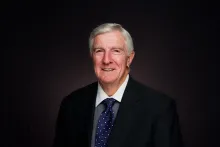
Before his retirement in 2021, Dr. Donald Ward pastored churches in Texas and Louisiana, and taught at Ambassador Bible College in Cincinnati, Ohio. He has also served as chairman of the Council of Elders of the United Church of God. He holds a BS degree; a BA in theology; a MS degree; a doctor’s degree in education from East Texas State University; and has completed 18 hours of graduate theology from SMU.

