
Robin S Webber
This transcript was generated by AI and may contain errors. It is provided to assist those who may not be able to listen to the message.
Thank you very much, gentlemen. I'm certainly glad that some people have beautiful voices to be able to praise God. Thank you very much. Well, today I want to bring you a very specific message, and I'd like to just get right into it. I see Debbie Barr here on the second row. She's going to hear it again because I gave it last week in Redlands, but it is something that I'm going to be giving everywhere I go for the foreseeable future, because I think it's a very important message. It's an important message whose content many of us in this room have already experienced.
It's a message of whose content some of us have not experienced. For those of you that have not experienced it, and for those of you that have experienced it, please do not tune me out in the minutes that are ahead. Last week we had an opportunity in Redlands to be able to baptize a young lady that had grown up there. Her name is Isis Ahearn. Her mother is Perisha.
Maybe some of you know Isis. She's very special to all of us out in Redlands. She's like our mascot in the sense that when we started the Redlands congregation 17 years ago, Isis was just a bald-headed little baby. And Perisha was just a young mother and holding that little baby back in the lobby at that time.
All of us were able to watch and experience Isis growing up, who's now back at the Ambassador Bible Center. But she wanted to be baptized back home. While she had received some counsel back there, she wanted to be baptized with her spiritual family that she counted as Redlands. She's special to us. We're obviously special to her, and that is really, really neat. After having baptized her last week after church, in which the whole church was there, that's how we do it in Redlands, and everybody does it differently, and I understand that.
Sometimes people want to be baptized privately, and we certainly honor that, and some people desire to be baptized publicly. And that's why we have this baptismal font behind us. For some of you that are new, you might have been wondering what was back there. That is actually a baptismal pool. And it is the baptism that I would speak this afternoon to all of you.
What exactly does baptism mean? And what do you that are baptized remember it meaning? Because my approach to this message this afternoon is not only to express baptism as a gateway to the most incredible journey that yet lies ahead, but it is also an anchor, and it is a mooring in each and every one of our lives to keep us spiritually steady when those challenges of life and that suffering that Mr. Osterly spoke about does come upon us. Last week we baptized Isis, and I suspect that during the course of this week we had baptisms around the world on all six inhabited continents.
We'll continue to have baptisms. What happens when an individual is baptized? Some of you are perhaps new to religion, perhaps new to the Church of God, and you might be wondering, well, how do we address the subject of baptism? How do we understand it? Baptism is simply this. When an individual is baptized, that individual accepts it as a member into the family of God. When an individual is baptized, that individual has God's name set upon them.
When an individual is baptized, they are indeed given a life-giving spirit. A gift is granted to them. Baptism is a very special moment. God intended it to be. And he recognized that even though we are spirit-led, as it says in Romans 8.14, for as many as are led by the spirit, the same are the sons of God, he recognizes that we're in these physical bodies. And we need object lessons. We need something that is tangible. And thus he gives us the ceremony of baptism.
And baptism is a special moment. It's a snapshot moment in life. When I was young and used to visit Disneyland quite a bit, I haven't been back for many years. I let the garnets do that for us. But when I was young, we used to go to Disneyland and you know there'd be the Matterhorn.
And you'd round the corner and there'd be a pole and it'd have a sign on it saying, if you're going to take a picture, this is where you want to take it. This is where you want to fix it. This is indeed the very best spot to capture this neat time that you're having at Disneyland. I think all of us know that at times we call that a Kodak moment. Baptism is like a Kodak moment.
God wants us to take a snap of it, put it in the pocket of our heart, and carry it with us the rest of our life. To begin this message, I'd like to direct your attention to the story that is found in Acts 2. Join me if you would. Let's open up our Bibles on this holy day. And let's go to the book of Acts, the story of how the church began. And we pick up the story in Acts 2. Acts 2 is the recording of the sermon that Peter gave to the people there in Jerusalem on the day of Pentecost.
He basically is talking to the crowd, telling them what had happened. He begins to come to a crescendo. And basically what Peter tells them when it's all said and done is, gentlemen, do you recognize what you have done?
You have indeed slain Messiah. You have crucified the anointed one. You have put away God's best hope for humanity. You can imagine how once they came to that realization, how the audience was crushed. They couldn't believe it. Verse 36, Chapter 2, Therefore, let all the house of Israel know assuredly that God has made this Jesus, whom you crucified, by the way, He is Lord and Christ. God made Him that, made Him sovereign, and made Him anointed. Which is what these words point to.
Now, when they heard this, they were cut to the heart and said to Peter and the rest of the apostles, men and brethren, what shall we do? Basically, they come to a point of recognizing what God was choosing to perform and what they had allowed to happen in their life and what they had been a part of. And they asked a question. I would say, in a sense, it was a question of desperation. They had killed God's gift, crucified. Seemingly, there was no hope. There was no bridge to another shore. And then one of the great verses comes forth out of the Bible.
This, my friends, is a clarion moment of Scripture where hope is lost, hope is given, where we are confronted with human darkness, light emerges, where there is no future by those men's actions, apart from God, by repentance. God dismisses that and allows them to receive a gift, the gift of the Holy Spirit. The reason why I wanted to go to the Book of Acts for a moment is baptism is at the forefront of Christian history. Do I dare say we can't get around it? It is at the door of Christian history. It is at the forefront of the individual Christian experience. Experiencing Christianity without baptism is like receiving a beautiful new car without keys to ignite. And thus, you're in the car. It has four wheels. It looks like it can go everywhere, but when it's all said and done, it goes nowhere. My question to all of you this afternoon is simply this. Does it really matter whether you are baptized or not? Let's ask ourselves that question. Does it really matter?
Some of you, perhaps for years, have been confronting this question, looking at these words in the Scripture and not, perhaps, acting upon them for one reason or another. Now, as I give this message today, please understand my intent and my motivation is not to squeeze or force somebody into baptism before God's time and God's way. But I am to, here as a spiritual instructor, share the words of God, the hope of God, and the quest of God in each and every one of our lives. So does it really matter whether or not we are baptized or not? Maybe if we are not baptized, maybe we should just continue to come to church or read the Bible and just sit in the same pew or sit in the same side aisle for the rest of our lives. And I'm going to church and that's all right. We need to ask that. We need to address that question. Many people come up against baptism in different manners, through different facets. Some of you may not have considered baptism a big deal. It's no big deal. Why? I grew up in the church. I know about the truth. I believe in God. I keep God's laws. I'm actually a pretty moral individual and law-abiding at that. Isn't that enough? After all, I'll get around to it someday. Some unknowingly or unwindingly treat baptism like an elective course. Hear me? Like an elective course. When you're in college or when you're in high school, there are major courses that you have to take. And you get to pick and choose around the edges what you want to take for lesser credits. Or it's like going to the soup plantation. And you're going down the aisle or being forced down by the crowd. You're going along and you take this and you take that and you take this. That's the broccoli. I think I'll skip. I'm going to pass over the broccoli here. I'll come back someday.
Baptism is not broccoli. Baptism is one of the main courses of the Scripture. It is the entrance towards life eternal. It is entrance into having a relationship with God the Father and with Jesus Christ. And we'll address that as we go along.
Another category of individuals is that some are perhaps running from baptism. Running from baptism. Some of you look around. Perhaps some of you, even as I've started to discuss this, some of you are looking around this room and saying, well, they're baptized and I've been watching them for years. I don't want any part of this.
Or, after all that I've experienced in organized religion, why would I want to be a part of any organization?
That's very human. And that's a very good question. But we mistake something, and that is simply this. Baptism is not about being a part of any human organization. Never has been. Never will be. Baptism is about something far grander and greater. Baptism is about entrance into the body of Christ. Baptism is about entrance into a spiritual organism. When individuals, over the years, and perhaps you've never been to a baptism, but when we baptize individuals, we specifically state, and you'll hear it when you go to a baptism, we do not baptize into any sect, creed, and or denomination of this earth.
So thus, when an individual is baptized, they don't become a United Church of God Christian. They're a Christian who attends the United Church of God. Quite a difference, isn't there? And to recognize, then, that your allegiance is not to some corporation down below here, or some organization down here below, but you're baptized in the name of the Father, and in the name of the Lord Jesus Christ. And it is into that name. It is into that realm of understanding of what the name of God the Father and Jesus Christ mean.
That thus you have yourself lowered into a baptismal pool.
Some will, at times, shall we say, go into neutral and stall. They'll say, I don't know if I am baptized, or whether or not I can spiritually succeed once I commit. And no, you can't, until you receive what comes at baptism, which is the power and the indwelling of God's Holy Spirit, which is God Himself.
God is Holy, God is Spirit. He gives us His essence. He gives us His love. He gives us His power and wisdom. I was in a stalling pattern for some time. I was out in the tarmac of life when I was a young guy going to Ambassador College.
I was kind of out on the tarmac, but I wasn't going up in the air, and there was a reason, because I was afraid of committing. Others had committed when I went to Ambassador College. Others went into, and we all know that pool that used to be over there in Pasadena. But I got to thinking, Robin, because I had grown up, like some of you young kids here that are out there, and this was back in the 1960s, and I thought, you know, I've heard those verses that minister up there on the stage has said, he's quoted that the words of Jesus, that if you deny me, I will deny you.
Ooh, that's not good. And I thought, what happens? I'd always enjoyed history, read history. Seen a lot of movies back in the 1950s and 60s, all those Sandal and Toga movies. Demetrius and the Gladiator, The Robe, Quovatus, Sign of the Cross, Ben Hur, and some of you could probably fill in other movies back in that genre.
And there'd always be that scene of the woman and the old man and the little child underneath the man's toga as he took him in there, and you heard the roar of the lions. And I thought, oh, this is how wonderful, how beautiful, how courageous they might be. I didn't know if I could do that. I thought, wonder if in the future when I would read about persecution or I would read about the end times, I thought, wonder if I am there, would I be able to do that with Robert Taylor and Gene Simmons, not that they were included.
Some of you say, who are that? Some of you that are older, really remember, and they're really before my time. I was watching the reruns. But anyway, I thought, oh, this is glorious. Could I do that? And wonder if I couldn't do that? What am I going to do? What am I going to do? And I wrestled like a Jacob with that question for about a half a year. And then I came to understand what the issue was. It solved it. I was worried about what I was going to do. I was worried about me.
And as much as I had grown up in the church, I knew the promises of God. I had dismissed the promises of God. It was me alone out there rather than all the promises of God when he said, I will never leave you nor forsake you. And even if magistrates do this or the judicial people do this, I will put my words, I will put my thoughts, you will not be alone and you will know what to say. Now, can I share something with you? I'm just Robin talking to all of you. That worked for me. I recognize that baptism was not about me.
It was all about God and his gift and his promises and what he had in store for me. When I erased the me out of that equation and made God bigger than all of me, I got baptized. I got off the tarmac. I got into the air and things have happened ever since. Some of us that are here that have been baptized, not those that are stalled, not those that are on the tarmac, not those that are running away from it, not those that even think that why do I need it.
But some of us that are baptized have not fully unlocked the potential of the baptism that occurred in us. Some of us are reeling to and fro from trial to trial. We mark our existence from trauma to trauma rather than securing our mooring in our baptism and staying there. And that when we were in that pool of deliberate decision, holding to the value statements that we said that we would make by two questions, when we baptized an individual, we just simply asked two questions.
You know what they are. I'll repeat them. They are vital for you to know. The first question that is asked of an individual that is going to surrender their life to God Almighty and Jesus Christ is simply this. And that is, have you accepted Jesus Christ as your personal Savior? The second question that is asked is simply this, and have you repented of your sins?
Now, if the affirmative comes back and it's yes and yes, then we say because you have accepted Jesus Christ as your personal Savior and your Lord and your King. And because you have repented of your sins, and not only of your sins, but what you are apart from God. And then the baptismal ceremony continues. But that's something that is not just up in the pool.
Those questions become actually the rudder of our life, our acceptance of Jesus Christ as our Lord and Savior, and that we recognize what we are apart from God. And even when we stumble, God can cover that with His love and with the blood of His Son. Let's understand as we go forward then a couple of things about baptism that I'd like to bring to you. And that is simply this. No matter how you approach baptism, and I hope some of you are listening, and some of you that are younger will be listening today.
No matter how many human approaches there are to baptism, God has only one approach to us. Just like in the beginning, as He pointed to the Tree of Life to Adam and Eve, today He says it's yours. That Tree of Life, baptism, it's a gift.
He wants us to be His children. He wants us to be in His family. He wants us to be on the inside looking out rather than on the outside looking in. And that can only begin with baptism. I'd like to give you a basic definition of baptism if I may for a moment. It is simply this. Whether you do it in private or whether you do it in public.
Because even when you do it in private, let's understand that the host of angels above is looking down. As it says, they rejoice over one center that has come to repentance. Baptism is simply this. Are you ready for a definition? It's this. Baptism is an outward expression of an inward confession. It's an outward expression of an inward confession. So let's talk about it. Before we ask any further about why baptism, we need to ask ourselves, what is God doing down here anyway?
What is God doing? We go to Genesis. Join me if you would. Chapter 1. Genesis is a Greek word that simply means beginning. We have to go back to the beginning and understand what God's purpose is. In Genesis 1 and verse 26, this is the purpose.
So God, in the beginning, said, let us make man in our image, patterned after us.
None of the rest of the creation was in that manner. Verse 27, so God created man in his own image, and the image of God, he created him. He basically repeats the thought to show how special this was. Male and female, he created them. Then he blessed them, and God said to them, be fruitful and multiply, fill the earth and subdue it. Have dominion over the fish of the sea and over the birds of the air and over every living thing that moves on the earth.
God had made this very special creation called man, called woman, had made and reformed the earth to be the pivot point, to be the laboratory, as it were, of this special creation that was created, that was groomed, that was given every opportunity, basically created for one purpose. And that was to worship God. Humanity's purpose, brethren, of Los Angeles, was we were created to worship God, to give God his worth. That's what worthship means. To respond to the goodness of God, to partake of the gifts of God, so that, number one, we could have a right relationship with God. Number two, have a right relationship with our fellow person.
And number three, as you see this in verse 26, a right relationship with the material world around us, the environment. Not just any relationship, not just a relationship, but a right one that would honor and give God praise because of what he had done. We recognize that through all of this, that God put two trees in the garden. One was the tree of good and evil, and that was in the midst of the garden. He also created the tree of life. The tree of life representing what he wanted to give humanity.
Now, it's very interesting that when you picture that garden that is described in Genesis 2, Genesis 3, we recognize that there were two trees. I'm glad there were not three trees because I get confused enough just tackling the two trees. I remember many, many years ago when Mr.
Herbert Armstrong would get up in the auditorium and say, Brother, I've got new truth tonight. I've been reading Genesis again. I've got new truth. I thought, maybe there's a third tree. Maybe I've overlooked it. For those of you who remember the man's preaching, he always centered on that garden experience because it's all about there, what we need to know. And that's why we're revisiting it.
God put two trees that represented two ways of life. There was one that was based upon self-experience. And there was the other that was based upon revealed knowledge called the tree of life. Now, God said, don't touch that tree of good and evil. But he didn't say that about the tree of life.
It was open. The access was there. You think about it. Are you with me? Think about it for a moment. There was no moat around the tree of life. There was no barbed wire. There were no alligators in the moat. There was no little caribou there with a machine gun saying, stay away. The tree of life was open to humanity. God wanted humanity to succeed. There'd be His special creation. But you know, and I know, going through Genesis 2, we know the rest of the story, humanity decided to partake of that tree based upon experience, based upon touch, taste, feel, and see.
Based upon, let's find out. Just like the man who jumps off the building and conducts a scientific experiment. And so, it's a 30-story building. So he puts a man on the 20th floor, he puts a man on the 10th floor, and he puts a man on the 5th floor. Because any scientific experiment needs, if you remember 8th grade science, needs observation. So there's observation points. Then he jumps off the building without a parachute. Going down. Goes by the 20th floor. The man yells out the observer, how's it going?
He says, so far, so good. Keeps on going down. To the 15th floor. Man yells out, how's it going? So far, so good. Keeps on going down to the 5th floor. How's it going? So far, so good. The tree of good and evil only takes you so far, so good. And I think we understand what the end result is. That's what Adam and Eve chose. That's what they did. They rejected the relationship that God Almighty offered. They didn't obey. They did not take God at His word. I think because they felt left out of the loop of opportunity.
They felt that somehow God was not sharing with them the full deal. I have a question for you. What did they reject? What did they reject? That can be ours to receive. Join me if you would in Ephesians 1. Paul illustrates this. I say Ephesians 1, pardon me, Ephesians 3.
And let's pick up the thought in verse 14. This is what was rejected when it said and done. For this reason I bow my knees to the Father of our Lord Jesus Christ, from whom the whole family in heaven and earth is named, that He would grant you according to the riches of His glory to be strengthened with might through His Spirit in the inner man.
God's desire was that He would give riches. Oh, not the riches of silver or gold. The riches that are spoken about in the Bible are spiritual riches. Because silver and gold will perish. Let's talk about something far grander. And that Christ might dwell in your hearts through faith, that you being rooted and grounded in love may be able to comprehend with all the saints what is the width and the length and the depth and the height to know what the love of Christ which passes knowledge, that you may be filled with all the fullness of God, that you're not only made in my physical similitude, you're not only made in my physical likeness, but that we can be transformed into the spiritual likeness and that image of Jesus Christ, who is the image of God the Father above.
That is what the tree of life would have rendered. Beyond that, join me in Hebrews 2. In Hebrews 2, again, notice the relationship bond that is desired by God. Hebrews 2, and let's pick up the thought if we could, in verse 18. In Hebrews 2 and verse 18.
Did I say 18? Pardon me. Hebrews 2 and verse 10. Pardon me. For it was fitting for Him, by whom are all things, and bringing many sons to glory, to make the captain of their salvation perfect through suffering. For He who sanctifies and those who are being sanctified are all of one, for which reason He is not ashamed to call them brethren. Saying, I will declare your name to my brethren in the midst of the assembly, I will sing praise to you. If you go back up to verse 11, where it says, and they are set apart or sanctified and are all of one, it's very interesting how the NIV translates that. The NIV says there, all of one is all of the same family. The same family. Now, why do I share this with all of you this afternoon? Because baptism is the beginning. It is the gateway to being in relationship with God Almighty. Of having His name placed on us, saying that you understand the tree of life, that you've rejected the tree of good and evil, that you want to embrace and not only embrace but internalize that fruit that comes from the tree of life. Now, then the question goes to this. Once we understand what God is doing, how is this accomplished? How do you come to baptism? Join me if you would. Let's turn to John 6, verse 44. John 6, 44.
This is priceless what we're about to see revealed through Scripture. In John 6, verse 44, we come to understand something specific by going through this verse. It says simply this, Let's understand something. Jesus Christ is our Savior. Jesus Christ is the Lord of our life. God the Father is the Father. It is His prerogative to call whom He will. And that's very important to understand that it is not whomsoever will, but whomsoever is called. It's God that calls. Some of you might be here today and saying, well, I'm here today because, well, I believe like that church believes over there on Merton and Eagle Rock, so I've linked myself with them.
You're not here because of joining a church. You do not join the body of Christ. You are invited. You are called. God begins to work with your spirit and your heart and your mind to become a part of the body of Christ. It's a miracle when we speak of conversion and when we speak of the converted mind, when we speak of the transformed spirit. It's a miracle. It's not done. It's not growing down here below. It's seven-cent. And God's Spirit begins to lead us, begins to guide us. And then we recognize that we can go no further. And we call out and say, God, forgive me. Allow me to be your new creation. I accept the sacrifice of Jesus Christ. I need that spirit of promise that you told the disciples about. I am yours. You are mine. I'm ready to be baptized. God the Father is the one that calls. It's personal. It's direct. Now, some of you are members of the Church of God community for two, three, maybe four generations. But let's understand something when it comes to baptism and how God views you. Some of you that are younger here in the front and in the back. Some of you that might be in your 30s or 40s, what we might call second-generation Christians, is to recognize that God wants a personal relationship with you. Oh, yes, it starts with your parents or it starts with your family or might start with a friend. But make no mistake. God zeros in on each and every one of us. And while our great-grandparents and or our grandparents might be in the Church, they're the children of God. He wants you to be the children of God. God does not have grandchildren. It is personal. It is direct. It's up front.
What is the next step? Romans 5. Join me if you would for a moment. Romans 5 when it comes to baptism. In Romans 5 and verse 6.
Because not only God the Father calls, but there's something that we have to come to accept in faith and understanding. Romans 5 and verse 6 forward is my consideration. One of the most important verses to go back again and again. And not before we're baptized, but when baptized and even with God's Spirit to... Brethren, do I dare say this? To anchor ourselves. As Mr. Osterlei just brought out that the Christian walk is not an easy walk and at times we will be in the storms of life. We need mooring. We need anchoring. And we need to go back to basics and understand God's love. It says, For when in verse 6 we were still without strength in due time Christ died for the ungodly. For scarcely a righteous man will one die, yet perhaps for a good man someone would even dare to die. But God demonstrates His own love towards us in that while we were still sinners, Christ died for us.
Not when we were holy, not when we were spiritual goody-two-shoes, but when notice we were in sin, Christ died for us. He went over the cliff as it were for us. Much more than having now been justified by His blood will be saved from wrath through Him. For if when we were enemies we were reconciled to God through the faith, through the death of His Son, how much more than having been reconciled shall we be saved by His life? And not only that, but we also rejoice in God through our Lord Jesus Christ through whom we have now received the reconciliation. The togetherness no longer separated. Now what does this mean to you and me? Very important. In this encounter in Romans, it is simply this. That God came to us, His call came to us while we were yet in sin. Now this raises an important point and this is why I want to bring it up, especially those sometimes that have grown up in the church. We often suffer from the human misapprehension that we need to wait to be baptized until we are right with God. Until perhaps we're more perfect. Perhaps we're more God-like.
Now please understand your pastors are telling you to go out and do a lot of wrong tonight and paint the town red. But there are times that there is something in at times culture or religion that becomes to where you have to, in a sense, work your way up or work yourself up and then you'll simply be good enough. And then you can be baptized. I've seen this put off people sometimes for years from being baptized. Here's what I want to share with you. Please hear me. Baptism is not for the sinless. It is for sinners. Let us be blunt.
Baptism is for sinners. It's not for the perfect. It's for the fallen. It's for the fallen. Even people at times that have come to church for decades and decades are in this category. Sinful and fallen. And we can repent and we can receive the gift of God. When I think of baptism, in a sense, it's for a Jacob wrestling with God. It's for a Samson who is before the pillars and has nowhere to look up, even with his blind eyes, and to look up and say, God, if you can use me, I've blown myself. I've been a clown all of my life with the gifts that you gave me. I thought it was because of what I was on the outside when all the time you wanted my inside. I thought it was my hair that gave me my strength. When all along, the hair was only a reflection of where strength comes from. It's for the person that was at the sight of Christ in Golgotha. When he came to recognize that he was hanging by somebody special, and he recognized who he was, and he recognized who the individual was that was before him. Baptism is for sinners. You can find sinners sitting on pews. You can find sinners that understand the Bible but are not acting upon it. We all need to consider who and what we are apart from God and His grace, and His Son, and His love, and what He wants to give us. It's not about who we are. It's not about how much we know. Sometimes people say, well, you know, I just don't know enough in the Bible. Baptism is not simply about what you know. It's about who you know. It's about knowing God. It's about knowing Jesus Christ as the Son of God. It's about obeying and acting upon what you do know in the Bible so far. There are some times when I baptized people, and they don't know there as much as maybe some of our 14 or 15-year-olds that are in this church right now. But everything that they have come up against, they act upon. They search the Scripture. They immediately begin to put it in their life. I recognize that as they're baptized and that God gives them His Spirit, the keys to everything else open up because it's not what they know. It's who they are. They want to be like God. They want to be like Jesus Christ. They want to say, not my will be done, but your will be done, Father. Your will be done. And I will surrender my past, my present, and my future to you in faith to receive your grace. And as Lauren brought out, that God's will will never take us down a path in which His grace will not uphold us. Let's understand that. But before we receive this new identity and this new name, something has to happen. Join me if you would in Colossians 2. In Colossians 2.
Colossians 2. Let's pick up the thought in verse 11. We need to understand how the Bible defines baptism. In Him you who were also circumcised with the circumcision made without hands by putting off the body of the sins of the flesh by the circumcision of Christ. Buried with Him in baptism in which you also were raised with Him through faith in the working of God who raised Him from the dead.
And being dead in your trespasses and the uncircumcision of your flesh, all that you had brought, all you had tried to do, He is made alive together with Him, having forgiven you of all trespasses. Now, there are several key factors we need to understand here. What is Paul saying? What is God's Word saying through Paul? God says, through Paul here, that God is no longer working with the externals.
God is no longer working from the outside, and He uses this term of circumcision, which was the right of the Hebrew and Israel and the Jewish people for 1500 years, to where they molded the male anatomy on the outside as a sign of covenant between them and God. As a sign of relationship, Paul is now saying that God is working from the inside out. What is happening here is being done not with human hands, but divine work.
One thing I want to share with you, and you might want to underline it, let's look at this really quickly here. Verse 12, that we're buried with Him in baptism. Baptism represents a death. It's a watery grave. It's a watery grave in which you were also raised with Him through faith in the working of God. Again, let's understand something, because humanly, so often we think we're doing it by our own doing or our own goodness. What is being accomplished is God's working in us. God's work, as many as are led by the Spirit. Baptism, leading to conversion, is not of the human intellect.
It's not of the human mind. It's a miracle. Now, you see back here for a moment, this baptismal pool you can look up here. This baptismal pool, when some of you will be baptized sooner or later in it, water is pretty hot, pretty good. But so often we think of baptism as a death, watery grave. And in part it is. But if we only leave it there, we lose the significance that when the individual goes down, depending upon the sin level, five or six minutes, not just teasing, is that they are then raised up. So you go down to die in Christ.
You are then raised up in a sense of resurrection. You are lifted up, no longer dead to sin, but now alive, not to serve yourself, but to serve God. It's incredible. It's wonderful. And then God says, as it says in 2 Corinthians, then we are a new creation. A new creation. Why then be baptized? Why then be baptized? Let's answer that. We're baptized, number one, because Jesus Christ, consistently in the Scriptures, said to follow me.
To follow me. He practiced what he preached. He did it. When you go to Matthew 3, and I'm not going to turn to there right now, but it says that he came to the baptism of his cousin John. John the Baptist. And it says that they went down into the water together. He was setting us an example. Number one, he was doing it to validate what God Almighty was doing through his cousin John as a stepping stone to the further baptism that he would introduce of the baptism of the Spirit. John was the baptism of repentance, what we call commonly the baptism of water.
When Jesus Christ came along with the baptism of the Spirit, it was not countering what John did, but it added, and it was the next chapter of what God wanted to reveal. And thus, Jesus went down into the River Jordan. The word itself, you might want to jot this down, baptism. Baptizo is Greek. It means immersed. It means immersed. That's opposite other renditions of baptism of rantizo, which means to sprinkle. Some churches sprinkle little babies. Others do what we call a kaio, or they pour.
They'll take a, I presume, they might call a holy cup. I'm not sure with holy water in it. I'm not saying that to mock, but whatever they might say. They pour water. That's not a really good coffin. How do you die in a sprinkle? How do you die in a cup of water? See, God is the master teacher. He knows what we need to have in these spiritual Kodak moments to get the point. And thus, that's why He has us go down and immersed underneath water, all of us, dead all over, as it were, figuratively speaking, as rover.
We must die first, figuratively, before we live before God. Jesus also was baptized because, in that sense, He was our Savior from the foundation of the world. But He came to this earth to qualify to be our high priest by experience. High priests were always washed before they went into service of their people. He is the great high priest. We are being called to be a realm, a kingdom of priests before our God and under our Christ.
We, too, then are immersed. We also recognize in Acts 2.38, we've already gone there, that you cannot receive the Holy Spirit until you do repent and until you are baptized. One verse that I would like to join and have you come with me to is Romans 8 as we begin to conclude. Romans 8 and verse 9.
How important is baptism? Utterly important.
Romans 8. Let's pick up the thought in verse 9.
Actually, if you've written it down, I'm sorry. Let's go to verse 8. So then those who are in the flesh cannot please God.
But you are not in the flesh, but in the spirit, if indeed the spirit of God dwells in you.
But to be in the spirit, you have got to have the spirit of God dwell in you. You do not have the spirit of God dwelling in you unless you have repented and are baptized. And if Christ is in you, the body is dead because of sin. But the spirit is life because of righteousness. But if the spirit of Him who raised Jesus from the dead dwells in you, He who raised Christ from the dead will also give life to your mortal bodies through His spirit who dwells in you. You do not receive the spirit of Jesus, synonymous with the Holy Spirit, unless you repent, unless you are baptized, you do not have that life-giving spirit in you. Let me be plain. Baptism is a requirement.
And I use that word carefully, but it is a requirement for salvation. Now, I said we're about to conclude. Let me share just a few last thoughts here with all of you. You say, yeah, but I notice others who are baptized, and they still sin. So why even start down that road? That's a good question, isn't it? You don't think so? It's a good question. Because last time I noticed people, they like to watch other people. Or maybe I'm the only one. And we like to observe. And we might even like to talk about people, and we don't adhere to what Mr. Fish told us today in 1 Peter, about that love covers a multitude of sins. See, I was listening. So that you ask yourself, then, if these people are baptized and they're sinning, why do I even want to go down that path? I don't want to be a phony! I don't want to be a hypocrite! And God doesn't want you to be a hypocrite. I would say this.
Why do they sin? Because before baptism, they were running towards sin. They were running towards that tree of good and evil. Now they are, after baptism, God willing, converted in heart and spirit, action, thought, word, and deed, they're running from sin. But they will stumble. But at least they are moving while others judge in their state of spiritual paralysis, and those people that judge in their state of spiritual paralysis know neither the victory or the defeat.
And understand that God can help and supply His gift. I think one thing that how we can grow as a congregation, and a congregation is only as strong as all the individuals within it. Isn't that true? We're all linked to this together. When we come to this point of recognizing that Christianity is not about keeping score of the stumbles, but keeping faith with a God who called us, loves us, allowed His Son to die for us, and who is to know how God will use our stumbles to fulfill His purpose. And why do we even stumble after baptism? I would suggest probably 60-70% of you are baptized in this room. And yet, you, like me, still stumble. Why do we continue to stumble? I think it's a good question, and it deserves an answer, doesn't it? And that is simply that no flesh should glory in His presence. And we are still flesh.
But the God that I preach, the God that I teach, the God that loves me and I love because He gave His Son for me and He gave His Son for you, keeps score not merely of my stumbles, for those can be forgiven, but takes note of my surrender, God willing, on a daily basis, of my past, of my present, of my future, and I give that to God because I realize that He's given everything that's precious to Him. And that's His Son, Jesus Christ. It's a covenant pact. That's what baptism is. Let's make no mistake about it. It is sealed in the blood of sacrifice. It is sealed in the blood of Jesus Christ. It's a new beginning. It's also a necessary ending of the old life. You know, sometimes you say, all of our life, perhaps, we've waited for this moment to be baptized. Baptism is not an end. It's only a beginning. Remember when you graduated from high school? Remember when you graduated from college? He said, oh, it's all over. Finally made it. All done. Are you kidding me? Life was just beginning. And that's what baptism is like. It's not an end. It's a worthwhile beginning. It's the slamming of the book of our autobiography and handing our life and the rest of our autobiography over to God. And all the bad stuff is erased. All the bad stuff that when you are baptized is taken to the deepest part of the ocean and sunk. Goes down as far as it can go down. And then God puts a sign up there. And it says, no fishing allowed. Nobody goes back. Nobody can condemn you. Romans 8 says, who's going to condemn you? It's Jesus Christ that died for you. But what we do sometimes is we go back ourselves and we want to dig it up. We want to bring it up like the Titanic. God says, don't go back. No fishing allowed. Forgiven. And the judgment of that sin is removed from that sin as far as east is from the west. And the twain shall never come back again. Join me if you would in conclusion. As a congregation, let's open up the 23rd Psalm. The 23rd Psalm. I can think of no more fitting Psalm when it comes to baptism of what baptism is about. Remember what I said that the first question that is asked in the baptismal ceremony? And that is simply this. Have you accepted Jesus Christ as your personal Savior? And then once the person says, yes, because you have accepted Jesus Christ as your personal Savior, as your Lord, and as your King, the ceremony proceeds. But baptism is a little bit just like the 23rd Psalm. Let's notice it. The Lord is my shepherd. I shall not want. That is basically... no, not basically. It's a race that word. That is your confession. That is your testimony by God's servant that takes you down into that pool. That you're saying that the Lord is my shepherd. And because He is, I shall not want. He makes me to lie down in green pastures. He leads me beside the still waters. He restores my soul. He leads me in the paths of righteousness for His name's sake. And all of these different variances of the chapters of life roll out the 23rd Psalm. The still moments, the quiet moments, the good moments, the happy moments. Those pictures that you want to put in your scrapbook, as it were, spiritually speaking. The moments of growing in grace and knowledge. But we heard what Mr. Osterly said that at times it's through suffering that we learn the most. Notice what it says here. And this is what you're saying when you are baptized. Yea, though I walk through the valley of the shadow of death, I will fear no evil. For you are with me. Your rod and your staff, they comfort me.
At times we will think that we are alone even after we're baptized. And we must be rooted and grounded in what we said and what we testified on that day of our baptism. And that understanding that came by the Spirit of God to lead us to that point. That it is at this point in the valley of the shadow of death, that time when the shepherd would take the sheep from the low lands and take them up to the crevices and the cliffs up to the high country, that that is not when the shepherd abandons the sheep, but it is at that moment when the shepherd is doing his most delicate, sensitive, behind-the-scenes work that even the sheep does not even know about. But nonetheless, the sheep follows the shepherd. Notice what it says then. You prepare a table before me in the presence of my enemies. You anoint my head with oil, my cup runneth over. Surely goodness and mercy shall follow me all the day of my life, and I will dwell in the house of the Lord. I've got some homework for you. I've just read through it for a few minutes. But whenever you were baptized, I was baptized a long time ago. 1970.
42 years. 42 years, I think you're right. I'm getting older, I'm forgetting. Long time. When were you baptized? Have you looked at baptism as just being something that you did and left behind, or have you allowed it to remain an anchor? A Kodak moment. A pivotal spot for God working in you and His Spirit in you to pivot off towards the challenges and the opportunities that life brings you. Go back this week. Do a slow read of the 23rd Psalm. Think of what your life has been like since you were baptized. Use it. And for those of you that are not yet baptized, allow me to share something with you. It is the entrance, it is the doorway of experience, of ceremony, that leads you to the most exciting, rewarding, incredible adventure visited upon humanity. To literally have God living in you, setting up His temple in your heart. Loving, working, experiencing life with God, ups and downs, triumphs, agonies, valleys. And, nonetheless, to remember what David said at the end of that Psalm, even so, I recognize at the end that tables lay before me and I will dwell in the house of the Lord forever. And it begins with the step of baptism. Look forward to seeing all of you after services. God bless you. Susan and I look forward to coming back in a couple of weeks to experience God's Holy Day with you.
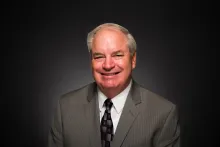
Robin Webber was born in Chicago, Illinois, in 1951, but has lived most of his life in California. He has been a part of the Church of God community since 1963. He attended Ambassador College in Pasadena from 1969-1973. He majored in theology and history.
Mr. Webber's interest remains in the study of history, socio-economics and literature. Over the years, he has offered his services to museums as a docent to share his enthusiasm and passions regarding these areas of expertise.
When time permits, he loves to go mountain biking on nearby ranch land and meet his wife as she hikes toward him.
