
Robin S Webber
This transcript was generated by AI and may contain errors. It is provided to assist those who may not be able to listen to the message.
Hello, and good evening, and welcome to the Cincinnati Congregations here. What a great pleasure to be with all of you, and indeed a great honor to be able to address you on God's Holy Sabbath Day. Sarah, wherever you went to, thank you very much. That was very nice that Sarah played because she's a Bakersfield girl. You have to understand Bakersfield. That's down home in Southern California. That's a completely different state than from where I hail from, which is basically Los Angeles.
And just saw her parents last week up in Bakersfield. Appreciate it, the lovely peace, and appreciate seeing all of you. Love being back in Ohio. For those of you that know me a little bit or have not met, my wife is a Buckeye, so I claim Ohio as a second home. Susan, my wife, is one of Ohio's most loyal daughters. You can take the girl out of Ohio, but you cannot take Ohio out of the girl.
And 40 years of California sunshine have not been able to evaporate the Midwest from her heart. We are coming in today from the McNealy's. I'm staying with Darris and Debbie. And just to be able to go along the country road to see the wonderful meadows, to see the woods even with their winter beauty, to be able to see the old houses that were along those roads in Civil War days, there's nothing quite like it.
But I do want to remind you of something. If you look out for just a second, this is about how bad it gets in Southern California. This is a bad winter day. Especially where Mr. and Mrs. Luecker were from in Orange County, because there was no weather in Orange County. And of course, the people that moved to Orange County pay for that. So that's just the way it goes. I do want to mention that you would certainly remember us this week as we have the Council of Elders meetings. Some of us have already arrived.
I saw Mr. Mickelson was here. I hope you saw him. He gave the opening prayer. And of course, we are looking forward to working with the administration this coming week as we move the goal forward. Oftentimes, people will ask me, Robin, what are you going to talk about? What are you going to do? Along with all the rest of us that come here. There's only one thing that we talk about, and there's only one part that we're about, and that's about our Father's business. And it never does change season in and season out in the United Church of God meeting in or meeting out.
And our prime directive is the mission statement. And it is to preach the gospel of Jesus Christ and the kingdom of God. It is to make disciples in all nations, and it is to care for those disciples.
The mission is always before us. That's why it's so important to understand what the mission statement is of the congregations that you become a part of to forward this mission. We strive to do our best. We do certainly ask that your prayers might be there, that God's Spirit will lead us in humility, with love, with vision, with confidence in Him and His Son's example, and that at the same time, we might be bold. We need all of that in this coming week to be able to move that mission forward.
I'd like to bring you a message today speaking about that mission and speaking about the gospel of Jesus Christ and the kingdom of God. It's a message that I look forward to giving to you today. I do must tell you that it is not a message of just simply sweet things or soft things that I bring to you today. But I do believe that it is part and parcel, heart and core, of the gospel that we are to spread around this world. It is today that I would bring to you an incredible invitation.
It is today that I would bring to you a calling and privilege of utmost honor. It is today that I would bring to you a divine petition upon your person, upon your being, upon your life, undergirded and guaranteed with everlasting love. To understand this, let's open up our Bibles on this Sabbath day. Come with me if you would, and let's go to Luke 14. Luke 14, the gospel thereof.
As you turn to Luke 14, allow me to create some framework to introduce the Scripture that I'm about to share with you. Jesus, by this time, was well known. People were flocking to him for all manner of reason. People were coming to him to hear of these concepts, these precepts, that had never been spoken before. People came because, as he went to and fro, it seems as if miracles abounded. Wonders were done. The lepers were healed. The blind were made to see. And even those that were with want were fed.
Jesus was a natural magnet in that day as he wandered through the Galilee or went through Judea. Many people were attracted to him for all sorts of reasons, and may there say that that still is the case today. Many people are drawn to this personality, drawn to Jesus Christ for many a reason. Many folks had traveled far and wide to see him, but now, in this passage, he's going to describe the rest of the journey. Their presence there on that afternoon or in that morning is about a beginning of where Jesus would have them to go.
He makes it very real, and he tells it exactly like it is. One thing about Jesus Christ that you can say is that he never kept anything from anybody. It is in this passage that he is indeed brutally honest about the future for those that would follow him in that year, and yes, to you today that are assembled in this room.
In verse 25, Luke 14, Verse 27, And whoever does not bear his cross and come after me cannot be my disciple. For which of you intend to build a tower, does not sit down first and count the cost, whether he has enough to finish it? Last, after he has laid the fountain and is not able to finish it, all who see it been too mock.
Well, look, this man began to build and was not able to finish. Or what king, going to make war against another king, does not sit down first and consider whether he is able with ten thousand to meet him, who comes against him with twenty thousand? Or else, while the other is still a great distance off, sends a delegation and asks conditions of peace. So likewise, whoever of you does not forsake all that he has cannot be my disciple. As we look at this, we recognize that, indeed, this is not a casual invitation.
It is not soft talk that he offers to those that might follow him. His invitation is utterly pervasive. It is a call that is a priority and will demand a certain walk awaiting those that will join the Master on the rest of the journey. It will demand their all, as it did, and it will demand our all to you that are here today in Cincinnati.
Every peace of you, heart, mind, and soul, we might call it the walk of the cross. He makes it very clear here in Luke 14, 26-27, if you do not bear a cross, you cannot be a disciple. It is very interesting. The background Greek here, to bear, means to literally to take up this burden and to follow him. That is what it means. It is very interesting because what Jesus is basically telling us there is you can be in the know, you can be titillated by lofty concepts, or you say, well, I really agree with that, or I really agree with that.
But what he is basically saying is you will not really learn from me because what I have to offer is more than just simply brain food. It is not there to simply titillate the gray matter. It is not just simply heart syrup. Remember when we were kids and your mama would get you a spoon with that awful tasting stuff? The syrup was for the cough. But I am using the analogy that unfortunately sometimes people will come into a community like this, a church community, and they can be titillated by facts and figures and concepts, and they can be information collectors. But that is not what Christ is calling us to.
And we think we can get a temporary quick fix of an emotional plug, get some syrup into our heart, and for a moment we rise, but we go out on Monday and Tuesday and Wednesday and the rest of the week and we fall. What Jesus is saying here is that what I have to offer you is experiential in practice. You see, it is not simply what I know or what I am sharing with you. It is what I am. It is what I personify. And what Jesus personified that I bring to you today is simply this, brethren, in Cincinnati, the crucified life.
And that is what we need to understand. Bearing a cross was not lost on his audience. In that day and age under the Roman Empire, the condemned had to bear their own crossbar. They'd have to put that burden on their shoulders, and they would have to literally walk to the place of their execution. Crucifixion, in a sense, was a living death. It was the ultimate dig. It was a humiliation. It was a totally tortuous experience, and it was meant to be.
It was meant to be an example. It was meant to be literally awful, in that sense, to magnify the power of Rome. So when Jesus said this, it was not lost on that community that hurt him. Many a Jew had seen many a road filled with crucifixions, as they would go along the Galilee or in Judea, that they would see these crucifixions. They knew, in part, at least by example, what Jesus was speaking about.
Even so, even so, Christ's invitation to follow me, to come after me, never ceases. The invitation of Christ always goes out, but there are a few steps along the way, and that's what I'd like to center on today. One thing I'd like to share with you before we go any further is, again, let's look at some of the words in verse 27. Friends, here in the audience, let's notice something here. Christ plainly states His cross, and or in this day and age, it's say, Her cross.
Can we bring you ladies in? You're not going to get out of this today. This is a whole church effort. This is a whole church experience, man and woman, that we are to bear our cross, His cross, Her cross. In other words, we don't simply jump on His cross and it sends a piggyback into the kingdom based upon what He did. Now, it is in part, yes, absolutely, because it is what He bore and what He went through that allows us reconciliation and redemption and restoration towards our Heavenly Father.
But the clarion call and the invitation here is very, very clear that it is not just simply what He bore to Golgotha, but you and I, as people in this way of life, you and I are also going to have to bear a cross. The goal and the role of what we do then is to bear and to carry what is upon us as He did Himself. What I'd like to do is, we're going to go this way in a moment, but allow me to prepare the personal journey before you with something that I feel is very important that we need to understand.
Appreciating and emulating the cross-like existence and experience was foundational and was central to the preaching and teaching and expectation of Jesus and the early church. It was a centering element of understanding why they were called. Where might we begin to understand this? Join me if you would. Again, let's open our Bibles and turn to 1 Corinthians.
The book of 1 Corinthians. And as we open a window on the Corinthians church without going through the entire book, to understand that here was a church that had issues. That's a word that people use today, especially young people. I've got issues.
Remember, I'm from Los Angeles, and there's that valley out there. We have issues.
And they had issues. This was a gifted church. There were many gifts that this church abounded in at the individual and the personal level. It was a church that was full of knowledge, full of facts, full of understanding. It was a church that had dynamic personalities that had split that church right down the middle. As we know the words in the beginning, I am of this person. I am that person, that person. There were also then the different factions in the church. There were the meat-eaters versus the vegetarians. There were the married versus the single. There was this. There was that. And it seemed as if the whole fabric was literally being torn apart. That's why we notice in 1 Corinthians that Paul had to come in. Notice verse 17, he had to, as we say, get right down to brass tacks. Folks, he said, this is what it's all about. Christ did not send me in verse 17 to baptize, but to preach the good news, the gospel, not with wisdom of words, not no sis, as it were, lest the cross of Christ should be made of none effect. For the message of what? Of the cross is foolishness to those who are perishing, but to us who are being saved. It is the power of God. For it is written, I will destroy the wisdom of the wise and bring to nothing the understanding of the prudent.
All the smart folks, all of those that put their strength in what they know, what they understand rather than what they are, where is the wise? Where is the scribe? Where is the disputing of this age? Has not God made foolish the wisdom of this world?
For since in the wisdom of God, the world through wisdom did not know God. It pleased God through the foolishness of the message preached to save those who believe. For Jews request a sign. Greeks, well, they seek after wisdom. But we preach Christ crucified. To the Jews, a stumbling block, and to the Greeks, foolishness. But to those who are called, both Jews and Greeks, Christ, the power of God and the wisdom of God.
And because the foolishness of God is wiser than men and the weakness of God is stronger than men. We notice as we go into the set of scriptures, it speaks to the cross of Christ. In fact, we speak of the message of cross. We speak of Christ being crucified. But allow me now to move you a little bit further into the New Testament. Join me if you would. Again, let's open up God's holy word and let's allow it to teach us. Join me, if you would, in Galatians 2 and verse 20.
Because here, and this is what's important, friends, we now begin to see something. It is not only what Paul preached to others, but internalized. It was, in a sense, the motor that allowed him to move. It was his life's engine. He brings Jesus' initial teaching that we read about in Luke 14, 26-27, of bearing a cross. Not just following what he did as he bore that cross to Gogotha, but the cross that is upon us. Notice Galatians 2 and verse 20.
I have been crucified with Christ. It is no longer I who live, but Christ lives in me. And the life which I now live in the flesh, I live by faith in the Son of God, who loved me and gave himself for me. Fascinating set of Scriptures here as we look at it. As we look at what Paul is saying, he speaks to the crucified life. See, the reason I'm bringing this to you this afternoon, friends, we often think, well, this is the kind of message that we might be hearing in March or early April as we come up to the New Testament Passover.
The crucified life, first and foremost, of the Master of Jesus Christ, and or the crucified life that we are to exist in and demonstrate, as Paul speaks here, is not something that you reserve for March or April. You don't put it on your calendar. You live it every day and in every way because of what God has done for you and for me.
Thus, we speak about it. We look at it. We understand that that crucified life must be staked firmly in our heart, which is the seat of our motivation and understand it even more deeply. Now, with that said, let's understand something.
While we do not worship before a man-made cross, nonetheless, our daily worship of God is molded by this powerful biblical metaphor of a cross-like existence, personalized.
I think sometimes we think of Christ being crucified, and he is, in that sense, firmly placed on Golgotha for you and for me. But we lose the rest of the journey. Jesus says that you and I are also to bear a cross. What he bore is special. That was the Son of God on there. But we, as the children of God, are also called to bear that cross. And so we look at this, and it's one of the centering elements of not being conformed. Hear me, please. It is one, this cross-like existence. Being before us on a daily basis is a centering force, an element of not being conformed to this world.
It is a centering element of having our minds renewed constantly, and it is the ultimate element of you and I moving to the ultimate step that God has in store for you and me. And that is to be transformed into the image of his Son, as his Son is indeed the image of his Heavenly Father. Thus, how do we bear a cross like Christ? And that's the title of this message, Baring Your Cross Like Christ. Let's get right into it, because you see, friends, here in Cincinnati, Jesus completed the work that was set before him in bearing the cross that he bore. And at the end, he was able to say, it is finished.
You and I have also been assigned a cross. I know this is not a comfortable message to give, but it is the reality of the Gospel. And you and I, in that sense, also have a cross to bear. Our responsibility is to bear it like Jesus Christ. Allow me to give you that first step in the journey, if you will accept this privilege of bearing a cross like Jesus Christ. Step number one, his purpose was always before him. He always had it in mind. That's why I brought it up here.
We are in December. We're not in March. We're not in April. In which so often your pastors will focus, your ministers will focus on this topic. The issue and the reality of what lay before him and bearing that cross outside the camp and onto Golgotha was always before him from the beginning. Christ did not simply wind up at the end of his life on a cross that, what am I doing here? Something I didn't know, Father? He knew it from the very beginning.
It was always before him. It was in his heart. It was in his mind. And this is the comfort that I share with you on this Sabbath day. He was not an accidental Savior. He didn't wind up on Golgotha by accident. It was by design, and he knew about it. Join me if you would in John 3. In John 3, at the very, very beginning of his ministry, as recorded to us in the Gospel of John, we notice that he began with the end in mind. John 3. And let's pick up the thought if we could in verse 13.
Speaking, no one has ascended to heaven, but he who came down from heaven, speaking of himself, that is the Son of Man who is in heaven. Now, notice verse 14, key to our discussion at this point.
And as Moses lifted up the serpent in the wilderness, even so must the Son of Man be lifted up. This was speaking of his human end. This was speaking of that date that he had in a place called Golgotha. This was speaking to the cross that he would have to bear for you and for me and all humanity. He began with the end in mind. His purpose was always before him. You and I are more acquainted in verse 16, very famous passages. For God so loved the world, he gave his only begotten Son. We so often focus on that verse, and may I say rightfully so, but to recognize, notice the mind frame.
Notice the heart frame. Notice how he began with the end in mind. How does this speak to you and me? See, Jesus from the beginning recognized that his life was special. He had a calling, and his life was devoted to meet and to make that date on Golgotha for you and for me. Join me if you would in John 15 and verse 16, same gospel. You and I have also been given a calling. We've been given an invitation, and we have the privilege and the honor of accepting it.
Notice John 15 and 16. You did not choose me, but I chose you and appointed you that you should go and bear fruit, and that your fruit should remain, that whatever you ask the Father in my name, he may give you. We did not simply join a church. We were called by none other than God the Father. You and I are here, not simply because, well, you join a church, or you join people that just happen to think like you, or you join this faith community versus this faith community.
Brethren, you're here because you have been given a calling from God Almighty and no less. How incredible. How wonderful to consider that. But to recognize what the calling is about, join me if you would in 1 Corinthians 1, because this gives depth and substance to what God is doing for you and for me, and why we need to understand the crucified life and bear our cross like Christ. 1 Corinthians. Let's pick up the thought if we could in chapter 1, verse 2.
Notice what it says. Notice it didn't say to the Corinthian church. The church of God is wherever God plants His name and wherever the assembly is. To the church of God, which is at Corinth. To those who are sanctified. Those that are set apart. Those that are called to that which is holy in Christ Jesus. Called to be saints with all those in every place who call on the name of Jesus Christ our Lord, both theirs and ours.
These words of sanctified and this word of saint, they come off the same Greek root of hagios, which means to be set apart. In other words, stay with me. This is my PowerPoint. I'm about to go into it. I'm it. Okay. In other words, we were over here. Now, the cameras over here, he knows me too well. We were over here, but God in His mercy and by His grace grabbed a hold of us. And then He placed us in the body, His body, the body of Christ.
And as it says in the epistles that Christ grabbed a hold of us over here, that over here we might grab a hold of the things of Christ. See, it's double. We're grabbed by Christ on behalf of the Father, and then we are to grab a hold of the things that Christ gives us, embrace them, internalize them, practice what we preach.
Very important. Likewise, with understanding this holy calling, see, brethren, you and I have not just been called a, quote unquote, a church. We are members of the spiritual body of Christ, this organism known of God. And the Father and the Son know who are His. And you and I have been called to more than just simply showing up at 2.30 on a Saturday afternoon here in Wintry, Cincinnati.
You and I have been called to sacred service. You and I have been called to the Holy. You and I, I remember many years ago, an elderly gentleman in Pasadena saying, it is now time that we learn to become teachers, because we are going to be a kingdom of priests in the wonderful world tomorrow. What does a priest do? A priest deals with that which is holy. And there can be, in a sense, nothing more profound and centralizing about the holy than understanding the crucified life.
In bearing a cross like Christ did, we need to make sure that our cross matches His. I think you and I can appreciate as students of the Scriptures that His cross was God-designed. It was not man-made. Oftentimes, we can feel overburdened or persecuted for one reason or another, and we can say, well, this is a cross that I cannot bear. It is just simply too heavy. And humanly, that might be the case. But as we bear the burden of a cross, let's be sure that it is God's cross and not a cross of our own making.
Sometimes we make that mistake. We get mixed up on the cross issue. Jesus Christ said, blessed are you when you are persecuted for righteousness' sake, not foolishness' sake. Sometimes we are persecuted not because of Godly design, but because of what we've done, and then we assign it to God. Now, God's commandments and precepts will still be a way of helping us out of that, but let's make sure, because self-will and God's purposes go down two different roads.
I've been reading a book recently, a marvelous book, and it goes into the issue of pruning, and how important it is for us to learn to prune. And, you know, the Bible is full of issues dealing with agriculture. And to have the crucified life, to make sure that the calling of God the Father and the example of Jesus Christ as ever before, is, I think, more than ever, we need to understand what pruning is all about. When a person begins to plan a garden and to have a rose bush, if you're really serious, if you're really serious, what you're going to do, first of all, with that rose bush, is you're going to nurture it.
A beautiful rose bush just simply does not happen. You have to have, from the beginning, the end in mind. You have to know what the rose is to look like, right? What is the rose to look like? What are you shooting for? What is the goal? What is the design? And, of course, you and I know that ultimately what the Father has given us to image in our minds is the total completeness of the example of Jesus Christ.
Thus, there is the goal. There's the bloom. It is the bloom of eternity that God allowed to come to this earth for us to behold. To be our example, to follow as it were. But then what happens is, as that rose bush begins to develop, different things happen along the way. Or am I the only one that's noticed? And you notice that pretty soon you have branches, or you have buds that, well, they're ugly. They're dead. But too often we leave them on there for a while. And or you notice also that there are branches and or buds, but they look like they have the flu.
They're sickly. And then there are buds, buds, and buds, and buds, because a rose bush will always put out more buds than it can possibly nourish. And thus the cultivated horticulturalist, that is the rose grower, has to have that end in mind. Number one, you have to cut out the dead branches, the dead things. Number two, you have to cut out those branches that are sickly, that are not moving towards the goal.
And then this is the hardest part. Are you with me? The hardest part is to cut away the buds. The buds that look beautiful, but there are too many buds for that rose bush to nourish. Thus, I suggest to you, and you ask where you are and only you know, dealing with whether in your life you have a dead branch that you have not cut off, whether you have a sickly branch that you continue to nurture and to play with, hoping that it will come on your way.
This might be the most important thing that you can do, but never comes around with. This might be the issues in your life, relationships that are in your life. And there might be a lot of wonderful, like roses, because remember, a rose will always produce more buds than it can possibly come to bloom.
And there's a lot of, do I dare say, good things, good things that are happening in your life. Wonderful things! Good things! And they look kind of purdy. But they're not a part of the prime directive. They're not a part of the crucified life. They are a distraction. They are an interruption. They are pulling you away from the nourishment of God that you so much need to move in this prime directive of following Jesus Christ as He asks each and every one of us. You must, then, in other words, abandon your own will and your own agenda as long as you cleave to a personalized agenda and just deal with the good, just deal with the pretty, and continue to nourish it.
The personalized will of God will be thwarted in you. Join me, if you would, in Galatians 6, verse 14. Notice this transformation in the life of a developing Christian called the Apostle Paul, Galatians 6, 14. But God forbid that I should boast except in the cross of our Lord Jesus Christ, by whom the world, notice, has been crucified to me. Okay, then notice again, and I to the world. Two things are happening here, friends. Notice, by whom the world has been put to death, the ways that were so attractive before seemed so titillating, drawing me forward, taking all of my energy, all of my being, all of my creativity, and I.
These are crucified to me. And notice, and I to the world. Very important for the Christianity that the Father has called you and I to experience does not come from the outside in. Christianity is about the inside of the person, and being able to deal with those exterior forces that are out there. Here's what I want to conclude with here, and that is for you to understand this. While we must bear our cross, it must come into the conformity and match that of Christ to do the will of the Father.
And here's what I want to keep on reminding you, dear brethren, here in Cincinnati, and those that may hear this message in the future. While we must bear our own cross, that is a part of the deal. Before we bear a crown, we must bear a cross. Did you hear me? Before we bear a crown, we must bear a cross. And keep it ever before us is the first step. Number two, Christ bore his cross. Christ bore his cross with humility. Join me if you would in Philippians 2. In Philippians 2, Paul was writing to a church that he cared so very much for.
He loved the Philippian church, but he wanted to take them to a deeper step in understanding the cross-like existence. In Philippians 2, let's pick up the thought in verse 1.
This speaks to humility. This is what I want to share with you today. Sometimes we do not understand how radical Christianity was when it was introduced in the first century. In the prevalent Hellenistic world of that day, humility was not to be a virtue. It was not to be esteemed in the Hellenistic community. It was not to be thought of. And yet, it is always, if you'll notice this, you might want to do your own personal study through the Scriptures. It is always that which is brought out first.
It is humility. That which the Greek world tossed out the door is what Christ said that his church needs. And perhaps, do I dare say perhaps, we need that more than ever in the body of Christ. We notice what it says here, then, going on. Let this mind be in you, which was also in Christ Jesus. It's not just simply precept.
It's not theory. This happened on the ground. Who, being in the form of God, did not consider itself robbery to be equal with God, but made himself of no reputation taking the form of a bondservant. That is a slave and coming in the likeness of men. That means, when I was a young person, and we have some young people here, I used to look at this verse when I was growing up in the church where it says, Who, being in the form, did not consider it robbery to be equal with God. I didn't understand what that meant.
I thought, was there some kind of a spiritual heist going up on in heaven? I didn't get that, what it meant. What it means is that Jesus, who gave himself as a gift, did not hold on, did not cling, did not grope to that which was rightfully his. He didn't hold on to that trunk of the tree as it were up there, and it was kicked down. Here, you're going down.
No, no, you're going down. You're going down. No. He wasn't fighting. He let go of that doorknob to the doorway of his father's throne. He didn't hold on to it. He willingly came down for us. He humbled himself. And just imagine that that which is uncreated coming into the realm of the created, that which is that of eternity, forever, coming into that which is locked in by time and space. And he did that for you and for me. I'd like to share a thought with you for a second.
And I think it's important because humility is something—and I will say this as a counsel person, as a pastor, and as a fellow Christian— I think more than ever as we move forward in 2012 into whatever time that we might have in moving this mission statement of the United Church of God together and forward, I think the most important thing that we have to deal with, brethren, is humility.
We have not always been a humble people. Some of the issues, some of the challenges that we have had before us have been because of not understanding the crucified life. The life which should be supreme in us, the cross-like existence, not just simply the precept. There's a lot of folks that can talk precept, but don't practice the walk.
See, this is a walk. This is not a walk reserved the week before the New Testament Passover. This is our everyday walk. It's a tough walk. But it is an invitation.
It is a privilege. You and I cannot do it by ourselves. It is only by the Spirit of God and Jesus Christ walking before us with the example of His cross before us. But, brethren, if we are to be an effective instrument within the hands of Almighty God and His beloved Christ, we must be a humble people.
There was a time when there was an audience around Jesus Christ. And again, Christ drew all sorts of folks. Folks that you thought, well, who? Oh my! Who let them in the door? And sometimes that's how religious folk are. Who let them in the door? Who let them in the door? Kind of like a puffed up frog on a lily pond.
My PowerPoints are much more fun than the stuff, the real stuff I've heard. No.
You laugh, brethren, but you know that religious folk are a tough crowd when it comes to sinners. And the business that we have is dealing with sinners. That's the business, that is the calling that God the Father gave to Jesus Christ. Not to deal with people that didn't think they'd ever done anything wrong, but to those who knew what they were, knew what they had done. And yet recognize that there was an answer of hope to bring them out of a dark world, in a dark existence, one that had not known God. And not just simply known facts, but come to experience and understand the love of God, the embracement of God, a love that never fails, that will never be separated from us. But to do that, we have to be a humble people. What is humility? Humility is a proper estimation of ourselves apart from God and who He is. It is a proper recognition that we have deserved nothing but death, but have been rescued apart from ourselves, reconciled, restored. And but by the grace of God would still be drowning in our sins.
And thus, we look at when we understand that and recognize that we are forgiven, but remember where God found us.
We then treat, respect others as God has treated us and as we ought treat them. That will be magnified in our tone and in our posture and our discussion, one amongst another in this room as Christians, to recognize that we have been forgiven. And thus, we come down off of our throne, which frankly never existed, only in our mind. And we meet one another in that common ground before the cross of Jesus Christ and recognize that apart from Him we are nothing and deserve nothing but death. And yet our life has been redeemed. Our life has been given worth, not by our self-worth, but by the worth vested by the Father and the Son to us. And thus, we are redeemed. Thus, we are reconciled. Thus, we are given life. Sometimes Christians forget that Jesus Christ did not come to make good men better. Jesus Christ came to take dying men, men that were dead men, may add women too, dead women walking and gave them life. We forget that. We forget sometimes where God the Father picked us up on this journey and said, I want you to walk the walk of my Son. It's a glorious walk. It's a privilege. It's honored. But, by the way, you will have to carry a cross like He did. Before we bear a crown, we must bear a cross, and the cross is planted firmly in the footstep of humility. Point number three. Point number three. Christ bore a demanding cross. Christ bore a demanding cross. Matthew 10, verse 38. Join me if you will. Let's open up again to Holy Scripture.
Isn't it a joy that you're a part of a church that opens the Bible every time you come to church? Brethren, I hope we never take that for granted. Because an open Bible is the beginning of having an open heart and having an open relationship with God Almighty. Matthew 10, verse 38. You're already there.
Notice what it says. And He who does not take his cross and follow after me is not worthy of me. There is no weight. There is no value. That's what the Greek bears out. And He who finds his life will lose it. And He who loses his life, for my sake, will find it.
It's a hard concept because it's so unnatural to the human framework that basically Christianity is about losing your self-life.
And yet we cling on to it. Oh, we hold on to it for dear life at times. Wittingly or unwittingly, even as Christians, because we're not at the end of the road yet. And yet, remember what Paul said in 1 Corinthians 15, 31. I die daily. I die daily. I am in that sense crucified daily. I am in that cross-like existence daily. I am in that walk of the cross daily.
It is no longer I who live, but Christ Jesus lives in me. We all know this. We all know that we are to give our lives one to another, not only just folks in the church, but to all that might be before us. Those that come into our path of life as we do this walk of the cross. And sometimes what happens is, though, we always hope it's, well, remember Vivian laying gone with the wind?
O-rat. O-rat. And then she'd sit down and she pout on the steps. Well, there's always tomorrow. Monyana is the death knell of a Christian. It is not about tomorrow. It is about today, and that's why I opened up the invitation. Today, if you will hear this, ABC students. Today, if you will hear this, new church members of the United Church of God. Today, if you will hear this, those that have been in the church for 30 or 50 years.
To understand deeper, I do not share necessarily new things. I just simply expound them. They have been here for 2,000 years. We must embrace, we must internalize, the walk of the cross. The cross-like existence. To have the world crucified to us, and we be crucified to the world. It is not just simply that stake on Golgotha, but that stake of mind, that stake of heart, that firmness of calling, of being a part of that which is sacred, implanted in us.
Brethren, this is glorious business. What a supreme privilege that you and I have been given to be able to walk after the Master, and to recognize that as He was burdened, we are burdened. This is humanly not nice, but this is glorious when you understand what God is calling us to. But we don't plan for it at times.
We say it's not convenient. It's not on our time schedule. And or you say, who? Me? Me? Me? You talk of me? Me? Really? I thought that was for Mr. Luecker to do. I thought that was for Mr. McNeely to do. I thought that was for Mr. Myers to do, because he knows everybody that's sick in Cincinnati. I just got that through the announcements. I mean, that's Mr. Myers' job to do all of that. Well, because after all, he's Mr. Myers. No, this is what a part of a whole church effort is all about.
It's a whole...it's not looking over...it's not looking for somebody coming over the hill. God's already implanted His essence in us, His Spirit. And you and I become a committee of one, but sometimes we think it's somebody else's job.
I'd like to share a story with you for a second, to bring this to home, because it's amazing what just one single act can do, and I want to share this with you. It's entitled, He Who Loses His Life Finds It. On one occasion, Sadhu Sandur sang, and he said, well, who is that? He was an evangelist back in 19th century India. On one occasion, Sadhu Sandur Singh and a companion were traveling through a pass high in the Himalayan mountains, and at one point they came across a body lying in the snow.
Sandur Singh wished to stop and help that unfortunate man. But his companion refused, saying, we shall...we're going to lose our lives if we burden ourselves with our own. But Sandur Singh would not think of leaving that man to die in the ice and snow. As his companion bade him farewell, Sandur Singh lifted the poor traveler onto his back. And with great exertion on his part, he bore the man onward.
But...this is neat... But gradually the heat from Sundar Singh's body began to warm up the poor, frozen fallow. And he revived. Soon, both were walking together, side by side. And they caught up with their former companion. They found him dead, frozen by the cold. In the case of Sundar Singh, he was willing to lose his life on behalf of another. And in the process of found it, and in the case of his callous companion, he sought to save his life. But he lost it. Brethren have...do I dare ask the question? Have we considered losing our life more than we have up to this point?
Have we considered that when God calls us and implants the spirit of the Son inside of us, that we have been called to the life of crucifixion? Of giving our life away. One person, one act, one deed, one situation that's not convenient in our time schedule, that God has planted in front of us.
We need to consider that on this the Sabbath day, as we understand how we are to bear our cross like Jesus Christ. We are to bear a cross. That's the deal. And before we bear a crown, we bear a cross. Let's go to point number four. God will give us others to share the load.
There's only eight more points. Don't worry about it. God will get...that was to make you laugh so I could go on for a moment. I don't tell jokes like Mr. Myers does. I only tell the truth. There's eight more points. Not just Jesus. God will give us others to share the load. God will give us others to share the load. Join me if you would, and Mark.
Forever stamped in Scripture to encourage us. Jesus, our Lord and Savior on that, that walk from the middle of Jerusalem to Golgotha, which was a trek, especially after he had endured the night before of all the beatings and all the torture and all the suffering that no man should bear, and then to have to carry the crossbar of a cross to that forsaken place, but to criminals known as Golgotha. And let's remember, even as he was indeed the Son of God, he was the Son of Man, he was encapsulated in his flesh, and his bones hurt and his muscles were weary, and he sank, and he could go no further.
And we find in Mark 15, verse 21, and then they compelled a certain man. Actually, let's pick up verse 20. Pardon me. And when they mocked him, they took him from the purple, and they put his own clothes on him, and they let him out to crucify him.
And then they compelled a certain man, Simon Iserenian, a man from North Africa, the father of Alexander and Rufus, as he was coming out of the country and passing by to bear his cross. And they brought him to the place Gogatha, which is translated the place of the cross.
Here's what I'd like to share with you, friends. Fellow brethren, as I seek to internalize this lesson myself, allow me to be frank. The crucified life is, in part, radical. It's radical. And it is lonely. And whatever cross that God has placed on you to bear like Jesus Christ is, at times, lonely and individually alone, apart from God. You will not always be surrounded by crowds of like-hearted people that truly understand the call of the cross-like existence that is from the inside out.
Oh, there's a lot of people that can talk the talk. There's a lot of people that can share the facts. But they do it from the outside in and not the inside out. They don't embrace and understand the sacred calling, the holy effort that our Father has placed us into in this training of becoming a kingdom of priests, of being holy as He is holy. They won't always understand.
They say, Oh, you're a fuddy-duddy. Oh, you've got to be kidding! Perhaps some of you that are in ABC 18, 19, or 20. And I think we have marvelous young people in the church, and to see all of you is to touch the future. But sometimes we can rib one. Oh, you've got to be kidding. We don't do that in our church area. You must be radical. Are you from the moon or something? You've been eating green cheese?
What Scripture have you been smoking? You know they can do that in Washington now. Oh, I'm sorry, Leanne. I'm going to be very blunt, and I'm of seriousness. The crucified life, the cross-like existence, it is radical. It is apart from human nature. It is of the divine. It is but by God's grace that you are led down that walk. It is a walk that will at times mean loneliness.
It is a walk that will mean at times ridicule. And do I dare say even ridicule from people of faith that are faithless? Did I say that? Do you understand what I'm saying? People that are in a community of faith but simply don't get it. They speak the accent but without a trace of the language.
The cross-like existence is radical. It can be a lonely experience. Let's think about it for a moment with Jesus Christ Himself when you think about it. That when you look at it early on, the early ministry, the disciples didn't get it. He'll be talking about that of which was to come. He would allude to the cross. He would allude that He wasn't always going to be here. You know and I know because we've all read the same Scriptures. They didn't get it. They didn't understand. They were in a sense in the dark. In that time right before Jesus was crucified, He was in the garden.
He had to pray alone. The others were asleep. The others were asleep. They didn't have that state of urgency dealing with the crosswalk, the cross-like existence. They were asleep. Later on, they all fled Him as He was led to the chamber to where He might be tortured.
Even outside in the courtyard, one that He had known so well denied Him three times. I share that with you because remember, we are to bear our cross as Jesus Christ bore His cross. I'm just warning you up front as Jesus was brutally honest. I want to share with you that we'll take up more than ever this supreme privilege, this calling, this invitation to the sacred to recognize that indeed it is a lonely walk, sometimes only with the Spirit of God and the Spirit of Christ and the love of the Father moving us forward.
Join me if you would in 2 Corinthians. In 2 Corinthians 4. In 2 Corinthians 4. You and I also can be, in that sense, like 2 Corinthians 1, pardon me, we can be a Simon of Cyrene. He Himself is dead and buried, but that Spirit lives on to help others.
Blessed be the God and the Father of our Lord Jesus Christ, the Father of mercies and God of all comfort, who comforts us in all our tribulation, that we may be able to comfort those who are in any trouble with the comfort with which we ourselves are comforted by.
Here's what I want to share with you, and this is the good news. May I give you some good news? The good news is that God, whatever cross that you have that you're bearing right now, that God has a plan for you. If God gave Jesus Himself a Simon, then here in Cincinnati, He's got a Jane, He's got a Sally, He's got a Bill, He's got a Harry.
And the Spirit and God in you has got to recognize it when you see it. And it will not always be whom you... Are you with me? It's not whom you would have chosen. It will not necessarily be on your day planner. Our responsibility is not to choose whom God gives us to help us bear the cross.
Our job is to accept, as Jesus did in God out of the way and allowed Simon of Cyrene to help him along the way. We must bear a cross before we bear a crown. And being there to help others bear their cross is a part of our journey, not only to be assisted, but for you. What's your name? You! To be a bearer of the cross and to lift the weight off somebody else.
I'm going to skip a point, and I want to go right to the end here. Maybe this is a sermon that has no end because I can't find it. Uh-oh. That'll stretch your faith. Let's conclude. I'll come back sometime if I'm invited, and we'll cover that whole point five by itself. But I think you've got the point today. Today we have considered a good consideration, my brethren. Wherever a minister of God speaks before the people of God, it is home. Because God's Spirit is here. Christ is here. And while I am a Southern Californian, I am home with you here today in Cincinnati.
And speaking of the journey that confronts each and every one of us, today we've considered the crucified life and how to bear a cross like Christ. There's only one question, and that is simply this. Not only you can answer, what do we do then as we leave this hallway today? With the privilege and the honor and the calling of coming into this cross-life existence.
What will you do with what I have shared with you out of God's holy Word today, on Monday or Tuesday or Wednesday? Or have I or another minister or Mr. Walselkopch has come to take up time with you? What will you do as you, now, in this time? The Bible always speaks about now. Not tomorrow, but now. The urgency of the moment, the urgency of the time. Will this simply be information? Will this be momentary inspiration? Or can you begin to allow the transformative process of God's Holy Spirit, tooling and dying your heart to allow the righteousness of God to expound, to expand, and to be an example to His glory and to His honor?
Join me, if you would, in Hebrews 12, to conclude. Hebrews 12. This is the calling. This is the privilege. This, indeed, is the invitation. Did I say Hebrews 13? Pardon me. Hebrews 13. Allow me to read it. Therefore Jesus also, that He might sanctify or set apart the people with His own blood, suffered outside the gate, away from the populace.
Remember what I said? Christianity, the cross like walk, it's radical. And at times, it's lonely business. He was outside the gate. Therefore let us go forth to Him outside the camp, bearing His reproach. For here we have no continuing city, but we seek the One to come. The world, the culture, the cosmos, the society is crucified to us as it was to Paul 2,000 years ago. Thus, what does this set of Scriptures tell us, brother? It says to get up, to go out, to meet Him, to embrace that cross-life existence, the crucified life.
What will that mean to you and me? Jesus bore shame and disgrace, and we must be willing to do the same. Jesus was willing to suffer outside the camp, and so must we. Jesus, the Son of God, the ultimate gift from heaven above to earth below, His own dear Son, His beloved, was not unashamed of us, and we can never be ashamed of Jesus Christ and proclaim His name.
There is one vital difference, as I conclude. There is one vital difference in our crucified life and the cross that our Savior bore in regards to what He did for us. And it is simply this, and this is what I want to leave you with. Jesus, as He bore His cross, was forsaken that when you and I bear our cross, we will never be forsaken because of what He did.
The love of Christ, the love of the Father, cannot part from us. Remember what I told you in the beginning about the invitation and about the petition upon you, the supreme calling and the privilege of the cross lifelike, that it is undergirded with everlasting love of God the Father and Jesus Christ. Before we bear a crown, we must bear a cross, and that's the deal. Christ carried His, and likewise we are called to carry ours.
No way around it. But we need to make sure that it matches the Master's step. Fully appreciate and know that God's grace will never lead you to where His Spirit cannot uphold you. And the greater the need, the greater the grace. And that's the deal that God makes with us when we have the privilege and the honor to pick up the cross and to live this cross-life existence. What a joy and what an honor to be able to share these deep, beautiful, wonderful, loving things that God has visited upon you and me. Not because of who and what we are, but because of His goodness and His righteousness. Let us go home today and ponder on these things and walk the walk of the cross.
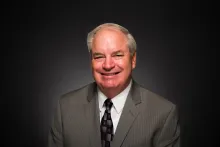
Robin Webber was born in Chicago, Illinois, in 1951, but has lived most of his life in California. He has been a part of the Church of God community since 1963. He attended Ambassador College in Pasadena from 1969-1973. He majored in theology and history.
Mr. Webber's interest remains in the study of history, socio-economics and literature. Over the years, he has offered his services to museums as a docent to share his enthusiasm and passions regarding these areas of expertise.
When time permits, he loves to go mountain biking on nearby ranch land and meet his wife as she hikes toward him.
