
Robin S Webber
This transcript was generated by AI and may contain errors. It is provided to assist those who may not be able to listen to the message.
That was fun, wasn't it? Kind of like the unfinished symphony. Nearly 500 years ago, or actually about 400 years ago, excuse me, Shakespeare penned Macbeth, a famous play about a Scottish king. In the course of writing Macbeth, Shakespeare used a line that I would like to build upon this afternoon. It's a simple line, but as I share it with you today, I will share it at the beginning of this message, and I will share it with you at the end. I hope that it will be a line that you don't simply equate with Shakespeare, but that you will equate with our Lord and Savior, Jesus Christ.
It simply goes like this, nothing in this life became him as the leaving of it. And it is that to which I would speak this afternoon to all of you about his life and how he left it on Golgotha as he hung on a cross. Often times, when we come to the Passover, we will read verses out of John 13, 14, 15, 16, 17, and 18 that we often colloquialize and say these were the last messages of Jesus Christ to his disciples.
But there's a whole other profound set of messages that Jesus gave to us to consider. We might call them echoes from Golgotha. Words that come down to us that I would like to share with you today so that we might better prepare for the New Testament Passover. And when we do go through this today, we are going to recognize that the Gospels record seven sayings of Jesus Christ that he gave from Golgotha. Now, I do want to share with you something to remember that as he was speaking these words that were later on recorded in the Gospel, he wasn't speaking like you and I are speaking right now, or that I'm speaking in the comfortable atmosphere of this building and behind this lectern.
He was speaking as he was nailed to a cross, as his arms were outstretched, as nails were in his arms or in his hands, and as they went through his feet. So we must always remember that it is in the context of the crucifixion that these words need to be understood. And the reason why I'd like to share them with you this afternoon is simply this, is that as we come up to the New Testament Passover, indeed it is a memorial of the death of Jesus Christ and of a life of crucifixion.
But as we come to Passover, let us remember that we are also, once again, renewing covenant. We are renewing covenant with one that experienced a crucified life. And as we renew covenant regarding the one that experienced the crucified life, you and I then take on that covenant that we then proceed from this room and that likewise we live a crucified life. I'll bring that to the total four at the end of the message.
But here's what I'd like to share with you this afternoon, and that is simply this, and that is that these are living words of life from the voice of a dying man. Chris mentioned, going through the aspect of Paul's instruction in Corinthians, that indeed we are to examine ourselves. And therefore we're going to look through these three sayings of Christ on the cross as a lens of looking, not at ourselves, as of and by ourselves.
We have no worth. The joy that you and I experience as we partake of the bread and the wine on Passover Eve is the joy of understanding that through Jesus Christ's sacrifice, we are accepted and we are approved. And we are able to experience coming before the very presence of God's throne room through that sacrifice when we use His name and when we say, Father above in Jesus' name. That name in part signifies what He experienced on the cross. I believe that we will come to see that these last words that Jesus Christ uttered, these echoes that come down to us today from Golgotha, should be our first response as we move away from this room that night.
His last words, our first response as we not only worship one that experienced a crucified life, but in covenant with Him before our Father, say that we too will live a crucified life, a crucified existence within the full measure and within the full stature of Jesus Christ. Let's go through those then. Let's begin with number one. I'm going to go right into it.
And turn with me, if you would, let's open up our Bibles on the Sabbath day. You're already dead for Christ. Please do so for me as well to honor God. Let's go to Luke 23. Luke 23 and notice the first thing that Jesus Christ mentioned as He was nailed to the cross for you and for me. In Luke 23 and verse 34 it says, And then Jesus said, Father, forgive them, for they do not know what they do.
Now, we need to understand something as we read this verse. Father, forgive them, for they know not what they do. We need to understand the context of what is going on here and we begin that by going to verse 32, which will allow us some framework by which these words are spoken. And it says, There were also two others. There were criminals led with Him to be put to death. And when they had come to the place called Calvary, and it is mentioned in Calvary in the Gospel of Luke, there they crucified Him and the criminals, one on the right hand and the other on the left.
So that gives us a PowerPoint presentation of what is occurring. And I think all of us realize how incredibly horrible crucifixion was. And it's not my point in this message to amplify every single detail of crucifixion, but it is the worst torture, the worst death that could humanly be devised. It was a living death and was intended to be so. And it was to totally humiliate the individual that was experiencing it moment by moment and hour by hour. It was not designed to be slow. It was designed to last. And here He was, up on Galgotha, up on Calvary, crucified, nails in His hand, nails in the legs, and the criminals were on either side.
And then Jesus said, Father, forgive them, for they do not know what they do. And they divided His garments and cast lots. And the people stood looking on, but even the rulers with them sneered. Those rulers were, in that sense, the good church folk of that day. That was the religious society. And they sneered at Him, saying, Well, He saved others, let Him save Himself. If He is the Christ, the chosen of God. And the soldiers also mocked Him coming and offering Him sour wine. And saying, Well, if you are the King of the Jews, forgive yourself. So we have this microcosm of all of society on the top of Galgotha. You have both the religious society of the Jews, and you have the world of the Gentiles represented by the Romans, and all the world is turning their thumbs down on this one that is nailed to the cross.
The reason I bring this up, this is the context in which He said, What do we learn from this as we move towards Passover 2012? It is essential to grasp the opening chapter of Christ's Last Moments was Forgiveness. This is where God's story begins with us. These words remind and refresh us that forgiveness is the first step towards eternal joy, happiness, and true well-being. You know, and I know there are many, many people out there today, and perhaps some of us that are even in this room today, that have issues, challenges, tumult over forgiveness.
In Christianity, Christianity 101, forgiveness comes first. I want to make it strong because God loves you, and I love you as your pastor, and we must bring the message of the Scriptures to you and how important it is to forgive. Jesus set the tone. He paved the way, and He put forgiveness first because it is the gateway for all else to enter in. Forgiveness is the gateway. It is the door that every other blessing, every other element of God's revelation to us, must enter in to find its expression.
It is not marginal. Sometimes we can have people that become attracted to this way. They might understand that our church understands this about the Bible, or this about the Bible, or this distinction about the Bible, or this interesting word play in the Bible, or this scenario about future prophecy, or whatever it might be. You've been there, I've been there, we know people like that. But brethren, when it's all said and done, this is a work regarding salvation. And that salvation, the first step that God brings forth from Him, is forgiveness. We ought to talk about that because it's not only God forgiving, but He wants us to be able to do that too.
When we understand that Jesus said, Father, forgive them for they know not what they do, let's understand something. Are you with me? And that is simply this. Jesus did not simply turn the other cheek. He changed the whole equation.
This was not just a matter of turning the other cheek. Jesus, in making this statement, paved the path for all of those down through the ages that would choose with Him to live the crucified life that comes by forgiveness. And in this, this man, this Son of Man, this God in the flesh, the Son of God, reflected God. Join me if you would in Psalm 86 and verse 5. Psalm 86 and verse 5. Let's notice a scripture from the Old Testament.
Because Jesus came to this earth to show us what God would be like if He was walking on all twos. And here it is. Because it is reflecting what the scriptures say here in Psalm 86 and verse 5. For you, Lord, are good and you are ready to forgive and abundant in mercy to all those who call upon you. Did you notice what it says? You, God, are good because you are ready to forgive. Now that just doesn't mean to spray forgiveness over everybody. That's not what I'm talking about. In forgiveness, there should also, to the one that you are forgiving, there should be an understanding of their responsibility and an attitude of contrition.
But what Jesus Christ is displaying here is an environment, an atmosphere, a framework. It's the launch pad. It's the beginning step. It is our desire that we forgive one another as we, in turn, have been forgiven from above. There is simply nothing more fundamental in Christianity than that. One plus one equals two. As you forgive others, then you are forgiven. It doesn't say you are forgiven while you kind of think about it or put it on pause or put it on ignore. Now, in saying this, I realize that some of us have issues, it's a word that we use today, issues with people. If anybody could have ever had issue with people, it would be this one that was nailed to a piece of wood as he's being sneered, as he's being jostled, as he's being paunted. And Jesus said, Father, forgive them, for they know not what they do. I have a question for you. How is it that Jesus Christ was able to forgive? I'm going to give you just two sub points. Point A. How was it that Jesus Christ was able to have that atmosphere of forgiveness? It's the first thing that came off his heart and off his tongue that was recorded. Number one, he didn't take them personally. How do you do that? That's the worst thing, because as human beings, we want to take everything personally. He didn't take them personally, but recognized their humanity and Satan's deception. If you got the true sense of what he was saying, it'd be more like this, Father, forgive them, for if they really, really knew what they were doing, they would not do it. But Jesus understood their humanity and understood the source of their deception and the world that they were in. Let's understand something. And we do this. I do this. I'm sure you do this sometimes as we grow a little bit older. We say, I wish things were the way that they used to be. Why can't things be like back in the 50s? When life wasn't complicated and we just had those old metal gray sunbeam toasters in our kitchen and we only had three stations. Two that sometimes work, we had the rabbit ears. People were nice then. We didn't have the problems that we have today in 2012. Where's Leave It to Beaver when we need them? Or maybe we kind of try to frame where we think that society was kind of good. Brethren, Jesus understood something that I want to remind you of. Humanity has been off the track since Eden. The world has been dysfunctional since Father Adam and Mother Eve rejected the tree of life. And sometimes we want to wallpaper it or paint it up and make it look pretty. But man, by and large, is cut off from God. That's the reality of the Scriptures. And Jesus understood that as those people were taunting Him, as they were scorning Him. He understood where humanity is apart from God and how God had to give them over.
Not because He wanted to, but because that was the choice that humanity made. And God respects choice. So He understood that and understood that He was a part of the solution.
When we look at it, when we understand what Christ was saying, Christ was not excusing sin, but He recognized its source and its results. Number two, Number two, or point B, Christ teaches us from the cross, Father forgive them.
He didn't say, I forgive you. He understood where forgiveness comes from.
Like Christ, as we come up to Passover 2012, we need to internalize His words, embrace them, that it's God's function to sort things out. You know, and I know, unfortunately, that we have situations in our life, people that we know and that we love, that just sit on an anger cloud that grows and grows and grows. And when you don't deal with anger, it grows. It doesn't diminish. It just doesn't go away. There are some people that are adults. There are some people that it's almost like they want to go to the graveyard and strangle the tombstone of their parent or their grandparent. They can't get them, so they go for the tombstone. There's something that is unresolved. What do we have unresolved as we come up to Passover 2012? And I'm sure in a room with this many people that we do have unresolved issues that you and I have got to take to God and say, God, help me. Help me to be like Jesus Christ. Help me to have this crucified existence. Help me to, as He did, say, Father, forgive them. And to leave it with God, to leave it with God and His perfection, which is better than anything that we can do down here below. Let's understand something, and that is simply this. Forgiveness is the first step of reconciliation and restoration. And Jesus did that even as He was being sacrificed for those people that did not understand the fullness of what He was doing. Forgiveness was the first stepping stone regarding the joy that was set before Him, as the book of Hebrews says. That moves us to point number two. Point number two is simply this. Join me if you would in Luke 23 43. Luke 23 43. And let's notice what it says here. And Jesus said to Him, Assuredly I say to you today, you will be with me in Paradise. In this, He is speaking to the one that has come to be known by man as the good thief, to use a colloquial term. Let's understand the context again as we go back to verse 39.
Then one of the criminals who were hanged blasphemed Him, saying, Well, if you are the Christ, save yourself and us. But the other answering rebuked Him, saying, Do you not even fear God, seeing you are under the same condemnation? And we indeed justly, for we receive the due reward of our deeds, but this man has done nothing wrong. And then He said to Jesus, Lord, remember me when You come into Your kingdom. And then Jesus offered an utterance of what we call Jewish solemnity. It's as if it's an introduction to everything else. And He said simply this, Assurely I say to you today, You will be with me in Paradise.
Now, oftentimes we can deal with a doctrinal dissertation on that. That's not my point at this juncture. The point of my juncture is that there was a relationship that was happening above the crowd. Two men talking to one another, nailed to pieces of wood. And a conversation is going back and forth. And it's a conversation that Jesus will manage and direct. We need to understand what's going on. When Jesus said, Assuredly I say unto you today, like I said, that was like a drum roll. That was a Jewish expression, kind of a grabbing point to share what's coming. When He says then that you will be with me in Paradise. The immediacy of God's plan was overwhelmingly present in Christ's life. And I do speak to that word, immediacy. He pictured the kingdom as if it already was. He was already in the sense of what that glory was going to be like again that He had shared with His Father forever and wanted to extend it to others. He could reach it. He could touch out to it because He lived it and it was a part of Him. In Jesus' mind, it was simply the next step. Jesus, even when He dealt with Lazarus, said, I go because our friend sleeps. Jesus did not look at death as a blockade. He did not look at death as a dead end. He looked at it as a pause. He looked at it as a comma. He looked at it as ultimately a springboard to the next step that God wanted humanity to experience. And He wanted those around Him to believe it as well and extend that conviction and invitation to them. Can you imagine that? Here's, as the world was looking, here's this Jewish man, this supposed Messiah, and he's been beaten all night and then he's hung up on a cross. And then he has the, to use a Yiddish term, the hutzpah. The hutzpah to say, by the way, assuredly I say unto you today, you shall be with me in paradise when everybody else is thinking he's dead, like Rover, dead all over. What do we learn further from this? Let's understand this. The sequence within this story and Christ's response should encourage us that some of the most rewarding moments and lasting relationships are yet to be had. Sometimes some of us think that our life is over.
Some of us think that we have written our story. Some of us think that we've experienced our last big experience. Here in the waning moments of Jesus' earthly existence and in the waning moments of the good thief's existence comes the most important part of life. Sometimes some of us that are a tad older, over 39, think that everything else has gone by. What else is there to learn?
What else will come my way? And we just kind of sit back and we wait and we wait and we wait and we're kind of like God's waiting room. We don't think anything else is going to happen. Never, never underestimate what God has yet to teach you in the last moments of your life.
As Yogi Berra once said, and you'll know what I'm going to say, it's never over until it's over. And some of God's greatest teachings can yet be in the last moments of our life. Just ask the good thief. Can you imagine the mutual comfort that was supplied by both of these dying men? What a conversation! I have often talked to people that are dying, but I haven't talked to two people that are dying talking to one another at the same time. Think that one through for a moment. Two men are dying. They know that they're going to die. And yet here, the one offers Christ. But all the religious people down on the ground could not offer. And that God was doing something very special with this individual. And then Christ, in turn, offers this individual dignity. Dignity! Loving the unlovable. Loving the unlovable. And who knows what all the issues were in that man's life, all of his life. But at the end of his life, he knew that somebody treated him like a human being. Interesting. Interesting. The message of Christ on the cross, the second message, is simply this. The reality of God's kingdom must be embedded in us where neither man or trial can ever reach. It's got to be internal. It's got to be real. It's not done just simply a week before Passover, my friends. While we yes, in a sense, examine ourselves as we come into the realm of Passover, Passover examination is a daily experience throughout the year. It's what we live. It's what we breathe. It's what we are because of the crucified life that occurred on Golgotha. And that in covenant then, we've said, our life, in turn, is going to be crucified as well. Let's go to number three, John 19, John 19, 26. In John 19, in verse 26, we come to hear the third saying of Jesus where he says, pardon me, when Jesus therefore saw his mother and the disciple whom he loved standing by, he said to his mother, woman, behold your son. And then he said to the disciple being John, behold your mother. And from that hour, that disciple took her to his own home. What do we learn here? What do we take with us as we come to Passover 2012? Christ looked down from his position and saw his followers as a family and gives us responsibility to care for one another. Now, when you think about it, friends, we all have a different mother, but we all have one heavenly Father and we are family.
As we put on Christ during the days of Unleavened Bread, our spiritual identity must move beyond our physical roots and where we've been, but more so where we are headed.
Let's understand something. And I think the way that we understand it is by going to 1 Corinthians 10. Join me there for a moment. Paul's words about the Passover experience. 1 Corinthians 10 and verse 16. Let's notice this. The cup of blessing which we bless is it not the communion or the kaionos, the fellowship of the blood of Christ. The bread which we break is it not the fellowship or the kaionos, that's the Greek word, of the body of Christ. For we, though many, are one bread and one body, for we all partake of that one bread. Now, allow me to share what happens.
And, hallelujah, this will be your first Passover with us, so you want to hear this one, okay? And that is simply this. As the elders up here break the bread, and that bread represents the experience of God in the flesh on this earth and his full and total experience for our stead, that as that bread is broken and then as we take those individual pieces of bread, and we imbibe of them, we are saying that, yes, we understand and we believe in that experience, that that bread represents of the truly unleavened one. And likewise, as we partake of that bread, we say that we become one. We become one. It's not just chomping on a piece of unleavened bread.
There is tremendous symbolism that we, being many, are one. It goes right back to Golgotha. It goes right back to where Jesus said, mother, behold your son and son your mother. What does that teach you and me in 2012? Allow me to share it with you if I can. It is not our job to choose God's family. It is our God-given responsibility to accept the family God brings to us. You say, well, no, I don't know if I like that. Because sometimes when the minister is not looking, I look over my back and say, what's that guy doing in here? Who let him in? I didn't think we were accepting anybody with three eyes. I'm moving beyond three eyes. I'm talking about how we as people tend to go back to kindergarten sometimes in our mind and chew on one another and forget where God picked us up at the beginning of our pilgrimage as if somehow we were better. Let's remember that the whole aspect of Christianity is not to baptize God beings, but salvation for sinners that were godless, that were apart from God, that didn't know God, that Jesus Christ came to this earth not to make good men better, but to allow men that were dead in their sins to allow them to live. Thus, as we come to covenant with God at Passover, let's remember this, while salvation is indeed personal, the body of Christ also has a collective responsibility to look after and to care for one another. Just as much as Jesus is on the cross, his hands are nailed, and he has the presence of spirit and heart and mind to look after the needs of his mother and the needs of the disciple. Let's go to number four, Matthew 27 46. Matthew 27 46. In Matthew 27 46, let's notice what it says. In about the ninth hour, Jesus cried out with a loud voice, saying, Eli, Eli, lama sabachtena, that is, my God, my God, why have you forsaken me? Note that he quotes this right out of the Psalm, Psalm 22, 22, and verse 1.
What's going on here? This verse is not always understood, and it's unfortunate because the message is so very powerful. It's at the very core of what God's plan of redemption is for you and for me and all humanity. Christ's statement of when he says that he feels forsaken, Christ's statement is not based upon the doubt of God's purpose for him and in him, but rather it is a sensory overload of the awareness of the moment and at the moment when he voluntarily takes our sins and the sins of the entire world, sins that we know and sins that we don't know, sins of commission and sins of omission. Because remember what it says in Jeremiah 48.10, curse it as he that draws the sword deceitfully and curse it as he who does not draw the sword at all. So that describes the sin of commission and it describes the sin of omission. And there was this moment in time, if you'll come with me, please, and we're going to go to a verse in 2 Corinthians 5 verse 21 that outlines this. 2 Corinthians 5 21 and it is here in 2 Corinthians 5 21 that we gain a sense for he made him who knew no sin to be sin for us. Let's remember something. The worst thing that Jesus ever did while alive was be perfect. Think about that for a moment. The worst thing that Jesus ever did was be perfect. That's not too worse, is it? You understand what I'm saying? Perfect! And yet, as Dorothy Sayers says that there was a beauty in him. There was a beauty in him that made all of us look ugly. So much so that for the sake of peace and harmony, we put the Son of God away. And it is here that we find that he who knew no sin to be sin for us, that we might become the righteousness of God in him. Jesus died. Jesus was forsaken when that sin came upon him, bearing out Isaiah 59 1 through 2, which says that our sins cut us off from God. Now, Jesus is the one that was the Word, the one that had inspired Isaiah, inspired Isaiah to say that. But now, in this physical framework, in this human tent, with feeling as we felt, he felt abandoned to the one that he had shared eternity with. I can't imagine. I've been married nearly for 40 years. I can't imagine living without Susan.
And yet, this is eternity!
Forever. He felt it. He not only felt the abandonment, but he understood at that point what sin does and feeling totally, totally cut off. We need to remember, as we come up to Passover 2012, that sins do cut us off from God. But because of that precious blood, and I believe that Mr. Smith gave a message last year with the title of Washed in the Blood, that when we accept that blood, when we are washed in that blood, and when we believe in what that blood is about, you and I don't have to be forsaken. We, he died, that we can live. Jesus' message from the cross to us as true believers is that we are to be distressed over sin's results, and acutely aware of its ramifications and its separation of us from God with sin gone unrepentant.
Number five. Join me up in John 19 28. John 19 28.
In John 19 28, we notice what is spoken here, where it says, and after this Jesus, knowing that all things were now accomplished, that the scriptures might be fulfilled, said, I thirst. Let's appreciate that after a night of beating, now being on Golgotha for probably hours and hours on end, he was incredibly dehydrated. It was a long agonizing ordeal.
And he said, I thirst. And in mocking the stain, the guards below offered up a sponge of vinegar mixed with other items. Didn't taste good. What do we learn from this that we can take with us as we go towards Passover? I would simply say this. As we approach Passover, I think all of us are thirsty.
All of us are thirsty. All of us this past year in human framework have gone through challenges or deals.
Spiritually, emotionally, physically, mentally, family-wise. Some of us have born things that we thought that we could never bear, have come our way. We're still trying to deal with it.
We're exhausted. We're dehydrated. People strive to give us help, like Job's friends, and they didn't go anywhere, just like the advice that Job's friends gave them. We seek self-help groups. We seek ready solutions. And we seek this. We seek that. We read this book. We read that book. And I'm not impugning reading books. I love reading books, and there are a lot of helpful guides that are out there. But at the end of the day, brethren, we come to understand that here below, here below, our thirst cannot be satisfied. Our thirst can only be satisfied from above.
And that's a profound lesson that we've got to remember as we come to Passover, and why we look forward to partaking of that wine, why we thirst for it, why we thirst for the answers that are behind it, why we remember that John 7, verse 37, speaking of Jesus, says, Come unto me, and that there are these fountains of living waters. The answers that are given down here below, the information that is given down below here at its best takes you seven feet, six feet forward, excuse me, one foot forward and six feet down. There are no lasting answers here below.
Hopefully, as we approach Passover, we thirst for that glass of wine. We thirst for the kingdom of God and recognize that it's only there that the answers are. What are we reaching for? What are we reaching for on this earth that we think is going to solve the dehydration? See, it's interesting when you realize that God put this spiritual component in humanity from the beginning, called the spirited man. We are not the result of monkeys. We are not the result of accident. There is a design, and God put this spirit in man in us. Man is encapsulated in flesh, but there's this spirituality in us, and we've been barking up all the wrong trees.
When the tree of life was given to humanity from the beginning, and for we that are in the body of Christ, the tree of life has been put smack dab in front of us and said, here it is! You can have it!
You can hold on to it! We have an individual in our congregation this week, past, that said, I want to partake of the tree of life! I want to hold on to it! I want to hug it!
I want to be as close to it as possible! I know I can't do it by myself! I need God's Spirit!
That's a beautiful thing, because that individual has come to understand that she will remain dehydrated, of and by herself, that any answer comes from above and not below. Which takes us to point number six, John 19, verse 30. In John 19, verse 30, it says, So when Jesus had received the sour wine, he said, it is finished! And bowing his head, he gave up his Spirit.
Rather than a sigh, I would suggest that it was a fact, and it was a triumphant statement.
The sacrifice of redemption for you and for me was in place.
Finished can mean be translated into English paid in full.
Paid in full. God didn't take out a charge card on us, okay? He paid it in full with the blood of his Son. The concept there is redemption. Let's understand redemption. Redemption was a term that was used in antiquity for when an individual could not help themselves out of the whole of society. Might have been a gladiator. It might have been a slave. It might have been a criminal. There was no way that they could buy themselves into freedom. And thus, it had to come from another source, in another manner. They had to be redeemed. The redemption came from somebody other than themselves. Each and every one of us were in Egypt. Each and every one of us were on the sloppy, muddy banks of the Nile, spiritually speaking, along with Israel of old. God looked down in Lamesa, in Santee, and yes, even Chula Vista, and said, I'm going to call this individual, and I'm going to offer them redemption. Not because of who they are, but because of who I am.
Not that it might be to them, but that it might be to my glory, as they represent and reflect the full measure of my Son, Jesus Christ. It is finished. At Passover, as we come next Thursday evening, we partake of the wine and the bread, and we are renewing a commitment that we are here to the finish line, that we will not quit what God has begun in us. We will not quit.
We go to the finish line. Now Psalm 23 tells us that there are all sorts of avenues along the way to the finish line. There's the still water. I like that one.
There are the green pastures. Oh, those are yummy.
There are the paths of righteousness. Amen, Lord. But there's also a valley of death.
There's also twists and turns that in all of our good thinking, we plot for ourselves. But have you noticed something? Life is what's happening that you haven't planned for? And to come to expect the unexpected from God? Because He's molding and He's shaping us, not for a world of time and space, but for a world of eternity. Thus, when you partake of that one, I want you to think about this. When you partake of the bread and the wine that night, you are saying, I want to be like my Lord and my Savior, who not only began, but finished, finished what our Father above set before Him. And He did it because He looked beyond the moment. Remember what it says in Hebrews, for the joy that was set before Him, He endured that cross. It takes us to point number seven, Luke 23 verse 46. Luke 23 verse 46.
And in Luke 23 verse 46, when Jesus had cried out with a loud voice, He said, Father, into Your hands I commit my Spirit. And having said this, He breathed His last.
Let's turn to Psalm 31 verse 1. Psalm 31 verse 1, in relationship to this.
In Psalms 31 and verse 1, we begin reading. In You, O Lord, I put my trust. Let me never be ashamed. Can you imagine humanly the shame that Jesus might have felt, as He is basically almost naked up there on the cross, blood running all over Him, crown of thorns on His head, nails going through His hand, all the populace, both Jew and Gentile, scouring Him, snaring at Him, rejecting Him, having to have to watch His mother look upon Him as He lay there, dying? In You, O Lord, I put my trust. Let me never be ashamed. Deliver me in Your righteousness. Bow down Your ear to me. Deliver me speedily. Be my rock of refuge, a fortress of defense to save me.
For You are my rock. You are my fortress. Therefore, for Your name's sake, lead me and guide me.
Put me out of the net which they have secretly laid for me. For You are my strength. Into Your hand, I commit my spirit. You have redeemed me, O Lord, God of truth.
That's our prayer on that evening. The same prayer, the same words that Jesus used, that as you partake of the bread and the wine, you say, God above, I renew covenant with you. Not a contract, not a contract, but a covenant. And I commit myself to you as my Savior, Jesus Christ, committed Himself to you. He exhibited the crucified life.
Now in turn, as long as you give me life, I must also bear the crucified existence of putting away self, of putting self to death. To echo what Paul said in 1 Corinthians 1531, I die daily because I commit myself, my being, my past, my present, my future. I give you my anger.
God's not going to take it away. God doesn't take away anger. You have to give it to Him because you trust in His goodness. You understand that He's a forgiving God. And thus, in turn, you must hand it over to Him. You say, I don't know. I don't know how that works. That could be a little tricky. No trickier than when the priest carried the ark in the Jordan River. Remember when the priest carried the ark in the Jordan River? You do remember that. Carried in the Jordan River?
The water didn't divide at first. They had to walk into the water. They had to walk into the water.
They had to start. They had to commit. They had to commit.
And that's very hard today, isn't it, brethren? Culturally, to commit. Especially when you think you have that television finder in your hand, the remote control. How does anybody commit to anything these days? We live in a world of uncommentment, but God has called you to commit. Let's conclude. Come with me, if you would. One last scripture.
And hopefully this can be foundational for your experience Passover 2012. Galatians 2, in verse 20. And I'd like to leave it with you. I think, hopefully, God would also like to leave it with you. In Galatians 2, in verse 20, a simple reading. You've heard me speak about the crucified life, the crucified existence. It is biblical. It says right here, I have been crucified with Christ. It is no longer I who live, but Christ lives in me. And the life which I now live in the flesh, I live by faith in the Son of God, who loved me and gave himself for me. And dear brethren of San Diego, as we come to Passover 2012, let us remember the seven sayings that Jesus gave us on that incredible day of when he was at the top of Golgotha. The same one, the same one with a capital O that had created wood. And as a young man had worked with wood, and then now as a 33-year-old man was nailed to wood. And even in all of that, he saw beyond that and comes down through the ages with those echoes of Golgotha and tells us seven specific things to prepare us for Passover 2012.
Father, forgive them, for they know not what they do. Assuredly I say to you this day, you shall be with me in paradise. Woman, behold your son, disciple, behold your mother. My God, my God, why have you forsaken me? I thirst. It is finished. Father, into your hands I commit my spirit.
When we think about Jesus Christ, let us always remember the line from Shakespeare, that there was nothing in this life that became him as the leaving of it for you and for me.
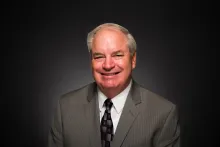
Robin Webber was born in Chicago, Illinois, in 1951, but has lived most of his life in California. He has been a part of the Church of God community since 1963. He attended Ambassador College in Pasadena from 1969-1973. He majored in theology and history.
Mr. Webber's interest remains in the study of history, socio-economics and literature. Over the years, he has offered his services to museums as a docent to share his enthusiasm and passions regarding these areas of expertise.
When time permits, he loves to go mountain biking on nearby ranch land and meet his wife as she hikes toward him.
