

Robin S Webber
This message was given on President's Day holiday weekend in America which is dedicated to reflection on our national leaders. The message focuses on the famous four presidential figures on Mt. Rushmore in contrast to The One "whose name is above all names" - Phil. 2:9. While the four are men of renown, they were subject to the forces of history and at their best--still very human and died. This message takes scripture and sculpts The One that ask us to look up to a spiritual and eternal summit--Mountain Zion upon which He rests as a living stone---eternal, perfect, accessible, loving, and the "same yesterday, today and yes--forever" (Heb. 13:8).
This transcript was generated by AI and may contain errors. It is provided to assist those who may not be able to listen to the message.
Well, I look forward to talking with everybody today on God's Holy Sabbath day. I want to welcome those that are here and also that are on the streaming service that may be hearing this message in the future. And I hope it'll be fruitful and a benefit to each and every one of us. It's going to be a sermon that deals with contrast, and we'll be stepping into that in a moment. And what is the contrast? The contrast is going to be about the leadership of this world, which is temporary and will be passing away, and the leadership which is and yet will be coming in its fullness in the future. And I hope that it'll be a message that will be encouraging for us to know that now we are not alone and to recognize a message to encourage others in the future as they come to know what true heavenly leadership is like. Why am I talking about leadership here on this date? Because it's presidential weekend. President's Day is on Monday. When we that are baby boomers were growing up, oftentimes in the classroom there would be two pictures. And the two pictures would be George Washington and Abraham Lincoln. And there'd be an American flag. And we'd also sing the different songs related to America, etc. That expanded over the years. It became a three-day weekend with everybody kind of put into the same basket. And they just called it all President's Weekend. I think somewhat personally that's a misfortune. I think sometimes when you change dates or you change names, you lose the meaning of what greatness can be or what specialness can be. But nonetheless, it is this weekend. And we do have a number of folks that are gone today, but they'll be able to watch this later. And to recognize that in general, President's Weekend represents 237 years of consecutive service by the chief executive of the United States. Not 250. I'm not confused. I know this is the 250th anniversary coming up of what? Of the Declaration of Independence and the beginning of everything. But you got to remember that there was a 13-year time span between the beginning of the American Revolution and when George Washington was inaugurated. When you think about the number of men that have inhabited this office now for 237 years, they come in all sizes and varieties, whether size, physical size, whether the size of their heart, the size of their intellect, but they've all come along on and on. In thinking of them and considering them, some of them were brave. Some of them were incredibly wise. Some were overshaped and subjugated by party spirit, all burdened by the weight of the office. I was just thinking of that the other day with our current president and to recognize that everything is going on in this nation right now and going on over in Europe and going on down in Africa.
How do you even take that home and deal with that in a sense? To recognize how much falls on the shoulders of the president of the United States. When we consider this list of men over 237 years, some of them were just simply as we say today, they were over their skis regarding ability. Some were destined to falter. Some to failure. They're a common denominator. They're a common denominator, whether they were some of the gentlemen that we'll be reviewing on the handout that I've already shared with you, whether they were presidents of greatness or presidents of failure. They have this one common denominator. All were human. Very human.
And they came, they served, they went, they died. Some of them died in office. Others would die later, sometimes many, many decades later. But they died. Perhaps today, at best into America's mind, the American mind, are those that are carved out on the South Dakota Mountains.
And that is Mount Rushmore. Now, let's look at your handout that I've just given you. And you have four gentlemen on there. This was done about in the 1920s, if I'm not mistaken. So this was done more at the beginning of the 19th century. That pulled in one of them, which I'll talk about in a moment. But there are four, and you might call them the big four, up to that point. Even today, historians looking at the four that are on there, they all still rank within the top 10 presidents, as thought of by historians. Number one, you see to your left, you see George Washington, the father of our country, given that name. Number two, then, you'll see Jefferson. You'll see Jefferson. And then, number two, you'll see Jefferson. Number three, you'll see Teddy Roosevelt. And number four, then, off on the right, you'll see Abraham Lincoln. These were what we may call stellar executives of the nation, and they are rated so till this day. And they were sculpted on this mountain, sculpted, rocky mountain top. And actually, just so you know, we're not going to be talking about U.S. presidents all the time here. That's not going to be our focus. Our focus is going to be about leadership. That is from above. That is above now. And we'll be returning. And to give us hope, and to recognize, that's our leader. And we'll talk about that in a moment.
The focus is going to not be on a fiscally created mountain, touched by man or the men thereupon, but another mountain of eternal spiritual origin. Let's go to Hebrews 12, verse 22, where it says, But you have come to Mount Zion, and to the city of the living God, the heavenly Jerusalem, to an innumerable company of angels, to the general assembly in church of the firstborn, who are registered in heaven, to God the judge of all, to the spirits of just men, made perfect. And notice then, over verse 24, to Jesus the mediator of the new covenant, and to the blood of sprinkling that speaks better things than that of Abel.
Now, the author of Hebrews is making comparison initially and in the story as set of Mount Sinai versus Zion above. Understood. That's important to understand. But what I'm going to suggest to you and illustrate further on is that we come up to Mount Zion today, not just the folks 2,000 years ago, and to recognize that we are welcome to do that and understand who is the leader of Mount Zion, and to recognize what we see here is that it says to Jesus the mediator of the new covenant. We think we go back in American history, we think of the Declaration of Independence that was signed. You think of the Constitution later, a decade later, signed. You now think of what we did with our own signature at baptism. When we signed off and we said yes, when the minister asked you as to if you were ready to be baptized, and they asked us, you, me, have you accepted Jesus Christ as your personal Savior, and have you repented of your sins? And then they looked, there was a pause, and I presume you all said at that moment you didn't walk out of the pool, you didn't walk on the water, and you didn't go out of the pool. You said yes, and a covenant, a bond was made, that at that moment we were no longer, we were looking up to Mount Zion. And that's the contrast that I want to share today, as you'll see in the paper that I handed out, about Mount Rushmore versus Mount Zion. And to recognize what a blessing it is that we know about Mount Zion, that God bids us welcome, that he's made the invitation. And not only that, but who is not top of that? Who's at the top there? It's not Washington, it's not Teddy Roosevelt or the others. The one that is there, it's very interesting, when you think about it, and Sandy, it's very interesting what you brought out here in Psalm 92 verse 15. Join me if you would a second. Psalm 92, 15. I kind of smiled and I jotted, I got my pen and jotted that down when you mentioned that. In Psalm 92 verse 15, we notice what it says right at the end, when it says, "'To declare the Lord is upright, and he is my rock, and there is no unrighteousness in him.'" There's no unrighteousness as wonderful as perhaps a Washington was in general, or a Lincoln, or a Jefferson, or a Teddy Roosevelt. They were human beings like you and like me.
Who we look at at Mount Zion in this picture out of Hebrews 12 is we know that there will be the Father and there will be the Son, and the Son's going to be placed over things. And that's what I want to talk about today in dealing with leadership, is to look at his example. Look at the example of Jesus Christ, and we're going to create an image. We're going to create a sculpture, not like Mount Rushmore, per se, because that's it. We don't create images. But we're going to carve that mountain and what it is going to be like and is by Scripture. Scripture is going to be our scalpel, and we're going to go through and we're going to see what you and I have been called to be a part of. Sometimes we have been in this way of life so long that it just seems, okay, that's fine. This is it. Kind of gone over the hamster wheel, and Weber, what are you going to tell me this week? I'm going to tell you a lot. To recognize the privilege and the honor that we have, and not only the ability to see and carve out that scriptural image of Jesus Christ, but to recognize, too, that we are asked to come forward and be likewise. Join me if you would in the epistle of 1 Peter. 1 Peter 2. Join me if you would there, please.
1 Peter 2. And notice what it says. Therefore, laying aside all malice, all deceit, hypocrisy, envy, and all evil speaking, as newborn babes desire the pure milk of the word, that you may grow thereby. And if indeed you have tasted, if you really bid into it, and if you have tasted, the Lord is gracious. Notice, coming to him as to a living stone, rejected indeed by men, but chosen by God and precious. It's interesting. Again, there's that analogy of a stone. We just talked about a rock in the book of Psalms. We can go to 1 Corinthians 10. Think about this for a moment. 1 Corinthians 10, when it talks about, and they were in the wilderness, and they followed him who is that rock. And that rock is Jesus Christ. It's amazing the number of verses in the Bible that speak of that solidity, of the rock, of something that's firm, something that is strong, something that doesn't bend at every breeze that comes its way. And you and I have the opportunity to come to that. And not only that, but notice what it says, and you also as living stones are being built up on a spiritual house, a holy priesthood, to offer up spiritual sacrifices acceptable with God through Jesus Christ. That sacrifice that we have is to be those living stones that come and rest on the faith in that rock and make a difference, not only in the wonderful world tomorrow, but right now in our daily lives. So the title of my message then is simply this, Mount Rushmore versus Mount Zion. And what can we learn? This afternoon we're going to carve, like I said, out from Scripture, the one whose name is above all names. All names.
All names. All the great people in human history that you can think of, of Julius Caesar, and or a Charlemagne, or you can think of Charles V during the 16th century, and or you can think of our U.S. presidents. You can think of Washington and Teddy, and you can think of others. Eisenhower back in the 1950s when some of us were growing up who had helped save Europe during World War II, and you can just go on and on all the great names, but it's interesting. Let's put our eyeballs on it for a second. Join me if you would in Philippians 2. Join me if you would there, Philippians 2, and let's recognize who we are going to be sculpting through Scripture for a moment, because it's important. This is such an eloquent part of Scripture.
Philippians.
Okay, Philippians 2. Here we go. Philippians 2. And let's pick up the thought.
This is speaking, of course, where Jesus abased himself and came down to this earth and suffered that we might be a part of God's family. Then notice what it says here in verse 9. Therefore, after that suffering, having raised him, therefore God also has highly exalted him and given him the name which is above every name. A name above every name. I want—let's just—are you ready with me? Let's sink that in. It's a name above every name.
It's not just any name. It's not Tom, Dick, and Harry. It's not Julius Caesar. It's not Constantine.
It's not Mohammed running back and forth between Mecca and Medina. It's not Genghis Khan.
It's not Cortez. It's not Columbus. This is the name that is above all names. Everything is left behind.
Christ is superior. He is supreme. He was God in the flesh. This is the name that we want to copy and then be a part of. And so that's important.
So let's take a look here at one thing that's important. It says here in Philippians 2—I'll stay right here— Let this mind be in you, which was also in Christ Jesus, who, being in the form of God, did not consider it robbery to be equal with God, but made himself of no reputation, taking the form of a bondservant and coming in the likeness of men. Coming in the likeness of men. The likeness of men took the form of a bondservant, the word, which is spoken more over in John 1.
Join me if you would in John 1. In John 1, and picking up the thought, in verse 1, in the beginning was the Word, and the Word was with God, and the Word was God. He was in the beginning with God. It's actually, He was there before the beginning, because the beginning is a mention of time and space.
It's a measurement, beginning, end. He was there before that. In the Hebrew script, the way the alphabets are, and the way that it would be played out would be like this. God in the beginning. God was there before the beginning. God is uncreated. I know Mr. Gardenhire just spoke to that the other day. He's uncreated. He can't measure God. I think we can measure His love. It's just so much for us. But beyond that, notice what it says, And all things were made through Him, and without Him nothing was made that was made. And in Him was life, and the life was the light of men, and the light shines in the darkness, and the darkness did not comprehend it.
This is, in a sense, theology. There are other religions that have a beginning of their quote-unquote their deity or the source of their enlightenment. But there's something different in this chapter as we go down this column that makes this the way so different, this Christianity that we experience today. Notice verse 14, And the Word became flesh, and dwell among us, and we beheld as glory, and the glory of the only begotten of the Father, full of grace and truth.
Okay? What does that mean to you and me? And I'm going to create a parallel to somebody that's up on Mount Rushmore in a moment. It says, and dwelled. The Greek word there is skenu. S-K-E-N. Oh, oh, I don't think they teach that word in public school. Okay? Skenu. Another word for skenu would be to dwell. To dwell. He literally left the uncreated world, bypassed the spiritually created world of the angels, and came down and lived with this physical creation.
And the word there is skenu. Another word, it's dwelling. He dwelt with us. Another term that is used sometime. You might want to jot this down. It's a four-letter word. Here we go. Tent. He tinted. He tinted. He was so much about his father's business that he came down and he tinted with us. I'm going to share an example for a moment. And we know the challenge that happened because in that tinting, ultimately, he was crucified. There was another man that had a tint. Maybe I've shared this with you before after our trip to Philadelphia.
Susan will remember what I'm about to talk about. And it just inspired me so much. We were in Philadelphia. We were in the, it was right across from the hotel. We were staying in Old Town there and it was the American Revolution History Museum. And there was a room that you went into and the lights were off as you sat. Kind of there were this many chairs that were in it.
And there was this there was this display that was behind the glass, but you couldn't see it. And it talked about George Washington and how George, you got to remember with the American Revolution, the American Revolution did not start in 1776 but 1775. And it did not end until 1783. Count that one up twice as long as World War II. And George Washington was that man of the moment. I could talk a little bit more about George Washington, how he came in as he was with the Continental Congress.
And he was the only man that showed up with a military uniform on, colonial militia. Like, I'm here. I'm here.
But he would never thrust himself forward, but he just kind of wore the suit. Like, if you need me, I'm on board. But that would mean, ultimately, that he would leave Martha up there above the Potomac River at Mount Vernon, and he would venture forth. And for eight years, there were times, obviously, that he might have been in a more permanent dwelling, like especially in Valley Forge.
But what this exhibition brought out was that he was, or you might want to jot this down, Washington was the man of the tent. He tinted amongst his army. Here was an aristocrat, plantation owner from the south, but he lived in the midst of his men. He was going to be down there with them. He was going to be one of them, whether they were a Southerner or whether they were a Yankee, whether they were a New England man, whether they were a Quaker from Pennsylvania, whoever who was ever in that mix. There weren't a lot of Quakers because they were pacifists. But anyway, to recognize that he was there. And then, all of a sudden, at the end, all of a sudden, the light comes on. Remember that, Susie? The light came on, and he'd go like this. Go, I get excited about history, you know that. And there it is, the tent. And it just was right there. There were woods behind it in the panorama. Other tents were around it. We worship somebody that is greater than what's up on Mount Rushmore, as much as he did a good deed and the right deed to bond with his men. But how much more so that great spiritual George Washington, Jesus of Nazareth, the Word, who came down and tinted with us to recognize the war that we were going through with the human nature that we have in the midst, in the middle.
You know what it's like how you bond when there's somebody that you understand is one of you. One of you. I know sometimes, have you ever run into somebody at a feast site or some other family event or whatever, and you find out they're from the same neighborhood as you.
They grew up in the same city as you. You don't even know their last name, but there's this kind of, wow, they know me, they get me. They understand who I am and recognize and how important that is when we recognize that Jesus Christ came and came down and was with us. And so he tinted. Let's go to another thing I'd like to share with you about scripture sculpting Jesus Christ when we come up to Mount Sinai and join me if you wouldn't look for. Look for.
Look for. And this, we might say this is his inaugural speech. Look for. Verse 16.
This is in Azrath, the hometown boy that's at home. And let's notice the inauguration as his ministry is beginning. He's going to be out of the blocks now. He's 30 years old, been baptized, been down to the Jordan, back home, and notice what it says. These are his opening words. He found the place because there'd be a scripture and coincidence. I don't think so. And so he's reading out of Isaiah, The Spirit of the Lord is upon me, because he has anointed me to breach the gospel to the poor. He has sent me to heal the brokenhearted and to proclaim liberty to the captives. He's talking about the agenda that is set before him and recovery of sight to the blind. And you know, and I know, when we look at the typologies of scripture, this is not only physical blindness, which he will do and did then. And then later on, when you read in the prophets about how the blind will see in the future, this is dealing both with physical blindness and spiritual blindness, and to restore to the blind, to set at liberty those who are oppressed, and notice to proclaim the acceptable year of the Lord. You might say, if you're new to the scriptures, you're kind of wondering what that what would you mean the acceptable year of the Lord? He's talking about the jubilee. The jubilee that would be every 50 years. When all debt is forgiven, all debt is forgiven. People are able to return to the land, and there is so much that is beyond that. It's like a new world, as a type of that new world which is yet to come in the future for all of humanity. This is the sculpting of the one that we call our brother, the one that we call God's anointed. The one that we when we pray to the Father, we ask in his name.
If you ever want to think of a code name for Jesus, just write jubilee. Jubilee. He is the one.
He is that greater boas that comes down and reaches to those that have lost family, that have lost husbands, that takes care of the widow. This is our hero. This is the one that we're sculpting as we see him on Mount Zion. There is no Washington there. There is no Lincoln there.
There's no Jefferson there. Men that were men had their rights, had their wrongs, had their good things, had their vices, had their ups, and had their downs. But what I'm trying to share with you is that we can be sometimes in awe of human leaders. And there are things to admire, and there are things to learn from them, both ill and for the good. But when we think of Jesus Christ, that line is never broken. We will never, are you with me? Never be disappointed.
And he's always there to receive us. Let's take a look at Isaiah 9 after this inaugural sermon, Isaiah 9. How can we get to know him better? Isaiah 9. This will be a familiar scripture, but we're doing some sculpting here.
Isaiah 9 and verse 6. Notice what it says.
You say, well, Robin, you're really turning here? Yes, I am. But we know this. It's even in song. I know that. But sometimes in our minutes and hours and in the days, we go grand funk. We're down. We're out. We think that we're alone.
There is somebody that understands.
Our champion understands. And this is how he is shaped in scripture. For unto us a child is born, unto us a son is given, and the government will be upon his shoulder.
I gave that message here, I think, last time on the wedding supper. Wasn't that right? You're all here for the wedding supper sermon? And in that bridal perception as they came to the canopy and they would be under that, the bride with her veil— watch this is the PowerPoint, I'm sorry. I'm not real smart like Matt. Sorry, Matt.
This is it. The PowerPoint. But what would happen is the bride—I'm going to take this for a second— the bride would take a part of her veil, and she would put that veil upon the shoulder of the groom. She'll be upon his shoulder. And we are the bride of Christ on his shoulder, and the government shall rest upon his shoulder. You see, Jesus Christ is not only our Lord and Savior, but he's our groom in waiting. We are engaged to him. We're not engaged to the gentlemen that are up on top of Mount Rushmore.
We're engaged to the one that is on top of Mount Zion. And his father loves us, so he likes us. You know, it's like when you meet your father-in-law, you go, what's that like? You know, is that that he likes us. In fact, he's the one that called us. He's the one that wants us to be the bride with his son. Interesting. Let's continue to read. And the government will be upon—and his name will be called Wonderful Counselor and Mighty God, Everlasting Father, Prince of Peace, of the increase of his government and his peace. How much peace do we need today in this world? You think of the massacre of Christians in Africa. It's heinous. It's unbelievable how many have been slaughtered in northern Africa, in the Sahara regions, while we're over here in America. And someone's times wondering why life is tough. And those folks over there may not quite come to the gospel the way that we do or understand what we do, but you know what? They are dying for their faith. And they do not renege. They do not back down. We think of what's happened over in the Ukraine with the Russian invasion, and it was a Russian invasion. And to recognize that, oh, are you following the figures and how much we need peace? Do you know that one million Russians, the invaders, one million Russians, one million? That's almost—we're getting up towards the population of San Diego, which is, I think, about 1,386,000, if I'm not mistaken. It might be. But because everybody's moving out, supposedly, out of California. One million.
And who knows how many Ukrainians I would suggest probably in the hundreds of thousands. Slavic cousins. Out of the same birth in Kiev, where Russian culture began, dying. For what?
For one man's glory.
Trying to restart up something that died. And dead.
What about the peace in our own country right now? With what? I mean, every day, every day, there's a meltdown.
Neighbor against neighbor. Party against party in the United States. The Republicans, the Democrats. Every day. Back and forth, back and forth, throwing lobs, throwing bombs, throwing firecrackers, politically speaking.
Where is the peace?
This is where the peace is, and this is the peace that's coming back to this earth. He is not dead like George Washington. He is not dead like Lincoln. He's not dead like Teddy Roosevelt.
He's not dead like Jefferson. He is alive. He has promised to come back, and he's coming back to restore peace to this earth. And even not waiting till then, but to realize he can also restore peace in us. The wars and the battles that go on in our everyday lives. Some of our own making, some of our own starting, some that have come from other sources. But what did God say? Are you with me? Blessed. Here's the tough work. Blessed are the peacemakers. Christ came to create peace.
Wonderful counselor. My everlasting father. Now, what does that mean, everlasting father?
That means he is the originator of the movement for God the Father. He is that first pilgrim that came down to earth from heaven. We are pilgrims moving towards the kingdom of God. He is the originator. He is the first of the first fruits. Are you with me? See how that works? He's the first of the first fruits. It's like George Washington. He is the father of our country. First in war, and first in peace. First in the hearts of his countrymen. And of the increase of his government and peace, there will be no end. Can you imagine peace breaking out all over the world? No more conflict with Venezuela. No more conflict between China and the island of Taiwan. No more conflict along the Volga and the Dnieper. No more conflict in the Donbass.
No more conflict in Africa with… I've just became acquainted again about the war that's happening in Sudan. I don't know if… Sudan is always at war. They're just at war with one another.
And there's going to be no more of that. And I'm just kind of sharing… You say, you know, I've been in the church for 50 years, 60 years. I know that. Well, good. I'm glad you have. I've been in for 62 years, and I get ignited when I begin thinking of what God is going to do for us. And it's not old news. It needs to be needed news, because then, as we understand what God's going to do for the world, we as disciples of Jesus Christ, of that one that we're sculpting by Scripture on Mount Zion, we need to be at war against Satan, against his ways, against our human nature. And even when we fall and when we slip and we don't have all the armaments, just like Paul said in Romans, thank God for everything I want to do. I don't. And everything I'm not supposed to do, I do. Oh, who is going to save me? And then he says, thank you. Thank you for the Lord Jesus Christ. We're preparing, when you think about it with leadership, we are being prepared as firstfruits. Not only firstfruits, but a synonym in the Scripture is that we're going to be a realm of priests. We're going to be teachers, and we cannot teach what we have not experienced. We cannot teach. We can teach what we have not experienced, but it will not be real. It will not be authentic, because then you can only sympathize, which is nice. It's nice to have a sympathy card. There's a difference between sympathy of being outside the goldfish bowl and looking in, and empathy, which means you have swum in those waters. You know what it's about. You know the pressures that are upon you. You know that Mr. and Mrs. Shark just live on the other side of that reef. You know that you need to call upon the name of the Lord. That's what we're talking about here. Let's take a look at Isaiah 11 and verse 10. Isaiah 11 and verse 10.
Sculpturing, framing that imagery of what Christ is like as he is up on the top.
Mount Zion. There shall come forth a rod from the stem of Jesse, and a branch shall grow out of his roots. The Spirit of the Lord shall rest upon him. The Spirit of wisdom and understanding.
The Spirit of counsel and might. The Spirit of knowledge and of the fear of the Eternal.
That fear is not shaking in your boots. It's putting your butterflies into formation. Because you have deep respect for God the Father and for Jesus Christ. His delight is in the fear of the Eternal, and he shall not judge by the sight of his eyes, nor decide by the hearing of the ears, but with righteousness he shall judge the poor. I'm coming back to this where it says, and he shall judge by the sight of his eyes, nor decide by the hearing of his ears. He's under control.
You look today at politics in America. People are taking shots at one another, both sides, without adequate information. They want three minutes of soundbite to become famous, to draw attention, to be on CNN, to be on Fox News, and they don't even know what they're talking about. But they want to get it out there.
You say, well, I'm not running for politics. Good for you.
But what are you doing in your life? Do you hear something and just run with it without checking the source? Is it true? Is it kind? Is it needed? Are you just ready to kind of just throw it out there and everybody, and then to recognize later on, you go, how could I have said that? I was so wrong.
See, we're not only to be on the foundation of Jesus Christ. We're not only to be sitting on the rock of Jesus Christ. We are to be those lively stones, emulating, emulating, becoming like… You know, it's like that old expression, you know, I'm going from granite to vegetable matter, and acorn doesn't fall far from the oak tree.
And that's how we have to be when we read the stories and the examples and what Jesus Christ is really like. And that's what lies before us.
I want to share another thought. Let's go to 1 Corinthians 15.23.
In 1 Corinthians 15.23, this is a spectacular story.
This is what we call in Hebrew a wouser.
It's always sent out a beacon for me to go to.
I'm going to talk to the ladies for a moment here. Okay, man.
Have you noticed that guys just don't quit when they're supposed to quit?
They're still going at it. They just… there's something else out there to go. Have you ever seen, like, baseball players or basketball players hang on for two or three more seasons, and they ought to?
They don't know when to quit. They don't know when to hand something over.
They don't know their time has passed. One thing about George Washington—I need to talk about the other three real quickly. George Washington is simply this. After George Washington went back to Mount Vernon—I think most of you know that story—the news spread across the ocean.
The news had actually spread across the ocean twice. When he was a younger man, he had written a novel about his adventures during the French-Indian war and how he and another man had escaped the French and had gone through the wilderness. In the late 17… or in the 1760s, there were only… are you with me? There were only two Americans that were known on the other side of the pond, as we affectionately call two Americans. You can probably guess who the other one was. The first one was Ben Franklin. The other one was a young man in his 20s, and his name was George Washington. That's how he started. But years later, he goes back to Mount Vernon, and the news comes to George III. And he has somebody in his royal dressing room with him. I think he was having a painting taken or whatever, a portrait taken of him, and the news came to him. And it said, sir, your highness, whatever, George Washington has gone back to his home.
And the king, whose family had been on that throne by then for nearly 70 years, he was the third Hanover, he says, that will make him the most famous man in the world.
Stepping away from power, stepping from having the admiration of the crowds, to going back home, back to Martha, back on that plane that goes down to the Potomac, and settle again as a farmer. How many people walk away from power? How many people give up power? Very interesting. There's a very short little verse about John the Baptist in this vein. When it said, John the Baptist said this about his cousin, who is now coming to the fore. He said, I must decrease that he, speaking of his cousin Jesus, might increase. Very interesting. Now, with that in mind, let's look at 1 Corinthians 15, 23.
Maybe you've noted it this way.
What did Jesus say when he was 12 years old?
As Joseph and Mary came to scold him for not going back home with him, and he found them, he found this 12-year-old talking to the wise men up there in the temple complex.
He said, I must be about my father's business.
It was not even about Joseph and Mary. It was not even just about him. It was about doing his father's business. Here is the ultimate being about his father's business. Notice what it says, verse 24. And then comes the end when he delivers the kingdom to God, the Father, when he puts an end to all the rule and all the authority and power. For he must reign till he has put all enemies under his feet, and the last enemy will be destroyed, his death. Do you know why God the Father has this love affair with his son?
Do we understand why God says, this is my beloved son, in whom I am well pleased? He trusts the universe to his son.
And here we see a certain subordination of the son, the one that was the word, that when everything has now been completed, he hands over the universe to his father.
This is a moment. This is something you kind of want to sit on for a while and recognize that there comes a time in our, you know, we're being asked right now to turn over our lives. But here was the one that was the word that came and tinted, was down here, died for us, and then he turns everything up over to the Father. Is there any reason? Is there any wonder that God the Father never has to worry about turning his back on the son?
You know, sometimes when you read Greek mythology, which I used to do a lot of when I was young, or Norse mythology, you know, it's pretty scary up there, you know, pretty scary up there in Scandinavia. And to recognize the battle between the gods. There's no battle between God the Father and Jesus Christ. And God, who sees things before they even are, knows what the Son is going to do, and that's why this is in the Bible. And that's what our Father wants us to do, is to turn over to him. Keep holding, stop holding things to ourselves and think they're mine.
Give our ends, starting with our hearts, render them up to God.
Have that Jubilee experience, even when it's not the day of atonement, of which the Jubilee is when it was. I know there's a big issue amongst our national leaders right now, and it's a word that all of you will know. It's called affordability. Anybody heard that word? Am I the only one that watches the news? A little affordability. That's the big issue this year because of the cost of living. Well, God the Father and Jesus Christ had a plan for spiritual affordability.
God the Father, through his Son, put forth a program that living might be worth it.
And to make it worth it for us, they put down a down payment that we could not.
Our ability to increase before God, to draw increases because of what God the Father and Jesus Christ did, that there was a redemption. That's a Latin word with redemption. Redemption is being granted something that you could not of and by yourself afford. It is when a gladiator and or when a slave would be freed. They didn't have it in them to be freed. They had no way of coming out of that prison. And sometimes they were not just in a barrier prison, but just being a slave they'd be walking about, but they were owned by somebody else. And to recognize that this affordability factor that I'm talking about in 2 Corinthians 5 and verse 15. Let's go over there a second. 2 Corinthians 5 verse 15. And he died for all that we might live.
He was the ransom.
God the Father and Jesus Christ worked together.
You say, well, how did God the Father? Well, they planned this all from the very beginning of time.
And a reckoning, well, yeah, but I thought only Christ was on the cross.
Yes, it was Christ that was on the cross, but his father was watching. His father was allowing that to happen. His father, our father, did that which he did not even ask Abraham to do, to sacrifice his son. And our affordability, our ability to have spiritual increase, our ability to have a worthwhile life comes from this. And I would suggest Jesus would do it all over again.
That's the kind of leader we have in him. Now, in all of this, what I'm talking about is this. You know, there's a lot of leaders that say, well, when I'm elected, I will do this, and I will do that, and I will do this. Sure as shooting, don't worry. And then once they get in, what happens? Flip and flop. They go back on their promises. They can promise the moon before they're elected, but once they become, what happens? I'm not saying all politicians, I'm saying in general, because we know that money is the milk of politics. And so we take a look at this. Now, what I want to share here with you is simply this. When we recognize this, Hebrews 13 and verse 7, would you join me here, please? This is more spiritual sculpting about Jesus Christ.
Hebrews 13 verse 7. And then we'll begin to start concluding. One second. Here we go.
13 and 7.
Actually, verse 8, Jesus Christ is the same yesterday, today, and forever.
You know who He was, you know who He is, you know what He'll yet do. He's never going to pull a fast one on you. He's never going to pull a fast one with you. That message that I gave about two or three months ago, no shadow of turning. Like Father, like Son. Like Son.
Now, I'm going to share just a few things, and we're going to conclude. I'm actually going to send my notes out to you. I think that'll help. Let's talk a little bit about, just very, very quickly about some men. Abraham Lincoln. Abraham Lincoln.
Incredible human being. Who came, who did, who died. I'd like to share just a few words that he said. This was running up towards the Civil War. Let us have faith that makes right. And in that faith, that belief, as it were, led us to the end, dare to do our duty as we understand it. A man who gave his life in the preservation of the Union, to do his duty, doing his duty, cost him his life. Do you realize that Abraham Lincoln, in the 1860s, was almost hated as much as he was loved? Of course, we have the Southern opposition at that time, but also even in the North. And this was a man that already suffered from depression, and a wife that was suffering from depression. Mary Todd.
He was reviled. He was made fun of. And yet he was dedicated to that cause. And a man that gave probably, if not the greatest, one of the three or four greatest speeches in American history, at Gettysburg, in which, just months before, 50,000 men had met at that battlefield. They had three different theaters. Both North and South suffered tremendous losses. And he was like, where is this going? Where is this going? And so he had to kind of put a reason to all of it. And he did not write it on the back of a coach on the stagecoach going to the battlefield. It was a trilogy, biblically patterned, after the birth of a nation, after the birth of a nation.
And then the death that would occur in the battlefield. So there is the life, there is the death. And then he says at the end, where are we going from here?
So thus we have the resurrection in the Gettysburg. There's the birth, four score and seven years ago. And he did that on purpose to make it sound very solemn, very biblical. It sounded better than 87 years ago. No, he said four score and seven years ago. A nation was brought forth, conceived birth in liberty. And then he goes through the tough stuff of the death, those men that gave their final best. And then he talks about the resurrection and how we're going to go on that and that and that and that. And he lays it down just like pounding on a hammer. Boom! And it allowed a nation to come back. Another thing about leadership. If somebody came to Abraham Lincoln and said, Mr. Lincoln, what are you going to do now that the South is going to surrender? He said, I will treat them like they never left. I wonder what would have been the course of the nation if Lincoln had survived and not martyred for the cause. Interesting. The same man in one of the great speeches, it's actually inscribed in his monument there in the Boschian Mall, in that temple-like edifice. There's the Gettysburg address, and there's the second inaugural. Simply this. But he's going to be the first one. Simply this. Just jot this down if you want to for a moment. Final assignment. Malice towards none. Charity towards all. Malice towards none. Charity. Doesn't that just sound a little bit like all what I just shared with you, like the Bible? Like the story of the prodigal son who left, who broke the union of the family and spent the inheritance, and yet came back with open arms from his father.
Thomas Jefferson. Brilliant intellectual mind up there on the little mountain of Montcello in Virginia, who made and wrote one of the great comments in human history.
All men are created equal. All men are created equal. Equality to what they understood at that time. We know that Jefferson was a slave owner. We know that George Washington was a slave owner.
And yet sometimes enlightenment comes in stages. Enlightenment will come in stages.
Most people, even today when they're talking about Washington people that don't really know their history or know about the man, do not realize that upon his death and in his will all of his slaves were freed, his slaves were freed, and given provisions to carry on. Sometimes you don't hear that side of the story. That is not to state what happened before, but they were caught in a turnstile of human history because there was slavery on all six continents, not just in America.
And sometimes it takes people time to come to understand things just like yourself. The early church, as it began in 31 A.D., they thought that God and Christ were only going to be dealing with the house of Israel. They were only going to be dealing with the Jews. They had no imagination of Gentiles being in the church, other than if they themselves physically became, for men, a Jew. Sometimes things come in stages. Growth and progress doesn't happen overnight. Little did those early Christians, you know, even though that they had heard it with Jesus on the Temple Mount, let every person come to me and have these living waters. They thought they had a hold on who gets the water, and it was only later on, 10 years after the church was founded in 31 A.D., or thereabouts, that awakening came, that expansion that God allowed his Son to die for all of humanity.
Washington.
Jefferson. Lincoln. Let me finish up real quickly, and thank you for indulging your time with me, okay? Let's talk about Teddy. We all know who Teddy is, Teddy Roosevelt. I'd like to share something with you about Teddy Roosevelt, and we'll conclude.
Teddy Roosevelt said this. It's in his book, Into the Arena. Where was Teddy Roosevelt in American history and as a president? It was the turn of the century from the 1800s going to the 1900s. America was beginning to become a world power player, especially after the Spanish-American War. But here's what he wrote in the arena. Far better it is to dare mighty things, to win glorious triumphs, even though checkered by failure, than to take rank with those poor spirits who neither know much nor suffer much because they live in the great twilight that knows neither victory or defeat. God has called us to the victory. If we are defeated, it will only be by our own works.
Mount Zion.
God the Father. Jesus Christ. There is none like him.
We've sculpted what he is like today. We've even read in holy scripture in the book of Hebrews, he does not change. He is wonderful. He is marvelous. He is man. He is God in one ball of flesh.
He is the beginner. He is the originator, and we follow his lead just as much as Israel followed the rock going through the wilderness. And we're still in wilderness. But thank God, as it says in Philippians, when you look at the challenges that Teddy Roosevelt brought out at the end, and that incredible phraseology is only he could write, is simply this.
If God be for us, who can be against us? And as it says in Philippians 4, I can do all things through Christ in me. Let's continue to walk past Mount Sinai, respect its purpose, and at that time, let's continue to move towards Mount Zion in confidence and in faith that we follow someone as challenging as it will be, has told us that he'll be there for us. And if we slip and we fall, just remember Peter. Here, Peter, time to come up out of the water and continue walking with me.
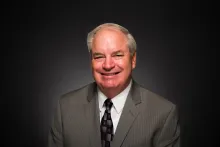
Robin Webber was born in Chicago, Illinois, in 1951, but has lived most of his life in California. He has been a part of the Church of God community since 1963. He attended Ambassador College in Pasadena from 1969-1973. He majored in theology and history.
Mr. Webber's interest remains in the study of history, socio-economics and literature. Over the years, he has offered his services to museums as a docent to share his enthusiasm and passions regarding these areas of expertise.
When time permits, he loves to go mountain biking on nearby ranch land and meet his wife as she hikes toward him.
