
Robin S Webber
What spiritual qualities are incumbent for all ages of mankind to develop for entrance into Eternity. Revelation 14:6-7 gives 4 specific points for each of us to develop towards this end.
This transcript was generated by AI and may contain errors. It is provided to assist those who may not be able to listen to the message.
Good morning, everyone! And a joyous and meaningful eighth-day celebration to each and every one of you. I was listening to Mr. Miller, and he was talking about how a report had come in that perhaps somebody felt left out or dismissed, whatever, and I had a smile.
About 35 years ago, I was the pastor of the auditorium in Pasadena at that time, and it was a Friday night Bible study. And while we would often have between 900 and 1100 people in that building for services, even at that time at a Bible study on a Friday night, I thought that it was my role to move around, get around, be around, and meet as many people as possible before and after services. And I will always remember going to the back row, because that's oftentimes where the action is that you miss. And there was a young, very thin young man at that time, and he was sitting on the back row.
I don't think Susan was there that evening, but that John was there that evening. And so I'm never shy about meeting strangers. I'm not saying that John is strange, but that is strangers. And here is this young man, younger than I was at least, and he was sitting down in his chair, and we simply opened up a conversation. Always good to say, well, where are you from? I know I've done a lot of that with all of you during this week and years past when Susan and I have had the pleasure of being here. And he told me he's from Ohio. And I've always remembered that. Remember exactly where you were sitting, John, on the back row, two seats from the aisle.
It's my inner German that makes that happen like you, okay? And we had a conversation. Little to know that over the years, the relationship that John and I, and of course our wives, who happen to be both Susans—we don't try to mix them up or confuse them—and the work that we've been able to do over the years together. And the work that's being done here, this is absolutely spiritually fabulous what is occurring in Walnut Creek. To be an open house of worship to those that want to come and worship in sincerity and truth without boundaries.
Because we're all ahead at that same direction, remember? Towards the kingdom of God. This is now our third time. Susan's my third time to be with all of you. I do not know if there'll be another time. That's in God's hands. But it is something that we've always looked forward to because there's something happening here. I think of all of you and some that come from different walks within the Church of God. I always think when we come back here that I can't wait—and you'll love my title for you folks—the Toledo people.
And because I don't think of that after that, I don't think of them as being the Toledo people. They're some of my and my wife's best friends here. And we think about you during the year. We do not—you can take people out of Walnut Creek, but you can't take what's happening here in Walnut Creek away. And so I do not know if we will pass this through again in our lifetime to be with all of you in this beautiful, beautiful setting.
And as glorious as the setting has been out here, now that the leaves are changing in autumn, the colors are coming, you are the ones that have shined. You are the ones that have the color of God's Spirit in you. You totally have been the welcoming force under the supervision of Mr. Miller and and the others that have administration responsibilities here.
Each of you has been a committee of one to make my wife and I—now my wife is a Buckeye, as you remember, so you may be a little bit nicer and more eager to meet her. But you've wrapped your arms around this California guy for now years. I just want you to realize that being under this tent—not that everybody has to have a tent in the Six Continents—but there's something happening here of bringing people together and going beyond the norm and allowing that norm to enrich our Christian experience.
Susie and I had the privilege two days ago to go up to Medina and to meet with our fellow brethren up there, and what a joy that was. And then yesterday their pastor and wife came down here and we all went up to the Dear Dutchman, a round table, and to sup with them, to eat with them, to talk with them.
We had others with us. We had Bill Paz and his wife and his sister with us, and we sat without any division. Wouldn't that be wonderful if that could be what we are yet to experience in the Church of God community? To realize we worship one Father, we worship one Son. We have a way of life.
Yes, we come at it this way and that way, but if our attitude is full of love and spiritual generosity and ready to step beyond what is the norm, things happen. We were over on the meadows the other day, somewhere out there. It all looks alike to a Californian. Trees, Holstein cows, buggies that you have to dodge, motorbikes that are coming your way. When Susan and I first came here about 50 years ago, because Susie's just an hour and a quarter up the road, she's with me now, but back then we would come down here and we would enjoy up by the Dear Dutchman stepping out and looking down onto this almost Garden of Eden beauty that's below us.
And to think that we're back here now with you in the winter of our lives. Just keep it up. Just keep it going. Support the Millers. Support the Millers in what they're doing and trying to activate something that is so beautiful and so wonderful. So I want to thank John and Susan for what they've done. We've already done that. I was hoping that they might have flowers or presents for our assistant coordinator, our friend over here, Gordon Schmidt. At least flowers for all the insults, kosher insults that have been hurled his way. And for him to remain silent at least for five seconds in answering back.
I've known Gordon since I was 14 years old back in Pasadena and to put him and my dad together was dangerous. Two characters. The rest of us had to build character, being around those characters. But coming here and seeing Gordon again, which we've treasured these many years and he and Susie talk sometimes and call. You know Gordon has us calling all people on the Sabbath day. But to see Gordon here, to have Clay Thornton come before me. Clay has known Susan before I did back in the early 60s when this area would go to Pittsburgh for the spring festivals or other festivals.
To see him still with everything we've been through these last 30 years still in this way of life. I met a young lady right over here. I'll remember where it always was and she introduced herself. She said, I was in your Bible class in Imperial schools. Well that was probably 35 or 40 years ago.
I'm not trying to age her. I'm not sure what, but that and I used to always tell my Imperial school Bible classes, someday, somewhere, we are going to meet together again. And there was living proof. She's a remnant of that class. If you are out there, would you stand up?
That young lady? She here? Oh, maybe she thought I was speaking again like one of my Bible classes, so maybe she's not. But she was there, she was there, and others that were at Ambassador College. And meeting them again. So I just wanted to share with you how special this will be. If we never have the opportunity to meet with you again, you will always be a special portrait in the hearts of Robin and Susan Weber.
I'd like to break into the message now and share with you. I'd like to give you the title up front. It is simply this, Dwelling Forever Within the Everlasting Gospel. Dwelling Forever Within the Everlasting Gospel. I'd like to begin this message by sharing a story that I have borrowed, but I think it'll make sense and I will share it again at the end of this message. There's a cathedral in Milan, Italy, and it features a remarkable entrance in which you pass through three doors down this hallway towards the sanctuary. And each door has an arch over it. The first doorway, the first doorway, is stone etched and wreathed in roses, and above, engraved in the stone, it says this, All which pleases is but for a moment.
All that pleases is but for a moment. Then you proceed down the hallway and you come to the second arch, and the second arch is etched within a cross, denoting suffering with the engraving. And it goes like this, All which troubles is but for a moment. The climax comes with the third arch as you're moving closer to the sanctuary, and on the final doorway into that sanctuary itself, the inscription reads, That only is important, which is eternal.
Let's put those three together. All which pleases is but for a moment. Again, all which troubles is but for a moment. And thirdly, moving up, dynamic, memorable, needful on this eighth day. That only is important, which is eternal. All are profound statements leading me to ask a question of each and every one of you, and that is simply this, to understand the importance of eternity. This is the eighth day festival. The eighth day, biblically, is a very significant day when you fully understand it. It's not just a number, it's just not in a rotation. It speaks much more grander than just simply placement in a numerical rollout. When you study the Scriptures, you, starting in the Old Testament, and let's remember something, the Old Testament is revealed further in the New Testament.
The New Testament is concealed in the Old Testament, but let's always remember this is a seamless revelation of it is written. To recognize what occurred on the eighth day that leads up to why you are here today. In the Old Testament, there were things that happened on this, what we call the eighth day. Circumcision, which many of you are familiar with, being Church of God people and coming into this way of life, you would hear about circumcision, and the circumcision was on the eighth day.
The consecration of the firstborn of both man and animal was on the eighth day. The priesthood and the tabernacle were consecrated on the eighth day. Solomon's temple was consecrated on the eighth day. The dedication would be completed. You look at in Ezekiel in the vision of the future and recognizing that the millennial temple in Isaiah is dedicated on the eighth day.
And thus, all of this leads to Revelation 21 and Revelation 22. At the end of the story, there are types and there are anti-types, and all of these were trail markers on the way to what God yet has in store for those who are sanctified, consecrated, and dedicated to Him and for Him, that His glory might be His and be theirs. It's interesting that what the eighth day pictures is the expanse of always. Always. Clay got up here and stretched our minds, you know, just it almost snaps of what is in time and space.
But there is something that is beyond time and space. What is beyond time and space is a loving Heavenly Father and a beautiful and wonderful older brother and family member for each of us, His Son. And remember that in the Old Testament, and even hinted to again in the New Testament, is the phraseology. You might want to write it down. It's not long. I am. The I am, who because of the love of God, the one that was the Word, the I am, the Father is I am in a spot in the Bible, and so is the Son.
And that one that is always, always, in a way that as Clay, our dear friend, along with Steph, and their son Trent, who's here, who Susie not only knew back in 1962-63, but they were in our congregations in Pasadena, as Clay tried to trip our minds up just with the universe that God has made, which is in time and space, that the Creator of that is uncreated. And He is the one that is patient and waiting to have you enter that eternity one day with Him as His immortal children. So that's what we want to concentrate on today.
And the question I would have for you is, do you and our Heavenly Father and the risen Christ see eye to eye and heart to heart in what is eternally important? Because remember that third arch? It is only that which is eternal, which is ultimately important. And we're going to keep on coming back to that. Or are we just simply stuck in the moment? Okay, we showed up, we've met underneath the tent, hugged a lot of people, certainly due to the Miller's graciousness, ate a lot of food. I don't think I've only been a growing individual spiritually, but otherwise. Maybe I'm the only one that's a piggy.
I shouldn't say that with this crowd. They don't eat pig. Anyway, anyway, let's get back to what we're talking about here. There's an ageless quality that God wants us to have. So that one day, stay with me, please, that we, by His grace, might have immortal entrance into an eternal residence and in His ageless kingdom.
Not just to be a timeshare, not to be just a condo for lease that we might use, that what God is doing and inviting you and me by His grace and by the sacrifice of His Son, which is grace personified, He is inviting us to be in His home, in His territory, to enter eternity once and forever. That's what we want to talk about. That's what we want to talk about. Again, to capture attention, is there somehow an evolving standard and sliding scale down through the ages as shown in the Bible?
Is there leniency on this one group, stricture on this one a group? Or let me just simply ask you, are the patriarchs of old, are those that were under the new covenant, old covenant? We think of a David, we think of a Daniel, we think of the apostolic era, the hundreds, AD. We think of all of those that stretched to our time, 2,000 years hence, are we under a different stricture, a different spiritual growth plan than those of old, less or more?
What about those that are going to come up in the millennium? Do they, in a sense, have an easier way to move towards eternity? Because, well, Christ is on the mount. He's landed. He's landed with two feet, planted Himself.
As God's viceroy, and as the king of kings down here. Thus, what about the millennium? Do they have a different standard than you and I do? And what about those that we read about in that vision of Ezekiel? Those that are once again going to be given opportunity? Or those that never had opportunity? What about the young lad in 13th century Africa, far and away from any thought of Christianity, right or wrong? What about the Eskimo up in Greenland, up in what is now Alaska? Are they left out of God's plan? Does not our Father in heaven have a love and a yearning for each and every individual that has ever lived?
Those that are made in His image and in His likeness? At least at the physical moment. But ultimately once have Him cross that bridge and come to know Him as He is, and to do what He asked you and me to do today. What a future we have! Be under the Lord Jesus Christ. To be that kingdom of priests that has talked about.
Whatever is coming your way, don't dodge our responsibilities to God. And that's what I would like to share today. One thing in that sharing is simply this to make my point. Forever, dwelling forever with the everlasting gospel. The gospel has not changed from the time when God began working with Abram until our day today. I'd like to just use some scriptures for a moment to bring that to the fore.
God's own self-disclosure. In Malachi 3 and verse 6 it says, He proclaims, I am the Lord. I do not change. You can go to James 1 and verse 17 where it says, speaking of the Father, there is no variation. There is no shadow of turning. God in that sense is using the figuration of a sundial and that gnomon that stands up to create that shadow. That God is always at high noon, even at midnight. He does not change. He is always there for you and for me. Acts 10 and verse 34 says, God is not a respecter of persons. He's not a respecter of persons.
We are on His same training tour for all that are His down through the ages that are made in His image to this point and in the future with the millennium and with that timing that is His. That He will make that valley of dry bones. I was thinking about having special music and we could just sing that song.
Them bones, them bones, them dry bones. But I've decided because of time I've got to keep on going. Okay? And what about Hebrews 13 and verse 8? Christ the same yesterday, today, and forever. That educational course is there for everybody that has ever lived.
I do not believe personally in the sense trying to get the word that I want. Universal salvation. I do believe, and that is what the church has spoken to over these many years, I do believe in universal opportunity. The opportunity is going to be given for every human being. That's the God of love that you and I serve. So the rest of the sermon we're going to be looking at Revelation 14.
Join me if you would for a second. Revelation 14. Verse 6. Then I saw another angel flying in the midst of heaven, having the everlasting gospel to preach to those who dwell on the earth, to every nation, every tribe, every tongue, and every people. Let's understand that this was revealed probably between 85 and 90 AD. I was not there, I'm not that old, but that's the normal norm of where we place this. And to recognize to every nation, tribe, and tongue.
That means to all people. When the Jewish community talks about the nations, they're speaking of what they consider the Gentile, the other people. Not necessarily derogatory, but there was always that language that is used. Even you find that in the book of Daniel. This is talking about all people that this message was to go out to. Saying with a loud voice. Loud is a word that I really appreciate in Scripture because it is loud about being when an angel is loud.
God wants you to know what is written. And I've really appreciated what John has brought out to all of us during this time is to really focus on the Word of God. Dig in, go out, come back, put it together, really understand what's being said, and then the bottom line. It's one thing to dig it. You can say, well, I dig that. No, you can dig it. But John's exhortation to all of us during this feast is, do it then.
Do it. All of us that are here in all of our different walks of life know Isaiah 30 verse 21. I think I might have mentioned that in the first time. The one thing I remember as a boy, 12, 13 years of age, this would always be brought out at the Feast of Tabernacles, of how we're going to one day be assistants.
We're not at Jesus level. He's the Master Teacher. But as a kingdom of priests under that high priest, we're going to come up and we're going to be able to show people Isaiah 30 21. Isaiah 30 21 says, this is the way. Walk you in it. It's one thing to point and say, this is the way. It's another thing to do it, that when Jesus Christ gives us the invitation and he says, follow me. Let's have some fun for a moment. I want to make sure everybody's up.
Get your finger ready. Get it up here. I want to say everybody's finger. 250. Okay, good, good, good, good. And that is, we're going to do this first. We're going to go this way because we're all in one direction. We're in harmony. See the windows over here? Let's point to the windows and repeat after me. This is the way. Walk you in it. But that's only where Christ began and God began back in the Old Testament.
When Jesus Christ came along, God in the flesh, He did something else. He didn't just point out God and His way and say, this is the way. He did something else. And there's a guy that writes a column in your mind, or you know, beyond a day. It's called, follow me. And recognize then that what He said is not enough as Christians to say, this is the way walk you in it. You've got to walk that way. You just can't point it out to others.
You've got to be tried and true and honest and with all of your strength and with all of your might go that way. Then we have the opportunity, not only in the millennium, but now to do this.
Okay, got your hand up. Let's have fun. Come to attention class. I don't see somebody's hands up on the last row. I've got eyes. Okay, so we're gonna go one more time. This is the...this is...no, no, no, no, no. Third time will be a charm. This is the way. Walk you in it. Follow...ready? Here we go. Follow me.
That's so important why we're here at this phase because we can't preach, we can't teach what we ain't. We can't preach and teach what we ain't. We've got to experience it first. So let's look at this where it says, then, saying with a loud voice, fear God, give glory to him, for the hour of his judgment has come. Worship him who made heaven and earth the sea and the springs of water. There are four major points to the everlasting gospel that you and I have been granted to be students in God's University with a graduate degree, ultimately not only of having immortality but entering eternity, which is beyond all.
Let's go to the first one. The first one, as we notice here, is fear God. Fear God. In fearing God—let me find my notes here—fearing God, it's noteworthy fearing God is the first to be mentioned as a foundational element of the good news that is endless in scope.
At first, sounds disconcerting. You might say, I might say, but I've got enough troubles with my own shadow, much less fearing a God who inhabits eternity. Will I have to be in a constant state of uptight, vigilance, or else gotcha, or else gotcha? Or is God expressing something far grander and positive that draws us together by desire? Not dread. Let's consider this for a moment. The Greek word phobia, which is normally the one that comes to mind, in our minds normally conveys fear of, fear of something.
You know, your knees are not only shaking, but your heart is shaking, and you wonder what you're going to do. You're wondering if you can handle it.
And there's another definition of the Greek word phobia, and you might want to jot this down.
Reverence. Reverence. That denotes a feeling or an attitude of respect, of love, of esteem, of veneration. And my favorite is simply this, breathless adoration. Have you ever put fear along with breathless adoration? Wow. Well, one apostle did. Join me if you would in Ephesians 1.
In Ephesians 1, and picking up the thought, we're going to start in verse 3.
The commentator, Barclay, William Barclay, in his commentary on Ephesians, speaks of this as breathless gratitude. Breathless gratitude. I've given messages just on this one verse over the years. Breathless. Have you ever just run out of breath and you can't go any further? What I want to share with you here is that from this point of start, verse 3, till the end in verse 14, there is no period. There is no period. There are no sentences plural. That's why it's called breathless gratitude. There is only commas in between. It's like Paul is thinking of his relationship with God Almighty and Jesus Christ, and it's like he's jotting it down. No, not enough. Jotting it down. Jotting it down. Jotting it down.
Here is what fear looks at what we're explaining when that angel says, fear God. Notice what it says.
Blessed be the God, verse 3, and Father of our Lord Jesus Christ, who has blessed us with every spiritual blessing in the heavenly places in Christ. Oh, comma. Just as he chose us in him before the foundation of the world, that we should be holy and without blame, before him in love, having predestined or determined us to adoption as sons by Jesus Christ to himself, according to the good pleasure of his will. Sometimes we read this and we say adoption. That sounds second rate or something like no. Adoption, he is speaking to the Roman world at that time. He's speaking in that sense to those that know Latin, which adoption is a Latin word.
He's speaking to where Romans would adopt children. They stop kind of having children on their own. It's a kind of a cultural thing. And adoption in the New Testament is just as equal with born again or born from above or you just want to go into the Greek, you know, good now. Adoption was special. How many of you have ever seen the movie Ben Hur? Let's see how old you are. Okay.
You remember Chuck Heston, right? Okay, Ben Hur. Remember the naval battle and where he's in a living death. He's down below in the galley.
Seemingly no escape ever. And then they have the battle. And remember that the man that was over the oars, and actually it might have been the admiral himself, he looks down into the galley before they go into the battle and he says, unchain that man, not knowing what would happen. Then they have the battle and the admiral's ship goes down of where Ben Hur, otherwise known as Chuck, that's his English name, and remember they're both in the waters.
And Charlton Heston is on a raft, and the admiral comes and gets on. And the admiral sees his fleet going down and he thinks, I have been an absolute failure. And he tries to kill himself and Charlton Heston knocks him over, knocks him down. Saves him, saves him from killing himself when he thought all was lost. After a while, the battle is over and off in the distance, coming over in a horizon, is a ship, the sails there.
The admiral says, whose ship is that? Charlton Heston's looking like this, looking out, and then he says something that just wants to sink your heart if you've never seen the movie before.
It's a Romanship.
When all seemed to be lost twice in a day, something was working differently.
And when got home, put on board, not on home, but in the galley, he comes up and the officer says, Admiral, you have a victory. We have won. He was going to cut himself out before he knew that.
He starts walking down the planks of the galley. He looks back at Charlton Heston, Ben Hur. He said, follow me. In the course of the next five or ten minutes, you see what adoption looked like in the Roman world. When you were adopted in the Roman society, it's like you never had a life before.
That was dropped. It was not thought of.
You were given a new name. You were given a title. You were a little bit like the prodigal son. Remember when the prodigal son came back and he was given shoes. That's a whole other story.
Slaves back then did not wear shoes. He was being brought back into family. In the world of adoption in the Roman world, you were not only given a new name, you were given new clothes. You were given a signet ring. If you remember the movie Ben Hur, remember he goes back and sees his boyhood friend who is now his enemy, and he goes, he stamps the family name with authority, with power.
With knowing that he is the son of a Roman admiral, and even joins him on the chariot in the victory parade in what we call the triumph in Roman jargon.
He and his new dad are one. That's what that's talking about, you and me. That we've had a past, but then when we were baptized, we were given a new name, given a new hope, given a new horizon. You and me, are you with me? And do you understand?
This is our moment to embrace that, to remember that. To know that same God did not just simply tap us on the shoulder, but knocked on our heart, and continue through his Son to shepherd us, that good shepherd, in what we go back to after this, the eighth day festival, after a wonderful week of the Feast of Tabernacles, of seeing what it's going to be like, but we're not quite there yet in this world that's out here. That's what it means to fear God. Let me just finish here. To the praise the glory of his grace, verse 6, by which he made us accept it in the beloved. In him we have redemption through his blood, the forgiveness of sins, according to the riches of his grace, of his grace, just as eternity is always. Thus also is the one that inhabits eternity. The expanse is magnificent as Clay was bringing out and talking about the fiscal universe now.
It's almost mind-blowing. God's grace to us never ends from his side. That's why we need to talk about it, and I'll suggest even more about God's grace in the Church of God culture.
Grace cannot simply—you know, I've always lived in California since I was three, and San Diego lived by Mexico. I used to go to the bullfights with my dad in Mexico. That was young and long ago. So you know enough Spanish to maybe say a word or two or three. God has called us today in this 21st century as his family to extol his grace. It's not about us. It started with him.
In the book of John it says, he loved us first. And when we do not start at the front door of grace and then go into the house and say, well, this is what I've done, this is what I've done, look at me, look at our organization, look at this, look at that. We're going the wrong direction.
Herbert Armstrong, about 40 years ago, I always remember—it was a Friday night Bible—I have a lot of remembrance of those Friday night Bible studies growing up in Pasadena. He said, Brevin!
And that was—he was friendly at that moment. You know, just, you know, I say this with terms of endearment with Mr. Armstrong. He says, it is not grace versus works. That's what the world has done out there. He said, and it's stuck in my mind, grace and works. Grace is the front porch.
It is the door. But then, because God has been so gracious and manifest his thoughts and his ways, then we see his constitution. And because we have been rescued, like that Roman admiral, because of wanting to yield ourselves to this God and to his Christ, therefore we abide in the constitution that he has given us, that we might be a whole people before him.
God did not put grace in the Bible to jump over, or to ignore, because the Protestants get steeped in grace, can almost drown in it. We need to be able to speak not merely the accent, but the language of the Bible. Being an American, English-speaking, I can get along with that.
I can get along somewhat in Spanish. I can go word for word, maybe a paragraph, not even a paragraph, but maybe a sentence I'll see words. I want you to remember something from Robin, your friend. As we go out, remember this, we have not been called when God has revealed what is written to merely speak the accent. We need to be as much as possible, fluid in the language, and go back again and again to it. I want to share one more thought here, if I can. Perhaps understanding the fear of God. I may not even get past into the others, there's so much here to cover. But to recognize, I want to pick a point here. Join me if you would, in Philippians 2.
In Philippians 2, and you've probably seen this scripture before, but it says here, Therefore, my beloved, as you have always obeyed, not as in my presence only, but now much more in my absence, work out your own salvation with fear and trembling. For it is God who works in you, both to will and to do, for his good pleasure. Notice, and I'm sure your eyes have lit on it before, where it says that work out your own salvation with fear and trembling. This is going to be my PowerPoint. Some of you always like my PowerPoints, if you listen to them. This is a PowerPoint, because I'm not as smart as Mr. John Miller, so I have to do everything on my... I am a living screen. Are you ready? But to recognize a fear and trembling, you can kind of think... I'm going to raise my voice a moment. Can you hear me back there? That's when you're all supposed to say in unison, yes. So you say fear and trembling, kind of like Moses. God's calling me up to the top mountain again. But as Christians at times, our legs will be shaking, but our heart has got to be in the trim. And to always remember when it looks a little shaky, and you're not quite sure, we always come back to this point that God so loved the world that he gave his only begotten son, that whosoever believes in him. Go back to those points, which is so important, but allow me to share something else from Barkley, which I think you'll find interesting. When we talk about fear and trembling, it says, perhaps understanding this foundational component of the everlasting gospel is best understood in Philippians 2, 12 through 13, to work out your own salvation with fear and trembling. It comes from a sense of our inability and powerlessness to deal with life triumphantly.
Thus, it's not a fear that drives us into hiding, but drives us into ever seeking God's answers and comfort of which otherwise we cannot exist effectively. Additionally, it comes with the thought of horror, fear, trembling, of grieving God. When we truly—stay with me—when we truly love someone, we're not afraid of what they might do to us, but what we might do to them.
And thus, a Christian's greatest fear is of crucifying our Lord Jesus Christ again. When He alone is our portal, where He alone is the door that our Heavenly Father has elected and chosen and is to one day enter into eternity. That's incredible. I'm not going to be able to give you all four points, unless you want to wait till tomorrow to hang in here for the next 24 hours.
One of these here, one of these, tells us—remember the portals?
That which is pleasing is but a moment. That which is like terror is but for a moment.
I've now pastored for nearly 50 years. I want to share a story with you. I think you already know I like to tell stories. But this is a snapshot that never goes away from me.
Susan and I are going to get on a plane tomorrow and go back to California.
But maybe the words that I'll share with you now, just like I do in my columns, because I love to write stories in the column that I write, will stick with you the rest of your life.
I'd like to share a story about a woman that I visited. It was her last day of life.
I was coming down the 99—you don't know that—99 goes right down the Central Valley in California, which is about 400 miles long. I was coming out of the Sierras and I was the pastor of Bakersfield at this at that time. And there was a woman that was in the hospital. So I went and I visited a lady. Her name was Olita Graham. I like to have you always remember what I shared with Olita Graham for about 15 or 20 minutes because she was fading.
I have to share a little bit about Bakersfield. I've heard a lot of accents here.
I have a northern accent. I have one of these boring New York broadcaster accents. Blah! But a lot of you are up from southeast Ohio, which is the south. I'm just joking. I do have relatives from Virginia 200 years ago. Stay with me. And Kentucky. And I love it. Wouldn't it not be boring if we all sounded alike and talked alike? Olita Graham was one of those old Okies.
And I do not say that pejoratively. You've got to love the Central Valley because, you know, if you remember Grapes of Wrath with Henry Fonda and any of you that study history, the Great Depression, the Great Migration of the people from Texas and Arkansas, parts of Kansas, and yes, Oklahoma. So when we say that term, it's of endearment. They are just salt of the earth people down home. They're not on Melrose Avenue over in West Hollywood. Not that kind of group.
Olita had been a faithful member for many, many years. I'm so glad that I visited her.
When you feel that, if I can just give you how my mentor taught me and what I learned from him, and what I try to share with others, is when you get news, you hear something's up, go! Don't let anything else get in the way. Go! And so I pulled off the 99. It was in Delano.
You would love Delano. Anyway, I'm in the house there and Olita's in a bed, and she said, in that accent of hers, she said, Mr. Weber, there's nothing else they can do.
They say I'm going to die.
And they say I'm not going to be able to breathe for a while.
She was scared.
I stepped up closer to our dear friend, Susan, those that were talking about it this morning, and I held her hand.
And I said, I know.
There's going to be that one minute in your life when you can't breathe.
And I think I can understand it's not me, it's you. I'm close to you, and I know it's going to be scary.
But I just want to remind you as your fellow Christian and as your friend that beyond that one moment is eternity. Glorious eternity.
Eternity not only worth dying for spiritually at baptism, but dying every day and giving our life to God. One minute of suffering. Isn't that a little bit what the Lord of the Millennium went through?
Our Savior? That he died in a day and in that moment? That you and I, you and I might live forever in this glory, this everlasting kingdom.
Jesus never said that it would be easy. Jesus always said it would be worth it.
And you and I look at this eternity that is yet ahead, this expanse.
And when we think of the Feast of Taberna, we think of the eighth day, we read in Revelation, we read about that temple that's 1500 miles up this way and 1500 miles that way. That's really apocalyptic literature. I don't think God used a yardstick on that one. It's apocalyptic and it's real. That imagery, that vision is real and it has real things. What that is really saying is there is no way. When you have 1500 miles by 1500 miles, what you have is you have a cube. A cube both in the Jewish world, the Israelite world, and even in the world of the pagan, had a significance of being a holy spot.
And what God is saying is that there's this expanse that we are invited into in this new Jerusalem, this heavenly Jerusalem, the images of expanse, that there is room for everybody.
There is room for everybody that will come to surrender their lives to God the Father through Jesus Christ. Remember how Jesus said, I go to my Father to prepare? He's preparing that expanse for you and me today, for those that will be in the millennium, and for those that will ultimately come up. You know, I'm really looking forward to seeing somebody come up. Obviously, my parents, my mother was a church member, but there's somebody else I'm really looking forward to seeing one day. Susie, I think, will be able to make it, okay?
I kind of get emotional when I talk about this. I think you were at that Bible study the other evening that I gave, and I talked about my brother, Flip. His name was actually John Philip, but we called him Flip, and that's on his grave in San Diego. My brother took ill very rapidly, and my mother dressed us both up in PJs. She was going to drop me off at a friend's.
My brother and I were in the back seat. My brother is 13. I was eight. I was the little guy, the brat, but my brother is my hero, always has been. Susan knows that. He was just at age 13.
I sometimes say, why him, not me?
And my brother looked at me as I looked at him, and he said, Robin, you're looking at me as if you'll never see me again. I never did. But by God's grace, by believing in him, by practicing the life of Christ in me, sometimes in futileness, but by God's grace he gives me, picks me up, sets me forward, I go.
What my brother told me, I've told probably 50 audiences at the feast, that there is a God that is going to raise our loved ones, that we miss, maybe a mate that is no longer at her side at the feast, maybe a child that you gave to God, but God has other plans. We talked about that the other night. You think, you think, of who has been in your life that you want to see again? A mate? I mean, Susie and I have been married 53 years. I know we look like recycled teenagers.
I can't imagine, I can't imagine living without her. We met at 18.
Fell in love with her at first sight from about 125 feet away at the freshman reception of Ambassador College, and we weren't supposed to have girlfriends back then. Sorry! Anyway, you think of who you miss, you think of who you long for. Stay on the path.
Stay on the path. Fear God. Give him the glory that was spoken by my good friend and brother.
Play Thornton. Don't let the distractions get in between you.
Things will come along that seem sweet, but therefore a moment. There are things that will come along that will seem like chains that are on your body, that lock you up from serving the Lord Jesus Christ and being a child of the Father. Remember that third arch in that cathedral in in that cathedral in Milano, Italy, the third arch. Then there are things that are worth eternity.
Keep looking up. Let's keep on loving one another. Let's keep on forgiving one another.
Let's look for those that John spoke about that are in the middle of the island. They're alone.
Don't think that someone else's job to go over and say, welcome. Welcome. We're so glad to see you. I think I've almost met... if I have not met you, I don't want you to write hate mail to John. If I haven't, you know, I'm kind of the guster.
No hate mail. If I have not met you during this feast, you come up here right after church. I would like to meet you personally, because you will be that personal postcard of a believer that Susie and I will take back, back, back to Southern California. We may never see you again. I must, again, John, if you could just give me one minute. We have just... every time we've come here, you are the body of Christ. You're in the United Church of God. You're in the... with the Toledo people, who we really... as you know, the Toledo people we really, really love. One of the Toledo people has been given the the gift of music. Barbara. Where are you, Barbara? There you are. And she's just like a family member of ours. Isn't it going to be wonderful that in the Church of God, one day we will not be divided, because we think what we are doing is right.
We've always had the somewhat disease in our Church of being righter than right, and right, and right, and get people into a corner where they can't get out, where we can't meet like brethren, like we did yesterday with the pastor from Medina. Let's get up. Let's get going.
Let's reach higher than ever before and embrace that we are not alone. God looked down long ago and said, I want him. I want her. Do not give up. Don't be set back by momentary pleasure.
Each of us have been called. Each of us have been called. And the Christ says to follow me. You know that famous story in Luke where he talks to the three different men, and each time, one man has an excuse for not following him. One says, I've got something to deal with. Another one says, I've got something to deal with. Another one says, I have to deal with it. And it really, the poor tint of that parable, one is having to deal with the present, the other has to deal with the past, and one has to deal with the future. Don't let your past, don't let your present, don't allow what you think is important in the future to swaver, waver, put you off track from following the Lord Jesus Christ as he takes you to the throne of God the Father. You are his child. He does have his name on us. Let us go forth. Let's experience his joy. Let's share that joy.
And John, in doing that, let's go deep, spread it out, bring it back. And as it says in this everlasting Gospel, let's give God the glory. Amen. Blessings to all of you, dear family in Christ.
We all know who our daddy is. We may not know that down here sometimes when you do genealogy, but all of us know who our Heavenly Father is. Keep looking up, experience God's joy, spread it out, look forward to seeing you in that world beyond worlds in the new heavens and the new earth as all children of God.
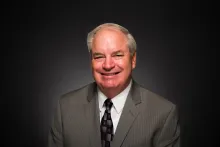
Robin Webber was born in Chicago, Illinois, in 1951, but has lived most of his life in California. He has been a part of the Church of God community since 1963. He attended Ambassador College in Pasadena from 1969-1973. He majored in theology and history.
Mr. Webber's interest remains in the study of history, socio-economics and literature. Over the years, he has offered his services to museums as a docent to share his enthusiasm and passions regarding these areas of expertise.
When time permits, he loves to go mountain biking on nearby ranch land and meet his wife as she hikes toward him.
