
Robin S Webber
This transcript was generated by AI and may contain errors. It is provided to assist those who may not be able to listen to the message.
Well, this weekend we celebrated our nation's birthday. But it's not just a birthday, it's not just a date, it's not just celebrating a birthday like we celebrate the birthday of a person. The July 4th weekend in the heart of an American needs to be more than just simply three days off. It's more than hot dogs or a good steak on a barbecue. It's even more than fireworks. The 4th of July is about celebrating freedom. It's about celebrating freedom. It's about celebrating liberty, which is symbolized not in the crown on a man or a woman, but is basically in our country symbolized by a flag, a flag that is in colors of red, white, and blue. When we think about America, when we think of what in history we call the American experiment, because in one sense it is ongoing, it is breathtaking. It is incredible. It is marvelous. It ought not be when you look at the framework and when you look at the scope of world history. The question that I have to set before you as an audience this morning is simply this. What has made America, which self-proclaims itself as an exceptional nation, what makes America an exceptional nation, not only in our own opinion or by our own self-proclamation or by that of our leaders, but by and large around the world for the last 70 years? What is it that allows the world to take note and why is it that still, even with many of our challenges here in our nation, why do people continue to flood our way and come into our shores? A couple questions maybe to bring you into this message. Questions that solicit perhaps comments out of your mind is sometimes it can be thought for one matter or another the following. Let's ask ourselves some questions. Is it Yankee ingenuity? That makes America exceptional. Is it 1000 years of English common law that has come to full bloom? Is it the ultimate product of the enlightenment of the 18th century? Is it because we are protected by two great bodies of water and thus do not suffer the plagues of Europe and Asia? Is it the racial and the ethnic diversity of our people, the fabric of our society that makes us an exceptional nation? Perhaps you're going down the list with me as I do and you say, well, yeah, I think so. And yes, to one degree or another, we could use one or use all of those, and yes, to a degree, that might be it. Or is it something greater and bigger in scope than all that which I have now presented before you? To begin with, I'd like you to turn over with me to Psalm 33. In the book of Psalms, Psalms 33, I'd like to pick up the thought in verse 8. And let's hear the Word of God.
Let the earth fear the Lord, and let all the inhabitants of the world stand in awe of Him. For He spoke, and it was done. He commanded, and it stood fast. The Lord brings the counsel of the nations to nothing. He makes the plans of the peoples of no effect. The counsel of the Lord stands forever, the plans of His heart to all generations. Blessed is the nation whose God is the Lord, the people He has chosen as His own inheritance. The Lord looks from heaven. He sees all the sons of men. From the place of His dwelling, He looks on all the inhabitants of the earth. He fashions their hearts individually. He considers all of their works. No king is saved by the multitude of an army. A mighty man is not delivered by great strength. A horse is of vain hope for safety. Neither shall deliver any by its great strength. Behold, the eye of the Lord is on those who fear Him, on those who hope in His mercy, to deliver their soul from death and to keep them alive and famine. Our soul waits for the Lord. He is our help and our shield. For our heart shall rejoice in Him because we have trusted in His holy name. As we read that, and it's a magnificent stretch of Scripture that has just been enunciated, the question I have for you this morning is this. How does this relate to America today? How does this relate to America today? Blessed is the nation that is for God, that God is for. There's an African tribe in West Africa. It's called the Yerubas. They have an expression. I'd like to share it with you for a moment. It simply goes like this. However far the stream flows, it never forgets its source. No matter how far the stream flows, it never forgets its source. But has America, the most outwardly religious society in the West, forgotten the source of its blessings and placed God on a convenient shelf, brings Him down when need be and puts Him back immediately when no longer desired or wanted? Does America truly live up to what is written on the coins in your pocket? In God we trust. Today in America, again, in a fascinating manner, the most religious society in the West has a split personality, has a double way of thinking about things, can acknowledge God in a speech, can occasionally hear it from people, has it printed on our coins, but nonetheless God has been marginalized. Sometimes when factors come up, emergencies come up, national disasters come up, a Katrina or 9-11, people get that religious feeling all over again for about three weeks, and then it dissipates, and they go back to business as usual. The reason why I bring this up is that today American history is being photoshopped.
I think many of you, especially the younger people, knows what it means to have things photoshopped, where literally you can take an image today and you can put something in that was not there in the original shot, and or you can take something out of the original shot and either replace it with something and or just paste it over. I suggest to you today, those that are listening to this message, that American history is being photoshopped. Something is being taken out that was originally in the snapshots of our history, that made this country what it is, that made it an exceptional country, that made it a nation that God could be for. And today in America, unfortunately, what happens is that our collective memories are becoming dulled by what made this nation great and what was the motivating force and what was the belief in the hearts of our founding fathers, and to understand that.
And at times, brethren, even we, yes, people of the book have become silent or have forgotten what God did in the founding of this country and what motivated our founding fathers. What were their true sentiments? Today, when you go to public school and you have children that are in public school, you have children that are in university, you have books that are being read that are being photoshopped and that are being changed, taking something that had a source and a source that is no longer recognized, that makes America an exceptional country. Well, today, the rest of this message, I want to go back to the source. I want to go back through the stream of time and consider the source of our national blessings.
What lies at the source of our national bounty, this nation that is so exceptional, especially since World War II as America took over the world stage? Where would the world be today without America? Sometimes in history, when you study, you talk about indispensable individuals. We'll talk about one later on that is often called the indispensable man.
But could we suggest by God's hand that America has been, indeed, an indispensable nation on the world scene in the 20th and 21st century? The answer lies in the title of the message that I'm about to give you, and you can jot it down if you want to stay with this. Fine. And it's simply called this, the faith of our fathers. We sing that at times. I'm not sure if it's in this hymnal or not.
We sing a song entitled, Faith of our Fathers, Holy Faith. And that's what I want to address today. That's the title of this message, the faith of our fathers. And again, why this message and why to you today? What is in it for me? As Christians, as members of the San Diego congregation, we need to be galvanized. We cannot afford to go to sleep. So often we have the onslaught of secularism and of humanism. That just like a tidal wave is, in a sense, if not pushing us away, pushing down our collective memory as to what God did with this nation early on.
You know, when you think about God and you think about religion, the greatness of our nation was once inseparably linked in its citizens' minds with its respect towards God. And the principles of morality and the principles of character that are taught in the Holy Scripture. Scripture that was read to you today when every family had a Bible at its home. And oftentimes it was a family Bible that was passed down from generation to generation.
But that reality is that over the last hundred years, that the very mention of God is increasingly being expunged from our books, is being expunged from our schools. Prayer is no longer offered up in school. Prayer can no longer be offered up even down south in the Bible Belt. Many of you remember when you used to play sports growing up, that you said of prayer as you went into, quote-unquote, battle.
You being the David, you need prayer because you knew that you were going up against the Goliath. And you gave the game over to God. Now, in one sense, that might seem juvenile. But is America better today, fifty years down the line, than it was fifty years ago when God was at the center of everything? You see, brethren, we need to understand that the founding fathers and their actions have been reinterpreted by modern-day scholars with 21st century eyes in such a way that is just opposite, opposite, of what was rendered in the 17th, in the 18th, and the 19th centuries.
And you're going to hear from the words of these men and these women unfiltered so that it can galvanize you, so that it can encourage you, so that we need not remain silent and just say, Oh, really? Maybe it is that way after all?
No, it's not. So let's go into it. The American experiment, as entitled by history and those that study history, the American experiment fundamentally rests on the opening lines of our founding document. If you're in a Western Civ class or an American history class, this will be kind of a history class with Scripture, so get ready.
Here we go. And that is—I'm an old history teacher, so get ready. I don't often talk about history, but I'm going to enjoy doing this one today for all of you. And that is simply this. When you talk about the founding documents, oftentimes we'll think the Constitution, but any historian will tell you that the founding document of our country is the Declaration of Independence.
Let's understand what the Declaration of Independence was. The Declaration of Independence was a political statement. It was a political statement designed to frame reason for the agitation that was occurring between two peoples now for nearly ten years. Wars never just start on a dime. There's a lead-up to them. And America had begun to separate from Great Britain around 1765 through the various acts that the British Parliament was visiting upon, seemingly the rebellious American colonies.
It also gave a reason for the sunshine patriot to give reason for the farmer to take up his musket and fight. See, Bunker Hill had been a year before. The war was already on, but the politicians recognized that the men that were in the field needed to know why they were doing what they were doing, going up the greatest empire that the world had ever known. There had to be a cause. There had to be a reason. There had to be something that they could hold to their chest and know that this is what they lived for, that they were willing to die for.
Allow me to read the very beginning of the Declaration of Independence then and understand that everything in America is based upon these first words. When, in the course of human events, it becomes necessary for one people to dissolve the political bands which have connected them with another and to assume among the powers of the earth the separate and the equal station to which the laws of nature and nature's God entitle them. A decent respect to the opinions of mankind requires that they should declare which impels them towards that separation. We hold these truths to be self-evident, that all men are created equal, that they are endowed by their Creator with certain unalienable rights.
That word unalienable means that these rights cannot be surrendered. They come directly from God, not a king, not a man, not a priest, not a religious figure, but God alone, that there is nothing between God and His special creation called man and woman. That among these are life, liberty, and the pursuit of happiness. Did not say that life would be happy, but it gave the individual the opportunity, the opportunity to create happiness and to pursue it. And for the support of this declaration, with a firm reliance on protection of the divine providence, we mutually pledge to each other our lives, our fortunes, and our sacred honor.
Now, some will say that this is the high point of the Enlightenment era, which was basically during the 18th century. They might say that, well, this is basically the fulfillment or the byproduct of the thoughts of Versailles or Voltaire or John Locke, of setting a society in order with a regulated universe based on natural laws, because they were coming to understand that the universe was regulated on natural laws, that there was cause and effect, and that there was a symmetry in the universe. Thus, that must be brought down into the human sphere, and that a king is not above a man, and that all are equal and come to a common end.
Some will mention that the founding fathers were deist, that acknowledged of a nine-distant deity, but had fled the tenets of God, that intervened in human affairs, and had discarded the relics of the Christian faith.
You go to school today, you go to university, you read books.
They will basically say that these men were more the disciples of Voltaire and Locke and Rousseau than they were of Jesus Christ. And, or at best, they were deists, they were agnostics. They had this thought that somehow there was this kind of this benevolent, kindly force up there that every so often kind of put his or in their mind her finger into human affairs, and then would go away.
A revolution without God, though, is a different revolution. It was not the revolution that was spawned on this continent by the will of God. It was a revolution that was spawned on another continent. It's called Europe. In France, they also had a revolution twenty years later, a revolution that was based upon liberty, fraternity, and equality.
Totally different revolution. Totally different undergirding. The American Revolution is that all men are created equal. Now, we recognize that the promise of that statement was not met out for many, many years and continues to be met out. We recognize that words are cheap and only that which are written on paper and that that would have to be met out further during the Civil War.
In which the franchise would expand. And that those statements could be expanded to all people, no matter of race or color or background. And it was bloody. And a half a million people died in that.
Europe today is based upon the French Revolution. Liberty, fraternity, equality. Everything's got to be equal. If everything has to be equal and provided by the government, therefore then where is the pursuit of happiness? Where is the personal responsibility? That revolution did not worship God the Father. It did not worship the giver of all gifts. It did not worship Jesus Christ. You can jot this down. You can look it up later. They basically, by 1793, were in a sense had a secular worship, interesting, secular worship of the goddess of reason.
That was the deity of the French Revolution. Maybe you didn't know that. Then maybe you wonder why today Europe is where Europe is and where America is and where the challenges are today. The stream comes from two different sources. Let's go back for a moment and understand why these men pledged their fortunes and their sacred honors. I want to share a thought with you. Talk is cheap. But when you read the end of this, it said that we give our lives, our fortunes, and our sacred honor.
Sacred is something that moves beyond man. It is of God. And they gave their sacred honor. When you say sacred honor, you know that this is an individual that believes in a force outside of themselves. These men that, in the years to come, as has been catalogued, that five would be captured by the British. And tortured before dying. Twelve had homes ransacked or burned. Two lost sons in war. Two others had sons imprisoned. Nine of the 56 would fight in the war and die. What would be the source of their conviction? And what would give muscle to their words?
Thus, for a few minutes, let's go back into American history and understand some foundations and again listen to their words. And their plain statements. Allow me to draw you back even further than the Revolutionary War to one of those things that has crept into the American psyche of when we talk about America being a special people, and a special nation, and an exceptional nation, and that the eyes of the world would come upon us. Let's go back to 1630.
It's the story of John Winthrop. John Winthrop was going to Massachusetts to be the governor of the Massachusetts Bay Colony. He was a Puritan, and he was on the ship called Arabella, headed for the colony. And what's very interesting is that he gave this sermon, and I would like to really encourage you to look up this sermon on YouTube, and you can do it. I told Susie this this morning. I said, Oh, wow, this is just incredible. This is a whole Bible study to itself, because we only get glimpses on what we call the city on the hill speech, which I'll talk about in a moment.
It's called a model for Christian charity. A model for Christian charity. We oftentimes call it the city on the hill speech that would have profound influence not only on New England history, but ultimately would seep into the national psyche and into the hearts of all Americans. It would later on be used and revived, actually, by John F. Kennedy, even though we often think, and it was his State of the Union address in 1961, and we often think of President Ronald Reagan talking about that city, which is on a hill.
That was his driving force in his political career. Allow me to share some of these thoughts with you out of this, the model for Christian charity and or known as the city on the hill. The words of John Winthrop as people were about to land from the old world into the new world. And rather than crossing the Jericho River, they were going into the promised land that was separated from the old world by the Atlantic Ocean, and they were about to go into a land of promise. They looked upon it as opportunity. Thus stands the cause between God and us.
We are entered into covenant with him for this work. For we must consider that we shall be like a city on a hill. Drawing words from Matthew 5 and verse 14. The eyes of all people are upon us, so that if we shall deal falsely with our God and the work we have undertaken, and so cause him to withdraw his present help from us, we shall be made a story and a byword throughout the world. We shall open the mouths of all of our enemies to speak evil of the ways of God and all professors for God's sake.
We shall shame the faces of many of God's worthy servants and cause their prayers to be turned into curses upon us until we be consumed out of the good land whither we are going. They understood something down deep, something inviting in them from taking in the Word that God was offering them a Promised Land, a new way, a new hope, and that they were fleeing the chains of Europe and the ways of Europe in which so much stood between a man and opportunity. That freedom was not necessarily a reality, but had to be eked out where it could be. He concludes with Deuteronomy 30, and I'm just paraphrasing.
I said before you life and death, good and evil, and concludes His sermon. Therefore let us choose life, that we and our seed may live by obeying His voice and cleaving to Him, for He is our life and prosperity. Now, of course, noting historians and how they think, or people today that sometimes in secular America can be, do I dare say, jaded, they might say, well, this was just a Puritan zealot of 1630. What else would you expect coming from the mouth of the words of John Winthrop? People will say there's much more to America. There is the rowdy-bouty Dutchman of Manhattan.
There is the gentry of Philadelphia, and or there is the aristocracy of Virginia. And so they try to divide the American experiment and diminish God's presence in what He was doing in this nation. And I only have to say, oh, really? Oh, really? I say no, no, no. The founders of America acknowledged God not in some metaphysical, ethereal manner. They were not just simply deist, but they were seeking after real answers for real problems in their day.
But you won't read these comments in schoolbooks today. You will not hear about it in school. American history is being photoshopped as if it never existed. Now, some of you will hear names. I'm going to go through a plethora of comments here. You'll hear oftentimes, well, there is this person, but, you know, we're really regulated by the thoughts and the words of James Madison, the father of the Constitution, and or we are regulated by the words of Jefferson.
I'm going to talk about Madison. I'm going to talk about Jefferson and a few others along the way to encourage you. Allow me to begin with James Madison of Virginia, and later on was the primary architect of the American Constitution. He's often called the father of the Constitution. He's often looked as one of these men that were apart from religion and a deist. James Madison, his words, We have staked the whole future of the American civilization, not upon the power of government. Hmm. Interesting when you see government today in action and its overreach into the life of the individual.
We have staked the whole future of the American civilization, not based upon the power of government. Far from it. That's what the Declaration of Independence was about. It said that life, liberty, and the pursuit of happiness, it was not regulated by government, did not come from government, did not come from man, but came from the Almighty. We have staked the future of all of our political institutions upon the capacity of each and all of us to govern ourselves according to the Ten Commandments.
Benjamin Franklin, sometimes what we call Uncle Benny, kind of a wise and unique bird, even back in that day, the guy that wore the raccoon hat and fascinated the French. And we kind of sometimes think, well, he's kind of out there. Benjamin Franklin, the summer of 1787 at the Constitutional Convention, if a sparrow cannot fall to the ground without his, that is God's notice, it is probable that an empire can rise without his aid. We have been assured, sir, in the sacred writings that accept the Lord, build the house, they labor in vain, and that build it. He then asked the committee, what committee? The Committee to the Constitutional Convention to offer daily prayer to ask for God's assistance and blessing in their deliberations.
Listen to the words now of whom we call the father of our country, a towering figure sometimes called by historians the indispensable man. And those that don't think so, that's why many books are written. But Washington continues to loom on our imaginations today, the nation's capitals named after Washington. The highest building in that capital city is the Washington Monument. And after all, there is also a state named after the man, the father of our country, the indispensable man, who said this Thanksgiving proclamation, 1789.
Wherein it is the duty of all nations to acknowledge the providence of Almighty God, to obey his will, to be grateful for his benefits, and humbly to implore his protection, aid, and favors. Now, therefore, I do recommend and assign Thursday, the 26th day of November, next, to be devoted to the people of the United States, to the service of the great and the glorious being, who is the beneficent author of all the good that was and is and will be, that we may all then unite in rendering unto him our sincere and humble thanks for his kind care and protection of the people in this country.
And for all the great and various favors which he has been pleased to confer upon us. This is not a benign deity. This is not just simply a first cause. Do you hear me, brethren? This is speaking in the mind and the heart of George Washington of an active and intervening God in the affairs of mankind. How can we, therefore, then possibly reinterpret the words of George Washington in this proclamation?
You know, and I know, that people try to and or they just simply Photoshop it. Here's another one by Washington. I now make it my earnest prayer that God would be most graciously be pleased to dispose us all to do justice, to love mercy, and to demean ourselves with that charity, humility, and Pacific temper of the mind, which were the characteristics of the divine author of our blessed religion. Thus he is not only speaking of a deity, thus he is not only speaking of an ethereal personality.
The divine author would have been Jesus Christ himself of that blessed religion. The question that lies before us as we look at history through the voices of those that made it, does the father of our country sound like an estranged deist? I don't think so. I would rather think that George Washington, you can jot it down, Isaiah 40, verse 15, would have rendered these words based upon the words of Isaiah, Behold, the nations are as a drop in a bucket and are counted as the small dust in the scales. I would suggest that George Washington look to God for deliverance.
I have a picture in my office for those that have been there before that I have that famous picture of George Washington on Bended Knee at Valley Forge, praying and looking for deliverance because, you know what, folks, the first couple of years of the Revolutionary War, there had been another general, it was a tough time, as Washington had to flee from Brooklyn Heights, cross the river, go into Manhattan, then go into New Jersey, and found him stuck over in Pennsylvania in the winter.
He looked to God for intervention. But Washington was neither common or alone in his day. Political science researchers at the University of Houston over a 10-year period of research found that the founding fathers quoted from the Bible four times as much, students out there, parents, grandparents, the students, get this, you will not read this in the history books today. They'll look at Voltaire, they'll look at Rosseau, they will look at John Locke.
They'll even throw Aristotle or Plato into the mix, which they do at times. To recognize that they quoted the Bible four times as much as any source, and more than a third of their quotes come directly from the Scriptures. Allow me to read a few more. Why am I going to read a few more? Because I'm going to overdose you, brethren, today with the reality of history, taken from the words of the men themselves that recorded and that are being photoshopped out of the hearts and out of the minds of Americans today. John Adams, Declaration signer, Bill of Rights signer, second president, as many of us know, Mr.
Fireworks himself, that kind of dowdy-looking New Englander who he thought, wow, this guy looks like he's never been to a party, was the one that said that American independence should be celebrated year in and year out and that there should, in his words, be luminations, which means fireworks. So every time, kids, every time you see fireworks in the sky on July 4th, take a picture of John Adams. You look at him. You say, this is the guy, yeah, this is the guy that created the fireworks.
John Adams. The general principles on which the fathers achieved independence were the general principles of Christianity, his words. I will avow that I then believed and I now believe that those general principles of Christianity, not de-ism, not a therioleligion, not God without a Christ, the general principles of Christianity are as eternal and as immutable as the existence and the attributes of God. John Adams shared an additional thought by saying, our Constitution was made for a moral and a religious people. It is wholly inadequate to the government of any other.
Again, John Adams said this, suppose a nation in some distant region should take the Bible for their only law book, and every member should regulate his conduct by the precepts there exhibited. What a utopia! What a paradise this region would be! Perhaps John Adams had read Deuteronomy 17. Join me over there if you would for a moment.
Rulers of ancient Israel had to do something. They had to go to the Bible. And notice what they had to do with the Bible that was assigned them in Deuteronomy 17 and verse 18.
Why? Why? And why is America, even though there is no perfect human form of government, the exceptional nation that it is today? Because it's based upon the biblical principles. This is why the king did it.
That he may learn to fear the Lord his God. And notice, and be careful to observe all the words of this law and these statutes. Verse 20, But opportunity is his. That his heart may not be lifted above his brethren, that he may not turn aside from the commandment to the right or to the left. And that he may prolong his days in his kingdom, he and his children, in the midst of Israel.
The Constitution itself, in so many ways, is based upon the Ten Commandments and the principles that are in the Bible.
Samuel Adams, firebrand of New England, cousin of John Adams, ratifier of the Constitution, put it this way, I conceive that we cannot better express ourselves than by humbly supplicating the supreme ruler of this world, that the confusions that are and have been among the nations may be overruled by promoting and speedily bringing in the holy and happy period, when the kingdoms of our Lord and Savior Jesus Christ may be everywhere established and the people willingly bow to the scepter of him, who is the Prince of Peace.
John Hancock, you know, the gentleman with the large autograph, the one that we say, there's my John Hancock, president of the Constitutional Convention, signer of it, of the Declaration, and also Massachusetts governor, sensible of the importance of Christian piety and of the virtue and happiness of the state, I cannot but earnestly commend to you every measure for their support and encouragement.
Here's one that I really like. It's by a gentleman that maybe you've seen his signature but never met him, and neither have I, because he's been dead. For 200 years, his name was Charles Carroll. He was a delegate to the Constitutional Convention, later a U.S. senator, and was one of the framers of what? The Bill of Rights. Bill of Rights? Doesn't that say that there's supposed to be a separation between church and state? We'll talk about that in a few minutes.
Grateful to Almighty God for the blessings which, through Jesus Christ our Lord, it doesn't sound much like a deist, and Savior, he had conferred on my beloved country in her emancipation and on myself permitting me, under circumstances of mercy, to live to the age of 89 years and to survive the 50th year of independence, adopted by Congress on the 4th of July 1776, which I originally subscribed on the second day of August of that same year, and of which I am the last surviving signer.
Over the last 40 years of my life, back to the 60s, noting sometimes the renderings of the Supreme Court, and it's interesting what John Jay, who was the first Chief Justice of the Supreme Court, also an author of the Federalist Papers, was able to describe. Providence has given to our people the choice of their rulers, and it is the duty as well as the privilege and interest of our Christian nation to select and prefer Christians for their rulers.
Now we're going to go deep, because I know many of you are often taught about Thomas Jefferson, that, you know, the rest of the Founding Fathers, they might have been a little shaky, but we know we could really rely on Thomas Jefferson being the good deist that he was. Got your seat belts on? Here we go. The practice of morality being necessary for the well-being of society, who's he has taken care to impress it, who's he, God, has taken care to impress its precepts so indelibly on our hearts that they shall not be effaced by the subtleties of our brain. We all agree on the obligations and the moral principles of Jesus, and nowhere will they be found in greater purity than his discourses. It's very interesting, many of you may not know it. But that Thomas Jefferson did experience a Christian burial. Most people think that he was simply a disciple of John Locke, Rousseau and Voltaire. He was buried as a Christian. Anybody read that? Recently heard that in class. You're really a tension. I still have you awake after all this, don't I? I am trying to fortify you with the tsunami of secularism and the rewrite and the photoshopping that is being visited upon America today. James Madison, disciple, normally thought of Thomas Jefferson, was also a disciple of Jesus Christ. I have sometimes thought that there cannot be stronger testimony in favor or religion, or against temporal enjoyments, even the most rational and manly than for men who occupy the most honorable and gainful departments and are rising in reputation and wealth. Public ally to declare their unsatisfactoriness by becoming fervent advocates in the cause of Christ.
And I wish you may give in your evidence in this way. Those are the comments of our founding fathers. Join me if you would in Deuteronomy 4. In Deuteronomy 4, and let's pick up the thought in verse 5. These were men that were along that stream from that source of when forefathers came over, and they looked at this as a promised land. They looked at it as if the eyes of the world were going to be upon them, that they were a continuum of the stream that developed during the Protestant Reformation, where the shackles of the church at that time were thrown off, and to recognize that a man could approach God without a priest. A man could be saved by grace, and not by the amount of money or by the amount of works that he did as a human being or that he gave to a church. And that created such a spawn of freedom in northwestern Europe that spilled over the British Channel to England and to Scotland, and then was visited upon this country. A freedom that held Europe down for a thousand years, the Dark Ages and the Middle Ages. That man was hampered, not by where he was going to or wanted to be, but where he came from. It was only in America, it was only in America that a man could be a new man. And it wasn't who your daddy was, but it is where you were headed. Isn't that what the Christian experience is about? It's not where we've been, but it's where we're going because we have a father in which we have an inhibited access to through his son Jesus Christ. Deuteronomy 4. You're there already, thank you. I'll catch up. Deuteronomy 4, verse 5.
Surely I have taught you statutes and judgments just as the Lord my God commanded me, that you should act according to them in the land which you go to possess. Therefore be careful to observe them, that this is your wisdom and understanding in the sight of the peoples who will hear all of these statutes and say, Surely this great nation is a wise and an understanding people. For what great nation is there that has gotten God so near to it as the Lord our God is to us? For whatever reason that we may call upon Him. And what great nation is there that has such statutes and righteous judgments as are in all of this law, which I set before you this day? So many of those laws came into and framed the words of the Declaration of Independence, the Constitution, the Bill of Rights. They come from more than an exceptional people. It's not about ganking ingenuity. It's not about English common law for a thousand years running through the veins of some people. Oh, are those contributing factors? You know that, and I know that. Brethren, I'm here to remind you today as Christians that we are not just simply in an exceptional nation. We have an exceptional God, and we have an exceptional Savior that have carried down their promises, down through the Bible of visiting our land today. And we rise or fall based upon how close we go back to that founding vision that God shared with those founding fathers. That is the faith of our Father. Allow me to share a few more thoughts with you, if I could. Today you don't find these kinds of facts mentioned because you hear so often about the separation of church and state. I want to bring a fact to you. You may not realize this. Maybe you do, that the separation of church and state is never mentioned in the Constitution. How many of you thought that the separation of church and state was mentioned in the Constitution? It's not.
Who wants to go back to school? The church of... no.
That was taken by a letter from Thomas Jefferson. It was written to the Danbury Baptist Church up in Connecticut.
The Danbury Baptist Church. Now, today you think there's, you know, 13 million Baptists down south, right? There's a lot of them.
Back then there weren't so many Baptists and they were being persecuted in New England, which was basically congregational. And you've got to remember that most of the early colonies and then, as they became states, still had this aura of state religion. This state was founded by this church. This state was founded by that church. So the Baptists were writing to Jefferson, Help! We need your help! And that is where that famous phrase comes by a letter to the Danbury congregation, that there should be, in some sense, a separation, this wall that comes before. The First Amendment of the Constitution drafted in 1791 directs that Congress shall make no law respecting an establishment of religion or prohibiting the free exercise thereof. You need to remember that if you went to Catholic, it was most Catholic Spain. If you went to France, France had historically been the defender of the Pope. If you were in the Holy Roman Empire, the emperor was a Catholic. If you were in England, you recognize that the head of the nation, the king, was also the head of the Anglican Church. There were state religions. The clear intent of the Founding Fathers is that they did not desire a national church of one Christian religion running the nation. That was the common understanding of that day, which has been, again, brethren, photoshopped out of the minds and hearts of Americans and were forgotten like amnesia because we have not heard it long enough, and we wither to the onslaught and tsunami of secularism and humanism trying to rewrite American history. What was their understanding? It was to keep government out of religion, not religion out of government. Did you hear me? It was to keep government out of religion, not religion out of the government. And we've just seen that this past week with the renderings of the Supreme Court. There are those that are still standing up for the sanctity of life, the sanctity of life, and the government staying out of the lives of individuals. It's happening around us today. This challenge, this battle is going on. And, brethren, we need to be on the front line of that, in a sense. We need to... You may not want to march. You may not... I'm not telling you to go to Washington. But when you have people at your dinner table, when you have people that make a comment, I'm giving you this information today to fortify your belief and your belief in an exceptional God that has a purpose and had a plan for this nation. That as we kept God's laws, as we honored Him, as we looked at Him as that benevolent author of all that is good into the land which we go to possess, to the degree that we do that, we are blessed. And to the degree that we do not, the punishment of God will come upon us.
Abraham Lincoln. I'll finish with this one. Abraham Lincoln was not shy in acknowledging God, and I hope you're not. No, brethren, I think it's kind of getting time when, you know, sometimes we're in a conversation, you know, when people start piping up and just, I better not say anything. I better just be quiet. Don't want to rouse anybody up here. Wouldn't be nice. Brethren, can I make a comment? You've heard me say this before. The thoughtless are rarely worthless. And there is a tsunami wave of secularism and humanism that is wanting to Photoshop American history, and to pretend and to portray and to project into the hearts and the minds of our citizenry and our next generation, that this just happened. It's just simply a matter of historical evolution, and the thoughts and the reasoning, the reasoning, just like the French Revolution, where they worship the goddess of reason, that this just happened all on its own. Let me close with the words of Abraham Lincoln. This was written as the Thanksgiving proclamation of 1863. This was not just one of the United States' worst-10 presidents. President Lincoln right now is rated as the number-one president in American history. As a semi-historian, I would have my thoughts as well. I do like Washington. I do admire Lincoln. But that's what books are written about. But let's read his words here for a moment. Obviously, a great man. And he said this in his proclamation. He said this.
I do hereby appoint and set apart the last Thursday of November next, as a day in which I desire to be observed by all my fellow citizens, wherever they may then be, as a day of thanksgiving and praise to Almighty God, the beneficent Creator, first cause, and ruler of the universe, active cause. And I do further recommend to my fellow citizens aforesaid that on the occasion that they do reverently humble themselves in the dust, and from thence offer up penitent and fervent prayers and supplications to the great disposer of events, for a return of the inestimable blessings of peace and union and harmony throughout the land, which it has pleased him, not by our might, not by our power, not by our spirit, not by our works, but by the way, it has pleased him to assign as a dwelling place for ourselves and for our prosperity throughout all generations.
Ladies and gentlemen, not my words. I think the words of a gentleman that we all respect and revere, Abraham Lincoln. Perhaps Abraham Lincoln was acquainted with the words in the book of Daniel. Daniel 4, join me there for a moment, that God was not just simply a first cause, not just simply a benevolent force, not just simply an ethereal mass, but was indeed an active cause and intervenes in human history down to our age. Deuteronomy 4, verse 34, And at the end of the time, Nebuchadnezzar speaking, I lifted up my eyes to heaven, and my understanding returned to me.
And I blessed the Most High and praised and honored him, who lives forever, for his dominion is an everlasting dominion, and his kingdom is from generation to generation. All the inhabitants of the earth are as reputed as nothing. He does according to his will in the army of heaven. And among the inhabitants of the earth, no one can restrain his hand or say to him, What have you done?
At the same time, my reason returned to me, and for the glory of my kingdom, my honor and splendor returned to me. My counselor and nobles resorted to me, and I was restored to my kingdom, and an excellent majesty was added to me. Now I, Nebuchadnezzar, praise and extol and honor the King of heaven, all of whose works are truth and in his ways justice, and those who walk in pride he is able to put down. Brethren, today America is a prideful nation.
It does not look at that coin long enough to recognize that in God we trust. It is no longer, and or increasingly no longer, a nation that is thankful. The warning of the book of Romans, chapter 1, is that they became an unthankful people. And unthankfulness is the beginning of a slide away from God. And because they were not thankful, as it says in Romans, they were given up to a different way. And they lost the knowledge of God, that which had been revealed to them, that which they had heard, that which had been passed down, from father to grandson to next generation. Brethren, I hope today, and I could go on for a couple more hours when it's history, I hope somehow I've fortified your hearts and your minds today to give God praise, to give God thanks, not only today in church amongst fellow Christians, but when you go out of those doors today and when you begin to become confronted with the tsunami of historical photoshopping, of changing our history, and giving credit to man rather than to God, which John Winthrop did, which the pilgrims did.
I'm really looking forward to bringing you a sermon. Susan, I've been studying some stuff. I learned something over this weekend. It was so exciting. I cannot wait to share it with you, but it's probably going to be in November. I thought I knew a lot about history, and I found out about a monument that I had never even heard about, and I was one mile away from it in Plymouth. And it is so incredible, the meaning that is packed into that monument, that in November we're going to take it apart and apart, because what God did with the pilgrims of old is what He's doing with us as pilgrims today, as we sojourn towards that greater promised land called the Kingdom of God.
Hey, it's really been a blessing being able to share all this with you today. So good to be with all of you in San Diego. Susan, I look forward to sharing some time with you afterwards. We'll have a message chat at 1.15 today. Look forward to seeing you.
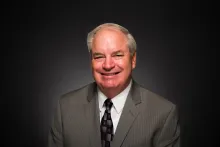
Robin Webber was born in Chicago, Illinois, in 1951, but has lived most of his life in California. He has been a part of the Church of God community since 1963. He attended Ambassador College in Pasadena from 1969-1973. He majored in theology and history.
Mr. Webber's interest remains in the study of history, socio-economics and literature. Over the years, he has offered his services to museums as a docent to share his enthusiasm and passions regarding these areas of expertise.
When time permits, he loves to go mountain biking on nearby ranch land and meet his wife as she hikes toward him.
