
Robin S Webber
This transcript was generated by AI and may contain errors. It is provided to assist those who may not be able to listen to the message.
Last weekend, we celebrated our nation's birthday. In America, we call it July 4th. Beyond what occurred over that three-day weekend, whether it was going out to the national parks, or roasting weenies over a fire, or watching sports, or viewing parades, the one thing that we really want to think about when it comes to that birth of our nation, are simply two words. I'd like to share them with you. You might want to jot them down to be able to stay founded on what we're going to be talking about this afternoon. It's simply two words. Freedom. Freedom. The second word is liberty. That freedom and liberty is symbolized and emblazoned and enshrined in the flag of the red, the white, and the blue. Today, I want to speak on that. I want to talk about the Fourth of July, because even though technically the Fourth of July was last weekend, the Fourth of July in America is really every day. Because what occurred during that time in Philadelphia is something that makes America America. And we need to understand the foundation and we need to understand the background of it. Most importantly, because we are Christians. And most importantly, because we're the people of faith and the people of the book. And that faith and that book is not being talked about today as much as it used to be.
And sometimes when we have the absence of discussion, and or when we vacate ourselves from being in that discussion, when good men don't speak up, and there is a vacuum. That vacuum is going to be filled with one thing or the other. So the purpose of this message today is really to help fill that vacuum which is increasingly being made by this humanistic and this secular society. When you think about the American experiment, for those of you that have ever been in history classes or graduate classes, lectures, you'll understand that the history of America is often called the American experiment. Because it is something that is still continuing. There is something progressive to it. And that American experiment, which started in 1776, is really when you think about it, is breathtaking. It takes your breath away. In one sense, it should not have occurred when it did, other than by God's grace, against the backdrop of world history then, as well as now. And the question that I'd like to put before all of you this morning, and one that I hope I'm going to be able to answer in the course of this discussion, is simply this. What has made America, which self-proclaims itself as an exceptional nation, and that is also ascribed by others as an exceptional nation, what has occurred over these last 240 years to make it that exceptional nation? Sometimes you and I will gather together a collection of recipe items to say, well, this is why America is an exceptional nation. We might talk about Yankee ingenuity. We might talk about 1,000 years of English common law that blossomed and bloomed and came to that fore right at that moment in 1776. It might be said to be the product of the enlightenment of that gilded age in the 18th century, when people began to consider natural law. It might be because we are surrounded by two great oceans, and so that we have not had the problems that Europe had with its many wars and wars that continue, even as we talk today. We might say, then, that all of these really might be also because of the racial and the ethnic diversity that in one sense is challenging, but also brings out so many different veins to strengthen us as a people. Now, I dare say, and I think you would too, that all of these are contributing factors of what makes America an exceptional nation. But let's ask ourselves one more question. Is there something bigger? Is there something greater in scope? To find the answer, let's go to the Word of God itself. Join me, if you would, in Psalm 33. Psalm 33. And let's allow Scripture to unlock the answer to the questions that I've asked you so far. In Psalm 33, in verse 8, we pick up the thought. Let the earth fear the Lord, that all the inhabitants of the world stand in awe of Him. For He spoke and it was done, and He commanded, and it stood fast. The Lord brings the counsel of the nations to nothing. He makes the plans of the peoples of no effect. The counsel of the Lord stands forever. The plans of His heart to all generations. Now notice verse 12.
Blessed is the nation whose God is the Lord, the people He has chosen as His own inheritance.
The Lord looks from heaven. He sees all the sons of men. From the place of His dwelling, He looks on all the inhabitants of the earth. He fashions their hearts individually. He can sitters all of their works. No king is saved by the multitude of an army. A mighty man is not delivered by great strength. It's not because they are exceptional. A horse is vain hope for safety. Neither shall it deliver by its great strength. Behold, the eye of the Lord is on those who fear Him, on those who hope in His mercy to deliver their soul from death and to keep them alive and famine. Our soul waits for the Lord. He is our help and our shield, for our hearts shall rejoice in Him, because we have trusted in His holy name. Interesting again what it says in verse 15. Blessed is the nation that God is for, and He does consider their work. How does that relate to the United States of America today? What is at work today and what was at work over these 240 years?
Before we go any further, I'd like to share a quote from Africa. I thought we were talking about North America. I'm going to go to Africa for a moment. I want to make a quote from the Yoruba tribe of West Africa. They have a saying, and I'd like to share it with you. However far the stream flows, it never forgets its source. But the question again that we have to ask ourselves, has America the most outwardly religious society today in Western civilization?
The same society that looks back to Plymouth, the same society that has with minted on our coins, and God we trust, has it forgotten the source of its blessings and placed God on a convenient shelf where He's accessible, where He's on our coins, but we have Him at a safe distance. He's not an active force in the life of our nation or the life of our citizenry.
And we only yell our affirmations for His presence when events like 9-11 came.
And it kind of just shows where America is today. I thought that, and perhaps you did too, that in that tragic event that occurred in Washington, D.C., and New York, and on the plains of Pennsylvania, that when we saw America under attack for the first time in over 200 years, that certainly this would be a wake-up call to America, that certainly this would be the moment when people would return to their God. And they did! Some for three days, some for three weeks, some for your own family members, and then they went back to business as usual and put God back up on a shelf and the same old, same old. Allow me to be this blunt, may I? Today, America is photoshopping its history. How many of you know what photoshopping is? How many of you want to know what photoshopping is? Photoshopping is basically that because of computers, let's put it this way, I'm on mic, so what we could do, if I took a picture right here, this is not a selfie, this is a big picture of all of you, okay? If I took a picture of all of you, and there's Brenda, Brenda, I'm going to pick on you for a second, okay? I hope you don't mind, but you know what you can do by computer is you're all there, but we're just going to take her right out of the picture as if she was never there. Period. Aren't you glad you're here?
And we can take her out, and then what we can do is we could take Darlene, we can take Darlene over here, take her out, and we'll put her right over here where Brenda was, hope you don't mind, and that's the picture, and that's the picture that goes into the future.
Brethren, today, secular and humanistic modern-day America, the contemporary society that we are living in, is photoshopping God out of our history and Christ out of our history, and what our founding fathers really believed about these subjects, and we need to be aware of that, and we need to start as Christians to speak up, whether it's around our dinner table or when our children or our grandchildren come to us, whether it's home school material, whether it's public schools material, whether our young people come back from college, and you know what college does, to be frank, that we need to stand up and to be able to share what our founding fathers believed in.
What is truly at work is that God and His principles found at this nation. The title of my message today, if you want to put it down, is simply this, the faith of our fathers.
The faith of our fathers, and what a better time to talk about it than as was last week, the July 4th weekend, but July 4th is every day in America, and the reason I'm bringing this to you on a Saturday morning here in Redlands, California, you might say, well, what is in it for me? Our national greatness was once inseparably linked in our citizens' minds and in their hearts with respect for God's principles of morality and character, and they were taught in as in the Holy Scriptures. And many of our citizens believed in the sovereignty of God, that God was doing something very powerful on this side of the Atlantic Ocean.
It was a new promised land, and it was opened up to them by God, and they brought God with them. They spoke about God. They talked about God, and not only talked about Him, but incorporated so many of the principles of Scripture into our governing documents. You won't hear about that in public school today. Now that they've taken prayer out of the school, now that they have photoshopped God out of the school, and that we get this information through our colleges and through our universities when our young people go there, that somehow the individuals that were the founding fathers were basically either simply agnostics and or they were deist at best. That somehow they believed in about nine distant first cause force.
Let's understand something as we now plunge into some history. We're going to put on our eighth grade, ninth grade, tenth grade. Remember going back and studying the American Constitution in different articles. But we're going to bring you into some of the founding documents of our country and what this country was based upon. Let's notice this. We're going to start with what is the Declaration of Independence. You might want to jot this down. The Declaration of Independence is looked upon as our founding government document. You might say, well, I thought it was the Constitution. 1787. No. Constitutionalists and historians will tell you that the founding document is the Declaration of Independence. Let's understand what the Declaration of Independence was about. The Declaration of Independence was a political statement. It was a political statement designed to frame reason for agitation between two people that had a common language and who had been agitating and at one another for 10 years. And the war was already on. The war had already started in New England. It had already started up in Bunker Hill a year before 1776. The war was on.
But those that were losing homes, those that were fighting in the field, had to know why they were fighting and why they were giving up their lives. Thus, this statement is a political statement. And it is a statement based upon principle of why people were separating. And this vast experiment in history that had never occurred, that people were throwing off the shackles of royalty and creating something that had never been known other than in very, very small republics in Italy and in ancient Greece called Republic. A political entity without a king and without a ruler. Let's notice what is enshrined in the Declaration of Independence. It starts out this, and you'll remember some of the famous lines, when in the course of human events it becomes necessary for one people to dissolve the political bands which have connected them with another, and to assume among the powers of the earth the separate and the equal station, notice, to which the laws of nature and nature's God entitle them. A decent respect to the opinions of mankind requires that they should declare which, that they should declare which impel them towards a separation, their duty bound. We hold these truths, truths to be self-evident, that all men are created, not hatched, not evolved. Notice the words of the founding governing document of our nation, are created equal, and that they are endowed by their Creator with certain unalienable rights. That means it's impossible to transfer. It is impossible to surrender because it is God, the Creator, that has given them. That among these, then, are life, liberty, and the pursuit of happiness.
Very interesting that that word, happiness, you don't find that in other documents going further back in history of happiness. Jefferson and those that helped him write the Decorate added happiness a couple of times in that document. That was not really an established human thought that human beings could be happy. They were here, too, at that point to serve others and be at the back in the call of a king, the pursuit of happiness. To have that full life, it wasn't that happiness was guaranteed. All men were created equal. The thought was, at least the thought, was that all people would start at the same starting line. They'd be given the same break. Now, you know, and I realize that that did not occur in 1776 with the racial fabric of our nation at that time, and that would have to be met out 75 to 80 years later because it's one thing to put one thing on paper. It has to go in the oven, and that part of the American experiment was not realized further for another 80 years, much less another 100 years into the 1960s. But nonetheless, there was this pursuit of happiness. And for the support of this Declaration with a firm reliance notice on the protection of divine providence, not the existence of divine providence, but that there would be the protection, the intervention, the act of hand of divine providence. We mutually pledge to each other our lives, our fortunes, and notice our sacred honor. Not our personal honor, but our sacred honor. You've just had the beginning of the Declaration of Independence read to you. Some will say that this is written basically because it was the high point of the Enlightenment period. The Enlightenment basically came to an understanding of setting a society in order as the universe is in order based upon natural law because there is cause and effect and there's an equal balance and the just say that the planets all revolve in a natural order and there's this balance. Therefore, that balance must come into human society. Some will mention that the early fathers were founding fathers were deist. They acknowledged the benign distant deity, but it fled the tenants of a god that intervenes in human affairs and they had discarded the relics of Christian faith. What I want to share with you, and you don't hear this, and some of you young people will not hear this, and that's a different revolution. That's a different revolution on a different continent which is affecting the world today and affecting America today as well. The American Revolution was based upon all men are created are created equal and that they have that privilege of life, liberty, and the pursuit of happiness. When you look at the French Revolution that occurred about 20 years later, the French Revolution was based upon a different standard of principles of liberty, fraternity, and equality. Equality was guaranteed. In the American experiment, it is that all men are created equal. It does not say that that all men will wind up equal, but are given that same start as their own forefathers had come over from Europe, and here was America, a land that lay before them. And it wasn't who your daddy was, but it was what you were going to do on this side of the Atlantic. And there was such liberty and there was such freedom that had never been. This is what excited our forefathers. This is what made America great, and that freedom came out of Scripture itself. When you think of Jesus Christ Himself who said, I have come that they might have life, and that they might have it more abundantly, and to recognize that as Christians, to recognize that we have open access to the Father, open access to Christ without any man, any woman in between us.
Such freedom, such unshackling of layers and layers and layers of what had been down in society in the past. Very interesting, too, when you look at the difference between the American Revolution and the French Revolution, you're going to find that how much God and even Christ was in the thoughts of the early founding fathers. In the French Revolution that gave equality to everybody without earning it, they worshiped actually under the reign of terror. You might want to jot this down and you can look up later. They worshiped. There was a cult of the goddess of reason, not the God Almighty, but the goddess of reason. Last time I looked in the Garden of Eden, reasoning kind of got humanity in trouble. So you recognize there's a tremendous difference between this. Now, let's go back and understand why these men pledged their lives and fortunes in sacred honor.
And talk is cheap, and they put it into action. I'd like to share some of the results of what occurred during that war with those original signers. Five would be captured by the British and tortured before dying. Twelve had homes, ransacked or burnt. Two lost sons in the war. Two others had sons in prison. Nine of the 56 would fight in the war and die. They gave their life, they gave their fortune, and they gave their sacred honor. The question is, what would be the source of their conviction and give them muscle to their words? And one of the reasons why I'm giving this message to fellow Christians today is because we can kind of get tired as that tsunami of secularism and humanism kind of keeps on coming at us. And we can become doubtful. Maybe this isn't a big deal, or maybe what we were taught when we were younger isn't really so. Or we just accept things, or we just stay quiet about it, rather than recognizing the blessings of God and His Word and His intervention in America. Brethren, so many of us have just kind of been, you know, okay, yeah, okay, that's what they think, fine. Rather than speaking up, rather than standing up, rather than speaking out. These are the facts I'm going to give you today.
Let's go back to some thoughts in American history and listen to the plain words, unfiltered.
A lot of the exceptionalism began was in the hearts of our founding fathers. I'd like to quote from John Winthrop for a moment. You say, who's he? Does he live over in Loma Linda? No. He was a Puritan about 400 years ago who had become the governor of Massachusetts, the Bay Colony. And he gave a message. It was called a sermon. The message was entitled, it was a sermon that he gave on board. I have enough trouble giving a sermon just with my two feet planted. Can you imagine being on board a ship? But I really want to encourage you, if you go to YouTube, jot this down, go to YouTube.
Are you with me? Go to YouTube and look up this message this afternoon. It's a model for Christian charity. And when you read that, and the flow of words, and the content, and the way that it's put out, sometimes it's saddened how dumbed down we have become in America.
In being able to explain and to be able to express ourselves. Now you say, a model for Christian charity. I've never heard that. You will know it as the speech or the sermon about the city on a hill. The city on a hill, which was brought back into vogue by President John F. Kennedy in his State of the Union in 1961, and also by President Ronald Reagan, who spoke to it often.
But what he gave would have this John Winthrop would give a profound influence on New England and the nearby colonies, and basically assimilated itself into the American psyche. Allow me to read from it. John Winthrop 1630, Thus stands the cause between God and us. We are entered into a covenant with him for this work. Remember how it says in the book of Psalms that God looks down upon the works? Upon this work. For we must consider that we shall be like a city on a hill, coming from Matthew 5 and verse 14.
The eyes of all people are upon us, so that if we shall deal falsely with our God in the work we have undertaken, and so cause him to withdraw his present help from us, we shall be made a story and a byword throughout the world. We shall open up the mouths of our enemies to speak evil of the ways of God and all professors, for God's sake. We shall shame the faces of many of God's worthy servants and cause their prayers to be turned into curses upon us until we be consumed out of that good land, that good land, whether we are going. And then he concluded with Deuteronomy 30, I set before you life and death good and evil, and then concludes his sermon, therefore let us choose life, that we and our seed may live by obeying his voice and cleaving to him, for he is our life and prosperity.
To that good land which God gives us was in the American psyche from the beginning. Now, of course, some people say, well, what would you expect out of a out of a Puritan zealot in 1630? They were a little stuffy. You know, they were, they were basically a theocracy up there in the Massachusetts Bay Colony. People say, you know, there's more than the religious zealots. There were the mercantile Dutch of Manhattan.
There were the urban gentry of Philadelphia. There were the aristocracy of Virginia and Maryland that were basically deist and didn't only recognize nature's God but didn't really honor him. What I want to do here for a moment is I'm going to read some words of some very familiar names to you and just, you know, like we had our scripture reading today, let the words do it without too much interpretation.
I've got to come back again and say, no, that is not the story. The founders of America acknowledged God, not in some metaphysical, metaphysical, metaphorical way. These were men that were seeking real answers to real questions who were going through real dilemmas and real struggles and needed real words from a real God and real solutions for the challenges that were before them just as you and I have today, whether we're in Costa Mesa, whether we're in San Jacinto, whether we're out in Indian Wells, whether we're in Riverside.
But you won't read these comments today in most public school and university material. They have been ignored, they have been reinterpreted, and or they have been just simply expunged. Remember what I said about photoshopping. Allow me to begin. Let's hear the words unfiltered by James Madison. James Madison, a Virginian who was later the primary architect of the Constitution. He's called the father of the Constitution. James Madison. And I realized I'm a history major. People often look at Thomas Jefferson, James Madison. They really got it. Those are our men.
That's really who we should stem from. So I'm just going to start with James Madison. James Madison. We have staked the whole future of the American civilization, not upon the power of the government. Far from it. We have staked the future of all of our political institutions, upon the capacity of each and all of us to govern ourselves according to the Ten Commandments. I'd like to read then from Benjamin Franklin, who said this in the summer of 1787 at the Constitutional Convention. Ben Franklin was, in his own way, a religious man. Uncle Benny, as we call him in American history, was a unique bird, even for his own time.
He was probably one that, in a sense, you would call a deist. He basically, though, was open to the idea. He says, my days of departure are at hand, and I think shortly I will find out whether or not I was right or wrong regarding Christ. He had that wit, and he had that humor. It might have even been some gallows laughed just as you were laughing a moment ago.
But this is what Benjamin Franklin said, if a sparrow cannot fall to the ground without his god, without his or God's notice, it is probable that an empire cannot rise without his aid.
We have been assured, sir, in the sacred writings, that except the Lord build the house, they labor in vain that build it. He then asked the committee to offer daily prayer. You can't pray today in school, but back then, when they were at the Constitutional Convention, Benjamin Franklin wanted them to have daily prayer to ask for God's assistance and blessings in all of their deliberations. We just have to fill our lungs with this oxygen. Some of you and all of us to wonder, greater than another, have not heard this. When you don't hear it, you forget it. You begin to have an amnesia of not remembering why and how this nation was founded. Let's talk about Washington, George Washington, who looms large on the American imagination. Sometimes he's called the indispensable man. Flechner wrote a fantastic book called Washington, The Indispensable Man.
Washington continues to his shadow crosses this country. Our capital is named after him. The largest, tallest monument will always be the Washington Monument in the capital, and even a state is named after him. First President, he said this in his Thanksgiving proclamation of 1789, wherein it is the duty of all nations to acknowledge the providence of Almighty God, to obey his will, to be grateful for his benefits, and humbly to implore his protection. Eight in favors. Now therefore I do recommend and assign Thursday, the 26th day of November, next, to be devoted to the people of the United States, to the service of the great and the glorious being. Who is the beneficent author of all the good that was and is, or that will be.
Sounds like an intervisionist deity that's not asleep. That we may all unite in rendering under him our sincere and humble thanks for his kind care and protection of the people of this country, and for all the great and various factors which he has been blessed and pleased to confer upon us.
Well, you might say, well, Washington is really talking about a natural God in the public square of religiosity. But let me share some of the words of Washington. Let's go a little bit deeper. Washington also said this. I now make it my earnest prayer that God would most graciously be pleased to dispose to all to do justice, to love mercy, and to demean ourselves with charity and humility and Pacific temper of the mind, which were the characteristics of the divine author of our blessed religion. That's Christ's talk, the divine author of our blessed religion. Now, the question we have to ask ourselves is, does the father of our country sound like some estranged deist who simply recognizes God as the first cause? Or does he sound like the words of Isaiah 40 verse 15, Behold, the nations are as a drop in a bucket and are counted as the small dust in the scales? Personally, I believe that Washington was a man of faith. In my own office, I have the picture of Washington at Valley Forge, kneeling down in the snow. God's hand was there at the beginning. At the beginning of the American Revolution, there was defeat after defeat after defeat. Washington had to flee the high ground of Brooklyn. He had to move his troops across the East River. He had to flee across New Jersey. And then with all of that, he got Valley Forge, which could have been the graveyard of our nation. But sometimes, when you're at your lowest, is when you begin to rise and to recognize that God had a destiny for this nation.
I'd like to read something here to all of you. Washington was not alone, and he was not uncommon in his day regarding his faith. Political science researchers at the University of Houston, over a 10-year period of research, found that the founding fathers quoted from the Bible four times as much as any other source. And more than a third of their quotes came directly from the Scripture. Basically, today you go to a philosophy class, you go into an American history class, they'll say that the founding fathers were basically influenced by John Locke, Rousseau, Voltaire, and other gentlemen or gentleladies of the Enlightenment. This is 10 years of research. The preponderance of their activity and their influence came from the Scriptures themselves. Let's go beyond George Washington. Let's talk about John Adams for a moment, a signer of the Declaration of Independence. He was a signer of the Bill of Rights. He was the second president. And if any of you enjoyed fireworks on July 4th, you can say thank you, Mr. Adams, because he was the one that said that America should always celebrate this day forward with luminations, meaning fireworks. John Adams said this, the general principles on which the fathers achieved independence were the general principles of Christianity. I will avow that I then believed, and I now believe, that those general principles of Christianity are as eternal and immutable as the existence and the attributes of God.
John Adams goes on to say this, and he shared this additional thought by saying, our... now you think about what's going on today in America, folks, with revisionist.
This is what the founding fathers put out there. John Adams, our Constitution was made for a moral and a religious people.
It is wholly inadequate to the government of any other. Again, John Adams said this, suppose a nation in some distant region should take the Bible, or as their only law book, and every member should regulate his conduct by the precepts, they're exhibited. What a utopia! What a paradise this region would be! Where did they get that? Maybe what were some of the thoughts? Join me if you would in Drudonomy 17. In Drudonomy 17, let's take a look here at verse 18.
That it spoke that when there be a king in the land, this is what the king would do in Drudonomy 17, verse 18.
That every king that came along was to do this. Also it shall be when he sits on the throne of his kingdom, that he shall write for himself a copy of this law in a book from the one before the priest, the Levites. And it shall be with him, and he shall read it all the days of his life.
He will not forget it. It will not just simply be a benign, distant force, but it will be an active interventionist in his thoughts.
That he may learn to fear the Lord his God. That means to respect him and be careful to do and observe his word of this law in these statutes. Why, why, why? Why, why, why? Verse 20. That his heart may not be lifted above his brethren.
That he does not in that sense become a divine right king, solely responsible to God.
That's why good for the goose is good for the gander. The law of God is to be equally applied both to king and both to subject.
And it's based upon the law of love. And that's what he was to do. That his heart may not be lifted up above his brethren. That he may not turn aside from the commandment to the right or to the left. And that he may prolong his days in the kingdom. That it can be an exceptional kingdom, because they worship an exceptional God and his children in the midst of Israel.
Samuel Adams, cousin of John Adams, father of the American Revolution, ratifier of the Constitution, said this, I conceive that we cannot better express ourselves than by humbly supplicating the supreme ruler of this world. That the confusions that are and have been among the nations may be overruled by promoting and speedily bringing in the holy and the happy period when the kingdoms of our Lord and Savior, Jesus Christ, may be everywhere established and the people willingly bow to the scepters of him who is the Prince of Peace. I'm going to skip a couple just because of time. I do want to go down to one, which I think you'll find interesting because of the challenges that we have in the Supreme Court these days. This comes from John Jay. John Jay was one of the authors of what's called the Federalist Papers, and he was also the first Supreme Court Justice. John Jay said this. Providence has given to our people the choice of their rulers, and it is the duty as well as the privilege and interest of our Christian nation to select and prefer Christians for their rulers. Boy, how that would go over today! Woo-hoo! Now, let's get to Thomas Jefferson, everybody's favorite person to kind of figure out where this nation is going. Thomas Jefferson said this. The practice of morality being necessary for the well-being of society. He has taken care to impress its precept so indel- who's he, God?
to impress its precept so indelibly on our hearts that they shall not be effaced by the subtleties of our brain. We all agree on the obligations and the moral principles of Jesus, and nowhere will they be found in greater purity than in his discourses. Let me move from Jefferson to sometimes what is considered his disciple, James Madison, who was again the father of the Constitution. I have sometimes thought that there cannot be a stronger testimony in favor or religion or against temporal enjoyments, even the most rational and manly than for men who occupy the most honorable and gainful departments and are rising in reputation well.
Public ally to declare their unsatisfactoriness by becoming fervent advocates in the cause of Christ.
And I wish you may give in your evidence in this way. You go to school today, you hear things on talk radio, you read magazines, you would think that these guys were blazing atheists, or at best, benighted deist. These are the words of Jefferson. These are the words of Madison. These are the words of George Washington. Let's understand something here that I think all of this echoes what has made this nation exceptional, Jeremy, if you would, in Deuteronomy 4. And I think these were the thoughts of John Winthrop as he was crossing on the Arabella and coming to Massachusetts, because they also felt that in that sense they were coming into the new promised land, that they were worshiping the god, they were worshiping Jehovah who had opened up this miracle for them to magnify his name.
In Deuteronomy 4, and let's pick up the thought if we could in verse 5.
Surely I have taught you statutes and judgments, just as the Lord my God commanded me, that you should not act according to them in the land which you go to possess. Therefore be careful to observe them, for this is your wisdom and your understanding and the sight of the peoples who will hear all these statutes. And surely this great nation, we might say this exceptional nation, is a wise and an understanding people for what great nation is there that has God so near to it as the Lord our God is to us for whatever reason that we may call upon him. And what great nation is there that has such statutes and righteous judgments as are in all of this law which I set before you daily. Remember that 10-year study that had showed that the forefathers, those that wrote the Constitution, those that started this nation, that most of their material came from the Scriptures.
Not from the Greeks, not from Socrates, not from Plato, not from Aristotle.
Were they, to a degree, perhaps shaped or molded? Yes, because those are the books that were being read at that time. But most of it came from Holy Scripture. Their greatest influence was not Voltaire, it was not Rousseau, it was not John Locke. It came from Holy Scripture. One thing that we need to understand today for we as Christians, as we look at our background, that today you will not find this in our books or your children are being taught this. The prevailing thought today is that in the United States of America that there is a separation of church and state. Can I ask what document that's founded in? Where do we find that document? Where does it say that there is to be a separation between church and state? Can somebody help me? I just came from Mars, landed here, and you're all Americans. And I know you hear about that all the time on the, oh there's a big separation between church and state. Am I talking to the right audience?
Where do we find that in our governing documents?
Pardon? It's not there. It is nothing.
Right. It is a principle based upon a letter that was sent by Thomas Jefferson, rightfully so, in that the Danbury Baptist Church, you gotta remember Connecticut was not the Connecticut we know today. Connecticut back then was a puritanical Protestant society, very congregationalist, you know those congregational churches. Baptists were not well-accepted. Now today we have 13 to 14 million Baptists basically down south. They were a very persecuted minority religion at that time. They were not liked. And they were having real problems in Connecticut. They were being in a sense persecuted. And so they wrote a letter to President Jefferson.
And President Jefferson basically used a principle that there should be a high wall between what was occurring. And we need to understand what was going on here. It was a principle out of a personal letter to this congregation. And the Supreme Court extracted that and then magnified it. And today you and I think it's in the Constitution. It was a very real problem. And he gave the right answer at the right time. And I'm going to explain why. The First Amendment of the Constitution drafted in 1791 directs the Congress shall make no law respecting an establishment of religion or prohibiting the free exercise thereof. The clear intent of the Founding Fathers is that they did not desire a national Christian church. They did not desire one Christian church to be supreme in the land. Recognizing that if you went to England, you had the king as the head of state. You go to France, then it was Catholic. You went to Spain, it was Catholic. If you went to Italy, it was Catholic. If you went to parts of Germany based upon the kingdom within those German kingdoms, it was either Protestant or Catholic. That was not to be. That's why so many people had come over and dared their life to come to this side of the Atlantic. That was the common understanding of the day. What was their understanding? It was to keep the government out of religion, not religion out of the government. You've got to put the cart and the ox in the right order. Yet the reality of our Founding Fathers vision is completely different today. Completely different. I want to conclude here with Abraham Lincoln. He was not shy and acknowledged in God. We can learn some vital lessons here from his proclamation that he gave. It was during the Civil War, during a time of great trouble. Lincoln said this, Now therefore I, Abraham Lincoln, President of the United States, do hereby appoint and set apart the last Thursday of November, next as a day in which I desire to be observed by all my fellow citizens, wherever they may be, as a day of thanksgiving and praise to Almighty God.
The beneficent Creator, note, I want you to listen to the words, the beneficent Creator, first cause, and ruler, the beneficent Creator and ruler, that God remains an active force in the life of nations today. And I do therefore recommend to my fellow citizens at Forehead that on this occasion they do reverently humble themselves in the dust, and from then to offer a penitent and fervent prayers and supplications, notice, to the great disposer of events for return of the inestimable blessings of peace and union and harmony throughout the land, now notice this, which it has pleased him to assign as a dwelling place for ourselves and for our posterity throughout all generations. It's pleased him, and he assigned us, this exceptional God, assigned us, not because of who we are, but because of what he is to this place. Join me if you would in Acts 17. Acts 17, Paul on Mars Hill.
And let's pick up the thought in verse 26, and he's speaking to the Greek world.
And of course, the Greeks thought they were et. If you weren't Greek, you weren't et. Anything that was not Greek was a barbarian. That's where the word comes from. Bar-bar. It was a term, meaning other. Notice what Paul says to these Greeks, this Jew that is amongst them. And he, speaking God, is made from one blood every nation of men to dwell on all the face of the earth. And notice, and has determined, has determined their pre-appointed times and the boundaries of their dwellings. Is it possible that Abraham Lincoln wrote, read this before he wrote that this is what God has been pleased to give us? Brethren, it was never lost on Abraham Lincoln that a great purpose was being worked out here below. That God had been queathed to us as a people, a land that would be protected by its enemies by two white oceans, surrounded by, in general, large and friendly neighbors, given that Mississippi and Missouri watershed, one of the great bread baskets of the world, and an energetic people, an energetic people, who were more interested in what you could do, rather than how or where you were born or who your daddy was.
It's not where we're from, it's where we're headed. Can you see the framework of Christianity, that it's not where we're from, but where it's we're headed? It's not necessarily who your physical daddy was or your physical parents were, but that we've been adopted by an exceptional God and given a future, in which there is no stone too heavy, that each and every one of us have been created equal before our God. This was a thought I think that all of us should consider. Join me for final scripture to 2 Chronicles 7. 2 Chronicles 7. This is at the dedication of the temple and the words that were spoken there on that day in 2 Chronicles 7. When I shut up heaven, and there is no rain, or command the locust to devour the lander, send pestilence among my people, if my people, who are called by my name with humble themselves, and pray and seek my face, and turn from their wicked ways, then I will hear from heaven, and will forgive their sin, and heal their land. Now my eyes will be opened, and my ears attentive to prayers made in this place. I think as we move through the season of July 4th, and let me just share something with you. Susie and I had the most wonderful July 4th we've ever had, and you know what? We didn't even have a hot dog. We didn't even go out and see the fireworks.
We just exposed ourselves to the Word of God, and studying about this nation, and hearing about from other people about what our founding fathers did, and what incredible, brave men, along with their ladies who had to give up their husbands at that time, they sacrificed their life, and their fortune, and their sacred honor. Brethren, I hope today by sharing this with you, and I know it's a week over, every day in America is July 4th. We love that flag, red, white, and blue.
It's a thrill to see the flag. What a wonderment to be an exceptional nation, but we're only an exceptional nation because we have an exceptional God who has a purpose and who has a plan. I hope I've been able to kind of fill your sails today because I realize there's a tsunami of secularism, and humanism, and books that are being written that, again, are photo-shopping the lives and the honor, that sacred honor of our men as if it never existed, whom they looked to, and committed themselves to, and died for, and saw a nation that might come out of the word of God, where all men could be created equal, and where all men could, in that sense, have that rightful and decent pursuit of happiness that has always been visited upon a God to his creation. I hope I've pumped you up. I hope you have something to talk about next time somebody wants to start a conversation. Allow them to start it, and you conclude it in humility, but with the facts and with fortitude that you stand on good ground, the same ground as our founding father, the faith of our fathers, which allows us to worship today in freedom and exceptional God.
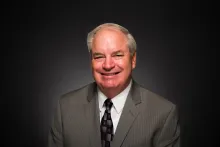
Robin Webber was born in Chicago, Illinois, in 1951, but has lived most of his life in California. He has been a part of the Church of God community since 1963. He attended Ambassador College in Pasadena from 1969-1973. He majored in theology and history.
Mr. Webber's interest remains in the study of history, socio-economics and literature. Over the years, he has offered his services to museums as a docent to share his enthusiasm and passions regarding these areas of expertise.
When time permits, he loves to go mountain biking on nearby ranch land and meet his wife as she hikes toward him.
