
Robin S Webber
This transcript was generated by AI and may contain errors. It is provided to assist those who may not be able to listen to the message.
Thank you very much, Mr. Beatty. I do need to bring to your attention that, once again, I have proven the Bible correct. Do not set dates. I made a mistake on the date. Everybody's nodding. Now they're nodding after I make confession. Why didn't you make nodding while I was blowing at up here? Okay. You're supposed to help my friends, like the Beatles used to sing back in the sixties. And that is James watching your face. You can't go anywhere until after June 22nd or 23rd. It's a couple weeks down the line. So you've got to keep on coming back to church. Okay? You can join the Mormons next month, right now. You're with us.
Well, let's get right into this message this afternoon, because there's some important material that I'd like to bring to you as a fellow Christian. I want to kind of build upon where we were a couple of weeks ago when I spoke on Pentecost, because I left you with a phrase that I thought was very, very important for us to understand.
And that is simply this. First fruits put first things first. It's an exhortation. It's a spiritual ideal. And it's very simple to say, and I hope it's catchy enough that we might remember it. First fruits put first things first.
But when it's all said and done, I think you and I know that, indeed, it's humanly challenging to maintain that standard. Because there's all of those decisions that come at us every day that we have to make. And it's not the decisions so much as all of the choices that are out there before the decisions are made.
There are so many choices out there that they can do two things to us. They can either cloud our decision-making to where we don't make a decision or we make an improper decision, and or there are so many choices that they crowd our mind and we become paralyzed and then we can't respond and we can't act. We live in a world where there are more choices than ever. All you have to do is just go to a marketplace, go to a super shopping center. When some of us were growing up and it is not really in the Jurassic age, we're not that old, but to remember when we were kids in the late 50s or early 60s, to recognize you'd go to the store and on a shelf might be three or four boxes of cereal. There would be shredded wheat, there would be Cheerios that have always been around, I think since the dinosaurs. There would be Cheerios, there would be puffed wheats, there would be Quaker oats, there would be this or that. There were not a lot of decisions to make back then.
Some of you didn't even go to the store, you just had the oatmeal at home. Today we live in a different world. There is so much coming at us that it can stifle our ability to make proper personal judgments that will ultimately glorify God's investment in you and in me.
A lot of decisions out there. We might call them proverbial decisions. Let's think about it for a moment. Such as the proverbial decision, just stay with me for a moment, of building a bridge and or crossing a bridge or meeting someone halfway on the bridge or burning a bridge behind us. Some of us might be having to make that decision even today and or this coming week or not even stepping on the bridge or running away from the bridge and or in this day and age can I even afford the bridge, making a bridge. And what will it do to me financially, maybe emotionally, maybe spiritually? And we've just been dealing with the proverbial thought of the bridge. When we come to think about it and we open the book and we can go to the book of Revelation. We can go to Revelation 2, Revelation 3, and it is God's discussion with the seven churches of Asia Minor. And to recognize that each and every one of those churches, whether it be Ephesus, Thyatara, whether it be Laodicea, all of them were impacted and spiritually conditioned by the prevailing culture that was around them at the time.
We've read articles on that. We've studied that. We know that. We are no less. We are no more today in 2012. We live in a world that does impact us. There are good things. There are in between things. There are bad things. There are matters that are eroding.
The souls of men and women that did not allow them to make good decisions today. There are the pressure points of humanism, of secularism, of narcissism. You say, what is narcissism? You know it's one of those schisms, but you might not quite know what it is even though you hear it. You might have been used the word narcissism.
It is the undue dwelling on one's self or one's own attainments. In other words, it is basically a love affair with yourself and your attainments. Sometimes today, in today's world, there are people that attain nothing other than being famous. You know and I know that they are basically just famous for being famous.
They've never really done much in their life other than being famous. Maybe that is doing something. I'm not sure. We live in a world that is no longer running simply at what we call break-neck speed. When I was growing up, that was a phrase that we often used of something running at break-neck speed. Today's world, because of the culture and because of the society, we moved beyond break-neck. We're now at break-thought speed. Break-thought. Things are coming so quickly in the nanoseconds and the nanomoments that basically we just simply don't have time to really think through things. Consider our choices, thus making decisions that render glory to God, that match that statement that I made, that first fruits put first things first. Now, why is this important to you and me? Why is it important to be properly decisive? Why is it important to make good choices? Is this just a decision message? Is this a choice message? No, it's much more than that. Here we are coming off of the Feast of First Fruits, the festival of first fruits, Pentecost. One thing that we need to remember when it comes to God's investment in you and myself, it is simply this. God has not simply called us to be seed-bearers, to simply have His Spirit deposited in us, that seed of His essence placed in us, and thus just to keep it dormant. God has expectations. He gives gifts, and He has expectations regarding those gifts, and that you and I become more than seed-holders, seed-bearers. But as it says in the book of John, chapter 15, that you and I, are you ready, folks?
This is the wake-up call, that you and I bear much fruit. Right now, up where we live in Sun City, we've got fruit all over our yard. We've got apple trees, just fruit and fruit and fruit, and then there's grapes, and there's boys and berries, or blackberries, and just fruit. We didn't plant vines, and we didn't plant trees just to look at the leaves.
I haven't gone up to my apple tree recently, so, boy, that's a really good tasting leaf. No, we do that so that we might have fruit. How does that relate? What you do with the choices that are before you, the decisions that you make, you are what you think about, you are what you decide upon, and what you decide upon either bears fruit and or it does not. Which brings me back to this scenario. How, then, can we as first fruits put first things first?
Because it's a challenge. Can we all admit that? It's a challenge. Sounds cool. Sounds spiritually neat. But, boy, humanly, it can be a challenge. Let me share a story with you to bring home this point. Because at the end of this, we're going to come back, but let me share a story. There was an instructor at a seminar, and he told the participants to prepare for a quiz.
He reached under the table and he took out a wide-mouthed jar. It was a gallon jar, and then he sat it on the table. Next to the jar were a number of fist-sized rocks. He asked the group, how many of these rocks do you think we can get inside this jar?
The participants began to make their guesses. The instructor said, well, let's find out. One by one, he began to put as many rocks as he could inside the jar until the rocks were level with the top of the jar. The instructor then asked, is the jar full? The participants looked at the jar filled with rocks, and they nodded yes. But then the instructor took out a bucket of gravel, poured it into the jar, and he shook it.
The gravel drifted down into all the crevices and spaces around the rocks. Then the instructor asked, once again, is the jar full? The participants were not about to be full a second time. They said, the jar probably wasn't full. They weren't fully committed. They said, probably wasn't full. And the instructor nodded and said, good. You are catching on. And he next took out a bucket of sand and proceeded to pour it into the jar.
Slowly the sand began to fill in all the gaps, all the holes left by the gravel. And after the sand settled, the instructor once again asked, now is the jar full? The participants were much more emphatic this time when they said, no. The instructor was pleased when they were beginning to understand a very important principle. He took a pitcher of water and poured a quart into the jar. And at this point he stopped and he asked the group, what is the point of all of this?
And one of the participants volunteered, there are gaps. And if you work as it, you can always fit more into the jar. But the instructor said, no, that's not really the point.
Now you're all in that class, what's the point? Gloria? Yeah, you're in San Diego, we go interactive here, go ahead. This lady, who I was in high school with, she used to do this, no. You got it, Gloria, thank you very much. She said, no, that's not really the point, it's this. If I had not put those big rocks in first, I would never have gotten them in. Firstfruits put first things first. You know that, and I know that. What I want to remind all of us today is that all of us face that big jar every day, and it's bigger than a gallon. It takes up 24 hours in a day, and it's a reality.
And there is a powerful tension that comes with deciding what comes first in filling up our lives. As to what is a rock, what is gravel, what is sand, what is water. We're going to be discussing that at the end, because what happens is, right now you would say, well, Mr. Weber, that story makes sense, and of course I want to put those fist-sized rocks in the jar. Do you think I'm dumb or something? But what happens is, once we leave here, and with all those pressure points of life coming at us in the nanoseconds, we get into a blur, we get into a fog, there's a cloud, it gets crowded, and then pretty soon everything starts looking alike, and we don't understand what goes first.
And you and I, are you ready? We need help! We'll talk about that towards the end of the message. Why is it that at times, we mistake first things and make them last things, and what comes into our life that clouds our vision or crowds our vision from making right decisions? There's actually people in the Bible that give us a clue of what's going on. I'd like to share it with you. Now, I want to understand that we're going to go through a few examples of, shall we say, bad decision-making. People that made wrong choices. I don't want to be too hard on them.
You might find that you have, at one time or another, nestled up to them. You've sat by them. You might have even been propping them up, but we don't want to stay on that playing field. By the end of this message, we're going to give you some encouragement as to how come off their field and their game plan, and get back on God's game plan. Why is it, friends, here in San Diego, that at times we make the mistake of not putting first things first? The first thing I'd like to share with you is simply this.
What happens is, sometimes we just simply live in the moment. Living in the moment. That is a classic case of putting that, which is urgent, crowding out what is essential. Join me, if you would, for a moment in Genesis 25. In Genesis 25, we have a classic example of a gentleman that was living in the moment. Now, this gentleman was a part of a covenant family, and yet he made the mistake of living in the moment. It's the classic story of Jacob and Esau and the lunch that happened between them. In Genesis 25 and verse 27, let's take a note.
His name was called Edom, but Jacob said, Sell me your birthright as of this day. And Esau said, Look, I'm about to die. So what is this birthright to me? And then Jacob said, Swear to me as of this day, in this moment, as it were. So he swore to him and sold his birthright to Jacob. And Jacob gave Esau bread and stew of lentils, and then he ate and drank a rose and went his way. And Esau despised his birthright. Here you and I are reading a classic case here of short-term satisfaction versus long-range life circumstances. What's fascinating when you are making your choices in the moment and for the moment, what can happen is that they can be intensely satisfying. You can feel powerful. You can feel as if you're in control when you're making decisions only for the moment. Here's the bottom line, though, friends. Ultimately, the future catches up. Are we making decisions right now because of how we simply feel? Decisions that we're making in the moment? Before judging Esau to harsh, let's ask ourselves some questions. What have we been willing to trade recently? Or simply to give up because of something that has just recently come up? Or how we feel? Do we find ourselves willing to negotiate anything based on how we feel now? Do family, our bodies, our integrity get mixed up in dealmaking and transference of how God has blessed us? I think about that. No, I'm not a grandson of Abraham or a son of Isaac, but I'm a son of God the Father, and He's called me. I know that. I think you know that with your calling. And God has given you and me a tremendous birthright. He's called us elect. He's called us the saints. He's called us His chosen. He's called us a covenant people. He says that in His plan of salvation that we are firstfruits. Are you with me? Firstfruits. You never want to give up that birthright of being a firstfruit. I could give an entire sermon, which I will not write now, but an entire sermon of the privilege and the opportunity, the incredible world that God is opening to those that are firstfruits. We know that there have been people that have been asked in this lifetime to be firstfruits that turn their back on God's calling. They lost their integrity. They lost their moorings. They lost their way. They decided to live in the moment. They decided to live in this world of time and space, and they despised their birthright. They're no longer with us. But you know, you and I can, on a momentary basis, and on a day-by-day basis, also despise our birthright by the decisions that we make based upon the choices that we ponder. We don't want to live in the moment. I've got good news. We can get off that bench with Esau. There's more that we'll talk about in a moment. What about the aspect of not just simply choices that are made in the moment, but choices that are made because of, number two, impatience. Impatience can thwart our decision-making. Join me if you would in 1 Samuel 17. No, excuse me. 1 Samuel 13. 1 Samuel 13. In 1 Samuel 13, verse 5, let's take a note here. This is one of those classic stories about, guess who? King Saul and Samuel, the prophet of God. Verse 5, chapter 13, 1 Samuel. Then the Philistines gathered together to fight with Israel, 30,000 chariots and 6,000 horsemen. And people was the sand which is on the seashore in multitude. And they came up and encamped in Micmash to the east of Ben-Avon. Verse 7. And some of the Hebrews crossed over the Jordan to the land of Gad and Gilead. As for Saul, he was still in Gilgal, and all the people followed him, trembling.
And then he waited seven days according to the time set by Samuel. But Samuel did not come to Gilgal. See, he set his watch for seven days. Samuel had said to wait seven days. But Samuel did not come to Gilgal, and the people were scattered from him. The army started melting away. So Saul said, bring a burnt offering, and peace offering is here to me. And he offered the burnt offering. Now it happened as soon as he had finished presenting the burnt offering.
Guess what? Here Samuel arrives and comes. And Saul went out to meet him that he might greet him. This was not the first time that Saul ever did this. He's kind of like a lapdog. And he's kind of going out like a little kid saying, Look, that's what I've done!
I just offered an offering to God. I've just done a ritual. I've just offered a sacrifice. Samuel was not happy. And Samuel said, What have you done? Saul said, Well, when I saw the people were scattered from me, and that you did not come within the days appointed, and that the Philistines gathered together at Micmash, then I said, The Philistines will now come down on me at Gilgal, and I have not made supplication.
Therefore I fell compelled and offered a burnt offering. And Samuel said to Saul, You have done foolishly. You know, poor Saul. And he was a big man, so he must have had a big jaw that dropped. Oh no, not again. He was a disappointment. You have done foolishly. You have not kept the commandment of the Lord your God, which He commanded you. For now the Lord would have established your kingdom over Israel forever, but now your kingdom shall not continue.
What do we learn out of this? Saul is no more, no less than you and I, man of like passion. Let's understand. It's difficult to trust God and make the right decision when you sense your resources are slipping away. That's what happened to Saul. He felt like the army was melting in front of him and there were these thousands of Philistines like a swarm of locusts out in front of him. And therefore he made a classic mistake.
He offered ritual rather than obedience. God does not want ritual. He wants obedience. That's a choice that we make, and God says to do something out of his word, do it, and then leave the consequences for him. To wait on the Lord means to wait. Some of us right now, perhaps something that's occurring in our life, we see things melting away.
And so therefore we start looking at different options, options that we don't find in Scripture, options that are against Scripture, options that are not what we know better to do. But externally we offer a ritual.
We try to put on a good face when our heart is obedient and to do exactly what God says to do. Psalm 46 and verse 10, you can jot it down. Be still, be still, and know that I am God. You can't know God until you're still. Until you obey His... that's a very short equation. Be still and know that I am God. You cannot know God until you're still.
Who, me? But all my resources are melting away. How can I be still? Well, you can do this all day long, but then you won't know God. You have to give up on what you want to do, let go, and let God. Be still. Let's talk about another one. Choosing the easy way versus that which is necessary. Choosing the easy way. What example can we use out of the Bible? Let's go back to the time of Boaz and Ruth, Naomi. Let's join Boaz at the gate of Bethlehem where he gathers the elders towards the end of the book.
And they gather around there at the gate of the city, and there's the elders. And to make a long story short, in that society the way God instructed, so that the family could survive, there's a certain socio-economic pact, so that the name of a family member would not go for naught in the land of Israel, that the closest kinsman was to marry the widow.
Well, what happened is we know that there's three chapters in there about Boaz getting to know Ruth, but he was not the closest kinsman. And then he has that kinsman there at the gate of Bethlehem, and he says, what will you do? What will you do?
And first of all, the kinsman is somewhat attractive because, oh, the widow Ruth in Naomi, there's a land deal here. Money to be made, you know, ding, ding, you know, cash register time, ding, ding. And by the way, by the way, not just the land, but you will have to take her to wife. It's at that point that the kinsman backed off. It was not convenient. It was not easy.
It was not the course of least resistance. It was necessary for the kinsman to marry that woman. He did not do it. Boaz did not do that, which was easy. He was an older man, if you understand the genealogy. He was much, much older. But he did that, which was correct. He chose not to just simply go the easy course and say no, but he did the necessary course of saying yes to God's law. Little did he realize that when he was doing that, what the consequences would be that would follow.
Little did he realize that their child, the child of Ruth and Boaz, would be Obed. Obed would be the father of Jesse. Jesse would be the father of David. David, the king of Israel. David, from whom seed would come Jesus Christ. Sometimes we do not gain God's blessings because of the choices and the decisions we make, because we only see the easy way out rather than what is necessary to do. Boaz could not have looked down the line.
He did not just simply live in the moment, but he did what God asked to do. He went by the word. He made a right choice. He left the consequences to God. A decision was made, and Boaz is in the line of Jesus Christ. Fascinating. Let's talk about another example of choices here. Thinking that the grass is greener on the other side.
Have any of you ever been on that trip? I have. Thinking that the grass is greener on the other side. Who could we talk about? Who comes to mind when I say the grass is greener on the other side? What example might we use in the Bible? Susan doesn't count because she heard this this morning. Gloria, don't say anything. You got your chance. Okay. Grass is greener on the other side. How about Abraham and Lot? Abraham and Lot. Nephew Lot. Looked greener on the other side. Interesting. Here we have the classic illustration. It's Genesis 13. You can jot it down. We'll just paraphrase it here for a moment.
Sometimes the prosperity we desire can both entice us and enslave us if our desires are not in line with God's directive. And even if we are strong enough with the decision we make, it may impact our family members. Here was Abraham and Lot. And Abraham decides to give Lot the greener side of the pasture.
Now remember, this is the same guy that had this pattern of giving his wife away. Ladies. Hello. So, hey, little land. And so he gave that land to Lot. But little did Lot understand that by that decision that he made the impact, not only on himself, but on his family. Later on, he would be kidnapped.
Later on, he would lose his wife. Later on, there would be challenges with the family. Later on, due to the circumstances and all the episodes that occurred, there would be incest with his two daughters after the destruction of Sodom and Gomorrah. And all of these were built upon a bad choice and bad decision-making because the grass looked greener on the other side.
Have you ever made that choice in your life because the grass looks greener on the other side? For 35 years or more, I've been counseling people. And sometimes I get together with people and they say, Yeah, but you know, my life's not happening. The grass looks greener on the other side. Now, they don't say those exact words, but that's what they mean. The grass, you know, if I just hop over the fence, somehow it's going to be better. Maybe you've done that exercise yourself. You're a little fence-hopping. But what people don't understand is, it's not the grass is greener on the other side because soon as they hop over the fence, that grass goes brown.
You know why? Because the deserts within them, the deserts within them, it's where they travel and where they go because of the choices that they make because of their attitude. That they take that attitude as they hop over the fence. The grass is greener on the other side. Another thing that sometimes we make wrong choices, wrong decisions is simply this, is because we seek to satisfy right desires in wrong ways.
Did you catch that? We seek to satisfy right desires in wrong ways. We want to do something that we think is right, but we go about it the wrong way, especially when it doesn't match with Scripture. Who comes to mind here is the gentleman Uzzah. How many of you know Uzzah?
That man that we think when you first read about it in the Scripture is doing a very noble thing. The ark is falling off of the cart. Good old Uzzah goes, and he gets fried by God. He gets zapped.
Now, it seems like the last thing he wanted to do was to disobey God. But what happened is that the Ark of the Covenant was on a cart that was going up to Jerusalem. David had an idea. David says, we need to make Jerusalem the religious center of Israel. I've got an idea. Let's bring the Ark of the Covenant.
So what he did was he put the ark on a cart. That's a no-no. God's instruction was that when you transport the cart, you will put the poles through it.
And my servants will carry it.
Now, the reason why God did that is because God is smart. He's all-knowing.
There's a difference between four men carrying the ark with poles and more sure-footed than a cart led by oxen on roads that match those that we have up in Riverside.
When I mentioned that this morning, Riverside, they got it. You have to know some of those roads in Riverside. Very interesting.
Which means what happens is our choices and our decisions, like David's, because it was David's choice that caused us to be in the place to want to do something nice, but disobey the rules and get fried.
Our choices, gentlemen and ladies, affect others. Now you say, but wait a minute, what about the Philistines?
Because they had that ark of the covenant for 20 years, and it says that they were moving it around in a cart and nothing happened to them.
But God wasn't dealing with them right now then. They were not a covenant people.
God was dealing with the people to see if they would be faithful to His Word.
To see if first fruits, because Jeremiah 2 and verse 3 says that Israel is a first fruit nation, if Israel would put first things first.
So we can want to do the right thing, but there might be a wrong way of doing it. You know, these choices are out here. Here's the last thing I want to share with you, and that is simply this.
Probably the last squeeze of human nature that causes us to make wrong choices and decisions is simply this.
Peer pressure. Peer pressure. We know what is right.
We know what God's Word says, but everybody else is telling us to do something differently.
That hasn't changed since all of us were in kindergarten, has it?
The law of the jungle gem. I didn't say the jungle. The law of the jungle gem. The law of the playground.
You might have an idea, but everybody else pressures you.
You know, if there's one individual that matches this in the Bible that we can pull up, it would be Pontius Pilate.
Pontius Pilate, who was a Roman who dealt with logic, had this man before him, and he told the audience, I find no fault in him. My decision, my personal decision, is I don't find any fault in him.
But you know, and I know the rest of the story of what happened to Pontius Pilate.
The pressure of everybody around him. Crucify him. Crucify him. Crucify him.
Now, how does this relate to you and to me? You ask.
Simply this. We weren't there, but we also have bent into peer pressure and made wrong choices that lead to a wrong decision in our life. Maybe even today. Maybe even last week.
But you don't have to go there this coming week. Here's the thing about Pontius Pilate and what we need to learn.
If you are going to be motivated and controlled and give over your decision-making based upon peer pressure, based upon what everybody else is doing, I want to let you know something. You need to go buy something. You need to go buy a very big bowl that you're going to put a lot of water into, because you're going to find that you're going to have to spend a lot of time washing your hands, just like Pontius Pilate did, to try to get rid of the wrong choices and the wrong decisions.
God has not called us to go buy bowls, friends. He's called us to bear fruit, to be more than seed bearers, but to be fruit bearers and to build much fruit.
How do we move forward? The remainder of this message is going to go very short.
I just want to share a few thoughts with you, and that is simply this.
Because, again, let's be honest. We're all in this together.
Sometimes those rocks, that gravel, that sand, that water, they're all coming at us so rapidly in this day and age that they can all look the same.
And therefore, we don't take that fistful of rock and put those in first.
We need to have a moral compass.
We need to have a compass that guides us in this world that has split-action decision-making today.
Join me if you would in Hebrews 8.
Hebrews 8. That compass is literally embedded inside of us.
Let's take a note of encouragement here for a moment. Hebrews 8 and verse 10.
For this is the covenant that I will make with the house of Israel after those days, says the Lord, I will put my laws in their mind and write them on their hearts, and I will be their God, and they shall be my people.
God literally embeds us with a homing device of writing His laws in our hearts.
And in our minds. Puts it right in there.
We no longer have to go to the mountaintop like Moses.
That's come down from the mountaintop by God's Spirit.
When Jesus said, I'm going to give you my Spirit, I'm going to put it in you, and it will lead you into all truth.
Truth is one thing. It's the revelation of God.
It can be what we call holy wisdom. It can be holy wisdom from the Greek word, which is called Sophia.
Sophia, wisdom, that which is revelatory, that which is divine.
But God not only gives us the divine wisdom, He also gives us the practical wisdom, the prudence to make rightful decisions during the day of knowing to put those big rocks in.
That means, here's what I want to share with you as we begin to conclude, we need to talk to God about the decisions that chew.
Just going to put it right out there. We need to talk to God about the decisions that face us.
And that does take tremendous strength to bend our knees, bow our heads, and explore our hearts and open our ears with God as our guide to help us with that homing device that He's put inside of us.
But it is the key to successful choices. God alone can determine the rocks, from the sand, from the gravel, from the water.
He alone is all wise, all loving, all powerful.
Beyond all that, all stuff. He's our loving Heavenly Father.
And He's there to guide us and to keep us. I'm not just saying this, friends, to fill up moments as we conclude.
These are the very real challenges that are before us, as this world just winds up more and more like a top, to where you and I are going to have so many choices.
When many of us were growing up, when we used to have a television with a funny little V on top called the Rabbit Ears, NBC, ABC, and CBS, when I was growing up, there were three television stations.
When Bob Gartenhire was growing up, there were three radios... No, I'm just teasing Bob.
There were so many radios... You know I love you, Bob.
They have a few moons on me.
Now look at the choices. Just on and on.
We've talked about cereal boxes on shelves and supermarkets. We talk about what's on television.
That's a whole other sermon. Another time, another place.
We can talk about all of the choices that are out there.
God help me.
God, you called me to be a first fruit.
And Mr. Weber has encouraged us for years now that first fruits put first things first.
But I'm a little bit like a Solomon.
I am but, at times, a child.
And I have the facts, but I don't have the understanding.
I don't have the wisdom.
I don't have what it takes to cut through and understand what to do.
Talk to God.
Bend your knees.
Bend your heart.
Be open. Be available. Be willing to listen to Him, to help you, so that you don't have to be an usa, so that you don't have to be a lot.
I want to share one or two more thoughts with you here.
When we do that, I want to share something that's really exciting.
I've shared this at times with San Diego over the years, but when we have that talk with God, and we are listening, and we are open, willing, and available, God is going to supply us choices that we have not even thought about and decisions that we have not even thought in our human brain.
We might have been in the church for 40 or 50 years.
God is ageless. He's got so much up his spiritual sleeve.
Let's talk about a moment, about a gentleman named Joseph. Joseph was confronted with a real powerful situation that he had not asked for.
Have you noticed that a lot of the choices that come our way are not choices that we planned for in our life?
Am I the only one?
And decisions that we never thought that we had to render.
Or am I the only one?
And yet here is this man, Joseph, and his fiancé comes up to him and says, Joseph, I've got some really interesting news to tell you.
Joseph says, tell me my dove, tell me Mary.
And Mary says, you won't believe this.
I'm pregnant by the Holy Spirit. Isn't that great news?
Oh, thank you so much for telling me.
Have any of you ladies done that in your life? Use that one? I hope not.
I think there's only one Mary.
One of that had been you, man.
Now, we know that God had seen things.
At the time, you knew what kind of man he was dealing with.
That would be the earthly father to Jesus.
Now, what Joseph could have done is simply this.
He could have done two things. He could have stoned her.
Hmm, that's not fun.
And or he could have put her away because he was a just man.
And those were the choices.
I believe that Joseph was a praying man.
God, I'm in a squeeze here. Help me.
I've got choices. I need to make a decision.
It's going to not only impact me, but it's going to impact Mary.
Angel Gabriel came to him, and Gabriel said something that Joseph had not even thought of.
He said, Mary her. Take her to wife. I have a question for you that are here in San Diego.
Might live in Santee, Alpine, La Mesa, Chula Vista, Bonita, Fallbrook, Temecula.
Hope I've caught everybody in between. Mira Mesa, Oceanside, out by Brawley.
See, Elena's out there. Got to get everybody in this. How many of us in our lives right now, with the choices that are before us, some of the decisions that you and I have to make, need that third option?
That can only come from God that is beyond human understanding, human wisdom.
That means that we need to pray about it.
We need to bend our knee, bend our heart, open our ears.
Because God may bring and send a message to us that humanly we're not ready for, but is the one that we need to abide by and to yield ourselves to.
I know that right now I can raise my hand.
Testimony is good. Confession is good for the soul.
We need, the Weber family, need some third options.
I'm not stoning Susan, by the way. Don't take that any further than E.P. or putting her away.
I'm talking about life issues.
We need some third options in our life with the challenges that we have as a family.
Do you need third options in your life? Things that are beyond simply earthly wisdom?
Things that are seemingly out of your control?
Are you ready to settle for a lesser choice than God's best for you right now?
Do you want your best or do you want God's perfection? Then you need to talk to him. As we do, and he begins to send his thoughts to us, just three questions that we need to ask ourselves.
And that is simply this, when you make your choice.
Does this action help my personal witness that Jesus Christ lives in me and loves me?
And the choice and the decision I make is, in response, my love towards God and glorifies him.
By the choice that I make, I'm not talking about the M&Ms that you're going to eat tonight, let's not make it mundane.
But we have some choices to deal with socially, economically, in marriage, in health, in finances, in living in a world which is right now seemingly, economically, financially, spinning out of control, a house of cards.
We do not know where it is going. Put your seatbelt on, have your airbags deployed.
We are in a 500-year set of cultural change on the globe. It is massive. It is dynamic.
Do I have all the wisdom to navigate Susan and I through that right now? No, I don't.
But I'm going to put my life and my heart and my wife into his hands and ask that he will help what is embedded in me, his laws and his spirit on my heart and on my mind, that I can show others that I am a witness for Jesus Christ living in my life.
Is my choice in alignment with God's Word? Is my choice in alignment with God's Word, or is it opposed to God's Word?
Remember what Samuel said? Wait. Wait.
So the choice that I'm about to make, the decision that I'm about to render, does it abide in the Word?
Is it of the Word, or is it opposed to the Word? Simple question, only you can fill in that answer.
Number three, ultimately, all the previous questions lead up to this one.
Do the choices that I am contemplating and the decision that comes from those choices, does it allow me to glorify God?
From the time that Adam and Eve were created, and we now, the Church of God, the body of Christ, this new spiritual creation, have been created of the Spirit to do one thing, to worship God and to glorify Him.
That was the call of Adam and Eve in the original garden.
They were created to worship God and to glorify Him by their actions, to have fellowship with the Almighty.
They made a choice, a choice that was based upon a feeling and in the moment. And they didn't wait. You and I have another opportunity.
Conclusion. The great jar of life awaits for you and me to fill it.
The choices will be yours. Remember what I've told you over this season of firstfruits. Firstfruits put first things first.
Give yourself to God. Open your life up. Tell Him I do not have all of the answers.
Let me have your eyes. Allow me to see what are the rocks that go on first.
Don't allow me to confuse it with gravel. Don't allow me to confuse it with sand.
Don't allow me to water it down first. God, I need your help.
I am still. I've read the Psalms, Be Still. I want to know you, Father. I want to know you, Jesus Christ.
I want to know and I can know that you will help me with the challenges that are ahead of me.
Help me to make right choices so that I might glorify you. And as a firstfruit, bear much fruit.
Look forward to seeing you after church. Remember, after that Amen, Be Still.
A few directions. We're going to get up here. We're going to get out there. We're going to get this all accomplished in a little bit more than a nanosecond.
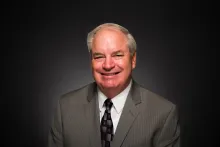
Robin Webber was born in Chicago, Illinois, in 1951, but has lived most of his life in California. He has been a part of the Church of God community since 1963. He attended Ambassador College in Pasadena from 1969-1973. He majored in theology and history.
Mr. Webber's interest remains in the study of history, socio-economics and literature. Over the years, he has offered his services to museums as a docent to share his enthusiasm and passions regarding these areas of expertise.
When time permits, he loves to go mountain biking on nearby ranch land and meet his wife as she hikes toward him.
