
Robin S Webber
This transcript was generated by AI and may contain errors. It is provided to assist those who may not be able to listen to the message.
I want to say thank you very, very much to the hymn choir for always bringing us to lightful and joyous music.
I have a question for you this afternoon, and it's a simple question. Do you know what the will of God is? Allow me to repeat it, because the question is short. The answer may be longer. Do you know what the will of God is? In speaking to this congregation, I do recognize that I may be addressing two different audiences. But I do trust that God is performing his work in you, whether you're in one audience and or the other. The first audience, some of you are just now beginning to spiritually awaken. Maybe because of physical age or simply life cycle and where you are in your journey with God. I also recognize that you may have some blank spots yet to be filled in in that journey and specific doors of understanding yet to go through as to what is the will of God. I hope to, in the course of this series, that I am beginning to open those doors for you and with you by what I'm going to share. Now I would like to address the second audience, and that is simply this for the remainder of you. The question isn't whether or not you know the will of God, but are you doing the will of God? Perhaps our growth is stymied? Perhaps it is stagnant? Why is that? For some of us, perhaps have been in the church for 30, 40, or even 50 years, that we have come up against a concrete wall. And we ask God, what is going on? Why is that? We know what the will of God is, but perhaps we're not performing it. And perhaps there's a reason behind that, and I'm not going to address that right now. But we've got to recognize that it is only those that not only know the will of God, but do the will of God, that the will of God will even ultimately become clearer in their lives.
To help guide and encourage both audiences that I'm directing this message to, I'm embarking on what I hope will be a spiritually enriching and life-changing series for each of us on the book of Ephesians. I don't know when the series is going to be over. Christ might have come back by then. Time will tell. But we are going to go through the book of Ephesians, every Sabbath, that I am here. As we approach this journey through Paul's writings, and it will be a journey that twists and winds and turns through Scripture, from chapter 1 through chapter 6, it is designed for one thing and one thing alone, that you will come to understand God's will. As I do, allow me to make myself plain and clear to every member of our congregation. The time that I will invest in sharing this message with you, and the time that you will invest by hearing and taking to heart what I'm saying, is not about simply the transmission of information. This is not designed to just simply be an almanac out of the Scripture. It is not even designed to simply inspire you, if but for a moment or a week or for a month. The purpose of this message, the purpose of this series, is to move from information to inspiration to transformation in your life, that you not only know what the will of God is, but you, as a child of God, are performing it. And what we're going to do by understanding that will is we're going to go through the Bible. Rather than reading into the Bible, we're going to read from out of the Bible and go through the book of Ephesians, from one verse to the end verse, and to understand what that will is as a member of what the Scripture calls the body of Christ. These are two words or two thoughts that need to go together. Please, if you want to take a note, the book of Ephesians and the body of Christ. Very important. Before I go any further, let's set the stage. Let's pause and consider and be refreshed as to the four-fold purpose of why God the Father in Heaven sent His Son, Jesus Christ, to this earth. It's going to be important that you take this down because, ultimately, the book of Ephesians is going to take all of this in, in one point or another, over the course of time that we're going to be spending together. But you need to know that, and you need to understand this. And then the first three points are ultimately going to lead to the fourth point. Number one, God the Father sent Jesus Christ to this earth to be our spiritual Savior and to reconcile us to Him. Jesus was sent to this earth to be our Savior. Point number two, in doing so, He came to destroy the works of the devil. He came to destroy the works of the devil. It began a Golgotha on the cross. And it will continue and move to conclusion as He moves from the Mount of Golgotha to the Mount of Olives at His second return to destroy the works of the devil. Point number three, He, speaking of Jesus, came to qualify, and I use that word very carefully, but that is what the Scripture defines as. He came to qualify as God in human flesh with all of its frailties, so that He might be our heavenly High Priest.
He was our Savior from the foundation of the world. That is known, and that's what Scripture tells us. But He came to this earth also to destroy the works of the devil. But in so doing, He also qualified, being the Son of Man and being in human flesh, to be a High Priest now in heaven, that can be tempered by what you and I are going through. He's been one of us, Emmanuel, God with us. But now that leads us to point number four, which will unveil the book of Ephesians. Jesus came to establish His church. Matthew 16, 18, our first Scripture. Join me if you would, please. Matthew 16 and verse 18, and let's notice Jesus' own self-disclosure in this regards. And I also say to you, this is Jesus speaking, and speaking to one of His disciples, You are Peter. You are that little rock. That's what Peter meant in one sense, little rock. And on this rock, speaking of Himself, I will build my church. And the gates of the grave shall not prevail against it. There is nothing that is going to stop what God the Father has sent me to this earth to perform and to establish. That one day I will hand back over to Him, and that is a bride prepared and adorned and ready to be invited into eternity. He says, I will build it. With that thought, and with those four major points now in all of our minds, a question. Where is that church today? Where is that church? The church that Jesus said that He was coming to build. A question for you, friends. What does it look like? Another question. What is it built with? Another question, of course. What is its function? Another question, and now it begins to be more telling. How would people distinguish it from other structures? If Christ is building something, it sounds like an edifice. If He's building, you normally build a building. So what does it look like compared to other edifices? There must be a distinguishing difference. After all, this is the Son of God that is doing it.
Now, when you think about it for a moment, friends, people meet in many places of worship. They meet in edifices that are made of brick, of wood, of glass. But is that what God is talking about? Is He talking about an edifice that is built with walls and that has a roof on top of it?
A lot of people make a habit of going to a church. They make a habit of going to a building. But that's not why the book of Ephesians is put into the Bible for us to understand and understand what the will of God is. Let's understand something. No, it's not a building as we consider a building like this 1925 structure that is made of brick, of adobe and tile on top. God has always focused on people. God is always focused on people. And in Scripture, they are called the ecclesia. That's a Greek word about people, called out ones, those that have been separated in that sense from others. Now, what does that do for you and me? Because I'm just beginning to give you filler material to move into the book of Ephesians. Thus, the church is not made of mortar or a post-it sign with a service time like we have out here at the intersection, saying church at 10 a.m. or church at 2 o'clock. The church is not made of timber. It's not got a floor made of cement. Let's understand something. The church that the book of Ephesians is going to address, the church that Jesus is building even to this day, is constructed with hearts and minds and flesh. And yes, a different spirit that transcends any man-made walls or any scheduled service time.
It transcends all of that. The building that Jesus was assigned by the Father to build is one that has no walls, has no barriers, as we might think of them. It's designed for a completely different purpose. With all of the state of this, the question then is, how and what is God building in the body of Christ? How and what is God building in the body of Christ? And the book of Ephesians answers that. Join me if you would in Ephesians 1. In Ephesians 1, in picking up the thought in verse 19.
Notice what it says. And what is the exceeding greatness of His power towards us? Who believe, according to the working of His mighty power? There is tremendous dynamism in a spiritual sense of that which is occurring behind this world of time and space that you and I live in. God is doing something. He's performing a work with power. Which He worked in Christ when He raised Him from the dead and seated Him at His right hand in the heavenly places.
Far above all principality and power and might and dominion and every name that is named not only in this age but also in that which is to come. Now notice verse 22. And He has put all things under His feet and gave them to be head over all things to the church, to the ecclesia, to this building of flesh and blood and heart and spirit which is His body, the fullness of Him who fills all in all.
God the Father has assigned Christ to fill all in all. It's very interesting that the Jewish mind, and that's the background that Paul came out of, did not look in that sense at just simply when he thought of societies or dominions or kingdoms. In the Jewish mind, it was not just simply what is seen.
The Jewish mind thought of realms and kingdoms and societies and civilizations both in heaven and down here on earth. And of course, the major one at that time being Rome. The Jewish mind of that day that Paul came out of had a much greater view than you and I do. And what God's Spirit is inspiring in the book of Ephesians is that basically God the Father has given Christ dominion over that which is in heaven and all that is spirit in heaven and that which is on earth. And that something is coming that we need to prepare for is the body of Christ.
Allow me to share with you two words. New society. A new society. And that is what is being built in the church. The ecclesia. The separated ones. A new society in his church. Referred to here as his body. Now let's pick that thought up and let's go to Ephesians 1 verse 19 to describe a little bit more.
Now therefore in verse 19, you are no longer strangers and foreigners but fellow citizens with the saints and members of the household of God. Sounds in a sense as we are speaking of a family structure. The household of God. Having been built on the foundation of the apostles and prophets, Jesus Christ himself being the chief cornerstone. In whom the whole building, being fitted together, grows into a holy temple in the Lord.
In whom you also, folks, that means you, that means me, as Paul was addressing, you also, now we're being brought along into this, are being built together for a dwelling place of God in the Spirit. Now when we bring these two sets of scriptures together, we come up with a full understanding of what God is building. Number one, he's building a new society. It's called his body. And out of Ephesians 1, 19-22, we come to understand, friends, that it is spiritual in nature. It is spiritual in nature. And one thing I want to share with you here, as we read the scripture, notice what it says here, that it is being fitted together.
That means it is still occurring. God's work is still in motion. Now the reason why I share this, for those of you that may be stagnating right now, or stymied, or feel like you're in the back alley, good news. God is still at work and is inviting us to be a part of that building, part of that structure, part of that new society, to be incorporated into that body, which is called spiritual. Notice what it says. Being fitted together grows. Not growing past, but grows.
God is, this is something that is alive. If you want to jot this down in your notes to begin to understand the enthusiasm behind the book of Ephesians, Paul sees something that is not spent, something that is dead, but something that is vibrant, and living, and growing. And it's a process. And it's going to take dips. It's going to take turns. It's going to take twists. But Jesus Christ said, I will build my church. And that church is also known as the body of Christ.
Let's consider something. Let's ask ourselves a question, friends, here in Los Angeles. If Jesus is, and I really want you to hear this, please, if Jesus is the head of this spiritual body, that's what the book of Ephesians says, Jesus is the head. Have you ever seen a head walking by itself? That's spooky.
No, we haven't. If you have, let me know. We'll talk after church, okay? If Jesus is the head of this spiritual body, then what is our role in this new society that God is developing? William Barkley, the Scottish commentator, puts it so well. Allow me to share this from Barkley. This then makes us the hands to do Christ's work, the feet to run His errands, and a mouth to speak on His behalf. That's why right now in adult Bible class, we're going through how to rightfully divide the word of truth. So when we use the words of the Bible, they give God glory rather than our own conclusions. Allow me to share that for a moment. What did William Barkley say? If Jesus is the head of this spiritual body, He says, this makes us the hands to do Christ's work, the feet to run His errands, and a mouth to speak on His behalf. Have you ever thought of yourself as such? Or do you feel like, well, I come to church, I park my car in this parking lot like I have the last 16 years, and I roll through the foyer, and I wave to the left, and I wave to the right, and then I come in and do my duty. I'm here for services, and I sing, and I pray, and then I go and fellowship at Wurtz Hall, and then I go home, and I have done what God has asked me to do. Brethren, I don't think we even begin to understand, other than through the Spirit in us, that you and I have been called as the spiritual body of Christ. If Jesus is that head that the Father has appointed, then we give our hands to God. We give our feet to His service. We give our heart for all that He would ask us to do, and all that He brings into our life. This is what we have been called to. This is what the New Society is about. This is what Mr. Schimmet addressed in his message, of a different world, than the world that you and I go around today, that we might bring all in all in Christ to the Father, and that one day, that those that we affect might have an opportunity to share eternity with God the Father and Jesus Christ in that greater society and eternity. Just a simple question again. And why I'm sharing this, friends, is I'm not here to just make time here with you to get this message through. We are going to be going through the Book of Ephesians for about a year. So get ready and put your seat belt on. Airbag is deployed. And this is the point. We are God's servant. We are a doulos. When you really understand what that word means, that means that we're God's slave. We are owned by God Almighty, purchased by the blood of Jesus Christ. Do you look at yourself that way? Do you just read that and pass over that? Or do we recognize that we are a slave unto righteousness, and that our past, our present, and our future belongs to God? And that in this moment of time, that you and I have been given the greatest blessing that can be visited upon earth to any human being, and that is to be called into his body right now. That's why it's so important that we go through the Book of Ephesians and revitalize and stir up those that are in the body of Christ to recognize the tremendous privilege and calling that we have.
Before we can fulfill God's desire and meet his expectations, before that, we do have to know what that will is. Have any of you ever been to a reading of the will? Well, we're about to have a reading of the will. You can know what the will of God is, and it is in the Book of Ephesians. Join me if you would in Ephesians 1 and verse 9. In Ephesians 1 and verse 9, it specifically tells us what the will of God is.
And just like any will, it's interesting that wills are a mystery until they are read or made known. And when we go to Ephesians 1 and verse 9, we notice this word mystery. And it is not a mystery that is devoid of an answer or there to trick us. That's not the sense of the Greek word mysterion. It is meant in the sense of an unveiling or a revealing in God's time and God's place that we can come to the fullness of what he has us to do.
And it says here in Ephesians 1 and verse 8, This is it, folks. This is the will. According to his good pleasure, which he purposed in himself. Now, let's understand something. Sometimes a will can be read grudgingly or in a way in a Spartan manner. Okay. We'll parcel it out. But two things that we understand about the will of God is that it gives him pleasure. There's a joy in it. And he purposed it in himself.
He could not purpose it any higher. Sometimes we go to an office and we sit down with a lawyer or a legal tech or a legal aide, and we have something notarized. Boom, boom. Now the will is good. Now the will will be noticed in a court or at a bank. God says he personally has notarized this. He purposed it in himself. He's put his stamp in it.
Here's the will. That in the dispensation of the fullness of the times, that he, speaking of the Father, speaking of himself, might gather together in one all things in Christ. Christ is going to be in the middle of all this, and this is what the Father desires. He is the hub of which all the spokes stem from and come back to, both which are in heaven and which are on earth, bringing this all together.
All that exists, all that exists, that which is heavenly and that which is angelic, and that which is fallen angel, and Satan's kingdom, that all of this is going to come underneath the feet of Jesus Christ. But those that will be reconciled with the Father in unity in Christ will be there. That is the will of God. When Paul wrote this, Paul most likely was in Rome at that time.
There is the old expression that all roads lead to where? Not cucamonga, but to Rome. There was a great pillar that was in the middle of ancient Rome, and it was from that pillar that all distance was marked in the empire, going out and coming back in. Perhaps it was there that Paul, at that time, and I want to give the secret away right now where he was, understood that Rome was the hub of the known world at that time, that all roads lead to Rome and go away from Rome.
This was a thought that was on his mind, perhaps, as he wrote this and then recognized that vision that God took him up in, that he came to see it, that the Father was going to bring all in all, reconcile to him, through this one that had met him on the road to Damascus, and said, Paul, what are you doing anyway? What are you doing? And his life changed.
His identity changed. He became a member of the body of Christ, and that identity was so fixed that there was a name change. He went from being called Saul, of whom he was, to Paul, of whom he now was, a citizen of the kingdom of God. Let's understand a little bit further here as we go down then to understand that we can know the will of God. With that thought, as we consider the body mentioned here in Ephesians, the household that is mentioned here in Ephesians, these concepts, we come to recognize a powerful scriptural reality that our walk before God isn't merely singular.
And I want to really get this point across to all of you today, because I think it's going to enrich society that God has called us into. God isn't merely calling us in a singular notion. The book of Ephesians, when it speaks of a household, let me reverse a moment. God says that, as he said, he's calling people the ecclesia, the separated ones. And please understand that you and I have an individual responsibility to work out our salvation with fear and trembling.
That's what the book of Philippians tells us. And we cannot, in that sense, get in on anybody else's coattails. You and I, I think, understand that or need to come to that understanding, that we do have a one-on-one relationship with God Almighty. But beyond that, the fascination that is Ephesians is that a household, a family, is being developed.
Thus, we come to understand something that I heard many, many, many years ago in the College of gymnasium as a young boy. God is not simply calling us for personal salvation. There's something in it beyond ourselves. And I want to share a verse with you to show you that. Join me, if you would, in Titus 2. Titus 2.
And let's pick up the thought in verse 13. Titus 2, verse 13. Looking for the blessed hope and glorious appearing of our great God and Savior, Jesus Christ. Now, notice verse 14. Who gave Himself for us, and indeed He did, that He might redeem us from every lawless deed and purify for Himself His own special people. Zealous for good works.
As we move through the book of Ephesians, brethren, we're going to come to understand a very profound point. It's not about us. It is about God. It is about Christ. But we have not simply been called for personal salvation. There is no privatization of the Gospel where we tuck it in our pocket and go along our way. It is about His church. It is about others. It is about His body. And that can only come by interaction with others.
And that's why the book of Ephesians addresses dealing with others that don't look like us, that don't come from our part of the world, that deal with the genders of man and of woman in marriage and how that is to work, of dealing with generations, older generations, with younger generations, employers dealing with employees, employees dealing with employers, that people are the direct object of God's Spirit in us, of conversion.
You cannot get converted just simply living with your Bible. It's a recipe. But have you ever tried to chomp on a recipe? How many of you ladies have in your kitchen a little box with little 3x5 cards that has grandmother's recipes that have been passed down? You ever tried to munch on one of those? Mmm! Mmm! Oh, man, that's really, really good. You can't live on recipes. Maybe you can. I can't.
You've got to put it into the oven. You've got to feel the heat. You've got to give it time. It'd be so much simpler if you'd say, oh, God, thank you. It's just you and me, Lord. That's not Christianity. You might want to jot this down in your notes and get used to it. The book of Ephesians gives us a cure for dealing with other people, recognizing that Christianity is a contact sport. It is a contact sport.
You huddle with God. You understand the play, the purpose, the power that he wants to work with in you. And then you've got to go out and face the people. That's why God gives us the book of Ephesians, to understand what it means to be members of the body of Christ and how to give Him glory by how we spend our time, by how we use our words, by how we deal with our spouses, by how we deal with our children, by how we deal with our husbands, by how we deal with our wives, by how we deal with people that don't look like us, or people that we wonder, well, what are they doing in church and when did God decide to call and choose them?
This is the book of Ephesians. This is why you and I are going to go through it. Thus, the gift of Ephesians is granted to us to understand the ingredients and the dimensions of this new society, the church, the body of Christ. To be transplanted and growing in us in two ways. I'd like to get this out. Two ways. This is what we're going to be centering on. Number one, a unity with God the Father that comes by abiding in Jesus Christ.
A unity with the Father above that comes by abiding in Jesus Christ. Number two, a unity with one another. In this, the body of Christ that transcends the ways of the world, that transcends, that is different, that is light that breaks into the darkness. That's what the body of Christ has been called to be. This epistle sets standards for building spiritual and moral clarity. I have been convicted as one who is a Christian and one who speaks to Christians and is a minister of Jesus Christ.
That I recognize that this society that you and I have been called to has been impacted by the world that is around us. Let's not fool around with it. Every citizen of the kingdom of God on this earth, down for the last two thousand years, has been affected by the society around them. Whether it be Greco-Roman, whether it be Muslim, or whether it be the culture that is now in the United States of America. How do I know that? Because I know that if all of you and I, that's bad English, if all of us went home and got into the bathtub, and you can go alone, thank you very much.
But if you got into the bathtub and you sat in that bathtub a while to soak, you know what's going to happen. You're going to get a little prunish. You're going to get some wrinkles. The water's going to begin to work on your outside and filter in. Just is! And Jesus Christ knew that when He said, Father, I don't want you to take them out of this world, but you keep them. That's why the book of Ephesians has been given to us to allow us to be kept in the world and still allow us to make a witness for Jesus Christ by having spiritual and moral clarity.
I have a question for you, friends. Can we talk? And that is simply this. Are you a person? Are you a man? Are you a woman of spiritual clarity? Now, don't raise your hand. This is not a Fox News poll or New York Times CBS poll.
Only you can answer that. We are not here to play games, folks. We are talking about eternal sweepstakes in your life. Are you a person? Are you a man and a woman that has spiritual and moral clarity? Or are you in a confused life where you have two feet on two shores and you keep on trying to occupy Wall Street? What shore are you trying to occupy? Or are you trying to occupy both? Are you trying to keep one foot planted in the world and one foot planted in the body of Christ? It doesn't work.
It just simply does not work. That's not why you have been called. You have not been called to have one foot in the heavenly Jerusalem and another foot in Babylon. It does not work. The book of Ephesians is going to give you and me the cure for that. This epistle sets standards for building spiritual and moral clarity. It describes a new society as aptly described by John Stott. A tremendous Christian writer, researcher, just died recently.
Allow me to share this with you. This new society that is going to be described in this book of Ephesians that you and I are going to go through this year is characterized by life. By life in place of death. By unity and reconciliation in place of division and alienation. My, my, look at our nation today. E Plurippus Unum? My, my. We have never been as divided as we are today, probably since the Civil War.
There's alienation. There's division. And people don't know how to get back together again. The book of Ephesians shows us how to do that. The Church of God as a whole. The Church of God as a whole. Fragment it. Divide it.
The book of Ephesians shows us the answer of what he's doing with a spiritual people. A spiritual people that will place unity over division, unity over alienation. The book of Ephesians gives us wholesome standards of righteousness in place of corruption, of wickedness.
Gives us love and peace in place of hatred and strife.
And the book of Ephesians, and we're going to get to it as we move into Ephesians 6. Unremitting conflict with evil. There is an adversary. There is a devil that is out there. And there's two things that he wants to do the body of Christ right now. May I share it with you? Number one, let's jot it down. He wants us to lose the revelation, the truth of God. He wants us to lose that truth.
But he doesn't even have to do that. Because he's more subtle. Number two, he wants us to lose heart.
And sometimes we do it to ourselves, don't we, friends?
We're going to go through that. We are going to stand side by side in Ephesians 6 with that Roman soldier. In what Jesus says, or excuse me, the Spirit says through Paul, he says, you hold fast. And having done everything to stand fast. We're going to go through Ephesians 1, Ephesians 2, Ephesians 3. We're going to be filled with the understanding of what the will of God is. And then we're going to activate that. Ask for God's Spirit to help us. Whether we're new to the faith, whether we're just coming into this, or whether we've been there for 30 or 40 years, we really want, well, what is our purpose? Is it just simply joining a church? Is it just simply to be a part of a biblical information bank? Is it just to be a womb-to-tomb society? Is it just where we do socials and we do activities so the kids will be happy? Or are we being called to something that is greater and bigger and more transcendent than anything that we've ever seen before? The book of Ephesians is going to answer that for us.
Many of us, at times, have called out like David, Psalm 51, verse 12. Psalm 51 and verse 12. I've often thought about this. Psalm 51 and verse 12. Here's David's classic psalm of repentance, where he says in verse 12, Restore to me the joy of your salvation and uphold me by your generous spirit. Then I will teach transgressors your ways and sinners shall be converted to you. You cannot teach what you do not know. And if you do not know what the will of God is, and if you are not performing that will of God in you, then God cannot increase the knowledge of his will for you to perform it more. Thus, all of us, let's all of us, as we begin to embark on this series, ask God in prayer, Restore to me the joy of my salvation. I know that my walk in this life has been a journey. I know that there's been low points. I know there have been points that have saddened me. I know that there are things that I have not understood. There are things that I would have done differently, God, but you allowed it for this purpose. Because sometimes you just have to leave things to God and understand that his will, his will, is awesome. And that at times things occur, not things that he would hope for, but things that we do. But even in that, I want to share something with you. And I don't know what you're going through in your life today. But I'm going to share with you a very cardinal point that I believe in. As one person of faith, to you there are people of faith. I believe nothing occurs that is apart from God's will. I didn't say it is God's will to begin with, but nothing occurs that remains apart from God's will. We bless these children today. We bless these children, these little babies, all over the place.
That will is that they have been made in God's image and after his likeness. And that at this point they only have the physical similitude. But God wants them to have the spiritual similitude, that spiritual likeness. But that's a process. And that's something that he wants for all of humanity. But you and I now are living that out in this new society, this body that's called the body of Christ. But we have to understand the will. We have to distance ourselves from the darkness. Walk in the light. I want to share one thought with you, then we'll conclude. It's way down in my notes, but I want to share something with you. Let's finish this with Ephesians 1 and verse 1. We're actually going to focus on this next time. But I want to go to Ephesians 1 and verse 1.
Paul, an apostle of Jesus Christ, by the will of God, to the saints who are in Ephesus, faithful in Christ. Grace to you and peace from God our Father and the Lord Jesus Christ. Notice what it says here, and we're going to expound on this in full next time. We may just, frankly, just tackle these two verses for the full sermon next time. There's enough in there. To the saints who are in Ephesus and faithful in Jesus Christ. Notice very carefully, he does not say to the Ephesian saints.
The body of Christ is not localized. But he says to those saints, and we're going to talk about what a saint is next time, to those saints in Ephesus. Yes, there are some in Ephesus and who are faithful in Christ Jesus. What does that mean? In Christ Jesus. Got my powerful word point thing up here. The body of Christ is a spiritual organism. And God knows who are His, who has the testimony of Jesus Christ, keeps the commandments, as it says in Revelation 14. But to recognize something that's very important, no matter where someone is in the body of Christ, Australia, Asia, Africa, Europe, South America, North America. Did I leave anybody out? Okay. Wherever they are, they are all hedged in. They are all hedged in. And spiritually, they are all in Christ Jesus. That's what we're going to build upon. What does that mean? God sees things differently than we do. Sometimes we may not know necessarily those that are in the body of Christ. We understand what the body of Christ represents, those that have the faith and the testimony of Jesus Christ, and keep the commandments, but we can't meet all of them at once, can we? We're in time and space, and we're human beings. But one thing that we need to understand in this mosaic, if I use another, a mosaic, it is not shattered. It is not shattered. The pieces are not all over the place. This is the concept I want to leave you with. You and I might sometimes think, well, you know, it just burst out, and it's all over the place. God does not deal with shattered tile, a shattered mosaic. The concept that begins with Ephesians 1.1 is simply this. What God the Father has destined is all of those that He has called into His body, this spiritual body, this household of faith, that Jesus was sent to this earth to build, are all in this hedge, surrounded and in Christ. I'm going to give you an assignment this week, until I see you two weeks. I'd like you to take an assignment, please. Always give somebody something to do. I would like all of you to please take down this assignment. I would like all of you. I see pens going down and papers coming out. I'm serious. I want you to read John 15, 1-8. When we pick up this Greetings next time, we're going to move right into the Bible, then, right into Ephesians. When you understand John 15, 1-8, you then understand what it means to be in Christ, and then how grace and peace proceed from our Father to us, so that then we can have spiritual and moral clarity, friends, to do the will of God.
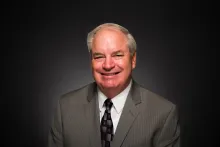
Robin Webber was born in Chicago, Illinois, in 1951, but has lived most of his life in California. He has been a part of the Church of God community since 1963. He attended Ambassador College in Pasadena from 1969-1973. He majored in theology and history.
Mr. Webber's interest remains in the study of history, socio-economics and literature. Over the years, he has offered his services to museums as a docent to share his enthusiasm and passions regarding these areas of expertise.
When time permits, he loves to go mountain biking on nearby ranch land and meet his wife as she hikes toward him.
