

Robin S Webber
This transcript was generated by AI and may contain errors. It is provided to assist those who may not be able to listen to the message.
Well, good morning once again. I want to bring you a message that, in looking back, I wish I had heard 40 years ago. But sometimes you have to enjoy the journey to get to a point of where God continues to work with your mind, and to understand the fullness of what He is calling us to, and the fullness of the responsibility that we have when Jesus Christ says, to follow Me. Two thousand years ago, Jesus made a definitive, bold statement regarding those that would follow Him down to our very day. As I state that, let's turn over to Matthew 16 and verse 18, which clearly defines who is in charge, to whom we report, what is the direct object of His attention, what would He do, and what is the goal line of success. And that's all just within two lines of verse. Speaking to Peter in Matthew 16 and verse 18, Jesus of Nazareth says this, And I also say to you that you are Peter, and on this rock I will build my church. And the gates of Hades, the gates of the grave, shall not prevail against it.
We're going to simply focus on that verse, and we're going to expand upon it today to what that brings to us spiritually as followers of Jesus Christ. As we explore this verse, there are a number of fascinating words, and I do underline fascinating words, that beg our attention, our consideration, especially when Jesus speaks in the first person when He says, I will build my church, which fills the rest of the message that I want to share with you today. And that is specifically, what is that I performing in our lives today? Which brings us to another question. It's always good to get the questions out of the way, and then we'll fill them in hopefully with answers right out of the Scriptures. And that is simply this. What is the church? What is the church? What kind of a structure is it? How would it be built? What would sustain the edifice that Jesus alludes to when He says, I will build my church?
Words at the end basically say what He is building and developing would be unstoppable, all within Matthew 16, verse 18. Which leads me to share with you the title of my message today. How does God build His church? This is a message that I'm giving throughout our circuit, wherever I go. So all four congregations are going to be receiving this message. Again, allow me to reiterate the title of my message. How does God build His church? And I do understand that several weeks ago we had Mr. Sharpe, our elder, speak to this in a sense. And whenever we have two different speakers come up, we will always hit different highlights along the way. So please allow me the permission to share some thoughts out of Scripture today. Where I would like to begin this discourse is by answering the question by visiting a planning meeting in a room in Jerusalem long ago, 2,000 years ago. And what is offered is a planning meeting like none other in human history. Join me, if you would, in Luke 22, verse 24. And this takes place on the night that Jesus Christ is going to be betrayed. And He brings together individuals that are going to help Him build this church. But He's laying down some ground rules that are utterly unique in how to build and how to work together. Again, allow me to set the stage and the timing. This is right before He's about to be betrayed that night. These gentlemen have been mentored for three and a half years, but they're not getting it. They're not understanding. Their minds and their hearts are still rooted in the soil of this world. And what they would get out of it being men and being human beings. In Luke 22 and verse 24, notice what it says.
Now there was also a dispute among them as to which of them would be considered the greatest. Imagine when we observe the New Testament Passover. Imagine if we come together as we come together and celebrate the deliverance of the night to be much observed. And a bro-hoo-hoo breaks out as to who's going to be in charge. Who's going to be the greatest? I mean, this, in a sense, humanly is embarrassing to even thinking that it's happening. It's just that you and I do it away from the Passover table or the night to be much observed, sometimes being human.
Lest we become too prideful in our own right. And there's a dispute. And he said to them, the kings of the Gentiles exercised lordship over them. And those who exercise authority over them are called benefactors and or friends of the people. But not so among you. On the contrary, we're going to reshuffle this deck. He who is greatest among you, let him be as the younger, and he who governs as he who serves.
For who is greater? He who sits at the table or he who serves? Is it not he who sits at the table, yet I am among you as the one who serves? This was just simply, in a sense, establishing the motto that he had already stated in Matthew 20 and verse 28. And that is simply this, just as the Son of Man came to serve and not be served. And he came and he gave his life as a ransom for many. He was offering a profound contrast as to what the team that he was calling to build and establish that church would be like. And what their personality and what their heart would be about.
That there would be a light in the midst of darkness so different that it would attract people to the Gospel of Jesus Christ and the Kingdom of God. Which then allows us to move to the next question. Exactly what was being built.
He says, I will build my church. Building a church. What does that mean? Is a church a building? Is it a corporate structure with organizational charts and treasuries and reserves? Is it an organization that has a tightly bound plan of succession as to who is in charge? Now, as I bring this message to you, all of you who know who I am also recognize that I do have responsibilities within an organization.
But at the same time, I ask you, and there is a rightful place for organization. And there is a rightful place for an instrument within the body of Christ. But again, I ask you to consider what is the church that Jesus Christ said that He would build. The word church is found in Matthew 16, 18. I will build my church. That church comes from the original language, which was in the Greek.
And the Greek is Ecclesia, Ecclesia with an E. And that means those that are called out. Jesus didn't simply mention this before He died. But again, allow me to come to Acts 2. Join me if you want to there. Acts 2, after His death. And as the church in that sense is being founded during that time of Pentecost and afterwards. Again, let's pick up one more thought of the word church.
And you'll find it throughout the New Testament. But in Acts 2, verse 47, it says, Praising God, that is the people of God, Praising God, having favor with all the people. And notice, And the Lord added to the church daily those who were being saved. I have a question for you. What was He adding? More cement, more glass, more tiles for a roof, more stained glass, more carpet. What did the building program consist of? What was He adding to the church? He was calling those that were called out. When I was younger, and there was a time for you teenagers when Mr. Weber was young, I was not born this way.
But I remember one of the first things I heard as I came within the Church of God community. And it's always stuck with me. You ever notice that the things that are most profound are those things that are simplest to remember? And that is simply this. The people of God don't go to church. They are the church. We are the living flesh, and blood, heart, and soul.
We are that living timber. Those lively stones that God uses to develop His church. Very interesting. It's dealing with people. It's not an earthly edifice. We need to understand that.
Now, let's understand the building process. Our Heavenly Father assigned to Jesus Christ. Again, God the Father is preeminent. God has reckoned to Jesus Christ the responsibility of building the church. And when you go back to Matthew 16, verse 18, if you ever want to do this, you might circle that eye. That's very big. I'm not saying circle your eye. I'm saying circle the letter I.
Because that is the foundation. He is the head. That is what the Father has established. That Christ is the head of the church. Everything stems from that foundation. But let's take a journey from A to Z for a moment. Maybe you're just beginning that journey. Maybe we're midway. Some of us are maybe in some of the latter chapters. But nonetheless, I think you'll recognize where you were on the journey. Let's start in John 6.44. Let's see how God builds His church.
In John 6.44, which actually backs up Acts 2, verse 47, where it says that God adds to the church. In John 6, verse 44, again, a verse that may be familiar to some of us, but some of you are here for the first time. So let's notice what it says here. It says, No one, Jesus speaking, can come to me unless the Father who sent me draws him, and I will raise him up the last day.
Now, sometimes when God says something once, you say, That's enough. But He also says it over here again in John 6.65. Some of you may not be familiar with this. And He said, Therefore I have said to you that no one can come to me unless it has been granted to Him by the Father. So we find it twice in the Gospel of John.
What does that tell you and what does that tell me? We come to understand that God the Father, preeminent over all creation in heaven and on earth, takes this prerogative upon Himself, holds it to Himself that He is the One that calls people to Jesus Christ. They're not working apart upstairs up in heaven.
They're working together. God the Father is the One that calls and then places people in, in Christ. Very important. Let's take this a step further because so often we just stop at John 6.44 and we don't understand the full outline.
Join me if you would for a moment over in Romans 8, which explains this calling process and what God is doing. Because the call is actually within the framework of God's purpose. In John 8, verse 28, let's take a look here. John 8.28 is a favorite verse of many of us, a verse of encouragement. But we're going to build upon it. And we know that all things work together for good to those who love God, to those who are called according to His purpose.
We say it's going to be all right. God's up there. No matter what I'm going through, at the end of the day, God wins. I win. And all of us, we hold on to this first. But let's move from that a little bit. The last word there is purpose. What is that purpose? For whom He foreknew. For whom He foreknew. God has a purpose. God has a plan. He does not do things fire-ready aim. He declared the end from the beginning.
And He said in the beginning, I will make man after my image and after my likeness. He also said, I'm going to call many, many, many sons to glory. So that's His purpose. And that's why humanity exists. It says that He also breathed destined to be conformed to the image of His Son. God has a purpose.
And it's met out in this thought of predestination. Not of vessels that ahead of time are called to destruction, but that He has a purpose of calling for fruits. He has a purpose of order in developing towards His Kingdom. And that those that He calls out in time are conformed to the image of Jesus Christ.
Verse 30, more for whom He predestined, who He has granted this opportunity, He has called. It's a calling. It's not whomsoever will, but it's whomsoever is called. Let's understand something. It's not about us. It's about God. And it's about Him. There's just something about human nature that always thinks that we own this process. It starts with God. It starts with His calling. It starts with His grace.
His light coming into our darkness. His divine will coming into our fleshly existence. He's called. In whom He called, He's justified. That justification comes through Jesus Christ. In whom He justified these, He has glorified that we might offer God praise in return. So we begin to understand that.
And God calls. God begins this process in us. And we might be familiar what it says in Romans 8 and verse 14. We're right there. Might as well turn over there. Romans 8 and verse 14. For as many as are led by the Spirit of God. For as many as are led by the Spirit of God. They are the sons of God. God's Spirit does not dominate. It's not domineering. It does not possess. God operates on choice. God has granted us free moral agency.
And the Spirit begins to guide. The flashlight comes on as it were in our heart and in our brain. That we're being called to something. And we begin to study God's Word as Mr. David Hall brought out. In the book of John 6 verse 68, I'm going to guide you through some Scriptures.
We're going to kind of go on a scriptural escalator to a point. John 6 and verse 68. And that point is ultimately going to be God's call and your personal responsibility. Your personal responsibility as a child of God. We notice in John 6 and verse 68. But Simon answered, Lord, to whom shall we go?
You have the words of eternal life. And also we have come to believe and know that you are the Christ, the Son of living God. When you look there at verse, if you would, verse 68, it says, you have the words of eternal life. Life! Life! We look at these hills around us right now. We look at these mountains right now. There's no water running down them. Lest I have to remind you. And yet sometimes you'll see a little line of green coming down the ravines, coming down the hills, coming down through the valleys.
Why is that little line of green coming down the mountains? Why is it green and everything else is brown?
Because there's water, and water brings forth life. And God's Word is like water. It brings life. It's not water from down here. It's not even arrowhead. It's from heaven. It's from God. It's from the Word.
And for the first time, we began to understand God's Word. Our need for a Savior, our need to surrender ourselves to that God and that Savior, we began to see things in Scripture. Remember that? 1963, 1973, 1993, 2003, and do I dare say 2014?
Where perhaps the lights were coming on for the first time.
Unfiltered. We saw it. The person next to you didn't see it. The family member didn't see it. Maybe even your spouse didn't see it. Maybe your parents... How many of us have taken a Bible over there and said, it's right here.
Thank you. I will read it to you. It's right here. And you sat down. Your parents or your children, your boss.
If nobody was around, you got the dog and the cat. It's right here.
Uh-huh. It was like waving a hand over somebody's eyes and no response. I have a question for you. What's that all about? Where does that come from? Well, that comes from God above. And what did we do? We began a never-ending process that goes into this day that we talk about with the fast that is coming up. Where we heard maybe for the first time, 1 Thessalonians 5 and verse 21. 1 Thessalonians 5 and verse 21. Prove all things. Hold fast that which is good. That's a two-fold responsibility.
Prove all things. Hold fast that which is good. And it began then. And we began to establish a choice out of that. And that choice was alluded to in Matthew 13 by our first speaker. Join me if you would there. Let's actually put our eyes on this incredible verse that you are a living and active part of. Where it says in Matthew 13 and verse 44, again, the kingdom of heaven, those are Matthew's words, is like treasure hidden in a field, which a man found in hidden. For joy over it goes and sells all that he has and buys that field. You basically just recognize it's like a magnet and you move towards it. You want a part of that.
Everything else moves less in importance to follow the way of God. And again, the kingdom of heaven is like a merchant seeking beautiful pearls, who when he had found one pearl of great price, went and sold all that he had and bought it.
We did what Abram did nearly 4,000 years ago. Understand, Laura, your grandparents are from Long Beach. We were probably in the same church when I was younger. Whether it was in Long Beach or whether it was in Fontana, whether it was in Garden Grove, whether it was in Tuscaloosa, Alabama, wherever we were, we began going down that road, the same road that Abram went down.
And we said that we will go, Father, wherever you lead us, wherever you guide us. And we don't know where this is all leading, but we're going to follow you no matter what it takes. What did God do then when we made that choice to turn our back? Join me if you would in 1 Corinthians 12, verse 27. In 1 Corinthians 12 and verse 27, and I'm trying to systematically guide us to some point here. In 1 Corinthians 12 and verse 27, notice what it says here. Paul's writings. Now, you are the body of Christ. Now, you are the body of Christ. And members, notice, individually. You might put it this way, thinking about it, that when God the Father called us in Christ, each and every one of us, as men and women, were individually wrapped. When you went down into the baptismal pool, you didn't have a surrogate. You didn't have a surrogate, and you say, I want you to go down and be baptized for me. You had to take those steps upon choice, desire. You had to take those steps. You went down into that watery grave of and by yourself. Let's understand. Let's put the verse together and get some connection. We are individually called, not into a church or an organization of this world. That's why when an individual is baptized, and we baptize them, how do we baptize you?
Every individual that has ever been baptized in the church of God community is baptized in this manner. I therefore baptize you not into any church, sect, creed, and or denomination of this world. You're nodding. Notting so far up here.
But I baptize you. We say in the name of the Father, or in the name of Jesus Christ. Matthew can look at the book of Acts. But we don't baptize. You're not baptized as a united church of God Christian. You are baptized and connected with God, the Father who called you, and Jesus Christ who lived and died for us. That is very important. So we are baptized individually. Here's what I want to share with you. Each and every one of us have an individual responsibility. Individual responsibility to none other than God the Father and to Jesus Christ. As they guide and lead and reveal their truths to us. But we don't stay lone rangers. And it's right there in 1 Corinthians 12. It also says we are members individually, but notice what it says. Now then you are also members of the body of Christ. He places us into a body. Notice what it says up here in verse 14. For in fact the body is not one member. You can't say, I'm the body. Unless you look like Hercules. I'm the body. No. That's not what it's saying. Verse 18. But now God has set the members, each one of them, in the body. So now we have to understand what that body is. Join me if you would in Ephesians 2.
In Ephesians 2. In Ephesians 2, and notice what it says in verse 19. Speaking of this body, and that's what the overall sense of the book of Ephesians is about, the body of Christ. Now therefore you are no longer strangers and foreigners, but fellow citizens with the saints and members of the household of God, and having been built on the foundation of the apostles and prophets, Jesus Christ himself being the chief cornerstone, in whom the building, being fitted together, grows into a holy temple in the Lord, in whom you also are being built...
Oh, there is a building program. Remember? There's a building program going, I will build my church. In whom also you are being built together for a dwelling place in the Spirit. Now let's understand something. I'll try to make it very simple. And that is this. God has a special creation, and it is a new creation. It is called the body of Christ. Let's understand creations, may we? Number one, there was an initial creation that was made out of dust, made out of the clay of Eden. That was the first Adam. But God, in His grace, also sent the second Adam, a greater Adam, a life-giving Spirit.
And from that comes this spiritual body. It's a spiritual body. It's not made out of dust. It's made out of the Spirit. And when you look at Ephesians 19, it tells us a couple of things. Again, verse 19, let's notice, it says, You are no longer strangers and foreigners.
What God is telling us is that He sees things as if they already are. We are not carrying a green card. We are not illegal. We are not carrying a green card. We are not carrying a passport. God says in the book of Philippians, Our citizenship is in heaven. He sees things as if they already are. We are the ones that distance ourselves. So He is offering a citizenship.
Notice number 2. He says also that you are members of the household of God. Very important. So we are citizens of that kingdom. Number 2, we are brought into, as we are called over here individually, and God is our Father, and Christ is our Savior and older brother, they then place this individuality into this spiritual organism, this spiritual creation. And He gives us familyhood. Not only that, but then it shows us the building program. It says here that you are being built as the temple of God.
God is designing a spiritual temple with people that already are singing His praises, living His ways, experiencing His love, keeping His commandments to prepare for that which is in the future. It's an incredible calling. The question that we have to ask is, is this spiritual body tangible? Are you going to be able to reach out? And are you always going to be able to see it?
Is it always going to be near? Are you always going to be able to smell it? Are you going to be able to touch it? Do we all know who is in the body of Christ? Join me, if you would, for a verse that's very interesting, spoken out of the words of Jesus Himself. Join me, if you would, in John 10 and verse 16, speaking to the followers then in John 10 and verse 16.
It says, And other sheep I have, which are not of this fold, for them also I must bring, and they will hear my voice, and there will be one flock, and there will be one shepherd. Our confidence is not in what we see, hear, feel, touch.
Our confidence is in the shepherd. Our confidence is in Christ, the one that the Father has placed in charge. Very interesting. Think about that. And our conformity is not to one another. Our conformity ultimately is to Jesus Christ, the shepherd. It is in that conformity, then, that then we can be of benefit to the rest of the body. For if Jesus is the head of the church, we that are called into the body, then become His arms to reach out, His tongues to do His speaking one to another, and His feet to do His errands. But what tangible fruits can be determined?
What can we sense from those that truly are members of the body of Christ? Join me, if you would, in Revelation 14. Scripture defines this. God defines exactly what we need to be looking at here. Revelation 14, verse 12. Speaking of then, remembering that the book of Revelation was written in the first century, and it's dual, it's for then, and it's also for now, and it's going to be for the future. But the qualities of this body never change. Notice what it says. Here is the patience of the saints. Saints from haggis, from holy, those that are set apart, those that are sanctified.
Saints, those that God has called and responded to that call. We built that point to this point. Here are those who notice, keep the commandments of God. They take God at His word. They take God at His word. They know that in this human tent, no amount of commandment-keeping of and by itself saves us. But to recognize, because we have surrendered our lives to God, because we've experienced His grace, because we've turned over the sovereignty of our life to Him, we say we will take you at your word, Father.
We will take you at your word, Christ. And we will respond in faith, knowing that what you have is for our best. And we surrender our laws, our ways, our thoughts, how we think things ought to be. And we will be conformed to the Spirit of Christ, your Holy Spirit within us. Notice also what it says here, verse 12. And have the faith of Christ. If you're daring with your pencil or pen, you might want a circle of. Very interesting. It doesn't say just simply to have faith in Christ, which is paramount.
But God is not just simply asking us to believe in Christ, but to believe that the Father has given us that same faith of Christ in us. The faith that motivated Him. That energy, that power, that love, that assurance, that Spirit of kindness. And yet also that Spirit of boldness would need it. The faith of Christ. Very important to understand. Because if we don't understand that, then we limit ourselves to what God is performing in us. Now all this comes about. Now it's very interesting. Ready to hear something interesting? God gives us choices. He asks us to use His Spirit to determine where His Spirit is nesting.
Join me if you wouldn't, 1 John. Because we recognize in a sense that God calls us individually. Yes, indeed. But then He asks us to become a part of the body of Christ, which in that sense is a spiritual organism. But yes, indeed, He does call us to assembly. Leviticus 23, verse 1. My Moads, my convocations, you shall gather together. It also says in the book of Hebrews, don't forsake the assembling of yourselves together. That can have a couple of meanings, but certainly I think we could bring in Sabbath- attending church, as we commonly know it, on the Sabbath day.
Who do we come amongst? Because God has a lot to say about company, doesn't He, in the Bible. He says, make sure who your friends are, and make sure that the company of what you're keeping, because bad manners corrupt us, if we're not careful. Let's take a look at this for a moment. Join me if you would in 1 John 4, verse 1. God calls, He asks us to prove all things, He asks us to think, and He asks us to read His Word to recognize that we have personal responsibilities.
Let's take a look at this in what I say. 1 John 4, verse 1. Beloved, do not believe in every spirit. Notice what it says, but test the spirits. Whether they are of God, because it says many false prophets have gone out into the world. So God says, when you assemble together, use my spirit, use my heart, use what I have shared as to what the body of Christ is.
Not what it says it is, but what it is. And understand that, and look at that. What would the body of Christ look like when it assembles? I'm thoughtful of John 4, verse 23-24, where it says, there is going to come a time when my people will neither worship on this mountain or that mountain, but will worship God in spirit and in truth.
It's not only what you know, but what is the motivation for why you are doing what you are doing? You can say something, but is it underlined with love, concern for others? Jesus said in John 13, verse 35, when He said that, by this will all men know that you truly are my disciples if you do have love, one for another. And that's what we need to think about. Not only what is in black and white, but what is the motivation? What is the spirit? What is the spirit?
That's so very important today. When we look at what is out and about us, to realize that God tells us individually to test the spirits. Often times, as a minister nearly 40 years, I've had people in counseling or talks tell me, well, the church. Have you ever heard that phrase, the church? Am I the only one that has ever heard that phrase? Well, the church. The church did this to me. The church made me do this. Well, the church told me this. You have been called individually. You have also been placed into the spiritual body of Christ. God has given you a responsibility always to prove all things, hold fast that which is good.
To recognize these demonstrable attributes of where God's Spirit resides is that there is spirit, there is truth, there is love, and absolutely also a full telling of the ways of God in every point of Scripture. That's very important to understand, and we need to understand that. I want to go to another point which I think is interesting for sake of time, and it's very important to look at this and to share this thought with you, biblically speaking.
And that is that at times we talk about God the Father, we talk about Jesus Christ, and then we talk about, there's that famous word again, the two words, the Church. Let's talk about that for just a second. I'm going to poll here for a moment. This is a sample poll, not Gallup. How many of you have ever heard of the phrase, the Church is our Mother? Let's talk about that. I have a question for you. Is that biblical? I want you to think about it for a moment.
Is that biblical? Here's what I want to share with you, because then this comes down to allowing you to have personal responsibility. Let's understand that we know that God speaks loud and clear of our Father that is in heaven. Are we all agreed on that? Are we also agreed that God says that this is my beloved Son, in whom I am well pleased, and he's made the head of the Church?
A little sample polling. I think we can all agree on that. Do we also realize that God has given us the gift of his Holy Spirit, as he said in John 14? God's Spirit being the essence of what he and Jesus Christ are. Can we all agree on that? If you don't, we'll talk to you after church. Okay, just a second.
Now, let's go down to this concept, because it's very important. The reason why I bring it up is to recognize that at times people have stayed encapsulated in unhealthy church societies, or have moved away from the gospel truth of God, of Jesus Christ, and the kingdom of God, and his ways because of this concept of thinking of the church being their mother. Let's talk about this for a moment. The Scriptures do not reveal an earthly mother figure. The aspect of Alma Mater. Do any of you have Alma Mater's that you went to school?
What does Alma Mater mean? Help me. Latin. My mother. Alma Mater simply means my mother. It's an extra-biblical concept. I want to share a thought where it has sprung from in some people's minds. This is kind of like a Bible study. Isn't this fun? Let's go to Galatians 4, verse 26. But your spiritual well-being could be dependent upon this.
Galatians 4, verse 26. Let's take a look at this. Paul is speaking about the covenants. Notice what it says. But the Jerusalem above... So he's using a metaphor. He's using an analogy. But the Jerusalem above is free, which is the mother of us all. Now let's understand what he's clearly stating here. That while things are down here below, he says that it is the Jerusalem, that heavenly Jerusalem, the throne of God, the life of God, life inherent in He and in Jesus Christ, that nourishment, that life-giving Spirit is that which comes from above.
That nurturing, that ultimately we need that guidance of the Spirit. And we can go through John 14, John 16 to show how the Spirit convicts us of sin. It convicts us of righteousness. It teaches us all things. And it keeps us in the way. So we need to understand that. At times what has happened is that people have done a quick slide into referring to that which is above. The mother, notice what it says, of us all, all those that are in the body of Christ pointing to up, we've done an escalator down to men.
Let's talk about this for a second. And let's understand that. The only mention, the only mention of another mother church is found twice. Join me in Revelation 17, verse 5. In Revelation 17 and verse 5. And on her forehead a name was written, Mystery, Babylon the Great, notice, The mother, this is a jaw-dropper, The mother of harlots and of the abomination of the earth.
That's talking about a different church. That's talking about a different religious society that has domination over the souls of men. I don't think we want to be a part of that mother. There's also another mother mentioned, and that's found over in Revelation 12. In Revelation 12, Let's take a look here for a moment. In Revelation 12, where it speaks in verse 1 now, A great sign appeared in heaven, A woman clothed with the sun, with the moon under her feet.
Now again, this is apocalyptic literature, figurative. And on her head a garland of twelve stars, Then being with child, who? This woman, there is a connotation of mother, but it just says, woman. Then being with child, she cried out in labor and in pain to give birth. And so you find this connection of a woman conjoined with the Christ child.
But here's the point I want to share with you. Christ did not come from the church. He is the head of the church. This is denoting that there would be a linkage, A linkage between this child in mature form, son of God, connected with this church that was truly following Him. Now, the reason why I bring this out is very important. I'd like to share a few thoughts with you, Of where this concept came of the church being our mother. As I said, it's an extra-biblical. Well, you see, so what's wrong with that?
It's all right, as long as it keeps us strong in the faith, And allows us to continue to prove all things and hold fast that which is good. And to recognize that we have nothing between us and God the Father and Jesus Christ. Notice what it says. I'd like to share a few thoughts with you here from. This is a quote from a new history of early Christianity by Charles Freeman. It's in a chapter called New Beginnings.
And the quote actually comes from a gentleman named Cyprian. Cyprian followed to Tertullian, and he said, Well, that sounds all Greek to me. We're talking about 180 to about 250 AD. These were what we historically call, analytically call, early church fathers in North Africa, basically around Hippo and around Carthage. And this is what Cyprian stated from his Edict De Unatape, meaning Unite, on the unity of the church. Now listen to this, please.
You might find this interesting. He no longer can have God for his father, who has not the church for his mother. Freeman, historian, not theologian, and analytically in church, there is no salvation outside the church. He then continues to quote Cyprian, Whoever breaks with the church cuts himself off from the promises made to the church. And he who turns his back on the church of Christ will not come to the rewards of Christ. He is alien, he is a worldling, and he is an enemy.
What does this mean to us? Early as 200 to 250 AD, through the austerity of Tertullian and Cyprian in the bishops at Rome, there was an absorption of Roman culture to dominate, control, and ultimately to control salvation up and down through one entity. Those that consider themselves the true church at that time, emanating from Rome. The mother, the alma mater. And as we find that within Augustine's city of God, written in the early 400 AD, as one city was subsiding, being that earthly Rome, that God was raising up another city.
No longer expecting that it was going to come, but now on earth in the form of an imperial church. Very interesting. Let's understand something here. This goes further to 1215, about a thousand years later. The fourth lantern council declared in its fifth canon that the Roman church, by the will of God, holds over all others preeminence of ordinary power as the mother and the mistress of the faithful. Interesting quotes, aren't they? Does that mean that we do not have a nurturer? Does that mean that as the people of God, we don't have one who cares? Yes, we do. God cares. Our Father cares. Christ cares. And they are able to nurture us. I want to show you a couple of things. Say, well, now we don't have anybody to nurture us. Yes, we do. Absolutely. Join me if you would for a moment. We're going to just go a few minutes here, and then we'll conclude the message. Let's go to Psalm 17, verse 8. God is more than capable of nurturing us. Psalm 17 and verse 8.
Keep me as the apple of your eye. Notice what it says. And hide me under the shadow of your wings. I've raised chickens. So is Susan. And you see a mother hen how, you know, just from the egg level, you take a hen off those eggs.
That's my chicken. You thought I was just a robin. I'll give you that one another day. And, you know, that's my PowerPoint. And what happened? That chicken, you know, she's going to put all those eggs underneath. And you think she's concerned about the eggs and the little chicks hatch?
Wow! And those wings just go over and love as much as a chicken can love. And nurturing and caring. God says, you're under the shadow of my wings. Remember Jesus' words in the book of Luke 13? I'm not going to turn there for the sake of time. It says, oh Jerusalem, Jerusalem, how oft I would have wanted to have taken you under my wings.
The reason why I'm stating this is for you to recognize that you do have been baptized.
That you gave your life to none other than God the Father and to Jesus Christ. Yes, indeed, He puts you into this spiritual body called the Body of Christ. And yes, we have this choice and this opportunity is where we roost, to continue with the chicken term. Where do we roost? Where is God's Word being spoken in full? Where are we growing not only in knowledge but the understanding of God's grace? Where are we not only growing in what to do but how to do it? And with what motivation and what attitude to do it? Where are we learning to be loud where God is loud with Scripture and quiet where God is quiet with Scripture? That allows us then to muse in between. Where are we learning to be conservative with God's law but liberal with His love? How do you get that balance? You only gain that balance by the Spirit of God to recognize that God's law is always in place. But to recognize that we learn how Jesus Christ used it week by week in our own studies and when we come to church and when we hear from men that get up here and are able to offer us that sweet reasonableness. That sweet reasonableness that lies just a hint beyond the letter of the law that allows us to understand the heart and the mind of Jesus Christ as how He dealt with the people in His life.
That is where you want to roost.
We all need to understand that first and foremost we are individually called. Number two, then, we are placed by God into this magnificent spiritual creation. New! A new creation. Then He gives us a choice, our choice, of where we place ourselves to where we can be nurtured and hear the Word of God effectively.
And be around His servants. Am I saying in any way that somehow there is a priesthood of universal believers? Absolutely not! Because I do want to show you one verse as we begin to conclude. Let's go to that verse. Join me if you would and let's go to 2 Corinthians 1, 24. 2 Corinthians 1, verse 24.
God is building a building.
And any time you are building a building, you need to have supervisors.
Absolutely! And we notice what it says here in 2 Corinthians 1, but it's from a different regard. Notice what it says? In 2 Corinthians, you are already there. You are quick today.
I'm still thinking about those chickens in the roost. Here we go. Notice what it says. Paul speaking as a minister. Now, not that we have dominion over your faith. Did you hear those words I just mentioned out of history? And how people that thought that they were doing God a favor in the past took away the controls from people and created a roadblock towards the salvation that God had granted them. Not that we have dominion, which is interesting. It's a Latin word based upon what we said, over your faith, over your ability to connect and to be responsible towards our heavenly Apostle.
I remember some years ago, now nearly 18 years, as I moved from one church organization to another. And that church organization had certain functions within it. One was an Apostle. And I thought, I'm leaving a church that has an Apostle. That was the title that was given, a spiritual designation. And I thought, oh, woe is me!
I've always lived in a church that has an Apostle. I said, I'm going to become Apostle-less. All alone am I. Susan, I've been listening to that recently.
And then I remember what it says in Hebrews 3 and verse 1.
Consider your heavenly Apostle, Jesus Christ.
The one that died for us, the one that lives for us, the one that gave us the example that is the visible example of Him who is invisible, His Father. That is who you owe your allegiance to. That is the foundation of the church. That is the gospel that we need to be hearing of not only of the Kingdom, but of all the things that Jesus Christ did. Acts 28, verse 31. That they went about, Paul, in those years at the end, went about preaching the gospel of the Kingdom and all that Jesus Christ had taught.
That's why it's important when you look at the mission statement of the United Church of God. We preach the gospel of Jesus Christ.
Not just a message from Jesus Christ, but a message of Jesus Christ. He is good news. He is the foundation and the Kingdom of God.
The Kingdom of God is not just simply a destination. It is a way of traveling in this lifetime to that promise that God has given us.
I have about three more pages of notes.
A lot more I'd like to share with you. We'll do it another time.
In all of this, brethren, I recognize today some of the challenges that are facing different people, different places, people that we have loved, people that we know that are still coming to the realization of what I've shared with you today.
Not to put your trust and your confidence in men alone.
Oh, please understand, I do hope you know that Susan and I love you, and we know that the bars and the sharps they love and serve and work with you. And we would want that respect. Hopefully we have gained that respect, not just simply because of who we are, but as family in Christ of what we are.
But to recognize that sometimes covenant people, both in the Old Testament and the New Testament, forget that not everything that glitters is gold.
And sometimes they want something that they can get a hold of, like a golden calf.
A golden calf.
Something they can touch, something that they can feel. And even when there was a golden calf, you know what they were doing? It was a feast. If you go back in the Scripture, it says, let's have a feast under the eternal, but they used a calf. They used the idol.
They mentioned God's name, and then they did that, which is not biblical.
And sometimes there are people that will say Christ, or they'll say God, or they'll say kingdom, or they'll say this, or who I have known.
There's only one person to know.
And it's only him that lives forever.
Jesus Christ and his Father.
I've known a lot of men. I've worked for a lot of men.
I've had a lot of experiences in my church life. Most of you know that.
I could write a book, but I'm not going to.
Because the best book is in front of me.
And it's not where I have been, but it's the destination that I'm headed towards.
And to recognize that beyond that, beyond that, it's not by what I have done, but it's by what God has done.
And we're in this period of, we are not yet what we shall be.
We are in a historical continuum within the Church of God.
And we have to have the proper GPS.
That we focus on the Father.
We focus on His beloved Son.
We take responsibility.
We take responsibility for our own lives. Have you ever been with somebody that blames everybody else other than themselves?
Am I the only one?
When I've seen only just mirrors around me.
Your responsibility.
God called you.
You accepted it.
I remember there was a time, I've got to share one more story here. I remember there was a time, and again with Laura on the front row, and just met Laura.
Remember your name, because our oldest daughter is Laura.
And her grandparents were the Lancaster's, and we probably rubbed shoulders.
I was probably a young little whipper snapper of about 11 at the time.
But I remember that old Long Beach Church on the east side of Long Beach.
I learned that phrase, prove all things.
Hold fast that which is good.
Dear brethren, what has happened over the years?
Why are there those that are no longer with us, that were once with us?
Did they stop proving?
Did they stop holding?
Did they stop growing?
The things that in our fast that we're going to be exploring that's coming up, and what Mr. Cupid is asking for us is not necessarily to go wider. You know, truth is truth. You know, there's no such thing as new truth, because this is the truth.
Unless you go get another Bible, I'm not sure what new truth is.
The truth is here. Are you with me?
Truth!
So we're not necessarily going wider. I can't go any wider. I can't go wider.
God asked us to go deeper. Deeper into understanding the mystery that He has revealed to us.
And nobody else has that. I have a responsibility. Larry has a responsibility. Others have a responsibility. It's how we mold that and love and, you know, share the Word, etc. But you have that responsibility. It's your journey.
It's your journey. It's your time.
It's your place. It's your place.
Don't put your trust in the sons of men.
Put your confidence in Jerusalem, which is above and is free.
And put your trust in the head of the church, the head of this body, called Jesus Christ.
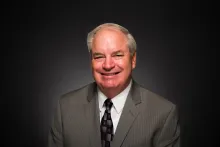
Robin Webber was born in Chicago, Illinois, in 1951, but has lived most of his life in California. He has been a part of the Church of God community since 1963. He attended Ambassador College in Pasadena from 1969-1973. He majored in theology and history.
Mr. Webber's interest remains in the study of history, socio-economics and literature. Over the years, he has offered his services to museums as a docent to share his enthusiasm and passions regarding these areas of expertise.
When time permits, he loves to go mountain biking on nearby ranch land and meet his wife as she hikes toward him.
