

Robin S Webber
This transcript was generated by AI and may contain errors. It is provided to assist those who may not be able to listen to the message.
I'd like to say thank you very much to the choir. Oh, he's certainly a very beautiful anthem for the Thanksgiving season. Appreciate that.
I just need to kind of take a good look at all of you before I start. It's been a while. See if I still recognize all of you.
So far, so good. Allow me to begin my tenure as your pastor with words of praise, words of blessing, and words that define those that solely belong to God and give their allegiance to Jesus Christ. Join me, if you would. Let's open up our Bibles on this Sabbath day and turn to Psalm 133.
And allow me to read it to you. Behold how good and how pleasant it is for brethren to dwell together in unity. It is like the precious oil upon the head running down on the beard, the beard of Aaron, running down on the edges of his garments. It is like the dew of Herman descending upon the mountains of Zion. For there, the Lord commanding the blessing, life forevermore. These are words that I grew up hearing in this very area across the Arroyo from the time I was a young teenager to my college years, through my early adult years, again and again. The echo of Psalm 133, 1-3, would be spoken from the stage. That Psalm instilled a vision in me, as it did you. It instilled an expectation as to what the members of the spiritual body of Christ might appear as to the world around us and to one another. I want to share it with you today. As you will see each time that I write to you, whether it be weekly or biweekly, you'll notice on the updates and reminders that I send to you. They always find that Scripture right at the top. I've always felt that things should be put right at the top of people's lives, to give them a goal, to give them something to shoot for beyond that which is ordinary and around, and to recognize what the goal is. That we've been called as members of the body of Christ, to be united before God, for God, for Him, for one another, for this world. It's important to me. I think it's important to God, first and foremost. I hope it's important to you. I pray that it is important to you because I think Psalm 133 is really, in a sense, an Old Testament preamble to another thought that I'd like to share with you for a few moments. Join me, if you would, as we turn our Bibles to John 17. Let's capture the time. Let's capture the moment. It is the last night of our Savior's physical life on this earth. He is surrounded by His disciples, and He's praying to His Father and our Father above. These are some of the last recorded, captured words that He spoke. As we turn to John 17, it's fascinating because He moves from the audience that is in that room called the Loft, and now He's looking down through the ages. He's speaking to you and to me also. John 17, verse 20, I do not pray for these alone, but also for those who will believe in Me through their word. That's you. That's Me. That they may all be one, as you, Father, are in Me, and I in you. And that they also may be one in us. That the world may believe that you sent Me. Fascinating that the product, the proof that the Father sent Jesus is by the oneness and unity that we in the body of Christ. We and the here in the United Church of God Los Angeles possess the unity of the Spirit, His testimony, that God is involved on this earth. That we might be one. When you use that phrase that they might be one, it doesn't mean that everybody have blonde hair. It doesn't mean everybody have brown hair. It doesn't mean everybody have no hair. I'm getting there. Some things have changed over the last six years. Not always according to what I would like.
It doesn't mean that we're yellow pencils. It doesn't mean that we're non-entities. Or just all the same personality. But it does mean that we are, indeed, united in spirit. But reading such high-phrase eology and poetic verse and lofty expectations regarding unity and its blessings does not come simply with wishful thinking. And or a trial-free life. Interesting that this pales the Bible class that we had this afternoon on the book of James when it says, Count it all joy when you fall and you're deep in the trials of this life. No, no, no. The unity that I speak to you about today and that the Bible speaks to us about today is forged and it's molded. And it's crafted by our master's hands in lives of very real people with very real challenges in a very real world. Really an age that is apart and set against and in confrontation to God. That is where God says where it is darkest, that our light of unity is to shine. And it can be done by His grace. And that is what it is about. This unity that is forged and molded and crafted through the challenges that you and I face, friends, I remind you on this Sabbath day is to move us from human dust to the eternity that God has prepared for us. Eternity. Unity. Today. You and me. That's why we're here. That's what we're here to talk about. We're not here to talk about ourselves, my trips, what I'm doing. We're here to talk about the grand purpose of God Almighty through Jesus Christ. We're here to talk about a future that none of us deserve of and by ourselves. And yet by God's grace, by His forbearance, by His forethought, by His divine purpose has been sore for us. When we speak of that, and that is what the goal is, how do we move forward together as a new pastor and a congregation? As brothers and sisters in Christ. As one family called the United Church of God, Los Angeles. As one page turns and another page opens up. As one positive chapter with another pastor ends and another pastor comes along. The basic question is simply this, where do we go from here? Thankfully, we have some things that never change. And it is that to which I would speak to you on this Sabbath day. I'd like to couple another verse with Psalm 133, verse 1. It's a song that we often sing, but it is to that which I would speak to you today. Join me if you would in Psalms 127. Psalm 127. Let's pick up the thought. Front and center, loud and clear in Psalm 127, verse 1.
It tells you on this, the Sabbath day, and it tells me. And reminds me as a pastor. It reminds us as the family of Christ in the Los Angeles congregation. Unless the Lord builds the house, they labor in vain. Who built it? If the Lord does not build the house, if he is not front and center, all is for naught. All is for nothing. All will come down around us.
That scripture begs some inquiry and some questions that I want to share with you. You might want to jot them down because we're going to answer them through the rest of the second message today. Here are some questions to consider. Who is your Lord? Who is our Lord? Who is the literal head of our congregation? What house is he talking about? How is it being built? And how can you and I as fellow laborers glorify God in what we build together in our respective roles that are ultimately one before Him? And the last question I have for you, you might want to jot this down because it's going to be the most important. Simply this. And will you start afresh and help me with that task? Because I certainly can not do it alone, friends, with the assignment that is before me. Pastoring from the Mexican border, to Barstow, and to Malibu. I kind of like the Malibu part, but there's a lot in between, isn't there? And when I was asked to become pastor, I said, I'm going to do it, but I'm going to do it the way I've been doing it for some years now. Because it's not going to be about me. It's all going to be about God the Father and Jesus Christ. And I can pastor a congregation, but I can't dominate a congregation. I can lead a congregation, but I can't force a congregation. And simply where I am right now, I can't be all things to all people. I can't be everywhere at once. You already know that. I'm just reminding myself as we begin this new phase. But maybe this is what we should have been doing all along. Because all of you, we keep on talking about preparing a people and preaching the gospel. Preparing a people and preaching a gospel. Has anybody heard that, or am I the only one? Well, when are you going to get prepared? A lot of you have been followers of Jesus Christ for 40 or 50 years now. So when do you get out of the starting blocks? To be involved in the activity and the dynamism of what God is accomplishing here in Southern California. I can't do it alone. I don't think any of us were ever intended to. And thus, I share this message with you. It reminds us Psalm 127.12, Unless the Lord shall build the house, it is vain. Thus, that is the title of today's message. Unless the Lord builds the house. Let's first deal with God building a house. And bring in some scriptural considerations. Join me if you would in 1 Peter 4. 1 Peter 4. Let's pick up the thought. If you'll come with me, please. 1 Peter, there at the end of the New Testament. 1 Peter 4. Let's pick up the thought in verse 17.
Notice the phraseology, the words that are used here. 1 Peter 4. Let's pick up the phraseology, the words that are used here. 1 Peter 4. Let's pick up the phraseology, the words that are used here.
For the time has come for judgment to begin at the house of God. And it begins with us first. What will be the end of those who do not obey the gospel of God? My reference point here right now is not to discuss the whole verse, but to discuss the whole verse as to how God refers to the body. This spiritual organism called the body of Christ that he's dealing with. He calls it the house of God. Now, normally when we think of a house, we think of what? A structure. We think of an edifice. But the edifice, the structure, the house, the building that God is developing all around this world is different than anything you've ever seen. When we think of buildings, we can think of the capital in Washington, D.C. We can think of the Leaning Tower of Pisa. We can think of the tower with Big Ben, the clock on it, in London. We can think of this or that. That's our mind of buildings. But God is building something different. He's building something different. He's creating, establishing, and building an edifice not made out of stone, not made out of block, not made out of mortar. No Roman cement, but flesh, and blood, and heart, and spirit. The word that is used throughout the book of Acts of the Apostles, that pronouncement about the first century church, speaks in the Greek sense of ecclesia. That means literally, act means to out of, and ecclesia means calling. In other words, those that are called out. And this is profound, and to me it was utterly fascinating when I was a young boy first coming into this way of life. I had been in churches, I had been in buildings, really pretty ones, just like this. Beautiful carpet. Beautiful stained windows. Beautiful this and beautiful that. And we had a pastor who had a beautiful voice. How many of you remember Orson Welles? I don't want to date myself. The younger Orson Welles, when he really had the pipes, and the voice, and the looks. Before, shall we say, he became a growing individual later on in his life. My mother loved that pastor. She thought she was watching Jane Eyre all over again.
It was beautiful. And then we were called by God, and we were invited to our first service in San Diego, California. This predates Long Beach that I told you about by one or two months. And we lived out in La Mesa, California.
And we were asked to go to the Union Carpenters Hall in San Diego. You have to understand what La Mesa was like then, and understand going to a Union Carpenters Hall in downtown San Diego area.
Old brick building. No more Orson Welles. No stained glass. No beautiful carpets. No nice pews. Nice, beautiful, hard steel chairs. But it was beautiful. Because there, at age 12, I remember the pastor getting up and saying, I've got news for you. You're not going to church. You are the church. I thought, wow! Because before that, I'd just gone to church on Sunday in a Protestant church. And this guy is up there telling me, I'm the church.
I'm 12 years old. And I'm part of the church that God is developing, just like the folks back in the first century A.D. That was profound in this young boy's mind at the time. But here's the point. Beyond that, God simply doesn't want to build an edifice.
He's creating a home. You know, I think all of us recognize there's a difference between a house and a home, isn't there? A house is something that is hard. A house is something that is structural. It's a subdivision. It's a tract. It's a condo. Out in Monrovia. Azusa. Glendora.
And Kukamunga. But God isn't just building a house. He wants a home. He wants some place to reside. And join me if you would in Ephesians 2. Ephesians 2. And let's pick up the thought if we could in verse 19. Now therefore, you are no longer strangers and foreigners, but you're fellow citizens with the saints. And members notice of the house, household of God. Now we're not just simply the house of God as mentioned in Peter, but we're also a part of now a household.
That's a difference, isn't it? We're getting closer. Having been built on the foundation of the apostles and the prophets, Jesus Christ Himself being the chief cornerstone. He's it. He's the mark. He is the spot. In whom the whole building, being fitted together, grows into a holy temple in the Lord.
In whom also are being built together for a dwelling place of God in the Spirit. Fascinating set of scriptures. Let's look at this for a moment. It mentions that Jesus Christ is the chief cornerstone. It also mentions the foundation. I remember many years ago that I had the opportunity to build a second house on the lot that we lived in in Monrovia. Some of you were there.
We used to call it the barn. It was a two-story cottage that Susie's dad, Russ Leimbach, and some of you know Russ. I see Lloyd back here. And we worked together on it for about a year and a half. And we built that. And that's the best thing that a minister can do that doesn't know how to use his hands is work with his hands for about a year and a half.
Because it brings the whole Bible to life as the importance of foundation. Because everything goes into the foundation. That is where the labor, that's where the expense, that's where the time, and that's where the energy goes. Because if that foundation is plumb, if the foundation is square, you're pretty good going up. But if it's just off by maybe a half an inch or three-quarters of an inch or an inch, you'll be fighting it. You'll have to be adjusting.
You'll have to be changing your mind all the time that you're going up. That's why Jesus Christ is the foundation. Let's understand that God is not simply desiring measurements and yardsticks, but when we see the term household, it brings something else incredibly into play. You might want to jot it down in your notes so that you can follow along with me. That is simply God is calling us to relationships. He's calling us to relationships. He's creating a family and a household. He's desiring us being His household and being united before Him.
There's a fascinating scripture that goes along with this. Join me if you would in 1 Corinthians 6, verse 19. In 1 Corinthians 6 and verse 19, we pick up the thought here, Paul speaking. Or do you not know that your body is the temple of the Holy Spirit? Again, it's very kindred to what we just read about in Ephesians.
It is the temple of the Holy Spirit who is in you whom you have from God, and you are not your own. The word there for temple is naos. When the term naos is used in the Greek, it is actually speaking of the Holy of Holies. It is speaking not just of the Holy Place, which was the fourth part of the Tabernacle or the Temple, but it's speaking of the Holy of Holies.
That area where the priest alone entered on the Day of Atonement. The profoundness, friends, and I hope that it hits all of us on this Sabbath day, smack dab not only in the forehead but in our heart, is that God says that He is residing in us. He's not residing in a physical edifice anymore. He's been there in Dumvet, at Sinai, and in Jerusalem. That the body of Christ now, the members of the body of Christ, are that temple. And He is residing in us, His presence, His power, His love, His Spirit. And if He is doing that, then there is something to be expectant upon us.
Simply this, brethren. Our God is calling a holy people for a holy purpose before a holy God. And that is to be united in Him through Christ. And for each and every member of our Los Angeles congregation, from the front row to the back row, from the west row to the east row, to be united together. Otherwise, we cannot be expectant of that blessing that comes out of Psalm 133, of how good and how pleasant it is. Because if we are not united as a body moving forward, then we cannot receive that blessing. We will not experience good things. The good news is that you and I, pastor, members, brothers, and sisters in Christ, can move forward together united to come to what He has called us to. When I speak to you as your pastor in the months and the years to come, allow me just to be very blunt. I am here to help through God's grace and God's Spirit, for you to be all that you can be. I am not here just simply for activities and games. I am not here just for simply a social womb-to-tomb church society. I've been there. I've done that. So have you. Over the years, years, years. But, if you want me to come and you want me to be your pastor, to lead you forward to the fullness of God in Christ, to relationships, to motivate you, to strengthen you, to inform you, to inspire you, to allow God's Spirit to help you, to transform yourself to be a holy people, to be a sacred vessel before God, I'm interested. And I'll come back in two weeks. Because I don't have the time for anything else. And I think that's what God has called us to, isn't it? Wouldn't you agree? That's what we're preparing for. That's why Christ gave his life and lives and is exalted before God, that we might have that ability to be a holy people for a holy God, for a holy purpose. What is such an edifice built upon? Because the answer to that will guide us to who the literal head of our congregation is. We've already seen that Jesus has spoken as a cornerstone. Allow me to now move you to 1 Corinthians 3. 1 Corinthians 3 and verse 11.
And let's notice more about that foundation. For no other foundation can anyone lay than that which is laid, which is Jesus Christ. And then it goes on to speak about if you try to substitute that for this or for that. And before that, it talks about, as you have experienced these many years in the Los Angeles area where one pastoral couple comes and one pastoral couple goes. The Griders had five wonderful years here with all of you, and now they'll be experiencing more wonderful years in Florida. We come, we go. As pastors, that's a part of the deal. But why is that a part of the deal? Because we are no big deal of and by ourselves. It's just simply not about us. Jesus Christ is the cornerstone. Are you with me? Jesus Christ is the foundation of all that I will bring to you. God the Father above would have it no other way. He is not only the cornerstone. He is not only the foundation. But join me in Ephesians 1. Ephesians 1 and verse 17.
Ephesians is sometimes called the epistle of prayer. Paul seems to have had a tremendous revelation, and he's just, frankly, to use a word out of the sixties, he's blowing out. He just can't believe what God has revealed to him. That he begins to see that everything in heaven, down to earth, all kingdoms, whether they be spiritual or whether they be physical, all things that the Father has designed are going to come through the unity that is in Christ. Verse 17.
He worked in Christ, which he raised him from the dead, and seated him at his right hand in the heavenly places, far above all principality and power and might and dominion, and every name that is named, not only in this age, but in that which is to come. And he has put all things under his feet, and gave him to be head over all things to the church, which is his body, the fullness of him, who fills all in all.
I've come to point. I want to share with you, up front, on my inaugural sermon with you, who is the head of this congregation. I just read it in Ephesians 1. Jesus Christ has been given by the Father all things. I want you to realize, because I think it's very important for you to realize where your pastor is coming from and who I report to, that Jesus Christ is the head of the spiritual body all around the world. And I look at him as being the head of our United Church of God, Los Angeles congregation. Thus, when the Griders leave and the Weber's come, and the Weber's will come and the Weber's will go, I might come back again, I don't know, fourth time. But the head of the congregation never leaves us. That's what it's about, folks. What foundation and where does he lead? When it speaks of Jesus being the cornerstone, when it speaks about him being the foundation, when it speaks about him being the head, you can think, well, this is ethereal, this is mysterious. What does that mean? When we speak of Jesus Christ being the head of the United Church of God, Los Angeles, it is not ethereal, it is not mysterious. We know what we're talking about. The foundation that he has laid for us is through his perfect life. The foundation for us is through his death and humility. His foundation for each and every one of us that is in this building today, this edifice, is recognizing that he who lived the perfect life, who died the death of humility, is now exalted at the right hand of God the Father, and that he is indeed returning. And when he does return, and he will return, and we'll be happy to talk about that a lot, he is coming back not to find a building, but to find a home, someplace that he's familiar with, that he feels comfortable in, that he recognizes is like him. We're kind of like that when we're with family, aren't we? We can take our shoes off. We can even take off our suits and get into some shorts because we're home. And when he comes home, he has expectations. He's told us what he expects about those that he's called to follow him. They're called to be lights. They are called to love. They are called to be united. They are called to govern their thoughts. They are called to govern their words. They are called to govern all that is in them, for indeed they have already surrendered their kingdom, their personal kingdom, before hand. And said, God, Father, allow your Son to live in me, and be my Lord, and rule over my thoughts, rule over my tongue, rule over my actions, rule over what I might write to others, as to whether it diminishes them or whether it edifies them. And allows the world around us to know that something spiritual is happening here amongst these people, this portion of the Body of Christ called the United Church of God. What makes a house a home? What makes a house a home? At times, it's genetic linkage, family ways that develop lifelong relationships. It's having common family values, common memories and inheritance. Even when there are all the different kind of personalities in the family. For you that know the Weber family over the years, there's Robin. There's Susan. Some of you know our three daughters. I mean, they all came out of the factory, but wow, especially that second one. Don't tell her I said that. Julie, Julie.
She's the joy of my life. We're all different, and God adds a little spice and some big spice, doesn't he, to our lives to make it rich. You know, you and I, we have a home. We have common family values. Join me if you would in Ephesians 4. Paul spoke about this because Paul recognized that to remain united, we had to keep the big picture in our mind. He recognized that we might get runoff on little details from a news show or things that don't count that could begin to create disunity, begin to get us off program, get us off target, move us from the prime commission of preaching, the gospel of Jesus Christ, and the kingdom of God that is returning. He recognized that we would stumble over our eyes or stumble over our feet. So he said, hey, folks, remember what the home is about. You have common family values. You've all come down the same birth canal. Ephesians 4, I therefore, the prisoner of the Lord, beseech you to walk worthy of the calling with which you were called, with all lowliness and gentleness and with long suffering, bearing with one another in love, endeavoring to keep the unity of the Spirit in the bond of peace. Not just Greek, not just Hebrew, not just doctrines, but the Spirit in love. The love that is being spoken there is acape, outflowing, outgoing, concerned, away from self.
Now comes the birth canal. The one that we've all come down together is the family of Christ in Los Angeles. There is one body, one Spirit, and just as you were called in one hope of your calling. Notice. Some of the family members are mentioned. One Lord, one faith. What do you mean, one faith? Faith that God the Father sent His Son to live a perfect life, to die a humbled death, to be exalted on high, and that He is returning. That is the perfect faith of the Bible. One faith, one baptism, surrendering ourselves, going under, bearing us, having heat at the Father's call, and said that we will accept Jesus Christ, the Lord and Savior, one God, one Father of all, who is above all and through all and in you all.
I hope that as I am your pastor, that these are the things that we can talk about. These are the things that excite us and unite us. This common family value of one Father and one Lord and one baptism and one calling and one purpose. I remember growing up in Pasadena. I'm not a Johnny-come-lately to this area. I remember on Friday night Bible study we went there, 1500 strong every Friday night. We were energized and we were motivated. We recognized that God had called us for a purpose.
I haven't forgotten that. I don't think you've forgotten that, have you? And that's why we're here. I'm still that little boy in Pasadena, overwhelmed that I could be there and hear that aged man just filled up, brimming over with the purpose of God in him. Didn't have time for smallness. Didn't have time for small talk. His mind was constantly focused on the purpose of why God had called him. I not only grew up as a little boy before him. I had the pleasure of working for him later on in life and serving him in the auditorium PM later on being ordained by him. Funny if you stick around long enough, what happens in life to you, isn't it? That's why we've got to stay in the game. That's why we've got to focus on the family values. These are the values that are interesting. Poser, a writer, comes out of a Christian missionary alliance background. It's really interesting way that he talks about these values. He puts it down in his writing. A real Christian is an odd number anyway. He feels supreme love for one whom he has never seen, talks familiarly every day to someone he cannot see, expects to receive eternity on the virtue of another, empties himself in order to be full, admits he is wrong so he can be declared right, goes down in order to get up. He is strongest when he is weakest, richest when he is poorest, happiest when he feels worst. He dies so he can live, forsakes in order to have, gives away so he can keep, sees the invisible, hears the inaudible, and knows that which passeth all knowledge. That's why God has called us, friends. That's why we have this audience here today. Because as your pastor and with your elders and with your deacons, we can't do this alone. We need to ask you to be there for one another, to remind one another of this, the family values, of this, what God has called us to, of this which he has asked us to live. Sometimes, no matter what congregation I pastor or visit, I've always taken back a little bit about the smallness of people's talk when there is the greatness of what God is calling us to. I hope that in the months and the days and the years ahead that when we're over in Wurtz Hall, is it still there? Yeah, I've heard.
That you and I can point to the purpose, talk about the plan of God, remind one another as we see the days grow shorter, tougher, uglier about the provisions of God. The promises of God bolster one another up. What's it say in the book of Hebrews? The author of Hebrews says, to assemble together, that we might strengthen and help one another as we see these days come about. Very important.
That will be my goal. As a member of a home, we're a family. I say that knowing I'm your pastor. I just want you to know how I come to people. I come to you as a family member. I look at you as brothers and sisters. I look at those that are older, like Mr. Helgi, as fathers. Just teasing Ralph. But that's how I've always tried to immerse myself in a congregation. I also want to look upon each and every one of you as simply my friends. When you read my writings, when I write to you and I'll try to communicate with you as oft as possible, you will normally find whether you're a deacon or an elder or a member or all three put into one, when I write to you, I'll just simply say friends. Somebody once asked me, why do you do that all the time? I said, I'm just trying to follow the leader, the head of the church. Join me if you would in John 15. John 15.
Again, on that last night of his life, amazing the revelation that he shared with those that would listen and those that would follow. In John 15, verse 15, No longer do I call you servants, for a servant does not know what his master is doing, but I have called you friends. Now, for any of you that understand what rabbinic teaching was like or rabbinic structure, this is, again, completely in a different orb and satellite. In the Jewish community that day, Mr. Rabbi, Rabbi, Rabbi, was up, up, up, up, up, up, up, up, up, up, way up there.
Yes, my students, at my feet. We hear about that, Paul being at the feet of Gamaliel, right? But he says, I call you friends, for all that I have heard from my father, I have made known to you. I'm just trying to share with you how I pastor, how I approach people not only in communication, but from my heart. I look at each and every one of you, whether I've known you for a long time or today, that I'm going to adopt you as my friend.
I'm going to trust God's Holy Spirit in you. I might be a bit like President Reagan with the Russians. Trust, but verify. But that's okay, because Jesus did the same thing himself. As we move forward together, though, the things that I'm going to share with you as my friends allow me to explain. Allow how I teach. Allow me to express how I preach and how I will visit.
I believe today that God is calling the body of Christ to step up a notch, to move forward, for the times are short, and the need is great. I, as your pastor, am not here just simply to inform you and give you facts and give you tiddling information.
Nonetheless, I will. I will not only just simply be here to inspire you, but for a moment in a message or a Bible study or a visit. My goal as a servant of Jesus Christ is to move you, those that are in my share of responsibility, to deal with facts, to deal with information, to deal with inspiration.
But we know inspiration can be like cotton candy, big deal about nothing. And it can melt in the next day's sun. I come to you as a servant of Jesus Christ with the guidance of the Father, the example of the Son, and the power of the Spirit to help you transform your life.
And nothing short of it. That's the goal. See, it's very interesting that in the New Covenant, it says that God would give us a new heart. It says that He would give us a new spirit. It didn't say that He would give us a new mind. That's where the rub comes in.
Oh, rats! Why didn't He give us the whole thing? Because then we wouldn't have any homework. We wouldn't have any heart work. And our mind, our thoughts, our motivations, must come in agreement, as it says in Philippians 2.5, with the mind of Christ. It's only then that we'll be transformed. I hope that you will join me as we move forward on the fine foundation that has been here the previous five years.
To move forward, I'm not the only one that has been blessed growing up in this area. Each and every one of you have had a tremendous blessing of being a part of a church. I hope that you will join me as your friend and as your brother and as your pastor, that we can have a congregation that has opened doors, a congregation that will open their Bible, always looking and exploring and being titillated and excited that they might receive something new. We open our doors. We open our Bibles together as the people of God and give it honor and respect, recognizing what it is.
And that when we come to Sabbath services, that we will open up our hearts to receive the message from God on that day that we might be able to be a united people. Now, I know it's not going to be easy, this transformation business. I want you to join me in 2 Corinthians. I'll probably be my last verse. I'll go just a minute or two over time here today.
2 Corinthians. How long is church here? About two and a half hours? That's how it used to be when I was growing up around here. Just teasing. But seeing this as my first message with you, I want to share something with you. 2 Corinthians 4.
2 Corinthians 4. Verse 16. Therefore, we do not lose heart. Why do Paul say that? Because we do, as human beings. Especially when we forget that God has given us the new spirit and the new heart, and that does want to work with our mind. Therefore, we do not lose heart. Even though our outward man is perishing, yet the inward man is being renewed day by day. That word renewal means literally to be coming into agreement or fitting into the model of Jesus Christ. Verse 17. Here's where the rubber meets the road, like in the book of James, as Mr. Garnet brought out today. For our light affliction, which is but for a moment, is working for us a far more exceeding and eternal weight of glory. Boy, that's a mouthful. It's a life-full. Notice what Paul says. For our light affliction. Hello, me? You don't know how heavy the load is that I am bearing right now. This is awful. Nobody's ever gone through this but me. I feel like Atlas with the world on my shoulders. Give me a new globe.
Paul calls it light. Which is but for a moment? Oh, this has been going on since I remember Weber playing basketball in high school. This is 40 years now. Lord, give me relief. When will this ever end? I know none of you ever say this. Paul says it's but for a moment.
What's the use? What's the purpose? Why am I going through this? Where's God?
It's working for us. Far more exceeding and eternal weight of glory. All that we see around us, my friends, all that is here in this capsule of time and space, will vanish. It's temporary. You and I are just passing through.
God calls us to permanence. While we do not look at the things which are seen but the things which are not seen, for the things which are seen are temporary, but the things which are not seen are eternal. My goal as your friend, as your brother, and as your pastor, will be like Paul to remind you, are you with me? That it's light. That it's but for a moment. And what the eternal goal is.
I'm really looking forward to being here with all of you. I wish Susie was with me today. She sends her love. As your pastor, please understand that while I will give much away as a pastor, there are two things that I will not give away. And I give a lot away. And that will be that this word, other than God the Father and Jesus Christ, are the authority over our lives in this congregation. The sacred, holy, scriptural word of God is what we will speak from. And you can be assured that I will teach the doctrines of this church. Secondarily, another role of the shepherd is to watch over the flock. To make sure that we are united, as I mentioned, I will guard jealously any church of God. Any assembly of the body of Christ. But I have special pleasure, honor, and opportunity to watch over my old hometown church.
I will guard jealously the aspect of unity, of seamlessness, of we, we happy few, to come together in a unity that will glorify God. That will be a testament to His glory in the Los Angeles basin. You know that out in the country, that in an old farmhouse, when you go to the window and you just put up a little itty-bitty candle with just one little wick of light going. That on a dark night you can see that piercing light for miles and miles and miles away.
That's why we're here, brethren, to worship and to serve a holy God who's called a holy people for a holy purpose. And you've heard it today on this A Holy Day.
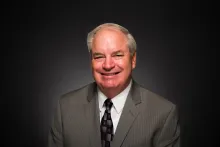
Robin Webber was born in Chicago, Illinois, in 1951, but has lived most of his life in California. He has been a part of the Church of God community since 1963. He attended Ambassador College in Pasadena from 1969-1973. He majored in theology and history.
Mr. Webber's interest remains in the study of history, socio-economics and literature. Over the years, he has offered his services to museums as a docent to share his enthusiasm and passions regarding these areas of expertise.
When time permits, he loves to go mountain biking on nearby ranch land and meet his wife as she hikes toward him.
