
Robin S Webber
This transcript was generated by AI and may contain errors. It is provided to assist those who may not be able to listen to the message.
Thank you. I appreciate that very much. We've got Redlands here today. We have a number of people here from Bakersfield. We have the Bates. We have Dr. Karlec here. We appreciate you coming down, John, to be able to share some information with our students today. We appreciate it very, very much. I'd like to finish up today a series that I began several weeks ago. This will be the last part of it. For those of you that are here, I'll give you a little background for the first few minutes so that we're all together so we can finish up. Today we do move into the part three of our three-part series. The title of it is, How Come It Is Taking So Long?
The purpose of this entire series is to directly address some of the questions that we have sometimes, especially when we become frustrated with our experience being a disciple.
We wonder if this was really everything that it was cut out to be. Sometimes we come up with that proverbial question, How come it's taking so long? God, is there another way? It is a very real dilemma for all of us to consider because, on one hand, God does by Scripture, 2 Corinthians 5 and verse 17, we are to become a new creation in Christ. And we go, hooray! That's wonderful and that's fantastic. But at the same time, then, we are also besieged by our humanity that remains in us.
So how does this new creation and how does our humanity work and where is this going? The reason that we're talking about this is to not fully grapple with this reality, it is ultimately to set the stage for what we might call a defeated Christian. And perhaps there can be nothing any sadder than that thought of a Christian that has sat down on the job on that proverbial log and does not get up and continue the journey that Jesus Christ said when Jesus said, Follow me. I think God wants more for us. He's willing to work with us as He leads us by His Spirit. As a guiding light, I'm going to be using several outstanding principles and historic examples from a book by the very same name, How Come It's Taking So Long, nearly written 40 years ago by a gentleman named Lane Adams back in 1971. And some of the principles and some of the thoughts, some of the historical examples he alluded to, I certainly want to give him full credit. When we've been together over the last two times, we've come to understand that at times we can, as Christians, when we begin the journey, and some of you began the journey, in a sense, right behind me in that baptismal pool. When we began that journey, sometimes we have false expectations of what it's going to be all about. We've read about it, get into the journey. It's a little bit like that map that we have. Sometimes when we open up a road map, and boy, that line doesn't look too bad. It's black, it's on a white background, and we don't always see all of the bumps and the dips and the curves that come along the way. And I think a part of this is due to a lack of understanding that can ultimately derail a Christian, derail us from the journey.
And that robs us from God's full potential that He wants for all of us. We've come to appreciate that in our discussion that conversion is not just simply an event, but it is an existence of surrendering our total being to God one step at a time, until we are free from that enemy that is inside of us. And that enemy, our human nature, is just simply that. It is an enemy. One thing that we centered on is that we came to understand that there truly is a difference between being committed to Jesus Christ and growing in Jesus Christ. They are not necessarily the same. And to make them synonymous underestimates what God is performing in us and the struggle that lies ahead of each and every one of us. This struggle that I'm talking about, brethren, if you weren't here before, is something that affects each and every one of us. The struggle affects pastors, it affects deacons, it affects elders, it affects members, it affects men, and it affects women. It affects each and every one of us. So we need to understand that.
Part of the analogy that we used in this, and I'll be going back and referring to it again today, is simply the example that is used as thinking of the United States during World War II. As the United States forces began to move towards the Japanese Empire and moving towards Japan as they went through those island chains, moving up ultimately to the goal, which was to conquer the Japanese Empire in its homeland.
Which was Japan. And it took a certain plan to be able to do that. That in that, there was a beachhead that had to be established on every island, that had to be secured. And by having that beachhead, that then meant that you could bring in equipment to be able to take the next journey. Sometimes people would think, oh, we landed, it's okay, it's all right, and everything's going to be okay.
That was just the beginning. Those beachheads need to be. Just as baptism is a beachhead in Christianity, it needs to occur. You need to establish it. God says He will supply some of the heavy artillery, as it were, the Holy Spirit. But then we have to go into our interior.
We have to move off the beach and go into the rest of the island. The valleys, the cliffs, the delves, the glens, the plains, and everything. We have to move into that, which is still not occupied by the work of the Holy Spirit inside of us. Today, we're going to take it a step further. We're going to move off the beachhead. We talked about the interior last time. Ultimately, today, we're going to talk about how there is one that waits for us in the center that has already done it.
So, the title of this message is, then, understanding our victory in Christ. Understanding our victory in Christ. And when we do that, we'll move forward. One thing I want to share with all of you as we now move into this third part of the message is simply this. As we move from a beachhead of where God's Spirit came into us, where Christ is living in us, now we move into the interior.
There's something that we kind of need to understand, which I think is going to be helpful. Before we go any further, it's a good time to stop and take a look around, as well as looking inward to each and every one of us at ourselves and recognize who God is dealing with. God's story is basically the story of Him dealing with very ordinary people to do extraordinary things. The troops that we are surrounded by are ordinary people, and we are one of them.
God called ordinary people to do extraordinary things that the victory of Jesus Christ might reign in them. You go back and you think about God's plan over the ages. Let's talk about that for a second, where He took slaves from Israel and gave them a Promised Land, where He took shepherds and made them kings and prophets. He took fishermen from Galilee, which was thought that there's no good thing that comes from Galilee, and yet that's exactly the target rich environment He used to take fishermen and make them evangelists for Jesus Christ. He took, in the Gospels, He took wayward women, becoming saints of God and friends of His.
And when you think about it, one of the most marvelous stories in all of the Bible, and it always impacts me, and we've talked about it before, that probably the last conversation that He had with a human being was the criminal to the right of Him. That's what is commonly called the good thief, to a man that He had that conversation with about His coming Kingdom in Paradise. Never underestimate who God is going to use to establish a beachhead in, and then ask them to move into their own interior, and then to meet God and meet Jesus Christ in the middle of what He's asked them to do. Let's go to Scripture to understand this. Join me if you would in 1 Corinthians 1.
1 Corinthians 1. Let's pick up the thought if we could here.
1 Corinthians 1.
Let's pick up the thought in verse 26.
It's always very important to, again, begin with the end in mind. And that's why 1 Corinthians 1.26 is so very important.
Now why is that? Why did He call what is the weak of the world? Why did He call those that are not necessarily wise? We find it in verse 20. That no flesh, no flesh, that means your flesh, and that means my flesh, no flesh should glory in His presence.
No flesh.
So what we are asked to do on this pilgrimage and on this calling to become a new creation is nothing that is homemade or earth-growing. It comes from God. It's His miracle. It's blessing. Oh yeah, sometimes there'll be those that come amongst us, whether in the first century A.D. or now like an Apollos who was eloquent, who was gifted, who had the language and the knowledge of Alexandria. There'll be those that are gifted. There'll be special proteges. But that doesn't mean that God changes the overall education program that has been designed for all humanity to come to an incredible place in their spiritual development. We need to know and remember where we've come from, where we've come from, who we are traveling with, and what stage they are at. Be it in the beachhead or the full incursion. Right now, if I can make a comment, we probably have people here that have just begun, we might say, landed. They're at a beachhead. They have not, perhaps, had revealed to them necessarily what's in the interior that they yet need to occupy. There is unoccupied territory still inside of them that they have not fully surrendered to God the Father and to Jesus Christ. Haven't gotten there yet. Haven't gone over that cliff. Haven't gone into that valley yet. And some of us have to recognize that all of us in this room are at different stages. Different stages. And we need to understand that. And we need to understand that everybody is going to ultimately go through this process. Why is that important for us to understand? Join me, if you would, in 2 Corinthians. In 2 Corinthians 1.
It says, God. That's why God, in a sense, as the Scripture says, calls us individually. But then He places us in the body to help one another. But sometimes we have to understand, while we have the same Savior and we have the same destination, we are in different stages. And we need to be patient with one another. Doesn't mean we need to tolerate things, but we need to be patient with one another where people are and to help them. One thing that's kind of important is simply this. A question that I think all of us need to ask sometimes. Ever considered that God intends us to enjoy the process of conversion? May I ask you a question? Do you enjoy what God is doing with you right now? Do you enjoy what God is doing with you right now? You guys say you've got to be kidding. After this week? After this morning? After what I just heard? Now there's a scripture that I'm going to go to that tells us that we're to count it all joy. In this pilgrimage that you and I are on as we have this beachhead established and then broaden our lives as we move into the interior of our existence, God says that we're to have joy. Join me if you would in James 1. James 1. Let's notice what it says here in verse 1. James, notice. And it's very interesting what we're discussing in this surrendering to God and having ourselves occupied by His Spirit. James, a bondservant of God and of the Lord Jesus Christ to the twelve tribes that you're scattered abroad. It's interesting that word bondservant for those of you that are new to the scripture is really slave. It means slave. It means a surrendered individual whose will is not their own, but everything that they do is for and from the Master. And James says, I'm a bondservant.
Verse 2, my brethren, notice it says, count it all joy. Enjoy it! Count it all joy when you, notice, fall into various or different trials, knowing that the testing of your faith produces patience.
But let patience have its perfect work, that you may be perfect and complete, lacking nothing. If any of you lack wisdom, let Him ask of God who gives to all liberally and without reproach, and it will be given to Him. I have a question for you, please. When we are suffering trials, when we're being pummeled, when we're moving into that unoccupied territory that has been unfamiliar to us already, and there it is, it is cropped up, and it's painful. It's hard. It's a challenge. There's something in our life that is contrary to God's perfect will for us. It is not one of the fruits of the Spirit. We're wrestling with something else. Does that mean we're supposed to say, oh, wow, wow, we're so happy. This is so fantastic. I'm just full of joy today. Thank you, Lord. Send some more. It's not talking about being joyful or enjoying necessarily the conditions that are on the ground. What it's talking about is that there is a knowing and a firm and a confident and a faith-filled spirit in us, a smile on our heart, even though it's hard to smile on the outside, that God is going to supply our needs in the right way at the right time and never be late, and that it's going to take patience and to allow patience to have its perfect work. That we have that confidence just as much as back in World War II, that when the Marines established a beachhead on Peleliu or Iwo Jima or Guadalcanal, that that beachhead was established that then allowed a supply line going back to the Navy to bring in the heavier equipment so that they could begin to advance into the interior and to be able to occupy the rest of that enemy territory. We need to have, brethren, that same confidence. Notice what it says here in verse 5, If any of you lack wisdom, let him ask of God, who gives to all liberally and without reproach. And it says the heavy equipment, the spiritual insight, and not only the insight, but the spiritual backbone to allow us to move forward will be granted to us. But let him ask in faith, with no doubting, for he who doubts is like a wave of the sea, driven, tossed by the wind. For let not the man suppose that he will receive anything from the Lord. Because if he does, he's a double-minded man, and he's unstable in all of his ways. That word, double-minded, is one of my favorite words in the Greek language. The word there is dpsukos.
Dpsukos. It literally means a person that is like that has two brains. It's like having two drivers on the steering wheel going down the 210 freeway. I'm not talking about a backseat driver. That's bad enough. I'm talking about four hands on one wheel. Who wants to go on that adventure?
Any takers? No. But that's why God is imploring us that when we have committed ourselves to Jesus Christ, now we have to grow in his Spirit. And that means that we have to be in touch with God to ask Him to grant us the understanding of where we are going and to supply those things that we are going to need.
And to accept it from the tools that it's going to come from.
I'm not sure what's happening in your life. I know there are things that are happening in my life. My life continues to be challenged. We say, well, how can that be? You're the pastor. No, my life continues to be challenged. There are areas yet that I have not fully explored in my own life.
It's not that I don't want to explore them. There are things that have not yet been opened up to me. I don't always see myself as I am. You know, it's like the old trick that we used to do when we were in school. If you really want to hear yourself, you know how you put your hands over your ears and that way you can kind of hear... And then you say, I don't want to do that anymore. I'm going to put my hands down. There are some things that we don't like to see about ourselves.
But God is going to supply that. And we've got to be ready to see that. You know, it's interesting if I can just make a comment. And it came out when we had the question and answer period with the employees and the students that... And I think... I've mentioned this before, but just in the rare opportunity that we have right now, that are serving on the council, it is a classroom. It is a classroom. It takes you, if you allow it, to a very deep level of understanding why you do what you do and what you're sharing and why you are sharing it. And is it God? Is it God that is sharing it? How much of it is of God and how much of it is of man? How much of it is of the divine and how much of it is the self? And it's something that you kind of come to understand that ultimately, oftentimes when people first come on to the Council of Elders, they come on because they want to be involved. They see something that needs to be corrected. They see something that needs to be directed and they've come on charging like Joan of Arc. And of all of a sudden, you know, as you begin to understand it, you are not necessarily there yourself to be to save a church or to save a congregation. God's got you in a laboratory to go to work on you to help you see some of that unoccupied territory that you have not yet surrendered yourself to God the Father and to Jesus Christ. It's a crucible. It's a test ground. It's a battlefield to make sure not only what we're doing, but why are we doing? What are the motives behind what we do? Are they guileless? Are they humble? Is it to serve others or is it only to serve ourselves? Thereby, we then have to listen to others. We have to see ourselves for what we are. And I have, by the way, a very good wife that when I do not see myself, she is there to be God's tool and to whittle away on yours truly.
Just as your mates, husband to wife, wife to husband, sometimes children that come up and share things with you, never underestimate the tool that God is using to allow you to surrender enemy territory to Him that previously that you had not surrendered.
These last five or six years for me have been an incredible growing ground, and I am God willing and thank you, Lord, not yet what I shall be. It's a class. It's a study. And each and every one of us, whatever we're going through at whatever level, all of us are in this. Never underestimate that committing yourself to Christ is the same as growing in Christ. Committing ourselves to Christ by responding to the call of God the Father is a beginning. It is not an end. Conversion is not an event. It is a process and it is an existence of slowly, step by step by step, surrendering every fiber of our being into a holy cause in which God says, I am holy, therefore you be holy. Let's consider for a moment, may we? Consider for a moment how at times you and I might be, as we look back through the Gospels, we might be a little embarrassed of recognizing who Jesus' first followers were. In a sense, you might say after three and a half years, if you just left them at that part of the story, you might say, well, they're total failures. Here were gentlemen that had had three incredible connective years with Jesus Christ, and they seemingly didn't appreciate and or comprehend the total experience. They saw, they heard miraculous matters up close and personal that none of us will ever be a part of, that God called them to be a part of, and it seems as if they abandoned Jesus Christ, especially when he humanly need it the most when the chips were down. They failed him, one betrayed him, one denied him, and all of them deserted him. But if we go back, we recognize really that their development was slow, but in God's point of view, it was steady. It's kind of interesting that even after the crucifixion and after the ascension and after Pentecost, the disciples were still in Jerusalem for some time. And it was only when persecution came upon the church in Jerusalem that finally that persecution scattered them, and they began even more so to do what God had called them to do in the first place, and that is to go out into all the world and preach the gospel. And so in a sense, you might say, why is it taking so long and why did it take so long for them? It's also in our saying, why is it that so many of the writings of the New Testament did not emerge until 60 to 90 A.D.? You ever ask yourself that question? Why did it take so long to put it into writing? Were Matthew, Mark, Luke, and John, were they being lazy? No. No. No, not at all. It takes time to handle the wonders of God and understand who He is, understand who we are, and surrender ourselves to Him and to grow in that grace and knowledge that He desires.
It took time for John to go from being a son of thunder to being the apostle of love. How would you have liked to have met John around 29 to 30 A.D.? Do you know what kind of a guy he was? And his brother? Sons of thunder? They were known as the Nuke Boys. You know, when Jesus was up there in the Samaritans and somebody gave Jesus some lip? James and John said, Jesus, zap them. Zap them. He didn't realize that, and they didn't realize at that time that God had sent His Son to this earth to die for everybody. For Jew and for Gentile. For those that would believe then and those that would come along later. See what they did was, and I've got this thing in my pocket, they did this. You know what this is? This is a tape measure. And why is it as people that we like to measure other people? See, I see Mr. Knute-Josephic here right now, and I'm going to measure him. Now, you say, that's funny, I can't see that out there, but I'm seeing it through my eyes, and I've got Mr. Knute-Josephic at four inches. But only God knows, but only God knows how big His heart is and how big His love is for God. Who's next? And what we do with her, you know, you're all laughing, but you know we all do that, don't we? Confession's good for the soul. But of course, for ourselves, so good. See, I think one thing, and we're smiling and laughing a little bit, but kids tend to remember tape measures, and children of God remember tape measures, and to recognize that God already measured us, and He knew that none of us measured up, and yet He gave His Son for us anyway, and His Son died for us anyway, even though we didn't have an inch on God. He gave Himself fully and completely. And I think sometimes as a congregation, as a body believer, what we do is we measure one another, rather than recognizing at times that somebody's just established a beachhead for God. And we're just at the beachhead moment. We have some of those here. We have some that right now, and I'm there with you, brethren, some of us are struggling with some of that interior matter that's in front of us. There's some valleys. There's some peaks that we didn't think, you know, were going to be there. You know, it's a little bit like out here that we can talk. We're in California. You know how when you're down in Pasadena and you see those mountains and they're 5,000 feet high, you say, Wow! Especially if you're from Ohio. You go, Wow! We don't have mountains like that. And you say, Wow! That's really big. I think I can do that. And you're willing to do that. And you don't even realize that Mount Wilson and Monrovia Peak, they're just a front range. If you're up close, say you're up by the 210 freeway, you don't even see Mount Waterman behind it, right? You don't see Mount Waterman behind it at 80, 150 feet or whatever it is. God didn't have us see that right now because we could not have handled it when we established that beachhead. When we first started out, Mount Waterman would have been too big for all of us to tackle. So God, in His grace and in His love, says, we're going to start small with you. We're going to start with just seeing if you'll honor my word, that you will accept that my son lived and died and was resurrected and ascended and is coming back once again to this earth and to wrap our head and to wrap our heart around that. But then later on, as we move into that interior, as it broadens out, now we're dealing with some real tough material to deal with. We're dealing with pride. We're dealing with envy. We're dealing with a lack of agape, godly love.
We're dealing with anger.
You know, you can be the best Christian Sabbatarian on earth and keep Sabbaths from 24 hours. You can keep it by the letter, but you could be just terribly bound up by not keeping it in the Spirit. The Sabbath is about peace. And if you have anger and if you have envy and if you're coveting and you are not developing the love of God, you might as well throw that Sabbath out. That's not going to do any good. Now, I'm not saying to throw the Sabbath out. You know what I'm saying as a technical observance. But you have to know how to fill up the cup of the Sabbath.
And not only on one day, say, well, I'm going to... Sabbath is holy, so I'm going to be holy on the Sabbath. God expects us to be... the Sabbath is always holy. It is enshrined to be holy. God put His presence into the Sabbath, but you and I are to be what? We are to be holy every moment, every day, and every way by what we say. Because what we say out of the abundance of the heart, the mouth speaks. Now, what I'm saying in all of this, friends, is sometimes we can even get a little bewildered and discouraged and derail ourselves by saying, well, we've only gone this far.
God, this is all I've gone. This is it. This is discouraging. But we also got to recognize the same God that Saul Peter and John and Andrew and Bartholomew and the others flee that garden, knows that there's more story down the line.
And that God is patient, and to allow patience to have its perfect work. And I'm imploring you, as my hometown congregation, that when we think about one another and that when we think about those that come in amongst us, we need to understand that to a degree, while we're all on the same journey, while we're all headed towards the same destination, and while we desire to travel the same way, we're all at different stages.
And we need to be able to comfort one another and to encourage one another. Let me take you to 1 John. Join me if you would there for a moment in 1 John. It's interesting that 1 John is written by a seasoned senior citizen of God's way of life, who recognized that after having lived this way of life for 60 years, yes indeed, there is going to be a gapping distance between God's achievement in us, so far that is, and the perfection of Jesus Christ that is yet ahead of us. Absolutely. But rather than staring at the distance that so easily can be noted, that can so easily have the roar and the echo of Paul saying, all the things that I'm not supposed to do is what I'm doing, and all the things that I want to do for you, Lord, are the things that I find lacking in.
But rather than focusing on ourselves, we need to be focused on the blood of Jesus Christ that covers each step of the way, from the beachhead, to the incursion, to the expansion over unoccupied territory that has not yet been claimed and given to His sovereignty. And that's what John did in 1 John 1. Join me if you would there. Wonderful verses in 1 John 1, verse 5. This is the message that we have heard from Him and declare to you that God is light, and in Him is no darkness at all.
If we say we have fellowship with Him and walk in darkness, we lie and do not practice the truth. But if we walk in the light as He is in the light, we have fellowship with one another, and notice the blood of Jesus Christ, His Son cleanses us from all sin. All sin. And if we say that we have no sin, we deceive ourselves, and the truth is not in us. But then again, notice verse 9. If we confess our sins, He is faithful, and just to forgive us our sins, and to cleanse us from all unrighteousness.
If we say that we have not sinned, we make Him a liar, and His Word is not in us. It's very interesting that in this set of words, verse 9, it says, if we.
What's very interesting is that John the Apostle, the one whom Jesus loved, He uses the we pronoun personality. 60 years into the journey, He says, if we confess our sins. I suggest to you that John was not yet there, even at age 80 or 85, that there was still perhaps territory inside of him that he was still working on. That was still not totally occupied. That was not totally surrendered that he was bumping into.
But what was bigger than the bump and the surprise and the shock of sin residing in a Christian, residing in my mind, an Apostle, was the greatness and the bigness of Christ's sacrifice and the largesse of God Almighty's mercy to Him. He's right there with Paul. John does not excuse his remaining condition on the ground, but continues to position himself in Christ.
There is no excuse for sin made here. God's righteousness remains in place. And it is the goal, but there remains the blood of Christ to allow our journey to continue. May I suggest, brethren, that what John has done here is informative. Let me explain. It takes real discernment and patience to help others, especially when they are confronting new and unoccupied spiritual terrain or matters that have been concealed. For those of you who were not here a couple of weeks ago, we talked about that before World War II broke out that the Japanese Empire had inhabited those islands of coral in the Pacific for years and years and years.
And they had literally tunneled down deep, deep, deep, deep, deep, deep, double deep into that coral. And so that when our forces, the Allied forces, came onto those islands, at first the Marines saw a beach. They made a landing. Then they went into a valley. But then they went up into the mountains. And they thought that perhaps the island had been taken, but to recognize how deep the enemy forces had gone all the way down. Things that were concealed, concealed, that they didn't know about. Is there anything that you're finding in your life?
My life? That is concealed? That is hidden away? In which our eyes, our ears are not picking up, that we're asking God, God, is there something about me that you do not like? Here's a good question to ask God. Is there something about me that is not yet surrendered to you? What is not occupied and given over to you, Father?
Will you show it to me? That is a prayer to think about. I may say that, may I? Understand that when you say that prayer, put it on your seatbelt, airbags deployed, and do not underestimate the tool, the man, the woman, the member, the non-member, the police officer, the politician, the dog catcher, and the little three- or four-year-old child that will show you a better way. Never limit God and never limit the resources in which He tells us His ways.
If you don't think so, just ask Balaam. He had a famous donkey that showed him a better way. Here's one thing that I want to share with you, and as we begin to conclude this message, it's simply this. If dying to self is so painful or long, why even bother? If dying to self is so painful and so long, then why even bother? Why even start on the journey? Why even respond to Jesus when He said as He did to Peter to us, follow Me?
Follow Me. Why even begin to go down that trail? Most of society out those windows is not. In fact, more and more, this society is worshipping the tantalizing God of self. It would be so much easier. Why didn't God call Me to be a fishy that goes down the stream, rather than tapping Me on the shoulder and saying, By the way, you are now going to be a salmon. You're no longer going to go downstream with everybody.
You're not going to be doing what everybody else is doing, your family doing, in your neighborhood doing, in your community doing, in the United States of America. You are now not going to go downstream, but you're going to go upstream. Rocks. Think of a salmon. Have you ever seen those stories of the salmon going over the falls, and how they have driven into them, driven into them, that they have to go back to that original spawning pool from whence they came?
And nothing, nothing will stop them. We all have rocks in our life that look insurmountable and don't seem to go away. How do we go over those rocks? God said, Not by your might, nor by your power, but by my spirit. But some things are going to come along, Lord, that aren't going to look pretty. I'm going to go to the left, I'm going to go to the right, I'm not going to be in that way.
God says, That's okay. I want you to recognize something very, very important. I want you to recognize that there is something that we need to understand. 1 John 3 and verse 8. Join me if you would there, please. 1 John 3 and verse 8. And 1 John 3 and verse 8. We, brethren, were not the first to hit the beach. We were not the first to move into the interior of our lives and move towards the quest of saying, Not my will, but thy will be done, O Father, above.
And here we have it written in 1 John 3. 8. For this purpose, the Son of God was manifested that he might destroy the works of the devil. One of the reasons why Jesus came to this earth in fulfilling the prophecies of old was to be Messiah and was to destroy the works of the devil and to found his church. That church means those that would believe in him. That is amplified if you'll join me in the epistle of Colossians, which gives more words to this incredible understanding that in a sense if we think of that island that needs to be occupied, we have somebody that's already in the middle waiting for us.
The victory is already won. Just the details have to be worked out. In Colossians 2, if you'll join me there, look at Colossians right after Ephesians, right after Philippians. Pardon me. Colossians 2 and verse 9. Just take a look at this. Colossians 2 and verse 9. For in him dwells all the fullness of the Godhead bodily, and you are complete in him who is the head of all principality and power.
In him you were also circumcised. That means molded with the circumcision made without hands. This is not of man. It's not by our works. It's what God is performing in us by putting off the body of the sins of the flesh by the circumcision of Christ.
Whittled into consecration and holiness by the life, the death, and that resurrection of Jesus Christ, buried with Him in baptism, in which you also were raised with Him through faith in the working of God.
It's not about us. It's about Him. We have been chosen. He called us. He opened up a revelation in which you were raised with Him through faith in the working of God, who raised Him from the dead. And you being dead in your trespasses, in the uncircumcision of your flesh, He is made alive together with Him, having forgiven you of all trespasses and having wiped out the handwriting of requirements that was against us, which was contrary to us, and He has taken it out of the way. He's taken that judgment. Not the law. It's a holy law. Romans 7, 14 says that the law is spiritual. It's not talking about the law. This is talking about the judgment of that law, that He took that judgment upon Himself. He who, in that sense, was perfect because of what we could not do, He did. Notice verse 15, having disarmed principalities and powers. When Paul is speaking of this as a Jew, he is not only speaking of Rome or Parthia, the empires of that time. He's not talking about that which is earthbound. The Jewish community always looked at two spheres. They looked at the world and they looked at that which is in heaven, and divided heaven into dominions and into realms and into powers. It says, having disbursed, having disarmed principalities and powers, He made a public spectacle of them, triumphing over them in it.
In ancient Rome, a triumph was an incredible thing. When either Caesar or General were granted, and they had to be granted, they just couldn't do it on their own. When a Roman general came in and was granted by the Senate or granted by Caesar, and that was a little tricky when Caesar did it, but where the Senate would grant them a triumph, and where the Romans would come in, and normally they had manacled one of my ancestors, one of the Germans, but they had the tribes of the Germans or the tribes of the men of Gaul, and they would have them manacled. And this is a scene that is being set up, that sin and its judgment was conquered, once and for all, through this Jesus Christ, the one who establishes the beachhead, the one that is moved into the interior, when he faced Satan in the wilderness, and when he was tempted once and twice and thrice, never surrendered as you and I have sometimes surrendered to those temptations. He did it! And he is there. And it is his blood. And it is his life that we draw upon in fulfilling God the Father's calling.
1 Corinthians 1. I'll finish with this. 1 Corinthians 1.
I just get so absolutely excited, brethren, talking to you about what our Father has done through Jesus Christ. We are not alone on the beach. We are not alone on those interior island challenges that we didn't know about five or ten years ago, but have propped up now. Jesus Christ came from the top, he came below, and he's gone back up the top. And his Father and himself, they wait for us. And they are championing.
They're saying, you can do it. We realize that sometimes I speak to you, and I know I'm speaking to you, if I just am speaking to one person today out there. And you feel like derailing. You feel like the journey, the pilgrimage, the calling is not worth it. You come talk to me. First and foremost, you talk to your Father, but share it with a fellow pilgrim.
Share it with Mr. Garnet. Share it with Mr. Helgi. Share it with Mr. Fish. We're all on this journey together, and sometimes we just get tired. We just get weary. We look into a mirror, and all we see when we wake up is all we do is see ourselves. And we don't look through that window that God wants us to look through, and to know what lies ahead. Being a Christian is tough slatting.
Being a Christian, humanly, is unnatural. It's of the divine. It's spiritual. It comes from a different world and a different realm that we are a bit welcome to enter. But the course and the education is down here below. 1 Corinthians 1, verse 3. Join me there. This will be our final Scripture as a congregation today. Grace to you in peace from God our Father and the Lord Jesus Christ. I know that this is a theme that runs throughout the Bible. I've given sermons on it. I know that this is something right now that Mr. Kubik, the President of the United Church of God, just keeps on hitting again and again and again and again.
This is the theme that we're looking at in the United Church of God. Debid one another grace. Debid one another peace. Peace does not mean the absence of conflict, but that God will indeed bless the peacemaker and bring along the answers that we need. I thank my God always concerning you for the grace of God which was given to you by Christ Jesus, that you were enriched in everything by Him in all utterance and all knowledge.
When the beachhead was established, what Paul is saying here is the heavy artillery and the heavy equipment isn't offshore. God will and God does supply everything that we need down here below and will not leave us alone. Even as the testimony of Christ was confirmed in you so that you come short in no gift, eagerly waiting for the revelation of our Lord Jesus Christ.
Notice verse 8, Who will also confirm you to the end, that you may be blameless in the day of our Lord Jesus Christ. Lord, Lord, why is it taking so long down here below? Answer verse 9, God is faithful by whom you were called into the fellowship, the koneya, that communion, and that union with Christ in life, in death, and in that sense of resurrection. But to recognize that in that sense you cannot have a crown above until there is a thorn below, and to recognize that that is a part of the deal, and that God will grant you and give you all that you need to be able to have yourself occupied by His Spirit, by His Son.
Brethren, there is nothing more that we can do today than to really encourage one another. As people come to us, there is a time to talk about our problems and talk about our challenges, and then we need to move into the Bible and remind one another of what God the Father has done, what Christ is doing, the revelation and the wisdom that comes through the Bible.
Go to the source of our answers. Go to the throne above, recognizing that any, any condition that is on the ground is trumped by our position before God the Father up above through Jesus Christ. After all, that's why we call ourselves Christians. Isn't that our belief? Shouldn't that be our practice? Shouldn't that be our first answer as we continue to storm forward on the pilgrimage that God has given us?
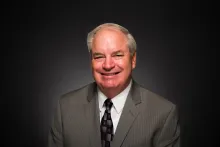
Robin Webber was born in Chicago, Illinois, in 1951, but has lived most of his life in California. He has been a part of the Church of God community since 1963. He attended Ambassador College in Pasadena from 1969-1973. He majored in theology and history.
Mr. Webber's interest remains in the study of history, socio-economics and literature. Over the years, he has offered his services to museums as a docent to share his enthusiasm and passions regarding these areas of expertise.
When time permits, he loves to go mountain biking on nearby ranch land and meet his wife as she hikes toward him.
