

Isaiah Chapter 7
Given on
Given in
Downloads
Downloads
To download a file, right-click (or long press) a link above and choose Save As.
This sermon examines two historical events, one from the ancient history of Israel and Judah, and the other a more modern day occurrence. More specifically it examines a time of perceived crisis that the nations of Israel and Judah were facing in Isaiah 7 and then examining a perceived crisis situation in Europe just prior to the onset of WW2. This message focuses on a fundamental spiritual principle vital to all of us as Christians! That fundamental spiritual principle is "Stand Firm in the Faith, Not Trusting in Flesh, or You Will Not Stand For Anything
Transcript
This transcript was generated by AI and may contain errors. It is provided to assist those who may not be able to listen to the message.
And after the sermon on Isaiah 7, we are now caught up with Chicago. We were about six months behind, but since I've been here for the last six weeks, mostly the last six weeks, we've been able to catch up. So I want to outline for you what we want to cover, and we're not going to cover the whole chapter. We're just going to cover the first nine verses of Isaiah 7, and then at a later date we'll cover the rest of chapter 7.
We're going to look at a time of perceived crisis that the nations of Israel and Judah were facing in Isaiah 7. That's one of the things we're going to look at today. Another thing we're going to look at today is a situation that took place in Europe just prior to World War II. We'll be doing that, looking at both ancient history and more current history, with an eye toward focusing on a fundamental spiritual principle. And that fundamental spiritual principle is this, and this is the heart and core, the theme of the sermon today.
Stand firm in the faith, not trusting in flesh, or you won't stand at all. Stand firm in the faith, not trusting in flesh, or you won't stand at all. And brethren, as you and I watch world news, you know, I've talked about that, I've related information about that several times in the past.
As you look at what's happening around the world and in this nation, when you see what's happening politically and the repercussions that's going to have on our society, the ability, perhaps for us even, to proclaim the truth of God, the Word of God, the way we would like to without fear of jailment or something of that nature, things are really heating up on the world stage.
And certainly, that means we've got to be people of faith. We've got to stand firm in the faith. If we trust in flesh, whether that be our own bodies, our own minds, our own personalities, or that of others, if we trust in the flesh, we will not stand as these things that we've been prophesying for generations take place. So let's, as we think about Isaiah, Chapter 7, let me give you some background to the chapter.
After the death of Solomon, as you're well aware, Israel was split into two. You had the northern kingdom of Israel and the southern kingdom of Judah. At the time of Isaiah Chapter 7, Judah was ruled by a wicked king by the name of Ahaz. Israel and Judah were often at war with each other. And this is important for us to always understand. And as you're talking to people who think that all Israel was Jew, you bring up the point that at times Israel and Judah were fighting wars as two separate nations.
Most people don't understand that in terms of understanding the Bible. So Israel and Judah, along with other smaller nations of that region, such as Edom, Syria, and Thalistia, were often dominated by larger empires, such as the Assyrians. And that is a case we're seeing in this Chapter 7, that Assyria is a powerful empire. Assyria wants the Egyptian breadbasket to feed its empire. And nations like Israel, Judah, Edom, Syria, and Thalistia were standing in Assyria's way.
And so, in one sense, Assyria was like a large predator, a large animal. And these other little nations, again, Israel, Judah, Edom, Syria, and Thalistia, were just like table scraps that were going to be gobbled up by the larger empire. One way of looking at the Assyrians, from a historical point of view, the Assyrians in their day were violent, they were ruthless.
Some people compared them to the Nazis of their time. The Nazis of their time. Their emperor, at this particular time, was a fellow by the name of Tiglath Pileser III, who was an expansionist. He wanted more territory. He wanted to keep on conquering. He wanted that Egyptian breadbasket and whatever stood in his way. Of course, Israel and Judah stood in the way, so he was all set to conquer them.
That being the case, King Ahaz of Judah, along with King Pica of Ephraim, and Syria under King Raisin, were concerned about the state of affairs they found themselves in. So, to give themselves some leverage, Syria and Israel banded together. They banded together against the Assyrians, and they desperately wanted Judah to join in. Judah didn't want to join in that alliance. And we'll get into the reason why they didn't want to do that in a little bit. And so, since Judah would not join Israel and Syria, Israel and Syria said, we're going to go conquer Judah. We're going to make them a part of this alliance, whether they want it or not. So, let me outline just the portion. Again, we're not going to go through the whole chapter today, just the first nine verses. And then we're going to talk about a modern-day example. But to outline the nine verses we're going to cover, verses 1 and 2 of Isaiah 7 show a life and death threat has emerged. A life and death threat has emerged. It's a time of perceived national crisis. Verses 3 through 7 show that God's plan will stand. God's plan will stand. And then in verse 9, you've got the key statement that I've made the theme of the sermon today, stand firm in the faith, not trusting in flesh, or you won't stand at all. So, follow that as background. Let's turn over to Isaiah 7 and begin reading. Isaiah 7. Here we're going to see in verses 1 and 2 a life and death threat emerging. Verse 1, Now it came to pass in the days of Ahaz, the son of Joth and the son of Uzziah, the king of Judah, Ahaz the king of Judah, that raisin the king of Syria and Pica, the son of Ramaliah, king of Israel, went up to Jerusalem to make war against it, but could not prevail against it. And it was told to the house of David, this is the southern kingdom, Judah, saying, Syria's forces are deployed in Ephraim, so as hard as people were moved, as the trees of the woods are moved with wind. And so here we see that the nation here of Judah is fearful. They see Israel coming against them, they see Syria coming against them, they feel squeezed because they know that at one point, Assyria wants to come against them. So they feel kind of like hounded on all sides.
So to stand against this threat of Assyria, you've got these two nations now wanting to join an alliance against Judah. But Judah had other plans, Judah had other ideas. We're going to see that in a little bit. And those ideas were not to align themselves with these two small nations. Judah says, if we're going to align ourselves with anybody, we're going to align ourselves with Assyria. So they didn't want to just settle for fourth or fifth best in their eyes. Judah, unbeknownst to Israel and to Syria, they already had a peace treaty in one sense, kind of like what took place in World War II in Europe and Russia, this peace agreement. But we don't trust in flesh.
King Ahaz of Judah was going to trust in flesh. He was going to trust in an alliance. He thought that was going to be what was going to help him through the difficult times. They weren't going to trust in God. And of course, brethren, the idea here for us to be thinking about is, do you and I trust in flesh? Do we trust in ourselves? Do we trust that with our intelligence or our personality or our place in life or our business acumen or whatever, we're going to be able to just save ourselves from anything? Well, if we feel that we as fleshly human beings can put up whatever walls are needed to withstand the trials that come against us, we better re-examine our thinking.
We move now to verses 3 through 7, which show that God's plan will stand. Not the plan of men, not your plan or my plan, not the plan of flesh, but the plan of God will stand.
Verse 3, Then the Lord said to Isaiah, Go now to meet Ahaz, you and Shear Jehoshap, your son, at the end of the aqueduct from the upper pool on the highway to the Fuller's field.
So, you know, God's going to declare through Isaiah that he's got a plan here.
And King Ahaz has a decision to make. That decision is embodied by Isaiah and Isaiah's son. Isaiah and Isaiah's son. Isaiah's son, Shear Jehoshap, means a remnant will return.
A remnant will return. Isaiah's name means the Eternal is salvation, or the Eternal shall save, or salvation is of the Eternal. So, as King Ahaz, evil King Ahaz, is looking at two human beings. God is presenting King Ahaz with two possibilities.
They can rely upon God, pictured by Isaiah and his name, or they can trust in flesh, pictured by Isaiah's son, and the fact that they're going to go through a lot of hardship, and yet God's still going to save some, but they're going to go into captivity.
And so, God is using this whole scenario here very, very dramatically to get Ahaz's attention.
In verse 3, we see Ahaz is at the aqueduct. He realizes invasion is imminent. And when you realize invasion is imminent, you want to check for the most important things. One of the most important things to check is your water supply. He's making sure that he got plenty of water. There's going to be water to get to the people of the area, to the nation, and so forth. Verse 4, And say to him, Isaiah, say to Ahaz, Take heed, and be quiet. Do not fear or be faint-hearted, for those two stubs of smoking firebrands, for the fierce anger of resident Syria and the son of Remaliah. So God is saying, basically, don't worry about Syria. Don't worry about Israel. I will take care of them. I will take care of them. Notice the very beginning of verse 4. Take heed, and be quiet, and do not fear or be faint-hearted. Put a marker here.
Let's go over to Exodus chapter 14. Exodus chapter 14. You know this story well. We go through it every day of unleavened bread.
Exodus 14 and verse 13. The children of Israel are at the Red Sea. Things look very dire.
And notice what it said here.
Exodus 14 and verse 13. Moses said to the people, Do not be afraid.
Stand still and see the salvation of the Lord, which He will accomplish for you today. For the Egyptians, whom you see today, you shall see again no more forever.
This is always God's word to His faithful people.
Stand still, get your bearings, understand where you are, that you are in the presence of Almighty God.
Stand still and see the salvation of the Lord. He's going to work things out.
Your flesh is not going to work things out. Your alliances are not going to work things out. Your contrivances aren't going to work things out. God's going to work things out. No matter what the odds look like, God is going to take care of things.
So now we go back to Isaiah 7. Verse 5 and 6.
Because Syria, Ephraim, and the son of Ramaliah have plotted evil against you.
And notice the way God does this.
The son of Ramaliah is the king of Israel. But he kind of just has a backhanded reference to him. Because Syria, Ephraim, of course Ephraim represents the northern kingdom, and the son of Ramaliah have plotted evil against you, saying, Let us go up against Judah and trouble it. Let us make a gap in its wall for ourselves. And, and here is a very important issue, and set a king over them, the son of Tabal.
Now we don't want to go through this quickly.
What is being said here? What is being said is that the northern kingdom of Israel and Syria were planning to conquer Judah, split the territory for themselves, and eliminate the dynasty of David.
And eliminate the dynasty of David. Now you know what scripture says about the house of David.
You know what prophecy says? There will always be somebody to sit on the throne of David. And yet, Israel here and Syria here were plotting to put this son of Tabal on the throne, thus breaking God's promise. Now, none of us ever want to be in a position where we take God on.
We stand toe to toe with God. We will not win.
There's no way in the world we're going to win with something like that.
Put a marker here again. Let's go back over and take a look at these over in 2 Samuel.
These promises to David. 2 Samuel chapter 7.
Here we've got God's promise to David.
2 Samuel 7, 12.
When your days are fulfilled and you rest with your fathers, after your dead, David, I will set up your seed after you who will come from your body. I will establish his kingdom.
He shall build a house for my children. I will set up your seed after you who will come from your body. I will establish his kingdom.
He shall build a house for my name. Of course, we know Solomon did that. I will establish the throne of his kingdom forever.
Now, when God says something's going to stand forever, it's going to stand forever.
King of Israel is not going to short-circuit that. Syria is not going to short-circuit that. So when they said they were about to try and do that, you knew they were going to fail.
Verse 14. I will be his father. He shall be my son. If he commits iniquity, or iniquity, I will chase in him with the rod of men, with the blows of the sons of men.
So yes, if the kings on David's throne do things they shouldn't be doing, they're going to pay a price for that. But is the throne going to be ripped away?
No.
But, verse 15, my mercy shall not depart from him, as I took it from Saul, whom I removed from before you.
So God took away Saul's throne, but he's not going to take away David's throne, or from David's people who come after him.
And your house and your kingdom shall be established forever before you.
Your throne shall be established forever.
So here we see God's covenant with David, to have a throne established forever. And yet, Israel and Syria are thinking they're going to short-circuit this.
They think they're going to bring this to nothing. Well, of course, they are going to come to nothing. 2 Chronicles 13 2 Chronicles 13 This helps back up what we just read in 2 Samuel 7.
2 Chronicles 13, verse 5. 1 Chronicles 13 1 1 1 1 1 1 1 1 1 1 1 1 1 So there's no way in the world this is going to come to an end.
We now go back to Isaiah 7.
And so, the son of Tebel probably was a person from Syria.
They would not have been at the house of David.
Verse 7.
Isaiah 7, 7 Thus as the Lord God, it shall not stand, nor shall it come to pass.
You know what's interesting from a historical point of view?
From this point, both men, King Pekah and King Rezon, Pekah of Israel, Rezon of Syria, died two years later.
You don't say you're going to short-circuit God's plan and have good consequences. Two years later, these two fellows died in 732 BC.
History points that out.
732 BC. They died.
Once again, let's put a marker here and let's remember something we read back in when we were studying the book of Daniel. Go over to Daniel 2.
Daniel 2.
Daniel 2.
Daniel 2. Starting here in verse 20.
Daniel answered and said, Blessed be the name of God forever and ever, for wisdom and might are his.
And he changes the times and the seasons. He removes kings and raises up kings. He gives wisdom to the wise and knowledge of those who have understanding.
So God removes kings and raises up kings.
And here he removed the king of Israel and the king of Syria.
Chapter 4 of Daniel.
Daniel chapter 4.
Daniel chapter 4 and verse 17.
This decision is by the decree of the watchers and the sentence by the word of the holy ones in order that the living may know that the Most High rules in the kingdom of men gives it to whomever he will and sets over at the lowest of men.
So again, God is the one who's in charge. You may think you go to the ballot box and you determine who's going to be the president of the United States. You don't. God does. And one of the reasons why, and as I've made mention to you on a number of occasions, why I don't vote, is because typically, you and I would think, if we go to the polling station, we want to vote for the best guy. But what if God doesn't want the best guy in there? What if God wants the fellow who's really going to mess up, who's really going to advance this nation's decline?
Or could be just another person who's going to be a good guy.
Or could be just another way. Maybe God does want the best guy. But we don't know. And so I don't want to put myself in a position of fighting God's will. I'll let God... God says He's going to take care of it. I'll let God take care of it. Okay, one last time. Let's turn over to Isaiah 7. I think this is the last time I'm turning over to it. Isaiah 7, verse 8. For the head of Syria is Damascus, and the head of Damascus is Rezen.
Within 65 years, Ephraim will be broken. Talking about the destruction of the northern kingdom. We'll get into that the next time we go through Isaiah. So there will not be a people. Verse 9. The head of Ephraim is Samaria. The head of Samaria is Ramaliah's son. If you will not believe, surely you will not be established. That's the point of the sermon. If you will not believe, if you don't stand in the faith, if you don't walk in the faith, you will not be established.
So let's remember that statement. Because you and I, if we are living in the last days, if Jesus Christ is coming in our day to day, we need to be people of tremendous faith. Because the Bible shows at the time of the return of Jesus Christ, there is horrible persecution. You've got Satan coming down to earth with a vengeance. You thought it was bad up until that point. Wait till he comes realizing he's got a short time. And who does he want to take his wrath out on? You see in Revelation 12, he wants to take it out on the nation of Israel, the physical people of God, and also the spiritual people of God.
We're both in this nation. We are the nation of God. We are God's Israel. We're also the Church of God. Satan has a double hatred toward you and I. So we must make sure that we stand firm into faith. I'd like to read Isaiah 7, verse 9, and a couple of other translations. Isaiah 7, 9 from the Christian Standard Bible says, If you do not stand firm in your faith, then you will not stand at all.
Same verse in God's word translation. If you don't remain faithful, you won't remain standing. Now in your notes, you might want to jot down Habakkuk, chapter 2 and verse 4, where it says, The just shall live by faith. Are you and I living by faith? That same thought is quoted again in Romans chapter 1, verse 17. The just shall live by faith. Now we've taken a look at ancient Israel and we know that within a lifespan after this point, much shorter than a lifespan, within a couple of decades after this point, Israel is going into national captivity.
God uses the crises of our life to expose our true faith. Think about the trials you've gone through in life. Think about the trial you may be going through right now. As you and I go through our trials of life, I've gone through my share, you've gone through your share, we'll go through more as time goes along. But as we go through the trials of life, it lays bare who we really are.
It lays bare who we really trust in and rely on. Do we trust in ourselves to get ourselves out of difficulty? Do we put it all on our shoulders? Or do we realize, yes, there are things we should be doing, but I've got to turn it over to God. I'm going to turn it over to God. Everything I can't do, He's got to do because I can only do so much. God expects us to do something with the situation we find ourselves in. He expects us to use our intelligence. He expects us to use our talents, but He also expects us to trust intimately in Him.
Now, I said that was the last time I was going to turn to Isaiah 7. I wanted you to turn to Isaiah 31 for a moment, because we see a related circumstance here, a related situation.
Isaiah 31, verse 1. Woe to those who go down to Egypt for help. And here, Egypt can represent any nation in the world, or anybody in the world, or any individual, for that matter, any entity in the world. Woe to those who go down to anybody for help other than God, and rely on horses who trust and chariots because they are many, and in horsemen because they are very strong. But who do not look to the lofty one of Israel, nor seek the Lord? So here we see in Isaiah 31.1, woe to those who trust in the flesh. Who trust in the flesh. King Pica of Israel, King Raisin of Syria, died two years later because they were trusting in the flesh. They were trusting in their own contrivances. They were trusting in their own alliance. They thought that was going to save them. It didn't.
Now, at the beginning of this sermon, I said we're going to take a look at something that took place just prior to World War II. I want to now keep that promise. How many of you, when I say the word or the phrase the Maginot line, you know what I'm talking about?
Most of you do. The Maginot line was named after the French minister of war, André Maginot. It was a series of concrete fortifications, obstacles, and weapons that France had constructed along its border with Germany during the 1930s. In World War I, France paid a tremendous price at the hands of the Germans. They lost a significant number of millions of people in that war. They said to themselves, this will not happen again. So they established the Maginot line. The idea behind the Maginot line was it was going to be a system of fortifications that would allow if Germany tried to attack them again, it would allow their army a chance to assemble and to go to the hot spots and take care of business. Now, on completion of the Maginot line in the 1930s, prior to World War II, experts from around the world came to France to examine the fortifications of the Maginot line. They said this was brilliant. And these are military experts. This, what France had done, they said, was absolutely brilliant. They had state-of-the-art living conditions. They had an underground railroad. They had a series of forts all along the frontier with Germany. They had air conditioning. They had comfortable eating areas. As I said, they had the underground railroad supplying troops to whatever the hot spot needed to be. The forts, they had artillery and so forth. Now, when I say a Maginot line, you're tended in your mind to think it's just one layer of forts along the whole French border with Germany. If we think that, we're thinking improperly. The Maginot line was between 12 and 16 miles deep, from the border inland into France between 12 and 16 miles. You had these major fortresses every so often. The larger forts would hold a thousand men. The smaller forts would hold between two and five hundred men. You had artillery. You had tank traps. You had barbed wire. You had all sorts of elaborate defenses to keep the enemy out.
Now, you ladies probably aren't interested in any of this, but I'm bringing this up because we as human beings can imagine all sorts of elaborate defenses for us. As we go through our life, we set up our walls of flesh.
We sometimes feel vulnerable, like the French people did. And like the French people, we set up our own walls. And brethren, that's folly. That's folly. Because any wall of flesh can be overcome by flesh. And certainly, any wall of flesh can be overcome by Satan. So here you've got this tremendous maginal line. There were 50 of the large forts, and there were, I forget how many there were, the smaller forts. But they all had overlapping fields of fire. Every fort could fend off the fort to its north or to its south. So you had all these overlapping fields. It was something to behold. It was something to behold.
The French thought that this would hold back anybody. Germans would never be able to overcome it. You know something? In one sense, they were right. When the Germans decided to invade France, they tried a direct assault on the maginal line, and they were beaten back badly.
But what did the Germans do? You know history of World War II. The Germans swept around the maginal line to the low countries. Holland and Belgium and Luxembourg, they went north around, and the French thought, well, they're not going to come that direction because you got this Ardennes forest. They thought the Ardennes is so impenetrable, and Hitler with his mechanized army, they can't get through there. If he tries to get through, it's going to take them two or three weeks to get through there. Hitler got through in two days, at the beginning of the war. Two days, not fifteen, two days. Now, at the end of the war, the Ardennes was also focused of the Germans.
You've heard of the Battle of the Bulge. That's where it took place, the Ardennes forest, and tremendous loss of life there in the Ardennes. So again, what did the Germans do when they couldn't make way against the Maginot Line? They went around it with their army, with their tanks, and so forth. The Luftwaffe flew over it, and France was conquered in six weeks. Now, there's a spiritual lesson there for us. As you and I have our walls of flesh that we think are going to protect us from whatever, Satan will go around or over, or through. He'll do whatever it takes to get at you and I, and he's very good at what he does. And so you and I simply can't allow ourselves to rely upon trusting in flesh.
So let me ask you a question. What is your Maginot Line? What have you constructed in your life because you feel vulnerable?
What have you set up?
Israel and Judah had their alliance. Alliances proved fruitless. France set up walls of concrete and steel, made by man. And of course, it was overcome by man. And you and I fortify ourselves with our walls of flesh. Historians look at the Maginot Line, and there's four major things they say was wrong with it. I'm not going to go through all four of those today. I'm going to go through just two of those today. Two of those things today. And again, these have got spiritual ramifications, spiritual implications for you and I.
Number one, the Maginot Line gave the French a false sense of security, a false sense of security.
Number two, the Maginot Line gave the French an improper focus on defense, an improper focus. You may not understand this, or I shouldn't say understand, you may not know this, but historically the French people have been known for their ordinance. They have been known for developing tremendous weaponry all through their history. But when they had this Maginot Line, their focus was so so intent on manning that and developing that and putting all their national resources into that, they let everything else go. They let everything else go. They were focused on one thing, and they let everything else go. And that was going to be to their detriment.
Brethren, chances are you've been deeply hurt in some area of your life. As a result, you or I have built our own Maginot Lines. As I was thinking about this message, I was thinking about the different kinds of walls. Sometimes we establish walls of flesh. Let me give you just three that I came up with, not having to think too very hard.
Perhaps you have a Maginot Line, or I have a Maginot Line, where we've got an emotional wall. We have been hurt emotionally. And so we're putting up all sorts of walls so we will not be vulnerable again. We are going to distance ourselves from people so we can't be hurt again. We are going to turn our heart into stone.
We're not going to have close friends.
We're not going to allow family to be close anymore. We're all but going to become hermits, emotionally speaking.
Other people, they may not have emotional walls, but maybe they've got economic walls. Economic walls. We feel that if we put enough money in the bank, no matter what happens, our family will be okay. We'll have food stored in the seller. We'll have shelves completely full every time there's a sale on anything. If it has a long shelf span, we're going to buy a bunch of it. A lot of canned goods, a lot of dry goods, water, enough to float a Titanic. We're going to make sure we've got all the right things. Silver, gold, jewels, precious metals, economic walls.
Some people in God's church have church walls. They said, I'm not going to be loyal to any group anymore. I was hurt by the worldwide Church of God. I don't trust organized religion, so I'm going to sit at home, or I'm just going to come to services, but give no real allegiance to anybody. I'm going to put a wall up. I'm really not a part of United. I'll go to their fee sites. Those are nice. Or whatever the group. I have church walls. I only have token loyalty to any organization. Brethren, one of the reasons we have all the splits is because we've got people with church walls. Church walls. The difficulty with these walls, emotional, economic, and church walls, is they rely upon human flesh.
Human contrivances, self-reliance, some other kind of individual fleshly thing. And we can't do that. We can't do that. 2 Corinthians 3.
2 Corinthians 3 and verse 5.
2 Corinthians 3.5.
Not that we are sufficient of ourselves to think of anything as being from ourselves, but our sufficiency is from God. Our sufficiency is not from ourselves. Our sufficiency is from God. We rely upon God. We rely upon His Spirit. Next weekend is Pentecost weekend.
It pictures the power of God given to us. The power that can change the unchangeable. When you think about human nature and how hard-hearted human nature is, and we've all got it, God has given us His Spirit to take care of that, to overcome that. But we don't overcome it just with our own efforts. We have to have our own efforts, but we have to have our efforts in reliance upon God, trusting in His power, trusting in His everything that He can give us. Romans chapter 5.
Romans chapter 5 verses 1 and 2.
Romans 5 verse 1, therefore having been justified by faith, our sins are forgiven because we've got faith in the sacrifice of Jesus Christ. We have peace with God through our Lord Jesus Christ. I'm sure that speaks to all of you.
You know, one of the great things that I've enjoyed about being in God's church as I go through the trials of life, and again, I've seen my share of trials, and so have you, I always can sit back and say, well, you know what? I'm just one day closer to the kingdom.
I may not be everything God wants me to be. I may not have overcome everything the way I want to overcome, but I know I'm on the way to the kingdom. And that gives me peace. That gives me peace. Because I have Jesus Christ as my Savior. Because I trust in God. And you feel the same way. We have peace with God through our Lord Jesus Christ. Through whom, verse 2, we also have access by faith into this grace in which we stand. Through Christ, we have access to grace. God's grace. God's grace to help us in time of need. God's grace for forgiveness. God's grace for strength. God's grace to help us understand.
And rejoice in the hope of the glory of God. That last phrase, we rejoice in the idea of the resurrection. There's coming a time when we're not going to be in this flesh any longer, but we're going to be in God's kingdom.
Ephesians chapter 6.
Now, we don't want a false sense of security. We want real security. And real security comes from God. It doesn't come from walls of flesh. Ephesians chapter 6, verse 10.
Ephesians 6.10.
Finally, my brethren, be strong in the Lord, strong in the Lord, not our flesh, not our walls of flesh, and in the power of his might. Put on the whole armor of God. And we need to ask ourselves, are we doing that? Are we putting on the whole armor of God? Or are we putting on just part of the armor of God? Are we exposed? Are we vulnerable because we're only putting on part of the armor of God? Put on the whole armor of God, that you may be able to stand against the wiles of the devil? Again, any fortification we make of flesh, Satan can penetrate easily. For we do not wrestle against flesh and blood, but against principalities, against powers, against the rulers of the darkness of this age, against spiritual hosts of wickedness in heavenly places.
We can't keep... Satan is beyond our intelligence. There's no way in the world we're going to match Satan, IQ for IQ.
He was able to turn aside holy righteous angels that maybe had known God for a billion years. Who do we think we are? Satan has worked with humankind since Adam and Eve. Who do we think we are?
He knows every kind of personality. He knows all the hot buttons. He knows how to prop you up and to knock you back down. He knows how to give you and I certain things. He knows how to then hit the right button at the right time. He's patient. He's patient.
Sometimes, I don't know about you, but sometimes in my life when I think, things are going good, things are really going good, then all of a sudden things aren't going so good. Because I got kind of big in my own eyes. Satan says, I've got him where I want him. He thinks he's okay.
He thinks he's okay. Well, he's not so okay. Verse 13, therefore take up the whole armor of God. You know, if repeated a second time, the whole armor of God that you might be able to withstand in that evil day. This is verse 13, and having done all to stand. Having done all, not done part, but done all. So, both in Isaiah chapter 7 and with the Maginot line, we learn not to have a false sense of security in the flesh. And secondly, both in Isaiah chapter 7 and with the Maginot line, we learn not to have an improper focus, an improper focus. I made mention that France spent tremendous amounts of money, treasure, getting that Maginot line ready. That encouraged a defensive mindset.
And what did that do? That stunted their growth as a nation. You and I have got to be very careful that we don't have the wrong mindset that will stunt our growth.
France took a defensive posture. Do we need to take a defensive posture? Does God want us to be on the offensive? God wants us to be on the offensive. He doesn't want us to just kind of sit back.
He wants us to be proactive. Isaiah chapter 66.
Isaiah chapter 66 verses 1 and 2.
Thus says the Lord, heaven is my throne, earth is my footstool, where is the house that you will build me, and where is the place of my rest? God talking about his greatness, his grandeur, the awesome God who designed and created and sustained the universe with all of his power. And notice verse 2. For all those things my hand is made, and all those things exist, says the Lord, but on this one will I look. Now to me, this is so encouraging. That tremendous being with all that tremendous power says, on this one I will look, on him who is of a poor and contrite spirit, and who trembles at my word. So that power can be behind you. That power can be there for you.
You don't have to be a genius to have this power working with you. As I've mentioned to you in times gone by, when I was in North Carolina we had a gentleman whose grandparents were slaves, who in his life he never learned to read or write. He would come to services and he would listen, because he didn't know how to read or write. He didn't bring a Bible. No, he didn't bring a Bible. He can't read. But he was able to have the power of God rest upon him. He was able to have the power of God work through him. So we don't need to be people with great educations or all sorts of abilities. If we have those, that's fine. That's wonderful. God's given those to us. But we have got God looking to us if we have this spirit here, a poor and contrite spirit who trembles at the Word of God. What does it mean to tremble at the Word of God? Let's take a look at another example of people who knew how to tremble and what that meant. Acts 17.
Acts 17.
Verse 10.
Then the brethren immediately sent Paul and Silas away by night to Berea, and when they arrived they went to the synagogue of the Jews. These were more fair-minded than those in Thessalonica in that they received the Word with all readiness.
They received the Word with all readiness. What does that mean? As you are studying the Scriptures, and as I am studying the Scriptures, we receive the Word with readiness. We receive the Word as something we want to act on, something we don't want to just have academic understanding. We want to know the schematics. We want to know the blueprints. We want to know how to put this into our lives, into action in our lives. We want to be ready to do whatever the Scriptures say to do. And they search the Scriptures daily. These people were intent on looking into the Word of God on a daily basis to find out whether these things were so, a positive mental frame of mind. Therefore, because of these things, because they were fair-minded, because they received the Word with all readiness, because they searched the Scriptures and they did that daily with a positive attitude, look at verse 12. Therefore, because of what we just read in verse 11, therefore many of them believed, and also not a few of the Greeks, prominent women as well as men.
And that was saying something for their day and age. You know, back in, you know, there was not a liberal movement back in those days. Women were to be cooks and bear children and that sort of thing. Be kind of behind the scenes. But yet, here, ladies, that they are they are listening, they are understanding, they're asking questions, and they're coming into the truth, the truth, and the church.
So we don't want to have the improper focus. Let's take a look at a group of people, and this is prophetic. Revelation chapter 3, a group of people, and we don't want this to be us. It may well be a group of people in our day and age. It could be some of us here in this room. We don't want that to be true.
People with an improper focus here, Revelation chapter 3 and verse 17. Because you say, I am rich and have become wealthy and have need of nothing. In other words, people who feel they are where they need to be spiritually. And do not know that you are wretched, miserable, poor, blind, and naked. People are self-deceived. They don't understand where they truly are.
They're wretched spiritually. They're miserable spiritually. They're poor spiritually, blind and naked spiritually.
And what are they told? Verse 18, I counsel you to buy from me gold refined into fire that you may be rich. There's something that needs to be done. And white garments that you might be clothed, that the shame of your nakedness may not be revealed, and anoint your eyes with eyes that you may see. So yes, there's things we are to do with God's help, with God's power, with His Holy Spirit. We can't do it by ourselves. And yet God won't do it for us. We're in partnership with God. Verse 19, as many as I love, I rebuke and chase, and therefore be zealous and repent. So if any of us are finding ourselves in this lay of the scene attitude, we need to take heed.
Verse 20, behold, I stand at the door and knock. Is that where we want Christ in our life? Where He's outside of our home? He's knocking because He wants to get in. Is that what we want for Christ? Or do we want Him inside our home? Do we want Him inside our hearts and our minds? Not standing on the outside trying to get in. We want Him in. I stand at the door and knock. If anyone hears my voice, it opens the door.
Have we closed the door? Have we done things? Do we have a seared conscience? Are we doing things that are closing the door spiritually to God? If anyone hears my voice and opens the door, I will come in to Him and dine with Him and He with me. This is a tremendous promise we have from God. To Him overcomes, El Granthas, with me on my throne. As I also overcame and sat down with my Father on His throne. He who has an ear, let Him hear what the Spirit says to the churches. We are to be overcomers. We don't want to have this improper focus.
So a spiritual takeaway here, brethren. A spiritual takeaway. In what or in whom do you trust? In what or in whom do I trust? These are questions we must ask and answer of ourselves. Do we trust in the flesh, in walls of flesh? Or maybe some should be asked, in what type of flesh do we trust? Do we trust in alliances?
Now, what would be an alliance for us today? Well, my family's in the church. I'm third or fourth generation church of God. You know, great-grandma and grandma and my mom and my siblings. We're all in a church, and so that's my alliance. Somehow we think, well, because we've got all this family in the church, somehow that does something for us. Well, read the chapter, the fourth, fourteenth chapter of Ezekiel, where God tells Ezekiel, He says, hey, you take three of these very righteous men, Noah, Daniel, and Job, they're only going to save themselves. Alliances aren't going to work. Are we trusting in alliances? Are we trusting an imaginal line? Are we trusting in walls of flesh? Are we trusting in ourselves?
Final scripture for today is over here in Matthew 11.
If I would have had longer announcements, we would fill up the time. Matthew 11.
Matthew 11, verse 12, and from the days of John the Baptist until now, now, why talk about the days of John the Baptist? Well, many people believe that's basically when the New Testament begins with John the Baptist. The time of the New Covenant was made when Christ had died, but we can think of the New Testament era beginning with the John the Baptist. Now, from the days of John the Baptist until now, the kingdom of heaven suffers violence, and the violent take it by force. Now, there are different ways we've looked at this particular verse in the past, but certainly one of the ways we've looked at this verse is that a person has to storm into the kingdom of God. We don't just kind of, you know, laze our way into it. We don't just kind of morph lazily into it. We've got to have a spirit of a soldier who's storming a city. We can't be half-hearted. Soldiers who are half-hearted don't get the job done. We can't be complacent. We can't be indulgent. We can't be at ease. We have got to be warriors who know what our goal is, and we're going after it with all our hearts.
The kingdom of heaven suffers violence and the violent take it by force. By force. So, brethren, to me, Isaiah chapter 7, the few verses we read in Isaiah 7, talk about such an important issue for us today. Standing firm in the faith, not trusting in flesh. If we don't stand firm in the flesh, we won't stand at all. Please, let's remember that lesson. It will hold us in good stead for all eternity.
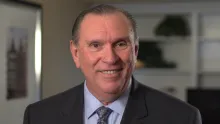
Randy D’Alessandro served as pastor for the United Church of God congregations in Chicago, Illinois, and Beloit, Wisconsin, from 2016-2021. Randy previously served in Raleigh, North Carolina (1984-1989); Cookeville, Tennessee (1989-1993); Parkersburg, West Virginia (1993-1997); Ann Arbor and Detroit, Michigan (1997-2016).
Randy first heard of the church when he was 15 years old and wanted to attend services immediately but was not allowed to by his parents. He quit the high school football and basketball teams in order to properly keep the Sabbath. From the time that Randy first learned of the Holy Days, he kept them at home until he was accepted to Ambassador College in Pasadena, California in 1970.
Randy and his wife, Mary, graduated from Ambassador College with BA degrees in Theology. Randy was ordained an elder in September 1979.
playlist
