
David Mills
This sermon was given at the Pigeon Forge, Tennessee 2014 Feast site.
This transcript was generated by AI and may contain errors. It is provided to assist those who may not be able to listen to the message.
New Zealand. They're well ahead of us in the Philippines, in Africa, and in Europe. We want to remember our brethren as they meet in different parts of the world. For example, over in the Philippines right now, it's about 8.20 in the morning. They're having their breakfast tomorrow morning. So let's remember our brethren as we fellowship here together. My wife Sandy and I are very happy to keep this feast with you in the beautiful East Tennessee Mountains. And we're looking forward to meeting you and shaking your hand and becoming acquainted with you. I think in many ways, brethren, this may very well be the most important feast we have ever observed. We are living in very terrifying and difficult times. We realize what is happening in the Middle East and in world conditions, our own country and other parts of the earth. And these are very, very serious and perilous times in which we are living. And I do think in many ways that it is the most important feast that we have ever observed. I'd like to give a title to the sermon this evening. Come, let us worship and bow down.
I'd like to begin with a question. Where were you in 1977? That's 37 years ago. You know, for a good number of us, we weren't even born yet. 1977 is when the United States, NASA, launched two satellites, Voyagers 1 and 2, to explore our solar system, to reach out into our solar system, and to have flybys to the planets. In 1979, two years later, it went by Jupiter. Took some photos. In 1980, by Saturn. In 1985, by Uranus. And in 1989, by Pluto, one of the outer planets. In 2004, 27 years after launch, Voyagers 1 and 2 crossed a boundary where the solar winds began to slow. You know, now 2014 is 37 years after being launched. The Voyagers are about 12 billion miles from the Earth. And they're at a point called heliopause. And that is the point where they leave the solar system and enter interstellar space. Where the solar winds actually stop and the magnetic fields shift to that of deep space. The Voyagers will continue to transmit data to NASA, but in about five or ten years, they will lose power to send data. They're still sending it right now. But they will continue their journey, and in about 200,000 years, they will come close to another star.
You know, why tell the story about the Voyagers? How does it connect with the Feast of Tabernacles? How does it connect with us and why we are here? You know, we marvel at just the size of the solar system. These spacecraft, traveling at 35,000 miles an hour or so, have just reached the outer limits of our solar system and now ready to enter interstellar space.
We marvel at the size of just our solar system, not to mention our galaxy or clusters of galaxies or the universe. The Holy Bible states in Psalm 19 and verse 1 that the heavens declare the glory of God. And they do. We look up at the moon, we look up at the stars, we look up at the sun. Without saying a word, the heavens indeed do declare the glory of God. And Psalm 19 goes on to say there's no speech or language where their voice is not heard. Everywhere on the earth you can look up and you can hear that voice. And it's like the heavens are beckoning to mankind. Without saying a word silently, they're crying out, and there is a Creator God, and He has a big purpose for mankind. God, the Creator, does have a big purpose for mankind. We're here to learn more about it at this feast. What are we doing here these days? We're here to get to know this great Creator, this great God, and to learn more about His purpose. And the holy days that we will be observing these eight days will help us to know God, and also His purpose, and to see what we should be doing about it. Life for us to turn for our first Scripture to Genesis 1 and verse 14. In the very beginning, God had a calendar in mind, and He had festivals and holy days in mind. On the fourth day, this is Genesis 1 and verse 14, God said, Let there be lights in the firmament of the heavens, to divide the day from the night, and let them be for signs and seasons, and for days and years. So God, it goes on down in the verses, following to say that He set the sun and the moon and the earth in their relationship to each other. He put the earth out at about 93 million miles from the sun. That's just about right. A little bit farther would be too cold, a little bit closer would be too hot. Just right, 93 million miles. And He put the earth spinning on this, on its axis, every 24 hours, creating days, well, 12 hours of day and 12 hours of night. And God set it on this very unusual angle of 23 degrees. And so as the earth makes its journey around the sun once every year, which is 365 and a quarter days, then there are seasons we're able to enjoy summer and winter, spring and fall, because of having this odd 23 degree angle to the sun. In the meantime, God also put the moon in its orbit around the earth, always facing toward the earth, and orbiting around the earth every approximately every 29 and 1 half days. Why did God do this? He was creating a calendar for men. And the word for seasons in Hebrew, in verse 14, is mo'ed.
And the word means seasons, and it means for an appointed festival, an appointment at a fixed time, a festival. So God had in mind that there would be festivals that would come up. So we just happened to be at that time in our journey around the sun this year, that we're in the seventh month of the year, and we're at the time of the Feast of Tabernacles, the fifteenth day. We just happened to be on that particular part of our journey. And God has ordained that this would be one of those days that would be holy. Let's turn. Well, before we turn, I want to quote one verse and not turn to it. That's Psalm 104 and verse 19, and it says, God appointed the moon for seasons, and the word is mo'ed again, or appointments and festivals. Now let's turn to Leviticus chapter 23, and this is the one chapter in the Bible where we find all seven of the annual holy days. Did you know that this is the only chapter that has all seven of them? Other chapters have several of them, but Leviticus chapter 23 has all seven of the annual festivals. Let's begin in verse 4. The first three verses are devoted to commanding the Sabbath, the weekly Sabbath. Verse 4, these are the feasts of the Lord, holy convocations which you shall proclaim at their appointed times. I believe the King James Version has seasons, and the word in the Hebrew again is mo'ed. And it means that time that has been set aside for festivals. And so these are the festivals of God that come up during the year. Already this year in the spring, in April, we observed the Passover, and we learned more about the sacrifice of Jesus Christ and how much we need that sacrifice. And we could never get started toward eternal life without the Passover. Then we kept the Feast of Unleavened Bread, and we realized that we want to purge out sin. We don't want to continue that way. Sin doesn't work, and we don't want to go the way of sin. We want to keep God's laws and commandments. And then we kept Pentecost in the month of June, and representing the first fruits of those who God has given His Spirit to. You know, already God has begun to pour His Spirit out upon human beings, but it's only upon a very small number, the first fruits of the Spirit.
And then just two weeks ago, we observed the Feast of Trumpets. The Feast of Trumpets we learned represents the powerful return of Jesus Christ to the earth. You know, mankind—and that's why I say this is a very important feast for us, because this world marches steadily toward that time that is described in Matthew 24, where Jesus said that mankind would be ready to destroy himself. Come to the very point of no flesh would be left alive, except those days were cut short. And so we see human beings now that would have no qualms about destroying the world if they had nuclear weapons. No qualms at all. They might even think they were doing service to their God or gods. And so Jesus Christ is going to come storming back to put an end to man's journey toward self-destruction and also destroying this beautiful planet that we saw a lot of in the special music. World events indicate that we're very near that time that is described in Matthew 24. As Johnny Cash had a song many years ago, Matthew 24 is knocking at the door, and I think we all can see it. And we need to draw closer to God than ever. I think this feast is a very important one for us to think about ourselves and our relationship with God and draw closer to Him. World events indicate we're getting very, very close. We don't know just exactly how close, but certainly closer than ever before.
Then just a few days ago we observed the day of atonement, the day of fasting, the time that represents the binding of Satan the devil. And we felt very, very puny, didn't we, about five or six o'clock at night. I know I did. We felt humble and repentant. And when Jesus Christ returns, He's going to find a humble and repentant mankind.
A mankind that is willing and ready to listen to the Creator God. I've not read the verses here in Leviticus 23, but I do want to read verses on these days. So let's look forward in this chapter to verses 34 and 35. Leviticus 23 and verse 34 speak to the children of Israel, saying, The fifteenth day of this seventh month, and that is this day right here, right now, shall be the Feast of Tabernacles for seven days to the Lord. On the first day there shall be a holy convocation. You shall do no customary work. And so we know the Feast of Tabernacles pictures that wonderful age, a golden age that lies ahead after Christ has come, after Satan has been bound.
It will be a time of refreshing. It will be a time of restoration. Nations will beat their swords in the plowshares. A year will go by without any war or any bloodshed anywhere, and then a decade will go by, and not one war, no killing. And then a century will go by, and a thousand years will go by. Isn't that wonderful to think about? Nations will beat their swords in the plowshares. We have this statue that is taken from this verse in front of the United Nations building. It was actually sculptured and put there after World War II, oddly enough by the peoples of the Soviet Union, the former Soviet Union. And it has these words from Isaiah chapter 2 that they will beat their swords in the plowshares. But the United Nations has never been able to do that. And yet many realize that without a world government, mankind will not be able to solve his problems. And mankind's problems are getting out of control fast. And so Jesus Christ, at His return, is going to turn things around, and He is going to set up a world government. It's going to be a wonderful time. Other verses indicate that the earth itself is going to be renewed. The deserts will rejoice and blossom as a rose. There will be no more sickness and disease. Like we have today, the blind will see, the deaf will hear. No more hunger or starvation. Will that be wonderful? Many people die of starvation today. The plowman will overtake the reaper. You know, many of these verses will be turned to. I'm not turning to them tonight. I'm just putting our appetite for what lies ahead.
I've heard the sermons that are coming, the titles and summary of the various sermons that will be given in the days ahead. We have a lot to look forward to. This Feast of Tabernacles, pictures, Jesus Christ and the saints bringing peace and salvation. And all nations will keep the Ten Commandments. Can we imagine that? All nations will keep the Ten Commandments. Everyone will go to church on the Sabbath, not Sunday. And everyone will keep the Feast of Tabernacles and the other Holy Days, not the holidays of the world. And every person on earth will be able to draw waters from the wells of salvation and will understand his purpose in life. And the knowledge of God will cover the earth as the waters cover the sea. This Feast of Tabernacles, pictures, then that time. We're here to get a foretaste of it. Let's drink it in. It gives us hope for the future. Drink in this coming golden age. Let it counteract all the bad news that we hear all the time in the world today. Let it relieve you of disaster fatigue. Yes, we can actually become conditioned to all that is happening, where it no longer affects us as much as it should.
So let this feast soothe your soul and fill you with hope.
You know, one way from now, the Feast of Tabernacles will be over. But the eight days will not be over. We will be in the eighth day. Let's read about it in verse 39. On the fifteenth day of the seventh month, when you've gathered in the fruit of the land, you shall keep the Feast of the Lord for seven days. On the first day shall be a solemn rest. So this is talking about the Feast of Tabernacles. But notice the last part of verse 39. On the eighth day, a solemn Sabbath rest. And so the eighth day is that final seventh holy day of the year.
We call it sometimes the last great day. And if there's a wonderful last great day of salvation, I don't think any of us can imagine how wonderful it's going to be when the masses of people, billions and billions, who have lived all down through the ages, will come back to life and have the opportunity to understand. This will all be described in sermons on that last day of the Feast. The rest of the dead will be resurrected. And the Book of Life will be open to them.
And it's going to be wonderful. It will be the first opportunity that many, many, billions and billions have ever had to be converted and enter the kingdom of God.
Brethren, God is concerned about every human being. There's not one that has ever lived anywhere at any time that He's forgotten about. Every single one, every little baby, every little infant that died will be brought back to life. He wants everyone to be in His family.
And in the end, as it says in Ephesians 1 and verse 10, His plan is to gather together in one all things. And I want you to marvel at that as we think about all the problems in the world today and all the problems that will be resurrected in the Second Resurrection, that God is going to bring it all together in one. In the end, that is His purpose, that is His plan.
So I'd like to ask us, again, what are we doing here? We're keeping an appointment with God. We are appearing before Him. We're keeping His feast, and we'll be banqueting at His banquet table. And what an honor it is!
There are three vital things I'd like for us to do, each of us, during this feast. Three vital things that will help us to be a good feast for you and for all of us. Number one, I'd like for you and me and all of us to come to rejoice. I tell you, we're here to have a good time.
I want to read from Deuteronomy chapter 12 and beginning in verse 12. When we come before God at His appointed festivals, you think He wants us to come with a sad face? Why no. He wants us to come to rejoice and to have a good time. So I'd like to ask all of us to keep up those big smiles I saw before the service and our fellowship and rejoice as we come before our God. Deuteronomy 12 in verse 12, you shall rejoice before the Lord your God, you and your sons and your daughters, your men servants and maid servants and the Levite. Let's get going on forward to verse 17. You may not eat within your gates the tithe of your grain or your new wine or your oil or the firstlings of your herd or your flock or any of your offerings that you vow.
Not to eat within their own gates. Notice, you shall not eat within your gates this tithe. This is obviously not the tithe that was given to the Levites. This is a different tithe. This is the one we often call the second tithe or the festival tithe. Verse 17 goes on to explain where it may be eaten.
Verse 18 rather, but you must eat them before the Lord your God in the place which the Lord your God chooses you and your son and your daughter and man servant and maid servant and Levite within your gates. And you shall rejoice before the Lord your God in all to which you put your hands. So as we come to enjoy that tithe, the most of our second or festival tithe is spent at the Feast of Tabernacles. It is obvious that God wants us to come and have a good time because that's a sizable amount of our income, a sizable amount of our money that we bring here to rejoice before Him. So let us rejoice. God wants us to. He wants us to have a good time. And I want to ask all of us to work to make sure that that happens. I want to read from a book by the title of the Temple, Its Ministry and Services by Alfred Edershine. And in the 14th chapter about the Feast of Tabernacles, it has this to say, The most joyous of all festive seasons in Israel was that of the Feast of Tabernacles. It was the most joyous. It fell on a time of the year when the hearts of the people would naturally be full of thankfulness, gladness, and expectancy. All the crops had been gathered. It was appropriate that there should now be a harvest feast of thankfulness and of gladness unto the Lord.
Of course, it was God that ordained it to be this way, to fall at this time of the year. But it falls at the time of the year when the crops had come in and everyone would just naturally be very happy and joyful. This book goes on to have this quote, The harvest thanksgiving of the Feast of Tabernacles reminded Israel of their dwelling in booths. While it pointed to the final harvest, when Israel's mission should be completed and all nations gathered unto the Lord. It's quite a bit of understanding, isn't there, of what we understand and know that is going to happen. Brother in God has certainly blessed us in this country. We do enjoy the birthright promises in the United States. My wife and I have had the opportunity, three of the last five years, to have the Feast of Tabernacles in Africa, in very poor nations. Zimbabwe, Malawi, and Zimbabwe. And, did I say, Zambia. We spent more time in Zambia than any of the other three. These countries are very poor, some of the poorest countries on the earth. Some of the people in some areas do not have electricity. Some of them have no water that's near. Those who do have water near, if they don't have electricity, they have to go to a pump in their neighborhood and then bring water to their home. To wash, to cook, to water their animals, and whatever they need water for. Some of them have to walk six or more miles to get their water supply. But you know they're very happy, they're very joyful, they're children, a big smile, some of the happiest children you've ever seen. They're the poor of the earth, but they're rich in faith. But after being there for the Feast and coming back to our country and seeing not desert-like conditions, but beautiful grass and trees, you just really do feel like, as we've all heard, just kneeling down and kissing the ground because you're so happy to be back with the birthright promises that we enjoy. In many ways, those people live a very simple life, a community-type life, family life. Their social security is that they live with their families and their families take care of them. And in some ways, you feel bad for us because maybe we don't have as close family life as they have, and some of our values are not as good as theirs. Even so, God wants us to enjoy the blessings we have, obviously, and in the millennium He's going to give more than the birthright promises we enjoy to all nations. So let's come before God rejoicing. We have so many things to be thankful for. Let's come before His presence with thanksgiving, as it says in Psalm 100. God is the host of this feast, and He wants us to have a good time. So, rejoice. And as Paul said in Philippians, again, I say, rejoice during this feast. Number two thing I'd like for us to do is remember that we have come to worship. We've come to worship the great God. Let's turn to Zechariah 14. We turn there in the Scripture reading for the special music, but I want to point out a thing or two about the verses that were read.
Zechariah 14 and verse 16. It shall come to pass that every one that is left of all the nations that came against Jerusalem shall go up from year to year to worship the King, the Lord of Hosts, and keep the Feast of Tabernacles.
And it goes on to say that if any nation does not come up, they will have no reign. God will put pressure on every nation to obey and keep the Feast of Tabernacles. They'll receive no reign if they do not come up to keep the Feast. And verse 19, it will be the punishment of Egypt and all the nations that do not come up to keep the Feast of Tabernacles.
Brother noticed that it is not optional that they come up to the Feast. They will come up or else.
When my parents told me as a child, you do this or else, I knew what else meant, and I didn't want it.
And God is going to tell the nations, you come up and keep the Feast of Tabernacles or else they'll get no reign. And when they get no reign, they'll have no food and that will soften their attitude and they will begin to come up and keep the Feast of Tabernacles.
Well, you know, it's not optional for us today either. And we as God's people take it seriously. We're here because God commands us to be here. We want to worship Him. By the way, the word worship here in the Hebrew is sheka. It means to bow down. It means to make obeisance too, to pay homage to our great God. That's what we're here doing then. We are worshiping Him and bowing down before Him. That's the primary and first reason we are here.
There was one lady that took the Feast seriously years ago. She told me this story. She lived in the western part of North Carolina. She had never been anywhere outside of her own county, but she learned the truth about the Holy Days of God.
And she wanted to keep the Feast of Tabernacles back in about 1960. And there was only one festival site in the United States in 1960 and that was in Big Sandy, Texas. Well, she had never been anywhere, but she got on a Greyhound bus and she headed west through the state of Tennessee and Arkansas and arrived at Big Sandy, Texas. And if anybody's been to Big Sandy, you know it's not very big.
She arrived there about 10 o'clock at night. The bus station was closed. There were no streetlights. The Greyhound bus let her out with her luggage and there she was in the dark. What was she to do? Well, she prayed. And before too long, someone drove up and rolled his window down and said, Lady, can I help you? She said, Well, I'm here to keep the Feast of Tabernacles with the radio then Church of God. He said, Well, I know right where that is. I'll take you to a motel nearby. And he did. And he helped get her luggage inside.
And after he left, the clerk at the motel said, Well, Lady, do you know who that man was? She said, Well, no, I've never seen him before in my life. And the clerk said, Well, that man just got out of prison last week. But God provided. And guess what? She went on. She went on to have a wonderful first ever Feast of Tabernacles.
So she had come to worship the Great God. And I tell you, like Ella, her name was Ella, and the nations and the millennium, we too have come to worship, to bow down, to honor and serve the Great God. The third thing I'd like for us to do while we are here at this feast is that we have come to quench our thirst.
Every human being has a deep inner yearning. You and I have it. We're seeking after something in life. And we've come here to satisfy that hunger and thirst. Let's turn to Isaiah 55. We're looking for something in life. You are, I am, everyone is. Do you know as we're turning there, I'll just mention that some of those Americans who have joined ISIS actually are looking for meaning and purpose in their life.
That's what they're looking for, meaning and purpose in their life. They're not going to find it where they're going at all. But they're looking for something. In Isaiah 55, verse 1, Ho! Everyone who thirsts, you know, that's all of us. Everyone who thirsts, come to the waters. And you who have no money, come buy and eat. Yes, come buy wine and milk without money and without price. Why do you spend money for what is not bread and your wages for what does not satisfy? Listen diligently to me and let your soul delight itself in abundance.
Incline your ear and come to me. Here and your soul shall live and I will make an everlasting covenant with you. Thus, actually, what every human being is looking for. He hasn't let it reveal to him yet exactly what is going to satisfy that inner yearning and hunger and thirst. But it's a relationship with God. It's seeking the only meaning and purpose there is in life.
And that is a relationship with Almighty God and eventually being a part of God's own family. So, at this feast of tabernacles, let us then strive to quench that thirst by drawing close to God and meditating about his ways, coming to every service, attending and participating in activities, finding ways to serve every day, staying healthy during the feast, letting our light shine to this community.
But can we do these three things? I know we can. We can rejoice as we appear before God. We can worship him with all of our heart and mind. We can quench that thirst, that spiritual thirst that we have. Rather than these eight days are going to go by very rapidly, you'll be surprised, but they can fill us up to the brim spiritually. Just think, we've never kept this feast of tabernacles before. We may have kept many before, but we've never kept this one.
The eight days are a blank right now, just a blank. How will we fill them in? So just like the Sabbath every Friday night, it's new. That one has never happened before. This feast of tabernacles has never happened before. Let's fill in the blanks then. Let's become more committed to our high calling. Let's be more zealous for the work God's given us to do.
Let's have teachable hearts, humble and broken, rejoicing together with thanksgiving. May we be refreshed and renewed and rejuvenated in heart and in mind. Let's draw closer than ever to our God. Three times in the Bible we read the expression, Abba Father. Abba is the Aramaic for Father. The expression means Father. Father is an intimate, close, warm expression. On the night before he died, Jesus cried out to the Father, Abba Father. Father, Father, because he was in such agony over what was about to happen.
The true God is a personal God. He desires a close and warm relationship with each of us. So how would you describe your relationship with God? Abba Father? Just some self-examination. Perhaps grow this feast in that Abba Father relationship and walk with God more closely than ever before. Let's turn to two final scriptures. First of all, in Psalm 42. Psalm 42 verses 1-4. Psalm 42 and verse 1. And you know, let this be us here at the feast. Let it be you and me at this feast. As the deer pants for the water brooks.
You know, just picture a deer that's been running hard and comes to a water brook. As the deer pants for the water brooks. So pants my soul for you, O God. My soul thirst for God, for the living God. When shall I come and appear before him? We are appearing before God at his feast. And let our soul thirst for the living God. My tears have been my food day and night. While they continually say to me, Where is your God? And verse 4, When I remember these things, I pour out my soul within me. For I used to go with the multitude.
I went with them to the house of God with the voice of joy and praise with a multitude that kept a pilgrim feast. The King James Version has holy days. We're here keeping a pilgrim feast. We're just pilgrims and strangers. One lesson of this feast of tabernacles is that we are in a temporary tabernacle and we long for an eternal tabernacle in the future.
So let's rejoice with the multitude here in Pigeon Forge and let's also yearn and thirst for the living God. Jesus said, Blessed are they who hunger and thirst for righteousness, for they will be filled. For the final scripture, I'd like for us to read Psalm 95. Psalm 95, verses 1-7. O come, let us sing to the Lord. This beckons to us so well at this feast. Let us sing to the Lord. And as you sing and as I sing, think of the words. Those words are beautiful in our hymns. But our minds can be wandering off on something else. You know, that happens to me. I think to all of us. Think about the meaning of those words as you sing them. Let us sing to the Lord. Let us shout joyfully to the rock of our salvation. Let us come before His presence with thanksgiving. Yes, let us do that. Let us shout joyfully to Him with Psalms. For the Lord is the great God and the great King above all gods. In His hands are the deep places of the earth. The heights of the hills are His also. The sea is His. For He made it. In His hands formed the dry land. O come, let us worship and bow down. Where I get the title of the sermon from. Come, let us worship and bow down. Let us kneel before the Lord our Maker. For He is our God. And we are the people of His pasture and the sheep of His hand.
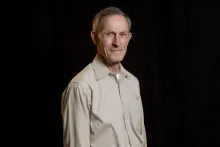
David Mills was born near Wallace, North Carolina, in 1939, where he grew up on a family farm. After high school he attended Ambassador College in Pasadena, California, and he graduated in 1962.
Since that time he has served as a minister of the Church in Washington, Florida, North Carolina, South Carolina, Oregon, West Virginia, and Virginia. He and his wife, Sandy, have been married since 1965 and they now live in Georgia.
David retired from the full-time ministry in 2015.
