
David Mills
This sermon was given at the Jekyll Island, Georgia 2016 Feast site.
This transcript was generated by AI and may contain errors. It is provided to assist those who may not be able to listen to the message.
Well, good evening, dear brethren, dear friends, and dear family. It's so good to be together again. I know we all want to say thanks for that special music. It was very, very beautiful. And I'd just like to say welcome to you all, or as we say down here, y'all. A warm welcome to the Feast of Tabernacles 2016.
Welcome to all members of God's church and visitors and friends that are with us. We've come from near and far, and I hope you've all settled into your festival lodging. No problems, and you're ready to let the Feast begin. Actually, the Feast began here about, what, 653, just over an hour ago. But did you know the Feast began in some areas about 16 or 18 hours ago over in New Zealand and Australia? Some of those areas run pretty far ahead of us. So we want to remember that as we go through the Feast and be praying for all of the festival sites all around the world that God will certainly be with them. Before getting right into the main aspect of the message tonight, I thought it might be good for us to get acquainted. No need to be strangers. How many people do we have here from the grand great state of Georgia? I'm going to raise my hand on that one. Okay, fellow Georgians, welcome to all of you. How many do we have from outside the state of Georgia? Uh-oh! We're far outnumbered. We welcome you, all of you, that have come from outside of our state, and we hope that you will enjoy your visit here at Jekyll Island, Georgia. How many people have come from outside the United States? I know I've met one from the Caribbean this morning. Okay, very welcome to all of you. I hope I get to meet you during the Feast, and we certainly are so glad you can come and visit our country and that you can come and visit or keep the Feast here at Jekyll Island. I want to ask also, how many are here for the first time ever for the Feast of Tabernacles at Jekyll Island? Raise your hand. We have a goodly number then, and isn't this a beautiful island? And just the way it was protected from the storm a week ago, God certainly has blessed us. I hope we'll all give thanks for that. Let me ask this also, in getting acquainted with one another, how many, or do we have ones keeping the Feast of Tabernacles for the very first time ever? Let me see your hands. We do have a few, and we hope this will be a memorable...all right!
We hope this will be a memorable Feast of Tabernacles for you. We're glad you can be here with us.
How many have been keeping the Feast of Tabernacles for 10 years or more? Raise your hands. Oh, we have a lot of people. Okay, let's up that now to 25 years. That goes back to 1991. All right, we have a lot of old-timers here, don't we? Let's go all the way up to 50 years. How many? I think we might diminish the number. Look at that. We have ones here, quite a number, that have been keeping the Feast for 50 years or more. Wonderful. How many young people do we have here? I expect to see all hands on this one. All right, let's say young people 25 years of age and below.
Okay, we have a goodly number here. We welcome you and hope that you'll have a wonderful Feast and that we all will. Wherever you're from, however many Feasts you've kept, whether you're young or old or in between, we say a big welcome to everyone. To you all. I mean, y'all.
My wife and I, my wife Sandy and I, are very happy to share this Feast with you at beautiful Jekyll Island. We were last here nine years ago in 2007. Since that time, we have kept three festivals in Africa, Zambia, Malawi, and Zimbabwe, one in India, two in the Caribbean, Jamaica, and Barbados. And so we have traveled quite a bit since that time, but we are very happy to be back with us at New Jekyll Island. We didn't recognize anything. It is totally different than it was nine years ago. But what a beautiful facility we have that the guy has blessed us with, all the things they've done to the shopping areas. We've not seen all of the changes which have been made since 2007, but it looks like it's just very beautiful the way it's been laid out. And we're just... aren't we very blessed? I hope we just thank God every day that we're able to be here and to keep the Feast of Tabernacles in such a beautiful location. So let's be sure to do that. My wife and I look forward to keeping the Feast with you and meeting you. I wish we had time to sit down for an hour with each and every one of you, but we won't have time right now. But that day will come in God's kingdom where we can do that. We look forward to meeting as many as possible.
Before getting also right into the main meat of this message tonight, I thought it would be good to give a little modern history of keeping the Feast of Tabernacles. This is knowledge that, to me, is very inspiring and very interesting, and I think it will be also to you. Mr. and Mrs. Herbert Armstrong began... have proved to themselves the Sabbath, and then they looked into the Scriptures and found, hey, the Holy Days also. God expects us and commands us to be keeping the Holy Days. That was way back in 1926-1927 in that time frame. Well, that's like 89 or 90 years ago. Their first Feast of Tabernacles must have been in 1927 in Eugene, Oregon, and they kept it alone. But gradually, other members of the Church in that area began to keep the Feast of Tabernacles with them. In 1933, 21 people kept the Feast of Tabernacles in Eugene, Oregon. Between 1933 and 1938, only the two high days were kept. They did not have meetings on the other days, unless it was the weekly Sabbath. 1939 was the first year the full eight-day festival was observed. 1939. And it continued in Eugene through 1944, and the attendance in 1944 was up to 60 people. So the numbers are pretty small, and they stayed pretty small. In 1945, Mr. Armstrong came to understand the second tithe and also began to see that it was very good and desirable to keep the Feast of Tabernacles away from the world. And so, beginning in 1945 and through 1951, they kept the Feast of Tabernacles in a place called Belknap Springs, Oregon. My wife and I, we were in Oregon for five years of our ministry, and we visited that area where they had the Feast way back then. In 1951, there were 150 people attending the Feast of Tabernacles. But you know, this is a long time after they had started keeping the Feast and still only 150. But they had outgrown Belknap Springs, so they went the next year, 1952, to a place in Northern California called Seagler Springs. And the attendance jumped up to 450 people. Well, 1953 began the Feast of Tabernacles in a place in Texas that doesn't quite live up to its name, Big Sandy. Not all that big a place, but land had been donated to the church. A building had been built, the old Redwood Building, and the Feast was held there for the first time in 1953 in Big Sandy with an attendance of 750 people. We see the numbers beginning to go up. 1958 was my first Feast of Tabernacles, and by that time, the church had built a metal building that would seat about 4,000 people, and there were slightly over 4,000 people in Big Sandy, a big multitude of people.
So the building had to be expanded after the very first year, and by next year, it would seat up to 6,000 people. In fact, in 1960, there were over 7,000 people in Big Sandy. It was very much overcrowded. So they had outgrown Big Sandy. What to do? Well, at that time, someone, one of the ministers, talked with Mr. Armstrong and said, what we need to start doing is to have more than one festival site. After that time, Mr. Armstrong felt like we should just have one. And so, Squall Valley, California became our second festival site in 1961. I was able to be there as a student at Ambassador College. Almost 10,000 people attending the feast in Big Sandy and Squall Valley that year. In 1962, there were almost 13,000 people in Big Sandy and Squall Valley together. Needed more festival sites. And so, in 1963, a third festival site was chosen. And does anybody know where that was?
Right here on Jekyll Island, 1963, our third festival site. And that year, here in Jekyll Island, we had 6,747 people. How many—any one here present for that? I know my wife was. There are a few that were here. And we didn't meet in a big modern building like this convention center. We had a big tent. A big tent. How many remember the big tent days? In the 1960s, okay, we had a big tent where people came. And during this time, there were some memories created. We remember storms blowing in and the tent flapping. And we wondered if it would stay together. I think God did protect us. That's the only way that that tent did not come down. It got flapping pretty hard at times.
But during the 60s and 70s, the Feast of Tabernacles attendance continued to rise, and many other festival sites were added, such as Long Beach, California, Mount Pocono, Pennsylvania, Lake of the Ozarks, Wisconsin, Dells. And also, there were many international sites.
And by the year that Mr. Armstrong died in 1986, there were over 100,000 people keeping the Feast of Tabernacles in the U.S. and Canada alone. I don't have a figure for the international sites, but would not be surprised if that wouldn't put it up another 10 to 20,000 people. And so, the Feast of Tabernacles have become a very big thing as far as the number of people keeping it.
You know, we don't have nearly that many people keeping the Feast of Tabernacles now. What happened? In the mid-1990s, our faith and belief concerning the Feast and other things was severely tested. And not everyone passed that test, but many did pass. And it's encouraging to see thousands and thousands of people to continue keeping the Feast of Tabernacles since 1995. This year, the United Church of God has festival sites in at least 34 countries.
I'm sorry, 34 countries or nations. And there are around 60 separate festival sites in the world, and this is indeed very, very encouraging. Well, it might just be very interesting to all of us to see just a bit of history of the Feast of Tabernacles in our modern age.
Well, we might ask ourselves the question. I'd like to briefly address this, and I think it would be appropriate. Should we even be keeping the Feast of Tabernacles? Aren't these days ceremonial? That's what came up in 1995. Aren't they Old Covenant? Can we prove that God's holy days are for us today? And the answer is, yes, we can. It is easy. It is simple to prove that we should be here keeping the Feast of Tabernacles. Number one, Jesus kept the Feast of Tabernacles, John 7, and the last day there. And Jesus kept the other holy days. Should we not follow His example?
The New Testament Church continued to keep the holy days, began on one of the holy days, Pentecost.
And so there's plenty of evidence in the book of Acts and the letters of the Apostles that the early church continued to keep the Feast of the Festivals of God. Number three, the holy days will be kept in the Millennium when Jesus Christ is reigning as King, Zechariah chapter 14. You may turn to that verse later tonight. So there's lots of Bible proof that we should be keeping the holy days. These are God's festivals. They're not the churches. They're not mine or yours. And by contrast, there is no proof in the Bible for Christmas and Easter and the holidays that most people in the world keep. I'll say, if anyone is new to the holy days, then we encourage you to look in your Bible. That's what I was encouraged to do in 1958. And when I learned about the holy days, I was encouraged to look in the Bible. We have this in our booklet, God's Holy Day Plan, a chapter, in fact, for each holy day, and plenty of proof from the Bible that we should be observing God's festivals today. I'd like for us to now move right into the main aspect of this message tonight. This message will be just a little bit shorter tonight. We know that you've traveled long and and we're going to have lots of services beginning tomorrow afternoon and days following. So this will be just a bit shorter, oh, about 40 minutes. And I'm not sure exactly how long I've already gone, but I'll try to keep track of that. I said try. The title of the sermon is, Oh, Come, Let Us Worship and Vow Down. Brother, this year, more than any year up to this point, we need a sense of urgency about the times in which we are living. Can we just look back over the last year since the last Feast of Tabernacles and see how conditions in the world have deteriorated?
We have terrorism that has struck in nations in Europe, has struck in our own country.
We have storms and floods like the recent one affecting North Carolina, even still, and Louisiana.
Powerful hurricanes. We have so much that is going on in the world that shows we are getting closer and closer. And when Jesus said, when you see these things begin to happen, look up because your redemption draws near. We are getting closer to the end of this age, and we need a sense of urgency. We need to be aware of the signs of the times and be able to discern what is happening in this world. I hope that we can all of our messages will have an increased sense of urgency this year because of the times in which we are living. I'd like to ask a question of you. Where were you in 1977, 39 years ago? You know, for many of us, it may be a good number of us, we weren't even here yet.
But 1977 is the year that our nation sent two satellites into space, Voyager 1 and Voyager 2 were launched, traveling at 35,000 miles per hour. They explored planets. The objective was to try to learn more about the planets in our solar system. Well, they eventually, in the 1980s, got to the outer planets of Jupiter, Saturn, Uranus, and Neptune.
In 2004, they crossed a boundary where the solar winds began to slow. And now, 39 years after launch, they are about 12 billion miles from the Earth, and they are at the point where they are either about to leave or maybe have just left our solar system moving out into an interstellar space where the solar winds stop and magnetic fields shift to those of deep space.
Voyagers, both of them, will transmit data to NASA, but in about five to ten years, they will lose power to send data.
But even there, they will continue their journey. And in about 200,000 years, they will come close to another star.
Why tell the story about the voyagers? How does it connect with the Feast of Tabernacles? How does it connect with us and where we are right now? You know, we marvel at the size of our solar system. Here is our spacecraft moving at 35,000 miles per hour. And at 39 years, they're just reaching the outer extremity of our solar system.
The Scriptures state that the heavens declare the glory of God. Psalm 19. They do it without saying a word. You can look up at the stars and they don't say a word. And yet their speech or language is heard everywhere, the Scriptures say. They silently beckon a message to mankind. And the message they beckon is, there is a Creator God.
And He has a big purpose for mankind. What are we doing here these eight days? We're keeping in appointment with this Creator God that made such an awesome universe. We're here to get to know this great Creator and to learn His purpose and discover what we need to be doing.
The Holy Days help us to know God and His purpose and see what we should do. A life for us to consider, though, when do we keep the Holy Days? Let's consider how God created and preserved a calendar so we can know just when we ought to be keeping His Holy Days. Can we know that this actually is when we should start keeping the Feast of Tabernacles?
Can we be sure? The answer to that is yes, we can be absolutely sure. Not only did God create a calendar, He is the Creator of the calendar, but also He has preserved that calendar as well. Let's go back to Genesis 1. We see here in Genesis 1 the creation of a calendar. Genesis 1, verse 14, So God put all of these things in their connection to one another, and especially as far as the calendar, it would involve the sun and the earth and the moon.
So He made the sun, which is much larger. What is it? A million times? I don't remember the exact times larger. The sun is a huge orb, like a basketball, and here we are like a BB bullet. There's something rotating around it. We're so small by comparison. But God placed the earth out at 93 million miles, just the right distance, a little bit closer, and it would be too hot for human life, a little bit farther away, and it would be too cold, just right.
He put the earth spinning on its axis once every 24 hours, creating the first element or component of a calendar, the day. Creating a day, day and night, making a 24-hour period. He put the earth also at a strange 23-degree angle as it makes its orbit around the sun. Now, the earth makes this orbit every 365 and a quarter days, a complete orbit around the sun, and it is traveling, our spaceship earth is traveling at 66,600 miles per hour, and it takes a whole year for us to make a journey that is 584 million miles.
That's how far a distance we travel every year. We don't realize it. During this service here, we will travel probably 75,000 miles or more. And so, God made the sun and the earth in that relationship, creating a year. The earth goes around the sun once every year. But in this journey, He created this other orb called the moon. He put the moon out at about 238,000 miles from the earth, and the moon makes its orbit around the earth once about every 29 and one-half days, creating a lunar month.
And so, as the earth makes its rotation, or its orbit around the sun, the moon is making its orbit around the earth, creating months, another component of the calendar. So, right here in Genesis 1, we have these three basic components, a day, and a year, and a month.
Now, you know, we do notice that these are based on astronomical things that happen, the relationship of the sun and the moon and the earth to one another. But then God created another element of the calendar called the week. Every seventh day, every seventh time the earth rotates on its axis, He ordained to be holy time. Now, there's nothing astronomical about the week, nothing. But yet, the week is so perfect that even man who changes everything has never been able to change the weekly cycle.
Six days of work, we're ready for a break. So, the weekly cycle is absolutely perfect. So, we see here in Genesis 1 that God was creating a calendar. Let's go back to verse 14 and notice one other thing. Let there be lights in the firmament of the heavens to divide the day from the night, and let them be for signs and seasons and for days and years.
You know, the word for season here is from the Hebrew word moed, M-O-W-E-D. And this word means an appointment at a fixed time, a festival. It is obvious that God then had in mind appointments such as we are now keeping when He put the earth and sun and moon in their relationship to each other. Now, you can put this down. We won't turn to it right now. But Psalm 104, 104 in verse 19, God appointed the moon for seasons.
He appointed the moon for seasons. So again, the word there in Psalm 104 verse 19 is moed, appointments, festivals. So God created the calendar for man, but did He preserve that calendar? We do know that God gave it to ancient Israel when they were in Egyptian slavery.
He said this will be the first month of the year to you. They lost knowledge of the calendar. A guy gave them the knowledge of the calendar and how it should be preserved. Eventually, the northern tribes went into captivity. But guess what? The Jewish people have faithfully preserved the Old Testament scriptures, and they have faithfully preserved the knowledge of the Sabbath and also the calendar. Every year you hear about Rosh Hashanah, you hear about Yom Kippur. The Jews have faithfully preserved the knowledge of the calendar.
A very key verse as far as preserving the calendar is Romans chapter 3 verses 1 and 2, where it says that God has committed to the Jews the lively oracles of God. So not only has God created a calendar, He has preserved that calendar so that we know exactly when we should observe His festivals. So with that in mind, let's go to the chapter in the Bible that has all seven festivals.
And which one is that? Leviticus 23. Okay, some of you were going to say it. You're right. This is that one chapter in the Bible that has all seven of the holy days. And already this year we have observed, of course, Passover. Well, we might read verse 4. So the appointed seasons of God's calendar when these different festivals are to be kept. The 14th day is the Passover, then the 15th day, the Feast of Unleavened Bread for seven days.
Then Pentecost is mentioned. Then in verse 23 and 24, the Feast of Trumpets, which we kept two weeks ago. And then the Day of Atonement, we kept it as a fast day just a few days ago. Let's come on down to verse 34. Speak to the children of Israel saying, The fifteenth day of the seventh month shall be the Feast of Tabernacles for seven days to the Lord.
Brethren, this is the fifteenth day of the seventh month. It is the Feast of Tabernacles. On the first day there shall be a holy convocation. You shall do no customary work on it. Then later we read that the eighth day also, verse 36, is a day that has been set aside.
We'll be keeping that last day, the eighth day, of the Feast beginning one week away. So we find these festivals then here in Leviticus chapter 23. I just want to especially help us think about the meaning of this festival. We know that Passover represents the sacrifice of Christ, the Feast of Unleavened Bread, the keeping of the commandments of God, Pentecost, the first fruits of the Spirit, ones that God has called during this age, Trumpets, the Second Coming of Christ, and Day of Atonement, the binding of Satan, and the world being reconciled to God.
Here we are, the Feast of Tabernacles. What does it mean?
We're going to hear messages. We have many very inspiring messages to look forward to explaining the meaning of this Feast. It pictures a wonderful time.
One thousand years when Jesus Christ and the saints will reign.
It'll be times of refreshing and restoration. Nations will beat their swords and the plowshares and learn war no more. Deserts will rejoice and blossom as the rose, no more sickness and disease.
No more hunger or starvation. This Feast of Tabernacles pictures the Kingdom of God reigning on the earth. Jesus Christ and the saints bringing at last peace, joy, and salvation.
All nations keep in the Ten Commandments. What is that going to be like when everybody keeps the Ten Commandments? All people keep in the Sabbath and Holy Days.
And the knowledge of God covering the earth as the waters cover the sea.
These next seven days, then, we are here to get a foretaste of this time.
The sermonettes and the sermons will be focusing on it. Brother, let's drink in about this golden age. Let it counteract all the negative disaster fatigue that we have coming at us in the news today.
And let it soothe your soul and fill you with hope.
And then, of course, one week away we will be observing the last great day or the eighth day. And what a wonderful last great day of salvation that is!
A first opportunity for most people that have lived down through history and today as well.
So the Holy Days picture a wonderful, wonderful plan of salvation. And we're going to be painting that picture and trying to help us to really appreciate it as we go through our messages.
Well, I want to rush along. I've got about 10 more minutes, and then I'm going to sit down. I might be halfway through a sentence, but I'm going to sit down.
Young or old, near or far, we're keeping an appointment with God, but how are we to come before Him? I want us to think about that. You know, people in the millennium might also delay reading this, but they're going to come from all nations to Jerusalem to worship the King.
What are they coming for? To worship the King, Jesus Christ, who will then be back on this earth.
So they're going to come, and if they don't come, they have no rain.
You might say they will either come or else. And I got to understand the meaning of or else. My parents taught me the meaning of that expression. So the nations are going to come to keep the Feast of Tabernacles, or else they'll suffer some pain. No rain.
And then no rain, no crops, no crops, hunger. Then they'll say, well, which way is it to Jerusalem anyway? So, you know, it's not optional, is it? People will have to keep the Feast of Tabernacles. It's just going to be the law. It's going to be the law of the earth. It's going to be enforced. And today we approach the Feast of Tabernacles that way, too. It's not optional for us today. And it's not easy to get children off out of school, get off the job. We've had people lose their jobs. I've known of a good number in my ministry. You know, they told me they always either had the job reinstated to them or they found the better job. One man found a better job elsewhere, and then his previous employee, he fired him because of the feast, came back and wanted to hire him. Too late. He was making a better job. But what are we here for? We're here to worship. And the word worship is from the Hebrew word shakah. S-H-A-C-H-A-W. It means to bow down.
It means to make homage, to prostrate ourselves, to do obeisance. So that's what we're here to do. We are to bow down. Oh, come and let us worship and bow down. The title of the message. We are to realize deeply that at the Feast of Tabernacles we come into the holy presence of God. We appear before Him, it says in Exodus chapter 23. And we are to come with godly fear and reverence. We read in Deuteronomy 14. The word, well, the NIV there says that you may learn to revere the Lord your God. So these eight days are very important in our relationship with God.
Very important. The holy days also say that, or the instructions on the holy days also says, we are to rejoice. Rejoice both physically and spiritually. It shows that God is a festive God.
He is the host of the feast. He wants us to rejoice. So we're here to get a foretaste of this wonderful time that is pictured by the Feast of Tabernacles.
We're here to satisfy an inner thirst that every human being has. Every human being seeks a life that has meaning and purpose. You want your life to have meaning and purpose.
We want to know why we and the universe exist. Like every human being, you have a deep inner yearning and craving. And only a relationship with the Creator, understanding His purpose for creating you, can satisfy that hunger and thirst and craving.
So we are here to drink of some spiritual waters that will satisfy. Jesus said, blessed are those who hunger and thirst, for they shall be filled. Jesus also said, drink of these waters and you will never thirst. I think those who have been in God's Church a long time realized that that is so true. That thirst is quenched. That thirst is satisfied in the relationship that we come to have with the Creator God, one that made the vastness of our solar system and the universe.
I want us to turn over to Isaiah chapter 55.
Isaiah chapter 55. Here's what really satisfies. This is what we're really looking for. Every human being is. Isaiah chapter 55 and verse 1. Ho, everyone who thirsts come to the waters.
You who have no money come buy and eat. Doesn't take money. Yes, come buy wine and milk without money and without price. Why do you spend money for what is not bread and your wages for what does not satisfy? Listen diligently to me and eat what is good and let your soul delight itself in abundance. Incline your ear and come to me. Here and your soul shall live and I will make an everlasting covenant with you. So, brethren, that is the relationship that really does satisfy. This is what really hits the spot. It is a relationship with God. That's the missing link. Man looks for a missing link. It's not down. The missing link is up. A relationship with God, with the Creator, who made the vastness of the universe and made mankind with a definite purpose in mind. I want to end with a few thoughts. What do you plan to take away from the Feast of Tabernacles? Eight days from now, these eight days will be over. What do you plan to take away from the Feast of Tabernacles? Here are a few things I'd like to take with me. Maybe they'll trigger some thoughts. They're not all the things I'd like to take away, but I'd like to have a better and fuller understanding of God and His great plan and purpose. Number two, I'd like to walk with God more closely and have grown in the Abba-Father relationship. Number three, I'd like to have more of God's law etched on the fleshly tables of my heart, more of His divine nature and godly character. Number four, I'd like to have a deeper love for my dearly beloved brethren. Number five, I'd like to be more thankful than I am now. I am thankful, but I realize I'm not nearly as thankful as I should be, and I'd be a lot happier if I would be more thankful. Number six, I'd like to have renewed zeal and commitment for God's kingdom, seeking God's kingdom more than ever. And number seven, I'd like to have a greater sense of urgency for the perilous times we live in, as Jesus said, discerning the signs of the times. So, brethren, what will you take away from the Feast of Tabernacles just eight days away? I'd like to end by quickly reading a couple of scriptures in the book of Psalms, Psalm 42, verses 1 to 4. I'll just read them. I'm not going to make comments.
My time is running out. Psalm 42 and verse 1.
As the deer pants for the water brooks, so pants my soul for you, O God, my soul thirst for God, for the living God. When will I come and appear before God? May we feel the same. My tears have been my food day and night, while they continually say to me, Where is your God? When I remember these things, I pour out my soul within me. For I used to go with the multitude. I went with them to the house of God with the voice of joy and praise with a multitude that kept a pilgrim feast. The King James Version has Holy Day. Brethren, may we have that hunger and thirst that is mentioned in the first few verses, and may it be satisfied these eight days. Final scriptures. Let's go to Psalm 95 and read verses 1 through 7. Psalm 95 verse 1. O come, and I say to us here tonight, let us come before our God. We are here in His holy presence. O come, let us sing to the Lord. Let us shout joyfully to the rock of our salvation. Let us do that. Yeah, let us sing. If you can't sing, make a joyful noise. Let us shout joyfully. Verse 3. Let us come before His presence. And here we are before His holy presence with thanksgiving. Let us shout joyfully to Him with psalms. For the Lord is the great God and the great King above all gods. In His hand are the deep places of the earth. The heights of the hills are His also. The sea is His. He made it. And His hands formed the dry land. And verse 6, verse 4, the title of the message. O come, let us worship and bow down. Let us kneel before the Lord our Maker, for He is our God. And we are the people of His pasture and the sheep of His hand. So yes, as the sheep of His pasture, let us kneel before our Maker during these eight days. Come, let us worship and bow down.
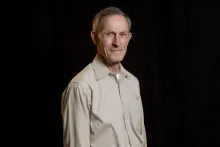
David Mills was born near Wallace, North Carolina, in 1939, where he grew up on a family farm. After high school he attended Ambassador College in Pasadena, California, and he graduated in 1962.
Since that time he has served as a minister of the Church in Washington, Florida, North Carolina, South Carolina, Oregon, West Virginia, and Virginia. He and his wife, Sandy, have been married since 1965 and they now live in Georgia.
David retired from the full-time ministry in 2015.
