
Robin S Webber
This transcript was generated by AI and may contain errors. It is provided to assist those who may not be able to listen to the message.
And I'd like to talk about transitions today. But all of us in that sense are in transitions. And it's good when we are turning chapters in our life or turning chapters in our congregation. And kind of what I've noticed is that those chapters change decade by decade. I don't think life takes a vacation unless you live on a different planet than I do. Have you ever noticed that life is basically what's happening that you haven't planned for? And if it does happen, it isn't how you plan for it exactly to happen.
And that is exactly what I would like to talk to you about today, about being in a world of change, a life of change, even for Christians, and things that do not change. And I hope that the message that I'm going to be able to bring to you this afternoon will be one of reality, one of encouragement, so that all of us can be able to walk together in the future as God's children. In Proverbs 29 and verse 18, I will just read it as a beginning foundation of this message.
It says, where there is no vision, the people perish. That's from the King James translation. In the New King James, it goes this way, where there is no vision, the people cast off restraint. And then again, in the New Living translation, a more modern translation, and it is a translation, it says this, when people do not accept divine guidance, they run wild.
God has, for each and every one of us, provided a vision. And I'd like to talk about that to you today in a very personal level, because I realize, as I've mentioned, some of the individuals that are transitioning, and as this congregation is transitioning, all of you that are out there somewhere in your life are transitioning from one chapter to the next.
Some chapters are wonderful. Some chapters are desired. Some chapters are not desired. Some chapters are those that, indeed, we have planned for another chapter to come upon us like a thief in the night. All of them, all of them, are designed for our development. All of them are designed for our growth, even when it's the last chapter that perhaps you and I want to be in personally.
With all of this change, with all of the change, with all the transitions that occur in life, I personally anchor myself by what it says in the book of James, the book of wisdom that is found in the New Testament, that mentions to us that every good gift and every perfect gift is from above, from a Father above in whom there is no variableness, and where there is no turning, and there is no shadow of turning, that His purpose and His goal for each and every one of us to share eternity with Him and with Jesus Christ remains in place.
So what is that vision? What is the spiritual guidance that I may be able to share with you? I'd like to invite the congregation to open up the Scriptures with me. Let's turn to the epistle of Philippians, one of Paul's writings, and read through it together, and then we'll build upon it. In Philippians, in picking up the thought in chapter 3, Paul is speaking about his past.
Paul is speaking about a life that had been planned by his parents and by himself, and being involved in a way of life and in a culture that had been basically extant for hundreds, if not over a thousand years. And all of a sudden, there was a transition. There was a movement from one place to another that God allowed and that God was behind, and that God wanted the Apostle Paul to grow in. Let's pick up the thought, if we could, in Philippians 3, and picking up the thought in verse 7.
It's almost like a balance sheet. There are losses and there are gains. Seemingly, there are deposits and there are prophets. And Paul moved forward and did not look at what humanly would look like a deficit or a loss. He considered it an honor as he moved forward in a life that was in transition. In verse 9, and being found in him, or abiding in him, not having my own righteousness, which is from the law, but that which is through faith in Christ, the righteousness which is from God by faith, that I might know him and the power of his resurrection and the fellowship of his suffering, and being molded or conformed by his death.
If by any means I may attain to the resurrection from the dead. Very basic, very foundational. And then verse 12, Paul has what we might call an honest moment and an inward reflection. Not that I have already attained or am already perfected, but I press on that I may lay hold of that for which Christ Jesus has also laid hold of me. One of my favorite verses that always brings me back to a reality when I come to those middle chapters of my life when I'm in transition, that why and where we are today in our lives, and why we do what we do and why God is doing what he is doing with us today, is not just simply because we've come together as an assembly of Bible believers.
We have not just come together because I happen to agree with this in the scripture, or I agree with that in the scripture, but God is doing a marvelous work. And it can't get any more tangible or graphic than this, that what Paul is saying is that God grabbed a hold of him, took him out of this world of darkness, took him out of going down the stream of life with the rest of the fishes, and said, I'm going to grab a hold of you. Very graphic. And you're no longer going to be going downstream, but like in the northwest, you're going to be going upstream like a salmon.
You're going to reverse course. You're not going to be like everybody else. I'm going to grab a hold of you. I've got a design for you. I've got a future for you. And thus, as I've grabbed a hold of you, now you grab a hold, you grab a hold of that which is important. Have you ever thought in your life that God tangibly reached down and just grabbed a hold of you, took you, grabbed a hold of you, and put you in a place to where now you could grab a hold of the things that are important to Him?
That's how Paul felt about it. Brother, and I do not count myself to have apprehended, but one thing I do, forgetting those things which are behind, and reaching forward to those things which are ahead, I press towards the goal for the prize of the upward call of God in Christ Jesus. The analogy there is very important. I press towards the goal.
I think all of us at one time or another have been in a race where we see in that gun lap, and that gun lap as they come around, and you see those runners, and they're going towards the finish line. They're going towards that tape, and they literally, it's almost as if they extend themselves beyond where they are at. They put their chest out. They want to, they are pressing, they are moving, and it's in all of their being. To finish the race. And that's Paul's comment here. Therefore, let us, as many as our mature, have this mind, and if anything you think otherwise, God will reveal even this to you.
Nevertheless, to the degree that we have already attained, let us walk by the same rule, and let us, and I can colloquialize that today and make it personal, and let us, as members of the body of Christ, and as members of the Seattle congregation, be of the same mind. The message that I would like to give you today is a very simple, it's a very simple title, and I hope it will stick with you. And it is simply this. Looking up and leaning forward. Looking up and leaning forward. That is my encouragement to you today and to every member of the body of Christ, wherever I drop in on his Sabbath day, is to look up, not look around, and to lean forward, and not to look back.
Yes, understand the past, but the past has come and gone, and we are in the present. But God is in the future and waits for us to meet us, to greet us as we press forward through all the different challenges at times that we have not planned for in our marriage, in our employment, in our child rearing, in our neighborhood, on the job, and do I dare say, in a congregation, even with friendly-looking people like all of you. This is the growing ground. God never called us to be in isolation.
This way of life, Christianity, is a contact sport. It's a contact sport in which you must come into play, in place with other hearts and other lives and other minds that don't necessarily come from the same direction as you do at this point. And we must learn to walk together.
With that stated, I would like to give you five specific points today. If after three hours I'm only on point one, that's all you'll get. That's supposed to wake you up. But there's five things that I would like to share with you this afternoon that I hope will encourage you, that we can all come together and be of one mind and one heart as we proceed in this transition period and in supporting the interim pastor and praying for he and his wife and praying for one another, that we can move forward as a congregation.
And what we need to do then is to remember that without a vision, a people perish. So let's look at five facets of that vision. I'm simply here as one Christian to another today. I just have an opportunity to be able to share the Scripture. You'll be able to share the Scripture another Sabbath, another day. But I've been asked to come here to share with you some very foundational points of following Jesus Christ. Remember what he said. The first thing that he says to a disciple, and the last thing that he ever says to a disciple, is simply two words.
Follow me. And in that following there is a journey. There are mountains, there are valleys, there are plateaus, there are dark spots, there are bright spots. But wherever we are, the request never changes. Follow me. Number one, first point about the vision, to realize why we are here is Christ grabbed a hold of us, and now we grab hold of the things that the Father and the Son want us to grab a hold of.
The first grab a hold of, how's that? It's simply this. We are called to be holy. We are called to be holy. Out of the echoes of Leviticus comes the famous chant, Be holy for I am holy. We are not called simply to be gatherers and collectors of knowledge. To be like bees on a spring day, going from rose to rose, or flower to flower, bush to bush, and gathering pollen, and gathering knowledge, and collecting words out of the Bible.
We are to be holy. Holy is something completely different than simply being good, or very good, or very nice. Those are all human qualities that of and by ourselves we can, ourselves, obtain. God has called us to be holy, to remind us, and to refresh ourselves that God has called us to be a covenant people.
Covenant is a large word that crops up in the Bible, whether it's in the Old Testament or whether in the New Testament. And what we need to understand, friends, is simply this, that there is a difference between a covenant and a contract. A covenant is a formal binding agreement. Not a contract. A contract is a piece of paper made for lawyers. To find loopholes. To find ways around. To bind us when we don't want to be bound. A covenant is completely different. Let's remember that our covenant at baptism and our covenant at marriage have many of the same things going for them. They are until death do we part. They are for life. They are for thick and thin. They are for mountain and for valley. They are for richer and for poorer. They are through all the chapters, all the transitions of life, knowing that we have given and offered ourselves and surrendered ourselves to Jesus Christ. And that we are espoused to Him for life. That is a covenant versus a contract. Join me if you would in 1 Peter 2. In 1 Peter 2. And let's pick up the thought if we could in verse 9. Peter speaks of this. And defines what the body of Christ is like. He says, but you are a chosen generation. Remember, Christ grabbed a hold of us that we might grab a hold of the things that are of value and importance to God the Father and Him. We notice Him, but you are a chosen or, shall we say, grabbed or selected people. A royal priesthood and a holy nation. His own special people that you may proclaim the praises of Him who called you out of darkness into His marvelous light. Who were once not a people, but are now the people of God. Who had not obtained mercy, but have now obtained mercy.
So we are, by God's words, to be a holy people. The word holy there comes from the word haggiah. It's the same word that is used for being set apart and or to be sanctified. To be placed in a position to be used in a very, very special way. And to notice that. And that's where the word saint comes from. It comes out of that same haggiah expression out of the Greek. My question to you for a moment that only you can answer, but the Bible also gives us that answer. What makes such a covenant to holiness possible? Because it's not human. What makes it possible? Join me if you would in 1 Corinthians 6. In 1 Corinthians 6, I'm picking up the thought here.
In verse 19. In 1 Corinthians 6, I'm picking up the thought here.
Because sometimes we have to be reminded. We can kind of sometimes, whether we're in Los Angeles or Riverside or in San Diego or in Seattle or up here in Cedral-Woolley, we come, we go. The sun rises, the sun sets, the moon rises, the moon glows, the moon sets. The seasons come, the seasons go, we come into church, we sing in church, we learn something in church, we try to practice it on Monday, Tuesdays and Wednesdays and sometimes Thursdays.
And we get into a rhythm rather than grabbing a hold of an incredible reality that God the Father has done through us, through Jesus Christ. Verse 19.
The reason why we exist, the reason why we draw breath as people in this way of life is to glorify and to worship God, not just as we come together on one day out of the week, but every day and every minute and every moment and every need and every heart that we come into contact with.
That we are not our own person, but we have surrendered to God. We were bought with the price. The understanding of antiquity when it says that we are bought, it means that we were redeemed, that we had no way out of and by ourselves. This terminology was in ancient times used of a slave, it was used of a gladiator, it was used of a criminal of which of and by himself or herself, there was no redemption, there was no purse, there was no means, no ways, no value that they could offer of and by themselves. And thus we come to recognize that the grace that has been visited upon us does not come by human works or human hands, but by God's favor, by God's invitation, His intervention, His continuing involvement with us. And that redemption price was no less than the life of the Son of God that we are bought and paid for. And because we have come to understand that and accept that and grow in that understanding. I was baptized when I was of the ancient age of 19. How much more do I understand that commitment? How much more do I understand that commitment today at age 39? No, I can't say that. I'm not a Christian. Age 64.
And how much more do we grab ahold of the things of God today because we love Him, because He loved us first. And that holiness and that love and that desire that moves simply beyond our thoughts, words, and deeds, but are the motivation of the why we do what we do. Not just simply what people see, maybe the good things that people see, but sometimes people do good things for wrong motivations. But that our motivation is godly like God, where it's outflowing and outgoing away from self. And that because He's called us to be this holy people. How much is our love affair with God growing? How much more do we love God today in 2015 than when we first met Him in 1975 or 1985 or 2005 or a year ago? Can we talk? I remember the first time I told my wife that I loved her. And I really meant it because I was the oldest I'd ever been before. I was age 19. And I told her that I loved her.
Now today, after years of dating, 41 years of marriage, three children, seven grandchildren, and a life of valleys and plateaus and mountains and many a transition. Because it happens to all of us. None of us have a silver spoon. And I will yet have transitions in my life. And yet when I tell my wife I love her today, how much deeper that means, how much richer that is, how much more volume is there? That's where a holy people should be. That what we do and why we do is in faith towards God because He was faithful to us first. And thus with that faith and with that desire we look forward to the future. We walk and we bounce and we step with a joy and an enthusiasm. Not just simply because of what we know, the Greek, the Hebrew, the parlance of the Scriptures, the understanding of our distinctives. But because there's a great joy in life, there's an enthusiasm in life, there's a vigor in life. Not simply because of what we know, but because of what we can share with others. Can I share something with you? I remember years ago in the auditorium.
As I was the pastor of the auditorium, we'd have many speakers come in and I would introduce those speakers and there'd be special music and then they would go out. Have you been in the auditorium? Some of you saw videos from the auditorium years ago. And those speakers had everything on their notes. They had all their words down and they had all this, perhaps all the right scriptures. But they were going to go out and speak to 1,200 people. They can kind of make you nervous sometimes. And just before they went out, I'd hold the curtain and I'd kind of push them out.
I'd say, feel the joy.
Feel the joy. I've got to get through my notes. There's going to be 1,200 people staring at me. 24 eyeballs. Think of it that way.
No. Understand the experience that God has put us in to worship Him, to be a holy people, to feel that joy. And a joy so much that I love this hall because there's open windows, open doors, lights coming in, that in all of our churches in the United Church of God, we want to be known to have open doors to people.
We want to be known as the people that open up the Bible, and thirdly, we want to be known as people that open up their hearts to others, even when sometimes we don't understand them at once. But to recognize that God is calling them just as much as He's calling you and me, and His mercy has been visited upon them just as much as it's been visited upon you and me. Brethren of Seattle, point number one, grab a hold that God has called us to be a holy people.
Number two, let's grab a hold of this point. God starts what He finishes. God starts what He finishes. Let's remember that all of us, to use the examples that are in the New Testament, we're in a race, 1 Corinthians 9. I've already alluded to it a little bit, but in 1 Corinthians 9, Paul, who must have seen some of the games because he keeps on alluding to it, join me if you would there in the epistle of 1 Corinthians, verse 24. Notice what it says, do you not know that those who run in a race all run, but one receives the prize.
Run in such a way that you may obtain it. And everyone who competes for the prize is moderate or temperate in all things. Now they do it to obtain a perishable crown, but we for an imperishable crown. It used to be that they would have what's called in the Greek the staphanos, that laurel of wreaths that would be in that sense the victor's crown.
Sounds really wonderful, but if you've ever had olive wreath, you know, after about a week, they don't look so good, just like roses. It comes, it goes, it's corruptible. But God is offering us something else. Therefore I run, not with uncertainty, and thus I fight, not as one who beats the air, but I discipline my body and bring it into subjection, lest with I preach to others I myself should become as qualified.
Paul is just not going through the paces. He's not just breathing up and down. This race, and or this walk, and following me, and following Christ, and in heeding the call of God the Father, is for a purpose. It's to move us towards eternity, and a relationship with God Almighty and Jesus Christ forever that is going to be so intimate, that is going to be so immediate, that is going to be so wonderful, that nothing on this earth, nothing on this earth is worthy to distract us from it.
God starts what He finishes. How long is the race before you and me? I don't know. Do you? I don't. Some of us have been called to run a sprint. For some of us, it's a marathon, isn't it? And sometimes, because of where we're at, and our minds are our hearts, it can seem a whole lot longer.
I do not know how much longer I have to run as a Christian, because that's how I see myself first and foremost, just like all of you. I'm just a follower.
I'm a Christian. I've also been given a responsibility in this time and in this age. But why do I run? Do I run in fear? Do I run in dread of what is out there? Or do I look up? Do I look up? Do I remember that I have been redeemed? Do I remember that God's favor has been upon me and visited upon me and visited upon you? And thus, why do I run?
Why do I come up to Seattle to share the Word of God with you? Why do I go here or there? Why do I go back to Cincinnati four or five times a year on the board? Why do I have the responsibilities that I have?
I remember the movie years ago. Some of you might remember Chariots of Fire. Did anybody remember that? That's getting ancient now. I didn't say Bing Crosby or George Bryan. Moving it forward. Got to watch this audience. But the story of Eric Lidle, the Scotsman who ran, and his fiancé is kind of like this at him right now because she's kind of had it up to here. And he's about to do something that she doesn't want him to do. She wants him to go and be a missionary over in China, which he was, and later on died in China, if you follow that story, under Japanese occupation. But finally, in kind of desperation, he says, why do you run? And he said, I run to feel God's pleasure. I have a question for you. Dear friends in Seattle, family of God, why do you do what you do? How long is your run? Is it a sprint? Is it going to be a marathon? Only God knows. I don't know. But every step that I take, and every step that you take, why do you take the steps that you take? What motivates those steps, and why do you run? I personally, and it can only be a personal statement, I run to feel God's pleasure. I live this way of life.
I have faith in God, and I know you have faith in God because you want to feel His pleasure. You want to experience Him. You want to have an intimate and a deep relationship with Him. That's why I run. But we do not run alone. Join me if you would in Philippians 1. Philippians 1. Let's pick up the thought here.
In Philippians 1, a familiar verse, but an anchor verse. Notice what it says. Notice, being confident of this very thing that He who has begun a good work in you will complete it until the day of Jesus Christ. Being confident. Notice, of this very thing that He who has begun, and the word begun there is a Greek word that was often used in actually extra-biblical literature, speaking of sacrifices, of a beginning. So the very context, which maybe you've never thought about, is in doing this, it is speaking about our surrender, and it is speaking about our sacrifice, and at times in faith when we don't really see the end of the race, the whys, the whos, the where's, the what's. And we sit down by Job on the bench and we say, Lord, what's happening? That bench has got to be really crowded, because I've been on that bench with a lot of other people.
But the very thought that whatever God has begun, He will stay there till the end is an incredible and a wonderful thought. Join me, if you would, in John 10, 27, the Gospel of John, in verse 27, a real verse of encouragement.
Have you ever read that verse before? As Paul said, God grabbed a hold of me, and I am to grab a hold of the things that He has placed before me. If you want to grab a hold of a very grabbable verse, in those lonely moments, those spurt moments on the sprint or those long moments on the marathon, look at John 10, verse 28. God says, and this is a promise that you can take to the bank in your heart, that when God has started, He will conclude, and nothing shall deter Him or derail Him or snatch you out of His hand, no matter what is happening here. Let's go to point number three. Point number three. Something that God wants us to grab a hold of. A few long words here, but maybe you can jot it down. Is loving like God loves is God's goal for us. Loving like God loves us is God's goal for us, and nothing short of us. Let's think about that for a moment. Join me if you would in John 13, verse 35. In John 13, verse 35.
On that night in which He was betrayed.
After everything that Jesus had shared for three and a half years, He brought it down to this. By this we'll all know that you are my disciples, my followers. That you're the real deal.
That you're just not a scriptural almanac.
You're not just a glossary of doctrine. And biblical information is important, and doctrine is essential. Doctrine from the Greek word means teaching. But this is the real McCoy. This is the real deal. This will be the sealer. This will be how men know that you have a surrendered life to me.
If you love, notice one another. And that love there out of the Greek is agape. Outflowing. Outgoing concern for others. Can we talk for a moment? May I? May be you're on the same globe I am. There are some people that are not lovable. At first, me. Or second, Greek. Or third, time around.
That's how the church, during Jesus' ministry, thought. What are they doing here? Who are those people? Who let them in? Isn't that out of a... Who let the dog... What was that thing? Who let the dog out? Well, I'm going to reverse that. Who let the dogs in? Who are they? Jesus always welcomed a stranger. Jesus always welcomed those that were off the plate of humanity. He welcomed the lepers, He welcomed the widows, He welcomed the women, He welcomed the Samaritans. What made Christ... Righteously furious were those that thought that they were all put together so well, of and by themselves. Remember the famous story where He's talking to people. And all of a sudden, the church of that day, the Sadducees and the Pharisees said, Oh, look at who He surrounds Himself with.
And then the famous line comes out of Luke 15, and so... And He talked about the one shape versus the ninety and nine. He talked about the one coin versus the other nine, the one that was missing. And then He brought it down so very personal to human relationships of the Son and the Father.
All churches need to be having open doors. We need to have open Bibles, sharing the sure truths and the doctrines of God, and allow God to do His work with people in His time and in His way, because each and every one of us are individually wrapped. God starts what He finishes. Let's go to point number four. Let us grow in grace and knowledge. Let's grab a hold of that. Let us grow in grace and knowledge. Join me if you would in 2nd Peter 3, 18. You know, I've been talking about faith, and the lady behind me gave me this kind of Seattle-like watch. It's a Google watch, and none of you really realize how decrepit I am of technological skills. And I can't turn it on, so I don't know what time it is. So, Mr. Holiday may be a prophet. Okay? So, anyway, here we go. 2nd Peter 3 and verse 18. Let's take a look here.
Let's see what it says and see what it doesn't say. Notice what it says here. 2nd Peter 3 and verse 18.
But grow in the grace and knowledge of our Lord and our Savior Jesus Christ. To Him be the glory both now and forever. Did you know where we are to grow and how we are to grow, and to whom we are to grow in, is God's greatest gift to us? His Son, Jesus Christ. And that marvelous example that came to this earth for three and a half years now reigns above at the right hand of God. We are to grow. And notice that. 1 Corinthians 1. How do we grow and what do we grow in? 1 Corinthians 1.
Paul here was speaking to a congregation. That was, indeed, in transitions. But He was trying to center them. And we notice what He says here in verse 26 of 1 Corinthians 1. For you see your calling, brethren, that not many wise according to flesh, not many mighty nor many noble are called, but God has chosen the foolish things of the world to put to shame the wise. And God has chosen the weak things of the world to put to shame the things which are mighty and the base things of the world, and the things which are despised God has chosen. Just like He chose ancient Israel as a slave people to show forth His glory, He is incorporated within the Israel of God today. A people that are weak, a people that are base and are only mighty and strong in Him, that no flesh should glory in His presence. But of Him you are in Christ Jesus who became for us wisdom from God. And notice what the wisdom was about. It was not about things that are esoteric, but things that are of that which is holy, of incorporating the mind and the love and the motivation of God the Father and Jesus Christ. Notice what Paul centered on, who became for us the wisdom from God and righteousness and sanctification, or being set apart, and redemption. Thus, as it is written, He who glories, let Him glory in the Lord.
What was the wisdom? That God imparted through His Son to us. Unfortunately, times today, people think that wisdom is to take a bunch of numbers and come up with a date when Jesus Christ is going to come back on their time schedule.
But they were not listening to what Jesus said. No man knows the day or the hour. And then some people say, well, that's fine, but they didn't say the month, so I'm going to get to the month.
If we knew when Christ was coming back and we had it all figured out on our little computers, it would be by our works. It would not be by faith. This is where the body of Christ needs to be today, is understanding that the righteousness of God has been given to us, planted in us, growing in us. Now, it's just not His righteousness flowing through us. We're not robots. Our effort is to surrender ourselves, to acknowledge that it's by His mighty hand, it's by His love and His grace, and the faith of Christ in us. Not only the faith in Christ, but the faith of Christ in us. That Holy Spirit that allows us to appreciate that God is molding and spiritually circumcising, if I can use that word, shaping and grooming us.
And what a wonderment! What a blessing! Ain't yet a challenge, because we're still in these human tents.
We're to grow in grace and knowledge. Knowledge is important. God has revealed a wonderful truth to us. Truth of a Holy Sabbath day. Truth of the meaning of the biblical festivals. The understanding that this world is not going to explode or implode, but that Jesus Christ is coming back to this earth. It is not theory, it is not a myth, it is not just something that's kind of in the corner of our minds. It is our hope, it is our prayer. Thy kingdom come.
It's real to us that are members of the body of Christ. We can taste it, we can feel it. We want it so very badly, especially as we see what's going on in the world today. But with all of that said, Jesus said, by this will men know that you are my disciples, if you have love for one another. Did you ever notice that knowledge is not a fruit of God's Holy Spirit? Knowledge will go to the grave. But as we incorporate that love of God in us, and God sees our surrendered lives and our desire, even when we will trip up over it, even when we will blow it, even when we are not loving, God knows above that we want to practice His way of life, and yet we will stumble. That's sometimes the frustration of the human life. There was a kid one time that said, Mommy, no kids always have the questions, don't they? Like the old ArtLink letter days. Mommy, I've got a question for you. You want to get baptized, but I heard that if you get baptized, you're going to still sin. So why get baptized? Have you ever asked yourself that question or no? Why get baptized if you're going to sin? It was a wise mother, and the mother said, Honey, Honey, said, Before baptism, I was running towards sin. After baptism, I'm running away from sin, but there will be stumbles both ways. But when I stumble after baptism, God knows my heart, God knows my desire, and I know that I do not run that race alone.
Good question from the kid. Wonderful answer from the mother, and something that I remember when I stumble. That you and I, and what we express to this world around us more than anything else, is what a gracious and a loving and a forgiving and a redeeming God that we have.
Join me if you would in Ephesians for a moment. Ephesians 4.
I want to show you something that's going to be very important when it comes to loving. Ephesians 4. I recently mentioned this to the General Conference of Elders, and I will share it with you. Because I believe that in part this is the vision. Remember, where there is no vision, the people perish. I believe that this needs to be the vision within the body of Christ today. I therefore, verse 1, the prisoner of the Lord. Paul never called himself the prisoner of Rome. You can check it out.
Life to him was not an accident. God had a purpose and a plan for every transition, and everything that was occurring in his life. He never called himself the prisoner of Caesar or the prisoner of Rome. He was God's prisoner. His life was for a purpose. Beseech you to walk worthy of the calling with which you were called.
So we are not just a trip through life and kind of study this and study this and get into this. We are to have a life that is worthy of the calling of why God grabbed us in the first place, and therefore grab those things that are worthy. This is what is worthy. That we live a life with all lowliness, all gentleness, with long suffering, bearing, carrying, as it were, one another in love, and endeavoring to keep the unity of the Spirit and the peace. We are called the United Church of God, this particular fellowship within the body of Christ. It's quite a name to move towards, to look up and to lean forward towards. Paul was a man of antiquity. Paul was a man that would move from the Jewish world to the Greek world to the Roman world. And even as he moved to the world of Asia Minor, there were Phrygians, there were people that were Asians, there were people that were Pontians, there were people that were just all sorts of different people, but they were all being called to a great calling.
But he recognized that the differences might get in the way.
And so it is here in Ephesians 4, he says, if this body of people is going to stick together in the transitions that will come to them, thus and then, this is what they need to focus on as people come in through the door, as people visit us for the first time, as sometimes people will disappoint us, as sometimes people will actually, do I dare say, get us a little ticked? Mad! And we want to separate from them for some purpose or some reason to go back to these very basic points. And what Paul is asking you and me to do, whether we're in Seattle or Los Angeles, Las Vegas, Riverside, or Timbukh 3. Have you heard of Timbukh 3? That's the suburb of Timbukh 2. That's in Mali. God is asking us to major in the majors and not to major in the minors, to always bring us into this realm. There is one body. There is, that is a spiritual organism known but to God. God alone knows who are His. God alone reads the hearts. God alone gave His Son that those people might be redeemed. There is one body and one spirit, just as you were called this birth canal, in one hope of your calling, one Lord, one faith, one baptism, one God and Father of all who is above all and through all and in you all, pervasive, abounding in each and every one of us.
When the children of Israel were down in Egypt and they were introduced to Pharaoh, the one line that came out of those 11 rascals, because that's what they were at that time, apart from Joseph, and what brought them together before the greatest man on earth at that time was S. They simply said, we have a Father.
Even with all of their differences, they said, we have a Father. The spiritual Israel of God today, Galatians 6, 16, each and every one of us have a common Father. That's why we need to look up and remember that. Now look around, but look up and understand what God is doing, because we're different. God, in His wisdom, is not creating yellow pencils. He's bringing in all sorts of people, men and women from every group, every background, every personality. And sometimes, you know, it can get a little frustrating when we don't understand what God is doing. When you look at the Scriptures, when you look at the Bible, you look at just the New Testament, you recognize for every Peter there was a Paul, for every Barnabas there was a Sylvanas, for every meat eater there was a vegetarian, for every Jew there was a Gentile, for every slave that was in the church, the slave owner might be right by Him. It was diverse. It was unique. It's always been that way from the very beginning. God is not in the process of creating yellow pencils. He's creating a divine family of immortal children to share eternity with Him.
How incredible is that? Thus, how patient are we as a people when we see God go to work on everybody else? The bottom line, brethren, is simply this. God, in His greatness, is calling us and imbuing us with His Spirit of love to develop a patience to see Him work on each and every one of us. Sometimes it's challenging because we all look at things different ways. That's what happens. We all look at things different ways. Sometimes we can look at church in different ways. Sometimes we can say, well, I'm coming to church today. I hope the speaker's up to it. I hope the preacher's in the mode. I hope I'm going to get something out of services rather than what Mr. Holiday mentioned about. Let's work together as a family. Let's work together as a family and see what together we can do, recognizing that one plus one does not always equal two, but with God's Spirit it can equal three. But sometimes our perspectives hold us back. It reminds me of the story of the three men that were overlooking the Grand Canyon. How many of you have been to the Grand Canyon before? Anybody? Good. Always know the audience. And there were three men. One was an artist, one was a pastor, and one was a cowboy. And they were all looking at the same canyon. And the one man, the artist said, oh, what a wonderful thing to put on canvas.
Well, the pastor, knowing the pastor, what he would say, what a wonderful testament to the creation of God. And then you know what the cowboy said? He said, what a horrible place to lose a cow. That's how life is. We all come in with our different perspectives. I'm going to abbreviate this and bring this because I'm going to read something at the end. I think I've made my point today and I hope you've heard me. We are in transitions.
Whether it's the fourth point or the fifth point, I'm going to bring it to you. We all serve in the body of Christ. I really liked what Mr. Holiday mentioned here today. Let me just speak for my heart. My favorite story. Some of you have read this when I've written about it in the different magazines that we have. My favorite story. You say, well, what's your favorite story in the Bible? I'll share my favorite story in the Bible because it means a lot to me. Seeing I have the microphone, I'll share my story right now. My favorite story is the story of the little boy that is in the midst of the 5,000 people.
What is very interesting is, again, if you want to read the story later in John 6, there's a disciple. His name is Andrew. You say, what is my gift? What can I do in this congregation? You don't hear a lot about Andrew, but the things that you hear about Andrew, you know what Andrew always did? He always connected people with Christ. That was his gift. He brought them and put them right in front of him, and the rest is history. Andrew was a little...while all the disciples are trying to figure out the programming... Okay, Christ, you got us in here. 5,000 people. Oh, boy, great. What are we going to do? There's not enough bread in that village down there to feed this crowd. Andrew brought the little boy. What did the little boy do? The little boy shared his little lunch of fish and loaves. Have any of you ever shopped for a hungry man dinner in the market? It was less than a hungry man dinner. And that little boy, he gave Jesus that fish and that loaves. And he fed the 5,000, which set him up later for the next chapter talking about him being the bread of life. My question is this. What would have happened if that little boy had not shared what he had? But what that little boy did...and I hope all the young people are hearing out here, because that's a great story for young people. What that little boy did is he shared what he had. Not what he didn't have or what he could become, but he shared what he had. What he did was he gave his little and God made a lot out of it. But the point is this. If we do not give God our little, whatever our little might be, then God has nothing to work with. But if we give him just our little, what we have to give...in this day, at this time, in our life... God can take that little and make history. And by you giving your little, you glorify God, you worship God, you abide in Christ, you are doing what God asked you to do. Dear friends, here in Seattle, I don't know if I'll be coming up again in another three years, but it has been a pleasure being able to speak the word of God with you for a few minutes. When I see a group this large of 120, 125 people, whatever it is, I realize there's 125 stories out there. And I realize that right now we are in a transition in this congregation. And I will continue, as Mr. Kubik will, as Mr. Holiday, David's father, and all of us continue to pray, that we can glorify God in this transition and move forward. There are some things that we will never understand in this life, one way or the other. And just like Job, sometimes we have to leave things to God and to pray about it and move forward as a people.
What I will say is this, I'd like to share a story with you. Everybody likes a story. Christ told stories. I'll tell a story. And I do not know, as one Christian to another. That's all I am. I'm a man, I'm a Christian, I'm a person, I have an opportunity to share the Bible and share stories. But I want to finish with this story with all of you. Whether there is something in your life that you have not planned for, you do not think that you are up to at this moment or at this time. Or you say, I've gone through this again and again and before and before. I'm just getting too old for this. I've just gone down the stream of life too much and I don't have it in me. No, you and I may not have it in us in dealing with our marriage, in dealing with our job, in dealing with our employment, in dealing with our children. But God said that He would never leave us nor forsake us. He said, when He has begun, He will finish. May God bless each and every one of you here in Seattle with the hills, the challenges, the transitions that await you. And as all of us do not simply climb any hill, but the hill towards the kingdom of God, let's remember that we walk not alone, that we follow in the footsteps of Jesus Christ, and that His Father, our Father, our common Father, who works within us, through us, with all of us, said that He will never leave us nor forsake us, as we move upward, as we look up and lean forward towards the kingdom of God.
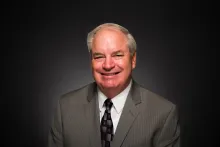
Robin Webber was born in Chicago, Illinois, in 1951, but has lived most of his life in California. He has been a part of the Church of God community since 1963. He attended Ambassador College in Pasadena from 1969-1973. He majored in theology and history.
Mr. Webber's interest remains in the study of history, socio-economics and literature. Over the years, he has offered his services to museums as a docent to share his enthusiasm and passions regarding these areas of expertise.
When time permits, he loves to go mountain biking on nearby ranch land and meet his wife as she hikes toward him.
