
Robin S Webber
This transcript was generated by AI and may contain errors. It is provided to assist those who may not be able to listen to the message.
Let's just get the title right out in front of us, and it is simply this. Overcoming. Oh, the overcoming word. Overcoming, though, in this title is this. Overcoming to the finish.
When you think of something that is really big, really, really large, what comes to mind, let's just kind of think about, think of the biggest object, biggest structures. David talked about a little bit in his very fine message to begin with, but let's talk about some big things that kind of fill the space of our minds. Well, we could talk about, as he did, the Sequoia tree.
The Sequoias, we think of Sequoia National Park, and even up in the the coast range up around Eureka, those trees get up to about 370, 380 feet tall. That's 38 stories. Think about Sequoias. If we think about buildings, we might think of the Empire State Building.
We might think of the merchandise mart along the Chicago River.
We might think about the Pentagon, one of the largest buildings that are on Earth. If we're thinking about geography, we might think of the Grand Canyon and how vast it is. We might think of it on the ocean. We might think of mighty and high waves, or sometimes we've unfortunately seen these news events of the the swells of a tsunami, the great swells of a tsunami that can literally go miles inland. We think of great acts of history. We think of the the invasion of the beaches of Normandy back in 1944 and how great that was. Or we think of what is often called in history the great armada, the Spanish tried to inflict upon England back in 1588. Here's one for you to think about great. Sometimes you see this in scientific magazines or books where they show you the size of the earth up against the size of the sun. The earth looks just like a speck of a pea that is kind of engulfed in just one little solar flame of this star that is really just a mid-sized star when you study astronomy and you begin to recognize how immense things are. Well, I hope I've stretched your mind a little bit here for a moment in the subject of largesse or those things that are great, but now let's talk about something that we all need to deal with. But at times nothing looms bigger than the object confronting us that stands between us and happiness.
In this battlefield up here, between these two ears, because this battlefield is larger than thermopoly. It's larger than grannicus. It's larger than normity. It just goes on and on like radio. It just has a width and the depth and a band that cannot be boxed. What are you dealing with today in your life that you have not overcome? What is in your life that seems so large and so great?
Kind of dealing with the trees that David dealt with, the tree that blocks the forest of God's promises and God's blessings, and Jesus Christ's invitation to follow me. What is so great that is happening in your life? That it is paralyzing you, has stymied you, has in a sense cast you in cement to where you cannot move and where you cannot break free. In other words, that challenge, that trial, that which is within our human frame that just seemingly never, never goes away, that you and I carry around with us like a comfortable old purse, like a comfortable old wallet that fits our behind. And that sometimes what happens as we go along that we become so familiar with this challenge that seemingly it becomes a friend. It's an acquaintance. It will not go away. And so thus we become secure in our insecurities and we leave it alone and we wake up with it day in and day out and go to bed with it day in and day out. Now, with all of this said, in our up moments as Christians, we hear what is spoken in John 1633. Let's take a look at it. Let's open up our Bibles. That's why we're here today on the Holy Sabbath day to be refreshed by the Word of God and to get those roots down deep that David was talking about in the first message. And we realize on the last night of Jesus' life, humanly speaking, he said this, these things I have spoken to you that in me, in me, you may have peace.
You may have peace. You may have confidence. You may have closure. And in the world you will have tribulation. But notice what it says, be of good cheer. Be of good cheer, for I have overcome the world. I've overcome the world. Now, in the Greek here, the word there is nekeo. I may not quite be pronouncing it correctly. Nekeo. And it comes from a legal term. And that means, I have prevailed. I have prevailed. I have conquered. And when we see this statement, it gives us cheer. It gives us hope because we know that Christ has broken through the wall of death. We know that He has deflated the power of the grave. We read it. We get excited. We hear it in church. We hear it on the night of the Passover when the ministry reads the words of Jesus to us to refresh us.
And then we go out the door. We face life. And we recognize that God the Father and Jesus Christ are here. And they bid us welcome. And they invite us to follow. And we see that road set for the kingdom of God, in a sense. But in our enthusiasm, we didn't recognize all the curves, the humps, the bumps, the swerves, the dips, the roadkill that lies in between that halts our advance towards their desire for us to join them. And it blocks our view. We're going to be talking about overcoming today. Your favorite subject, right? To go home and tuck into your heart. Why couldn't we hear something sweet today? Something that kind of soothes our spiritual fancies.
That's why I'm here. To remind you what the Word of God says. Join me if you would in Hebrews 12 Hebrews 12. Overcoming is a part of the Christian journey. It's not just an intellectual exercise coming up against the truth. The truth is that God has called us to be overcomers and to prevail by His Spirit and through the example of Jesus Christ. What do we overcome? We overcome the giants in our life and sometimes just to bring that down to a small word we overcome sin. And we still do. It's still before us all the time. It's just like the little boy that one time he said, Mama, if you're going to still sin after you're baptized, then well, why then get baptized? And the woman thought about it for a moment then said to the little son of hers, she said, Look, before I was baptized, I was running towards sin. After baptism, I'm striving to run away from sin, but I'm still going to stumble. And that's where you and I are. We strive to run away from sin on this journey towards the kingdom of God, but we're still in this human flesh and things are going to happen. And you don't have to get a butterfly net to go out and capture sin. I remember doing that as a boy growing up in San Diego. He used to go out and get little moths and go for butterflies and get our nets and go down the block, go down the other side of the neighborhood. You don't have to do that with sin. It'll come at you. You don't have to even think about it in that sense. Because notice what it says in Hebrews 12 over here in verse 1. Hebrews 12 and verse 1, Therefore we also, since we are surrounded by so great a cloud of witnesses, let us lay aside every weight and notice, and notice this is the Bible speaking, not Robin Weber, and the sin which so easily ensnares us, trapped ensnares the sin which so easily ensnares us, and let us run with endurance the race that is set before us. Now let's understand something. The author of Hebrews is not writing to the pagans in Athens or the pagans that are in Antioch. He's writing to new covenant Jesus followers in the first century. Those under the new covenant, those that have been baptized, and he still says that this sin still will easily ensnares us unless we have the tools, unless we have the understanding of how to deal with that. With that stated, another question, may I, to draw you in. Think about this. Some of you have been in this way of life for a year, some for a decade, some of you for much of your life, multiple decades. Susan and I have had the blessing of being in this way of life since we were young youth. That's kind of a young youth. I have to think that one through. I think if you're youth, you're young. Okay, but here's the question, friends. Can you recall the last real victory you had? Personally, I'm talking to each and every one of us. Me too. Can you remember the last real victory you had in surmounting, in prevailing, the obstacle in front of you? Yes, there was struggling. Yes, there was slipping. Yes, there was climbing. Yes, there was praying. And then you stood on the mountain of victory. You experienced closure. You experienced peace of mind. And you thanked God for his victory, his victory, because that's the underlining part of overcoming his victory over sin through you.
Think about it for a moment. This is where I go still for a moment so you can think. I want you to really ponder. When was the last time you nailed it with God's help? Struggle as it might have been. And I realize I know many of your stories there have been struggles. What about perhaps the struggle you're going through right now?
Tired? Frustrated?
Feel like quitting? Just simply put it on cruise control and accept it. Well, this is me and I'm not going to be able to surmount this. I'm not going to be able to prevail. I'm not going to be able to overcome. God has not called us to fail, brethren. God the Father has not sent his Son, and Jesus did not come down from heaven above for you to fail, but for you to succeed. For you and me to be able to prevail and us to be able to overcome and to emulate the full stature of Jesus Christ living within us and the example that is set before us. Christ's example was one of finishing the job in John 4 and verse 34. Let's turn over there for a second. John 4 34.
John 4 34. In the Gospel thereof, Jesus, speaking early on in his ministry, said this, My food is to do the will of him who sent me, and to finish his work.
Jesus and his mission and his ministry was not underdone, undercooked. It was well done.
It was to the finish. It was across the line, even under death. He was willing to do it. He was able to finish, in fact, his last words. His last words were, It is finished.
Again, allow me to draw you back into this message, may I?
With the challenge that you had before us, that looms perhaps so big in your mind right now, and only you can fill in the blanks.
Are you ready to prevail?
Are you ready to be a conqueror through Christ to fulfill God the Father's will?
It's not enough just to know what is wrong. You have to do something about it. In Romans 12 21, join me if you would for a moment. In Romans 12 21, a very simple, simple, simple, simple, simple, simple, simple, simple, simple, thought here that I'd like to share with all of you that may help you, may help me.
The Epistle thereof written by Paul. Romans 12 21. Just a stuck in there. Let's notice what it says. Romans 12 21.
Do not be overcome by evil. Oh, there's that word. Do not be overcome by evil. But notice what it says.
Notice what it says, but overcome evil with good.
Simply put, God does not operate in a vacuum. Satan does. He loves a vacuum. I'm not talking about your Hoover. He loves a vacuum where nothing is happening, where you are settled, where you are complacent, where you've given up, where you just remain frustrated.
That's where Satan operates best. He loves it. That's his playground.
We are to overcome evil by replacing it with the good. And that's why I'm going to share the remainder of this message with you. And what I'm going to do is I'm going to give you some, are you ready? Some live ammunition. Something to help you and help me to be overcomers and be prevailers. Are you ready? And I just simply call them, if you want to put this down, the three D's. The three D's. And if you will, hear me, please. I'm not up here to waste your time or to waste mine. If you apply this, your life will change. You will become an overcomer. And if you're already an overcomer, you'll even become a better overcomer for God, the Father, and Jesus Christ, as that Spirit dwells in you. You will be a prevailer. You will be a champion in Christ. And you will have closure of mind. You will have peace of heart.
You will no longer be running with this best body that's been echoing in your mind for far too long. So we're going to call these the three D's, which will then allow you to be a three-dimensional Christian and being able to overcome and be able to complete it to the finish. And we're going to pick up the story this way. Join me if you would in 1 Samuel 17, one of the classic cases of a giant killer. You know the story, but you're going to get to know it better as I share it with you. 1 Samuel 17. And we're going to come on to find out a little bit about how one gentleman faced his giant and gave the glory and gave the honor to God. That's the neat part about this.
That's the neat part about it. And we're going to pick up the story in 1 Samuel 17. We know a little bit about the story, David the shepherd boy. And ultimately, he comes and faces somebody called Goliath, which is terms that have come down to our day where people face their giants or face their Goliath. And we pick up the story here. And the first one I want to give you is this, the first D. Because we're going to spend most of the time here, so if you get nervous, like this is going to be a three-hour sermon, don't worry.
You need to overcome that worry. I can see it right now. You're watching, okay?
But you're going to have to understand this. We're going to spend most of the time because the first point, the first D, is the most important. And my question to you is, do you have a desire, a burning desire, a God-given desire through His Spirit to overcome? Because if you don't have desire, God can't help you, I can't help you, and the Word can't help you. You have to have desire. When you go looking for a house for those that have, what do you look for? There are three things that you look for when you go looking for a house, and you'll probably know what the answer is. Location, location, location. And or if you want to use a synonym to that, neighborhood. Am I the only one? Neighborhood and neighborhood. You see, God wants to park Himself into our heart and into our life, into that neighborhood. And the neighborhood He is looking for is an individual that His Son has died for, and that individual that accepted that Son, and is still on fire and has a desire to overcome, to emulate the example of Jesus Christ.
Now, what happens, though, is sometimes we see those giants in front of us. But allow me to share a very brief thought by Oliver Wendell Holmes, for those of you that are a little versed in history. He was the Supreme Court Justice. And Oliver Wendell Holmes put it this way. What lies before us and what lies behind us are tiny matters compared to what lies inside of us.
And that means, then, what lies inside of us means that you have to have a desire, as Jesus Christ did, to finish the work, to be a prevailer, to be an overcomer. You know, sometimes some of us that are out here, we've been out here for 20 years, 30 years, 40 years, and we can just kind of get lulled by life. Kind of said it's over. It's never over. We have more prevailing to do. We need to be overcomers, and we need to have that kind of desire in us. What kind of desire? Very simply put, let me put it down this way. Three points, three easy words. If you want to jot it down, if you're serious about overcoming, you might want to jot it down. If you're just here to be entertained, don't jot it down, okay? But this will work, that you are open. You are open to God's call, and that when that openness is, the bell button is pushed, then that you are available. You are available. Not today, oh no, not today, not tomorrow. I'll do it next month. I'll do it next year. I'll do it next day. No, number one, you have to be open that God wants us to overcome sin. Yes, even in New Covenant Christians, to overcome that which lies within. You have to be open. Then you have to be available. Now, not tomorrow. Tomorrow is the most two-edged word in the dictionary. Great hope, but it can create great despair. You can put it off, or you can do it tomorrow. And number three, you have to be willing. You have to be willing to do it, even if nobody else comes along with you. And there here, then we find the story of David and Samuel. Not David and Samuel, but David and Goliath. Now, let's notice what it says. Verse 17, Now the Philistines gathered their armies together to battle and were gathered at Sokot, which belongs to Judah, and they encamped between Sokoth and Esakah in Ephesus, Deimim. And Saul and the men of Israel were gathered together, and they encamped in the valley of Elah, and drew up battle against the Philistines. And probably some of you have actually been to that valley. How many of you have actually been seen the valley of Elah? Okay, that's all right. It really does exist. Actually, the audience I gave this to before they have been in the valley of Elah. Okay, but we're going to go into that valley with somebody in a few minutes. And Saul and, okay, I mentioned that. The Philistines stood on a mountain on one side, and Israel stood on a mountain on the other side with a valley between them. They were looking for a strategic encounter who would have the upper hand. This is often what happened with the armies of antiquity. They were, in a sense, sizing up one another, just looking for a false move or a good move to get involved. And so there they were. And the champion went out from the camp of the Philistines named Goliath from Gath, whose height was six cubits and a span. And he had all of this equipment. I don't need to go into all of that right now.
When you read about cubits and when you read about span, you go to the different commentaries.
Goliath could have been up to nine feet tall. That's one big tall Philistine. He might have been shorter. I'm 6'1". Anything larger than 6'1 to me is a giant. They're taller. So whatever it was, he was big. Okay, big guy. He would probably dominate the NBA today, except he'd have to have a change of uniform. I don't think he could make it up and down the court. He was big. And not only that, but let's understand something. He was, from his youth, trained as a man of war. He was trained to be like an Apache attack helicopter, like a tank from the time that he was young because of his size. That was Goliath of Gath. Interesting. And he goes out, and what he's going to do is he's going to challenge one-on-one. This is very common in history. If you read Homer, if you've read The Odyssey, if you read about the fall of Troy with the Greeks, that you have the very famous one-on-one battle between Hector of Troy. Some of you are nodding. You've read it. Okay, that's good. You have Hector, and then, of course, you have the boy wonder, Achilles. And so this idea of champions is something that goes back way back because it could save a couple of armies. And so the challenge is there. Now let's move now to verse 8, because now we're going to get into the real stuff. And then he, that is Goliath, stood and cried out to the armies of Israel and said to them, Why have you come out to line up for battle? What are you even doing here? Am I not a Philistine and notice? And you, the servants of Saul, choose a man for yourselves and let him come down to me.
And if he is able to fight with me and kill me, then we will be your servants. But if I notice, prevail, and or overcome him and kill him, then you shall be our servants and serve us. And again, the Philistine said, I defy the armies of Israel this day. You get it up there, this day I am defying you. Notice that. Give me a man that we might fight together.
First mistake that was made here was by Goliath.
Because he was just looking earthbound, looking at that which is in front of him.
He made the mistake of calling the covenant people the servants of Saul.
Covenant people are not the servants of any man. They are the servants of God, the God of Israel.
The God of Abraham and Isaac and Jacob.
Goliath didn't get that. He only saw a bunch of men trembling up on a ridge. And unfortunately, perhaps the covenant people themselves had forgotten who is actually their champion, who was actually there to fight their battle for them. If only they would get out of the way and let him. Is that maybe your case? Has that been my case at times that we think we're just down here by ourselves, that we are the commanders of our own life, that we're an army of one, apart from God Almighty and Jesus Christ? Just asking a question. When Saul and all Israel heard these words of the Philistine, they were dismayed and greatly afraid.
They might as well have had a name tag hanging from their neck. Just two words.
Much afraid. What's your name? Much afraid. Oh, really? Well, I guess everybody's name is the same here because nobody's going down to the valley. Nobody's going to stand up for God's people. Nobody's going to stand up for God's way. David comes along. I think many of us know the story. He kind of come along. He's been sent to the camp to kind of feed his brothers and take care of them. And then notice verse 16. And the Philistine drew near and presented himself notice for 40 days. Morning and evening. 40 days. Now, for any of you that are in biblical numerology, you can 40 days time of testing and trial. They weren't doing too well at 40 days. Okay? That is Israel. 40 days. Have you ever had a headache? No, Anson headache number one. You ever had a headache that just won't go away? Day in and day out or pain in or pain out. I can talk a lot about that over the last four months. Just kind of always there. You're hoping it's good. Oh, it's back. I feel it. Sometimes at night right now, I kind of, you've been some of you've been through that where you're looking for that sweet spot where there's no pain in your leg or whatever part of your body is being affected. I found it. I'm at peace. No, I did not find it. It's back.
You ever had that? Am I the only person that's human here?
Well, this was a headache that went 40 days. Same thing comes out defies the arm of Israel. When will he go away? So he's looking at this. Then let's notice verse 20. So David rose early in the morning and dealing with the sheep and took the things as Jesse had commanded him. And he's going down there as the army was going out to fight and shouting for battle. They were shouting for the battle. That's what ancient people did. If you've seen the movies, they don't always talk a lot about the shouting. There was a, you know, they have men on one side and men on the other side. What do men do, ladies? And they're trying to scare one another, trying to man up over the other. That's a lot of it was psychological and they are shouting. But Israel is shouting for all the wrong way and for all the wrong purposes. They're not shouting God's praises. They're not being inclusive of him. They're just shouting as if they were a nation that was called to prevail, but they don't have the captain in place. And that's the God of Israel. A little bit like Jesus said, in vain do they worship me. In vain do they battle. In vain do they strive to overcome.
Calling me Lord, Lord, but don't do the things that I say.
Dear friends here in Los Angeles, that's not only people that are in other places in the world, other congregations, other denominations.
That can be New Covenant people that believe they have the faith of Jesus, that believe that they're keeping the commandments. But they're not prevailing. They're not overcoming with that giant that is in their mind or in their heart. Then notice, then as he talked with them, there was the champion. And notice he's using the same words. Verse 23, never goes off script.
Never goes off script. Same words every day. You men of Saul. I'm here to defy Israel. I'm here to defy the God of Israel. So they would listen to it all the time. And David just had to hear it once.
You see, he was sensitive. Verse 26, then David spoke to the men who stood by him, saying, What shall be done for the man who kills the Philistine and takes away the reproach from Israel?
God had done all of these wonders for these people for 400 years since the time of Egypt.
And this was a reproach upon them. For who is this uncircumcised Philistine? He's a pagan! After all, that he should defy the armies of the living God.
I want to share something with you. Are you with me, friends?
Did you notice what David said?
David is not just, excuse me, God is not just locked up in the Ark of the Covenant through the Emblems of Israel's past. He is the Living God. Living! Living!
Not like the idols of the Philistines, Dagon or Baal or this or that. Living!
If you want to have a really good Bible study, go through all the verses from Joshua all the way into Revelation that speak of the Living God. The Living God. This is a very big point. When when when when Israel was going to pass over Jordan, are you with me? When Israel was going to pass over the Jordan, God said, the priests shall go first. The priests are to touch the water. They've got to start going into the water before it parts. Oh God, won't you part the water first? Then, no, no. You will take the Ark before you and you, the priest will walk into that water. It was a work of faith and then the Jordan will part. You see, Moses was no longer. Joshua is now in charge. The promise was before them. All they had to do is have faith and confidence in God's grace, God's favor, and know that they worship a Living God. I want to ask you a question. Today, do you truly believe that you worship a Living God alive and well with Jesus Christ at His throne who is pushing and pulling for you, that gave His Son for you to be that example, to go before us, to live within us, His life written before us, in case we lose the script, to have it burned in our heart? The Living God. It runs throughout the Bible. Not just God, but the Living God. Sometimes we get attracted to personnel, personalities. We get attracted to Moses. We get attracted to some pastor today or some movement today. So, Joshua is very important because Moses is no longer. That human deliverer is no longer. He's dead, but the promise goes on. The march goes forward towards that promised land. And so, Joshua reminds the people that we worship a Living God. To the degree that you believe that and understand that is to the degree that you will be a prevailer, that you will be a conqueror, that you will be an overcomer, recognizing that that God has taken up home in our lives through His Spirit and through the Spirit of Christ. And the people that answered Him in this matter are saying, so shall be done for the man who kills Him.
One thing about David that we can emulate. There are things about David in the Scriptures. We don't want to emulate, but one thing here we want to, as a man after God's own heart.
When he saw it, he knew it. He cut to the quick. He got through the, I'll use a Hebrew term, the BS.
And just like those soldiers in Vietnam that had the nighttime jungle goggles, there was no darkness, there was no film. He knew exactly what was in front of him. He knew what was exactly in front of him. An uncircumcised Philistine that was insulting the people and the promises of God.
How about that with whatever is in us right now? Have we cut to the quick? Do we know what our giant is? Do we kind of pet him at night and put him to bed and think he's going to go away?
Not thinking that he's not going to come back. Goliath came back again and again.
I'd like to share a verse with you in Psalm 143. Psalm 143.
And let's pick up the thought if we could in verse 7.
Answer me speedily, O Lord, my spirit, do not hide your face from me, lest I be like those who go down into the pit. Cause me to hear your love and kindness in the morning, for in you do I trust. Cause me to know the way in which I should walk, for I will lift my soul to you. Deliver me, O Lord, from my enemies. In you I take shelter and teach me to do your will, for you are my God. Deliver me, O Lord, from my enemies. When we look at Psalm 17, we notice what it says here in verse 31. Now when the words which David spoke were heard, they were reported to Saul and he sent for him. And then David said to Saul, let no man's heart fail because of him. Your servant will go and fight with this Philistine.
Desire. Couldn't hold him back.
Desire. That's what joy is about. David addressed it a little bit. Joy is not just a feeling. It is a root which is down deep. The joy of knowing that the God of the universe has touched us and called us and to be a part of a covenant people, whether of Israel of old or we that are here today. That's the joy. Let's not trivialize it. Joy is deep. Joy is what's happening when everything out here is not happening well because happiness depends upon external goody-good things happening to you and me. Joy is something that gives us an inner confidence in our heart that no matter what happens, no matter what happens, God wins. Even in death, God wins. We learn that through the resurrection of Jesus Christ, don't we? He wins.
We need that kind of revival, brethren, in the church today of overcoming, of prevailing, of not getting caught up with the siren's song of this culture or those things that have frankly been bugging us, that have been rent-free in our lives for far too long to get fired up like a David and say, send me. Isn't it that beautiful verse in Isaiah 6 and verse 8 where God says, whom then shall I send before me? And Isaiah answers, send me. That was in the spirit of David. That was in the spirit of that greater David. The word, Jesus, who said, send me down there into the thick. Send me down into the valley of this world and I will finish. I'll get the job done. That's the spirit, brethren, that is to lie in each and every one of us. Let's go to point number two. The second one is David had discernment. His responsibility is a chosen tool of God.
What do I mean by that? David had the discerning wisdom to understand that God helps those who help themselves. The more we do, the more God will do through us. See, God does not again work in a vacuum. No, no, no, he doesn't. We notice in 1 Samuel 17 and verse 40, after he threw off Saul's good intentions. See, actually Saul should have been the one to face Goliath, because if you read the Scriptures, it says that Saul was a giant himself. He was head and shoulders over all of Israel.
Right? He didn't go out. He was in his tent. The shepherd boy had to go out. What did the shepherd boy do? 1 Samuel 17 verse 40. As he went down into that valley of Elah, what did he do? He discerned that God was going to help him as he did his part. Then he took his staff to his hand, and he chose for himself five smooth stones from the brook and put them in a shepherd's bag in a pouch which he had, and his sling was in his hand. And he drew near to the giant. Now, why did he do that?
Again, again, he realized that he had to do his part. And he discerned that it might not be easy.
He didn't say, well, one shot should kill this dude. He took five stones. And now I know there's a thought out there about that Goliath had four other brothers. That would have made a starting lineup for the NBA. I don't know. I'm not that old. I wasn't there. Don't want to surprise some of the young people. I wasn't there. That's why commentaries are written. I have a different thought. And that is simply that David was going to get the job done dead or alive. And it was going to be more than one good shot of the sling. So no, here you go. Here's.
I missed. God wants me dead. Great. No, no, no, no. David was going to keep on firing.
David was. And I believe that if he missed, he would have taken his sling and tried to strangle Goliath. That's the kind of guy that David was.
This tells us something very important about life. I'd like to share a story with that. I don't know if I've shared it here. And if I do, I'll share it again. This is oftentimes one of the most oft-used verses that I will use with fellow Christians when they face challenges or trials.
Whatever that challenge is, whether it be health, whether it be marriage, whether it be finances, whether it be a personal vice of this or that, whatever it might be that they want to overcome. I always go to 1 Samuel 17, verse 40. Because it may not be a giant to me, but it's a mighty, mighty big giant to them.
I'd like to share a story with you. I, of a recent date, was dealing with an individual, another member of our circuit. And they had had cancer already for several years. And then the cancer all came back. I happened to be very close to your personal friend of Susan's and my as well as a member.
And sat down and said, well, she said, well, Robin, with everything that I've done, where do I go from here? I said, well, that'll be your choice. Because I don't make choices for people. I just pointed to the Scripture. I said, but can I take you to 1 Samuel 17, 40 for a moment? Because I know that you believe in God. I know that you believe that God can heal. And I know you. But you might want to look at this, and this might give you your answer.
So we went to 1 Samuel 17, verse 40. The next week, the individual came to church. It was a lady. And she was wearing an amulet around her neck, down to her chest. We might say, over her heart, was an amulet, something that could contain something. And you know what was in that amulet? She'd gone to her backyard, Riverside County, lots of gravel, for those who've been lots of gravel and stones. And she put five stones in there, in that amulet. And she wore that basically till the day that she died. And she did die. She did die in the battle.
But she decided that she would go on and do what she could physically, humanly, surgically. But she never took her eyes off of God. Another twist and turn of this story is simply this. When we gave her memorial service, after the service, a relative handed Susan and I an envelope, said, you can't open it right now.
Oh, okay. You've got an envelope that you can't open. Oh, can't open it right now. It's from Perisha. He said, Perisha, so you know who I'm talking about. And went home, and I was dutiful. They said not to open it up, so we didn't open it up till later. And there was just a brief note, and guess what was in that envelope? Stones. She said, I have used my one stone, and I'm passing on to you the other four stones for you to face your giants.
You see, God has passed on stones to each and every one of us, dear friends, not necessarily made of granite or made of quartz, but from the Bible, from this way of life. Let's think of some stones that we can think about.
He's given us the stone of prayer to face our giants. Number two, He's given us the stone of study, studying the living Word of God. There is the living Word of God. He gave the spoken Word of God. He's given the written Word of God. Now we have to embed it in us, the embedded Word of God. So we have the Word of God. Number three, we are to meditate and to ponder on the holy things of God to help us to overcome.
To know that we are not alone, we read and we think to know that we're not alone. Number four, He gives us the tool of fasting, perhaps the stone that is most unused by more than one of us. And number five, He gives us the stone of counsel, talking to wise people that are vested in the Spirit, vested in the Word of God, vested in the example of Jesus Christ. Been there, done that. Might be a minister, but maybe the minister will direct you to somebody else. We have the resource. We are not alone.
We do not forsake ourselves as the manner of some as, but we gather together to encourage and to share with one another. We do have those stones, and that is so very important. We can't do it alone, brother. And sometimes when we don't use these stones, these spiritual stones, we spend too much time. We waste time because we're not discerning. Remember, the first D is to have desire.
The second key is to have discernment, discern that God will help those who help themselves, and also to discern the tools that God has given us. Otherwise, it's a waste of time. I often reflect, and maybe I've shared before, the example of Alexander the Great. When he came to Asia Minor, he came to the city of Gordium. And in the city of Gordium, there was this vast, vast, gigantic piece of rope that was perhaps either between two trees or two carts or whatever. Again, it wasn't there, and there's no pictures. There were no smartphones back then, videos. But there was seemingly this gigantic knot. And so what people did, because they wanted to fulfill the myth that was there, the myth was that the person that was able to untie that knot would be the ruler of all of Asia.
So people came, and they kind of do this, and they kind of do that. They would kind of just be at all the edges and get... Have you ever done that with your overcoming with that? Which lies... You know, you kind of work the edges, but don't get anything done. You're working around the edges, and you're not ready to do the whole thing because you're not using the right tool. I do that with my shoelaces all the time. They get tied up in knots. You should see me. I'm a mess.
Now you know about me. Alexander looked at that knot, looked at his men, looked at the knot, and perhaps for hundreds of years that knot had stayed in place. Alexander said, sword, please.
He gave him the sword.
He went on to conquer the Persian Empire, which stretched into Asia all the way to the Indus River.
Brethren, we have all of the tools. As it says in Ephesians, we have been spiritually blessed with all the heavenly riches that come from above. And yet why is it that sometimes, like those Israelites looking down in the valley of Eloth, we are like spiritual bakers.
Spiritual bakers, when God has given us the richness of the sword of his word, the sword of his spirit, to be able to face that which lies in front of us. Be resourceful. Do it. Let's go to point number three. Let's go to point number three.
Point number three is simply this. Point number three is decisiveness. You might want to jot that down.
The third D reveals to us David completely vanquished his foe because he was decisive.
Decisive. Somebody once asked Napoleon, one of the greatest military strategists of all times, that is, at least until he started losing.
They once asked him after the Battle of Austerlitz, which got him over into the Austrian Empire, Hapsburg Empire, they said, Mr. Bonaparte, he said, what is the difference between victory and defeat?
He said about five minutes.
Napoleon would ride along like he borrowed a lot from Rome. I was talking to Matt earlier about Rome. He borrowed a lot from Rome and how a Roman general, he would move around, he would kind of get a feel for the battlefield, and all of a sudden when he saw the moment, he was decisive, and he would move in his troops. While others might wait and ponder and Manana wait for another day. He was decisive. Let's see how decisive David was here, okay? Let's pick up the thought here, if we could. Notice in verse 40 it says that he drew near. He drew near to the giant.
So the Philistine came in verse 41 and began drawing near to David. And the man who bore the shield went before him. And when the Philistine looked at David, he disdained him, for he was only a youth, ruddy and good-looking. So the Philistine said to David, am I a dog that you come to me? Which is an epitaph in the Middle East. That's about the worst thing you can be is called a dog. That you come to me with sticks. And the Philistine cursed by his gods. This was a god thing. This was the gods of this world against the god of Israel, the commander of the covenant people. And the Philistine said to David, you come to me and I will give your flesh to the birds. You're going to be bird food. Then David said to the Philistine, you come to me with a sword and with a spear and with a javelin. But I come to you in the name of the Lord of hosts. Notice the god of the armies of Israel. They're not Saul's army. This isn't about men. This is about God, whom you have denied. This day, not manana, the Lord will deliver you into my hands. Not my five stones. That's just a part of it. God helps those who help themselves. It is all about God. And this day I will give the carcasses of the camp of the Philistines, the bird of the air, and the wild beasts of the earth, that all the earth may know that there is a god in Israel.
Then all the assembly shall know that the Lord does not save a sword or spear, for the battle is the Lord's. And He will give you into our hands. Yes, I've got to do my part in prevailing. Yes, I've got to go down into the valley when nobody else is coming behind me. Yes, my knees are shaking, but my heart is firm. And if the heart is ready, all things are so, as Shakespeare himself said.
So it was when the Philistine arose and came and drew near to meet to David. No, I love this verse.
That David hurried and he ran towards the army to meet the Philistines. This was one of God's energizer bunnies. He ran towards it. Are you running away from what you need to overcome, or are you running towards it with God's help? Are you shadowboxing like you're all alone, that God has not given you the equipment, brother? And I'm telling you, He has.
Ephesians tells us that, that we have been blessed with every spiritual blessing, every heavenly riches coming down to us to wage this which God has called us to do.
Can you get excited about this? Do you know what you have to confront? Do you know what you need to overcome? You ask God. That's why God has given me a wife, to know what I need to overcome. Because I'm just your pastor. She's my wife, and she knows me better than anybody, and she does not hold back in love. And that's what good mates do, don't they, for one another.
Just like those exercises on my knee, my wife is God's tool, God's chisel, on this tough old Dutchman.
Tough because, after all, my ancestors wore wooden shoes. That tells you something about me, okay?
And so I need all the help I can get. She already knows that. Some of you already know that, that are closer to me. We're not alone, brethren. Then David put his hand into his bag, and he took out a stone and slung it, struck it. And the stone sank into his forehead, and he fell on his face to the earth. So David prevailed over the Philistine with a sling and a stone, and struck the Philistine and killed him. But there was no sword. Therefore David ran and stood over the Philistine and took the sword from the Philistine, notice, and killed him, and didn't just stop there, but cut off his head with the guy's own sword. Are you with me? Did he stop? Did he say, you know, I'm going to kind of miss that voice coming out of the valley.
He didn't say, oh, what have I done? What have I done? Philistines are going to call the society for the prevention of the cruelty to giants.
I've got roadkill right here in the valley of Eloth. Oh, no, he nailed it, as we say.
See, the head was off. The conquest was complete. It was not only himself, but it was God through him using this. And brethren, that's the same encouragement I give you. We worship the same God.
That spirit lives in us of Jesus Christ who said, I am a finisher. Sometimes we'll say, well, what kind of overcoming you're talking about? It sounds kind of legalistic. It's kind of like you're doing it. Are you apart for God? No, not at all. Overcoming has everything to do with grace.
Overcoming has everything to do with faith. We strive to prevail because we know we have been touched by the calling and the visitation of God in our lifetime. We have experienced his favor.
We have at baptism, and we think about it as we come up to the Passover, we have accepted Jesus as being our champion. As the one that goes before us, the one that is behind us, the one that says, lo, I am with you always, even to the end, even in our own personal valleys of Elath, when everybody else is watching, and that he is with us. Join me if you would in 1 John.
We're about to close up here. 1 John.
Want to share a verse with you here? Notice verse 3. For this is the love of God, that we keep his commandments, and his commandments are not burdensome. For whatever is born of God overcomes, prevails, finishes. The world. By what? By our faith.
By our faith? How new covenant can you get? It says that Abraham was a counter righteousness, unto him righteousness because of his faith.
Revelation 12. Do you know that the word overcome is used more in Revelation than any other of the new covenant books? That's one that's written last according to tradition. In Revelation 12. Let's notice something here. Revelation 12. Revelation 12. Speaking of the church down through the ages, Revelation gives us a broad GPS of what the body of Christ would experience from 85-90 AD forward to our time and perhaps past our time. But notice this encouragement. No matter what comes our way, no matter what comes our way, and they overcame him, overcome, they prevailed by the blood of the Lamb. Not just five stones, but the blood of the Lamb, the sacrificial holy blood of the Lamb, and by the word of their testimony, and they did not love their life to death. Just like David, he did not love his life unto death, but was willing, willing to go into that valley of Elath and to give us all. See, he had remembered what God had done for him in the past. Remember when he's talking to Saul? He says, Saul, by the way, this Philistine is going down, just using valley jargon, seeing we're near the valley over here, okay? Going down, man.
Listen, let me tell you a little bit about my story. I'm a shepherd. I'm used to adversity.
Lions have come by the flock. Bears have come by the flock. And God gave the lion, and he gave the bear to me. He didn't even take credit. He said, God did it, and I killed them. That should have been a little bit of a thought of what was going to happen to Goliath. If he's done it to lions and bears, he's going to do it to Goliath, okay?
David, at that point in his life, was devoid of something that sometimes affects New Covenant Christians and all covenant people, Israel and the spiritual Israel of God today. You might want to jot this down. It's called benditis. I'm not talking about any operation. Benditis. What is this? I've never heard that before. Well, that's why you come to church. Learn new words. Benditis.
Benditis is simply this. Remember ancient Israel, every time that God delivered them, oh, thank you, Lord. And then they go, there's a lot of mountain ranges and bends in the wilderness, and they go around the bend. Oh my, where's God? Where's God?
Leave left us alone. We might as well have died in Egypt. Every time they went around a bend, they forgot the last miracle. Do you remember when you first came into this way of life, when you gave yourself to God the Father through Jesus Christ? When you buried that old man and you came up in a type of resurrection that you were going to be a new kind of human being, a new kind of man, a new kind of woman, a new kind of combined together as the body of Christ, as a new community to show the light of God. You know, Hebrews 10, 31 through 32, you can just jot that down. It says, you that are going through trial, go back to the former days.
Illuminate yourself. Remember what God did for you. Do you remember some of those things, those breakthroughs that you had in the 1960s, the 1970s, the 1980s? Do you remember what kind of a person you were before the Word of God and the love of God touched your heart and you began to change? And it was noticeable. It was noticeable to your wife. It was noticeable to your husband. It was even noticeable to your employer who didn't know what to notice, but it was noticeable.
And it was noticeable to the brethren around that whatever congregation you were in. I was in Long Beach, later on here in Pasadena. It's noticeable. When somebody steps up and overcomes, it's like a rippler effect and people begin to notice it. Just as much as when David killed Goliath, Israel went wild and they jumped into the valley and chased the Philistines. When overcoming is like a tsunami that spreads out and begins to affect others, then they want to overcome. The example is before them. As we depart on this day and as you move into your Sundays and Mondays and Tuesdays as I will, are you ready to follow the example of your personal Lord and your personal master who said, I have come to finish the work? Now, his was extra special and certainly above and far beyond. But he gave us a glimmer that we also have a work and following in his footsteps.
I do not know what is happening. I don't know what's happening in your mind or your heart today, something that you've been living with for far too long. You give it to God. You make God your partner. You ask for his mercy for waiting so long, but you're ready to kick in, kick up, and get to going. And you ask for the strength of his Spirit. You ask for the strength of that Spirit as revealed in Romans 8, 10 through 11, the Spirit of the Father and the Spirit of the Son, which is inside of you. The tools are all there. You just need to have that desire and that discernment and that dedication and that decisiveness to make it happen, to recognize that your life you have been born for a purpose, a purpose beyond fear, a purpose beyond not having peace in your life. That God, that God above, might be glorified by your overcoming because you understand his grace.
You understand that you come to him in faith, and you understand as you do your part that the body of Christ rejoices. The host in heaven, the angels, rejoice. And it begins to grow and grow and grow to be just as Jesus said in the Sermon on the Mount, just like that lamp on a hill, shining down to others and shining down to the ages, just as an example of David, that young boy has come to us today, that he was an overcomer. Brethren, let's get ready to walk into the valleys that lie before you and lie before me, and let's do it together with the same God and with the same Savior always, who no matter what happens says, lo, I am with you always, even to the end of the age.
That's a pretty good deal. I say, let's pick up on that one.
Punctuation change
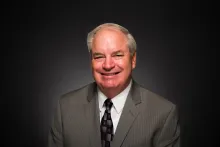
Robin Webber was born in Chicago, Illinois, in 1951, but has lived most of his life in California. He has been a part of the Church of God community since 1963. He attended Ambassador College in Pasadena from 1969-1973. He majored in theology and history.
Mr. Webber's interest remains in the study of history, socio-economics and literature. Over the years, he has offered his services to museums as a docent to share his enthusiasm and passions regarding these areas of expertise.
When time permits, he loves to go mountain biking on nearby ranch land and meet his wife as she hikes toward him.
