
Robin S Webber
This transcript was generated by AI and may contain errors. It is provided to assist those who may not be able to listen to the message.
I want to build upon what Mr. Beatty left us with, that indeed we are to go on to perfection. Sometimes when we've been in the way for many, many years, we think that God has basically dealt with us or taken us to mountain peaks that we never thought that we would climb or be able to obtain. Perhaps all of that is now behind us, but also to recognize that times God continues to ask us to stretch, ask us to build, ask us to do things that we have never even thought of, and that some of those things might lie ahead of you and lie ahead of me. It is to that that I would speak today and maybe build upon the message that I brought to you a couple of weeks ago, and that is, how big is your box? Because we're going to answer that another time in this message with a letter from the New Testament that is very poignant to us today as much as it was to whom it was addressed nearly 2,000 years ago. Would you please open up your Bibles and let's turn to the book of Philemon. I'd like to talk about Philemon with you for a moment to set the stage. There are many, many books in the Bible that are argued over and what their message is and or what their contents are about. I can just mention too, and you will recognize what I mean. You can mention the book of Romans and or if Romans doesn't get to you, we can mention the book of Galatians. And for many people, those are, shall we say, fighting grounds. But not so of the book of Philemon. The message is, oh, so clear. It truly is. The answer is in the epistle. But the bigger answer is, what will we do to mirror what that little epistle tells us? I'm reminded often when I think of this jewel that is within the New Testament, oh, how small it is. It reminds me of at times when we look in the books of the Old Testament, and we call them minor prophets. But there's nothing minor about the minor prophets. Each of those minor prophets have major messages for covenant peoples down through the ages. And so too does the book of Philemon. The book of Philemon basically centers around three very basic words, and I like to share them with you. You might want to jot them down so you'll stay with me in the course of the message, and so that I don't lose you. It takes faith, it takes love, and it takes action. It's that simple. Faith, love, and action. Now, I've often said over the years, and I've been in the ministry now a long time, but I have often thought about relationships, and how they so often are truly not what God really wants us to have as Christians or to be at at this time. So often, here's person A, and here's person B, and person A ought to talk to... I better give him an A, and there's a B. And person A ought to just go talk to person B, but so often person A talks to everyone other than person B. Now, allow me to show you how that works. When we were in geometry, we learned a very basic geometrical principle. The shortest distance between two dots is what? A straight line. That's the only A I ever got in geometry.
The shortest distance between two dots is a straight line. We're all agreed on that. We all got that A. But basically what we do... Here's person A, person B. We do this. Have you ever noticed that? We go all over the place, and we're talking to people here and there and there. Who are we talking about? Person A is talking about person B, or person B is talking about person A. The difficulty is there's going to be no solution between person A and person B until you deal with that straight line. Now, to make this relevant, may I? How many of you today are person A and or person B, and you are talking to everybody but the individual that you really need to talk to? It might be a parent. It might be an adult child. It might be your boss. Do I dare say it might be me? It might be Mr. Smith or Mr. Coel, Mr. Clark, Mr. Gardenhire. We'll throw in Mr. Miller just so he stays awake.
It might be a young lady in this congregation. It might be a senior citizen. And what's happening is the story goes on and on and on and develops chapters and chapters and chapters when it doesn't need to be. It can be as short as the book of Philemon. And that's why I'd like to present this for a moment.
Let's consider that the book...
Do we have a better eraser than this? Could we? Let's consider that the book of... Let's call it a jewel, because I think that's what Philemon is. It's a jewel. And all jewels... That's a jewel. It's a round jewel. But all jewels have different facets to it. This short book of 25 verses has five specific facets, and I'd like to share them with you. The first facet that I would like to share, if you'd like to write with me on your notes, is simply this. It has an intro. Now, why is that so important? Well, allow me to back up for just a second and rewind. Because the book of Philemon can... It's almost like a stage play that's set in the Bible. Stage plays are really neat when you go to see them, where it just involves three people. And that's just how the book of Philemon is. It's really just three main characters. And I'd like to... For those of you that don't know the story, I'll just put it down real quickly. Three characters. Are you ready? There's Paul, there's Onesimus, and there's Philemon. Well, how much trouble can you get with just three people? Well, let's talk about it for a moment. Paul is the preacher-pastor. And Paul is going to become the bridge between the two other individuals. Then who is Onesimus? Mr. O. Onesimus is a runaway slave. And who is Philemon, of whom the book is named for? Hard in our age and our mind to wrap our mind around this, but Philemon, as repugnant as it sounds in the 21st century, was a slave owner.
Let's understand then these three individuals and what's happening. Basically, it is the story of three individuals. The preacher, the slave owner, and the slave. You say, so what? The difficulty is that they're all in the church.
They're all in the church. Boy, what a tangled web. What do we do about this? And beyond that, the slave has run away, which has all sorts of ramifications for everybody that we'll talk about in a few minutes. Let's understand the background of Rome, the Roman Empire, about 1618. Let's understand that it was an empire built upon slavery. It has been estimated that one-fourth of human beings under the rule of Caesar were slaves. The economy depended upon it. It had always been in the mind of man and woman. These slaves were white, they were black, they were brown. One-quarter of the empire had slaves.
To run away was not a good thing to do, which I will talk about as we move into the course of the message. The difficulty that we have is, here's Paul, the preacher who knows both Philemon and Onesimus. Both are dear to him. Somehow, rather than going all around, he's got to connect Mr. A and Mr. B together to where they're not working against one another, but both of them serve in Christ. There is the dilemma before us. The book of Philemon is written for all ages to show us how to be bridge builders and how to bring people together. The first thing that we want to look at, the first facet of this jewel is the intro. Why are intros so important in problem solving? You think about it where you are as person A and dealing with person B. It's often been said that most accidents in the air don't happen in the air, that most airplane accidents happen when? Takeoffs and landings. Most accidents do not occur at 35,000 feet. Thus, this tells you and me that how we approach and how we exit is extremely important, not just on the tarmac, but also how we deal with individuals. Let's pick up the thought then in verse 1 as we deal with just the first facet. Paul, a prisoner of Christ Jesus and Timothy, our brethren, to Philemon, our beloved friend and our fellow laborer, and to the beloved Athea, our kippus, our fellow soldier, and to the church that is in your house. Now, it's very interesting that here Paul is writing to a gentleman who is a Christian, who has surrendered himself to the Lord, and he's not just a marginal member. It's where the church meets. But notice how Paul introduces himself. He does not introduce himself as one that has been exposed to Christ. He does not introduce himself as one who is an apostle that has the authority, the rightful authority of a minister of Jesus Christ. He just calls himself out by name, and he reminds Philemon that he's a prisoner of Christ Jesus. He himself is housebound and orange shackles. We do not know the situation right now, but he himself does not have free movement. You have to understand that he's beginning to lay down some tracts here to come to a point. And he extols Philemon for what he has done. And he mentions that his family are like comrades in Christian arms, and that he's mindful of his hospitality and what a good man he is. I think when I've looked at this message over the years that I'm struck by verse one, that sometimes when life comes at you and you really realize that everything has been taken away and your life is at a standstill, and maybe you are shackled to a wall, or maybe he was tied to a Roman soldier, and or he was just simply under house and president, A, B, C, some of the above, none of the above, whatever it was, you really recognize when you are under those limitations as to what is really important. And my question is, why is it sometimes when everything has been taken away from us? And we are down to just simply that which is simple, that we begin to really recognize what is important.
You know, sometimes people spend all of their life climbing up the ladder of success, only to find that when they've gotten to the top that the ladder is leaning on the wrong building.
And there's nobody to hold it because they kick them off going up. And to recognize, like Paul, that he's in a room, he's perhaps by himself other than Timothy, the soldier's out the door, he has no freedom of movement, that he's saying, here are individuals that have freedom of movement, and look, they're not even talking to one another, they're running away from one another, they have thoughts towards one another, when both of them, both of them are members of the same church. That's the first facet. As Paul opens up to understand where he is at, so he can now move into other people's lives, he tells them what they are doing correctly.
This now moves us into the second facet, if you'd like to write this word down, approach. Because Paul is going to offer an incredible approach. Just like in Proverbs 25, 11, where it says, you know, allow your words to be like apples of gold on trays of silver. It's very important how we approach these things, because remember, relationships so often crash on takeoffs and landings, and we're still a little bit on the take-off here. Notice verse 3, grace to you, and peace from God our Father and our Lord Jesus Christ.
And I thank my God making mention of you always in my prayers, and I hear of your love, and I hear of your faith, which you have towards the Lord Jesus and towards all of the saints. Paul has nothing to offer at this point. He's aged, as he'll bear out later in the letter.
He's a prisoner. He's in a cell. What does he have to send Philemon in this letter, but the best gifts? And what are the gifts that he lays out? Notice what he says. Grace. This is the gift that Paul reminds Philemon that God has laid at his door, and peace from our Father and Jesus Christ.
You can jot this down. You can maybe think about it this afternoon, Philippians 4, 6-8, that if we really have faith in God the Father and Jesus Christ, it says that they promise us peace, that passeth understanding. That means a calm at the center and a resolution in our life that does not necessarily match the facts that are on the ground. Understanding comes by facts. The peace that God gives us are better than facts. Because so often what happens in our life, are you with me? Person A, person B?
Why doesn't person A move towards person B and talk with them rather than going out and talking to everybody else? Basically, are you with me? Because we panic. We panic. It's scary. If I do that, but let's understand something. Recovery and restoration of the relationship only lies on the other side of the panic that we feel. Recovery in any situation, relational. Person A, person B? What happens is we have the big P right here. We have the panic. You cannot cover a relationship on this side. The only way to restore relationships is to move through the panic. True healing is on the other side of panic. You think about what you're going through right now with your mother, your father, your adult children, somebody in this congregation.
Two Christians having problems. Maybe something that you need to bring to me or to bring to one of the elders. Recovery is not on this side. Spiritual recovery is only on the other side, but you have to be willing to go through it. Why? Because there's grace and there's peace. And a peace that is better than the facts that are on the ground. Why does it remind Philemon of grace?
Grace is to remind us that all of us at one time or another were in bondage. All of us were slaves to sin. None of us of and by ourselves could redeem ourselves, bring ourselves back. That strong hand had to come from somewhere else. You notice the skill that the Spirit of God is using in Paul to begin to work with Philemon.
Let's pick it up a little bit further. I've heard of your love, your faith that you have towards everybody, all the saints, and that the sharing of your faith may become effective by the acknowledgment of every good thing which is in you by Jesus Christ.
It's very interesting that Paul introduces something that's very important, and it is simply this. That any conversation we have, any letter that we have, any meeting of minds and hearts that we're going to have in our spiritual community, when we're just talking about ourselves, when we're talking about our own goodness, when we're talking about maybe what the other person did wrong, but we notice this is so important, that Jesus Christ becomes the center of the conversation. There is no hope for restoration beyond that. Christ becomes the pivot point. He becomes the main stone, the cornerstone of the relationship building that Paul is trying to seek out. For we have great joy and consolation in your love because the hearts of the saints have been refreshed by you, brother. But now Paul is going to push Philemon to the next step because here's the difficulty. You have that difficulty and I have that difficulty. It's very easy at times being a Christian to all of the masses and all of the hundreds and all of the thousands. While that may be challenging to some of us, there's not a demand. But the difficulty with Christianity or the blessing of Christianity is it's not only dealing with many, many, many, many, many people. The greatest challenge is one-on-one. A Philemon and Onesimus. And you can say, well, like Philemon, look, I've got the church in my house. I've had people over for the love feast. I've had people over and we've broken bread together. I've done this and I've done that. And Paul, and you know, you drop out your Rolodex of deeds and good deeds. And that's all right. But Paul's saying, I'm now going to push you to the next step. It's not what you've done. It's what you've got yet to do. See, Christianity, when you move it from simply being a recipe and put it in the oven, goes down so deep that you begin to recognize there are things about you that God is still working on and or has not revealed that you need to be so that, as Mr. Beatty said, we can move on to perfection, which now takes us to the next point because the next point is going to be the argument. The argument that Paul is going to present. The argument. Let's pick it up. Therefore, you knew that was coming. The difference between Paul and you and me friends is simply this. Are you ready? Paul waited till verse 8 to get to therefore. How often in our relationships with person A or B do we lower the sledgehammer on verse 1?
We have not told them what they are doing correctly. We have not mentioned Scripture. We have not mentioned Jesus Christ. We just go right in with our own personal tweezers and we're ready to pull out not only hearts but fingernails of the individual that we're having problems with. Not so Paul. Not so the Holy Spirit and Paul notice what it says. Therefore, though I might be very bold in Christ to command, what is fitting? I could tell you what to do, Philemon, but that's not where it's at. I want you to own the solution that I'm about to offer. Yet, for love's sake, I rather appeal to you, being such as one as Paul the aged and now also a prisoner of Jesus Christ.
He kind of leans on there. Won't you consider this from an old man? I'm a little cold in the bones. I'm a prisoner. Won't you listen to me? And I appeal to you for my son, Onesimus, whom I have begotten while in my chains, who was unprofitable to you but now is profitable to you and to me. We don't know the full story here. Your guess is as good as mine. Philemon was a Greek Christian slave owner in the city of Colossae. Perhaps the church was meeting in his house.
Perhaps Onesimus had been a slave that waited at the door and saw this Paul come and go. Maybe he was not a Christian at that time. But perhaps Paul looked him in the face when he entered the household. Perhaps Paul gave him some food on the way out. Perhaps Paul acknowledged him by name, which a slave was not always acknowledged by name. Because if you acknowledged a slave by name, you raised him up to the level of a human being. Maybe it was only by Paul's good works that this slave, when he ran away from his slave owner, said, I know a good man. I will find him wherever he was. Because it says here that I had begotten while in my chain. So perhaps the event, perhaps the conversion, actually came when Onesimus came to Rome. And he was of no use to you. His name is Onesimus, which is actually a play on words because the Onesimus, the name Onesimus, literally means unprofitable. How would you like to have that name? Hey, you, get over here, unprofitable. That was his name! How do you live up to a name like that? You don't have to, because you're already unprofitable. But notice, I am sending him back. You therefore receive him. That is my own heart. What I find so encouraging about this, friends, is that Paul does not run away from the fight.
He is asking the slave owner, Philemon, the Christian, to own up to some new business that God wants him to understand.
And he does not shy away from it.
How often sometimes when we have been in the middle of controversy, or we know somebody that's in need, or people begin to be talked about, maybe people that we have been friends with, maybe people that we've broken bread with, all of a sudden say, well, you know, come to mention it, I didn't really know him that well anyway. I wasn't over at their house maybe but a few times, and frankly, I never liked the individual to begin with. And, not so Paul. Paul owns him. He says he is mine. He is like flesh and blood. He is of spirit. He is of the family of God. I never would have thought that I would have maybe gone out on the limb for this slave, but again, that it's not my job to choose God's family, but to accept God's family, whoever they are. How often, friends, and just a challenge in your Person A and B conflicts that you might have, do we own an individual as God owns an individual, and to recognize that we are all owned by God? And if God owns Person A and God owns me as Person B, and if we are both owned by God and Christ died for each and every one of us, that makes us blood brothers, and blood sisters, and blood family, and that we stand up for one another. I'm going to send them back.
You therefore receive them. That is my own heart. I want you to take them back as if I was walking in through the door, whom I wish to keep with me, that on your behalf he might minister in my chains for the gospel. But without your consent, I would do nothing, that your good deed might not be by compulsion, but voluntary. Not because you have to, but because you want to. See, I remember many, many years ago, Mr. Blackwell used to say in his Texas accent, I won't go to the Texas accent right now, but anyway, that he'd always say this. You know, the difference between a converted mind and an unconverted mind is that a con... an unconverted mind looks at the Ten Commandments as don'ts.
Don't do this. Don't do this. Don't do that. A converted mind looks at it as do's.
An unconverted mind only looks at the law of God as a calamity, whereas that which God's Spirit is working with looks upon it as an opportunity. Doesn't mean that there's not a human risk, but there's a spiritual challenge. It means that the knees aren't shaken, but your heart's not shaking because you own it and you recognize that God is going to help you. So he's saying, you talk about ownership, you want to talk about slave owners, you want to talk about slaves. Here's one for you, Philemon. I want you to own what you're about to do. I could tell you to do it. But it would wind up in calamity. Here's what I want you to do. For perhaps he departed for you for this purpose, that you might receive him forever.
Paul begins to put a completely different twist on this matter about a runaway slave. No longer a slave, but more than a slave. He is now a beloved brother, especially to me. But how much more do you both in the flesh and in the Lord? Now, we missed this point in 2010 when we recognized what slavery was like at that time. And for him now to pull Philemon down to the level of the slave and say, by the way, it's what we're all kin. Get used to it. Here Paul is extending the great words of the Galatians' chronicle. There is no man. There is no woman. There is no free. There is no slave. There's a oneness. Now, you can read that. Boy, it can read well, but wonder if it was your runaway slave. Because now let's notice what's going to happen here. If you then count me as a partner, receive them as you would me. Very interesting. Now, let's understand three basic things that you'll understand so we get the drama in this short epistle. Number one, Paul points the person in the right direction. I have an encouragement for each and every one of us because Philemon will unfold before us in our own life in the days and the weeks ahead that when you have person A and B, you may be person A or B and or you may have the opportunity to be a healer of the breach, a repair of the wall. Here we go. Are you ready? Number one, be like Paul. You've got to point the person in the right direction.
What's that mean? Open the Word of God. Number two, remind them about Jesus Christ. Number three, remind them there is a responsibility. With opening the Word of God, with extolling Jesus Christ, we then have a responsibility. Love is not a feeling, it is an action. Number two, it's not only Paul. He did the right thing. Onissimus, the slave, must respond. Let's understand the drama that is in Philemon. Going back to Colossae could have meant his death. Could have meant his death.
Back in the times of yore, a slave was often branded a shorogma, an imprint, showing that he was a slave. Sometimes it was put here on his forehead and at times on his wrist. Just think of the book of Revelation and spiritual slavery. When he was caught, there were other things that happened. He could be branded again with a certain brand called a stigma. He was stigmatized. He was set apart. That's where the word comes from. He might have his nose cut off. He might have his ear cut off. He might have his tongue cut off. He might be crucified. Boy, when you start thinking that through Philemon, it gets kind of exciting, doesn't it? And recognizing what was ahead of Onesimus. What about Onesimus now? It was daring for Onesimus to go back, but what about Philemon? Excuse me, the slave owner. Wonder if he shows mercy to his now newly found brother in the flesh and in the spirit. What are all the other people on the block going to say that have slaves? You're going soft. If you don't do something, what signals are going to send out to all the slaves? They're going to thumb their nose at their master.
There'll be another Spartacus revolt.
Philemon gets kind of exciting, doesn't it, when you start thinking of the ramifications?
Now we go into the appeal. We're almost done.
The appeal is the fourth facet.
But if he has wronged you or owes anything, put that on my account. So far, Paul has reminded Philemon of the trunk of the tree of relationships. He says, hold on. But now Paul is willing to go out on the limb for this slave. He says, look, if he and he must have stolen something because it's brought up in that sense. This is an answer to something that is not mentioned. If he has taken anything, put it on my account. Take some skin out of my flesh. I'll be willing to do it. You see, Christianity is about sacrifice.
I, Paul, am writing with my own hand. I will repay, not to mention to you, that you owe me even your own self beside.
Yes, brother, let me have joy from you and the Lord. Refresh my heart. This is the second time the word, you might want to jot this down, this is the second time the word refresh is mentioned in this brief epistle.
Refreshing God, refreshing Jesus Christ, refreshing those that we come into contact with is not a past event. The book of Philemon, through the writings of Paul, through the encouragement of the Spirit, always reminds us that the time of refreshing is yet ahead. We have something else yet to do, a part of us that is yet to surrender to the Spirit of God in matters that we never thought would come our way when we first came into this way of life. We thought we'd done it all at baptism. We thought we had given up everything. No, we'd only given up everything that we knew at the time. And God has more surprises for us. Let me have joy in the Lord, refresh my heart in the Lord. Having confidence in your obedience, I write to you, knowing that you will even do more than I say. Don't limit God's Spirit. Hey, I've taught you how to fish. Now go out and fish and do even more. Don't do that, which is merely profitable, because if you've only done what you're supposed to do, fight them, and you are going to be basically an unprofitable servant. Don't put a border. Don't put a boundary on the limitless Spirit of what God wants you to do with this slave. And I say to you today, the San Diego congregation, do not put a limit on what God wants you to do for person A or for person B that might be in your life. Well, you say, well, I don't have a person A or B in my life right now. Well, just hang on. You will. It'll be coming tomorrow or the next day or the next month and or right now, because we are so steeped in the culture of this world that we've just put it all on ignore. And we're not ready for the challenge that the book of Philemon invites us to, which takes us then to the fifth jewel. And God always saves the best for last.
And that is the conclusion. Let's take a look at it together as we begin to wind up.
But meanwhile, also prepare a guest room for me. Now, this is a little bit of the humor that comes out of the book of Philemon. By the way, I've told you how to do it. I've told you what I think I'd want you to do. And by the way, I am coming. So get a room ready. You know, kind of like Reagan used to say, you know, with the Russians, trust, but verify. And I'm coming to Colossae when I get out of here. Five minutes going, oh, okay, I better do something. So there's just a little bit of framework there. Prepare a guest room for me, for I trust that through your prayers I shall be granted to you. Paphras, my fellow prisoner in Christ Jesus, greets you. As do Mark, Aristarchus, Demas, and Luke, my fellow laborers. We're about to finish up with verse 25, but I did overlook something that is really important that I'd like to take you back to for a moment. And that's in verse 4. Actually, let's start with verse 3, verse 4. We'll end with verse 25. Remember the introduction. Remember how takeoffs and landings are so important. I'd like to go back to the take off and then conclude with the landing in verse 25. Grace to you and peace from God our Father and the Lord Jesus Christ. Do you know that there is nothing more beautiful to be able to tell a fellow Christian that they are experiencing grace and that you're praying for them? I just had that conversation with my mother in a hospital that she's experiencing God's grace and that there's a peace that passeth all understanding. You know, some of us, because of our economy, we're not able to buy big boxes with big big toys with batteries that'll wind down and cost us a lot and we don't have that money. And so often we try to placate people by what we think we have to give them rather than give ourselves.
And it is only that when the giver arrives with a gift that the gift truly means something. And Paul, being in prison, could give nothing else but to remind Philemon of the gift that he come to him. The best of gifts, grace and peace. And notice what he says here, I thank my God. A thankful person is a growing person. You show me a person that is not thankful and I will show you a person that is not growing. And maybe right now you're scared of person B. Say, I don't know. Be thankful for person B because they are going to stretch Christ's Spirit in you to go on to perfection like Mr. Beatty talked about. And notice, always in my prayers. Now, when verse 8 comes, the boot drops. Therefore, there's going to be some tough medicine that Philemon has got to take. But, you know, it's really hard to get mad at somebody when they say that they've been praying for you always. How do you strike back at somebody when they say, you know, you are constantly in my prayers. You see how important the take-off was and the approach to whatever is facing you. Let's conclude with verse 24. The grace of our Lord, Jesus Christ, be with your Spirit. It's very important to recognize that the Book of Philemon begins with grace. It ends with grace. Grace reminds us that the love of God is something that we did not deserve by our own actions, by running away from Him for oh so many years until we were stopped into the track by His invitation, by His involvement, and by His encouragement. Grace, when you go through the New Testament, is often what I call the bookends of every epistle. If you'll go through the writings of Paul, maybe you want to look at it this afternoon, you've got time, you go through the writings of Paul, you go through the writings of Peter, you will notice that they normally begin with what? Grace. They end with grace. The Great Covenant Bookend Effect to remind you and me that when we deal with somebody to realize that we have experienced grace. Allow me, if I may, on this good Sabbath day, to leave you where I left you at the very beginning of this message. It's very simple. Remember, it's what I got an A on in geometry. But it's really Christianity 101.
Here is a dot. And here is a dot. Person A. Person B. Remember this. The shortest distance between two dots is a straight line.
Got two more things to tell you, though. But there's something between that that causes us to go everywhere else on the board. There will be this. There will be panic. But remember that recovery lies on the other side of the panic that we feel. Beyond that, you may not be Person A or Person B because what does Philemon remind us of? How many people are on the stage? One, two. There is Person C. What a joy of salvation that you and I might be like an Apostle Paul, where we see two people moving away from one another, and that you and I might be a healer of the breach. After all, isn't that what God's called us to? Book of Philemon. Personal.
Challenging. Wonderful.
Let's go out and live it.
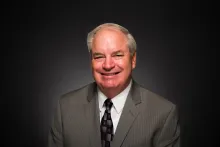
Robin Webber was born in Chicago, Illinois, in 1951, but has lived most of his life in California. He has been a part of the Church of God community since 1963. He attended Ambassador College in Pasadena from 1969-1973. He majored in theology and history.
Mr. Webber's interest remains in the study of history, socio-economics and literature. Over the years, he has offered his services to museums as a docent to share his enthusiasm and passions regarding these areas of expertise.
When time permits, he loves to go mountain biking on nearby ranch land and meet his wife as she hikes toward him.
