
Robin S Webber
This transcript was generated by AI and may contain errors. It is provided to assist those who may not be able to listen to the message.
I want to say thank you very much, Nancy. You certainly appreciate the beautiful hymn of praise to God. I want to certainly thank Mr. Sharpe for the first presentation today, and we'll try to build upon that. I want to welcome everybody to the Kingdom of God seminar here in Redlands. We do have guests with us today, and we really appreciate you coming. We actually have a number of these going on around the world right now. Over the last month, we've had about 200 of these on many of the continents around the world in the United Church of God. Sometimes people take the Good News magazine, and they, in some way, as much as we express that we are local, and especially on our webpage, so often people think that this is a church out of Cincinnati, kind of an educational church, or this or that. Sometimes they are surprised when they find out that there's actually a church right in their community, and we actually have hundreds of churches around the world on every and habitable continent. We don't have one on Antarctica yet. I don't think anybody has one. There's a lot of faith in Antarctica when people visit, but it's very hard to keep a church going too long. I also want to say thank you very much for those of you to come out on this special weekend. It is Veterans Day weekend, a very special thought in all of our minds with those that have given their full devotion to our country, that we might have the freedoms that we have. Some of us sometimes are so far apart of recognizing how this began.
I just want to go back for a second because I think it's germane to our discussion today. It's often been said that in 1918, that on the 11th month of the 11th hour of the 11th day, that the guns drew silent. And you could actually begin to hear the birds sing once again on the muddy barbed-wired fields of Belgium and France and Holland. And people were so excited back then, three human generations back, because they thought it's over. And this is the war to end all wars.
And that's how that great world war was known until it was completed, 20 to 25 years later. Because oftentimes historians now look back and they don't call it World War I or World War II, but really see it a combination of both wars together, and that there was unfinished business and results that came up from 1918 that were then visited upon Europe and the entire world in the late 1930s and 1940s.
That's one of the reasons why we're here. That's why we come on the Sabbath day, a day which pictures a time in which the Prince of Peace, Jesus Christ, is going to set up his millennium, his thousand-year reign on this earth.
And what an exciting time that is, because when he does come and establishes his presence, he is bringing with him judgment. He is in that sense bringing his army from heaven, but indeed it is that war that will truly end all wars. And then there's going to be peace on this earth. I'd like to build upon the fine presentation, foundation that Mr.
Sharp brought us. And actually I'd like to take you right back to Mark 1, 14 through 15, because that is our cardinal verses to be looking at. I'd like to approach it in just a little bit manner and then build upon that and build upon the foundation that Mr.
Sharp gave us. Let's go to Mark, and it is important in a sense as we approach Mark 1, 14 through 15 do, shall we say gain a sense of the verse and even gain a sense of the gospel that we know as the gospel of Mark. Mark is actually thought to be the most primitive of the Christian writings. In other words, it was most likely the first of the gospels to be read and actually to be spread through the Mediterranean basin.
It's a very simple, it's very action-packed, probably because Mark himself was most likely a very young man when all of these things were occurring in Jesus' earthly ministry. And so as any young man, any young boy growing up, he's going to be kind of looking for these action items. But more than that, to recognize that the gospel of Mark was going to be going out into the Roman Empire. And the Roman Empire was based upon movement, it was based upon action, and also it was based upon a heraldry, especially when a Caesar and or when a general would come towards a city and that what is called a triumph would be given and they would enter and there was heraldry and there was proclamation.
The king is coming, the king is coming, and that is why in that sense the book of Mark is started out in this way where we find in verse 14, now after John was put in prison, it says Jesus came into Galilee. There isn't that sense of a procession, there is an entrance. Christ has entered the world stage. The Son of God has entered in that sense human history. And it mentions what his proclamation is about, preaching the gospel of the kingdom of God, saying the time is fulfilled, the kingdom of God is at hand, repent, and believe in the gospel.
Very important as we go through this discussion today is to recognize that all of us, based upon what I just mentioned, look forward to the totality and the fullness of the kingdom of God established on this earth when Jesus literally lands on the Mount of Olives just outside of the walls of Jerusalem and establishes his kingdom. That is the fulfillment of the kingdom of God. But we find from this verse, wherever Jesus is, wherever his presence comes, the kingdom is in that sense near. The kingdom is at hand, and there is indeed a responsibility for all of us to understand. And saying the time is fulfilled, the kingdom of God is at hand, repent, and believe the gospel.
I like what the expositor's commentary speaks to regarding this set of verses, and it actually kind of puts together the presentation of Mr. Sharp and myself. It puts it this way, and shall we say modern parlance.
What Jesus was really saying is simply this in common terms, a new world order is at hand.
Get a mind that fits it. And as was mentioned earlier, he stated two specific steps. Number one, repent. And number two, believe in the gospel, which we've already defined as good news.
And it is great news. There can be no more exciting news than what we're talking about here today.
Sometimes people mistake the message of Jesus Christ, not just one person, many persons, and sometimes unfortunately even denominations that in one sense sincerely strive to follow Jesus Christ, but mistake the message, the gospel of Jesus Christ. It is clear that Jesus called people to repentance. Just as much as John the Baptist, sometimes people will think, well, that Jesus was John the Baptist's light. He was different than his cousin. He wasn't out there on the river ranting and raving and this wild man that's out there that all Jerusalem came to see what he was like. No, he never minimized sin. He never unlinked the inherent consequences of sin.
But here he transitions. And that's where I want to kind of build upon Mr. Sharp's presentation. There is a specific distinct transition to the next step. And it is in that next step, folks, that is transformational. That truly makes the difference in our lives and maintains that difference. And it is the transformational step of believing in something. In believing in someone beyond ourselves, beyond our world. Let's just get a working definition of the word believe for a moment. I happen to be able to open up a vine's commentary. You can do the same. Go to the original Greek. Try not to give you more Greek than need be. That's a very basic rule of hermeneutical speaking. Do not give one more word of Greek than need be, because it's all Greek to me and it's of all Greek to me. It's all Greek to you. And I do study Greek. But let's look at that original Greek tongue for a moment and understand a sense. You might want to jot this down because we are in a classroom setting, okay? We're all students of the Gospel today. Here we go. And that is that in the Greek tongues it means to be persuaded. To be persuaded. Now when you persuade somebody that doesn't want to be persuaded, that has this very firm belief about something, it shows a sense of movement and or a change of position. To persuade means to move from point A to move you to point B. It also means to place confidence in and or to trust. Very importantly, it means to come into a reliance beyond creed alone, beyond simply pak, beyond simply reading something that is by rote that your parents believed, that your parents taught you, that your grandparents taught you, that you hear everybody else saying, and that you have said, and you nod your head, but when the big moment comes, you really do, but you are persuaded, and you have confidence beyond simply what you see before you.
So when we look at this, we understand it. In other words, to believe something is what you are.
It does more than permeate. I had an opportunity to get out of dictionary, and I came to understand more than ever the difference between being permeated and being saturated. Have you ever thought about that yourself? You probably didn't think that at 355 today, I'm going to have to define the difference between being permeated and being saturated. I'm not going to fail you, I'm not going to pass you, it's just getting it out there for a moment.
When something is being permeated, it's something that's been infiltrated, something is kind of seeping in, there's a development that is occurring. That's to be permeated.
But being permeated is only a step towards being saturated. Saturated means that you are fully permeated, fully engrossed, fully persuaded, so much so that when the conditions of life come to us and press against us, what you are, not what you know, but what you believe, what you are is squeezed out of you. It betrays in that sense what actually is inside of you, whether it be for good or whether it be for ill, whether it be for not or whether it be for something beneficial. When Jesus came, he said to do more than repent. When you repent, as Mr. Sharp brought out, repentance is stopping in your tracks. And that's stopping you saying, I've been wrong.
I'm going to turn around and I'm going to do something different. But you've got to start walking because God does not operate in a vacuum. Satan does. You've got to move. You've got to begin to do something. It's like those cartoons that we used to watch long ago and far away, where they'd always pull the kid out of the pool and then, you know, they'd press on his chest or, you know, out goes the bad air, in comes the good. You can't just live on nothing. You can't live on standing still. You've got to move. Thus, that is why belief is that transitional step. It's not enough just simply to say something is wrong. You've got to now imbibe of the good news that Mr. Sharp talked about. And that's what Jesus brought. Jesus brought good news. He brought this news that would later be spread by Christians and people of faith like you and I that defined more than what even the Hellenistic world understood. The Hellenistic world, basically tutored by Plato in a sense, had this concept of the unmovable mover. There was, with everything that was moving, there was beyond all of this somehow what they they called the unmovable mover. But it wasn't good news. It was just logical that beyond what they saw, there must be a unmovable mover. Beyond that, they had another name that they ascribed to the unmovable mover, as did Plato, and that was simply they talked about the good. Whatever the good might be, there must be good, but we have to understand what good is and define it and talk about it and kind of get our handle on it. Jesus came to define that unmovable mover and that we might be able to believe in him. He brought good news. In fact, Jesus himself is good news. He voiced it further by speaking of God not as the good and or the unmovable mover, but he said we're going to address him as our heavenly Father.
A relationship. Not just something logical, but a relationship that you can live for, you can love, you can even die for. He would speak of his own invitation to his followers of come unto me. He would, beyond that, speak of a good news, of a reliance on God, of utter confidence in his love, and an invitation to just utterly believe in such love and to be able to accept that love, as was brought out by Mr. Sharp in John 3, 16 through 17. Later, he would even implore his followers to beseech God by talking about, thy kingdom come and thy will be done. I'm sure all of us from either our Sunday school background or growing up in the Church of God community and or in our private prayers have often used that line, thy kingdom come, thy will be done on earth as it is in heaven. And that is where the rub comes in. Because if truth be known too often, we're not narrows worried about what's happening up in heaven as we are down here below. Is anybody up there? Hello! I prayed the prayer, thy kingdom come. It's not come. Okay. And thus we come into this crisis of faith. But again, that's where ultimately the big answers come are upstairs to the answers or the needs that we have here below. And that's why we need to, for a few minutes more today, engage and understand this fundamental prerequisite into what I would like to call, let's jot it down to students, a kingdom relationship. A kingdom relationship that is called belief by Jesus. We might also define it as faith. It's throughout the entire Bible. It's interesting that the common denominator of the relationship that God wants us to have with Him is basically based upon faith. You know, it's often been said that if you look at the Old Testament, it's made up of 631 rules. You can bring that down to 10 commandments. You can bring that down to the two great commandments, love God, love neighbor. But ultimately, when it's all said and done, if you want to bring it down to the common denominator, it is simply this. Out of the book of Habakkuk and the words of Paul that echo Habakkuk and Romans, the just shall live by faith. And that's what we want to talk about this afternoon. It's a powerful anthem. Let's talk about how our minds can be fitted with faith more than our minds. How our hearts can be fitted with faith by not only believing that Jesus Christ is going to literally return to this earth and set up His kingdom, but now that we can begin to practice kingdom living now right here in the Inland Empire. Before we discuss how, let's gain some spiritual mourning for a moment so that we can all be on the same starting line as we begin to bring in some of the building blocks. Let's understand the challenge of Jesus' words when He said, repent and believe in the gospel. What is the challenge? Let's put it down on a paper so you'll stay with me in this class, this presentation. The challenge that Jesus puts out for every one of them that would follow Him is simply this, is to walk by faith in a faithless world.
Ouch! To walk by faith in a faithless world. And let's understand we do live in a faithless generation. In Luke 18 and verse 8, I'm going to turn to other verses right later on. I'm going to just allude to that. Jesus offers this dire prophetic utterance based upon a scenario that He's in. He basically says this, will the Son of Man when He returns find faith? That was a big question in His mind, and He's making a very important statement. Today, you and I are living in that world, friends. Today, we live in a world where the Judeo-Christian culture, practicing the principles of God's love and God's law that makes for long-term success, is steadily evaporating to the steady onslaught of materialism, of secularism, of human reasoning. We are seeing it happen literally before us. Just so you will know, I am an apolitical person, and the United Church of God expresses the values, not parties. So please understand that. But we do express the values of the Scriptures, and what you are seeing happening in this land of the free and the home of the brave, in which our quenitch is meant within God we trust. Our values, those that held us together for so many years as a country, are indeed evaporating. Values that come right out of the Bible, values that were enshrined in the founding document of our country, the Declaration of Independence, to recognize that God is mentioned, that we are not just simply products of evolution, but that we are the design of a Creator, the disposer of events, and as the Founding Fathers would use other definitions to speak of God. Instead, we find the religion, and it is a religion, because religions have thus's and thou's and shalt not's. And so does secularism, and so does humanism, and so does rationalism coming out of 19th century Germany, that basically seeing is believing. Let me share a story with you for a moment, may I? I'd like to share a story with you that'll bring this point of what we have been seeing happen in the history of the world the last couple hundred years. Imagine a family of mice who lived all their lives in a large piano. To them in their piano world came the music of the instrument, filling all the dark spaces with sounds and harmony. At first, the mice were impressed by it. They drew comfort and wonder from the thought that there was someone who made the music, though invisible to them, above and yet close to them. They loved to think of the great player whom they could not see. Then one day a daring mouse climbed up part of the piano and returned very thoughtful. He had found out how the music was made. Wires were the secret.
Tightly stretched wires of graduated lengths which trembled and vibrated.
Well, they must revise all their old beliefs. None but the most conservative would any longer believe in the unseen player. But later, another explorer carried the explanation further.
Hammers were now the secret. Numbers of hammers dancing and leaping on the wires. This was a more complicated theory, but all went to show that they lived in a purely mechanical and mathematical world. The unseen player came to be thought of as a myth.
He came to be thought as a myth. But, but, the pianist continued to play. It reminds me of what is mentioned over in Romans 1. Romans 1. Try me if you would there for a moment. Paul's comment on the world that we have inherited, Paul's comment on the world that stemmed from the steps of the academy at Athens, a world that worshipped man and humanism and human thought that had now encapsulated itself in the Roman Empire. In Romans 1, let's pick up the thought in verse 19. Because what may be known of man is manifest in them. For God has shown it to them. For since the creation of the world, his invisible attributes are clearly seen being understood by the things that are not, that are made, even his external power in Godhead, so that they are without excuse.
Because although they knew God, that is, do I dare say, the great player, they did not glorify him as God, nor were thankful, but became futile in their thoughts, and their foolish hearts were darkened. At notice verse 22, professing to be wise with their explanations of hammers and measured strings, as it were, they became fools. And they changed that glory of the incorruptible God into an image made like corruptible man, something that they could taste and touch and feel and be like them in this world of time and space. And they began to worship that. That is why Jesus said, will I come back and find faith on this earth? And yet, here's what I want to share with you today, and the good news about the kingdom of God and Jesus Christ.
It is in this piano world, for you and I do exist in this, as it were, piano world. Let's just shove the mice over for a moment in this piano world, where you and I, in a sense, want to say, beam me up somewhere, get me out of here, any place but here. It is in the piano world that Jesus said, in his final prayer, when he was with his disciples on that night that he was from the great Father, I do not ask that you take them somewhere, but you keep them right here.
You keep them in this piano world, and you send them out in this piano world, but you keep them, you preserve them with your truth.
God's people have always been in the midst of the action. God's people have never been called to be hermits. Humanly, it'd be very easy. Lovely! And to be a hermit. God has not called us to be hermits.
God placed Israel right in the midst of the way of the sea. He didn't put them in the North Pole. He didn't put them in the South Pole. He put them right between Egypt and Babylon and Syria to the North. And he said that, you will be my people, and I will be your God. Believe, and you will be blessed.
Let's go to another point, and that is simply this. Humoringly left to our own devices, we operate on fear and not faith. Fear comes very naturally to each and every one of us that are human beings. And even as people of faith, even as Christians, at times we wait as long as we can and then we reach with our hands no more, no less, than Adam and Eve so that we can wrap our own hands around something. We know, in a sense, that God, because he promises, does it, he says that he'll never be late. The problem is our human nature arrives early, and it changes the entire equation. Here's what I want to share with you. Fear, that four-letter word of fear. And we all have fears. We all have phobias, as it were. Fear, no matter how great it is, God cannot use it.
God cannot use fear, no matter how large. Faith, belief, in someone, something, that which is promised by God. Faith, no matter how small, that God can use. Do you see the difference in the equations? That's where you're supposed to nod right now, or I can't go any further. If you don't see that equation, God cannot use fear. Satan can use fear. Satan is dominated by fear. He is motivated by fear, and thus he also motivates us with that spirit of this age. Point number three in getting our moorings. It's no secret. Belief and unbelief can collide in the same person. Belief and unbelief can collide in the same person. Just jot down Mark 9.24. You can go home and read it in context later. I'll just talk about it. It's a very well-known story. There was a man that came to Jesus. His son needed healing. And he said, Lord, I believe.
Yes, I do. That was not his problem, was his belief. It was his unbelief. He said, Lord, I believe. Deal with my unbelief. And that's why we have a message like today from Mr. Sharp, from myself, to encourage us to understand, to wrap our minds around, to get our hearts fitted with this need of the kingdom relationship of faith, which leads me now to what then can we do? Point number one, and they're very short. Number one, we must put our faith in God and not in man.
We must put our faith in God and not in man. We've just come out of an election season, and we won't have to see any advertisements for a while. But I think of the election season for the president. They were making promises, promises, and probably, you know, there's an old Hollywood song out, I think, the 60s. I'm not going to launch into song. That's Nancy's job. Promises, promises, promises. If we know a politician on the left and or the right, they're all the same. What are they going to give? Promises, promises, promises. Are they sincere about making those promises? I'll grant them sincerity about making their promises. But can they deliver? I'll just simply leave that with you. It's very interesting that one man said, it's my time. It's my time to be your president. The other man said, give me more time to be your president. Each of them, whether it's it's my time or give me more time, they both gave promises as to what they could do. What does God say about the rulers of this earth and the people that are around us? Join me in Psalm 146. Let's open up our Bibles. This is our textbook, Psalm 146, verse 3. Psalm 146.
Verse 3, do not put your trust in princes, in leaders of this world, nor in a son of man, in whom there is no help. His spirit departs. He returns to the earth. In that very day, his plans perish. So what do we see around us today? And what have we in that sense always seen, may I speak plainly, since Eden? And that is that people put their trust in the sons of men. More so now as the world becomes more secular and more materialistic, politicians become gods. You look at the audiences, it's an infatuation leading to a romance, leading to a trembling at times of looking at this one individual, left or right, whoever they might be, the Savior, the one that will bring us out of our challenges. And as Mr. Sharp brought the challenges because of our lack of obeying God, has brought this nation to its knees. Whether it be Mr. Obama, whether it be Mr. Romney, they all get to face the same wailing wall of 16 trillion dollars in debt.
Let's take it a step further. What does God say about faith? Once we understand where it needs to go, Hebrews 11. Let's go to Hebrews 11 here. Let's get a working definition right out of the Bible. Sometimes people in different churches call this the chapter, the faith chapter, Hebrews 11. Verse 1, Now faith is the substance of things hoped for, the evidence of things not seen.
For by it the elders obtained a good testimony, and by faith we understand the worlds that were framed by the word of God, so that things which were seen were not made of the things which are visible. Now think about that because I'm going to come back to that in a few minutes.
Verse 6, But without faith it is impossible to please him, for he who comes to God must believe that he is, and that he is a rewarder of those that diligently seek him.
How can this faith be outlined? Where does God want us to place his faith, our faith, towards him, his purpose? It's interesting that nearly 50 years ago now, Winston Churchill, famous British Prime Minister, orator, said there is a purpose that is being worked out down here below. Why are we here? Why do we have the Bible open? Why are God's words being read to us? What is his purpose? I'd like to just give you three elements of what God is desiring to do with you and me. You and me under this point one. Three elements of faith, and it does take faith. Number one, let's go to John 3. I'm going to build up to where Mr. Sharp left off in John 3. This is where it starts. That God has a purpose for you. That the unmovable mover, the great designer, our Father that is in heaven, has a purpose for each and every one of us.
And there's something that he's wanting to do with us, not because he has to, but because he desires to, he wants to. His favor is upon us when he does this. He doesn't have his arm behind his back twisting. You got to do it. He doesn't have to cry uncle because he is the Father.
And this is where it begins. John 3 verse 1, there was a man of the Pharisees named Nicodemus, a ruler of the Jews, a man of faith, a man that under the old covenant worshiped the God of Israel.
And this man came to Jesus by night and said to him, Rabbi, we know that you are a teacher come from God, for no one can do these signs that you do unless God is with him.
So he understood that the man that he was addressing was very special. Jesus answered and said to him, most assuredly I say to you, unless one is born again, he cannot see the kingdom of God.
Now that's essential because we're dealing with a kingdom of God seminar and the wonderful things of God that he wants to bestow upon us. But he says, Jesus speaking, he says, unless, notice, one is born again, he cannot see the kingdom of God. That term there, born again, can better be phrased born from above. Born from above.
It's not happening down here. It comes from above. And if you don't have this new process, this new creation occur, you're not going to see the kingdom of God.
Nicodemus said to him, how can a man be born when he is old? Can he enter into a second time into his mother's womb and be born? And Jesus answered, most assuredly I say to you, unless one is born of water and of the Spirit, he cannot, cannot enter the kingdom of God. Jesus is making it very clear. One plus one equals two. Today in this world, in the America that you and I live in, people that have a tinge of religiosity say, I want to have in God we trust on my coins, but don't tell me what to do. Don't get into my life. These people want to make one plus one equals three.
And yet get two. One president at one time talked about fuzzy math, and people approach God with fuzzy math. For every cause there is an effect. One plus one equals two. You can't get around it.
People try, they sin, they miss the mark, and they die. You don't sin and live forever.
You don't sin and your immortal soul floats up there with Plato. No, no, no, that's not what the Bible says. Notice what it says here. Jesus answered, I say, unless one is born of the water and of the Spirit, he cannot enter the kingdom of God, that which is born of the flesh is flesh, and that which is born of the Spirit is Spirit, do not marvel that I said to you, you must be born again. The wind blows where it wishes, and you hear the sound of it, but cannot tell where it comes from and where it goes. So is everyone who is born of the Spirit. Nicodemus answered and said, how can these things be? And Jesus answered him, are you the teacher of Israel and you do not know these things? And that was the issue. He had to be persuaded. It was all so new to him.
And sometimes that's what people don't understand about the step from repentance to belief. And there are people that come to God, and they think that when a person in that sense is born from above, a person is given by the opportunity of God to be a new creation. Well, the new creation is turning the sock inside out. Now, guys, I know you've probably done that at one time or another to save your wives doing extra laundering. When we come to God and respond to his calling, it is not turning the sock inside out. What God is talking about here is a new creation. He's talking about being a new sock, as it were, for God. You see, Jesus did not come to this earth, as was explained by Mr. Sharp, that God so loved the world that he sent his only son in that whosoever believes on him should not perish but be saved. Jesus did not come to this earth to make good men better. Think that through a second. Jesus did not come to make good men better.
Jesus came, sent by his father, to take dying men, dead men walking, and to allow them to live because of this process of being born from above. A new creation in Christ that believes that the father above sent his son to this earth, that he sent, as it were, a member of the Godhead to this earth, that humanity might touch God, and that God, in turn, might be touched by humanity and its needs.
Let's understand what God is doing down here and be persuaded of it, that God so loved the world as has already been brought out, that he has a purpose, and he has a plan, and he has a calling. In John 6 44 it says, whoever approaches me is called by the father.
It's not whomsoever will, it is whosoever is called. There's a difference. God has a purpose. He has a plan of harvest, and we can discuss that another time. We begin, but this is not the end of the process, because salvation is a gift, but it's also a process. It begins with us being this new creation in Christ for the Father, in which we hand over our past, we hand over our present, we hand over our future. He said, wait a minute, I thought repentance was just about handing over my past. No? Repentance is a state of mind. It's an action. There is a readiness. It is not only handing over your past, it's giving God your present, because the kingdom of God is at hand, and now this gets tough, and giving him your future wherever he might lead you. Ultimately, that leading comes to 1 Corinthians 15, that we have faith in this, and this is quite a statement that is made by the Apostle Paul, because we believe in the United Church of God that when a person dies, he dies. He's in the grave. You can go through many a scripture, and that's not the point of this presentation. That takes a whole class in itself, but there is a resurrection from the grave. Just as Job said 3,500 years ago, I await my change. I'm not up in heaven watching myself being changed. Are you with me? He says, I await my change. I'm not waiting for my body to catch up with me. I'm looking for the gift of God of mortal life in the kingdom of God. 1 Corinthians 15. Let's take a look at this a second.
1 Corinthians 15.
Are you already there? I'm the slowpoke. Okay, 1 Corinthians 15. Let's take a look at what it says here. Verse 48. As was the man of dust, so also are those who are made of dust. As is the heavenly man, so also are those who are heavenly. As we who have been born the image of the man of dust, meaning Adam, we shall also be the image of the heavenly man that is Jesus. Now, as I say, brethren, that flesh and blood cannot inherit the kingdom of God. Neither does corruption inherit incorruption. In other words, there is a change that is yet to occur. The first change in the process occurs here when we give our life to the Father through Jesus Christ and accept that sacrifice of atoning and redemption. And that takes faith that God allowed Himself, as it were, to be sent to this earth and to be sacrificed on the altar of this earth for us. We had no way back, no return to Eden, as it were, no way past those carobes of old that guard at the gate of Eden, much less across the river into the promised land of life in the kingdom of God, apart from God giving nothing less than Himself, and that's His Son. That's the beginning. But now, if we accept that and we become secure in that grace, as it were, and understand that it's not about us, but God's work in us, as was defined by Mr. Sharp, there's going to come a time, not now, but in the future, where it says that, brethren, I tell you a mystery, we shall not all sleep and or be dead. Sleep is just language for dead, but we shall be changed. In a moment in the twinkling of an eye at the last trumpet, for the trumpet will sound and the dead will be raised incorruptible, and notice, we shall be changed. But that change begins with Mark 1, 14 through 15, where it says, a new world order is coming. I'm not talking about the new world order with the black helicopters, by the way, lest you mistake me. But a new world, a new culture, the Greek word there is cosmos with the K. That's where you get the word cosmos, looking up at the cosmos. That speaks of a society, or of a culture, of a way of being a manner of reasoning in a society. And the kingdom of the Father, that which is going to be the empire of Christ, reasons differently than today. Today, man doesn't reason. Man just is a sensual creature. And what happens today is, we're just like, you know, little Johnny or Janie when they're a year and a half old and they're on the on the kitchen floor. I'm sure we can all relate with this. Some of you mothers will remember this. Grandmothers, aunts, and Johnny's on the floor. And also what else is on the floor? Kitty's food.
Rover's food. Rover's other stuff over in the closet after the food. Johnny's on the roaming. And what does Johnny do? Janie do? Reach. Everything goes to the mouth. Remember that? Everything goes. You see it? You reach. You eat. And there are some things that you ought to be eating. And you have to learn. And we're just recycled children. You and I are still learning. When we learn and when we begin to imbibe of what God has for us, we're going to be there one day. I want to share one more item of faith in this Revelation 5 and verse 10. Because salvation, that God grants as his gift, that comes as we repent, that comes as we believe, is not just personal salvation. Yes, we are individually wrapped, as it were, in the framework of Jesus' life, death, resurrection, and ascension, as he is now our high priest and our Savior in heaven. But he's coming back to this earth. And yes, we are in that sense going to be in the kingdom of God. We are going to be the Christian resurrection always speaks of two things. Individuality, a body, and it speaks of immortality. You might just jot this down as students, the two eyes. The Christian resurrection is defined by individuality and immortality. Now, that's spoken, though. You and I have not just simply been called for personal salvation. It starts with personal salvation. But we've been called to help the Father and Jesus Christ with others in the future. Revelation 5 and verse 10, let's notice what it says. And that takes a lot of belief that God's going to use me one day. God's going to use me. I live up in Banning. I live up in Beaumont. I live up in Cabazon. I'm down there in Woldemar.
I've got to pick on somebody else I see out of the right corner of my eye. I live up in Hesperia. There's no good thing that comes out of, to use a biblical phrase, and I'll let you fill in the blank. And yet God is using us. Notice Revelation 5 and verse 10. Revelation 5, 10. Speaking of our future and has made us kings and priests to our God, and we shall reign on this earth. Some translations said that we're going to be a kingdom of priests. Now, whether it's one translation or another, kings build, kings rule. Priests teach, priests instruct. And basically in this regard, we're going to be teaching and instructing about the holiness of God. Because God says throughout the Bible, I am holy, therefore you be holy. And that's why it's so important, these presentations today, about repentance and belief. Because God has not called us out of this, are you with me? Piano world right now. Because it's down here that we learn the lessons to repent and to believe. Because otherwise, our teaching is going to be very hollow. They'll say, well, have you practiced what you're teaching? Have you practiced what you... I know none of you have ever heard this from your families, right?
No, we're going to be the spirit of experience. And Jesus Christ is coming back to this earth.
There is a kingdom of heaven. That's what Matthew calls it. But it is synonymous with the kingdom of God. And the kingdom of heaven and or the kingdom of God is coming to this earth. Just think for a moment of what Jesus said in the Beatitudes. He said, blessed are the meek, for they shall inherit a harp. No, blessed are the meek, for they shall inherit a what? A cloud? No, blessed are the meek, for they shall inherit the earth. Now, I remember what Mark Twain said. You know, we read Mark Twain, Huck Finn, or Tom Sawyer, but he got kind of, shall I say, a little cranky as he got older. Very cynical. And one time Mark Twain said, I cannot wait to watch Jesus give the world to the meek to see the unmeek take it away from them. But there's something missing in that equation. Jesus Christ, the Prince of Peace, is going to be the great arbiter, the great guarantor of the peace, and to keep that reward. So what do we believe in? We believe that we have a purpose. We have a purpose that God did not stop creation. See, a lot of people make the mistake of times, even very sincere people, that God stopped creation on the seventh day, and He made the Sabbath, seven days, that end of that biblical week of creation. No, God is creating today. God is designing and establishing and creating the body of Christ to be a family of immortal children that are going to be invited into eternity, to be with Him forever. And during that millennial rule, to be kings and priests, the kingdom of God is not boring. It's not going to put anybody to sleep. It's going to be rebuilding this world after the seven trumpets and the three woes, and Jesus Christ coming back and establishing His kingdom. How exciting. How wonderful. Just briefly, point number two, because Mr. Sharpe covered some of this. Living faith comes from God.
Ephesians 2.8. Mr. Sharpe alluded to it, but I'd like you to have your eyes as students of the Scriptures look at it. In the United Church of God, we always open our Bibles. And if you come back to the United Church of God sometime, wherever I am as pastor, there are just simply three rules.
Our doors are always open. Our Bibles are always open. And our hearts are always open. Kind of makes it simple. Did you notice the key word? Open. And I hope you're open to this and receiving these presentations today. For by grace, verse eight, you have been saved. There's nothing that we can do to save ourselves. A drowning person can't save himself. There has to be a hand come from somewhere to pick him up out of the water. You can't, you cannot, if you're drowning and you're flailing, you can't go like this. This, this is the PowerPoint. You might want to look up for a moment. I don't have much hair left, so I've got to be careful. But you can't just reach for your scalp and pull yourself up out of the pool. You can try it. You may not have any hair left. And put yourself on the side. No, there's got to be a strong and there's got to be a loving hand coming from somewhere else beside yourself. We cannot save ourselves. Salvation is the gift of God. And faith, notice, is a gift of God, not of works, lest anyone should boast. For we are his workmanship. The creation is still going on, created in Christ Jesus. No longer created in that sense out of dust, but from the heavenly man that was spoken of by Paul. For good works, which God prepared beforehand, that we should walk in them. 1 Peter 3 and verse 9. 1 Peter, no, 1 Peter 1. Pardon me. 1 Peter 1. Let's take a look here. As you turn to 1 Peter 1, there's a purpose in why I mentioned this. It tells us that faith is a gift of God. That is only so much information that I just shared with you. And the information goes in between two ears and is lodged somewhere here in this anatomical computer called the brain. But we've got to reach beyond that. You know, what happens is too often people that call themselves Christians are living on information and they think they're surviving.
God has not called you or me just simply to live on information.
Information will basically take you to the grave.
God has called us to receive information, to read the Word. It says that faith does come by the Word of God, yes, but then it must go on to inspire us and then it must go on to transform us.
We all are, apart from God, starving from life because it is only in God and Jesus Christ that life is inherent. Sometimes there are peoples around the world, you know this and I know it, they are starving. There's been civil war over in a country in Asia or a country in Europe where there's been a famine. You can fill in the blank of all the things that we've seen in our lifetime. And so, you know, there's a lot of good people out there and so what they do is they send over bags and bags of seed. Seed that is to be used to do what? To plant and to watch grow and to nurture and to gain fruit. But so often what happens in these countries, because of the immediacy of the moment, as those bags of seed come off the docks, the people simply take the seeds and eat them.
They take the seeds and eat them. They never put them in the earth to develop, to grow, to nurture, to bear fruit that will see them beyond one meal but be there to provide them for the necessities of life. This is a mistake a lot of Christians make when it comes to faith and repentance, and they just simply are munching on the seeds. God has not called us to be a seed munchier.
He's called us to develop fruit. And that's why with that background we look at 1 Peter 1, verse 3, "...blessed be God and Father of our Lord Jesus Christ, who according to his abundant mercy has begotten us again to a living oak through the resurrection of Jesus Christ from the dead." And that does take faith to believe in that. "...to an inheritable and carnival and undefiled, and undefiled, and that does not fade away, reserved in heaven for you." It's up there. It's coming down here. "...who are kept by the power of God, noticed through faith, for salvation, ready to be revealed in the last time. In this greatly rejoiced, though now for a little while it may seem you have been grieved by various trials." That the genuineness that you bite into it as it were, and you know it's the real deal, the genuineness of your faith being much more precious than gold that perishes, though it is tested by fire, may be found to praise, honor, and glorify at the revelation of Jesus Christ. "...whom, having not seen, you love, though now you do not see him, yet believing, you rejoice with joy inexpressible and full of glory, receiving the end of what? Your faith, the salvation of your souls, of this salvation the prophets inquired about." Now, let's understand something that's going on here. That faith is a process, and just like that man that said, Lord, I believe, help thou my unbelief.
And to recognize that we need to ask. Matthew 7 and verse 7 are very simple. I'm glad it's a roll of sevens. I always remember Jesus in the midst of the Sermon on the Mountain said, you need to ask, you need to seek, you need to knock. That's an acronym, right? For what?
Ask. You receive not because you ask not. And James echoes that again in the book that Mr. Sharp had us all turn to. And then we have to believe. Let me share a story with you to make this point. There were two little girls that were counting their pennies. One said, I have five pennies. The other said, I have ten. You know, there's always one out there, isn't there? I have ten. No, said the first little girl, you have just five cents. The same as I have. So one little girl can one, two, three, four, five. The other little girl we spent at one, two, three, four, five. But she said, you have five cents just like I do. But the second girl replied, my father told me when he came home tonight, he would give me five cents. I have ten cents. The child's faith gave her proof of that which she did not yet see. And yet she counted it because it had been promised to her by her father. What does Hebrews 11.1 say? The substance of things hoped for, the evidence of things not seen. Rather than seeing five pennies that were laid out before her, she saw a silver dime. That's the approach of kingdom living that God above wants you and I to have today. To not just simply see the pennies that are before us, or munch on the seed. But understand whatever you're going through, wherever you live, whoever you are, that God says, believe. No. Understand that I'm already involved in your life and I'm not going to quit on you. I'm not going to quit on you.
I'm going to be there for you. And sometimes you can be counting your pennies or you can be looking at the dime. And depending upon what you focus on and what you count, whether five pennies or just one dime, will determine the words, the thoughts, the actions, and the results that happen to you in this piano world. Point number three, very simply. I'll keep it very short. Mr. Sharpe already alluded to it, but sometimes even the Bible says things twice. And that is simply this.
Faith comes by obedience. This is a challenge that's out in the world today because too often people of faith and faith communities separate faith from obedience. They separate grace from law. Somehow the battle that is described is, and over in this corner, weighing in at, in black shorts, law. And now over in this corner, in, you guessed it, white shorts, coming in at, grace. And there's a fight that is set up. It's a straw man fight. It's unnecessary.
It's not grace versus law. It's understanding that God is grace.
And rather than verses, there is law. Grace is what God gives us. It's His favor. It's His gift to us of which we cannot do by ourselves. But once we surrender ourselves, we then live by every word that proceeds out of the mouth of God. We see what is written, as Mr. Sharp alluded to.
I have a question. Sometimes people say the word law like an epithet, like a curse word. Like last time I saw law, it's three letters, not four. But sometimes people will talk about laws if it's a curse word. I have a question for you. Don't raise your hand. Okay, just a minute. What part of God's law don't you like? What part of God's law doesn't work? Can a good God somehow make a bad law? I think that's an oxymoron.
Romans 7 verse 14 you might look at it says that the law is holy, it's spiritual.
It's not to be diminished, it's to be understood. Now, he that lives by the law shall, yes, die by the law. He that lives by the law of and by itself as if the law is a savior, yes, he will die.
Our savior is above, but God is love, and love is defined by law. Love is defined by law. It's the mind of God. It's the blueprint of how we're supposed to live down here below.
And sometimes people make this take, well, I'm either going to be in this corner or in that corner. It's like the person I'll just expand Mr. Sharp's equation. It's like the guy that was out in the rowboat, and there were two oars, and he took one oar and he looked at the paddle and it said faith. So he started, you know, just with one hand. Just started using that oar. He's in his little rowboat out there in the lilies. Not a very good pilot. He's in the lilies. So he's rowing like this. And what's he doing? What happens when you use one row? You go around in circles. He says, boy, I really didn't work. So then he went over and he used the oar that said works or law. And he did that. What happened? Going around in circles. And then he says, I gots it. God gave him a revelation right there in the lily pond. And he took both arms.
And he took both oars. Not working against one another, but recognizing that Jesus Christ is the captain of that rowboat and the captain of his life. And he began using both oars together. Faith and works. And not that it wasn't easy getting out of the lily pad. Not that it's easy down here in the piano world. But in faith, he used both. And the rest is history.
I hope that both Mr. Sharp and I today have illuminated your minds more about the kingdom of God and Jesus Christ. This is what we talk about every Sabbath, God's holy day. A taste of eternity on the seventh day. The very mission statement of the United Church of God, that we have congregations and beyond that congregations, people that are in valleys and mountains and hills and swamps and jungles around this world are committed to one thing. And that is to preach and to teach the gospel of Jesus Christ and the kingdom of God. To make disciples in all nations. And yes, just as we are here today, to care for those disciples. That's the mission that's set before us. That's why we exist. Oh yes, we are members of the body of Christ. We understand that the body of Christ is a spiritual organism that is only but known to God, to those that he knows, have the testimony of Jesus Christ, keep the commandments of God, and have been bequeathed with the gift of the Holy Spirit. He alone knows that. The United Church of God is an instrument within that spiritual organism designed to preach and to teach that gospel about someone and about something so precious that God gave his only son. That's someone, the great one, the Savior and the high priest for all humanity. So I hope that this series has been productive, not only for our guests but for our members. So what it's all about?
That it's more than it's about us. That this world that we live in, are you ready? The piano world is more than hammers and tongs and strings, but to recognize that you and I rise, we live, we love for the great player. And as we go out these doors today to recognize that don't be disillusioned by what is out there, because after all, the great player plays on.
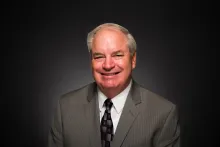
Robin Webber was born in Chicago, Illinois, in 1951, but has lived most of his life in California. He has been a part of the Church of God community since 1963. He attended Ambassador College in Pasadena from 1969-1973. He majored in theology and history.
Mr. Webber's interest remains in the study of history, socio-economics and literature. Over the years, he has offered his services to museums as a docent to share his enthusiasm and passions regarding these areas of expertise.
When time permits, he loves to go mountain biking on nearby ranch land and meet his wife as she hikes toward him.
