
Robin S Webber
This transcript was generated by AI and may contain errors. It is provided to assist those who may not be able to listen to the message.
Thank you very much, Mr. Toms. About a month and a half to two months from now, some of you, perhaps all of us, are going to be going through a common experience, especially for those of you that are going to be traveling to other parts of the United States or internationally for the Feast of Tabernacles. Many of you are going to be setting your alarm for very early in the morning to be able to make the airline. I know that all of us at one time or another – actually, Susan and I are going to be going through that on Thursday to get her down to San Diego to get on the airplane to go back home.
I think most of us know what happens when we have to get up real early, especially the night before when we begin to fidget and to play with our alarm clock.
Before we go to bed and before we turn off the lights, we begin very delicately working with it. We make sure that the alarm, when it says 3.30 in the morning, it's not 3.30 in the afternoon.
We're making sure that it is on the AM and not the PM. We make sure that the little light is on.
And then, if we want to go the extra step, then we take our cell phone or another alarm and we kind of get it all geared up because we do not want to miss that flight in the morning because we either have business and or we have a family on the other end.
And so what happens, though, if I think we're all alike, we can set our alarm for 3.30 in the morning, 4 in the morning, or 5 in the morning.
But what's with it that we have that kind of internal alarm clock within us, that if we have to wake up real early in the morning, it seems like we oftentimes are restless.
And so therefore, we'll actually wake up even a little bit earlier, becoming sleep deprived before we get on the plane and hopefully the hum and the drum and the motor will put us to sleep as we are on our flight.
And so we recognize that that's probably a common experience to all of us and understand that.
Why is that important that we do set our alarm? Why is time important to us?
And why do we get restless as we set the alarm clock the night before, restless during the night, and that we have that internal alarm in us that tends to wake us up even before the alarm clock goes off?
Because timing is essential. Because, again, we either have loved ones and or we have business responsibilities at the other end.
The thought that I'd like to share with all of you this afternoon as I invite you into this message is simply this. Have you ever considered that we are not alone in being restless before such encounters that do demand specific timing?
Perhaps you have never considered and put these words together that our Father above, our Heavenly Father, is a restless God. And that's the purpose of this message this afternoon is to introduce you and to explain why and how God is restless towards His people. And perhaps you've never considered that before. And what we're talking about isn't about a takeoff on a tarmac down at San Diego or Ontario or Los Angeles. It involves a landing and not a takeoff. And it involves actually doesn't involve a runway, but it involves coming one day to this planet earth and setting up His kingdom. It's called the Second Coming. Unfortunately, many a person has come to the conclusion that God is either sleeping and or He has missed His flight. Most people today do not believe that the Father is sending His Son back to this earth, that He's not returning. Some people feel that God has gone away or God doesn't care. And that's why I'd like to invite you to open up your Bibles to 2 Peter, 2 Peter 4, 2 Peter 3. This is not a new thought. It's been around for many, many years, almost 2,000 years. In 2 Peter 3, and let's pick up the thought beginning right in verse 1.
The first thing is that there will be scoffers. Scoffers will come in the last days walking according to their own lust and saying, Where is the promise of His coming? For since the fathers fell asleep, all things continue as they were from the beginning of creation. And not only the fathers have fallen asleep, but what Peter is saying is that the scoffers are either saying that God doesn't exist, God doesn't care, and perhaps He Himself is just asleep. And for this they willfully forget that by the word of God the heavens were of old and the earth standing out of water and in the water, by which the world that then existed perished, being flooded with water.
And so they willfully chose to forget. And so we look at that. What is the bottom line thinking again? That perhaps God's alarm, if God did have an alarm clock up in the heavens, has not gone off. He's missed His flight. And why? He doesn't either exist and or, perhaps more sadly if you think about it, that He doesn't care. Either about this world and or you personally.
Now the reason why I'm giving this message today is simply this, to be personal. Because as I often discuss with you that our Father above deals both at a macro sense and a micro sense. He's dealing, and by the way, I've got good news for you on this Sabbath day. He is not asleep. He is alive. He is well. He's on His throne. He is awake. And we're going to describe a little bit later that He is not only awake, but He is restless.
And He's on the move for you and for me and for every human being that exists. But I know, because we all go through sometimes, we wonder if God is asleep in our lives. Where is God? God, where are you? Don't you know what I'm going through? Right here. Right now.
Here I've given my life, my heart, my existence to you. And when I need you most, where in the world are you? That's a question. That can be a doubt. I would suggest perhaps more than a question because a doubt itself is an answer. But we all are in this human condition sometimes wondering, is God awake? Well, nothing could be further than the truth that God is asleep. He is awake. And as Peter says, let's get stirred up. And that's the goal of this message, is to stir you up. Did you realize that God's desire for us is to develop an intimacy with Him by reflecting on His incredible attributes? I'd like to share one with you right here. Join me, if you would, in Isaiah 62. In Isaiah 62. And let's pick up the thought here.
In Isaiah 62 and verse 1.
For Zion's sake I will not hold my peace. And for Jerusalem's sake I will not rest. Until her righteousness goes forth as brightness, and her salvation as a lamp that burns, and that the Gentiles shall see your righteousness, and all the kings your glory. And ye shall be called by a new name, speaking of Jerusalem. I'd like you to notice again here, in verse 1 of chapter 62, And for Jerusalem's sake I will not rest. Let's think about this for a moment, then we'll build forward. Are you with me?
I remember growing up in another church, in another decade, long ago and far away. And in that church, I remember often 1 John 4 and verse 8 being quoted, That God is love. And I came to understand that love and to embrace that love, and understand that that love is personified by his son, Jesus Christ.
But later in the development and the calling that God gave my family back in the 1960s, I came to understand something else very, very important. That God is more than just simply love. It's not just something amorphous and or ethereal. It's very, very, very real. Join me, if you would, in John 5 verse 17, the Gospel thereof. In John 5 and verse 17, it tells us this. And this is a self-disclosure by Jesus Christ. In John 5 and verse 17, But Jesus answered them, saying, My father has been working until now, and I have also been working.
Love can be defined perhaps as a feeling or just simply an emotion. But God is more than a feeling. He's not just simply a soft pillow up in the sky that you can lean upon. There is a dynamism. There is an activity. There is an energy that is focused not only on all of this world, but also on each and every one of us. And so we look at that and we come to understand that. And in Isaiah 62, it says that I will not rest. Now, let me share something with you for a moment. May I? Two things to understand. They kind of come together, but we're going to separate them for a moment first. We talk about the nature of God, what God is, if we can use that term, what is God, what composes God, etc. And then we can talk about the attributes of God. What is very interesting is when you think about the nature of God, which is His omniscience, His all-knowing, His omnipresence, being everywhere.
We think of the other aspects of His nature, of being all-loving, but there's a focus point. And the bottom line is He describes Himself by this attribute, that He is restless. Have you ever just been really restless that you want to get to something? You want to get it done? You know that it's important for your family and or for you. And perhaps you have an assignment at work and you're restless because you just do not stop. You want to get it done. Well, that's why today I want to introduce you to what I call the Restless God.
The Restless God. And the title of this message is simply this. The Restless God's Restless Interest in You. The Restless God's Restless Interest in You. And we find it right here in Isaiah 62. He's basically saying that I am a lighthouse in the dark and I'm going to perform my will.
I have a purpose, I have a plan, I have promises, and I have provisions that are going to back up those promises and that purpose. And it is going to be done. And that's very important to understand. Let's consider for a moment, let's consider for a moment, that perhaps right now you do not see the restlessness of God in your life. I often think of winter time. And in winter time it seems like everything is very, very still.
Trees don't have their leaves, they look a little dead, it's cold outside. But there is so much activity that is going on underneath the surface of the earth, underneath the soil. There is something loud that is happening down below, even when it is quiet up above the surface. And that's oftentimes how God acts, because we want everything in our time. We want everything in spring and in summer. And sometimes, in what we might call the winners of our life, it doesn't seem like anything is happening. Maybe God's alarm didn't go off.
Maybe He is asleep. Maybe He is a cosmic, absentee landlord. Ring, ring, ring, pray, pray, pray, study, study. Okay, God, where are you when I need you? Let's discuss this going back down through the ages and seeing how God has worked with people down through the ages when it comes to understanding how He is restless.
Let's first of all talk about the children of Israel. We're going to go through three different examples here. Number one, let's talk about the children of Israel. The Israelites might have thought, while they were in Egypt, that God had been asleep for hundreds of years. We talk about Rip Van Winkle being asleep for 20 years. Well, God seems to have been asleep for hundreds of years as they endured the lash of the Egyptians' whip.
All seemed quiet when there was no tangible arrival of the divine will. The heavens did not part. The lightning bolts did not come down when they wanted them. But little did they realize that while it appeared quiet, God was working very dynamically behind the scene in a realm that is beyond human comprehension. And let's talk about this for a moment. We want God to be in our pocket. We want to understand Him in our human realm by our human comprehension.
And God's ways are not our ways. You brought up that verse again. God's ways are not our ways. And His thoughts are not our thoughts, as it says in the book of Isaiah. But let's go a little bit further here and understand what's happening. He was allowing the Egyptians to become even more puffed up. Even more puffed up about their human but limiting potential. He was wide awake.
Join me if you would in Genesis 3. In Genesis... No, Exodus 3. Pardon me. Exodus 3. In Exodus 3, and let's pick up the thought in verse 7. And the Lord said... He wasn't talking in his sleep. And the Lord said, I have surely seen the oppression of my people who are in Egypt and have heard their cry because of their taskmasters, for I know their sorrows. It's not that God did not hear.
It's not that God did not know. It's not that God had forgotten His promises to Abram and Isaac and Jacob and Joseph concerning their descendants. But there was a purpose that was being worked out here below that transcends the moment. Transcends time and space. What was God doing in all of this? Well, He was working with the plan. He was restlessly grooming the man that he would use as a deliverer, named Moses. That... Let's consider it for a moment that would grow up, taken from the River Nile, and grow up as a prince of Egypt. What actually, as it says in the book of Acts, would learn all of the wisdom and all of the learning of Egypt.
He would become an educated individual. And not only that, but in that sphere, as it says in Josephus and in the Antiquities, that this prince of Egypt would be called Mirmashoi Kinkare. He would be a general under his adopted father. He would be the head of an army. He would conquer Ethiopia and bring it under the sphere of the Egyptian Empire. He would become a leader of men. He would learn how to move masses of individuals from this point to that point. And as any general, he would have to learn how to delegate responsibilities.
Later, he would. And again, he would have to learn to move masses of people, learn how to at times feed them. But that wasn't enough. That takes time in itself, doesn't it? To learn the wisdom of Egypt. To become a general. And then, and then beyond that, then he was sent to Midian for 40 years. Are you with me? Forty years. To become a shepherd. To learn a lot about sheep.
Not how to move an army, because an army just says, however you say it in Egyptian, yes sir! And they move. Sheep don't quite move as quickly as an army. What was God doing? How was he grooming this situation, not in the time of the cries of the children of Israel and Egypt, but to help them forward? Because later on, when God did deliver Israel out of Egypt, Moses would need to have all of these qualities set in him.
There were times when he would have to be a general. There were times that he would have to be the shepherd of the sheep of Israel. And there were times later on that God would inspire him to write down God's history, God's purpose, and the religious books that we now call the law. Genesis, Exodus, Leviticus, Numbers, and Deuteronomy. He was familiarized with the religious writings of Egypt and chronology and order.
And yet then God would use that wisdom to inspire what we have today in our books. That doesn't happen overnight. I have a question for you. Do you think the children of Israel got frustrated? Do we think that perhaps the children of Israel thought that God had gone to sleep? Do we think that perhaps the children of Israel said, Forget it! Not going to pray anymore. God doesn't love us. We are abandoned. And 3500 years ago they were saying, We're toast.
Nobody cares. And yet God was incredibly, incredibly moving history, whether it be the conquering of Ethiopia under Moses, or whether it be Moses even being the adopted son of Pharaoh, or later on how he was over in Midian and then came up against the mountain and recognized that there was a purpose for everything in his life. He thought he was going one way and God said, No, you're going to go this way.
He thought he was going to go east away from Egypt because he was non-griot back home. And God said, You're going to go back and you're going to tell Pharaoh, Let my people go. And of course, then Moses says that, well, when this all happens, who do I say, sent me? And of course, God said, You tell them this, I am that I am has sent you.
And I'm here today, brethren, to tell you in Los Angeles and those that are listening, that you and I worship the same I am that I am. He is alive. He is well. He's on his throne. Your life is not lost in his hands. He's not a butterfingers. He's a father above that does not have accidents. And he knows exactly where you are and where I am. Let's go to case number two. Are you with me? We're going to move forward now. Again, about a thousand years later. So we're talking around 400 B.C. And this is in the post-exile period of Israel, Nehemiah, and after Malachi. It seems as if God had once again become a cosmic absentee landlord.
There was no official voice of God. The Jews themselves, and Mr. Garnett may be familiar with this. He kind of likes to read these things. They said that they were merely being contacted by the voice of the angel. The voice of the angel, but not the voice of God. God had rescued them. God had inspired Cyrus to send them back to Jerusalem. But there was not that sure revelation. And they wondered.
And they pondered. It seemed very quiet. It seemed like winter. It seemed that maybe God was asleep again rather than being restless. Rather than working dynamically and loudly behind the scenes, even when it seemed quiet. And then, of course, after 67 B.C., they had the Roman boot at their neck. What is God doing?
Let's talk about those 400 years for a moment. That seemed perhaps quiet to the Jewish people in Judea at that time. Little could they recognize the seeds that God was planting in their life. For the arrival of the Son and for the future preaching of the Gospel. During those 400 years, let's understand what happened.
Number one, we have the expansion of the Hellenistic world through Alexander the Great and those generals that followed him. The Greek language became more and more extant, especially in that which would later on be called the Eastern Roman Empire. To recognize that there was, as we would say today or in yesteryear, we would say, L'Angua Franca. There became the L'Angua Grisha or Hellenistic tongue. It spread, and it spread so much so that in Alexandria, Ptolemy II brought in all the wise men from the Jewish community and 70 of them, and composed what we call the Septuagint. The Scriptures of the Old Testament that were in the Greek that would be spread abroad to prepare the seeds of what was going on. Number two, all during that time, because of the Jewish community after Babylon, some back to Judea, and then later on they began to spread, and they began to spread, and they began to spread. Quietly, surely, city to city. But synagogues popped up all over the known world of that time in the Mediterranean basin. And then, as Rome began to emerge, the Romans, with their buildings, began to build roads. Travel would be safer than ever. The word could get out faster than ever. Join me, if you would, in Galatians 4 and verse 4. In Galatians 4 and 4, that during this time it was all moving to this great moment that Paul capsulizes here in Galatians 4 and verse 4. But when the fullness of the time had come, God sent forth his son, born of a woman, born under the law, to redeem those who were under the law that we might receive the adoption of sons.
When the fullness of time had come, not in our time, not in our time, brethren, but in God's time, when he saw it all coming together with all the seeds that he had planted, even when it seemed real quiet for those 400 years before Jesus Christ came, all of a sudden he did come.
That star was over Bethlehem. The shepherds did come to the manger. The wise men did come out of the east a couple years later. And the king had arrived on the earth. Not on Judah's time. Not on your time or my time, but God's time.
The reason why I'm sharing this, brethren, with you is simply this. We are a people of faith.
And one of the foundational faith items that we need to have is simply this. We believe, as a matter of faith, that God created time when we read Genesis 1 and Genesis 2.
Planets, sun, motion, earth, etc. We believe in God the Creator.
If I look around this audience, I think I could say that I believe that everybody in this audience believes that God is the Creator of time.
Don't have to raise your hand. Thank you very much. No. Don't have to raise your hand.
But here's the second element of belief. Do you believe that God is the Master of timing? Big difference.
That's a whole other level. Not only that God created time, but He is the Master of timing for His purpose, for His plan, for His promises, and for His provisions to be worked out.
And that is a growth step that each and every one of us has to take when we follow the call of Jesus Christ, saying to follow Me, and to give up on our timing, and to follow the timing of His Father.
Join me, if you would, in Mark 1.14. Again, let's notice the Apostle Paul in Galatians is basically mirroring the words of what Jesus said here in Mark 1.14-15.
Now, after John was put in prison, Jesus came to Galilee preaching the gospel of the kingdom of God, and notice Him saying, the time is fulfilled.
Houston, we have a landing, we have a touchdown, and the kingdom of God is at hand.
God knows exactly what He is doing with the cosmos, with the world, and with the world that lies in your heart as you look at Him to be your provider.
Interesting.
Interesting.
So we look at all of this, and understand that when we were baptized, we said, Father, that you're going to set the clock, and that we will go by your timing.
And you said that I'm going to give... you're going to give your life in faith to that.
The question again comes up as simply this.
That God, when you think about the question, but the reality is that God pinpointed the exact right time, not only for His Son to enter into this earth, but for the gospel to be preached.
When you look at how the gospel was preached, it was basically preached to, yes, through the Hellenistic world at first.
It was preached as Peter, and James, and John, and Paul, and Barnabas, and Sylvanus would walk those Roman roads that were built.
And so often, as we know through Scripture, it says that they would go to the Jews first, and then to the Gentiles, because there were synagogues. The launch pad was there. God had prepared all of that, even when it seemed to be quiet. And again, so I don't lose you in this, what is God doing planting seeds in your life right now that we need to be sensitive to, to prepare you for the next stage, next step, and His continuing deliverance and guidance in your life?
Can we look underneath the soil? Or are we just sunshine patriots, sunshine Christians, and recognize that even sometimes when it is cold, even sometimes when it is dark, like it is under winter, that God is at work, that He is restless, restless for us to have that intimacy with Him, that knowing and that confidence that He is going to fulfill His promises in us.
How much does our Father love us? And how restless is He?
I've given messages on Luke 15 before. I'm not going to go into that right now.
But one of the keys that was in Jesus' ministry is that He revealed something that no other religion has about our Heavenly Father.
And that is that we worship a Father that is restless and seeks after us, the seeking God, the seeking Father.
Think about that for a moment. Speaking in the parables of the Good Shepherd that goes after the One, verses the 99.
The woman that loses the one coin out of the ten and will not rest until it is found.
And then finally, the greatest story of the one-on-one, where it goes from animals to metals to one-on-one of a Father's great love, of being restless, of being at the door. And never giving up. Never giving up. Never giving up that that child is going to return to Him.
And doesn't wait for an explanation that goes out and embraces Him, runs to Him, embraces Him.
And this is my son and he was lost, but he has returned. How restless was that Father? And if that Father was restless for His earthly child, how much is our Heavenly Father?
I'd like to share a story with you about a Father that was restless.
It's a story regarding a Quaker family during the Civil War. A Quaker family that was in Pennsylvania.
And against the Father's wishes, because Quakers are pacifists, His son Jonathan enlisted in the cause of the North.
Well, time passed and no word came back from Jonathan from the front line.
The Father had a very disturbing dream.
Something He felt had happened. I'm sure we as parents or grandparents have had that with our family members. He was very restless and He knew that His son had been wounded in action and He needed the care of a Father.
So the Father left the farm and discovered where the troops might be.
He came in, his buggy, into the encampment and found the commanding general and said, General, is my son here? He said, well, the general said to the Father, Well, you have to understand, we had a major, major conflict today and we had to leave many, many out in the trenches.
We do not know whether they are dead or whether they are alive.
And the Father said, can I go out and can I find my son?
And the general said, fine. So He did that and He went out. It was nighttime.
And all He had, He parked His buggy and then all He had was He had a lamp and a flask.
And going up and down, He looked around and with the light, as much as a lighted lamp, He just kind of recognized that that wasn't going anywhere.
And so finally He came up with the plan, I know what I'll do.
I will go up and down and up and down and up and down and I will not miss one person.
So He took His lamp and He began to go up and down and up and down and He says, John Smith, John Smith, thy father, knowing how Quaker speak, thy father seeketh after thee.
And He would go a little bit further and He would go a little bit further.
And He'd cry out again, John Smith, thy father seeketh after thee.
And He could hear the groans of the men as He went back and forth.
And He heard a voice come up and said, I wish that was my father.
But He would not give up.
And then finally, at the very end, frustrated and tired and He was about to go in, He went down one more row and He said, John Smith, thy father seeketh after thee.
And all of a sudden a voice came out of the dark.
Father, I'm here.
And I know and I knew that You would come after me.
Wherever You are in Your life today on this good Sabbath day, whatever jungle of our own making, or whatever circumstances have come our way by others, and we wonder as to whether or not our Father above is awake and alive, loves us.
I'm here to remind you as a minister of Jesus Christ that Your Father seeks after You.
He knows exactly what You're going through. He knows where You are.
You and I on this good Sabbath day have a reality that moves beyond times and dates and other personalities.
The loud, overwhelming theme of the Scripture is that we have a Father, a God of love, a God that is at work, a Son of His that is at work, that knows exactly where You are.
See, that's what makes God God. He can deal with the entire world, and timing is going to be essential there, as we'll see in a moment. And He knows exactly where You are at this moment.
And I wanted to mention that to be able to encourage you today.
It's kind of interesting that... Let's go back to Isaiah 62 for a moment. Isaiah 62. For Zion's sake I will not hold my peace, and for Jerusalem's sake I will not rest.
Until her righteousness goes forth as brightness and her salvation as the lamp that burns. It's interesting that some of the commentaries, and you know you can have three commentaries, and they can have five ideas about one verse, but it's interesting that some of the commentaries basically look at this as basically making the comment that there is a joint restlessness. It is not only describing the restlessness of the Savior God, the seeking Savior loving God, but it is also speaking of the restlessness of the prophet himself.
So some books will say it's about God. Some books will say commentaries will say it's about the prophet.
I have a comment. Why not both? Makes it easier, doesn't it? So often we get caught in the tyranny of either or rather than recognizing much of the Scripture is about and and bringing them together. My question to you, and all you can do is fill in the answer by how you live, is how restless are you? How restless are you to see your Father, to see His actions in your life, to see His promises of faithfulness come true in your life. I hope that after this message you will be restless in the sense that you will begin to see seeds that God is planting in your life that have not quite come to fruition, but are in the process. I think more than ever that the body of Christ needs an awakening, an awakening to recognizing how God works. And it's not always going to be in our time. It's not that we do this, therefore God does this, because God sees things in a different light, in a different vein, much like the same story that I've shared with you for many a time about the young man that had the conversation with God. And the young man said, God, what is a million years like to you?
God thought about it for a moment. He said, my son, a million years is like, hmm, but a second. Young man started thinking, that can be dangerous. Young man began starting thinking, I have another question for you. And that is, what is a million dollars like to you?
God thought about it for a moment and said, my son, a million dollars is like a penny. So the young man thought, I'm going to ask one more question. And the young man said, God, can I have one of your pennies? God thought about it. He said, yeah, but you're going to have to wait a second.
But sometimes you and I, I don't know if that's gallows laughter or not. It's cute, but there may be some gallows. How often have we wanted one of God's pennies immediately and now? Are you with me? Are we in the same condition? We all want it now. Rather than recognizing what God is doing underneath the soil that is around us and in us, and in ways that are going to be so much better than our best and to be patient and to lean not to our own understanding, but to recognize what God is doing.
I know every day that you as the people of God pray that thy kingdom come. And it is going to come. And sometimes we've had people that set times and dates and have it all figured out when Jesus Christ has said, no man knows the day or the hour.
But what some people try to do is they'll try to do just a minute to get it in. You know, just people kind of want to work the angles. Join me if you would in Matthew 24, 21. Matthew 24, 21.
God makes a promise here. This is a promise. A lot of prophecy is a promise. For then there will be great tribulations, such as not been since the beginning of the world until this time, nor ever shall be.
And unless those days were shortened, no flesh would be saved. But for the elect's sake, those days will be shortened.
God is going to know exactly when to intervene. If God comes back too soon, humanity will say, well, God, why didn't you just give us another thousand? We could have really worked it out.
You've come too soon.
But on the other pendulum side, if he comes too late, there wouldn't be anything here.
See, God is not only the creator of time, but he is the master of timing, and Father knows best.
That's a promise that I held in my heart since I was 12 years old and first began to understand the prophecy of how God works. That God is not just a feeling, he is not just love, and he's not just defined by work, but by the work that he does, that he is true to his word and true to his people.
We've seen how he fashioned Israel of old. We've seen how he fashioned the entrance of his son to this world. Likewise, he fashions us and to understand that.
Show me if you would, in Psalm 23. In Psalm 23, we worship, rather, in a restless God, and a loving God, and he guides us as that great shepherd of the sheep.
He sometimes guides us in places that are nice, and he guides us sometimes into places in preparing us that are not so humanly nice.
The Lord is my shepherd I shall not want. He makes me to lie down in green pastures. He leads me beside the soul. He leads me in the paths of righteousness for his name's sake.
Oh, I am so glad that God is alive and well and loving and awake.
Because I've got green pastures, I've got still waters, I've got paths of righteousness, I'm hopping and popping, and life could not be better.
I am so glad that I'm in this way of life, and I'm glad that God is my God and Christ is my elder brother.
Oh, excuse me, verse 4. And yea, though I walk through the valley of the shadow of death, I will fear no evil. For you are with me, your route and your staff, they comfort me.
And you prepare a table before me in the presence of my friends.
Is that what your Bible says? You prepare a place before me in the presence of my enemies.
God's alarm must not have gone off.
He's asleep again.
Hello? Hello, hello, hello?
Anybody up there?
Don't you have seen what I've done for you all of these years? I know you never think this way. All of these years, I've done this, I've done this, I've done this, I've done this, da da da da da da da da da da da.
Hello?
What we have to understand, this is where God is working dynamically and loudly behind the scenes.
When a shepherd takes his flock from the low land to the high land, and through the crevices to get up into that high land, that is when the shepherd is in full concentration, full focus, and is doing his most intimate, most sensitive, most trained work. Even when the sheep don't know it, the shepherd is working, the shepherd is at his very best, all of his training, and all of his love for the flock is going in at this point to bring them up.
Hmm. Interesting.
And God prepares a table before us.
And sometimes it's not a table of our choosing.
But if it was of our choosing, but if it was of our choosing, where would we grow and where would we develop in the faith and the confidence that God expects?
Do I dare say demands of us as we come into intimate relationship?
You cannot, you know, if you take five pound barbells, I'm talking to men for a moment, if you just take five pound barbells and think you're Charles Atlas and going to get there, you just have that conversation after church.
There is no gain without a certain amount of pressure and development, and to be able to do what Jesus Christ did himself. I want to share a thought for you here for a moment, and it's to recognize a beautiful verse. Let's go to John. Let's go over to John. It's not my notes. I'm going to go there anyway. John.
Jesus is at the sepulchre of Lazarus in Bethany, and please notice what he says here. This is one of the great striking points that comes out of this story of Lazarus at the grave, and it says in verse 41, Father, I thank you. I thank you that you have heard me. And I know, and I know, that you always hear me.
Hmm.
I would pray that each and every one of us, as members of the body of Christ, have that same confidence, as we follow Jesus Christ himself in that. And that takes faith, doesn't it? Because God hears me and always hears me, Robin Weber, and or yourself, you put your name in there, and it does not necessarily mean that God is always going to respond the way that humanly we think he ought to respond. But there's a faith and a confidence. Let's move that forward a month later when Jesus is on the cross on Golgotha.
And one last time, the last words that came out of Jesus' mouth, in that table that was prepared for him, the last words, the last of the seven sayings, are you with me? You might know it. He said, Father, into your hands, I commit my spirit.
I believe his father heard him. Do you believe that? And he is the first of many brethren. And what God the Father does for his beloved son, he does for you as his beloved son and daughter today. And we need to have that confidence that you and I worship, worship a restless God. Join me in concluding in Isaiah 40.
Let's allow the words of Scripture to fall upon us.
Have you not known? Have you not heard? Of the everlasting God the Lord, the Creator of the ends of the earth. Neither faints, nor is weary. He's not asleep. His understanding is unsearchable.
And he gives power to the weak. And to those who have no might, he increases strength.
Even the youth shall faint and be weary, and the young men shall utterly fall.
Just like a John Smith 140 years ago. But we have a father.
And we have a master and a savior that does this for us.
That those that wait on the Lord shall renew their strength. They shall mount up with wings like eagles. They shall run and not be weary.
They shall walk.
They shall walk. And not faint.
And in our weakness to echo Paul, the great God, our loving Father, is made strong.
And in his strength, we walk as we move from this building today, moving forward, recognizing that we are not alone.
That you and I worship the restless God, who has a restless love, a restless purpose, that he's going to fulfill in you and me.
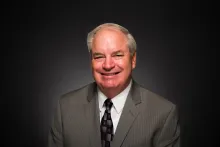
Robin Webber was born in Chicago, Illinois, in 1951, but has lived most of his life in California. He has been a part of the Church of God community since 1963. He attended Ambassador College in Pasadena from 1969-1973. He majored in theology and history.
Mr. Webber's interest remains in the study of history, socio-economics and literature. Over the years, he has offered his services to museums as a docent to share his enthusiasm and passions regarding these areas of expertise.
When time permits, he loves to go mountain biking on nearby ranch land and meet his wife as she hikes toward him.
