


David Dobson
Sins of the Tongue
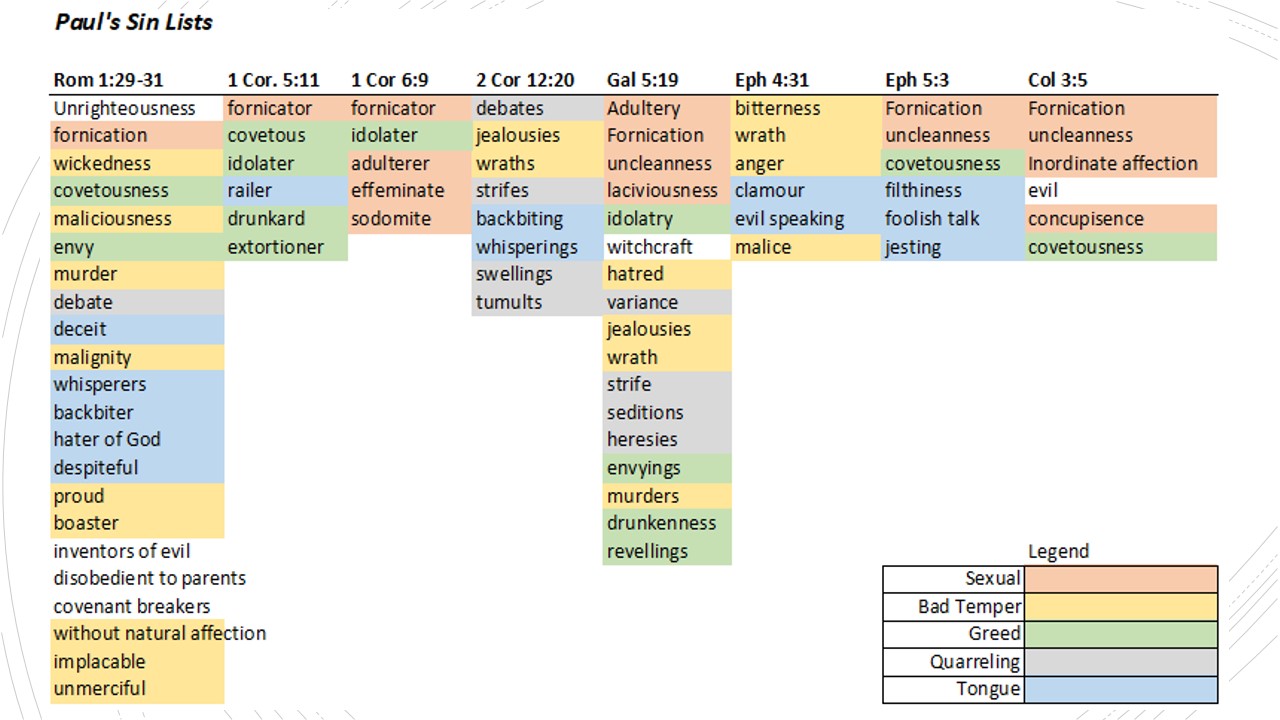
Previously, I introduced a chart where I compiled Paul’s 8 well known “sin lists”. I then categorized the 40+ different words Paul used to describe these sins and put them into 5 categories. Today’s category is “sins of the tongue”… James 1:26
Deceit & Guile
Deceit - dolos, G13887 G1388 G1389 - 12x - literally to set out bait and snare, or entrap. Also translated as guile, subtility, craft. Devising plans to gain control over a person.
Being honest and upfront with people is a huge part of developing the mind of God. It is the substance of the 9th commandment… God’s top behavioral priorities!
Our society is filled with laws, checks and balances, contracts, lawyers, bureaucracy, locked doors, standing armies, nuclear arsenals… because we don’t trust one another. The rule of God on earth will be enjoyable because people will be able to trust others, trust business associates, trust leaders.
If you are truly an ambassador of that coming kingdom your will act or learn to act with honesty and integrity now.
Four Ways We Attack One Another With Words
Attacking one another with words is related to hatred, anger, and even the spirit of murder… which connects sins of the tongue to the 6th commandment of God… but I am getting ahead of myself.
Let’s start with words said behind a person’s back… then escalate to angry words we say directly to a person. We’ll also start with words that plant subtle seeds of doubt, then escalate to words of passionate outrage.
Whispering & Backbiting - Things Said in Secret
Whispering psithuristēs G5588/G5587 is only found twice in the bible and both are in the sin lists. Its sometimes translated gossip but I think whispering is the best rendering. In Greek it’s an onomatopoeia… a word that imitate the sounds associated with the objects or actions they refer to… pss-psst-psst.
Whisperers sow seeds of doubt and suspicion… quietly dropping hints about the potential darkness within... but only when they are not there to defend themselves.
Backbiting katalalos G2636/G2637 - the literal meaning is simply “talk against” - sometimes translated slander… however backbiting convey the sense of biting at them “behind their back”.
It’s only found once outside the sin lists, in 1 Peter 2:1, which we looked at already. Backbiting is also a form of hypocrisy… acting one way when the target is around.. but another way when they are not around.
Whispering sows doubt and suspicion… backbiting escalates by moving into making actual accusations. So:
whispering might say “I don’t know about Cornelius, he seems to have anger issues”
backbiting might say “I bet you Cornelius beats his wife”
Now Let’s Escalate Some More
Lets go from talking about someone privately behind their back to committing sins of the tongue directly to their face!
Despiteful & Reviling - Things Said Directly
Speaking to injure (hubris) - G5197/G5196/G5195 - 10x. It is translated despiteful, reproach, harmful, cause injury… also to shame, to insult.
Among the ancient Greeks hubris meant speaking proudly and arrogantly intending to humiliate or degrade opponents. It signified a person who had overstepped the natural limits placed on human behavior by the gods.
Luke 18:32 this came to pass when He was given over to the Roman soldiers who subjected made a mockery of His messianic status and verbally abused Him… leading to physical abuse.
How might this apply to the Church and how we speak among one another:
Threatening speech … words like “you better watch yourself or I’ll knock your teeth out”… “I’d like to scratch her eyes out”. We currently see a lot of this sort of talk in our public discourse [entertainment & politics], its easy for us to get sucked in.
Words meant to humiliate … usually in front of others. The words and punishments meted out to Jesus, or later to Paul were done in such a way as to shame them publicly. Jesus was called a bastard child, a blasphemer, a deceiver… Paul was likewise insulted, and publicly denounced… stripped, beaten, thrown in jail.
Commonplace examples of this could be as simple as mocking a person, trying to make them seem small and weak… or making gestures of personal contempt - instead of spitting we tend to make obscene hand gestures… verbally we use the f-bomb.
Revile [railing] G3060/G3059/G3058 - 8x. based on how this word is used elsewhere in scripture I believe “reviling” to be a type of insulting accusation delivered with passionate energy. Previously we reviewed slander… as words against a person when they are not there to defend themself. Now we have accusations, or insults, made to their face.
2 uses of this word find Jesus being accused or insulted by the Jewish leaders…
1 Peter 2:23 --> 1 Peter 3:8-9 --> 1 Corinthians 4:12-13.
Action item: DON’T RETALIATE.
Matthew 5:38-39 a slap on the cheek was a cultural form of contempt and insult [this is not about self defense]. Within that context, the principle of eye for an eye says “they started it so I can insult them back”. But, then they can say “well now I need to insult them back” and the cycle goes on endlessly. Jesus’ instruction is to stop the never ending cycle of retribution. Otherwise, everyone ends up eyeless and toothless… the power to stop the destructive cycle is in your hands [or mouth].
Clamour - Things Said Publicly That Are Not Personal
The next few examples come from the Ephesians 4:30-31 sin list… they are said to grieve the holy spirit of God.
Clamour (G2906 - to cry out) the previous 4 examples were about personal interactions… is about stirring up the crowd. It indicates volume [the opposite end of the spectrum from the whisperer].
Crying out can be both good or evil… the evil would be because of the content, and the context. Standing up in a crowd to denounce the Church, or some group within the Church, or perhaps a teaching… all fit the context.
In Ephesians 4 clamour is associated with raging emotions… wrath, anger, bitterness, and lead to our next sin of the tongue… blasphemy.
Verbally Attacking What is Holy
Evil Speaking G988/G987 - 53x. The Greek is blasphemia the word is mostly translated “blasphemy”. It isn’t translated blasphemy in the Ephesians 4:31 sin list and few other places… probably because its words against a person rather than toward God.
However, I think using the word blasphemy would have been better.We already have a at least 4 other words for saying evil against another… blasphemy is for when God is drawn into the equation… even indirectly.
So, we all might think twice before saying bad things about God enthroned in the 3rd heaven… but not as careful regarding the people and institutions He is working through.
Another way for members of God’s Church to blaspheme is to speak like a follower of God and then act in a manner that makes God look bad. James 2:7, 1 Timothy 6:1, Romans 2:24, 3:8, 14:16.
Haters of God G2319 - the only instance of this is in the sin list of Romans 1:29-30. The meaning is self evident. Culturally we saw a rise in this sort of talk with the angry atheist movement of the 2010’s: God is a genocidal maniac, God is racist, God is sexist, God is a hater, God is unjust etc. … public rhetoric does affect God’s people.
Again… religious people are usually careful about directly insulting the most high God… but less careful with the people and institutions God works through.
Content of Our Talk - Filthy, Foolish, and Facetious
Ephesians 5:3-4 now we have sins of the tongue not against others, or against God… but which expose what is within us.
Filthy aischrotēs G151 - 2x literally means shameful or disgraceful…
People generally don’t talk openly about their own personal greediness or lusts because they fear social shame. But sometimes we do… and God find it offensive.
However, we are focused on words here so the application is to avoid talk about matters of sexuality which ought to be kept private.
Foolish- morologioa G3473 is a compound word: the talk of a fool. Its only used once, but the fool [moros] is mentioned often in scripture. In the NT writings a fool is:
Facetious - eutra-pelia G2160 (Jesting KJV) 1x … good-turning. To the Greeks it meant quick and flexible… we might say “quick-witted”. What’s the problem here? To call someone quick witted is generally a compliment right?
Probably the best way to consider this is the opposite of “slow to speak”… or saying something before giving is some thought or consideration. Being quick with a funny comeback or comment can lead to saying something you regret… or would not have said if you had given some more thought… this can lead to hurt feelings, which can turn into grudges… all for the sake of appearing clever.
Quick-wit these days is usually some form of sexual innuendo, or clever put-downs… which fall into the categories of shameful or insulting words.
Conclusion
On all these sins of the tongue I hope that looking into the meaning helps you identify and avoid “sins of the tongue”. I also think the principle of “don’t retaliate” is helpful guidance in most of these cases… because so much of our bad behavior is developed by imitating others.
Be your own person… protect your integrity… learn to avoid the “sins of the tongue”.

Craig Scott pastors the United Church of God congregations in Raleigh, Greensboro and Jacksonville, North Carolina.
