
Robin S Webber
This transcript was generated by AI and may contain errors. It is provided to assist those who may not be able to listen to the message.
Well, I don't know if you noticed when you walked in, but I sure did notice it, and it never changes, is that when you have people, have you ever noticed that people love to talk? What is that about all of us? We just love to talk. Sometimes too much, and sometimes things that just ought not be said. I'm sure all of us at one time or another have used the old phrase, tripping over our words. And sometimes it's more than just simply a trip.
It's actually a crash landing. And unfortunately, we may be the last ones to recognize that there has been a crash landing. We may recognize it in others, but we don't recognize it in ourselves. This message today is going to be entitled, A Spirit-Led Tongue. A spirit-led tongue. And there is probably no more important message that I might be able to share with you.
If you think I'm talking about you and to you, yes, I am. And at the same time, I am also going to be talking to myself. Because I think all of us, no matter how old we are, we've come to recognize that talk is not cheap. Talk isn't cheap. Its misuse can ultimately cost us everything that we own and hold near and dear. Whether it be a spouse, whether it be a child, whether it be friends, whether it be a fellow congregant, whether it be on our job, whether it be a neighbor. Ultimately, our words can cut us off from God Himself.
Because a wrong application and a wrong use of words is indeed a sin. But at the same time, let's fully understand and appreciate that our words not only can cut us off from people and are off from God, but most importantly and most encouragingly, our words, given by our tongue, can also endear us to people and endear us to God.
Just think about it. Whenever you've been in a conversation with somebody that has a mastery of a spirit-led tongue, and how that makes you feel in the midst of that conversation, and or when you depart, because sometimes you don't recognize it until you depart, that you have had a Christian conversation with somebody, and how good that feels, and how uplifted you are.
Even maybe in discussing something that is challenging, but you go away what? Encouraged. Because of the use of another individual's tongue, and or how God used you to affect somebody else. For a moment, let's note the contrast between the proper and the improper use of the tongue. As to whether or not we have, are you ready, a self-absorbed tongue? Have the emphasis on self? And or whether we have a spirit-led tongue? When I say self-absorbed tongue, I'm sure at one time or another, we've gone into those old country stores where they have those bottles of pickles up on a shelf.
Have you ever seen a pickle that's in a jar, and it's just soaking in that jar? That puppy's soaking. It's just in there. You swish it. And you know what? It just kind of jiggles, but all that juice is just permeating in it.
Well, just take the pickle out and put your tongue in there. And I want you to think about it a moment. Be honest with yourself. It's going to be honest to church. And wonder if that was our tongue in there, in that jar. Could we describe it as being when we look at it, or when we hear it, experience it? Is it self-absorbed, and or is it a spirit-led tongue? Bottom line to be graphic, what is it swishing in? And what is our conversation swishing in? How would other people describe it besides yourself?
Well, let's understand one thing to begin with. We've all heard of the old nursery rhyme of sticks and stones and how they will not really hurt our bones. Well, I think the reality is all of us recognize we all learned that in kindergarten, and that's when our lives start getting hurt by words and by what others said about us or said to us. And the bottom line is simply this. Let's just be frank. Words can either dramatically lift people up, and or our words can do incredible damage. Here's the bottom line, folks.
Words do hurt. Words do hurt. They hurt other people. They hurt other people. And they also hurt, conversely, our relationship with God and what God intends us to do. Join me, if you would, in Job 19, to make this point very clear. In Job 19—let's pick up the thought in verse 1—and again, let's realize that there's nothing new underneath the sun and to realize that the book of Job is written approximately 3,700 years ago. Just think about that for a moment. How much things have changed but haven't changed? Then Job answered and said, How long will you torment my soul? How will the soul be tormented and break me in pieces with words?
The patriarch Job. That words were shattering him as an individual. So we come to recognize that, to be very frank, words can hurt. Now, why am I bringing this up to you? Why do we go to the Old Testament?
But now, let's fast forward. We're Christians. We are to be a new creation. That's what God inspired the Paul to say. He said, You are a new creation. Old things have passed away.
So when you think about that, God asked us to be different. He asked us to be incredibly unique in how we use and create words and use our tongues. We're going to talk about that creative process a little bit later in this message. I'd like us to center for a moment. Join me, if you would. Let's turn over to the book of Colossians, the epistles thereof, to the Colossians. Join me, if you would, in Colossians 4 for a moment. Colossians 4. Let's pick up the thought in verse 5. Now, in the context of this, it's speaking to a great degree about evangelism outwardly. Paul started the conversation in verse 1, but then he asked the congregation at Colossae to join in with him. But I think we can use the principle in our everyday conversation.
It says to walk in wisdom towards those who are outside. We could almost change that. Rhymes with, sounds like, talk in wisdom towards those who are outside redeeming.
That means to make good the time. Let your speech always be with grace, seasoned with salt, that you may know how you ought to answer each one.
Notice what God encourages Paul to share with Christians now that our speech should be, notice again, with grace, or full of grace, and seasoned with salt. Let's break those words down. Let's kind of break down so we can build up them. What does the word grace mean? Out of the Greek, it actually comes from the word keras, C-H-A-R-I-S, grace. It means gift. It means charmed.
So what it's saying is, let's go back a second, let your speech always be as a gift in which somebody that enters your life and hears how you talk are, in a sense, charmed. Charmed by how you address things, how you talk to them, and how you talk to them about things, how you talk to them about other persons, how you talk differently than everybody else that's out in this world.
You have a charmed expression, and it's gifted. And we'll talk about that because ultimately it's not our gift, it's how we use God's gift from above that lodges in our heart, comes up through our tongue, and reaches out to others. Notice also what it says here. It says, and that it is seasoned with salt. Well, salt is a preservative. Salt is something that, again, we lose a sense of salt today because of the mass manufacture and the world that we live in today. We know that empires of old rose and fell based upon the salt trade. Salt was so precious because it was a preservative. It made things last for another day. Have you ever been in a conversation that doesn't last for another day because of what somebody says? It's dead on arrival.
It's over, buddy. Forget it, Jane. I'm out of here. That's it. We're not talking because somebody was not charmed. Somebody was not... I'm talking about in the church, by the way, not out there. I'm talking about in here. Because of the way that we used our words, the way that we used our hearts, and to recognize that it wasn't seasoned as with salt. Salt, which is a preservative that makes things last and also makes want people to come back.
Have you ever had a piece of meat without salt? Does it really make you want to dig into the next bite? But you put just a little salt on it. Not too much. But just a little bit, you want to go back again and again. Well, that's why God describes all of this in this one verse, that we, as this new creation called out of the world, are to have a tongue that is gifted and preserves and is seasoned to where people are going to want to come back. Just as much as the Queen of Sheba wanted to come to to to visit Solomon to see how it works, because you don't get that everywhere today out there and even some excuse me even sometimes even in our own midst. So let's talk about this. Why discuss this subject today with you here and now? There is probably no greater challenge that is going to face us, I'm including myself, on an ongoing daily basis, minute by minute, minute by minute, minute by minute. Because if you go through the studies, it's very interesting, you'll find this humorous to your degree, especially the ladies, is that most men basically talk about 10 to 12,000 words a day. Most ladies speak about 15 to 18,000 words a day.
Ladies, you already recognize that men are quieter in general than you. And gentlemen, we also recognize that our ladies tend to stretch out their conversation more than we do. And there are very real factors of why that is and why that occurs. But let's just face it, if you're a guy like me, you are still speaking 10 to 12,000 words a day. We have a lot to be accounted for and a lot to take care of in what we say and how we say it. And to recognize that our use of the tongue can either build up or tear down the very relationships that Mr. Hall was talking about before God and man. Frankly, there is no greater indicator, hear me please, Redlands, there is no greater indicator of a transformed life than the words that roll off our tongue.
We talk about testimony. And sometimes people give testimony. Well, we're giving testimony all the time, all day long, to our parents, to our children, to when people call me on the phone that I've never met before. And I'm just talking to them on the phone. They're interested in God's way of life or they're interested in the United Church of God. And I have to measure my words, word for word, because I'm in that sense representing church. But beyond that, just not simply as a minister representing the church to somebody on a telephone, I have that conversation every day in the words that I use towards my wife Susan or when I call Mr. Sharp or Mr. Barr or when I call one of you or one of you call me. What words am I using that either build up or level another individual? Let's please understand the challenge that lies before each and every one of us. Allow me again to be very blunt. We live in a world that has lost its way and frankly has lost its manners in what is appropriate. Very interesting that with this week of the memorial memorialization of President Kennedy's assassination and seeing that in 1963 and then measuring that was 50 years ago, it also helped me to kind of think how much the world has really changed and how much we accept that was not acceptable in our grandparents' time or in our parents' time and that now is just part and parcel of this age that is around us where everybody prides themselves, key word, pride, prides themselves on their self-prescribed liberty to say it like it is and or to spice up their speech. Watch out for that one. Spice up their speech or talk a little dirty or talk over someone. Don't allow someone to finish their conversation.
Talk down to someone. Well, say it now and then go on the apology tour later.
How often do you see people now on television where they just say something blatantly cruel about either a fellow public figure, media figure, or somebody out there and then they come back with an apology which most of the time, folks, is not an apology. An apology goes like this. Perhaps your parents taught you this. An apology goes like this. I am dead wrong. It's not, I feel sorry that you feel that way. That's not an apology. Oh, I'm sorry that you took my words that way. That's not an apology. An apology is I am dead wrong and I am sincerely sorry and I have learned my lesson and I'm taking that lesson forward. But today, people just are talking over one another. They're not listening to one another. They have what we call a self-absorbed tongue, which actually connects to something else that we'll be eating to later. So here we go. Why, again, is this important? Let's think about one more thing and then we're going to move a little bit further into the message.
What is God's messenger to this earth called? His perfect messenger. Jesus Christ.
What's another word for Jesus Christ? What does John 1 call Jesus Christ? Somebody help me in the audience. He's known as the Word. Very important, isn't it? He's known as the Word. He's called the Word. He came by Word, indeed, to represent a clear and unpolluted picture of what God would be like and was like in human form. God the Father had every confidence that Christ would not only represent His words, but reflect those words the way that He desired. In other words, He was the perfect Word. I'm trying to build a case for all of us to understand how important as a new creation, given a new opportunity in life, to follow the example of our elder brother, the Word, Jesus Christ, and represent God by every word. Oh, you say, oh, Mr. Weber, does it have to be every word?
How about every other word?
How many of you out there? We're in the United Church of God. We raised our hands. We're going to take a vote here. Okay, we can do that. How many of you think that God wants us to be responsible for every other word? That we speak to our wives. That we speak to our adult parents.
That we speak to our children. That we speak to somebody here in this church.
That we speak to our neighbor whose dog keeps on jumping over the fence into our yard, and, oh boy, do we want... Question. How many of you think that God wants us to be responsible for every other word? A show of hands. I thought your hand went up, Isis. It was going up. Okay, okay. Oh, you're just doing that. Okay. Oh, you're scratching. How many of you think God wants us to be responsible for every word? Can I tell you something? I have not been responsible for every word. You know why? Because I'm a human being, just like you. But that is the goal. That is God's desire. That is why Jesus is called the word, and to follow his example. So this afternoon, let's consider the Christian responsibility of a spirit-led tongue. Let's take a reality check. It's always good to deal with reality before we go a step further. Join me, if you would, in James 3. Very interesting here in James 3, which is often called the tongue chapter, because James just nails it here. In James 3, my brethren, verse 1, let not many of you become teachers, knowing that we shall receive a stricter judgment. For we all stumble in many things, and if anyone does not stumble in word, he is a perfect man, also able to bridle the whole body. The context of James 3 is specifically to those that were placing themselves into the role of being a teacher in the church. They wanted that exalted position. They wanted to self-annoint themselves that I'm going to become a teacher over others. And it's very interesting what James says here, knowing that if anyone does not, he is a perfect man, also able to bridle the whole body. What he's really talking about here, it does take training. Now, in the rest of James 3, though, there are principles and examples for all of us to consider about the tongue. And he brings this up.
He says, "...indeed we put bits in horses' mouths that they may obey us, and we turn their whole body.
Look also at ships, although they are so large and are driven by fierce winds, they are turned by a very small rudder, wherever the pilot desires. Even so, the tongue is a little member, and it boasts great things, and see how great a forest a little fire kindles." Just a match up here in the San Bernardino Mountains above us, during Santa Ana season, what just a little match and what a little flame can do and literally knock over 10 to 15 to 20,000 acres of precious wilderness. And the tongue is a fire. It's a world of iniquity. And the tongue is so set among our members that it defiles the whole body and sets on fire the course of nature, and is set on fire by hell. And so it just describes how this seemingly this little piece of meat that's in our jaws, what it can do of and by itself. But no man can tame the tongue.
It is an unruly evil full of deadly poison. So you have all of these analogies of the tongue being like fire or a little rudder that stirs a big ship. It is so small, but it acts like a 500 pound bully and drags us along. It says here that it's a deadly poison. Down in South America, there's a snake. It's called a two-step snake. Want to know why it's called a two-step snake?
Because when it bites you, you have two steps left in your life. That's how poisonous it is.
And sometimes, have you ever been around a person or have you and or I been that venomous person that stops a person in their tracks? Perhaps somebody that doesn't even know Jesus Christ.
Perhaps even somebody that is in our midst and in our community, but because we've not had a spirit-led tongue but a self-absorbed tongue, we've stopped people right in their tracks with poison. It's something to consider, and that's why I'm talking to you about this today, brethren, because God does want us to consider that. Because then it says here, with it we bless our God and Father, and with it we curse men who have been made in the similitude of God. Very interesting that this is brought out, that God says that when we address people and when we are around others, male or female, isn't it interesting that James brings out to always remember that the person that you're talking to in front of you is made in the image of God. They are made in the image of God, and whether you desire at that moment or you feel in your heart that it's your desire, God made them in His image, and therefore you are to respect them by how you use your tongue, the language that you use, the way that you approach that individual. For out of the same mouth, perceive blessing and cursing, and my brethren, these things ought not to be so. Well, you know, you could say, wow, this looks tough business. It is. Controlling our tongue is the toughest thing in the world, because so often you try to control the tongue rather than something else, and we'll be getting to that. The question is, you know, there used to be a song when I grew up in the 60s, it was by the Treblos, it was a Canadian rock group, it was called Silence is Golden. Some of you baby boomers will remember that. So what does God want us to do? Maybe you should just shut up. Maybe you should just go silent.
Is that what God wants us to do? Just, I'm so holy.
No, he doesn't want us to do that. What he wants us to do is to use his spirit and understand the root of the situation and to deal with it. And when we use our tongue, when we use our tongue, it is to his glory and to his honor.
None of us have to take the fifth on this. You know what the fifth is? The fifth is where you say, I'm going to take the fifth lest I incriminate myself. Well, I don't have to take the fifth, brethren. I'm working on this one. I'm working on this with my tongue. I'm working on this with my attitude. This is the work that is set before each and every Christian in showing to God that in faith we understand that he has called us to be a new creation and we are to be different in the world that he has called us out of. So let's look at this and incorporate three vital keys. I'd like to give them to you. Number one. Number one. Again, number one, recognize this is a part of your calling. This is a part of your calling. Join me, if you would, in 1 Peter 2. And let's pick up the thought if we could in verse 21. For this to you, you were called because Christ also suffered for us, leaving us an example that you should follow in his footsteps, who committed no sin, nor was deceit found in his mouth, who when he was reviled did not revile in return. And when he suffered, he did not threaten, but committed himself to him who judges righteously. When you look at this, this gives us a specific focus that you and I have a calling. It's not our calling. It's what God has called us to, to be like Jesus Christ and to follow his footsteps and to look at that and to recognize that at that incredible moment in his life on this earth, that he had perfect control of his heart, of his mind, and of his words. He had perfect control. Perfect control.
And to think of what he was going through with the questioning by Pilate, or later with the scorn of the people that were underneath the cross, that were mocking him and challenging him.
And yet he did not answer back because he was on a mission. He had his own calling.
And he understood something that he had said long before in Matthew 12. Join me if you would there for a moment. In Matthew 12. And let's pick up the thought here. In Matthew 12 and verse 32.
Matthew 12 verse 32. Anyone who speaks a word against the Son of Man, it will be forgiven him, but whoever speaks against the Holy Spirit, it will not be forgiven him either in this age or in the age to come. Either make the tree good and its fruit good, or else make the tree bad and its fruit bad, for a tree is known by its fruit. Brute of vipers, how can you, being evil, speak good things? For out of the abundance of the heart the mouth speaks. A good man out of the good treasure of his heart brings forth good things, and an evil man out of the evil treasure brings forth evil things. But I say to you that for every idle word men may speak, they will give an account of it in the day of a judgment. For by your words you will be justified, and by your words you will be condemned. What is very interesting when you look at verse 34, it says, out of the abundance of the heart the mouth speaks. And this is probably the biggest thing that you and I need to think about. So often, like we say, we talk about, well, I tripped over my tongue, or my tongue got ahead of me, or we have our parents teach us, think before you speak. The difficulty is there. We have not taken it back far enough, and I want you to stay with me on this for a moment. If we just simply try to control this tongue, this little piece of meat in the jaws, that's not going to work. We've got to recognize that our tongue is the dipstick to our heart. I want you to think about that for a moment, because you recognize that the tongue not only goes kind of on the teeth, but it goes down further.
And what Jesus is saying is, your tongue is basically telling you what's down down deep in your engine. What's down in your engine? You know, I go, you know, all of us have done the exercise, the in, the out, the white, you know, out comes the dipstick, you wipe it off, in goes the dipstick, you look, you hope you have, you know, up to the line, and or it's dirty, too.
Just because it's up the line doesn't mean it's good oil. It can also be dirty. You can just look at it. And that's telling us what's down deep there that operates us. In other words, our tongue, how we address our wives, how we address our children, how we address people that we meet in the street, what we talk about, how we deal with issues of dealing with people, talking about people, talking about people, being angry, using angry words, all of these things that the tongue does tells us what's what's really down deep and what is motivating us. The bottom line, rather, is that too often we're dealing with the surface rather than going deep and dealing with the trunk. Down here in our heart, what motivates those words? What are the lacks? What are the issues? What are the fears? And most of the time, to be very frank, a lot of our tongue is motivated by just simply pride. Just simply by pride. We started that at the kindergarten university at the Jungle Gems. When somebody looked at you and said, well, you've got a third eye, well, how'd you know? No, just teasing. And then you retort it because your pride was hurt. You said, well, your mother dresses you funny too. I'm sure all of you heard that one one time. See where I went to school. But in the Jungle Gems, in the playground. And we're just children growing up.
Somebody says something, our pride gets struck, we go back. And or somebody says something about somebody. Our pride says, well, I even know more about that person than they do. Can I can I chime in? I'll I'll really let you know about them. And then we go into gossiping. We go into rumoring about somebody. We begin talking about somebody else other than ourselves. Can I share something with you folks? When we move beyond ourselves and start talking about other people, we're in dangerous ground. We are trespassing. We are trespassing into somebody else's life.
We are trespassing. We have no right to do that. To talk about somebody without them even knowing about it. Being around people, they're talking about other people. Can I share something? And kids, hear me? Recognize this. If they're talking to you about somebody else when they're not with you, they're talking about you to somebody else. That's just how it works. Or am I the only one that's learned that? How important is it for us to deal with this tongue?
Let's go back a second to the example of Jesus Christ. He was not subject to his surroundings or who was in front of him at the time. So often, our tongue reacts as a matter of stimulus based upon the environment that we're in or the person that is in front of us. Join me, if you would, in Matthew 4, verse 1. Matthew 4, verse 1. You talk about an environment. Jesus was in the wilderness. You talk about an entity that was in front of him. It was no other than Satan, the devil.
And Satan kept on coming at him, not saying, oh, you've got three eyes and or your mother is dressing you funny, but basically was chiseling away and chiseling away with what? With words. With words. He kept on taunting Jesus. Well, do this, do that. That is, oh, by the way, that is, if you are the Son of Man. So it was this erosion. Now, wonder if Jesus had just said, oh, I'm going to show him. I'm going to tell you a thing or two, buddy. Get ready. You're coming down.
You know, is that what Jesus did? No, he always directed it. If you'll notice here, where in like in Matthew 4, verse 4, he put God squarely in the picture. It is written. It is written. It wasn't what he was saying. He put his father right up at the front of the track.
This was not going to be his issue. These were not going to be his words. Those, you know, choice little Aramaic words that he'd heard about in Nazareth as he was growing up. I'm sure Jesus knew all the neat four-letter Aramaic words of Nazareth and with a Galilean twist to them.
But he didn't use it. He was godly. He put God up front and he used God's words. He did that in verse 4. He did that again in verse 7. He did that again in verse 10. Well, he'd say, yeah, but I expect that from the Son of God. After all, he was God in the flesh. Well, let's use another example here for a moment. Join me if you were in 1 Samuel 17. In 1 Samuel 17, the classic story of David and Goliath. And let's pick up the thought if we could in verse 41. Environment and the person that was in front of him could have made David a lesser man. Could have brought out the worst in him. But that was not his motive. Then he took his staff in the hand and he chose for on a verse 41. So the Philistine, that is Goliath, came and began drawing near to David. And the man who bore the shield went before him. And when the Philistine looked about and saw David, notice he sustained him. For he was only a youth and ruddy and good-looking. So the Philistine said to David, Am I a dog? That you come to me with sticks? And the Philistine's cursed David by his gods.
And the Philistine said, They've come to me and I will give your flesh to the birds of the air and the beast of the field. Now, what was David's reaction? Hey, dude, you've done it now. You have gone too far. I'm going to tell you how he stayed in Bethlehem.
Get ready. And he could have gone, which you're all waiting for me to do something I'm not.
That's not a part of the blessing of the prayer today. He didn't. It's just he simply didn't.
And notice what he did do, though.
Then David said to the Philistine, You come to me with a sword and with a spear and with a javelin, but I come to you in the name of the Lord of Hosts, the God of the armies of Israel, whom you have defied. This day the Lord will deliver you into my hand and I will strike you and take your head from you. And this day I will give the carcass of the camp of the Philistines to the birds of the air and the wild beasts of the earth, that all the earth may know there is a God in Israel. Then all the assembly shall know that the Lord does not save a sword and spear, for the battle is the Lord's and he will give you into our hands. Now, David was in a terse environment down in that valley. He was in front of an individual that was not godly.
He was not alone. He recognized his calling. This was not about David. How often do we get into conversation and misuse words because we think it's all about ourselves? And because our pride, our pride has been hurt, whether in marriage, whether in child-parent relationships, whether with brethren. How often do we just put God right up front in our mind and in our heart, our heart, and recognize that dealing with our tongues through the rest of our life is going to be like in a valley. And we're not going to have the opportunity to always choose the environment and to the person that stands in front of us. But we understand that we are not alone, that the battle is the Lord's. Look, James 3 basically tells me I'm lost as a human being without God's help. When you go through James 3, I am lost without God's help in controlling my tongue, which is the dipstick to my heart. Now, please understand there's some hope in this. Join me if you would in James 3 again in James 3. Because I want to go back to where James left off here. Notice.
In James 3. Because this question comes up about, well, what are you going to do then?
You can't have both poison and blessing coming out of the same fountain.
Then it says this, verse 13, Who is wise and understanding among you? Let him show by good conduct that his works are done in the meekness of wisdom. But if you have bitter envy and self-seeking in your hearts, do not boast and lie against the truth. This wisdom does not descend from above, but is earthly and sensual and demonic. For where envy and self-seeking exist, confusion and every evil thing are there. But the wisdom that is from above is first pure, then peaceable, then gentle, then willing to yield, full of mercy, good fruits, without partiality, without hypocrisy.
Now the fruit of righteousness is sown in peace by those who make peace.
You look at this, it's basically speaking about dealing with the tongue. It's a humility of heart and a humility of mind and yielding. Have you ever watched some of the cable news networks in this day and age? Nighttime? Are you finding anybody yielding?
Or are they moving through everybody's intersection?
And then you wonder when a collision is going to happen on television.
And in their own lives, how are you yielding our way to when we're talking with people that we do not take their story and write our name on it, but let them finish that we train our tongue, that we hold our tongue, that we hold our heart back and seek first to understand before before we need to be understood with everything that we want to bring to the story and everything that we know. Humility is very, very important. Incredibly important. King David understood this. Join me if you would in Psalm 19 verse 14. Psalm 19 verse 14. Let's read a psalm to anchor us.
Psalm 19 verse 14. Let the words of my mouth and the meditation of my heart, see how the mouth, the tongue, and the heart are inextricably tied together. Be acceptable in your sight. O Lord, my strength and my Redeemer, let the words of my mouth and the meditation of my heart, they go hand in hand. Point number two, ask God for help.
Ask God for help. And there's a reason, if I've made any impression today on all of you, let's please remember this. Remember, the problem is not from the neck up. That's how so often we handle communication. I know what I'll do. I'll just hold my tongue. Have you ever heard about it? Now hold your tongue. So we're gonna just hold that little piece of me. You know, well, that gets kind of awkward after a while. You know, so we just hold. No, what God wants us to do is something that only He can work and what He can perform in us. And that is that we need to hold our heart before we can hold our tongue and give it over to Him. Remember, the problem is not from the neck up. It's not simply about holding your tongue, but transforming our heart for God. And that takes at times repentance. And I think that's just something that many of us, all of us, have to look at. Join me in Psalm 51 verse 1. Psalm 51 verse 1. Psalm 51 verse 1.
Have mercy upon me, O God, and according to your love and kindness, according to the multitude of your tender mercies, blot out my transgressions. Wash me thoroughly from my iniquity and cleanse me from my sin. For I acknowledge my transgressions, and my sin is always before me.
And against you, you only have I sinned and done this evil in your sight, that you may be found just when you speak and blameless when you judge.
See, it's not only dealing with the tongue, it's dealing with our hearts. It's dealing with heart surgery and asking God to wash us clean. And brethren, I'm just talking as one Christian to another. I don't have a perfect candle on this. I cannot do this without God's help.
James 3 basically tells you when you drew that description of the tongue, makes you recognize that basically we have dynamite in our dentures that can go off at any time.
And to recognize I don't have the way to snuff it out by myself. Oh, I can make dabbles at it. I can do a little band-aid. This is open heart surgery. And this means we have to go down deep and ask God to help us to heal some of the holes that are in us and also to give us language that is His.
And that language comes by having His heart and His manner of doing things.
Look at Psalm 41 verse 4. Psalm 141. Psalm 141.
And notice what David says here. Psalm 141. Verse 1, Lord, I cry out to you, make haste to me, give ear to my voice when I cry out to you, and let my prayer be set before you as incense. The lifting up of my hands as the evening sacrifice.
Notice what it says in verse 3. Set a guard, O Lord, over my mouth. Set a guard. Keep watch over the door of my lips. Do not incline my heart to do any evil thing.
To practice wicked works with men who work iniquity, and do not let me eat of their delicacies. Notice what it says here. Set a guard, O Lord, over my mouth. Keep watch over my mouth.
That leads us to point number 3. This is what we'll conclude with.
Point number 3 is simply this. Measure and weigh our words. Measure and weigh our words.
Now that allows me to bring out our mystery guest. That's pretty heavy.
If you want to see what's underneath this, scale.
Take measure. Dictionary. Can I ask the audience a question?
This is not past. This is past or fifth. What do you find in the dictionary?
Words.
Point number 3. We need to measure and weigh our words.
Here probably are all the words that you use.
And God asks us to weigh them.
To weigh them.
And also...
To measure them.
10 inches and 1 16th. Okay.
Now, it took me a lot of time to go upstairs and get the scale upstairs in our house, to go out to the garage and get my measuring tape, and to find a dictionary that was presentable for all of you to look at, not one of my old ones.
This didn't just happen for me to be able to measure my words and to weigh them. And that's the same with all of us.
And what I'm asking you to consider as a New Covenant Christian that is a new creation that has been called out of this world and is to glorify God with our words and to recognize that there is no greater testimony of what you and I do other than to measure our words. I have to measure my words about every six weeks because when you read one of those articles that I write in the Good News magazine, it normally has to be about 1,600 to 1,800 words. But you know what I do? Normally when I write, I write up to about 24 to 2,500 words in an article.
And then I have to measure and I have to weigh my words and bring them back and bring them back and bring them back where they do not fit those two pages. But I normally always start out about 24 to 2,500 words. And so I have to calculate what moves forward and what I leave behind. All of us, in a sense, have got to recognize that we have to take the time and use the resources and be patient and take the energy that our words can glorify and be pleasing to God. I'd like to share a statement here with you. I'd like to read it. It's a quote from Eben Morrison.
Like stones, words are laborious and unforgiving.
And the fitting of them together, like the fitting of stones, demands great patience and strength of purpose.
And particular skill. With that, state it. Join me if you would in Proverbs 15 and verse 28. Proverbs 15 verse 28.
God says, the heart, not the tongue, not the tongue. If you start with the tongue, it's like entering a movie halfway in. You have to go back to the very beginning and to the root. You have to start where it begins, and it begins with the heart. The heart of the righteous studies how to answer, but the mouth of the wicked pours forth evil. The Lord is far from the wicked, but he hears the prayers of the righteous. The light of the eyes rejoices the heart, and a good report makes the bones healthy.
I just want to take you a moment more. I want to share a verse with you here, Philippians 4. Join me if you would in Philippians 4.
In Philippians 4, it's a classic verse. Many of us are familiar with it. It's very interesting what it says, and this gives us the bumpers, as it were. This gives us the boundaries of what a Christian can operate in and how we ought to have our hearts, what our hearts need to be filled with, and what our words need to be composed of. I'm going to read it in full, then I'm going to tell you something. Finally, brethren, whatever things are true, whatever things are noble, whatever things are just, whatever things are pure. I like saying that. Pure! Whatever things are lovely, whatever things are of a good report, if there is any virtue, and if there is anything praiseworthy, meditate on these things.
The things which you have learned and received and heard and saw in me, these do, and the God of peace will be with you. What what Barkley says about this verse is that Paul the Apostle recognizes that basically you will become what you think about, and what you think about ultimately dominates your brain, dominates your heart. And so we have a choice of what we're going to think about. We're either going to think like this world and where it's going with its self-proclaimed liberty of using its tongue in whatever manner at once, and well that's because, well that's just the way I am. Get used to it, buddy. I am my own person, and or we can have a trained tongue. I want you to think about this for a moment. I realize that you and I, this week, are going to be challenged by our environment. We're also probably going to be challenged by individuals that we don't even know about yet.
Hello, are you all ready? Seat belts ready to go? Air bags ready to be deployed because we don't know what's going to come this week. What Paul is saying is that this is the path to travel. When you think about being pure, when you think about being lovely, when you think of being about a good report, and this is what you're talking about, and you're doing that, it's like going down a road. It's like going down a road. I'm going to come down here just for a second. God has given us a path. He says, this is the path. This is the path, and I want you to go down this path because this is the path that Jesus Christ went, and I want you to follow. Now, when you consider Philippians 4 and 7, and you keep on concentrating that on whatever is lovely, and pure, and just, and holy, and right, and you learn that by studying the Word of God, what happens is you keep on going over that, and you keep on going over that, and you keep on going over that, and pretty soon there's a path, and then pretty soon after that, what happens after a path? There becomes a rut. Have any of you ever been down a dirt road that has a rut in it? Some of our riverside highways have ruts in them, but anyway, have you ever been down a road that has a rut? That rut just kind of keeps you in place, doesn't it, when you're in a rut? You know, we often end up being a negative term, being in a rut, while they're in a rut. But a rut can also, if you keep on plowing that path, if you keep going over and over and over again, it creates a pattern that you stay in, even when you are affected, then, by going into a different environment and confronting a different person, you're in that rut. You're in that rut that you can't quite get out of. That's a good thing, if it's a righteous rut. And that's what Paul is saying. If you're going to think, you're going to make a choice. You can either go down the path of the rest of mankind, or you can begin to develop a rut. And you stay in that rut. When you think about what happens to ruts, when you think about, and let's just talk about California, when the indigenous population used to go over the mountains, they followed what? They started by following a rabbit trail that became a deer trail, that became a Native American trail, that some guy, some Spanish or Mexican gentleman or Yankee came along, and then that trail, it widened, it widened, and it became useful to where some of those today are highways, like going over a cajon pass. What God is encouraging us to do, brethren, is develop a godly rut in our life by using the Word of God and these principles to create that rut in your heart, that becomes so deep that no matter the environment, think of David, think of Christ, and or the person, think of Christ, think of David, that you do not deter out of that path which God has given you to give him glory and to give him honor as to how you use your tongue, which is an extension of your heart. I hope all of you, in closing, will look up here for a moment, one more time, seeing I can't do PowerPoint, I have to bring my own PowerPoints in, but look at this.
We are here, this is a scale. These are all the words that are in the English language, words that you and I are going to use every day, and God says, weigh your words.
Carefully, because my son died for you. You're no longer your own person. You're to reflect my way of thinking, my heart, in your flesh. And use this, and then to measure very carefully what you say.
Three little items up here. This is what's set before you, as we have our coffee this afternoon, as we have our scriptural intake later, as you go out this week. A basic line that, after this message, is how are you going to weigh your words so that your tongue can reflect God's glory and His calling in you?
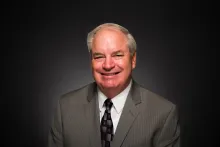
Robin Webber was born in Chicago, Illinois, in 1951, but has lived most of his life in California. He has been a part of the Church of God community since 1963. He attended Ambassador College in Pasadena from 1969-1973. He majored in theology and history.
Mr. Webber's interest remains in the study of history, socio-economics and literature. Over the years, he has offered his services to museums as a docent to share his enthusiasm and passions regarding these areas of expertise.
When time permits, he loves to go mountain biking on nearby ranch land and meet his wife as she hikes toward him.
