

Robin S Webber
Abraham heard God say "leave" - left Ur and allowed God to become his guiding compass. This leaves us an example to follow God as spiritual pilgrims in the 21st century.
This transcript was generated by AI and may contain errors. It is provided to assist those who may not be able to listen to the message.
Well, good morning, everyone! Is it really a good morning? Good morning, everyone! Oh, man, I am in the right crowd! Good. Well, listen, it is a great pleasure for my wife, Susan, and myself to be back with all of you for the third time. John, wherever you are out there, maybe the third time is a charm. We'll find out today. And it's just great to be back with all of you. We've been here twice before over the years. We've developed a lot of relationships, a lot of friendships, phone calls, letters, and even in our coming back after three years now. You've been so gracious and so very warm in receiving us, and we just feel like family when we're here. I don't know if some of you were not here when we've been here, but we're here. But, like for those that don't know Susan and I, and you want to like me, but you're not sure if you're gonna like me, I want you to know something. I married a Buckeye and I married up. How's that? So, Susan's and her family, the Linebox, lived about an hour and a quarter up above here, up towards the lake below Sandusky, so you all know the coordinates with that. And we visited the Amish country down here for many, many years, I think since 1974. Off and on over the years. It was always special, but then when we began having the Feast of Tabernacles here, it made it double special. And I'll share something. If you've been in Walnut Creek, and we have the Carrington Hotel up there, we used to visit Berlin, which is over there about five miles, and Mount Hope. But we would come down, and when they built the Derr Dutchman restaurant about 30 years ago or whatever, we'd go to the Derr Dutchman, then we'd come out and sit. We'd walk out on the parking lot and look over the valley over there, never thinking that years later we'd be keeping the Feast of Tabernacles here and having an accommodation looking over that same glorious valley. And so that has really been a blessing over the years when we've been back here. And I want to mention something for a moment. Would all of you that are on the back row, could you please stand up for just a second so I know where I need to speak to? No. Back row, here you go. Can you please stand up so I can see you? Is there anybody on the back row? Okay, thank you. You can have a seat now. You don't need to stand. That was just to make sure that you stay awake a little exercise before we get to going.
Well, in all seriousness, let's get right down to our father's business and to be able to share some thoughts on this, the Feast of Tabernacles. Here we are on the second full day, and I just want to share something with you. Maybe you that have been here before remember this, but each, if you think of the Feast of Tabernacles representing 1,000 years, then every day of the Feast of Tabernacles, the days of the week, each day is 143 years. And every hour is six years. Have you ever heard a sermon that seems like it's gone on for six years? I promise, as your friend and fellow member in the Body of Christ, I will try to refrain from that from you today. So I just wanted to mention that. One other thought I'd like to just share. Thank you to all of those. I see the people down here working on The Sound, all the people making this all happen. It's not just John Miller, but all of you coming together. I should say John and Susan, because behind every good man is a great woman. And having been a festival coordinator for over 30 times over 50 years, I know what goes with the territory. And sometimes the sacrifice that Susan has had to make, because I'm here, I'm there, I'm everywhere trying to, with the team, make things happen. So I want, as was mentioned by Mr. Rob there, would that we are all servants during this Feast. We are all family. We are all together. And a lot of the most important action at this Feast site is not going to come from this stage forward, but it's going to be what you're doing in the middle of the aisles, out in the hallways, the fireside thing. Last night somebody saved me. I almost fell into the fire.
So anyway, but I knew I had to speak today, so I bounced off. So anyway, well, let's get right into the message in all seriousness. Christian author A.J. Tozer once wrote long ago that worship, worship is the missing jewel of the church.
This sounded revolutionary in its day and may even be to some of our ears today, but it is as old as time, and what God has always desired, then, now, always.
And what is wanted and the desire, if I can just speak to you heart to heart today. I'm a heart Christian, so we're going to speak about hearts. God wants our hearts. God wants an intimate, not a casual. He wants an intimate relationship with each and every one of us. He wants it to be circular from him to us and back up to him and his Christ. The word worship is a very interesting word. It actually comes from the English worth ship. Is it worth the value? The Greek, the word is there is proscun, which means giving the hand to kiss. That's intimate. That's warm.
That's atonement. That's atonement. And you and I, we have an opportunity not only to live that, to love that, to grow on that during this festival, but to recognize that we've been called more than simply an event, but we've been called to an existence. We can show up at the feast, but it's only the starting blocks of continuing to grow up before God our Father, Jesus Christ, the world around us. For we are to be a light to the world, each and every one of us. A light to our wives, a light to our husbands, a light to our children, to our grandchildren, to our neighbors, to our co-workers, to our fellow students. As Shakespeare once said, the world is a stage for each and every one of us. It's not confined. And I would speak to that on this day to each and every one of us. Allow me to explore this question with you. What does that look like in real time? Your time? Here we are in what is called a pilgrimage festival entitled Tabernacles, which is simply a fancy Greek word, Tabernacles, which means tent. Tent. What does living and temporary dwellings have to do with the jewel of worship? Now, stay with me. Stay with me. Here I am. We're all and this is going to be together.
A tent. And worshiping God. How do those two come together? And we might ask ourselves, is there more? Why is this a festival of faith? This is a festival of faith. This is not just simply a festival of works. The faith precedes the works. Yeah, we got to put up the tents. We got to go the mileage. We got to go the distance. We got to do this. We got to do that. But it's more than all of that. It is a festival of faith. And what do we, as New Covenant Christians, as children of the Father, as disciples of Jesus Christ, what can we learn again and again as repetition is the best form of practice?
And practice moves us closer to that jewel of worship, especially when we understand what we're doing. Very important. God has reached out and touched many a person through millennia, from Adam till now. He's touched out. Remember, worship the value thereof. And actually, in the Greek meaning from the word krascoun, meaning to kiss the hand. God has extended his hand to others.
Do you ever remember, you know the famous picture by Michelangelo, the one where God is reaching down like this? And here's Adam kind of in a reclining gesture this way. And his hand is kind of, how do you say it, it's just kind of a limp. It's like he wants God to kiss his hand, but he's not doing nothing back, okay? Not a good start in a relationship, and it went from there with Mrs.
Adam, Eve, and we know the rest of the story. And to recognize that it's one thing to come into relationship down through the ages, down through Genesis, through the Patriarchs, through the disciples, to you and to me today. It's one thing to God reach down and we hold his hand, but it's a much greater thing to be done to keep holding his hand. Now and always, and not letting go, even you don't understand the moment that you're in with our Father and his Christ, of what we're doing on this pilgrimage towards the wonderful, beautiful, fantastic, incredible, wonderful world tomorrow that he has in store for us to serve along under our Savior, under the heavenly High Priest, to be teachers, to be examples, and you can't teach what you ain't.
You can't teach what you have not experienced yourself. And I would speak to that, to all of you today in this message. There was one man—I want to share him with you because he is so exciting—there was this one man that not only was touched by God, but he continued to hold the hand of God through all the things that came after him. You know this guy. You know this patriarch in the Old Testament, and his name is Abraham.
And that's what we're going to dwell on today. Abraham and his relationship with God, the man that was the father of the faithful, the man that was called in the book of James the friend of God. So the title of my message is simply this. Are you ready? Ready, set, go, because we're going to cover a lot because I understand this message can only go two hours. Okay, you're still awake. We'll have some fun along the way, but for you that have ever heard me, you know that I am live, dead, serious about what we're talking about.
The title of my message is simply this. A Spiritual Pilgrim's Legacy. A Spiritual Pilgrim's Legacy. Put two words after that. Two dots, as John would say. I didn't know dot was a German word. Two dots. Tense, tense, plural. For you that are products of the American education system, T-E-N-T. It's a four-letter word, but let's put on S. Tense. The second, altar. Altar. Notice that I use the term tense in the plural. Altar in the singular, and that's where we're going to go. So what may we learn about this one man, the father of the faithful?
And I want to share something with you because all of us—and it's in there for a purpose, but sometimes we stand in awe. We stand in awe of Abraham or Isaac or Jacob or one of the disciples, the apostles. And we say, well, that's them, and we'll never be able to be that. Get that out of your mind. Yes, we are all called for a purpose. We're not all going to be an apostle.
We're not all going to be a leader, quote-unquote, in the church. We're not going to be this. We're not going to be that. But you and I, and I tell you on the truth of God Almighty above, you are here for a purpose today. Rob spoke to that in the first message, and I'm going to build up on his very, very fine foundation.
What can we learn about this man? And I want to share something with these figures that were in the Bible. They are all men. They're us. They're us. And by the grace of God, he touched them and he changed them. But when we talk about Abraham, you know the downside of Abraham. We know the downside of David. We know the downside of these people. God really used them. Are you kidding me?
No, I'm not kidding you at all, because what they did is for our example today.
It's in Abraham that we discover, then, the twofold legacy of the spiritual pilgrim. The two working parts—stay with me. I'm going to give you some assignments. These are working parts.
Working parts are given definition in the Jeremiah Study Bible. It's under picture this.
Abraham's tents and altars. It's been said that for Abram, later Abraham, the symbol of his life was a tent. The symbol of his life was a tent. But the secret of his life was an altar. The secret of his life is but an altar.
Interesting. Here we are, just in case you don't realize this yet, you've already been here for a day and a half. Would you please look up? We are under a tent.
But it's one thing to be under a tent, and God bless you for coming into being under this tent.
But it's another thing to have an altar underneath that tent, and we're going to differentiate the scenario between a tent and an altar. Maybe we're already under the tent, and we've been here since the other night. So we've been here about almost, if you look at millennial time during the week, almost 200 years. Because if you take the week, every day of the Feast of Tabernacles is 143 years in millennial time. Think of it that way. I kind of figured it out. I'm not really good at math, but right now, this morning, we are at about 300 years of millennial time right now.
And maybe we've been underneath the tent, but we haven't been coming up against that singular altar and worshiping God as He wants us to worship Him. Now, not to chide you, but to recognize, you still have 700 years to figure this out in the millennial week. And maybe you've just been out there sleeping, maybe not physically, but spiritually. This is the time to kick in.
This is the time to put your feet firmly in the blocks and to run the race of faith the rest of this week. And not only this week, because remember, our calling is not about hopping from event to event, but living with God the Father and Jesus Christ Spirit in us every moment, every minute, every hour, every day, every month, every year, as God gives us breath and energy to be able to worship Him, to give Him the value, to give Him the worth. And as He's touched you, maybe not just with a finger, as it were, figuratively, not just giving you your hand, anybody can take a hand. It's another thing to keep on holding onto it through thick and thin. And some of you right now are in the thick of life, things that are coming at you. And you need to recognize, and you need to remember, that our Savior said at the very end of the book of Matthew, Lo, Lo, I am with you always, even to the end of the age. So let's get back to this a little bit.
Let's consider the tent which spoke of His pilgrimage. Thomas Cahill, in his book, Gift of the Jews, page number 63, captures this experience. So Avram went, so Avram went, two of the boldest words in all of literature, two of the boldest words in all of it are just two, you know, just like John. It is written. It is written that Avram went. What made this so special? What made this so different? Allow me to share what Cahill says. When Avram got the call to leave Ur of the Chaldees, the Chaldeans were one of the first great cities of the river civilization of the two rivers, and it was like the Manhattan of its day. It was a seaport back then. All that's changed over there, but this is where all of mankind was coming in. All of mankind was coming in. They were coming into the city, into this new river civilization, just like the Nile was a river civilization, or the Indus River over in India was a river civilization, or one of the great rivers of China. Mankind was coming in. You know, it was a traffic jam. Can I tell you something? Are you with me? If you've never been to LA, you have not seen traffic jams. Susan and I are so glad to be out here with 23 million trees rather than 23 million cars. It's a good trade-off. Thank you, Lord! Okay, but let's hear this out or what have you. So think of all the traffic coming into town on one side of the freeway, and there's only one vehicle going out. All of mankind is being drawn into the city, and one vehicle is going out.
That's our father's friend. How about you? How about me? Cahill goes on to say this, period. They signal a complete departure. Abraham went. They signal a complete departure from everything that had gone before in the long evolution of culture and sensibility. Out of summer, out of summer, the civilized repository for the predictable, comes a man who does not know where he is going but goes forth in the unknown wilderness, under the prompting of his God. And we'll read about that in a moment. Out of mortal imagination comes a dream, something new, something better, something yet to happen, something in the future.
And he left Ur of the Chaldees on fumes of faith. Join me, if you would, to Genesis 12. In Genesis 12, and let's pick up the thought in verse 1. Okay, Genesis 12, verse 1. Now the Lord had said to Abram, Get out of your country, from your family, and from your father's house to a land that I will show you. I will make you a great nation, I will bless you, and make your name great, and you shall be a blessing. And I will bless those who bless you, and I will curse him who curses you.
And in all the families of the earth, and in you all the families of the earth shall be blessed. So Abram departed as the Lord had spoken to him, and his family went with him. The earth would be blessed. The greatest focus of these verses is that through the seed of Abram, later Abraham, would come. Another pilgrim, which we'll talk about in a moment.
Did you know, and do you remember, and do you get it, that Jesus of Nazareth was a pilgrim? We'll talk about that in a moment.
Abraham was told, basically by God, in so much unsweet terms. Are you ready? Get up! Get out! Get going! Get going! How often has the Spirit of God knocked on the door of your heart this year, and given you, in a sense, a message? Has you heard the echo, and it keeps on coming?
In your life as a pilgrim, what is your response time? What is the fullness of the assignment that you carry out? That you get up, you get out, and you get going?
I think that's an honest question that we need to entertain during this, the Feast of Tabernacles.
Has it sped up over this past year from feast to feast, or has it kind of bogged down and you've run out of gas?
Just think it through for a moment. What kind of a pilgrim are you?
And in my message to you, because I is one, to use bad English to make a point, I'm right there with you. My response time, not just simply as Mr. Pastor, or Mr. This, or Mr. That, but individually, unworthy, other than by the grace of God, that he's called me at this time, not because of who I am, but because of who he is, and because of his choices. What have we learned, and what are we doing? There were numerous times in Abraham's life that he moved from place to place. There would be long periods where he lived in tents and in the regions of Hebron or Beersheba, but only rarely do we read of Abraham living for a time in a city. Genesis 20 verse 2, he lived in a city. After it came to him in either Ur or later on Huron, which was a northern part of the pilgrimage that he would be in. But before we go any further about Abraham, time out. I just want to make sure that you're awake out there. Back row, are you ready? Let's all together, on the count of three, do you know what it means? You know, you ever seen a referee? Time out? Okay, good. Here we go. Time out. Ready? One, two, three. All together, all together, now like the Beatles. Okay, here we go. Time, time out. We've been talking about a man that's a pilgrim. Let's remember that the one that is I am, the one that is, pardon me, the word, made the greatest transference, the greatest pilgrimage ever that was, that he that is an eternity came out of that which is not measured into the world of time and space.
And he came down to this earth, as it says in John 1 verse 14, and says, and he dwelt with us. He dwelt with us. That word in the Greek is skanu, not scooby-doo, but skanu.
That means that he came in, he tinted amongst us. We that were the creation and him being the creator, who made all things, as it says in John 1, 1 through 4, who was and is and always.
And he gave that up, and he came down and tinted with us so that he might know us, so that the day would come when, through his sacrifice, which would be a part of his pilgrimage before he has sinned again, that through Jesus God touched man, but also through Jesus that man might be touched by God.
What does it mean to be a pilgrim? I'd like to share a story with you. It's one of my favorites.
There's a story of an American tourist.
He went over to Europe. This is at the end of the 19th century.
He was visiting a very world-famous Polish rabbi. The rabbi's name was Hophitz Ha. Try to do this in Hebrew. Hophitz Ha. Rob, are you feeling this? Yeah, I know Rob's been a little bit under the weather. Hophitz Haime. Okay. And upon entering the rabbi's lodging, the American tourist, this guy was famous, looking around, and all he saw was a table and a bench, and a bunch of books all scattered around on the floor. The tourist was quite amazed, and he asked the rabbi, he said, Rabbi, sir, where's all of your furniture?
You don't want to do this with the rabbi. You're going to lose.
And the rabbi said, well, where's yours?
Well, the tourist came back and said, but I'm a tourist. The rabbi came back and said, so am I.
And the American students said, well, what's that all about?
And the rabbi looked at him and said, I'm just passing through.
His roots were not in this world. He was not tied down to that which is below, but in his religion, he was tied to that which was above, and in the example of Abraham that decided never to put down roots, but to recognize that he was rooted into something that man could not see, but God had given him the vision. I have a question for you. What kind of a tourist are you? What kind of a tourist am I? Have we decided to put down roots in Babylon?
Or have we put our roots down into the heavenly Jerusalem? I'd recognize that as where life is, and that's ultimately where God wants us to head towards.
Let's just make sure that you got this message. I want you to do something for a moment. We did this before I think several years ago here, but are you ready? This is called an interactive sermon. I am an old school teacher, 16 years back in Pasadena. So let's do this. Let's get our right hand so we're all going the right direction. Everybody, come on. Right, right. Who wants not to be a student? Let's watch him. Look at him. Look at everybody and judge the person next to you. There's his hand up. Just joking. Okay, I'm going to give you one motion. We're just passing through. Now, are you ready for that hand? I see in the back row. There you are.
Are we pilgrims of God already? Are we just what? Pretty cool, but not Californian. I'm sorry. Okay, one more time just to make sure we got it. Hand up, and let's say it together. Stay at my cadence. I'm just passing through. One? No, no. Hand up. One, two, three. I'm just passing through. Oh, California cool, but very heavenly too. Let's continue here in all seriousness. I am very serious. Trust me. How do we do that? How do we come out of the world? I'd like to share something from my Pasadena experience over the years. I was in Pasadena for many years and was able to hear Herbert W. Armstrong many, many times. Mr. Armstrong was a knowledgeable man, but you know what? He kept on going back to everything, everything, everything, always. I remember growing up in the church since I was 12, and it was always he would open up.
Why are we here? Anybody hear that sermon before? I did. Okay, on and on. Got to share a story with you from Pasadena days. We're at a Bible, no, it was church service, and Mr. Armstrong got up. This was probably about 1982 or 83, and he said, Brethren, I have learned more this year than I've ever learned before in my life. I think Mr. Armstrong was about 91 at that time. I thought, wow, he's a recycled teenager. I thought, you know, maybe he has discovered a third tree in Genesis 2, something maybe he missed. Five seconds later, guess what? Back to the two trees.
Got to recognize being that in Pasadena as a kid and a student, later as an elder minister, whatever. I heard that message. We need to keep on hearing. Why are we here? That it is truly the purpose-driven life. And to recognize towards the end of his life, he wasn't trying to figure this out or figure that out, but he was taking the lessons out of the Bible to give the church that would be here when he was deceased. And he gave them, if you'd like to jot this down, three mandates. Three mandates. The first mandate is this. Come out of the world. Revelation 18.4. Next, he would give another mandate. Simplify our lives.
Simplify. There is, as it says in Corinthians, there is a simplicity which is in Christ.
There's a simplicity, and a part of that simplicity is taking your role as a pilgrim.
Not only for yourself, for God, but to be a light to the world, to be a light to the Gentiles, as Peter says, following where where Rob was. We're to be a light to others, and they may not understand the components of the light, but the light has at least touched the darkness. They said, there's something different going on here. We can say this with our Amish friends out here.
They have simplified their lives big time. I haven't seen any of them writing a Cadillac yet.
They're getting up to the motorbikes, I understand.
But, and then the last and the most important one, perhaps, in this all, is to, pardon me, pardon me, learn to be teachers now.
If you can write that down, come out of the world like Abram did in the Manhattan of antiquity.
Simplify your lives with every distraction, every attraction, every voice coming at you, which our generation, for those that are older, we did not have all of these bumps in the road trying to capture our attention and draw us away from God. I'm not saying that the progress and all of that is bad. Everything is an instrument, and everything can be a tool, but it can either be a weapon or, excuse me, everything is an instrument. It can either be a weapon or it can be a tool as to how we use the advances in civilization. Allow me then to talk about the second. The first was a tent. That was his cover as he became a pilgrim. Number two, the altar.
This is powerful. How does this start remain intact? You start underneath a tent, but how do you keep it going in the pilgrimage? The altar speaks of his fellowship with God, his fellowship with God. For the fellowship with God was the focal point of his worship. As God conveyed his commandments, Abraham confirmed. That means he shaped and he formed it by worshiping and building an altar. There is no record—are you with me? And let's understand that there is no record of him building any other altar other than to God. The God, the one God, in a world at that time coming up through the Babylonian system—well, or the Chaldean system, which later on fostered the Babylonian system—where there were altars to this God, that God, this God. He worshiped one alone, who was sovereign in his life, and he would not build an altar to another God, and he never worshiped on an altar that others built to their gods. He was singularly focused.
It was like he was baptized, maybe in the Tigris or the Euphrates. I was not there. Some of you think I'm that old. I'm not, okay. But that his eyes were on one. And he was doing this before 500 years later, that God would write on a tablet, thou shalt have no other gods before me. And he said that you should not make any grieving images, whether it be an idol or whether it be an altar to that God. This is Abram. This is Abraham. This is the man that got up, got out, got to go on. And ladies, can I make a comment to you? It wasn't just the man. How often did Sarah see Abram coming over the hill?
And you know, guys, our ladies really know us. You can't fool them.
Keep on trying. Not going to happen. Is that, she said, hubbing's got that look. God's been talking to him. I better get up, go over, and start pulling the rope from the tents.
It's time for us to get up, to get out, and to get going.
But now let's consider the aspect of the altar and why it's important.
The altar was Abram's engine.
The altar was Abram's engine. His heart. Why? Living in a tent, under a tent, like today in this worship service, and living for God can be two different worlds. Two totally different worlds apart, and God looks from the inside out, not from the outside in. He looks at our hearts, not our external coverings. Being different simply for different's sake is simply not enough. Abram's focal point was to worship God, to give God value, to give God worth as to proscoon, to kiss the hand of him who he could not see, but he who had touched his heart and said, get out. And Abram, as it is written, departed, setting us the example. Abram's focal point was to worship God. His wheels, for you auto-enthusiasts, his wheels were a tent. But don't confuse the wheels with the engine. Both are essential, but the engine is the heart. The tent is simply the covering.
The engine, giving God all of your heart, with all of your heart, with all of your mind, with all of your strength, with all of your soul. Abram's focal point was to worship God. His tents were, his wheels were a tent, but don't confuse them at all. God's word states that we're pilgrims and strangers here, the tent. But we are also to be in fellowship with the Lord by way of worship, the altar. And we, like Abraham and Sarah, are both to be witnesses of this reality. I'm almost wrapping into the last third of your message, so my message, so hold on. Abraham striking a tent and building an altar. Join me if you would just to show you how this works. Genesis 12, 7. Genesis 12 and verse 7. In Genesis 12 and verse 7, here we go. Okay, reading this light. Oh, is my light on? Oh, where's light? Shh! And there was light. Okay.
Give me just a second to count. Genesis 12 verse 7. Then the Lord appeared to Abram and said to your descendants, I will give this land. And there he built altars. Is that in anybody's Bible? He built an altar to the Lord who had appeared to him. And then notice, and he moved from there to the mountain east of Bethel. And he, notice, pitched his tent, not in Bethel, near Bethel, on the west and I on the east. And there he built an altar to the Lord and called on the name of the Lord. So Abram journeyed, going on still towards the south. You can find this matchup in a scripture or two throughout Genesis five or six times about building an altar, not worshiping on man's altars to other gods. And you can find him pitching a tent. If any of you would like my notes after all this, because I'm only covering half what's in my notes, email me after the feast. I'll send you my notes. But to recognize something here, and that is, he kept on building an altar. And I'll just share the story ad lib with you, Genesis 22. Remember, as he's going up Mount Moriah, no, no, not Mount Moriah, pardon me, as he's going up, yeah, it is in the hills of Moriah. He's going up the hills of Moriah and he goes up. He's got Isaac with him. And Isaac's looking around, and you know, Abram's kind of looking around, what's going on? And, you know, especially Isaac, who's not, you know, in kindergarten, he's probably a young man, no dummy, he's kind of, he might begin to be figuring out what the sacrifice is going to be.
But in that, but in that, Abram said, God will provide. If I can share something with you, because we're all going through this human experience, there are times we can't figure out God. God, I've been faithful. I've tried to be loving. I've tried to do this. I've tried to do this. And now this has been set upon me. A tragedy, a health issue, loss of a job. We can fill a book with the different, and I thought when I was baptized that that was all behind me. I thought I was maybe going to be in a Teflon kind of an experience. And nothing would happen. No raindrops on my human windshield. No thunder, no lightning, for we that are in California, no earthquakes to shake us up. I'd like you to do me a favor, because I'm just your friend, but for the moment I'm your teacher, too. If you have notes, please write down this. God will provide. Not in our necessarily our human time, but He will provide. You know, in America we're used to fast food.
We come from California. We come from the San Gabriel Valley, Pasadena. How many of you have eaten at In-N-Out Burger? Does that out here? Anybody? Oh, there are no Californians here. Okay, In-N-Out Burger is it, because you're in and you're out in a jiffy. Or at least that's the theory. In-N-Out Burger. Sometimes what we want in our Christian walk and pilgrimage is we want fast food religion. Simply in and out. God doesn't work that way.
Abram and Nisara had to wait for a child. The children of Israel were in the wilderness for 40 years. They think of the story later on that after Israel returns from exile, it's 400 years till they hear what they call the voice of God.
They only felt that they had the voice of the angel. After Malachi, it seems as if God had not spoken to them, had forgotten them. God will never forget. Never forget you as you worship him in the altar of your heart. For God now dwells in our heart, his son dwells in our heart. For such a time as now that kingdom of God has come to us, not in fruition, but the Spirit. The Holy Spirit is no less than the Spirit of the Father, the Spirit of Christ. You can go to Romans 11, look through 10 through 14, spells it out perfectly. They're not apart. They're together, and their presence, just like we kept the day of atonement where where the presence of God in that sense came down as that lone priest walked through the veils with the carobim on them. There was the ark of the covenant in front of them. There was the mercy seat, which was the top of the ark. And God came down, and that one man came into the very presence of God. You and I today don't have to walk through curtains.
You and I can boldly go before the throne of God in grace. I know that our heavenly high priest is at his right hand. In our pilgrimage, when it gets lonely, in our pilgrimage, when we start wondering, is this all that it was cracked up to be? Can I tell you somebody to talk to?
Are you ready? Just asking. Wouldn't it be fun to talk to Job and maybe enlightening? Someone once asked Mr. Armstrong—I've always remembered this—was Job ever converted?
Mr. Armstrong thought about it, and he says, absolutely. It's in Job 42 and verse 5. I've heard of you by the hearing of the ear, but now my knife sees you. And Job's experience is our experience. You know, Job was in the Old Testament. You know what Job said right in the middle of all those trials, those 42 chapters right in the middle? I know that this is going to happen to me one day, but I do know that my Redeemer liveth. I think we need to talk to Job sometimes. I think we need to talk to Job sometimes and talk it over with our Father and his Son in our prayers. Let's conclude. Why are you here today? Because many of you—and this is not a scolding in any sense. I think you know me. Most of you know me enough. And, Susie, if you don't like me, I know you love Susie. Because she's a Buckeye. And I'm the city slicker from California.
But both Susie and I have drawn so close and so near to so many of you. And even if I forget your name when you come up to me, it's the hardest thing for a pastor when he comes into a big group like this. And somebody comes up, are you ready for this? And they'll go, you remember me.
And I'm in my mind saying, don't ask that question right now. Start whirling, whirling. If I have forgot your name while I've been here, you have an assignment. Be a forgiving pilgrim along with me. But you are near and dear, and that's why I wanted to share this message with you. Because many—this is not a scolding—this is a hurrah for our loving Father, His gracious Son, the indwelling of a spirit in us. To go forward and not put roots down into this society, but to recognize like the forefathers of old, we are moving forward towards what? Something new. We're moving forward towards what? Something better. We're moving towards what? Something in the future. Moving towards what? Something that is yet going to happen that's not now, but we'll see it soon. Somebody talking about vision, somebody being in California—I used to live about 15 miles from Disneyland in Orange County, so I'm very familiar with Disneyland.
Uncle Walt, for many of us, Sunday night watching Disney—we all knew Walt Disney—but he got surrounded by orange groves, and he could not expand his commercial empire down in Orange County, which used to be—how's that saying going? Smog-free Orange County? Now it's the reverse. It's orange-free. You know, go to Smog County. But anyway.
And so he moved to Orlando and bought out the whole county, as many of you probably know on the East Coast going down there. And as it was being completed, a couple of executives were up on a hill and looking over, and you know what they said? It's a shame that Walt can't be here to see this. And one of the executives that was on the side says, it is here, because he did see it. It was a vision. And it would come later than his life existence, but it would be built. I've got news for you. We are not citizens of the Magic Kingdom. We are citizens of the heavenly kingdom that is going to be always. Let's continue on our pilgrimage. Let's keep on looking up. That's like Rob Wood brought out in being servants to feel the joy of God when he allows us to touch other people. To feel his joy, to experience his joy, to spread his joy. And as our Lord said once and forever in teaching us how to pray, thy kingdom come. God bless you. God keep you from one friend, Susie and me, friends, to all of the family.
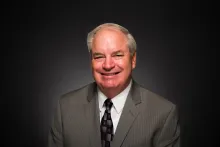
Robin Webber was born in Chicago, Illinois, in 1951, but has lived most of his life in California. He has been a part of the Church of God community since 1963. He attended Ambassador College in Pasadena from 1969-1973. He majored in theology and history.
Mr. Webber's interest remains in the study of history, socio-economics and literature. Over the years, he has offered his services to museums as a docent to share his enthusiasm and passions regarding these areas of expertise.
When time permits, he loves to go mountain biking on nearby ranch land and meet his wife as she hikes toward him.
