

C Mitchell Knapp
This sermon was given at the Wisconsin Dells, Wisconsin 2019 Feast site.
This transcript was generated by AI and may contain errors. It is provided to assist those who may not be able to listen to the message.
Good evening, everyone. It is a good and auspicious, lovely evening because of the beginning of the feast. And so I welcome you officially to the Feast of the Eternal, Opening Night, 2019. You know all this. This is the official welcome.
I just calculated this is the 48th year we've kept the Feast on the Dells. We started in 72, but you subtract one for Oconomowoc. And so we come up with 47 right here, I think. Don't check those numbers.
At any rate, welcome to the Feast of Tabernacles. It's called the Feast of the Lord. It's not our feast. It is because we're participating. But it belongs to God, and He's invited us. And what a wonderful thing. We are able to picture the Wonderful World Tomorrow.
We used to have a booklet by that title, the wonderful World Tomorrow. Did you know that the feast is supposed to start out on a negative note? Not kidding. But I'll explain it. It's supposed to turn very positive real quickly. The idea is that we just kept the Feast of Trumpets and pictured the change from the Day of Man to the Day of Christ. To use Paul's word, the Day of Christ. When God takes over, and man's world that He has created, influenced by Satan, is just going to stop. It'll take a while to redo it.
But it really does start out on that negative note. The reason is the background of coming to the feast. And then, of course, we're picturing the future. So I'd like to note Daniel 7, verse 2, a negative scripture, if you will. This is the background. This is one of the ways that God views His world, that He has created. He said, I created a divine, I came to pick the grapes, and there's sour grapes. It was true of Israel. It's really true of the whole world. So Daniel 7 starts out in end-time prophecy. Verse 2, Daniel spake and said, I saw in my vision by night, and behold, the four winds of the heavens strove upon the great sea, and then four great monstrous beasts come out of it, and the prophecy unfolds. But the state of the world is, it's just like the perfect storm. You might have seen the movie a few years ago. All three storms came together and did a great deal of damage and caused mayhem and death. It's like the whole world is in the perfect storm and has been. That goes back to Genesis 1. That's how we started out. He put light into the world and then developed his plan and so on. Satan has been given the rulership of the world in these days and has messed it up good. I don't even know how to say it poetically or clearly. He just really destroyed much of God's goodness that he put into this creation. God views everything, but he sees that angle of it, and we do need to see that ourselves. So we could consider the unsafe world that we have today. I noticed in a letter by Mr. Kubik a few weeks ago, one billion people, we don't even have a full eight billion yet, are on the move walking or camping or staying. They're hunting for food, shelter, clothing, all the needs that human beings have. That's an astounding thing. We could go on and on. I don't want to, at this point, anyway. Troubles in the world. We've got a lot of troubles. We actually picture that in our own lives because you can tell if it's before the spring holy days or the fall holy days. There are different troubles I had. A man called me the other day, and he told me all the grief he had just getting his sermon for the Day of Atonement ready. He said, Oh, it's finally here, and here are the notes. He sent me an email. Then I talked to him. He said, Well, this happened, and the car blew up, and then that happened, and the other thing, somebody got sick. Just about five things. He said, This all happened. He said, Because it's before the feast, of course.
He was sort of exasperated. I had to chuckle. We do chuckle. It's worth a laugh. But it's true. We don't want to be like Flip Wilson that said, The Devil made me do it to every little thing. He made a career, actually, out of that saying for a while there. We don't want to just say every little thing. The Devil's after me and develop paranoia. But if we ignore the fact that we have a dedicated enemy that's really smart, very clever and very powerful, we do that to our great distress and other negative things.
We shouldn't do that. We need to understand that. So I'd like to then, having started off on a negative note, point out that there is hope. And that's what the feast is, of course. If you would note in Isaiah chapter 30 and verse 29. Isaiah 30, we'll go to verse 29. Now, this is a chapter that's talking. There are serious warnings about punishments for Israel. Up to this verse. And then after this verse, it continues on that line. But it said, with all the trouble that's coming along, there's an inset verse, verse 29.
But you, you shall have a song. Who's the you? Well, it's talking about those who are faithful. But you shall have a song. As in the night when a holy festival is kept, you'll be able to sing. There'll be some joy in the middle of this seriously bad world.
And so this verse just kind of stands out from those before and after. He said, you'll have gladness of heart or joy. Well, that's what Christ said He would leave to us. As when one goes with a flute to come into the mountain of the Lord to the mighty one of Israel or the mighty rock of Israel, it's talking about going to the feast.
So we have a picture of this very night, opening night, because most of the holy days we keep during the day. There are a couple and a lot of things at night, of course. Count them all up. But this is a specific holy day, kept at night. You shall have a song, as in the night when a holy festival is kept.
So that's where we are. There's one scripture that specifically points out this night, and there are a couple of others that it talks about as well. It's opening night of the feast, and we're coming from a negative backdrop. Don't worry, I'll get off the negative stuff very quickly, because the feast isn't supposed to be a negative focus. But we need to have instruction in how to approach the lessons we learned at the feast.
And you could probably guess we have several specific instructions on the attitudes they were supposed to have when we start keeping the feast. And more intuitive, of course, as well. But I'm talking, and you probably are ahead of me, I'm talking about the Psalms of Degrees or Psalms of Ascent. Psalm 120 through 134, 15 Psalms. And this was a separate festival Psalter, a festival songbook. And there are different legends and historical comments about how the Levites sang these songs, and the Israelites themselves sang some of these songs in their trip to the feast, as they walked toward the feast.
So I'd like to then go straight, well, make the point, that here are instructions on how we start the feast in the first few, and then we won't go through all 15. But it tells all about going to the feast and the attitudes, the themes, and the lessons of the feast in this 15. And we'll just go through five and that quite briefly. So if you would like to turn to Psalm 120, you can read along with me. It's really five real short Psalms here, and they just tell us what we should do, what we should be thinking now.
Very, very inspiring. And when you get to reading, you say, well, of course. Here is how we start the feast. Just reading the first three verses, first three words. In my distress! This is the first three words in the festival Psalter. That's the background. Anybody have any difficulties coming here? I've heard several already. We arrived. It was not only raining, but also snowing at the same time. The wintery mix is called. A little tiny. You can get away with it. You can put up with that.
We didn't have the flat tires or the wrecks. I know a man. There are several, but I'm thinking of one. He could see a wreck coming. He was just afraid something was going to happen all the way. So he was out in the desert. He saw this crazy guy coming. He turned off and he was driving across the sand.
This guy turned. He was coming right for him. He speeded up and driving through the desert. The guy hit him out in the middle of the desert. It was a little bit worse than a fender bender, but he said, I even tried to avoid it.
He was thinking, you know, feast trials. Trying to avoid all the feast trials. Good. I'm sure that you've experienced that. I really have. This in one sense has been a harder year than others. I've heard so many comments about this. It's not a matter of, could it be? No, it does happen.
Not every single year, and, you know, not to the same degree every year, but that's the way you start out. Start out with kind of a theme of darkness to light. It's the first day of the feast. Let's just go ahead and read it here. In my distress I cried to the Lord, and he heard me. Deliver my soul, O Lord, from lying. Deliver my soul, O Lord, from lying lips and from a deceitful tongue. So he's been coping with that, and that's his main trial at this point. What shall be given to you? O, what shall be done to you, O false tongue? The other translations are interesting to read here. What is the proper punishment for you, you big fat liars? You know? I'm getting tired of this. I can't trust anybody. It's hard to even tell if the news is right. What shall be done to you? What's the right punishment? What are we going to do? Sharp arrows. So the answer... try some different translations. This is interesting. So sharp arrows with, you know, really sharp and painful arrows with hot fires of coal. Take that. That's... I'm adding a little bit, but not too much more to what the other translations said. That's the idea. These are high crimes and misdemeanors, you know? These are offenses, great crimes. And yet we have lying throughout the whole world, and it's growing. Truth is, in the words of the prophet Isaiah, falling to the ground. And you can't really... you can barely find truth sometimes. So, woe is me that I dwell in Meshach, and that I dwell among the tents of Kedar. You might notice a major contradiction in this verse.
Meshach is an ancient word for Moscow. That would be to the north. And Kedar is a tribe that was not too far, but around in that area. Bedouins are nomads, anyway. But they weren't... he was riding in Jerusalem, or close to Jerusalem.
So the contradiction is, he's saying, you know, I'm living... it's like I'm living in enemy territory. I thought I was in Jerusalem. I thought I was in Israel. The righteous nation. But it's like living in the lying place, which is, you know, the rest of the world. If I'm adding anything, it's really very little. This is what he's talking about. I'm living in enemy territory that I dwell among the tents of Kedar. My soul is dwelled so long, or too long, with one who hates peace. I am for peace. But when I speak, they are for war. We're living in contradiction to the world around us in many ways. And because of this current brief anomaly in history, where we have the freedom to preach the gospel, and we aren't persecuted directly that much. We have some opposition, rare persecution. We've gotten used to it, and it's pretty nice. But in general, God's people have had to be persecuted. That's prophesied also for this day and age. But we just live in a world of distress. We're going against the grain, and we look forward to a safe place, a safe space, they use the term. Something where God, a nation, a world where God protects, and it's safe, and it's peaceful. So that's how you start out. I'm for peace. There for the war. I'm in enemy territory, and I really want to go to the feast, and it just goes right into 121. So he's meditating then, which we do. You've meditated these same things.
These are all poems, you know, it's not direct prose. I lift my eyes to the hills. From whence does my help come? My help comes from the Lord, who made heaven and earth. And so the scene here is that he's looking probably from either the south, maybe more like the coast, and he's looking up to the mountains, and the highest one of all, Mount Zion. At least prophetically, if it's not right now. The highest one, that's where the temple was.
And so he's looking toward the hills, and that's where God dwells. Not from the hills, but from God himself, and from his throne, his temple. He will not allow your...my help comes from the Lord, who made heaven and earth. He will not allow your foot to be moved. Our feet are moved all the time. Things go out from under us. We have to make a judgment and change all that time. We're looking forward to some time when, well, Psalm 11 mentions this.
What can the righteous do when the foundations are moved? There are some jokes I've heard about this. One whole book was written, you know, Who moved my cheese? I just got it figured out where food comes in, and how to get there. Actually, it's kind of a cute little book, very interesting little book, about getting settled and dealing with change all the time.
So, talking about the same general idea, at least. God will not allow your foot to be moved. In this world, that means on the really big important things, because this world does move under you a lot. Because of the house of the Lord, I skipped a whole column. That really doesn't work very well in the Psalms. I skipped two or three Psalms. He will not allow your foot to be moved. He who keeps you will not slumber. Now, there's a Hebrew word, shamar, my best Hebrew, which isn't that good. But it's H-A-M-A-R in English, approximately. But he who keeps you will not slumber.
He who keeps Israel neither slumbers nor sleeps. There's a beautiful song, actually a choral number and a whole presentation on this. He watching over Israel slumbers, not nor sleeps. It's just a lovely, beautiful, inspiring song. And I think about it every time I read this. The Lord is your keeper. The Lord is your shade at your right hand. And the sun shall not strike you by day, nor the moon by night, protection 24-7, in other words, all the time.
The Lord shall preserve you. Now, this is a different word in English, and keep you from all evil. And preserve your soul. The Lord shall preserve you going out and coming in from this time forth and forevermore. This is really relevant to the feast in several ways. But first of all, the word shamar, which is the word that's translated keeps and keeper. But the thing is, you get to preserve and preserver and that word, and it's the same Hebrew word.
And this Hebrew word means preserve and keep and guard and protect and all those words. And it reminds you of Psalm 34, where it says, you know, God sends His angels to camp around you. Like, wherever you go, there is not just one angel, you're guarding an angel, but He's making sure to watch after you. Does this have any relevance when you leave your treasure in your house, in your car, in your garage, stuff full of expensive junk that you like to get rid of?
And all your stuff. I actually thought about this more seriously as I walked out of my office. I said, man, I've got some important stuff in here, mainly notes. And I kind of looked up, relying on you still, Father, you're as I have been all these years.
God, and there's actually, and Deuteronomy mentions this, watching after the land where you live, your place as you go to the feast. So this is really, this is very relevant to keeping the feast. It's relevant today, even though it's an ancient poem. Now, the principle is eternal, or the eventual is eternal safety. And God is promising what He has promised before. Now, let's go to 1.22 and possibly speed it up. We don't have to read each verse, but, I was glad when they said to me, Let us go to the house of the Lord. We talk about feast fever.
Actually, sometime, I remember looking at the moon, it was a full moon, it was two months, and a shock went through me, a shock of panic. And it was, I only have two months to be ready. That was a few years ago when I was unreadier than I am now. But otherwise, you see, and then you see the second one, almost perfect, and then it's round, one month, to the feast.
And of course, then here we are. It is the feast. This is the night that we were thinking about. So, can't see the moon because of the rain, but it's round at this point. But this is really a beautiful psalm here, because Jerusalem is a picture of, well, New Jerusalem, God's church, and also the New Jerusalem, which is where God's church will be living then, having been changed to glory, to a glorious body and a glorious mind, brought to glory, in Paul's words.
And so it's picturing the New Jerusalem, that is, the church, having been raised and glorified and beginning to meet out what the world so desperately needs. The waters go out both ways, and as they go, they begin healing, healing the land, taking the pollutants away, taking the poisons out, making the waters drinkable and giving food.
And then the leaders being set out from Jerusalem, all over the world. One of them being you. This is what our future job is, with leadership and authority to bring different places, whole cities, whole districts of cities, and bring them what they need. Food and water, for sure. Clothing, maybe some shelter. That would be less of a need, especially if it was warm. Those things we don't know, but the needs of the world. We want to do this. We look at the news and think how much we'd like to be able to fix things. We can't yet, but we can because God has called us to this.
What a fantastic thing. So with this picture, as we come to the feast, we're picturing, as we start the millennium, the idea of having these pictures in our mind and seeing what's going to happen and what part we will be able to have in that. Like, for example, what are you first going to speak on? One of the things, you're going to give a food, clothing, and shelter, and then you're going to have a Sabbath. And you're going to be the one speaking with authority. To people who know that you have what they need, physically, and then they'll begin to understand very quickly, this is my leader.
We've heard about God, and this is one of the firstfruits, a leader from Jerusalem, the headquarters of the world. Think, oh, listen to this sermon. Just think of what that will mean to so many people and what your part in that service will be. You won't be a mere minister. We get up and talk, you know, and it's worth more or less. This sermon will be inspired directly. I'm sure we'll have a lectionary.
Christ will say, now say this first, and then say that, and cover that topic, and so on. And people will know that. Think of what those services will be, the first few, and how you start things off in your districts. So I was really happy when they said, let's go to the house of the Lord and keep the feast, the Feast of the Eternal. Our feet have been standing within your gates, O Jerusalem.
This is the New King James, I guess. It's useful to read several translations of this because it can be past tense or future or present progressive and so on. So it's done differently. But we've been looking forward to going to the feast at Jerusalem. And now, here we are. Our feet are standing within your gates, O Jerusalem. One of the translations. But it's a picture of us having been looking forward to the kingdom and to going to Jerusalem and having experienced that astounding thing that we can't really even take in, but having been resurrected and rising.
And looking around, I'm sure we'll have a lot of angels for ushers showing us what to do to get used to the idea. And then saying, well, we would say it now. I can't believe it. I probably won't say that then, you know. And here we are. Our feet are actually standing, not in Jerusalem, but here we are in the kingdom of God.
You look around, you recognize people who you knew in the church, and they're fully in the family of God now. What a fantastic thing to think ahead to. So there's a lot packed into these short little poems that David wrote because of the symbolism of what we're actually picturing when we come to the opening evening of the Feast of Tabernacles, the very beginning of the millennium.
It goes into the others, and it goes on through the millennium as far as family values and other things, other big things that come up. Jerusalem is built as a city that is compact together. And of course, you go over to Jerusalem and you see there's another contradiction. It sure isn't. It's a hodgepodge like most major cities today. But one of the translations gives the sense, which this is written into, and it says, you are a city rebuilt on a glorious foundation, perfectly prepared, just everything fits.
Everything is right in this city, from the building, from the bottom up. So that's the idea. And we're not perfect as a church, but we need to try to work on our relationships and where we fall down. But we're talking about a point where we will have reached the first stop, our first place, in the kingdom of God, a sounding. And so then we'll move on to Psalm 123. This is actually the fourth of the Psalms of Degrees, 123.
And this is interesting. Well, they're all interesting. Did I skip 121? No, I remember that. Get too excited here and forget where I was. Sorry, find it in just a minute. Oh, yeah, I should finish 122. It starts out, I was really glad when they said, let's keep the feast, because they understood the meaning of the term, going up to Jerusalem and the kingdom eventually. I said it is a compact and described about keeping the feast and worshipping God. Thrones are set for judgment. In verse 5, Thrones of the House of David, there is authority in the church. There is organization in the church to reflect the direct authority, authorization and organization of the glorious kingdom, which produces peace. And then it says, pray for the peace of Jerusalem. May they prosper who love you. Jerusalem is a picture of the church. So there's something to be thinking about as we start for the feast. What an astounding blessing it is to have a church that does have services weekly, that does have a feast. A lot of people have been so persecuted they couldn't do that. And there are a few even now in other lands that can't do what we're doing. They're not meeting together. They have to furtively go to other people's houses. They keep the feast. But not like this. We have the great freedom that we have because of God's peace. He's given in advance for us to do the work. But so he says, For all the sake of my brethren and my companions, my friends, my family. And now that's verse 8, And I will say, Peace be within you. And then he says, verse 9, Because of the house of the Lord our God, I will seek your good. The kingdom of God. But that's our job now. These are the people, look around here, that will be in the kingdom of God. Faithful people. Keeping God's Word, striving to live. And we have our troubles, and we're humans, and we struggle along. But God sees faithful people. He sees the good. What a blessing that is. How wonderful and good of that itself. I wanted to just comment on verse 2, which I skipped over.
Verse 1, I was glad when they said unto me, Let us go to the house of the Lord. This whole feast is supposed to be more than just seven days of what we do. Extra food, usually, and a little bit of extra money sometimes, probably mostly. And we get to have church every day.
We get to learn. The purpose of it is to learn the words of God, the laws of God, so all those things. But it's much more than just what we're doing, because it pictures so much more. And it talks about the Church of God becoming the kingdom of God. So, and then I mentioned we're finally here. As we come to the feast on this day, we always say this, come and taste, Psalm 34 again, come and taste the way of the Lord. Peter quotes that as well. Get a taste of it. It's more than just experience it a little bit. Really get the feeling of it. And that's what we're supposed to do, to get the feeling of the world tomorrow, the peace and the attitude, the spirit of the world at that time. So, what we're supposed to do then, is to come up to the feast and disengage from the world that we've been living in. There's a change that's being made. We're picturing that by changing our daily routine, which is much different, sometimes more exhausting, sometimes easier. As you get older, it gets harder, and so on. And it is, it's harder to keep the feast as you get older. I was talking with my mom about this, and now I'm old enough to say, hmm, yep, I think I know what she was talking about. You know, just going around, sometimes it's tiring and such. So, everything isn't perfect about keeping the feast in this world. We need to look to the beautiful and wonderful things. But the feast is a touch of the world, as it will be. There will be physical human beings, and it won't be perfect, but it will be a world of peace where we can strive for perfection, or where we will have the opportunity to lead others to it. Okay, now I think I'll go ahead and shake loose from 122. I went back three times to it. So, let's go to 123, and this will be the fourth of the Psalms of Degrees. Unto you I lift up my eyes, O you who dwell in the heavens.
Now, this is a lesson for us as to what our personal attitude towards Jesus Christ, the husband of the church, the husband of the collective, all of us together, in the church, and as the wife who is described as beautiful and holy and faithful and good, like her husband. You know, God really says a lot of nice things about us because why? Because we're striving toward that. And so, here's the church, and here's our attitude towards Jesus Christ. He says, I look to you. Behold, as the eyes of servants look to the hand of their masters. So, you have somebody that's going along, he's with his master, he's a slave. He's walking along, and he's looking. What does his master want? He's not worried about other things. Distractions don't matter. What's really important to him is what his master wants to do. And then it says, as the eyes of a maid to the hand of her mistress. Again, read different translations. Try a commentary. Read some comments. This is a lady-in-waiting. She's the assistant to the queen or the princess, or whatever, her mistress. And she's looking at everything. She's looking to what her leader, her mistress, wants. And it says, she even looks at the hand. What does that mean? It means even a slight movement of the hand. Just an indication of what her mistress is looking for and wants to do, what she might need to do with help. It mentions the slave, the man-servant, and the maid, the female servant. That covers pretty much all of us. We are looking toward our master. Jesus Christ is our brother and our savior and our king, our captain and our healer, and all kinds of other things. I think there are 92 descriptions of Jesus Christ in the Bible. I read that. I didn't count them.
I'd like to do a list sometime, but I haven't had time to do that. He has many things to us. One of the most important is He's our master. He is the one that is just over us, and we are wholly owned by Him. And so we probably fall down on that a little bit, don't we? He is the young woman who is the servant, and watching every little movement, or the slave, the man-servant who is watching his master. We don't live in a world where we have that sort of slavery obvious to us.
We don't see it a lot. But we need to think of it because that's our reality. We really are wholly owned, owe our lives to Christ and His sacrifice, and should be looking to Him that way. And as we relate in the Church, and coming to the Feast, and being a part of the Church, we need to relate that way to Jesus Christ. And then, 124. So we've covered coming from a negative point of view, and saying, you know, 121, I really need to keep the Feast, and get my mind off of these things.
I'm looking to the hills. I'm looking to the above, not the around. At least for these eight days. I'm going to really focus on that. And then we've gone to the attitude towards Jesus Christ Himself. And now we go to 124. And this is the last one we'll cover here. This is interesting because it's an attitude that you probably have thought many times. If it had not been for the Lord, the Eternal, who was on our side, and let Israel repeat now, remember this is a song, it's a poem. If it hadn't been for the Lord, who was on our side, when men rose up against us, they would have swallowed us alive.
When their wrath was kindled against us, in their rage. Try to read two or three other translations, some of the modern ones. It really gives a flavor to it. And at a certain point we realize we're on the way. We're keeping the feast here. We're picturing this great challenge we have. We're going toward the kingdom. And if we hadn't had God helping us, we wouldn't have made anything. We made anything of our lives like this. We're not only wholly owned, but wholly dependent. And any kind of goodness that has come to our lives is just a gift of God.
So we look to God, and that's how we start the feast. Converted, holy, completely devoted to God and to Christ. Determined to keep this feast with the attitudes that we'll be preaching and helping the whole world with in the future. It's just a wonderful thing. You can, of course, gather more. We just covered some of the surface things. A couple of points.
Keeping the feast is God's will. Zechariah 14 verse 16. And it shall come to pass that everyone that is left of all the nations, which come against Jerusalem, so this is the end of the world, the beginning of the millennium, that period of time, shall even go up from year to year, guess what? God is going to win this contest. It's not going to be man. Shall come up to Jerusalem, shall even go up from year to year, to worship the king, the Lord of hosts, which we've just been reading about, going up to the rock of Israel, to keep the Feast of Tabernacles, what we're doing now.
Some people say, well, this is... one man told me, that went out a thousand years ago. I said, it was like 2000. That's what you mean. But it didn't happen anyway. Get your numbers straight, your dates. At any rate, he was wrong in the first place. But anyway, people are going to... when Christ comes back, and we're going to teach them how to live, it's going to include keeping the Feast of Tabernacles in the Holy Days, in the Sabbath.
The way of life that we're in the process of learning, we shouldn't think, oh, we've got all the truth now. We know exactly how it is. That's not true. We're learning. We know a lot.
We're thankful. We're learning all the time. So I'd like to just... but some people say, this is really foolish, to quote Paul. You know, they say it's foolish. I'd like to just go to Peter and just read four verses here. This is in 2 Peter 1, verse 16. Read along if you want, or just listen. For we have not followed cunningly devised fables. When we made known unto you the power and the coming of our Lord Jesus Christ, but were eyewitnesses of His majesty.
For He received from God the Father honor and glory, when there came such a voice to Him from the excellent glory above, this is my beloved Son, in whom I am well pleased, referring to Christ's baptism, and they were present. And then verse 18, 2 Peter 1, verse 18. And this voice which came from heaven, we heard when we were with Him in the Holy Mount, the same voice. It was an angel.
No man has heard God the Father at any time, but they heard that same voice and recognized it apparently. And that was the transfiguration, Matthew 17, when Peter, James, and John went up on the mountain. And Christ gave them a vision of glory, of what it'll be in the kingdom.
I wish we could see that. It would be very inspiring, but we can think it anyway, just at Peter's word. We have also a more sure word of prophecy, wherein to you do well, that you take heed, as into a light that shines in a dark place. That's what he's talking about, Christ. The light that Christ brought, and the light that He will bring back to earth, including, by the way, keeping the feast.
Until the day dawn, and the day star rise in your hearts, and he's referring to what Paul said is the day of Christ, the resurrection and the change.
So keeping the feast is the will of God.
And secondly, keeping the feast builds faith. I just referred to Romans 10-17. Faith comes by hearing, and hearing by the Word of God. When you hear the Word of God read and preached, and when you read it yourself, the purpose of the feast, which is to learn the way of God and the law of God, specifically states that's the purpose, is fulfilled.
That is, it produces faith by keeping the feast. It shall come to pass in the latter days that the mountain of the house of the Lord shall be established to the highest of the mountains, and shall be lifted up above the hills.
Isaiah goes into this and gives us many, many beautiful visions and views of the coming world. And this studying over that we do, the reason for the feast, the keeping of it, the going through the actions, builds faith in us. So it is God's will, and it builds faith, which is what we're picturing here. That's what we want to do, building the faith that changes us. That's required to have salvation, building faith and then doing the will of God. They work together. Obedience causes faith, and faith gives us the ability to obey further. So keeping the feast's tabernacles is the will of God for His people today. It's not some quaint, useless custom of ancient people to be forgotten. It's not a cunningly devised fable, a really neat idea to get a religion going, you know? But some people accuse, not just us, but they were saying this in Peter's day. This is no joke. This is God's will. He wills that we keep the feast. And He has commanded us to. So when He returns, when Christ returns, He will find His people, keeping the feast of tabernacles, looking earnestly to Him to return, to save the world and to save us in the nick of time, and to set up His wonderful kingdom. And He is going to find those people who have been keeping the feast and all the other things. But the feast is really like a flagship for the way of God. And when He sets up His kingdom, it's going to include those people who have been keeping the feast. Just wanted you to know. It's not some fable, as Peter said. So, quick question before we go. Where is God right now?
Again, you're ahead of me. God keeps the feast. He's at the feast of tabernacles that would be here. I will meet with you at the door to the congregation, the door to the tabernacle. He said, and He still says it today. He is with us if He would like to be with God. Being with God, people say that a lot. Okay, be at the feast. That's where God is. The Father and the Son, keeping the feast. It's a family occasion. So, let us disengage from this world. Society, attitudes, screens. I'm going to try to avoid all the email I possibly can in screens. Because a lot of the world comes to us by that means. And let's throw ourselves fully into the feast. That's what it's for. That's the whole meaning of all this. That's what David was writing about. Just coming out of and changing the way you're living, coming out of a mess, and dwelling with people who are for peace, in peace, together. In a spiritual attitude of peace and unity that we look forward to in the coming world tomorrow. So, happy feast, brethren. God bless you for keeping the feast. And God bless you richly in keeping the feast of the Lord.
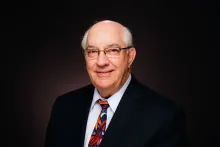
Mitchell Knapp is a graduate of Ambassador College with a BA in Theology. He has served congregations in California and several Midwestern states over the last 50 years and currently serves as the pastor of churches in Omaha, Nebraska, and Des Moines, Iowa. He and his wife, Linda, reside in Omaha, Nebraska.
