
Robin S Webber
This transcript was generated by AI and may contain errors. It is provided to assist those who may not be able to listen to the message.
Well, here we are all as a family. Most of us are back. I realize that some of us are still recuperating. But here we have, we've once again, annually as we do, we've included the festivals of God in the autumn. And in the last couple of weeks, we've been celebrating two very, very important individual festivals that do link up, which is the Feast of Tabernacles and a festival unto itself, which is the Eighth Day Festival. And all of God's festivals, and I know that Mr. Helgi has spoken to this, as our ministers did everywhere during the Feast of Tabernacles and the Eighth Day, they speak to the mighty, saving works of God down through history, to the present, and into the future.
And point to the ultimate goal of what God and the Word intended from the very beginning, of letting us make man in our image and after our likeness, not only physically, not only out of dust, but ultimately spiritually as the immortal children of God. It's quite a vision that has been shared with us over these past festivals. And it's something that is incredible, that if you join me for a second back over in Revelation 22, and I glanced on Revelation 21 in the last message on the Eighth Day.
I often center on it more than I did this time. But Revelation 21 and 22 are a snapshot that God wants us to carry all the time in our hearts and to lodge them there. You know how we men have a wallet and we put it in our pocket and we keep it there. And what God has done with Revelation 21 and 22 is it's like that.
He's created a snapshot that He wants us to carry every day of the year, in every action, every moment that we encounter. And that's important. There's a reason why. When we go through the book of Revelation, we recognize, boy, there's a whole lot in that. There are ups and downs. There are great valleys, great challenges.
Absolutely. But then we get to Revelation 21, Revelation 22. And as we've often said in the Church of God culture, we've read the end of the book and God wins. And that's why we have Revelation 21. That's why we have Revelation 22. That's why Revelation was written in the form that it was.
It's often called apocalyptic literature. Why? Because it is apocalyptic literature. It's literature that was at that time in that those years between 200 BC and 200 AD were written to normally people that were dispossessed. They were a remnant people. Times were tough upon them. And God used language that had imagery, was colorful, had figures. And at the end, He gave them hope that no matter what we were going through, at the end, with that snapshot in mind, that all would be worth it. With that thought, now I'd like to go to Revelation 22 at the very end.
There's an interesting interchange that goes back and forth between Jesus Christ and, in that sense, the Church. If you join me in Revelation 22 and verse 7, it says, Behold, I come quickly. Blessed is He who keeps the word, the prophecy, of this book. This is one of the seven great Beatitudes of the book of Revelation. We often think of the Beatitudes being in the book of Matthew, but Revelation has its own set of seven Beatitudes. And there's a blessing that's given to those that keep the words of the prophecy of this book.
And then we drop down to verse 12. Notice what it says. And behold, I am coming quickly. And my reward is with me to give everyone according to his work. And then Jesus gives self-disclosure. And He says, I am the Alpha, I am the Omega, the beginning and the end, and I am the first.
And the last. And then let's go over here to verse 16. We keep on the flow here. It says, I, Jesus, have sent my angel to testify to you these things in the churches. Plural, in that sense, for all ages. I am the root and the offspring of David, the bright and the morning star. So Jesus is kind of at the very end of the book, knocking on our door of our hearts and saying, I'm coming. And by the way, I am also coming quickly. And with that, then notice what it is in verse 17.
And the Spirit and the bride say, Come, and let him who hears say, Come, and let him who thirst, Come. Whoever desires, let him take the waters of life freely. Now, as we go through this interchange, in a sense, almost a literary conversation, we notice this going back and forth of coming and then the echo and or the response of come. And then we notice at the very end, verse 20, He who testifies to these things says, Surely I am coming quickly.
That's in red in your scripture. That's Jesus Christ speaking again, the word come, and He also gives an admonition. It's kind of a wake-up call, and He says, I am coming quickly. And then we notice the response. With all said and done, with having John having experienced the apocalypse and or the unveiling, what we call in Latin the revelation, here are the in words of one saint of God.
Amen! So be it! Even so come, Lord Jesus. What we notice in all of this, it's very interesting, it's transactional. It's not just Jesus Christ ascended now, but it's also the Apostle speaking. I would suggest on behalf of all of us, that with all of this stated, and for we, as we heard, as prophecy continues to unfold and all of that which is before us, is that the end of the journey, the end of the pilgrimage, the end of the walk of following Jesus, when He says, follow me, is all worth it, as a pilgrim.
And we say, so be it. Even so, Lord Jesus, come. Isn't that kind of what we say when we go through the model prayer that we find Jesus spoke to His disciples, when they said, teach us how to pray? We say, our Heavenly Father, which art in heaven? And then we go through the different comments that are made there, and then at the end we say, Your will be done on earth as it is in heaven.
Well, how does that happen? What's that all about, as we might say in Southern California? And my question to you on this Sabbath day is, how are you making that happen in your life, since the feast, during today, and as you're planning tomorrow? How are you, as a follower of Jesus Christ, as one called by God the Father, how are you planning to make God's will happen here on earth as it is in heaven? That's the subject that is before us. You know, so often we often say, Thy kingdom come. And I say, for the moment, we sincerely believe it.
But when we talk about Your will being done on earth as it is in heaven, and when we say, Thy kingdom come, we just have a personal question to ask you, please. And that simply says, how often do we do that as a last resort?
A last resort when everything is not going well, rather than the first cause, the first motion of our life, in everything that we do during the day, that we really recognize that God's will is, in a sense, being done here on earth as it is in heaven. And He's elected us to do that. This leads me, then, to a question for you today.
And it's simply that, and the question is actually in the title of the message. And for those of you that want to take the title, please take the title, then get ready, because we're going to talk about it. When does come really mean come? That's it. When does come? Because that's the word that we're going to focus on. When does come really mean come? Now, here we have been just at the Feast of Tabernacles and the Eighth-Day Festival.
And we followed, in this sense, a pilgrimage festival, which we continue to keep in the Church of God. A pilgrimage festival. We follow what it says in Isaiah 2 and type, where you go up to the house of the Lord. And it says, and He will teach us His ways. And then it states at the end of that, we will walk in His paths. You see, there's three things that are happening.
It's one scripture, but there's three things that are happening. We go up. Mm-hmm. We are taught. And then there's a statement. And we will walk in His ways. So that's what we want to talk about. How do we walk in His ways? How can we sincerely show God Almighty and His Christ that when we say come, we really mean come? And not only in the future, not only in the grand fulfillment, but now, every day in our life.
Because this is our life now. As much as we, in a sense, are just simply passing through, this is the life that you and I lead. How important is it to respond to God? To even respond to the aspect when He says, I am coming quickly. He's kind of giving a nudge there. Listen, this is not about manana. It's about today. It's about now. Scripture is always about now. It's not about mortgaging our faith and or our obedience to the future.
In a gentler, in a kinder, in an easier world to live. This is our world. This is our tour, as I talked about on the eighth day. We know how over Afghanistan and Iraq and other parts that the different troops, they do one tour, then they do two tours, and they do three tours. This is our tour. This is where God has assigned us. Jesus, on that last night before He was betrayed, said simply, that as Father, I do not ask that you take them out of the world, but that you keep them in the world.
So let's talk about that, and let's move forward. Join me if you would in the Gospel, then. We have solidified what the title of this message is, and what I'm going to explain to you. When does come really mean come? In Matthew 7, verse 21, I want to share how important it is that in our responses, in that God does, and Christ does hold us accountable for what we say.
In Matthew 7, verse 21, it simply says this, Not everyone who says to me, Lord, Lord, shall enter the kingdom of heaven. But notice, but he who does the will of my Father in heaven.
Not everybody that cries out, Lord, Lord.
There's something beyond that. You know, as we've often said, even our spiritual adversaries, as the book of James brings out, knows that there is a God. There's a difference between knowing God and acknowledging God in our life and in our Christian lifestyle, because that's what we are to be committed to. Why is that so important? Not only who we know, but by what we do.
It's simply this. When Jesus Christ returns, and we have that conversation with him. Can you imagine having that first conversation with Jesus Christ, the judge of the quick and the dead? And what is the first question that Jesus is going to ask you? You say, Mr. Weber, why did you bring that up? No, it's a good question. What's the first question? Is he going to ask you what you know?
Did you hear me? Is he going to ask you what you know?
And it is important, the knowledge and the revelation that we have been given. Please understand that. Absolutely. But he's not going to ask you what you know. He's going to ask you, and he's going to ask me, what did you do? What did you do? I remember many years ago, having grown up on the other side of that valley that you were talking about, Bob, that's where I grew up. That's where I listened. That's where I learned this way of life. I remember so often from the stage that it would be said that knowledge, knowledge is of no use unless you put it into action. And I want to speak to that a little bit. I'm going to borrow from an article that I read a couple of days ago to help define this. I'm just going to not read the entire article. I don't like to read more than need be, but I'm just going to share a few snippets. And you may want to jot this down. It's by a lady named Lois Peverberg. T-V-E-R-B-E-R-G.
And the title of the article is simply this, Shema. Hear and Obey. So please just sit back for a moment and let's listen and let's learn. The word that means hear or listen, Shema, or as they would say in Hebrew, as close as I can get, Shema, is an excellent example of the difference between Hebrew, which stresses physical action, and Greek and Western culture that stresses smarts or mental activity. Listening in our culture is a mental activity, and hearing just means that our ears, they pick up sounds. But in Hebrew, the word Shema describes hearing and also its effects. They are inextricably linked. Taking heed, being obedient, doing what is asked.
In fact, almost every place we see the word obey in the Bible, it is translated from the word Shema, that the person that hears, that listens, will obey.
Exodus 24 verse 7, I'll just read it to you. Then Moses took the book of the covenant and read it in the hearing of the people. And they said, all that the Lord has spoken we will do, and we will be obedient. The word there is Shema. Interesting. Now you say, if you're not into this right now, I'm going to use a 21st century example. May I? And that is simply this. How often that we that have our parents have been parents, once a parent, always a parent, but that's a whole other sermon.
But how often have we maybe been upstairs and everybody's kind of getting either around for the morning or getting ready for bed and you say, Johnny, Janie, please clean up your room. Please clean up your room. I think that is explicit that you're expecting the room to be cleaned up. Nothing comes back. Sounds of silence.
Johnny, Jane?
Yeah, Mom? I know none of you ever experienced this. I can see by your faces. Yeah, Mom. Yeah, did you hear me? Oh, oh yeah, I heard you. Sure. Soon.
You go into the room five minutes later and it's not cleaned up. Now they heard, they listened, but that they did not obey. That means lecture time, discipline time, and you will learn. That's what God expects of we, His children. That's what He expected of the children of Israel. That's what He expects of the children of the spiritual Israel of God.
To come to understand, to in a sense move away from our Western way of simply mental activity and to allow it to flow through all of our existence in total obedience to Him in our heart, in our soul, and in our mind, that when He asks us to do something, we do it. Let me go a little bit further here for a moment. The word Shema can be likened to a pledge of allegiance, that Jesus as an observant Jew uttered every morning and evening. It is the first word of the first line. Hear Shema, O Israel, the Lord is our Lord God, the Lord alone. And you shall love the Lord your God with all your heart, with all your soul, and with all your mind.
And that comes out of Deuteronomy 6, 4 through 5. By saying this, what was it? Was it vain jabber? No, not at all. There's a great point to it. By saying this, a Jew would remind himself of, number one, his commitment to love God. Number two, to dedicate himself to the following God. And number three, of doing his will. Now, I know what some of you might be thinking, because I is one. I'm one of you. You say, well, why are we doing all this stuff with Shema and Hebrew and about the Jews? We are New Covenant Christians and we are in the 21st century. That's a very good question, and thank you for asking that. I want you to join me, if you would, in Mark 12, for a moment. Mark 12. In Mark 12, which actually is an expansion of Matthew's account of this, but in Mark 12, it's most interesting. In Mark 12, it's again the first two great commandments. And notice what it says here in Mark 12, verse 29. I think you'll find it fascinating. And that's why we have four Gospels, because they complement one another and sometimes they expand. Here is Jesus, the head of the church, the Lord of your life.
When he was asked about the commandments, which was the greatest, Jesus answered in verse 29, the first of all commandments is, Hear, O Israel. It's not just in the Old Testament.
It's not just sifting through the sands of Sinai.
Hear, O Israel. The Lord our God. The Lord is one.
He gives that, in a sense, pledge of allegiance and that understanding of a special and called out people by God. Not by false gods, but by the true God. And then he goes on to say, You shall love the Lord your God with all your heart, with all your soul, with all your mind, and with all your strength. This is the first commandment. Now, in understanding of all of this, it's so obvious sometimes when you go through the Gospels, you go to Matthew 11, verse 15, where Jesus says, He that has ears, let him hear. What is he saying there? He that has ears, let him hear. If you are hearing this, and if you're hearing this message today, you are responsible. You are responsible for the knowledge and hopefully the love behind it to place into your lives. He that has ears, let him hear. Why is that so important?
The words of God are designed to, not my words, but the words out of Scripture that we talk about and we try to shape and mold to be effective in discussion. But these words are not just simply about information. There are three things and three words, and I would suggest that you might contemplate these, might write them down if you're taking notes, is simply this. So often, when God is first calling and dealing with us, we deal with information. I'm sure you remember that when you called away or wrote in or maybe you saw something on one of the telecast or one of the magazines, and you say, that is really unique information. But God does not want us just simply to stay at the information level. The second point is this. He wants us to be inspired. He wants us to be inspired.
Now, we all went to the Feast of Tabernacles wherever you went, and I know a lot of information was given to you in eight days. That's a lot of listening to messages out of the Bible. Information is important. And there were messages that were not always loud, was not always a loud voice. It could have been just quiet dynamism that was shared with you out of the Scripture.
And it was inspiring. But God wants something more out of the children of God, His children.
He wants transformation. Information, inspiration, is ultimately to lead to transformation.
Otherwise, the Scripture that God would use through Paul, that, behold, I create all things new, a new creation would not be true. So let's talk about this now of the transformed life. I'm going to go through four points as quickly as I can regarding when does come really mean come. Come. Practical 101. You can put down on your notes. You can put in your heart and go to work on this. This is not rocket science. It is partly revelation, but it's not rocket science.
Number one, we, that's you, that's me. But if you don't do it, I'm responsible for it. Because Jesus says, I come quickly. We're responsible for this. Number one, we proclaim come when we recognize God has called us to worship Him in spirit and in truth.
We proclaim come when we worship God in spirit and in truth. Join me if you would in John 4.
In John 4. And let's pick up the thought in verse 23. But the hour is coming, and now is when the true worshipers will worship the Father, notice, in spirit and in truth. For the Father is seeking such, notice, to worship Him, to give Him glory, to give Him honor, to give Him His worthship.
God is spirit. And notice what it says, and those who worship Him must, must.
I was kind of stunned by that word this morning, as I so often have gone over these scriptures.
This is not optional. This is not like going down through the salad bar at a soup plantation, saying, I'll take a look. Oh, I'm going to skip over it. No, there's no skipping over this.
Those that worship God are going to worship Him in spirit and in truth. And as Bob brought out in his fine message, not in the building, not in grandeur, but recognizing that God has designed us to be the portable temple of God on two legs. We no longer have auditoriums, which I used to preach from and was responsible for. We no longer have auditoriums. As Bob mentioned, we no longer have a fleet of buildings. But what we do have, with those taken away, it allowed us to understand the building program that God is about that moves beyond what we might think is pleasing to Him.
He says, we're His temple. We are His abode. He has chosen to reside in us, His presence in us.
What a marvel. What a joy. What a responsibility. What a blessing.
But perhaps we had to learn that the hard way. But sometimes that's what happens. God has to kind of ... And then we learn. What does it mean by spirit and truth? Let's talk about that for a second.
By spirit and truth, it just doesn't simply mean to know about God or to have academic understandings of His doctrines, which are beautiful and precious, and or His truths.
It's not talking about what everybody else sees, but it's talking about what He sees.
Because His eyes are on us. He says that we are the apple of His eye. And so He's watching, and He's observing, but not how men and women observe, because all they can see is from the other. They want to know, God knows and wants to know, what we're doing in here, in our heart, where nobody else can see but Him. Just kind of a private party between you and Him and the Christ.
And that leads me then to ask if we're going to worship God in spirit and truth. And the big question is, we are this portable temple of God on two legs. The question I want to ask you as you move forward into October, November, December, January, and on is simply this. Why do you do what you do, and ultimately for whom? Kind of like the questions of a reporter, who, what, where, when, why, and how. Simple question. Why do you do what you do, how you do, and for whom? For whom do you know it or do it? No, so often we can see people's activity, and it looks good on the outside, and it looks like it's perchance for all the right reasons.
It looks loving, it looks caring, it looks responsible, it can look like Johnny on the spot or Janie on the spot. But what is the motivation underneath that? Why are we doing that?
Are we doing that out of selflessness? Are we doing that out of godly love for love's sake, outflowing, outgoing concern? And or are we working off of some holes inside of us?
That have not been touched fully, healed fully. Things that maybe we experienced as children, things that we experienced in school, that somehow we have to please, and that, but it's with the strength. Somehow it's making us sufficient. I speak of myself.
When I give messages, I just speak to myself, and I hope somebody's hearing.
Why do we do what we do? What is our motivation? No, motivation is very interesting. It has the first syllable as motor. What is the engine? What is the cause? When you think about that, brethren, as worshipping God in spirit and truth, as we move off of the feast, it's simply this. How often do we at times say, oh, I should have thought before I spoke? Right? We've all heard that. No, but we've got to take it back. We have to take it back beyond the tongue, beyond the thought, even beyond the feeling. We've got to go back to down here.
What is the well that that is drawn upon? What is the motivation for why we do what we do, and who are we serving? Are we serving yourself, or are we serving God? Jesus Christ served God. Join me, if you would, in Matthew 2028. In Matthew 2028. Let's take a look here.
It says this, speaking of Jesus, self-disclosure by the Son of Man, just as the Son of Man did not come to be served, but to serve and to give his life, notice, as a ransom for many. Jesus came to serve for all the right reasons. For all the right reasons. Why do we do what we do?
You know, having grown up in the San Gabriel Valley, right across the ditch over here, that we lovingly call the Arroyo, look up at Mount Wilson. And you see all of those television towers, right? You see the television towers. All of us know the television towers. Actually, we have more time to look at them now, when we're stuck on the 210 freeway, every hour of the day. Oh, there's the television towers. And, you know, when I was growing up, there was KRLA, there was KHJ, some of you, I know John will know some of these stations, KRLA, KHJ, etc., etc., boss radio, and everybody, you know, you would tune in. Everybody has a tune-in channel. And with these television towers up there, they are powerful transmitters. They're sending out something.
And humanly, we also are very powerful transmitters. And it always surrounds this. Are you ready? You might want to jot it down. WIIFM. All of you on the second row, do you know what WIIFM is?
As we say in the Marine Corps, then listen up. Here we go. And it's somebody that WIIFM means what's in it for me. What's in it for me? And that's the opposite of Christianity.
Christianity is not about glorifying ourselves, and it's not just moving through life by our own.
Christianity is for two things and two things alone. Number one, to glorify God.
And number two, to be a blessing to other people. That's it. Simple religion, simple theology, no Hebrew, no Greek. We're to glorify God by every thought, by every word, by every deed, by every motive that is rolling around in our hearts. So when we do this, when we move beyond operating on feelings, catching our words, catching our thoughts, but get into the spirit of the matter which lies in deep inside of us and ask for God's help.
That's when God knows that when we say, Come, Lord Jesus, come, we mean business. We get it.
We understand. Let's go to point number two. We proclaim, Come, and desire God's will on earth as it is in heaven when we observe His law defined by His commandments. Let me repeat that. We proclaim, Come, because talk is cheap. Talk is cheap. Parents can talk. Talk is cheap. Many will say, Lord, Lord, but do not the things that I say. And listening and hearing in the language that Jesus was speaking, not only to the Hebrews, but to we, the church, the Israel of God, is hearing is obeying. One, two. That's what it means. We proclaim, Come, and desire God's will in earth as it is in heaven when we observe His law and obey it. Join me if you will in 1 John 5. 1 John 5.
The epistle thereof.
And we notice here where it says in verse two, By this we know that we love the children of God.
When we love God, notice, and keep His commandments. For this is the love of God.
The commandments are the outline of God's love. They give us the borders. They give us the boundaries. They give us the GPS of loving God and loving our neighbor. When we love God and notice and keep His commandments. For this is the love of God that we keep His commandments. And notice what it says.
And His commandments are not burdensome. Very important. I've already gone through Mark. I've already gone through Matthew where it says that the first and the second commandment does not even deal with our brains. It deals with our hearts. I love when you go through that and you get in this rhythm. It's not only a rhythm, it's connecting the dots. You are to love God with all of your heart, all of your mind, and all of your soul. These commandments that God has given you and me that we observe and keep as New Covenant Christians are not simply lost on the sands of Sinai. Because we recognize when we read the book of Hebrews, join me if you would for a moment in Hebrews. Let's pick up the thought here in Hebrews. My eye falls upon it. We'll go to it here in Hebrews. Let's go there. I know where it is. I'll find it and I'll tell you. Hebrews 10. And let's take a look at verse 16. This is the covenant that I will make them after those days says, Lord, I will put my laws into their hearts and in their minds and I will write them. They are etched into our heart by the Spirit of God.
With Moses, he used his finger. With you and me, he used his Spirit and put it on this fleshly table. And not just to stay there, but to be used and to be understood.
Join me if you would in Romans 7.14 for a moment of how important the commandments are.
In Romans 7, verse 14, this was a verse that anchored us back in 1993, 94, 95, as the church was under siege, not from the outside, but from the inside, saying you don't have to keep those laws anymore. They were on tables of stone.
They're old-fashioned. They're a burden. I have a question for you. How many of you thought the Feast of Tabernacles was a drudge and a burden? I don't think so. As I said 21 years ago in Tucson, if this is bondage, give me more of it to understand the blessing that we have of keeping God's ways and laws and to be able to have this GPS of the festivals to remind us and move us towards the great saving acts of God. But Romans 7.14, this was cardinal. This was essential. For we know that the law is spiritual, but I am carnal, sold under sin. The law itself is a spiritual law codified and was initially put on stone, but is now written in our heart. But allow me to take you a step further. What does it mean to worship God in spirit and in truth, coupled with observing the laws of God? Observing the laws of God in spirit and in truth, and it is spirit. When we observe the laws of God, at times it takes us to a place where there is a sweet reasonableness that lies just beyond the letter. I didn't say that the letter is taken away, so please share me carefully. But there is a sweet reasonableness that lies just beyond the letter. What do I mean by that? Join me if you would in Matthew 23.23. Matthew 23.23.
Let's take a look here. Notice what it says.
Woe to you, scribes and pharisees, hypocrites, for you pay tithe of mint and anise and cumin, and have neglected the weightier matters of the law, justice and mercy and faith.
And these you ought to have done without leaving the others undone.
How do we put this together? Allow me to paraphrase a story that I think many of us are familiar with.
And it's the story of the woman that was—I've got to stretch my knees here for a moment—that there was the woman that was called an adultery. My, my, my. Wow. Dragged out of the room.
Throwing down in front of a bunch of men. Hello?
Why is it always just the woman?
And she was caught in the act, and they were setting up a trap for Jesus to somehow get him in some dialectic trap. And Jesus didn't go there. That's why he's God in the flesh, and our example. And in that entire story, Jesus never moved away from the law at all.
By the law, she should have been stoned. He knew that, brought it out in conversation, says, you, you that are without sin. So he was recognizing that what she had done was sin and against the law, but he said that you that are without sin, you cast the first stone.
Hmm.
And as we know, they all went away. And then what did she say? What did he say to the woman?
He said, Go and sin no more. If Jesus was not observant, if he did not believe in the commandments, he would not have equated that act with sin. So he was fully verifying the act of adultery as being sin and breaking one of the commandments. But he said, Go and sin no more.
He offered judgment. He offered mercy. And he offered encouragement.
God knows that about you and me when we try to model that in our own lives as we have situations come into our life. I remember so vividly Mr. Helge's very, very fine message during the feast, and all of our elders did an outstanding job in deacons, etc. But I would really encourage you to listen to Mr. Helge's because it spoke to the love of God profoundly, beautifully, and wonderfully. And he went through John 3 16, where it says, For God so loved the world that he gave his only Son.
That whosoever should believe on him should not die, but have eternal life.
For God did not send his Son into the world to condemn the world, but that through him the world might live.
We do not worship a condemning God. Oh yes, we worship a God. There is a judgment. Yes, yes, yes.
But he's not up there shaking his fist at us. He loves us. You say, well, how do we know that he loves us? Because he gave a Son that we might even be able to have a conversation with him when we use his name.
I have a question for you. When does come really mean come by how you approach life and by how you approach people and the mercy and the judgment that you share with others?
When you model the example of Jesus Christ rather than that which comes so easily with us as human beings, God's going to know. He's going to say, Susan's got it. Robin's got it. Ralph gets it. Ted's a mover. John Garnett, he's in.
Chris Tombs, young guy. He's already on his way. He gets the picture.
I want to share a couple thoughts with you. Shut these three words down if you haven't taken anything yet. This is the sweet reasonableness that lies beyond all. Number one is justice. What is justice? Justice is where we get what we do deserve. Do, do, do. Do deserve.
We get our come ups and come up and come upsense. It's a Hebrew word. Come upsen...no, just teasing.
Eye for an eye. But mercy is different. Mercy is when we don't get what we deserve.
Mercy is when we get what we don't deserve.
One plus one has jumped over two to three. But then grace. Grace is when we receive what we don't deserve. We receive something. We are given something. Something is shared with us beyond our wildest imaginations. There is no math. It's not one plus one equals two, or one plus one we jump over three. God's math is completely different. He says, come.
The math has been done through my son. And then we say, because we follow that son, and the son says, no man hath greater love than to lay down his life or his brother. We model that. We remove ourselves out of the equation in dealing with people. And we show the same love to people that has been shown to us as a Christian. And when that happens, it is so rich. And it's so beautiful.
And Christ tugs on the shoulder of his Father in heaven. He says, catch this. Look down.
Paul gets it. Bonnie gets it. Hoover gets it. And the Father looks at him and says, you know what? They're just trying to be like us. When does come really mean come?
When does come really mean come? Let me go to number three very quickly.
We proclaim come and perform God's law on earth as it is heaven when we accept and abide with that special life that is in us.
When we accept it. Bob spoke to this in his message, and I'll build upon it, generally if you would, in 2 Corinthians 13.5. In 2 Corinthians 13.5, and sometimes it's so astounding that apostles and even pastors like me have to kind of keep on reminding the people of God.
In 2 Corinthians 13.5, examine yourself as to whether you are in the faith.
What is faith? Faith does not always know where God is taking a person, but it knows who they're following.
They may not know the somewhere, but they know the someone that is their guide.
David knew that. David said, the Lord is my shepherd. I shall not want.
And here Paul says, examine yourselves as to whether you are in the faith.
Pest yourselves and do you not know yourselves that Jesus Christ is in you unless indeed you are disqualified. And so we find here, we find here, as Bob was bringing out, so emphatically and in short style, but I'll build upon it for a moment, as Paul says, no, you not in 1 Corinthians 3 16 through 17, know you not that you are the temple of God. I think this to me, and I know I speak about it, but it's all right. I've got some good examples from past New Day.
But it's all right. I've got some good examples from past New Day of people repeating and repeating and repeating. I remember when the gentleman said, I've got something really new for you tonight, brethren. It's really exciting. I've been studying it all week. And I thought, oh, wow.
Neat. Maybe he's found a third tree. Maybe there's something beyond the two trees.
No, it was the two trees. He just kept on getting excited about the two trees.
And he was so excited that he wanted to share it. That's why I share 2 Corinthians 13.5, know you not that Jesus Christ dwells in you. We are not alone.
That spirit that God gives us, that spirit that God gives us, is no less than the spirit, his spirit, the spirit of the Father, and the spirit of the Son. That's what Romans 8, 10 through 12 tells us. It's not a screwdriver. It's not a pencil. It's not a tape measure. We oftentimes define God's Holy Spirit as, well, I know what God's Spirit is. It's love, and it's power and assignment sound mind. No, that's what the Spirit does on our behalf, because we don't have the ability to do it ourselves, do we? But the Spirit of God is the essence of God. It's literally God the Father and Jesus Christ dwelling in us. Why do I say that? Good question.
Otherwise, how could Paul say that we are the temple of God? And Christ dwells in us now.
That's a challenge today. You know, in America, in the public square, we have a public religion where we can talk about God. We can sing God we trust, or we can sing God bless America. But you throw Jesus Christ in that equation, and in that mix, all of a sudden we've got problems down here in River City. But it is by that name by which all men must be saved. And to not know Christ is not to know the Father, because Jesus Himself says, if you've seen Me, you have seen the Father.
No, it's very interesting. Join me, if you would, for a moment in John 14. I'm just going to put a thought here, and then we're going to conclude real quickly here. Hopefully, John 14. But I'm not going to see for a couple of weeks, so I'm going to finish this. John 14. Notice what it says here in John 14.
Verse 18. Some of Jesus' last human words. I will not leave you orphans.
There's that word. Look at it. You might want to circle it. And I will come to you. I will. There's that word again. It just keeps on popping out of the Bible, doesn't it? And I will come to you. What does Jesus mean by that? Does it mean we're not going to see Him until sometime off in the future? Or do we have that opportunity to experience Him now in our life? You know, it's very interesting. We often talk about the Second Coming. And when we think of the Second Coming, we think of Zachariah 14, where it says, and that, yes, He will land on the Mount of Olives. Those feet are going to touch down.
And we begin the Millennium. But we know that He came the first time as an infant, as a baby prophesied, another prophecy that Bob can deal with another time, a prophecy. He came to Bethlehem. That was the first coming. So often we go and we call the end, the eschatology, the very end in Jerusalem, and the Second Coming. But here He says, I will come to you. And that can only be understood by the Holy Spirit that resides in us, His Spirit, along with the Father, as Herbert Armstrong himself would say, that the Holy Spirit is the very essence of God, the essence. The Lord is my Shepherd. I shall not want. It does not get any better. Unlike Moses, we no longer have to go up to the mountain to find the burning bush.
God has come off that mountain, resides in us. And because of that, we say, come.
Because of that, we worship Him in Spirit and truth. Because of that, we work with people. We do not condemn them. And because of that, we understand that special relationship.
Let's go to point number four. We proclaim, come, when we acknowledge that God's grace is sufficient, that God's grace is sufficient. This was the challenge that was before Paul in 2 Corinthians. Join me if you would there, please. 2 Corinthians 12, 9. Let's notice it. He was plagued three different times. He prayed three different times about this thorn that was in the flesh. You don't know what it was. I don't know what it was, but I'll guarantee you one thing. Paul knew what it was. And he appealed to God three different times that it might be removed.
And then he says in verse 9, he said to me, my grace is sufficient for you.
This is Jesus speaking. He spoke to Paul. My grace is sufficient for you, for my strength is made perfect in weakness. Basically speaking about Paul's weakness, our weakness. And then Paul comes, therefore, most gladly, I would rather boast in my infirmities that the power of Christ may rest upon me. And therefore, I take pleasure in infirmities and approaches and needs and persecutions and distresses. For Christ's sake, for when I am weak, then I am strong.
We say come, Lord Jesus, come and mean it in our lives when what God has done for us to this point is sufficient. His intervention, His grace of unmerited pardon, His continuing favored grace that sustains our life, that keeps us in connection with Him. I don't say this in a cavalier manner. I say to myself, God owes me nothing.
Does He owe you something? He doesn't owe me anything. He's already given me His Son, His dear, sweet Son that He called my beloved Son. But sometimes we want to have God like a cosmic bellboy and keep on pushing the button, keep the request line going.
When God has already, through His Son, said that I have the opportunity for salvation.
And if I die tomorrow, if I die tomorrow, then Jesus has come quickly. Because next thing I know, I will be awake and I'll be sharing eternity with God the Father and Jesus Christ. Not just simply as a destination, but a relationship that they've always wanted with you and that they've wanted with me.
Let's conclude in Revelation 3.
Let's conclude in Revelation 3.
Notice what it says, to the churches at the end, Behold, I stand at the door and knock. If anyone hears my voice, notice, and Christ is knocking, and He's knocking on your heart today, the door of your existence.
Through the words of Bob, through the words of the special music, through my words as an undeserving servant to communicate the gospel. But He is always knocking. The question is not, is He knocking? The question is, will we open our door? If anyone hears my voice and opens the door, notice, I will come in to Him and dine with Him. He will come. Promise. That's a promise.
And I will come and I will dine with Him.
And what are you going to feast on when He comes through the door of your heart?
Jesus made that very apparent in some of His words in the Gospels. He says, my meat is to do the will of the Father, because His life was meant to show us how heaven and earth come together, that God's will might be done on earth as it is in heaven.
And He says to you, and He says to me on this Sabbath day, as He always does to every disciple, His first call and His last words. With this said, simply this, follow me.
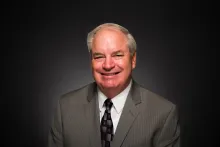
Robin Webber was born in Chicago, Illinois, in 1951, but has lived most of his life in California. He has been a part of the Church of God community since 1963. He attended Ambassador College in Pasadena from 1969-1973. He majored in theology and history.
Mr. Webber's interest remains in the study of history, socio-economics and literature. Over the years, he has offered his services to museums as a docent to share his enthusiasm and passions regarding these areas of expertise.
When time permits, he loves to go mountain biking on nearby ranch land and meet his wife as she hikes toward him.
