

Robin S Webber
This transcript was generated by AI and may contain errors. It is provided to assist those who may not be able to listen to the message.
I'd like to move right into the message for time's sake today. Today we recognize that we are here in one sense at the, do I dare say, the end of the Days of Unleavened Bread, 2019. But to recognize that God gives us these days as a tremendous GPS of moving forward. Sometimes when we think of the Holy Days, whether it be the New Testament Passover or the Days of Unleavened Bread, and on and on with all different days, that we think of them as events that we look forward to. But we miss the great lesson of these Holy Days that God has blessed us with.
If we only look at them as events, they are really a reminder and they are a springboard to our daily existence. Our daily existence before God Almighty and His Christ and heaven above. And to recognize the lessons that we learned during these times, as was magnified and explained this morning by the two messages, are something that we hope to do every day. It's very interesting that on this last day of Unleavened Bread by tradition, it took Israel seven days to leave Egypt, and we always harken to the point of Egypt going through the sea on that day, and then going from the shore of slavery to the sure shore of freedom and onto the Promised Land.
And it's interesting what happened here. The great lesson of the Red Sea is simply this, if you'd like to put it down, because we're going to expand upon that in the course of this message, and that is simply this. God will do only what God can do, and there are things that only God can do, and then He expects us to do our part. And so if there's any lesson that you will receive in the few minutes that lie ahead of all of us here, it is simply this.
God does what man cannot do, and man's extremities are but the beginning of God's opportunity, but then He expects us to do our part. When we think of the story of the Exodus and the Days of Unleavened Bread, we recognize that God is doing something very, very special. And the story of the Exodus cannot just simply be lost on the banks of the Nile or in the sands of the Sinai. The Exodus is really the story of Scripture in Todos. It's the story of God choosing a people that were not a people, a people that had been looked over, a people that had been placed aside.
And then He says, I want you to be something very, very special, not because of who you are, but of who I am, and that we will create a transaction. We will develop a covenant between me and Thee, and that we'll begin to do business together. And I've got something very exciting for each and every person that will follow me. And that is that I'm in the process of creating something. I am in the process of creating a new man, a new woman.
And with that new man and that new woman following my love and following my law, thus and then a new community will develop, something that has never been, a new community, a new creation, a new way of being a human being. Have you ever thought about Christianity itself being a new way of being a human being? Who's ever done that before? Well, we heard about it this morning, didn't we? Jesus, behold the man. Jesus, who was God in the flesh, taught us a new way of walking and talking and thinking, and whose heart motivation was to do the will of the Father. Now, ancient Israel got excited being chosen, and they got excited, especially when the Red Sea opened up in front of them that night, when the winds blew, and then God told Moses, okay, stop staring, get the people moving.
And thus they did, once God had done His thing, then they were asked to do their thing, and said, God told Moses, get the people moving, which is going to kind of be at the thrust of what we're going to talk about this afternoon. Now, as they moved from that shore of slavery to the sure shore of freedom, and headed towards that land of milk and honey, they thought that the worst was over.
They thought that their job had already been done. They made it to the Red Sea. But they made a mistake that often you and I make, because there's a little Israelite in each and every one of us. And that is simply that they thought they were finished, and they didn't realize that the journey was just really beginning. And that is a bad spot for human nature to rest around and to sit in, is to recognize that we've made it to a certain point, and we established an artificial goalpost.
You might want to jot that down if you want to follow in notes, and kind of stay with me where I'm going to be going. Humanity, to a degree, tends to create artificial goalposts, thinking that it's all over, when sometimes it's just begun. Back in World War II, there was a major victory in North Africa by the British over the Germans. And everybody got a hoopla, they got excited, they thought, it's over. And Winston Churchill, in one of those inimitable phrases, which many of you might know, kind of put it this way, Churchill said this regarding this major victory, and he stated this, lest the British people got into a lull and thought it was done.
And that was simply this. He said, now this is not the end. It is not even the beginning of the end, but it is perhaps, perhaps, the end of the beginning.
Did you follow that? I don't really want to repeat it, I might muddle up. But that's what we do sometimes. We go along, even we that have the Spirit of God, the Spirit of Christ, the Spirit of the Father in us, will think enough already, I'm done, and we sit back on our spiritual haunches, and think at this point that we are complete in Christ. But the journey's never over. The journey's never over. Even in this last 20 years, remember a very famous phrase, mission accomplished. Mission accomplished, banner. But was the mission really accomplished? I want you to think about it in your life for a moment. I'm going to slow down a moment, allow you to pause and for me to pause. Is Christ's mission in us accomplished today? Is it accomplished in us, and or is there more yet to be? I have a question for you that only you can answer, and I'll try to answer a little bit, but here's my question, the big question. Why did people falter in the wilderness after they had touched the sure shore of freedom? Why did they, which should have taken a month, probably would have taken about a month for about two and a half million people to go from Egypt up to what today we call the Holy Land or up by Israel, and if they'd done a straight line, they would have done it in about a month, but they wound up in circles. They wound up in circles for 40 years. I've always felt that the shortest distance, the one thing I remember in geometry, which I won't go into, but that the shortest distance between two dots is a straight line. Is that how your life is running today? Is that how my life is running today? Or do we sometimes go around in circles even after we've been on this pilgrimage of the Spirit for 20, 30, 40 years, maybe 20 months, maybe 30 months? I don't know how long. We have all variety of pilgrims that are here with me today.
But is your existence and your pilgrimage a straight line as you follow that cloud, not the cloud, but you follow the rock that we heard about this morning, the same rock that led Israel, is our existence a straight line towards the kingdom? And are we making too many detours and getting caught in the pits of human nature?
What happened to ancient Israel and sometimes what happens to the Israel of God today? Perhaps these days of Unleavened Bread, they're just like incredible days of alignment. Thank God that we have them. Alignment with that bread of life that we heard about this morning. An alignment with Jesus Christ, the ultimate pilgrim that came amongst us as an example.
We know His example. We want to be like Him, but sometimes we start living a life of circles. Allow me to quote a Christian author and writer. His name is N. T. Wright. I'm going to read a few lines and maybe go about a couple minutes just so you know how much reading there's going to be. But I want to kind of put it out there for you to just think about as we begin to move off the days of Unleavened Bread. N. T. Wright says this in his book, simply, Jesus. Jesus wasn't the sort of king people had wanted in His own day and time. But He was the true king. But they had become used to the ordinary shabby kind, second sort of king. They were looking for a builder to construct the home that they thought they wanted. But He was the architect coming with a new plan that would give them everything they needed but with a new framework. Question. How do you perceive the man sent from above to us, Jesus the Christ? Is he building something that you want and are you allowing him to be the architect of your life and to create God's designs in you based upon His foundation? Interesting. It says also, N. T. Wright, they were looking for a singer to sing the song that they had been humming for a long time. But He was the composer bringing them a new song. They had been humming for a long time. But He was the composer bringing them a new song to which the old songs they knew would form at best the background music. He was the king, all right, but He had come to redefine what kingship was all about. The Lord of our life, the one that the Father sent to this earth, came not only to deal with the old man, the old lump, and to forgive us of our trespasses, but to begin by God's grace to create in this new creation a new man, a new woman, and not just for themselves, but to bring a community together called the Body of Christ that might worship God, serve others, and move into the lives of others, to be that witness that we heard about this morning that there really are people that do believe that Jesus of Nazareth, He that was born in Bethlehem, really was sent by God. That's why we're here. That's what we're to learn about. There's an incredible indictment made in the Gospel of John. Join me if you would for a moment. John 1. Just join me here for a second. John 1. And I'd like to pick up the thought in verse 7. It's a stunning indictment. And perhaps we have never fully considered it even as a body of people. We know the very famous words that are in John 1.1.1.2. The Word in the beginning was the Word, the Word was with God, etc., etc. But I want to draw you down to verse 7. This man came for a witness to bear witnesses of the light that all through him might believe.
Speaking of John the Baptist, he was not the light, but was sent to bear witness of that light. And that was the true light which gives light to every man coming into the world. He was in the world, and the world was made through him speaking of the Word, speaking of the One that became incarnate, Jesus of Nazareth. And the world did not know him. The world didn't know him. Interesting. Incredible indictment. But then, maybe you've never noticed verse 11. Stay with me, please. He came to his own, and his own did not receive him. But as many as received him, to them he gave the right to become children of God to those who believe in his name, who were born not of blood, nor the will of the flesh, nor the will of man, but of God. Oftentimes, we've looked at this, and in our spiritual psyche we say, yes, we realize we've been called out of the world, and we recognize that the world to a large degree, and increasingly so, is rejecting the notion of God, much less the notion of Jesus Christ.
But it says that he came amongst his own, those that were a covenant people of old, and they did not recognize him. They were wanting a builder. God sent an architect. They were wanting somebody to sing familiar tunes, and he sent a composer.
They were wanting a ruler, but one that was made in their image, and what they thought was needed, and not a king of a different sort, and of a different stripe. Interesting. Why then did they not recognize the one that God the Father sent to us? We might ask that.
It's interesting that in Dorothy L. Sayer's book, entitled, The Greatest Drama Ever Staged, quoting her, he displayed a paradoxical humor that affronted serious-minded people, and retorted by asking disagreeable questions, perhaps, do I dare say, probing questions, that could not be answered by the normal rule of thumb.
But he had a daily beauty in his life that made the rest of us ugly, and officialed him, felt that the established order of things would be more secure without him. So they did away with God in the name of peace and quietness.
The composer came. They wanted a singer. But what did I share with you this morning in the Offertory in Psalm 40, in verse 3, that we are to sing a new song, not earth-born, but heaven-sent, by the one that God sent to us, so that we might be touched by God, and that God, in turn, by the experience that the Christ had, might be touched by us.
I mentioned in this quote by Sayers that he would ask questions that were at times paradoxical and disturbing to the covenant people of this day.
I want to share something with you that this coming year, as we move away from the days of the Days of Unleavened Bread, Jesus is going to continue to ask us questions. I'm just going to give you two questions. You've heard me ask you. I've mentioned this before, but the questions never, never change. There are two questions he's going to ask. The first question he's going to ask is, who do you say that I am?
Who do you say that I am? This is the question that every human being, everybody that draws life and breath, as they come up against Jesus of Nazareth, a question is posed to them, not only to Peter of old, but to each and every one of us out of Matthew 16, 15. Who do you say that I am? Not the person next to you. Not the person behind you. Don't look around.
Not the person behind you. But who do you say that I am? You see, when you come up against the personage of Christ, you have a decision to make. You may have a decision that you're needing to make today. You will either follow Him, you will either give your life to Him, as the Father wants you to, or you will reject Him. But for either acceptance or rejection of His way, there will be an outcome.
Not three outcomes, either acceptance or rejection. Because we cannot come into the presence of the Father other than by His name and His experience and His existence, and believing that it was the will of the Father to send His Son to this earth.
Now, oh, there's one other thing you can do. Excuse me. You can also ignore.
You can either accept, you can either reject, and or you can ignore. But ignoring the personage of Jesus is just like secondhand smoke. It's just secondhand rejection. And you will be living in a vacuum. I'm talking to you as a friend. This is Robin. This is my hometown church.
You've known me for a few years, and I've known you.
God wants us to accept the fullness, as Mr. McNeely was saying in the second message this morning, of becoming complete in Christ. And not just saying it by our lips, but by saying it by our existence. Knowing Jesus Christ is not an event, it is an invitation. It is not merely an event. It starts with an event and becomes an existence that then develops what we call that new man, that new lump. Join me if you would in 1 Corinthians. In 1 Corinthians 6. I think we touched on it this morning, but I'm going to go back to it again. 1 Corinthians.
Actually, let's pick up the thought if we could. Yeah, 1 Corinthians 5 and verse 7.
Therefore, purge out the old leaven that you may be a new lump, since you truly are unleavened, for indeed Christ our Passover was sacrificed for us. Therefore, let us keep the feast, not with the old leaven, but notice with that new leaven, not the leaven of the malice and the weakness, but with the unleavened bread of sincerity and truth.
The days of Unleavened Bread are a reminder of God's grace through the New Testament Passover and through what He did with ancient Israel, but it's not in itself. It's not the end. It's the beginning of the rest of the story. And my comments here for a few minutes this afternoon is to kind of say, buckle up, get your airbags deployed, and be ready for God to go to work on you as that new man, that new woman, and that new lump. If you want to look for a title in all this, it's simply this. The divine molding of the new lump. So we're going to spend a few minutes on this. Why is that important? Join me, if you would, in Isaiah 64 and verse 8. Mr. McNeely touched on this for a moment. So we're going to have some lightning strike twice here, but we're just going to make it resound and echo a little bit more. In Isaiah 64 and verse 8, we find this where it says simply this, But now, O LORD, you are our Father. We are the clay, and you are our potter. And we are the work of your hand. That's what we all said at baptism. When the minister asked you, have you repented of your sins?
Are you ready to get off the throne of self? And have you accepted Jesus Christ as your Lord and your Master, your Passover, your High Priest and your King and the Lord of your life? And you said, yeah, I'm ready to get off the throne. I want Him to sit on the throne of my heart. I want Him to be the ruler of my life. And I just want to be like the one that God the Father has sent me. But sometimes, once that happens, because words can be cheap, sometimes people do at baptism, they get wet. They get wet. But there's a difference between being wet and being converted.
Join me if you would in Isaiah 45. If you want to, I'm actually going to read this out of the New Living Translation. You can just kind of sit back and relax. Let me read Isaiah 45, 8-10 for you for a moment, out of the New Living Translation. It says, Brethren, friends, I'm here to remind you today that we are to be a new creation, and we are not yet what we shall be.
God has more work. God was just beginning His story as Israel came up on that sure shore of freedom and began to march through the desert. And as we come up to the last days of 11 Brad, understand and be prepared that God is going to have more work to do on you and on me. I want to share a thought with you here.
Exodus 12, verse 11. Exodus 12. What did you do on me over there? It's a story of the Passover of old in Egypt. And there's some lessons that I want to share with you so that we can all move together on this spiritual pilgrimage that God has given us to. This exodus of drawing us out of this world towards the kingdom of God. In Exodus 12, verse 11, we know the instructions before was how to eat the lamb that night so that they were imbibing of the lamb.
Are you with me? We all understand that they were imbibing of the lamb. They had the lamb, and if the people next door didn't have the lamb, they came over, they all eat the lamb, and then there was a way then of disposing of it. That's where we're at so far. And it says in verse 11, And thus you shall eat it. Just as we ate the other evening, the symbols of that greater lamb, the lamb of God, now the risen lamb, as we heard this morning, we partook of those symbols as they partook of that lamb.
But then notice what it says, And you shall eat it with a belt on your waist, your sandal on your feet, and your staff in your hand. And so you shall eat it in haste. It is the Lord's Passover. Now, we're going to go back again just for a parta- Are you with me? Notice three items that they had. They had sandals on their feet, they were to have a staff in their hand, and they were to be girded. What does that mean today, we that are the Israel of God? To ancient Israel, it meant simply this.
God was about to intervene. Get ready. Things are going to happen, and you've got to move. When God intervenes, and God does what only God can do, then God is going to expect you to do something. Have you ever noticed when you read the Gospels that when Jesus did something, normally when He healed a person, He asked them something to do. Jesus did what He could do as God in the flesh, He would heal people, or He would forgive sins, all the different items, and then He would normally ask that believer or that follower in the making, He would give them an assignment to do as well.
Well, that's what we find here, that God was about to intervene and pass through the greatest empire on earth as He passed over the people that He was selecting to be a new people and a nation and a holy priesthood to Him. But they had to do something. They had to be ready to go. My question to all of you today is simply this. How ready are you to move as God enters our life either by a message, either by the Word of God, either by the prompting of the Holy Spirit?
Do you have... Are you girded up? Do you have those sandals to walk the walk of faith? Do you have that staff to support you? Or... You know, I've been doing this for 20 or 30 years. I don't know if I'm going to learn anything new. Just kind of show up. I know I'm supposed to. I'm supposed to go through an hour or two of services or whatever. And I'm going to go home and just...
same old, same old. Same old stuff. S.O.S. And sometimes they've ever run into a person. All they're doing is sending out S.O.S. signals. Same old stuff. Same old stuff. Brethren, God has not called us to manufacture same old stuff where we learn... We don't learn the lessons of these, the days of the love and bread. Join me if you would for a second, if you'd be so kind. Join me if you would. Let's open up our Bibles and go over to Deuteronomy 16, verse 3. In Deuteronomy 16 and verse 3, notice what the great meaning of the days of the love and bread are.
This is the second giving as they are about to go into the land. You shall eat...in verse 3, no love and bread with it. Seven days you shall eat unleavened bread with it. That is the bread of affliction for you came out of the land of Egypt. Notice in haste that you may remember the day in which you came out of the land of Egypt all the days of your life.
What is this passage telling you and me on this afternoon? That when God intervenes, He who is uncreated, He who says, I will do it, that you and I need to be ready. That when God intervened and passed through Egypt, that Israel had to be ready to go. That when God...sometimes it can seem like things are going to go on and on and on. And then when the time is right, because God not only created time, but He's the master of timing, and He intervenes, He's going to tell His people always.
Are you ready for this? This is not even in Hebrew. This is going to be easy for you to remember. He's going to tell His people to get up, to get out, and to get going. Got that? That's not too hard, is it? To get up, to get out, and to get going. My question to you is simply this. As we've had this magnificent feast of Unleavened Bread, are you ready? As a young person in God's Church, as a middle-aged person in God's Church, as someone like myself that's observed the feast for over 50 years, are we tired of the pilgrimage?
Do we think that we are complete in Christ enough, and or are you ready to get up, to get out, and to get going? That is the lesson of the Days of Unleavened Bread. Because when God intervenes, it happens so rapidly, and He told Egypt to go, that they didn't even have time for the bread to rise.
That's the lesson of the Days of Unleavened Bread. It's about deliverance. It's about who our deliverer is. It's about the one that has a purpose in store for each and every one of us. How often did the father of the faithful, good old Abraham, was told to get up, to get out, to get going? Not just from Ur of the Chaldees, but most of his life.
And you know, there'd be Sarai, and all of a sudden she'd pass by the tent, or Abram passed her and goes, oh no, I think he's been talking to God again. I better start pulling stakes on my tent, because I know what God just told hubby. To get up, to get out, to get going. Interesting. I'm looking at all of you, and I know all of you are looking at me. I only have two eyeballs. I have about hundreds of eyeballs looking at me.
I'm dead serious, because we've been called to be a living lump, fresh, moist, in the hands of the great potter. And just these last couple of weeks, I've just seen, as I've been reading things about how religion is going down in America, which is one of the more religious countries in the western part of the world, that how much more your witness as a follower of Jesus Christ is going to be in an increasingly dark world.
I believe that in a sense we are going to sooner or later come into that same world that Paul and the early apostles did, where they're going to have a lonely witness. But, you know, the darker it is around when you have a light, you know, when you light, sometimes if you were in a farm and you lit a light from the kitchen window, and it's total darkness, sometimes you can see that from miles around.
It is so piercing the light. And that's why you and I have been called.
Not to settle. Not to say, well, I've been in the church for 40 or 50 years.
It's not where you've been. It's where we're going. It's not what you've done. It's what God has yet in store for us and for you and for me. I want you to consider something for more. Let me put it in John 2, verse 13. In John 2 and verse 13, in the Gospel thereof.
And this is early on in John's account in the Gospel. It says in John 2 and verse 13, chapter 2, verse 13. Notice what it says.
It says, Now the Passover of the Jews was at hand, and Jesus went up to Jerusalem. And he founded the temple of those who sold oxen and sheep and doves, and the money changers doing business. And when he had made a whip of cords, he drove them all out of the temple with the sheep and the oxen, and poured out the changers, money, and overturned the tables.
And he said to those that were selling these doves, Take these things away, and do not make my father's house a house of merchandise.
And then his disciples remembered what he said, Zeal for your house has eaten me up. Now, thank you, Mr. Weber, for sharing John 2, 13. But what does that have to do with me? Thank you for asking. Here's the answer. Did you realize that Jesus, you know, the Lord of your life, the one that you say in Jesus' name, Amen, the one that you call yourself a Christian by, that he actually overturned the tables in the temple twice? It just wasn't once. Did you know that? It wasn't once. You know, he is called the Alpha and the Omega. He did it in the beginning, and he did it in the end in the Gospels. He did it in the beginning of his ministry, and then he did it at the end of his ministry, over the same situation, because they were still sending out SOS signals. They were making merchandise in the Holy Spot of God. And he turned over those tables. He says, you don't get it. You're not ready. You don't understand. I told you the first time to get up, to get out, to get going. Hmm. How prepared are you? Just a question, and all you can do is fill in the answer. How prepared are you for the one that God has made the architect to come into the temple of your heart? After all, that is the temple of God that resides in us. He has established his throne, and he said that you wanted his throne to be established in your heart, to rule your heart. As we heard today from Mr. McNeely in his message about all the things that need to get out, and all those things that we need to receive and put in. How ready are you to be molded by God? And not with safe stuff, but some pretty tough stuff. You see, in Revelation 3, verse 21, join me if you would, please, over in Revelation 3, verse 21. Let's notice what it says here.
Now, I have a question. I want you to remember this, okay? We're going to kind of put some sound to it. It says that Jesus stands at the door. You see, those questions will always come at us. Who do you say that I am? Who do you say that I am? And he will knock at the door. He will knock on the door by the prompting of his Spirit and the Spirit of the Father.
Knock, knock.
Who's there? Oh! Get up. Get out. Get going. And that's with people that think that they are striving to serve God because all of us are sincere. I know all of you are sincere, but you know, close only counts in horseshoes and hand grenades. Everything else does not count. Close is not enough. I'd like to show you a verse in Psalm 19. Just join me there for a moment. Psalm 19. And pick up the thought if we could in verse 12. Psalm 19, verse 12.
Notice what it says here.
In Psalm 19, verse 12, Who can understand his errors? Cleanse me from secret faults. Keep back your servants also from presumptuous sins. Don't let them have dominion over me, and then I shall be blameless, and I shall be innocent of great transgression. Notice what it says here. Keep cleanse me from secret faults.
We can be striving, but sometimes there are things that are so down deep that we don't understand. We're close, we're giving it our all, but there's something that is hampering us. And that's why it says in Jeremiah 23. Jeremiah 10, verse 23, There is not a man who walks, who knows to direct his steps. Let me share something with you personal, up close. And that is all of you know that I've had this nice situation for the last six months, and it's getting better day by day. But there are times when I was doing my exercises, rather, whether at the clinic or whether at home, because I exercised a couple times at home a day, and I think I'm really doing a good job. I think I'm really close. I think I'm really making tracks, you know, just like Hammy the hamster. You know, and the hamster will. You know Hammy, don't you? You ever seen Hammy? You know, the hamster will, you know, you ever seen a... Have you ever seen a hamster that is not energetic? They get on that hamster wheel and... You know, they're going around. They're taking up time. That's my... I'm sorry, that's my best impersonation of Hammy the hamster. They're taking up time. They're taking up space. They're taking up energy, and they're saying, man, am I moving? And am I grooving? You know, look at me, go, go, go, go. And they're doing all of that, but they don't think they're going anywhere. They're going around in circles. Some of us, dear brethren, still are going around in circles when God has called us to make a straight line for the kingdom of God through the door of His Son, Jesus Christ. And follow His example. There are times when I'll go through my exercises and... Susan will look down, you're doing this, you're doing that. We need to have that outside help because just the other day, now, just sure, we were down in Orange County at a site and I had to go walk and get the car, which is just kind of nice to walk, and I'm trying to walk good. And actually, I'll bring in Debbie on this. Dear friend Debbie. And she said, Robin, you're not walking right. Well, thank you very much. Doing the best I can. But there isn't a man who walks, who knows to direct his steps. We need that outside help. I would try to get my leg down like this to get the flats, which I can now do. But I couldn't do it all, and Susan says you need to go down lower. So, Susan, as you all know now that I affectionately call Captain Crunch, you know, she would push down, oh, it's so much fun. And I always say, Susan, whatever I say about you in the next 10 minutes, you will have to forgive me and forget. And she'd just go like... Count to 10. I count this way. Go, 1, 2, 3, 4, 5, 6, 7, 8, 9, 10. Susan, count, 1, 2... She counts like God does.
We need that outside help. That's why God, in this creation of this new man, this new woman, this new community that he gives us is to help one another.
Along with his word and along with the example of Jesus Christ. Let me use another example here that I'd like to share with you. We're going to make this shorter. And that is simply this, Hebrews 4 and verse 12. Probably finish up on this one. But I hope you'll remember some of these things today. In Hebrews 4.
You know, we know that God's word is a lamp. And we're kind of cool with that. But then we go to Hebrews 4. And now it begins to go from a lamp to meddling in our lives. And God is going to meddle. God is going to probe. God is going to... And not in our time. And not in our way.
And not when it's convenient. And not how we would have planned. Because we want a builder. God sends an architect. We want a singer. God sends a composer. We want somebody that we can kind of get along with and have our way. And God says, no, I'm sending you a king. I'm sending you the Lord of my life. The Lord of your life. Move over.
Get off that throne of self. Get up. Get out. And get going. In Hebrews 4. For the word of God is living and powerful and sharper than any two-edged sword, piercing even to the division of soul and spirit and of joints and marrow, and it is the discernor of the thoughts and the intents of the heart.
And there is no creature hidden from his sight. But all things are naked and open to the eyes of him to whom we must give account. See, as we move off the days of Unleavened Brad, God is not just going to instruct us, brethren, are you ready for him to meddle with you? Are you ready for God to meddle in your life?
To move you from just wanting a songster to one that composes your walk? From one that builds not what you want, but the architect that plans what God wants in your life? I guess I'm talking to myself. I always do.
How willing am I to be stretched this year by God? I've been in this way of life for 56 years. I think sometimes that God is only at my age and my experience in this way of life is just beginning to help me to see a little bit more, along with my wonderful wife that guides me and helps me so much.
We need that stretching. We think, well, we've done enough. You know, the Israelites would say, well, we've done enough. We've gone around this bend. We've gone around that bend. And God said, well, guess what? You have a few more bins to go around. I want to share something with you. Some of you that have had knee operations will know what this is.
I'm watching Pam down here. You know what this is, right? See, when you have a knee operation, you've got to be able to put your knee back up because the knee's not doing anything at first. And you've got to be able... this is the PowerPoint. I want to miss it. Keep watching. You want to get your knee back up to about 130 degrees, back up that way. Ouch! That doesn't happen overnight. You don't become where God called you to become complete in Christ overnight. And you can only do so much on your own.
You can kind of think, you know, you're moving your knee up on the floor, and you're going, oh... And then what you do, you put this down here, like that. And then you wrap it around nice and tight. Because this is not for sissies. Are you watching? Then you go... because alone you can't do it. And we can't do what God wants, so you begin stretching. And you go back further. And if I start screaming, it's alright. We've already asked a blessing on this service. And you just keep on going back like this. See, I don't want to do that of and by myself. I think I've done enough. But that's humanity, thinking that we've done enough. We still have room to grow.
See this? I'm asking you as, well, my family, fellow Christians, on the journey. Remember this message, that God and His love... See, we worship God, not in fear. We're not worshipping Thor. We're not worshipping Seuss.
We're worshipping the same God that sent His Son because of His great love. And He's going to knock on our door this year. And He's going to say again and again, Who do you say that I am? And He's going to ask one more question. He's going to simply keep on coming back time and again, not by read my lips of what we say.
We'll read my lips, God, but by what we do. Because the Days of Unleavened Bread is more than an event. It is an existence. It is the booster rockets for the year ahead of us. To have the life and the love of the Father and Christ in us. To recognize that creation is not spent just on seven days found in Genesis 1 and Genesis 2, but the Sabbath day that we keep every week. And these days, these annual holy days that we keep throughout the year, point to that greater creation.
Behold, I create all things new. Now we're not alone in this. Galatians 2 and verse 20. Last scripture. This is the encouragement that the Apostle Paul gives us through the Word of God. You see, we know that Jesus of Nazareth before then was the Word. We know that He gave the spoken Word. We know that we have the written Word. But we also have the Word of God embedded in us in Galatians 2 and verse 20. It allowed this to be our anthem as we move from more than the sure shore of freedom towards the Kingdom of God. As we have that return to Eden.
Here we have the Passover. Not the Passover, the old days of where the blood was on the post, which is wonderful and fantastic. But it only alluded to the great door that returns us to Eden. A return to Eden. Where God walks amongst us, talks amongst us. We'll be our God and we will be His people. Wow! Not through the blood of a lamb or a bullock or a turtledove, but by the blood of the Son of God. As He said again and again in that prayer that we heard this morning, that there will be those who believe that you sent Me.
Not only to cover up the old lump, but to create that new lump. Whatever happens this year, brethren, as we move away from these days, allow this to be our signal verse in Galatians 2. Verse 20, I have been crucified with Christ. It is no longer I who live, but Christ lives in Me and the life which I now live in the flesh. I live by the faith in the Son of God who loved Me and gave Himself for Me. That same Son of God that said, I am the way, I am the truth, I am the life, I am that path.
Reminds me of the story of the man that had an airplane accident over in Africa, plain crash in the middle of the jungle. Tried to figure his way out of the bush, couldn't do that. All of a sudden, one of the gentlemen nearby in one of the villages came over and the aviator said, do you know how to get out of here? Sure, sure, sure I do. He said, just follow me. Well, the person that lived in the neighborhood, he started using his machete, going through, going through, going through, going through.
And he said, they weren't making any progress. And so the aviator said, I thought you knew your way out of there and you knew where the path was? The man turned around and he said, I am the path. That's what we said at baptism. And that is our compass moving forward. That Jesus will say, who do you say that I am this coming year as I knock on the door? And you will say, you are the way. You are the truth. You are the life. You are the path. And wherever you go, even when I don't see it for myself, I can assure you that I will take up that greatest invitation of all. That when you said, follow me, I'll be right behind you. Dear brethren here in Los Angeles, let's get ready to get up, to get out, and to get going because the Kingdom of God waits for you and for me.
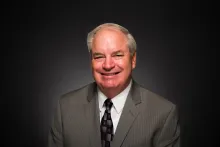
Robin Webber was born in Chicago, Illinois, in 1951, but has lived most of his life in California. He has been a part of the Church of God community since 1963. He attended Ambassador College in Pasadena from 1969-1973. He majored in theology and history.
Mr. Webber's interest remains in the study of history, socio-economics and literature. Over the years, he has offered his services to museums as a docent to share his enthusiasm and passions regarding these areas of expertise.
When time permits, he loves to go mountain biking on nearby ranch land and meet his wife as she hikes toward him.
