
Robin S Webber
Proverbs 29:18 states--"Where there is no vision the people perish". What lessons might be gained as we rehearse the events surrounding the Fourth of July by we, the spiritual soldiers of Jesus Christ, as we follow the "Captain of our Salvation" (Heb.2:10)? When we were baptized we made a personal declaration before God that we were going to move forward in a revolutionary manner apart from the kingdoms and ways of man, as we heeded the spiritual revelation from Above. What does that look and feel like in real time and how and why do we stay put as we access the value of our calling?
This transcript was generated by AI and may contain errors. It is provided to assist those who may not be able to listen to the message.
Well, today on this Sabbath day is the 250th anniversary of the official founding of the United States of America. Most folks know this simply as the Fourth of July, and it remains one of the greatest geopolitical interruptions in all of human history. And its aftershocks of personal liberty continue to influence the entire globe to this day. This is when the 13 separate and yet contiguous colonies of the British Empire on the North American Con Ed collectively put forth a document and would sign it later on. Most of us, as Americans, know a little bit of this and a little bit of that of the Declaration of Independence, but I'd like to explain it a little bit further as we begin to open up this message, and we'll add more along the line. We know some of the lines in the beginning and some of the lines in the end, but most of us may not be acquainted that this is not just another signatory letter of prose and eloquent words. This was a divorce document. Allow me to be plain and clear about that.
And in the midst of the beginning and the end of that, there are 27 different points of issue explained fully and explained that the colonies, not perfect human beings, but had done what they could to try to honor the mother country. But again and again, there is failure in that communication.
And what is interesting to recognize is this is when most folks in the United States today and people abroad mistakenly assume that this is when the fireworks of warfare actually began to happen. They hear 1776. They hear about Philadelphia. They hear about the signing of the Declaration of Independence and then the Revolutionary War. And if you know that much, that might be good, but we need to understand something else why the Declaration of Independence was written. And it wasn't only written for the ears of the king and the eyes of the king, but it was written for another audience altogether.
And that's the audience that I wish to dwell upon today that is going to be so important. Tensions we need to understand in colonial America had been brewing and developing and slowly erupting more and more clear back to 1760 after what is the French and Indian War, also known globally as the first great world war, which was the seven years war between the empires of Britain and France. Britain ultimately winning, and obviously then on the North American continent, the Americans being a part of that were victor. But this other audience is what I'd like to develop on and to bring your conscience of why this document is so very important.
You see, it wasn't the document signing in Philadelphia by the gentry of the nation, by the politicians of the nation. War had already been going on for a year. Most Americans don't understand that they kind of learn about it, but they forget the war had been going on since basically 1770. Tensions had been rising, especially in New England, from 1760 on, but ultimate warfare began to break out in the 1770s or skirmishes.
We have in 1770, we have the famous Boston Massacre, where there was a firing upon of British subjects being Colonials, and some of them died in that. There's a whole story behind that, but that's a very famous political cartoon that most of us would be familiar with. If we saw it, you would recognize that when you saw it. Probably one of the greatest and most important political cartoons ever in editorial history. Later on, in 1773, we have the Boston Massacre, not the Boston Massacre, excuse me, but we have the subject of the Tea Party, and where the Colonials go on board, and they dump all of the tea because of the tea tax that is coming up, and they make their point.
But it even goes further now in 1775, which is a whole year before the document would be signed in Philadelphia. And here we have the Battle of Lexington, in the Battle of Lexington, where the British troops are marching up towards Concord, which is about another six miles up the road from Lexington, because that's where the Colonials have armaments stored, and the British want to take them away from them. But first of all, they have to go through Lexington, and they meet the Colonials with guns faced upon the British troops coming up.
British subject against British subject, different sides, and basically the the Colonials take a beating in that, and several of them die. And then the British kept on marching up to Concord, which is just up the road. Susan and I have been there, along with our daughters, and there would be Concord, and that famous bridge at Concord, where what happened was that things were happening in the town, and the news got all around the hills, and the Minutemen, and the Sons of Liberty, and all those, they started coming over the hill, and they faced the British right at that bridge and fired upon what had been their fellow countrymen.
And then the Brits started running back and walking back desperately to get back to Boston.
And unfortunately for human sphere, it was like a turkey shoot, because the Colonials were in the woods waiting for them, and that's how the Colonials felt thought best at that time, kind of like Native Americans, and kind of like frontiersmen, and were picking off the British. It was in Concord that Emerson would write in his poem about the shot that was heard around the world.
So here's the bottom line. The bottom line is simply this. The war had already, in that sense, begun a year before the Declaration of Independence. It wasn't Declaration of Independence, oh, now let's have a war. There's a specific reason for the Declaration of Independence to be written. It was to be just like we say the word declaration. When you make a declaration, you make it loud, and you make it clear. That means you're declaring something. And also, it must be legitimately finite and to the point so you understand what the Declaration is about. And so that's the background of that. The other audience that I'd like to share with you is not the of the Hanoverian line being George III on his throne across the pond, as we might call it, but there was another audience, an audience that you and I can hopefully relate to as we, too, are soldiers of Jesus Christ and to understand the analogies back and forth as we talk about them. The other audience was the Patriot menfolk, the Patriot menfolk that had already been at war, off and on for nearly a year, and they were away from their wives, they were away from their children, they were away from their small businesses because the the this army was made up of this person, that person, this background, that background, and they were also, especially with the farmers, they were away from the harvest of their fields, and they were beginning to wonder, some were wandering off, some were going back home, and I remember Joel, a couple years ago, you gave the the message on Thomas Paine's From Common Sense about the Sunshine Patriot and what and where they might hold and hang on. These men needed to know that their sacrifice against the greatest military force on earth in the 1770s was going to be worth it, and why they should remain engaged against the trained soldiers of that force.
Upon its approval in 1776, and it was actually approved, let me share something with you too about history, may I? And that is simply this. They came up with the document on July 2nd.
No, excuse me, they came up with a voting to have the document on July 2nd.
That was just to come up with the document. They would go over the document. The document would actually then finally be signed, and it would be read to the audience in Philadelphia on July 4th. And so that's why we make that the official date July 4th of Independence Day. But how did the men out in the field? These were the guys that had given up everything to be out there. And so what happened was General George Washington had it read to every post of people that were in the army. He wanted them to know and know that they know of the cause, why they were there, why they were away from their families, why they were doing something that had not been done in human history on this North American sphere.
13 separate colonies. They did not think of themselves as we do today simply as Americans.
They had a common sovereign that they wanted to divorce from. But these were, they looked at themselves as New England men. They looked at themselves as Virginians. They looked upon themselves as Southerners. They looked upon themselves, all these people were different. You had the Puritans and the British Anglo-Saxon group in New England. You had the Germans and the Quakers in Pennsylvania. You even had people that came out of a normally different religious persuasion at that time in what was what was then called Maryland, which we now know as Maryland, because Lord Baltimore had founded that as a refuge for Catholics. And then you had the people down south. There were the Swedish that were in Delaware, and yet they had a common cause. They were out in the field, and they needed to be reminded of this. Why do I bring this up to you, my friends, the audience here today? It's simply this. It follows through with Proverbs 29 verse 18.
Proverbs 29, 18. Just allow me to mention it to you. Where there is no vision, the people perish. Where there is no vision. In other words, a question that goes back in Church of God lore, going back 50, 60 years ago, I remembered as an elderly gentleman mentioning this every time on a holy day. He would say, brethren, why are we here? And that's exactly what the Declaration of Independence brought. Why are we here in this course of human history? And why are you out in the field? And why is it so important that you will remain true to the cause and stay together and recognize the cause is righteous? That's what this was all about.
And so that leads me to my specific purpose statement and why I'm giving this to you today. And the title of this message is this, Maintaining Spiritual Vision. Maintaining Spiritual Vision Beyond the Moment. What I'd like to do for a moment is just read you parts of the Declaration of Independence. It's not the whole thing. We're not going to get into the 27 points of divorce.
But these are precious words. This is a geopolitical writing, underlined by the Enlightenment, which was the age that this was being written in.
And yet an Enlightenment that also spoke of that which is beyond us, of nature's God.
Even going back to the time of Plato, where he recognized that this didn't just happen, that something was going on here. It was called in that time in about the fourth century, the Unmovable Mover of History. There was something up above the clouds. There was something beyond the stars that was impacting what was happening here below. Allow me to read just a little bit. If you allow me, it'll be short reading.
So let's take note of the extracted excerpts from this document and then ask ourselves, what might we learn and internalize in our ongoing quest to heed the call of our Heavenly Father?
We're not just going to be talking about nature's God. We're going to be talking about our Heavenly Father. We're going to be talking about Jesus Christ. But what can we learn from this?
As we do not follow a Washington spiritually, but we do follow the captain of our salvation, who sets the example. In Congress, July 4th, 1776, the unanimous declaration of the 13 United States of America. That's the headline. When in the course of human events it becomes necessary for one people to dissolve the political bands which have connected them with another, and to assume among themselves the powers of the earth, the separate and equal nation to which the laws of nature and of nature's God entitle them. To a decent respect to the opinions of mankind requires that they should declare the causes which impel them to the separation. We hold these truths to be self-evident, that all men are created equal, that they are endowed by their Creator with certain unalienable rights. It's not from here below.
The world is not on its own. Something's going on here. There's something higher than even what man and man's courts and man's kingdoms espouse. There's something going on right here below. And they are endowed by their Creator. There is a Creator. This is amazing that this is in our founding political documents. There is a Creator, and that's who these men are reporting to at this point and affirming. And they are endowed by the Creator with certain unalienable rights. That among these are life and liberty and the pursuit of happiness.
The soldiers would hear the conclusion then as it was read to them. Washington would have it read to every outpost of soldiers. He wanted them to know so that they could all be together.
The soldiers would hear the conclusion of this document where the writers themselves for the support of this declaration. And it was a declaration. Here are 13 colonies separate but somewhat united against what they were against. Maybe not necessarily even what they were for, but they were against. And I'll talk about that later, about us being spiritual patriots to recognize it's not just simply what you're against but what you're for that will allow us to remain together. And they would look at this. And what I want to do here is to read this to you. And for the support of this declaration with a firm alliance on the protection of divine providence, we mutually pledge to each other's lives, our fortunes, and our sacred honor. What do I want to bring out about this?
Words and pledges have meaning and ought to. And a number of the signatories would personally face personal struggle, loss of everything, and death. Nevertheless, with all shared thus far, this is but a type of the greatest interruption so far in human history that was specifically heaven-sent. It not only encompasses a certain form of revolution from the kingdoms of this world, but is directly connected with revelation from above. You might write that. It sounds almost together, don't they? Revolution and revelation. And we're going to bring this together because this is what the Sabbath day reminds us of. It begins with a plain, stated declaration discovered in Mark 1.14. Let's go to Mark 1.14, please.
And allow me to read it. Let's open it up. Opening the book of Mark. And Mark is written from an aspect of a young man, and it's action-packed as far as the gospel. All the gospels are a little bit different.
But notice verse 14. You know how I love small words, basically two to three letters. And this is one of them right now. Please notice. Now, there's a small word with the big stuff coming behind it. Now, after John was put in prison, Jesus came to Galilee preaching the gospel, preaching the good news of the kingdom of God, and stating this, that the time is fulfilled, and the kingdom of God is at hand. Repent and believe in the gospel.
He's mentioning this in the kingdom of Herod, who is basically a puppet ruler for Rome.
The Roman Empire at this time in 31 A.D. basically spanned from the borders of Scotland.
Never got Scotland, but the border's up there, all the way over to the Middle East.
Half of northern Europe, all of northern Africa.
On that was the man that considered himself the Son of God, Augustus Caesar. Julius Caesar had been made Caesar. After Julius Caesar was assassinated, Julius Caesar was deified, and his memory and his intellect was made holy. And now comes Augustus Caesar during this time. Had already ruled for some decades.
But here he was as the Son of a God. And what the Caesars used to do was to when they came to the throne, they would send out a coin of themselves and with their picture on it.
And there was a reason. It was basically this. I'm here. Good news.
I am everywhere. There will be peace under my rule.
Here now comes a man of Galilee, and he says, this is now turned over with my appearing. This is the announcement. This is the declaration from the Son of God. And notice what he says. The time is at hand. This is the moment. This is the July 4th of the late 20s A.D.
And for three and a half years, he laid out what that declaration would be about and how it would bring God and man together. But where the allegiance of those that followed would need to be.
Interesting. Galatians 4 and verse 4, join me if you would there for a second.
One of my favorite verses, just to show how God operates. Galatians 4 and verse 4, Paul writing, but when in the fullness of the time had come, God sent forth his Son, born of a woman, born under the law, to redeem those who were under the law that we might receive the adoption as sons.
The time had come. Let's always remember that God not only created time, but he is the master of timing.
Not only to the empires and the nations and the kingdoms of this world, but what I want to take away and give to you today is in our lives. He is the master of timing of when he called us to be a part of that revolution that starts with the revelation from heaven.
Let's take it a step further here. What was Jesus Christ doing? He was basically declaring a new world order is at hand. Thus seek after it, receive a mind and heart that fits it.
The kingdom is the reign of God. It's his sovereignty over mind, over mind and heart and will, and in the world. And it is sonship to God and brotherly relationships with men.
We are to love God and to love our neighbor as ourselves.
In its fullness, it is the future. But whenever a human life is brought into harmony with the Father's purpose, it is present. And that's why you today, as members of the body of Christ, we have a kingdom experience, this kingdom experience, that was brought by Christ on the banks of the Jordan when he came and said, get a mind that fits it. Open a heart that will receive it. And he wants to remind us of why we remain in the field, why we remain a minority in a world that is increasingly being seduced.
By the God of this age, by Satan himself. When the framers of the Declaration of Independence spoke in the Enlightenment age term of nature's God, this is He. This is nature's God.
This is the one that we read in John 1, 1 through 4, that in the beginning was the Word.
And the Word was God. And the Word was with God. And that God, in that sense, made all things through this Word. This is nature's God that the Declaration of Independence is actually talking about. Amazing.
And yet from heavenly heights, the Word, the one that mentions now is the time, repent, get a mind that fits it so that you can be effective in the cause.
To recognize that He left heavenly heights and He became flesh. John 1, 14 says that He came and He scooned. Greek, for He dwelt. Another definition of that is He tinted. He became one of us, to know us. This is going to be so powerful as we continue this message to recognizing something very important about the aspect of what we're going through that He understands it.
And we'll talk about that in a few minutes. Frankly, this one had skin in the game for you, for me, and all humanity. But mankind, thinking that they were doing God a favor, put the Son of God to death. The only perfect human being born of a woman ever to live would become despised and rejected by men.
He was a man that was a man of sorrows and was acquainted with grief, as we read about in Isaiah. And how could He forgive the unforgivable?
What did the captain of our salvation envision beyond this lonely moment as He camped on earth?
What declarative statements does Holy Scripture offer to us as the current disciples of Jesus Christ? The Apostle Paul, in his pastoral epistles, talked about the strangers in that sense. What do we learn?
Let's go to something very fundamental. If I could have all your attention, maybe just look up here for a second, because this is going to be, and was your declaration.
Your declaration was given not only on earth, but before heaven, when you took your baptism of vows.
I, or another minister, and I've had the pleasure of baptizing some of you over these years, would say simply, what is your name? You would give your name. And I would ask just two basic questions. Have you repented of your sins?
There's no third option in this one. It's either yes or it's no. I've probably done maybe a hundred baptisms in my ministry, and I haven't had a no back at that point. And they would say yes. Then I say, have you accepted Jesus Christ as your personal Lord and Savior? You come back and you would say yes. And then I would say, because you have repented of all of your sins, which is the breaking of God's holy and righteous law, and because you have accepted Jesus Christ as your Lord and your Savior and your personal master, I therefore am going to baptize you, not into any church or sect or creed of this world. But I'm going to baptize you in the name of the Father and of the Son and of the Holy Spirit.
Do you understand? They would say amen, and I would say amen. Do you remember when you were baptized? Do you remember where you were? Some of you were a little bit younger. I'm not looking at this one. Some of you were a little bit younger. All of us were a little bit younger. I'm not a little bit younger. That was your declaration.
Not before the court of St. James in London, not between one of the Hanoverian line, George III, but before God the Father and Jesus Christ as his right hand. And you declared that, yes, you and I today can be so proud and so thankful that we are Americans. But when you did that, and you were taken underneath the water, figuratively in a thought of death, and then raised—I haven't lost one—then raised from the water as a type of resurrection and newness of life, you no longer were just an American. Your citizenship was in heaven, yes? Your citizenship—so we have dual citizenship, but we have a primary citizenship. When push comes to shove, that's that. It's up there. It's not down here. And I say that just personally, being very patriotic, always have been, my family, especially growing up in San Diego back in the 1950s and 60s, especially being the son of a marine from World War II, in San Diego like it was back in the 50s and 60s, it was a different time in San Diego. And so I was raised with this.
But my citizenship and my loyalty, first and foremost, when push comes to shove—and it does in this world, in this kingdom of man—when it comes to push to shove, my allegiance is to heaven above. Let's take it a little bit further.
What was that key phrase? And Joel's saying, you are such so good at all of these things, other than the joke—no, just joking—jokes, it says, what was the major—Joel's up to this—what was the major statement that was made that just drove New Englanders mad with all of their commerce and having all of these taxes placed upon them? There's a phrase, and this was the complaint. And they've been complaining for years before the signing of this declaration.
I can take you off the hook now, unless you want to go for it.
Oh, let's have some fun. Wake up. A little applause for Joel. Go ahead. Let's do it. I'm going to applaud him. Come on. Folks, come on. Applause.
Yes, okay. No taxation without representation. That was it.
But to recognize something here, that is exactly why we can have full allegiance to the kingdom of heaven and to God the Father and Jesus Christ.
Because a few thoughts I just want to share with you now. I'll send out my notes if you want them. That way we can spend some time here. It's very interesting. Upon Jesus' death—are you with me? Upon Jesus' death, that large curtain, that large draping across separating the holy place from the most holy place, the one that had the caribbons on it. You know what? When it was ripped, it was ripped from bottom to top, wasn't it? Can somebody help me? Pardon? Thank you. Next time we'll applaud. No.
From top to bottom. This was heaven's gift. This was not the work of man below working his way up.
It was God the Father having allowed his sons to die. And when his son—pardon me—singular died, that which had blocked humanity, a type of Eden from the presence of God, was ripped asunder, miraculously, divinely, saying, you may now have access.
Think of that for a second. It wasn't like England at that time. Just stay over there. You're a bunch of colonials. You are so lucky just to have us. No, that was a love gift.
And now and then was the time upon Jesus' death. And again, to think about that when it says, no taxation without representation, join me if you would. Let's get excited about this. Join me if you would in 1 John 2. In 1 John 2, the epistle thereof.
In 1 John 2, I'm picking up the thought in verse 1. Listen to this.
My little children, these things I write to you that you may not sin.
And if anyone sins, notice what it says. We have an advocate with the Father, Jesus Christ the righteous, and he himself is a propitiation for our sins, and not for ours only, but also the whole world. Think this through. We know that when he studied the course of some of the statesmen that were in the first and second continental Congress, Franklin would go over to France. Others would go over to the court of St. James. But they were Americans. They were they were Colonials. The Europeans were pretty impressed with Ben Franklin. There was only one of them. If you've ever studied Franklin, you know, the guy that wore the raccoon hat. You knew he would stand out. But he was a Colonial. He wasn't one of them. There is always some... Here's what I want to share with you today with whatever you're going through and sometimes thinking that you need to withdraw from the field of activity and pack it up. This isn't what I signed up for. I thought I was just leaving for a year or two, but for a lifetime that you have an advocate by God the Father himself who knows what it's like to be earthy, who knows what we're going through.
Think that through. In relationship to 250 years ago, Colonials just got tired of it. Sending over grievance after grievance and British just sending over troops and troops. Like two ships passing in the night. And then finally the Colonials in their colonial speech of that time, enough already. It's done and they rebel.
You remember that you have an advocate that when we pray to him and say, God, remember what Jesus himself when he was raging on the cross. Where are you? Where are you? Where are you? Quoting from the Old Testament. Why have I been forsaken? Is this it? Yes, it was it. That was the mission. He was in the field. He was on the earth. He is ours. Our Father, your Father, He's given us His own Son. We have representation every second, every moment.
And we don't have to go through rooms and rooms and rooms of palaces to get to the big guy. Whether that would be the King of France when Franklin and Adams would sometimes have to go in before him and bow and bow and bow or the court of Saint James in Britain. You and I have instant access to this God that we've given our lives to. Join me if you would in Hebrews 4 and verse 15.
In Hebrews 4 and verse 15.
Notice what it says, for we do not have a high priest who cannot sympathize with our weakness, but was in all points tempted as we are, and yet without sin, let us therefore come boldly to the throne of grace. We've got the invitation all the time and come boldly to do so, that we may obtain mercy and find grace to help in times of need, to receive grace, not what we deserve, but what God has given to us as a gift, and that when we recognize that we have an advocate in the court of heaven, not London, not Paris, not Washington, D.C., not back then, either in Philadelphia or Annapolis or New York, and I think there was one other that was a capital of the United States for a while in the first part of our country's history, but we've got Jesus Christ. And being in the human spirit, as you are, I realize sometimes we feel like we're far away from home, and we wonder if this is worth it.
I'm talking to Christians. I'm talking to fellow believers. That's why it's important to think of July 4th, July 4th, along with the Seventh-Day Sabbath.
July 4th and Seventh-Day Sabbath, and they've landed together.
Because we recognize that the Sabbath is not fully complete. God rested on the Sabbath day physically, but he has a spiritual work that proceeds from that Sabbath.
And that work is going on today as you and I become spiritual revolutionaries in peace, not in war other than against Satan for our Father above.
Another point I want to bring out to you today that I think is very important is the lessons that led up to July 4th, and the lessons that proceeded from that is simply this. All 13 colonies, and many of those colonies didn't really like one another, okay? You'd have to read it and believe it. But they had a common foe.
The foe was deafness from the throne of England.
I want to share something with you.
Because the American Revolution is an ongoing experiment.
It continues towards a more perfect union. It's not complete. It goes forward.
It's one thing to be against something together. It's totally different to be for something together.
When we think of some of the lessons of our forefathers, as far as so many of them were great men of intellect and being, I do not want to dismiss that at all.
But sometimes great men have great vices. And you think of the bond that Adams and Jefferson had.
During that time in the 1770s when they came together, a rusty, crusty, Puritan lawyer from outside of Boston lived in Braintree. That tells you he's pretty smart. And then you had this intellectual, enlightenment-oriented gentleman from the south living on a mountain, a little mountain called Monticello. And they came together for some years and they made music together.
Because they were both against something, but they weren't for it.
And they both signed their signature on a document.
It's not enough to sign a signature on a document.
That's one thing. It's another thing to stay together and watch it grow and watch it develop.
As I said, America is an ongoing experiment. I'll just share right here with the United Church of God that the United Church of God, in its beginnings in the middle of 1995, along with others, had a common foe, had a common target, had a reason of being together in the same room, signing the same documents. And yet, as time goes on, people weary, weary of things not going their way. And they depart. My thought in all of this, as we look at these things, is to ask you simply to remember it's not enough to be simply against something and stand up. It's not just another thing to stand together. It is also to keep on standing when nobody else is standing up with you.
That is true spiritual heroism and to recognize that. Ben Franklin said, famously, to his fellow signers, says, we must hang together, or we will hang separately.
The sadness of the American Revolution is two friends, Adams and Jefferson, and the politics leading up to 1800, which was horrific and vile, just as what we're seeing in our own country today, separated. They separated. The three of them, Jefferson and John and Abigail Adams, had been buddies over in France even. They were close. They were like family.
But then politics got in between, and these men did not talk to one another or communicate together for, I believe, over 12 years. And here's another story. May I, for a moment, about the American Revolution? There was another signer. He is my hero. You don't hear much about him, but it's Dr. Rush. Dr. Rush, a New England man, who knew both Jefferson and knew Adams. And years went by, and then he wrote to both of them. He said, what are you two doing?
What are you two doing? You were there! You, Adams and Jefferson, you were like the globe of the Revolution. One was in the North Pole, the other was in the South Pole, and they held it together. So there were opposites already recognized then. We were together, and you parted.
And Dr. Rush doctored up these two individuals, the Yankee and the Southerner. The blunt lawyer and the philosophical gentleman from the South. And they started writing to one another. They started writing to one another back and forth. They've got all the letters. It's in a book called Sacred Honor. And of course, you know how people could write in those days. It's just so—it's almost Shakespearean, and just the elevation and the humility that is there up front, and how they write to one another and court at one another over letters. And I think all of you realize—and you've heard the story before about what occurred in 1826—that both of them were aged mid now.
And after this correspondence of 12 or 13 years, they were bonded. And as they were both dying—and what date did they die on? July 4th. 50 years later, July 4th, the same date, they are in bed dying surrounded by their families. And at the end, Adams says, But Jefferson lives. In his mind, it's one more that goes back to remembering what the founding was like. He did not recognize that Jefferson had died that day. Two men.
Different as night and day? I mean, wow! And yet they came together for a moment, just as you and I come together now in this lifetime, as a band of brothers and sisters. And we've given a declaration before God the Father and Jesus Christ that we've left this world behind. Oh yeah, we're still stuck in that. We'll see. You know, Jesus, why did you pray that prayer where he said, Father, I don't ask you to take them out of this world, but to keep them in this world? Because that's where the growth comes from. It doesn't come from being on easy street, but being on the avenue of challenge, being in the avenue sometimes of isolation and remembering when nobody else is around that God the Father, at his side is Jesus Christ. We have an advocate, not in the court of Saint James, not at the not at the diversae in heaven itself. Dear brethren, those that are listening, listening to the future, we've got to believe that in all of our being and all of our faith. Jesus Christ himself said that, lo, I am always with you, even to the end of the age.
I'm going to wrap up here. I'll send you my notes because there's about a page I just skipped out.
But here's one thing I want to share with you, to bring the Revolutionary War along with this Revolutionary calling that we have. James Thomas Flexner, some years ago, wrote a biography on George Washington. It was called the Indispensable Man, one of the great biographies of Washington.
The same man who wanted his troops to be informed of the whares and the whys, of why they needed to sacrifice for something greater than themselves. And yes, the man from Virginia, who truly was the linchpin, the linchpin that kept this newly formed republic intact during eight years of warfare. This Revolutionary War lasted twice as long as World War II.
Think about that. Think about the sacrifice. Thank God. God bless America, as the song goes, that he used such men at this time and uses such men and ladies as now to live his word, to example his word, to come out of this world and to recognize that our citizenship is in heaven, and that we act like that every day, in every way, with every say that you and I have.
Additionally, he would be the one that would be president for the first two terms, then walk away and go back to the farm. Go back to the farm, setting the example for all presidents except one. I won't mention his name right now, but his initials are FDR. Okay, four times.
But here's what I want to conclude with, and please, if I can just have your attention for a minute as we wind up here. Washington was the linchpin of the American Revolution, and for such a time as then, God granted this man to be in the midst of our ancestors. Eight years.
And even after the Declaration of Independence was signed, there'd be more challenges. Up and down the coast, there'd be losses, there'd be suffering. Susie and I were at Valley Forge last year, and we're right there. And you just go on and on. The Battle of Brandywine lost and lost. The invasion of Manhattan lost and lost. It just went on. But they persevered. There was something special that had been given to them. What I want to conclude with, and I would be most remissful if I didn't conclude with this, with that said, there is only one truly indispensable man ever canvassed in human flesh. One who left his home, not Mount Vernon, but left his home above, stepped away from all power and came below and started a sacred revolution based on divine revelation. One who is fully God and fully man, his name is a name above all names. His name is the Lord Jesus Christ. Home is where the heart is. And the Son of Man, the Son of God, continues to bid us welcome to follow me, to be in the wilderness from this world for now, to recognize that there's something that is coming up that is going to be so glorious that we don't want to miss it.
He's the one that says to follow me. Because why? Because he is the way, he is the truth, he is the life, and he alone is truly the indispensable man, the indispensable one, the Lord of our life, the captain of our salvation, as we continue to war against the flesh, as we continue to confront the God of this age and his wavelength, and as we do, to always remember, we read, we read, to know that we are not alone.
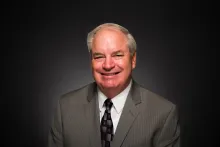
Robin Webber was born in Chicago, Illinois, in 1951, but has lived most of his life in California. He has been a part of the Church of God community since 1963. He attended Ambassador College in Pasadena from 1969-1973. He majored in theology and history.
Mr. Webber's interest remains in the study of history, socio-economics and literature. Over the years, he has offered his services to museums as a docent to share his enthusiasm and passions regarding these areas of expertise.
When time permits, he loves to go mountain biking on nearby ranch land and meet his wife as she hikes toward him.
