


Robin S Webber
This transcript was generated by AI and may contain errors. It is provided to assist those who may not be able to listen to the message.
I want to bring you a message today, brethren, that I hope will be one of encouragement. Wherever Susan and I travel these days, whoever I take a phone call from or receive a message from, whether it be mail or whether it be email, one thing that strikes home to me more than ever is how much the body of Christ needs, and not only needs, but desires encouragement. There can be no greater encourager than God, and there can be nothing more encouraging than reading about the promises of God that we find in Scripture.
With that thought in mind, let me backtrack for a moment, though, and share a very cardinal point about the teachings of Jesus Christ of Nazareth. Christ was always up front, and he was brutally honest about what occurs as one accepts his personal invitation to follow me. He mentioned, as we go through Scripture, and I just want to kind of mention it to you. We're not going to turn to each one, but it's always important to anchor ourselves in the Bible. That's why we're here. It's God's Word.
And we go to the Scriptures, and we find that Jesus mentioned that narrow is the gate, and difficult is the way which leads to life. And he says at the end, there are few, few that find it. Again, he further expounds that many are called. Many are called. But he says that few are chosen from Matthew 22, verse 14. And then, to simply top it off, he says, and he addresses those that would truly believe that he is the Son of God, that would follow him in life and in death, that they are but merely a little flock. And we find that in Luke 12, verse 32.
Narrow is the gate, difficult is the way, few are chosen, and with all of that spoken, but a little flock. What is the takeaway that we remove from these verses and linger with for a moment? The spiritually realistic takeaway is simply this. These passages tell us that genuine discipleship. And allow me to cite that again, please. Genuine discipleship under the living Christ is basically humanly, lonely business.
Always has been, and it always will be. After all, Jesus himself, Jesus himself on that last night of his human existence, when he needed people the most, when he needed those that had traveled with him through the Galilee and Samaria and through Judea, when he needed them by his side as he prayed and later on when he was caught, abandoned him. He was alone. He was human. Yes, he was God in the flesh, but he was also the Son of Man.
And so the very head of the church, the very head of the spiritual body, understands what loneliness is in following his Father and our Father's will. So I would pose a question to you this afternoon, and I would speak to your heart. Is this sobering scenario all there is in following the invitation to come after Jesus Christ? Is this it? Is it bleak? Is it dark? Question is, how lonely really is it? Here's a fundamental question. I just kind of want to get your mind whirling and twirling here a little bit, get the gray matter going, ask a few questions, and not only ask questions, but we're going to delve into the Bible to find the big answers here.
A fundamental question is to consider this. How is it possible that our Heavenly Father and the risen Christ are able to sort us out? Sort us out. Now who is us? Us is kind of like a collective. You know, us. No, I'm talking about David Hoover. I'm talking about Patty Josephik. I'm talking about Deborah Barr. I'm talking about Oli Zajjak. I'm talking about Becky Garnett. This is a vision test. I can see you. I'm talking about Liz Russell. I'm talking about Norma Kelly. I'm talking about each and every one of you. How is it that God and the living Christ can sort us out from 7.6 billion people on this globe?
How does He do that? Spread over six continents. How is that possible? And that is a good question. That's a great question. So, we're going to take it a step further. And let's be honest with ourselves as we take that step together. As followers of Jesus Christ and as children of our Heavenly Father above, how often do we sometimes, whether we're into Hunga or Sunland or Vekoyma or Monrovia, down in South Central, wherever our congregants might be, how often do we sometimes just feel all alone and wonder, why God?
Why me? Why now? And sometimes when we're in our rooms alone or in our offices alone or maybe we're stuck on the third lane of the 134 out here, we can sometimes wonder, is anybody listening up there? Is anybody listening? Does my life count before God? It may not count before men, but God, I've been devoted to you. All of these years, does my life count?
Is it really worth something? And sometimes we can do that story. Maybe you've heard it before about the man who falls off the cliff. And he, as he's going down, like in the old cartoons, he grabs ahold of that branch that's right on the side of the cliff and looks down, it's 2,000 feet below, and he's yelling and he's yelling, is anybody up there?
God, is anybody up there? And as he's holding, a voice comes down from on high. Yes, my son. Well, help! Yes, my son. Let go of your right hand. Is that it? No.
Now, my son, let go of your left hand and we'll begin to talk. Is anybody else up there? And we've all done that. If you're human, if you're human, because humans without faith can feel alone. And there is nothing sadder on God's earth than a child of God, devoid of his father. And there's nothing sadder on earth than a Christless Christian. And sometimes, in our lonely moments, are you with me? In our lonely moments, we can sometimes, you know, crawl into the cave with Elijah. There in first Kings. And we say, Elijah, move over, scoot over.
I want to sit on the stone bench with you. Just kind of want to be here in the dark. Want to be with you. I want to be with the mushrooms. And I want to be with the bats in this cave. Because all of the devotion I've shown, all the years of trying to please God, and now I'm cut off. I'm all alone. He doesn't even seem to know that I exist. His eyes are no longer on me. What I want to share with you with that thought, and if we're honest, and honesty is the best policy, and honesty is the only way towards growth and having a relationship with God, we have all been there at one time or another.
You and I have got to come to understand more than ever, brethren, whether we've been on the track since the 1970s, the 1960s, the 1950s, maybe of recent date. We've got to recognize something very, very important. Our church, the Church of God, has had amazing blessings given to us of understanding Scripture, understanding the great fundamental doctrines of the Church. We've even been blessed in a sense with understanding where this world is headed apart from God.
We've come to an understanding that Jesus Christ is going to be returning on behalf of His Father and to set up His Kingdom on this earth. We've also been given almost a prophetic GPS of different events that come along the way to get there. But brethren, simply to understand biblical doctrine, simply to understand some of the great prophetic events that are going to occur in the future are of no benefit, are of no value, unless we incorporate by God's grace and emulate the example of Jesus Christ that we have a living and we have a loving faith in a living and a loving God whose eyes are never, never off of you and me.
We look around this world with the 7.6 billion people on the six continents. We see major events happening. We actually right now, to a degree, see a reordering of the geopolitical sphere between Europe and Asia and America. We see gigantic personalities that are in the headlines. We also, by reading our Bibles, recognize there are going to be gigantic personalities that are going to come up in the future, whether it be a beast, whether it be a false prophet, whether it be the two witnesses, whether it be this, whether it be that, whether it be a small flock, whether it be a great church, and we can go on and on for Revelation 13, 14, 15, 16, and 17.
And sometimes we can say with all of this happening, God, are you really up there and you know what's going on down in my life? Or am I just lost in the shuffle? See the God that I want to share with you this afternoon and am eager to share with you is a God that can both handle macro events and intimately care for your personal lives. You see, that is what makes God God. That's what makes God God. He deals with those things that are tremendously large, and yet He can stop on a dime.
Stop on a dime. Just as much as when Jesus turned around, when that woman touched Him, and He felt His energy go out of Him, He knew that He had been touched, that there was a need. And He turned around and eyeballed that woman and dealt with her in the moment. To illustrate all of this this afternoon, I just have a basic question for you again. Here's the question. Have you ever seen a sparrow that you didn't like? I want you to think that through for a moment. Have you ever seen a sparrow that you didn't like?
Let's talk about sparrows for a moment, can we please? Sparrows are tiny, they're cute, they're jumpy, they're chirpy, and I think God created sparrows to make us smile. And God must have had fun making them during that week of creation because, well, after all, He made so many of them, didn't He? He just couldn't stop. But in that making, even at the time of creation, God had a thought in mind, because that's again what makes Him God, that one day He would use the example of a sparrow on this Sabbath day as we read out of the Scripture to encourage you and me.
Now, sparrows are cute. Sparrows are chirpy. They're flighty. But here's two things I want to share about a sparrow with you. You might want to start jotting down some notes if you're a note taker. And it's simply this, it's cute and it's chirpy. As sparrows are, number one, they are extremely vulnerable, aren't they? They're vulnerable. They're vulnerable to any birds of attack, any birds of prey. They're vulnerable to the falcon, to the hawk, to the eagle. At number two, at number two, so often they go unnoticed. And perhaps more than ever, as we dwell house to house, as the book of Isaiah said so long ago, woe unto them that dwell house to house. Because then we live in a world of cement and plaster and glass and we're devoid of nature.
We're devoid of seeing the little creations of God. And in this 24-7 world that goes, goes, goes and does not stop, will not stop. How often do you and I just stop and look at a sparrow and understand what God is telling us through that little sparrow? Did you realize that this tiny feathered critter called the sparrow is what God chose, that Jesus chose to directly address our gnawing concern about whether or not God notices us, looks at us, wonders about us, cares for us?
Here's the bottom line. If you don't get anything else out of this message, it's simply this. Here it goes. He gives us the sparrow. He gives us the sparrow to recognize that nothing escapes God's loving attention to those that are called according to His purpose. It's interesting, as we begin to turn over to the book of Matthew, as we turn to Matthew, that it's interesting that Christ chose to go, oh, so very small, to betray God's huge interest in us.
Ever the masterful teacher, ever the masterful teacher, He utilizes a common marketplace transaction that His contemporary audience would have understood. Thankfully, for you and for me today, it's recorded in two different Gospels, and we're going to go through both of those Gospel accounts, because what we're going to do is we're actually going to go down and down and down into the Gospels and put them together, which is actually going to multiply and expand our understanding of our calling, of what God is doing with us, what His purpose is about, and to recognize that once we are called according to His purpose, nothing escapes His attention about you and about me.
The title of this message is simply this, for those that are titled writer-downers, simply this. People are sparrows, too. Very simple. People are sparrows, too. I asked you to turn to the book of Matthew. The Gospel writer Matthew captures Jesus encouraging words in Matthew 10, verse 29. Join me if you would there, please. In Matthew 10 and verse 29, this follows the suit of Scriptures of which Jesus is telling His disciples much of what is going to come their way as they witness for Him, as they live His life in them, as they proclaim His coming and what God is doing, that how they are going to go up against certain seemingly innumerable odds for any one individual.
But then in verse 29, He makes His comment, Are not two sparrows sold for a copper coin, and not one of them falls to the ground apart from your Father's will? Again, allow me to read that to allow it to sink into us. Are not two sparrows sold for a copper coin?
One coin buys two sparrows, and not one of them, those two sparrows, falls to the ground apart from your Father's will? That's, to me, very encouraging. Nothing occurs apart from God's will, and even the little ones don't fall to the ground apart from His knowing concern. But this is only the beginning of the story, and we must go elsewhere now to the Gospel of Luke in Luke 12.
In Luke 12 and verse 6, let's pick up the rest of the story here and go a little bit deeper.
Are not five sparrows sold for two copper coins, and not one of them is forgotten, notice, forgotten by God? Not one. Now, it's here where our Western mind can be hindered because Jesus is utilizing a Jewish rabbinical tact. He's asking a lot of questions, both in Matthew and in Luke, and He does throughout the Gospels as well, because that's how the rabbi taught. The rabbi would actually teach by asking a question, and the answer was embedded in the question. Let me use an example.
The story of the Good Samaritan. Jesus asked a question, who then is neighbor? That's a question, isn't it? And we know who the neighbor is. We know who is the one that stopped for the man that was beaten on the path down to Jericho. And we know that answer. In fact, the answer is known around the world because we always speak of that story as being the Good Samaritan. Did you realize those two words don't come together in the Bible? The Good Samaritan. But Jesus takes that, which is utterly complex, and simplifies it for us to be able to understand. That's what set Him apart from the Pharisees and the rabbis of that day that wanted to just be very, very, very complex about so many issues in life, and then add on this sentence, and add on that paragraph, and add on this thought, and add on that thought, and Jesus cut right down the middle. And that's why He was loved, and that's why people were willing to follow Him and to give their life for Him.
Now, let's notice this again. Verse 6, are not five sparrows sold for two copper coins, and not one of them is forgotten. Luke here shares an expanded answer. Why does Luke, let's look at our Bible. Verse 6, why does he, Luke, hammer home this point of what Jesus said, that not one is forgotten? Okay. Like I said, we are at a loss being in a western tradition and out of the marketplaces of Jerusalem or Nazareth or Bethlehem long ago. Let's combine these two gospel accounts, Matthew and Luke. Let's put them together, and we come to see then, we're going to do a math test here. We come to see that in Matthew, one coin, one coin bought two sparrows. But in Luke's account, it says that two coins buy five sparrows. Now, wait a minute. If one coin in Matthew, if one coin in Matthew buys two sparrows, then in Luke, it should be that two coins should buy four sparrows.
But what is with this fifth sparrow? What is going on? Because the math does not simply line up.
So we have to understand what the custom of the day was. The custom of the day was simply this. You can kind of think in the movies that we've seen of the hustling, bustling of a bazaar, of a marketplace in the Middle East. People are coming and going. People are buying.
They don't want to be too easily begotten. And so sometimes what they would do is they went by the stand. Here's the hawker. The hawker is selling the sparrows. That's kind of a bad pun. But anyway, they're going by and they're about to leave and saying, you can have four sparrows for two coins. The guy starts moving. He says, no, no, no, wait, wait a minute. I'll tell you what.
I'll throw one in. I'll throw one in. Well, such a deal. We will seal the deal.
You get five sparrows for two coins. Now, this does not contradict Matthew's account. It's just simply an expansion of something that Matthew did not center on, that Luke did choose to center on.
Again, let's talk about the fifth sparrow because we're going to find a lot of commonality friends throughout the scriptures about the fifth sparrow, about Jesus Christ, and about you and me.
The fifth sparrow was the one that was not desired, was not treasured, was overlooked, not desired, not treasured, and was overlooked by man. And as Luke records, then, even that fifth sparrow that was overlooked by man is not overlooked, not overlooked by God himself, even as it has gone unnoticed by human eyes, God is targeted onto that fifth sparrow.
But now, let's go a little bit step further here in looking at Matthew and Luke so that we can understand God's acute observations of our comings, our comings now, and our goings before and because remember the title of the message, people are sparrows too. Let's combine the two gospels together into one magnificent and endearing conclusion. As we remember that Luke's sharing that not one is forgotten, and with Matthew's account, not one falls to the ground apart from God's will. Say, well, I've heard that before, Mr. Weber. Well, thank you. So have I. But I'm going to take you a step further now. We're going to keep on going down this strategy. You want to join me in the journey here to understand the acute observation of God's loving heart towards you and me? I want to quote William Barkley in his commentary on Matthew, Volume 1, page 389, and it offers this intriguing insight regarding the wording of to fall to the ground.
And he writes the following William Barkley Scottish commentator, the Revised Standard Version, and it's a perfectly correct translation of the Greek, has it that not one sparrow will fall to the ground without the knowledge of God.
Barkley continues in such a context the word fall makes us naturally think of death. Crash landing, 30,000 feet coming down, boom! And that gains God's notice. But there's much more to this.
But in all probability, the Greek is a translation of an Aramaic word, which means to light upon the ground. Barkley continues, it's not that God marks the sparrow when the sparrow falls dead, but much rather it's that God marks the sparrow every time it lights and hops upon the ground. So thus it is Jesus' argument that he's so eager to share this and declare it, if God cares for the sparrow that is feathered, then how much more does he care for you and me, dear friends, here in Los Angeles this afternoon, we that are made in his image.
He's checking out the sparrow that lights on the ground, not only falls, not only crash lands, not only a death dive, but flips and hops and jumps.
God knows. And if I can make an observation, God did not send his son to this earth to die for sparrows, but he did send his son to this earth that you and I might have relationship with our father.
And he knows exactly where you and I are this very moment. See, that's what makes God God.
One thing that I find sometimes in dealing with people that are studied, that are studied, they will talk about the omniscience of God, which means the all-knowingness of God. And they can read that, and intellectually they can understand that. They will talk about the omnipresence of God, that God being God is in one sense everywhere, and they can know so much Greek. And some people can know so much Hebrew.
And people can, in a sense, analytically probe and deal with God at a distance.
So they know the omniscient God, they know the omnipresent God, but they don't know the God who has unfailing love for each and every one of us, and that you and I were called for a purpose.
Even in this day and even in this age, you know, we can seemingly get lost in the hustle and the bustle of the crowd, and we can forget that God called us for a purpose. And Jesus himself, at the end of Matthew, said, lo, I am with you always, even to the end. You know, sometimes we'll talk about a family, and we'll talk about how sometimes families have an accident, an accident named Robert, an accident named Sally. Something kind of comes along that wasn't planned, but you're glad when it came along. You and I, brother, and I say this as simply as one Christian to another on this afternoon, we do not worship a God that has accidents. Are you with me?
We don't worship a God that has accidents. We are not an accident.
The culture of this world speaks about accidents. It speaks about evolution. It speaks about accidents upon accidents upon accidents that ultimately bring life that have made you and me.
I don't hold up that for a moment, brethren. You and I worship a Creator God, and you and I worship a sustaining God, and most importantly, you and I worship a loving God, and we need to understand that.
It's kind of interesting with Jesus sharing this, that Jesus spread this news about the sparrow and about God's concern for His people in the first century AD. During the first century AD, Rome conquered the world of antiquity from Britannica all the way to Mesopotamia, and wherever the Roman troops marched, wherever the Romans troops marched, they had the emblem of the eagle. They had the emblem of the eagle. There is a reason. Eagles denote power. Eagles denote cunning. Eagles denote sturdiness. Absolutely. And Jesus, who Himself proclaimed that He would bring a kingdom, instead of talking about eagles, spoke about sparrows.
You know, that kind of holds down even to today. You know, when you look at the sports listings, you look at the standings and the teams. You know, how often have you looked in there, whether it be the NBA, whether it be the NFL, whether it be the National Hockey League, how many teams have the name sparrow? Think about that for a moment. Hummingbird, sparrow, no, falcons, hawks, raptors, and eagles. But you know what? There's a reason, and it can be kind of cute to talk about it, but there's a reason I want to share with you. Join me, if you would, in Isaiah 55. Isaiah 55. And let's pick up the thought, if we could, in verse 7. Why aren't there teams named the sparrows or the hummingbirds?
Isaiah 55, in verse 7. Actually, let's go to verse 8. For my thoughts are not your thoughts, nor are your ways my way, say the eternal. For as the heavens are higher than the earth, so are my ways higher than your ways, and my thoughts than your thoughts.
God just does things differently. He thinks differently.
The steps that He takes move to different outcomes than you and I would have.
Again, with this foundation, let's notice 1 Corinthians 1.
In 1 Corinthians 1, let's pick up the thought of verse 26 to understand how differently God's ways are, and not only why they are different, but why they are different. In 1 Corinthians 1, 26, notice, For you see your calling, brethren, that not many wise according to the flesh, not many mighty, not many noble, are called. But God has chosen the foolish things of the world, to put to shame the wise. And God has chosen the weak things of the world, to put to shame the things which are mighty, and the base things of the world, and the things that are despised. God, notice this, brethren, you might want to underline it, God has chosen.
If you are in the body of Christ, if you have been baptized, if you've accepted the Father's calling, if you've surrendered your life to Jesus Christ, proclaimed Him the Lord of your life, and repented of your sins, you are chosen. He's done that. And the things which are not to bring to nothing, to bring the eagles of Rome, and those that think they are mighty, often by themselves, that are noticed by the rest of humanity, to not. But why? But why? What's this all about?
It's all in verse 29. Notice that no flesh, no flesh, should glory in His presence.
That God's story, God's strength, God's might, God's attentive, unfailing love towards us is greater than our own story. Now, it's kind of interesting when you go to Matthew and you see after the night that Jesus prayed, and He chose His disciples. You can find them all about Matthew 10, about verse 2, verse 3. Many of us here in this room at one time or another have handed in a resume, right? A resume? And you hand in a resume and you try to really make it good. And you know, resumes are normally maybe one page, maybe two pages, I'm not sure anymore.
The resume, have you ever noticed Matthew 10, 2 through 3, what the resume was?
It was just their names. A bunch of fishermen, a bunch of fishermen, tax collector, a guy that was a zealot that kept on, you know, this guy keeps on looking at my throat. What's he want to do? He wants to slice it. There's a zealot, there's a tax collector, there are a bunch of fishermen. They didn't have a resume apart from their calling of God because He was going to do something. He was going to send those men out as He deals and He sends us out today to live and to breathe a story that is greater than our own personal story.
And that's what He did with the original disciples. And sometimes you can wonder, you can wonder, here I am, one person in a crowd of maybe about 108 today in this, and here we are, 108 people in the middle of a megalopolis of about 18 to 19 million people. And this megalopolis is in a country with about 325 million people in a world that keeps on growing and growing and more and more. And it's just very human to feel that you can be lost in the crowd. I kind of remember the story of Walt Whitman, for any of you that ever studied Walt Whitman in American literature. Walt Whitman was a poet-philosopher back in about 1880. And at that time, there was a great immigration movement into America. New York was getting crowded. New York was beginning to go up. And that individualism, that ability to move and to do something and to shake the earth and to be a person, that American image that had been there as they went out west, young man, went out west, seemed to be disappearing. The individuals seemed to be disappearing.
And it's interesting that Walt Whitman put it this way in poetry. He said, O me, O life, of the questions of these recurring, of the endless trains of the faithless, of the cities filled with the foolish, what good amidst these, O me, O life?
He wrote, answer, that you are here, that life exists.
You have identity, and the powerful play goes on.
And I love the way he concludes it. And that you, that you, that you may contribute a verse.
Shakespeare once said that the whole world is a stage.
The world that we live in today, that you have been called out of, the weak and the base things, the fifth sparrows of this age. And I include myself right in there, brethren. I am nothing but you thought I was a robin. I'm really a fifth sparrow. And by God's grace, I've come to understand more than just simply what to do out of the Bible, but who I'm doing it for, and why he's called me in this day and this age. And that yes, yes, even in my humanity, even sometimes in my self-absorbed loneliness that I need to get out of and move away from that cave that Elijah the bats and the mushrooms are in, that God has a purpose for me, that God has a destiny for me, and it does not come easily.
When we read the entire scope of the Gospel, the Scripture speaks about the Kingdom of God coming to this world and coming to this earth, and that you and I are being called and chosen in this day and this age to be a king, to be a priest, to be under Jesus Christ during the millennium, to be there for people. And that does not come easily. We have to be shaped.
We have to be molded. We have to be sculpted. And sometimes we, like our Savior in the Garden of Gethsemane, yes, we'll be alone, but we're not alone. And we read through this story that Jesus is so eager to share with His disciples, then as well as now, that we're never really alone, that God knows your name. He knows what you're going through. He's given you His Spirit, whether you're using it or not at this moment. It's embedded in you. It's there for you to utilize, to shake yourself out of that loneliness, out of that despair, thinking that the parade is for everybody else except you. And to realize that God has a purpose that He's working out here down below.
Our personal verse will look like this, brethren, if you want to just jot down a few notes. It's going to go about five, ten minutes here. A personal verse that only you can write, because it's personal. That your life's surrendered actions tangibly declare, tangibly declare, that God's story is greater than your own. It's tangible. You know that light when you come to somebody and you know that God's story, and the Spirit of Christ in that person is bigger than their story and bigger than their Spirit. It's noticeable. God the Father and Jesus Christ meant for it to be noticeable. That's why He says you are lights. You're going to be the lights that are going to reflect off of my light. I am the light. And it's going to be noticeable, but it's not going to be by your might nor your power or by your strength, but that it might be to my glory.
How can we know that? How can we understand that we tangibly have surrendered our actions to God?
Very easy. Right? It's right here in our mouth. It's our tongue. Our tongues will portray and or betray what's down in our heart. See, the tongue is like the dipstick, like when you go to change your oil and you open up your engine, you put the dipstick in there to see how much oil is in there or how dirty it is. Your tongue will tell how much of God is in your heart and how much of self is in your heart. It never fails. Jesus Himself said, out of the abundance of the heart.
The mouth speaks. A personal verse, underlined by daily living faith, will supersede our darkest moments. It doesn't mean that we will not have dark moments, but it will ultimately supersede it as we begin to open up the Bible and we look at the promises of God. These are not just scriptures that are in the Bible, brethren. These are the promises of God that we anchor our life on. You know, sometimes when I open up the Bible and I start speaking to all of you and I put my finger in this Bible and I put my heart in this Bible and I put my eyes on this Bible, I can't help but to be electrified. There is power in these promises. And when we are in those dark moments and we wonder if anybody's noticing upstairs, open up your Bible.
A Bible that is not open might as well be a Bible that is lost.
Right? And God has not called you to be lost. That's very, very important.
I want to share a thought with you right here for a moment. Second Chronicles. David, this is for you. Second Chronicles 16. This is the God that we worship. This is the God that is for us. In Second Chronicles 16, notice what it says here. Verse 9, For the eyes of the Lord run to and fro throughout the whole earth, the whole earth, to show himself strong on behalf of those whose heart is loyal to him. God doesn't miss a beat. You go to Revelation 4 and 5, and it gives a description. It's an apocalyptic description, but it's there for our understanding. It gives a description of the four living creatures. Have you ever seen that description of the four living creatures? I'll just bring it to mind real quickly. John saw this in vision. He saw these four living creatures. And in these creatures, there's just eyes all the way up and down them. Did you know that? Just eyes all over, and then they turn around, and there's eyes all up and down their back.
I know as teachers, David, and as parents and grandparents sometimes, when we have youngsters around us, we say, be careful. I've got eyes in the back of my head, so be good. But these beings in heaven actually do have eyes up and all over them. You know, it's hard enough for me just to focus on two eyes. It's kind of like when these beings are there and we're going to see them. It's like, where do you look? You know, it's like they say the eyes have it. And so you kind of look at this and you recognize they are there as angelic hosts to remind us that God is always, always, always observant of us. I'd like to share another thought out of Psalm 17.8. Join me if you would real quickly. Psalm 17.8. It says here, keep me as the apple of your eye. Keep me as something that's so very, very special. This is from David the psalmist, and hide me under the shadow of your wings.
Keep me as the apple of your eye. How does that work? How do we remain special to God? Let's think about that for a moment. We remain special because number one, he made us in his image.
Number two, he sent his son to this earth to live and to die for each and every one of us.
It really isn't for everybody else.
It was for me, and it was for you.
Keep me as the apple of your eye. Do you think that Jesus Christ at the right hand of the Father ever forgets the name, the life, the needs, as our Savior and as our high priest in heaven?
Of those that he has died for? I don't think so.
I'm going to go to Isaiah 53 for a moment. Isaiah 53.
Why is it that our Savior and our high priest that's at the right hand of the Father loves us so very much, as does his Father, and is there for us? Something I want to show you.
We've already talked about the fifth sparrow in the marketplace of Jerusalem, Nazareth, or Bethlehem.
I think by now we've all come to understand that, yes, God calls fifth sparrows that have two feet, you and me. But maybe you've never noticed this before, a messianic prophecy about Jesus of Nazareth. He shall grow up before him as a tinder plant and as a root out of dry ground, and he has no form or comeliness. And when we see him, there is no beauty. There is no beauty that we should desire him. He is despised. He is rejected by men. And a man of sorrows and a queen with grief. And we hid collectively. We hid, as it were, our faces from him.
Jesus was not just rejected by one customer in a marketplace in Nazareth.
He was rejected by all of society. See, God the Father sent Jesus Christ to this earth to be the spirit of experience. He knows what it's like to be overlooked. He knows what it's like not to be desired, not to be wanted, not to be abandoned. And that's why we can relate with him. That's why God sent him to this earth, as in that sense. And yet, with all of that, I want you to think about this. Jesus, when he was on Golgotha and the very last minutes of his life, perhaps the last minute of his life, are you with me? The last minute of his life, he said, Father, into your hands, I commit my spirit. He understood God's unfailing, ever-present, ever-present view of him, that son in whom he was well pleased. And that even in his toughest moments, that God the Father was not going to take his eyes off of his son.
And even as he said that, I am so mindful of what Jesus said at the foot of Lazarus' grave, when he said, Father, I know that you hear me. You always, always hear me, but for them, let them know.
How do we conclude this? And we need to conclude. Why did I give you this message? Simply put, I hope that you will never look at a sparrow in quite the same way as you go out of this building today. I have an action item for you.
Everybody likes something to do. I'm going to give you something to do. Here's the action item.
Next time you see a sparrow, it's going to be very simple. This is not rocket science.
Next time you see a sparrow, I want you to keep your eyes on that sparrow.
I want you to stay focused on that little one for a while. And I really want you to focus and don't take your eyes off of that sparrow. Hmm.
Don't take your eyes off of that sparrow. Hmm. And realize that God above is looking at you the same way. He can't take his eyes off of you. It's like the little girl one time when she went in to see her grandfather and Grandpa and the little granddaughter started talking. The grandfather said to the little girl, he said, Honey, how do you know that that God loves you?
She thought about it for a moment. She said, well, Grandpa, I know he loves me. He can't keep his eyes off of me. Sometimes out of the mouth of babes, profound understandings come. And to recognize that our father above loves us so very much that he can't take his eyes off of us. After all, people are sparrows too. The only difference is this. When you go to your window in your office, you're looking at your living room and you're keeping your eyes on that sparrow and you're looking and you're looking and you keep on looking on that sparrow. But then you have to go in this 24-7 world. You're going to have to go sooner or later. You recognize that you're going to go, okay? And your eyes are no longer going to be on that sparrow. But you recognize that our father above never, ever takes his eyes away from you and me. His love, his eyes, his care, his provisions are always, always upon us.
God took one of the most complex situations that roll around in our mind sometimes.
Big questions. Does anybody know that I'm up there? Does anybody care? Does my existence mean something? And he took something as simple as a sparrow to help us to remember that you and I are never alone. And thus, that's why God gave us the scripture, simply to understand this, that as we read, we read to know that we're not alone. See you after church.
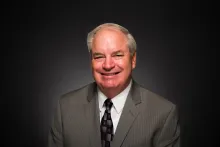
Robin Webber was born in Chicago, Illinois, in 1951, but has lived most of his life in California. He has been a part of the Church of God community since 1963. He attended Ambassador College in Pasadena from 1969-1973. He majored in theology and history.
Mr. Webber's interest remains in the study of history, socio-economics and literature. Over the years, he has offered his services to museums as a docent to share his enthusiasm and passions regarding these areas of expertise.
When time permits, he loves to go mountain biking on nearby ranch land and meet his wife as she hikes toward him.
