

Don Ward
This transcript was generated by AI and may contain errors. It is provided to assist those who may not be able to listen to the message.
The title, The True Wave Offering. The True Wave Offering. Last Sunday, the world celebrated Easter. The word Easter only appears once in the King James translation of the Bible. We can turn there, we can look at it. A lot of people, if you don't know, of course, what the Greek word is there, they may assume that, yes, you do find the word Easter in the Bible. Of course, this is a mistranslation to Acts 12. We'll just read the verse itself. There's, of course, verses leading up to it. When he had apprehended him, he put him in prison and delivered him to four courtinarians of soldiers to keep him, intending after Easter to bring him forth to the people. Now, the word for Easter there is pasha, p-a-s-c-h-a. It is the word for Passover. After Passover is the way it should be translated. Nominal Christianity, a celebration of Easter, focuses on the resurrection. Of course, Jesus did arise from the grave, and that's so very important, but we're not commanded to celebrate the resurrection per se. But Easter focuses, to a large degree, on the resurrection. And so many churches around the nation, and for that matter around the world, conducted so-called Easter Sunrise Services last Sunday morning in commemoration of the resurrection. But as we know, the resurrection took place around sunset on the weekly Sabbath within the Feast of Unleavened Bread the day before. Last Sabbath, about 1987 years ago, a new order of beings came into existence. That first being of that order is the Son of God, Jesus Christ, Spirit-born Son of God. He was the begotten, the only begotten Son of God, and now, after the resurrection, the Spirit-born Son of God. Before that event, there were no Spirit-born sons of God in existence. All other beings, except God the Father and the Word, were created beings, including the Lord, the Lord of the Lord, and the Lord of the Lord. All other beings, except God the Father and the Word, were created beings, including the angels. Look at Hebrews chapter 1 verse 4. Hebrews chapter 1 verse 4. In Hebrews 1.4, being made so much better than the angels, that is Jesus Christ, as He hath by inheritance obtained a more excellent name than they, for which of the angels said He at any time? Which of the angels said He at any time? You aren't my son. This day have I begotten you. Well, He never said it at any time. And again, I will be to Him a Father, and He shall be to me a Son. And you look once again, and this was repeated in 13.
But to which of the angels said He at any time? Sit on my right hand, and until I make your enemies your footstool. And then the purpose of angels, are they not ministering servants sent to the heirs of salvation? So before Jesus Christ was resurrected and born into the family of God as the born Son of God, there were no spirit-born beings in the whole universe. Look at Romans chapter 1. Romans chapter 1, we see somewhat the same thing.
In Romans chapter 1, verse 3, Concerning His Son Jesus Christ our Lord, which was made of the seed of David according to the flesh. David was in his genealogy, going back, and declared to be the Son of God with power according to the Spirit of Holiness by the resurrection from the dead. Jesus Christ's existence as the Word in eternity, He existed as the Word in eternity, and now He is the born Son of God, the first born from the dead. Look at Revelation chapter 1. In Revelation chapter 1, we shall also see this, the first born from the dead, that is, the first born as a spirit being. Of course, there were others that were resurrected from the dead, both in the Old Testament and the New Testament, but Jesus Christ is the first one who was resurrected as a spirit being, a born spirit Son of God. Verse 5, Revelation 1, and from Jesus, who is the faithful witness and the first born of the dead and the prince of the kings of the earth unto Him that loved us and washed us from our sins in His own blood.
We will experience the same spiritual birth upon resurrection. You look at Romans chapter 8, this time, Romans chapter 8 and verse 11. I've said very often this should be a memory scripture for all of us. In Romans chapter 8 verse 11, but if the spirit of Him that raised up Jesus from the dead dwell in you, He that raised up Christ from the dead shall also quicken, make alive, your mortal bodies by His Spirit that dwells in you. The same Spirit that is in God is in Christ, is in each one of us by that spirit that we have in us. He will quicken, make alive our mortal bodies. Verse 17, and if children then heirs, heirs of God, joint heirs with Christ, it shall be that we suffer with Him that we may be glorified together.
This is the greatest mystery of God. I do believe, I believe the Bible, what is the mystery? That one can live in the flesh and be recipients of the Spirit of God and then born into the family of God. Look at Colossians chapter 1. In Colossians chapter 1, we'll begin in verse 23. Colossians 1, 23.
In Colossians 1, verse 23, If you continue in the faith, grounded and settled, and be not moved away from the hope of the gospel which you have heard, and which was preached to every creature which is under heaven, whereof I, Paul, am made a minister, who now rejoiced in my sufferings for you, and fill up that which is behind of the afflictions of Christ in my flesh for his body's sake, which is the church. The church is made up of each one of us, each Spirit-begotten person. Whereof I am made a minister according to the dispensation, that's word for dispensation is all-ecanonia. It is a word from which we get also economy, administration, so there were a period of testing. There have been seven basic dispensations. We're in the sixth, or there have been six. We're in the sixth. There's one yet to come. That is the fullness of times, as in Ephesians 1.10. According to the dispensation, the oh-economia of God, which given to me for you to fulfill the word of God, even the mystery, which has been hid from ages and from generations, but now is made manifest to his saints, to whom God hath made known what is the riches of the glory of this mystery among the nations, which is Christ in you, the hope of glory.
Christ is in us through his Spirit. There is one Spirit, but there are two separate entities, and we are separate entities as well. We shall be born into thus the family of God as well. Now you look at Revelation 1 and verse 7, but in the days of the voice of the seventh angel, in the days of the voice of the seventh angel, the seven trumpets, some people confuse, try to say that the resurrection takes place at Pentecost. We'll touch on that a little bit later as we go. But in the days of the voice of the seventh angel, when he shall begin to sound, when he shall begin to sound, as in 1 Corinthians 15, the mystery of God should be finished as he is declared to his servants the prophets. That mystery is how that we can be, that human beings of the flesh can be born into the family of God. The resurrection of Jesus Christ from the dead makes him the first of the first fruits. You have to follow carefully all the way. If you had 20 questions now, could you answer them all?
So look at 1 Corinthians 15. 1 Corinthians 15. In 1 Corinthians 15, of course, in Corinth there were many problems that were divided over many issues. Even some in Corinth were saying there was no resurrection from the dead. How could you possibly say that and believe that the scripture? Verse 13, but if there is no resurrection of the dead, then is Christ not risen? And if Christ be not risen, then our preaching is in vain and your faith is in vain. Yes, and we're found false witnesses of God because we have testified of God that he raised up Christ, whom he raised not up. If so, that the dead rise not. For if the dead rise not, then is not Christ raised. And if Christ be not raised, your faith is vain. You are yet in your sins. Paul was a great logician in which he reasoned from them out of the scriptures.
Then they also which are fallen asleep, that is those that are dead, are perished. There is no hope beyond the grave. If in this life only we have hope, in Christ we are of all men most miserable. But now is Christ risen from the dead and become the firstfruits of them that slept. Now that resurrection was in within the Feast of Unleavened Bread on that Sabbath, the weekly Sabbath, within the Feast of Unleavened Bread. We'll be getting to our title shortly, but this backdrop is very necessary. I believe if you understand this, you have a great understanding about who is God, what is God, what is his purpose, who is man, what is man, what is his purpose. For since by man came death, by man also came the resurrection of the dead. For as in Adam all die, even so in Christ shall all be made alive. But every man in his own order cries the firstfruits, afterward they that are Christ, when? When? At his coming. At his coming, is what it says here. We read from Revelation 10 verse 7, when the seventh angel begins to sound, then the mystery of God should be finished. There should be no doubt about that if you follow the Scriptures at all. As we shall see, the wave offering represented the first fruit of the spring barley harvest. Now, of course, this was initially a physical offering, but it was symbolic and is symbolic of what Jesus Christ has done for us. We shall see that Jesus's resurrection from the dead and appearing before the Father in our stead is the spiritual fulfillment of what some call the wave sheep offering. It was some call the wave sheep offering. But the offering should more properly be called the wave offering or the wave omer offering or just the wave offering. I prefer just the wave offering. So the title, the true wave offering. Now we go to Leviticus 23, where the Holy Days are enumerated. I went to a dermatologist last week and had a little spot here on my forehead frozen. And the doctor, he said, well, do you have a big Easter plan? I said, no, but I have Passover plans. He said, oh, Passover. Oh, where do you keep the Passover? I said, well, in Big Sandy. He said, well, what church is that? I said, the Church of God. He said, well, what are you going to eat? I said, unleavened bread, have wine, real wine, not grape juice. And he said, well, I've just been studying the book of Leviticus. And what is the difference between a sin offering and a guilt offering? It seems to be that they're about the same. And I said, as far as I can discern, they are essentially the same. And the talk continued a little bit. And I said, we're not there to eat the Lord's supper, as you read from 1 Corinthians 11, where it says, you're not there to eat the Lord's supper. He said, oh yeah, and some of them were getting drunk at that time, as well. So we had a nice little conversation. I doubt he'd be converted today, but at least he is studying and reading and interested. I found that quite interesting.
In Leviticus 23 verse 7, In the first day you shall have an holy convocation, you shall do no servile work therein. And we have done that. But you shall offer an offering made by fire unto the eternal seven days. In the seventh day is a holy convocation.
That's today. In the seventh day is a holy convocation. You shall do no servile work therein. And the Lord spoke unto Moses, saying, Speak unto the children of Israel, and say unto them, When you come into the land, which I give unto you, and shall reap the harvest thereof, then you shall bring a sheaf. Now that Hebrew word for sheaf is omer. It is not... You know, I used to think when the wave sheaf was offered that they cut the stalks of green and had this whole stalks of green and would wave.
But as we shall go through this, you will see that was not what was waved. It was an omer. An omer is a measure of whatever you put in the omer. It's about two cords. And he shall wave the omer before the eternal to be accepted for you on the morrow after the Sabbath, the priest shall wave it on the morrow after the Sabbath, which Sabbath, the weekly Sabbath within the feast of unleavened bread, which last Sabbath was a double holy day.
So then on the Sunday would have been the wave sheaf offering or the omer offering. And you shall offer that day which you waved the omer and he and a he lamb without blemish of the first year for a burnt offering unto the eternal. And the meat offered thereof shall be two tints of fine flour, mingle with oil, and offering made by fire unto the eternal for a sweet savor. And the drink offered thereof shall be of wine, the fourth part of an hen, which once again hen is a measurement like in a cup or a glass.
And he shall eat neither bread nor parched corn nor green ears until the same day that you have brought an offering unto your God. In other words, you cannot continue with the harvest. You cannot harvest wheat or the barley until this was done. It shall be a statue forever throughout your generations in all your dwellings.
So let's now examine the wave offering and how it took place. Edersheim, you can look up Edersheim. I think his first name is Alfred Edersheim, E-D-E-R-S-H-E-I-M, and he was a Jew and did a lot of study with regard to the practices in Old Testament days.
So this is basically the description of how it took place. The barley grain was actually cut by members of the Sanhedrin. According to the Sadducees tradition, at the end of the weekly Sabbath, during the days of Unleavened Bread, which would have been last Sunday, the heads of the grain. Now this is a part. See what happened after they cut it. They didn't wave that whole what we would call sheaf. The heads of the grain were separated from the stalks and removed.
The grain was threshed, parched with fire, and ground into flour in the courtyard of the temple that evening. The flour was then mixed until it was pure in a very fine texture. According to the Midrash, oil and frankincense were added, and it says right clearly here, we just read that oil was added to it. The omer, or the sheaf, was then offered early the next morning at about 9 a.m., the time of the morning sacrifice in the temple as a meal offering waved before God.
Now there's some confusion when the various Bible translations describe this offering as a sheaf being waved because a sheaf in its usual sense is the stalk of grain itself. But that is not what was waved. As you can see very clearly, if you look at any concordance, it will tell you that it's omer, a measurement about two courts. In fact, the Bible does not actually refer to the ceremony as the wave sheaf offering. The Hebrew omer that is translated sheaf was a measure about two courts, and actually means a measure of things dry. The very first of the first fruit's crop offered as a wave offering in the temple was two quarts of barley grain that had been parched, roasted, thrashed, sieved, sifted into fine flour.
So the grain offering was of similar format to other grain offerings that were waved before God.
The Jewish Encyclopedia article titled Omer, Jewish Encyclopedia article titled Omer, O-M-E-R, declares that a handful of it was burned on the altar, and the rest was eaten by the priest in accord with the traditional wave offerings previously described in the Pentateuch. That ceremony, of course, was of great importance under the terms of the Old Covenant. It was a commanded ceremony, as noted in verse 14. It shall be a statue forever in all your generations.
The spiritual fulfillment of it is of much greater importance to us today. We should also note that some tend to confuse identifying terms and have referred to the wave sheaf offering as the Feast of the First Fruits. As we shall see, it is not the Feast of the First Fruits. Pentecost is the Feast of the First Fruits. Now, this which they cut was stalks of barley, and they thresh the grain from it, as we have described, made it into flour, and then waved that before the eternal. Pentecost was the wheat harvest, and it was called the Feast of First Fruits. But unleavened bread is not the Feast of First Fruits, even though Jesus Christ is the First Fruit of those that slept. The first one that was raised to spirit life, as we described up front, turning to the various scriptures as we began. Look at Numbers 28-26. We'll treat this for a moment because this keeps coming up, and I've already read scriptures that show that at the seventh trump, when the angel of the seventh trump begins to sound, the mystery of God is finished. And each man in his order, Jesus Christ being the first fruits, each man in his order, went at his coming. Let's see. We said Numbers 28-26. Numbers 28-26, we're looking at what Pentecost is called. Numbers 28-26. Numbers 28-26. Also in the day of the first fruits, when you bring a new meat offering unto the eternal after your weeks be out, see, it's seven weeks plus one day, and you shall have an holy congregation. You shall do no servile work. And it goes on describing what was to be offered then, the Feast of Weeks. Look also at Exodus 34 and verse 22.
Exodus 34 and verse 22 with regard to what Pentecost was called. Pentecost was called the the Feast of First Fruits. It was called the First Fruits of Your Labor, and it's called the First Fruits of the Wheat Harvest. Exodus 34 and verse 22. That's where we're turning now. Exodus 34 verse 22. And you shall observe the Feast of Weeks of the First Fruits of Wheat Harvest and the Feast of In Gathering at the year's end, that is, Feast of Tabernacles. Three times in the year shall all your men children appear before the eternal God, the God of Israel, and of course in other places says they're not to appear empty. So to make that distinction there that some get confused on, or some have it as a pet doctrine that they're trying to sell, unless the wave offering was successfully carried out, no spring grain could be harvested. We've already noted that once. It says it clearly in the scripture that until this ceremony took place, there could be no grain harvested. Okay, now listen. Unless Jesus had offered himself the Lamb of God without spot or blemish as an offering for the sins of the world, there would be no calling out of the first fruits, much less a feast or harvest of the first fruits at his coming. The calling out began on the day of Pentecost, 31 A.D., and that day some 3,000 souls were called out, and they will be a part of that great harvest when Jesus Christ comes again.
And when does he come again? According to 1 Corinthians 15, when the seventh angel begins his sound, according to Revelation 1.10. I don't know why I keep saying that. According to Revelation 7, when the seventh angel begins to sound, the mystery shall be finished.
So unless Jesus had offered himself as the Lamb of God without spot or blemish, there would be no calling out and no harvest of the first fruits. He was accepted, waved before God as the green was waved before the altar in that day. And we'll see this clearly. We'll go now to John 20, verse 17. As we're turning there to John, the Gospel of John, chapter 20, verse 17, This is the account of the people going to the tomb early in the morning, and that's where I guess churches get their sunrise service from with regard to going to the tomb. But as we know, the tomb was empty. He was not there. But there was an encounter that took place after the rest of the disciples had left. This woman, Mary, was still there.
We'll pick it up in verse 14. And when she had thus said, she turned, and when he had thus said, she turned herself and saw Jesus standing and knew not that it was Jesus. Jesus said unto her, Woman, why are you weeping? Whom do you seek?
She's supposing him to be a gardener, said unto him, Sarah, if you have taken him from hence, tell me where you have taken him, laid him, and I will take him away. And Jesus said unto her, Mary, she turned herself and said unto him, Rabona, which is to say, Master, Jesus, said unto her, Touch me not, for I am not yet ascended to my father, but go to my brethren, and say unto them, I sin unto my father and your father, and to my God and your God.
And Mary came and told the disciples that she had seen the Lord, and that he had spoken these things unto her. He said, Touch me not. He did not want to be defiled by human hands, because he had not yet ascended to his father. In Hebrews 9, we see somewhat of a summary. If we go to Hebrews 9 and we'll start in 23, we see here somewhat of a summary of sacrificial offerings through the ages under the Old Covenant, that sacrifices were offered without the shedding of blood. There was no remission of sins, and that the Second Covenant had to be purified, had to be ratified by better offerings than that of the blood of bulls and goats. So in Hebrews 9, verse 23, it was therefore necessary that this pattern of things in the heavens should be purified with these, but the heavenly things themselves with better sacrifices than these. They offered the blood of bulls and goats, but the better sacrifice, Jesus Christ, the only begotten Son of God, for Christ has not entered into the holy places made with hands, that is, the tabernacle in the wilderness or Solomon's Temple, or the Second Temple, which are the figures of the true, but into heaven itself to appear in the presence of God for us. Touch me not, Mary, I have not yet ascended to my Father, but go tell them, and he told them a place where they should meet. We'll see in just a moment. Nor yet that he should offer himself often as the high priest enters into the holy place every year with blood of others. Or then must he have suffered since the foundation of the world. But now once in the end of the world hath he appeared to put away a sin by the sacrifice of himself. He hath appeared before God the Father, and that sacrifice was accepted. After appearing before the Father in our stead, we go to Matthew 28 and verse 8. Matthew 28 verse 8, we will see that he did appear to them later in the day, and that they did touch him. In Matthew 28 verse 8, Matthew 28 verse 8, And they departed quickly unto the sepulcher with fear and great joy, and did run to bring the disciples word. And as they went to tell the disciples, Behold, Jesus met them, saying all hail, and they came and held him by the feet and worshiped him.
Then said Jesus unto them, Be not afraid, go tell the brethren, they go to Galilee, and they shall see me. So they held him by the feet, touched him after his ascension, and his sacrifice was accepted by the Father. The wave offering on the Sunday after the first weekly Sabbath within the Feast of Unleavened Bread gave it a pivotal role in the sacred calendar. Jewish tradition teaches that Pentecost is a culmination of the Passover season.
The two being connected by the counting after the Omer was waived. From the time that you offer the Omer, you shall count 50. Look at Leviticus 23 quickly. Of course, Pentecost literally means count 50. It is a term that is used later in the New Testament. In Leviticus 23 verse 15, you shall count you unto from the morrow after the Sabbath, the morrow after the Sabbath, which Sabbath? The Sabbath within unleavened bread. The counting is inclusive. You count that day also. Now, in the 60s, when I came to a master college, World Wide Church of God, they kept Pentecost. Pentecost was being kept on Monday because thinking that this was not inclusive counting.
But after further study, and there was quite a study back and forth and discussion on this, it was changed to the correct day, which is Sunday. You shall count on unto you from the morrow after the Sabbath, that's inclusive. Count that day from the day from the day. Of course, some argued about from the day that you brought the sheaf, the Omer of the wave offering. See, the Bible says, doesn't it not say wave sheaf authoring? It says wave offering. The true wave offering, of course, is Jesus Christ. The wave offering, seven Sabbath, shall be complete. So that day plus seven brings you back to Sunday. So the 50-day period incorporated the deliverance of ancient Israel from the slavery of Egypt through their baptism in the Red Sea on the last day of the Feast of Unleavened Bread to their arrival at Mount Sinai in the third month. According to Jewish tradition at Mount Sinai on the day of Pentecost, they received the Ten Commandments. Now let's go back to the symbolism and spiritual fulfillment of the wave offering. The stalks of barley grain from which the wave was taken was chosen in advance. It was the best of the best. In like manner, the Lamb of God was chosen when? Look at 1 Peter 1, verse 20.
How old is the plan of salvation? Well, according to 2 Timothy 1, 9, it was before time began. Here is expressed by the Apostle Peter in a little different language.
1 Peter 1, verse 20.
In 1 Peter 1, verse 20, Who verily was ordained, who was the who, and verse 19, but with the precious blood of Christ as of a Lamb, without blemish and without spot, who was verily foreordained before the foundation of the world, but was manifest in these last times for you. Before the foundation of the world. In Revelation 13, verse 8, it says that he was slain from the foundation of the world. So he was chosen way in advance. The Passover Lamb was set aside back at that original Passover in Exodus chapter 12. The Passover Lamb was set aside on the tenth day of the month. It was to be the best of the best, the Lamb without spot or blemish. So Jesus Christ was slain, foreordained for this purpose before the foundation of the world, straight from the Scripture. Just as the grain was bruised and beaten and making the flower, Jesus was bruised and beaten and scourged by the Roman soldiers.
The grain was parched in searing heat, and Jesus went through all the fiery trials of life and suffered excruciating pain on the way to the stake. Therefore, look at Hebrews 2, verse 14. We will begin probably in Hebrews 2.
So this grain was parched in searing heat.
Jesus Christ suffered excruciating pain. Of course, this was not the only trial, this being the events leading up to the Passover, the crucifixion.
Hebrews 2, verse 14. For as much then as the children are partakers of flesh and blood, he also, Jesus Christ himself, likewise took part of the same, that through death he might destroy him that hath the power over death, and he's identified, that is the devil, Satan the devil, and deliver them who through fear of death were all their lifetimes subject to bondage. Of course, Satan is the god of this world, and he holds the whole world in bondage at this time except those who have been called into God's marvelous light.
For verily he took not on himself the nature of angels, but he took on himself the seed of Abraham, wherefore in all things that behooved him to be made like unto his brethren, that he might be a merciful and faithful high priest in things pertaining to God, to make reconciliation for the sins of the people. For in that he himself had suffered being tempted, tested, he is able to succor them that are tempted, tested. He's been there, done that. The grain was sifted many times until it was pure. Jesus was tested, purified, and perfected by his sufferings. We must go through the same sifting process, and we are going through the same sifting process. Now, I cannot explain why that some people are tested far more than others.
Some people are tested to the point of death and die in martyrdom, die in the faith being tested. Some are not tested so much in that way, it seems, but all of us will be tested and tried. We must go through the same sifting process.
We sing the following words in a song, and I'd like for this to be the closing hymn. He is sifting out the hearts of men before his judgment seat.
Barley, the courses of grain, was used by the poor to take to bake bread. Barley, the courses of grain, was used by the poor to bake bread.
Can we see further symbolism in this? Look at 2 Corinthians 8 and verse 9.
See, when Jesus came preaching the gospel of the kingdom of God, who responded to his message? Was it the rich of the land? Well, a few rich people, even a few of the priests. In fact, I think it says one place in John that many of the priests accepted him, but not publicly. They did it secretly. In 2 Corinthians 8 and verse 9. For we know the grace of our Lord Jesus Christ that through though he was rich yet for your sakes he became poor. He was rich. I mean, he was God. So we'll read in just a moment. He was on the God plane, as we'll read in just a moment in Philippians 2, thought it not robbery to be equal with God. Though he was rich yet for your sakes, he became poor that you through him, through his poverty, might be made rich, rich spiritually. He gave up everything. Now let's look at Philippians chapter 2 and verse 7. Well, we're going to start in 5. In Philippians 2 and verse 5.
So how would you do on a hundred-point test? We get easily 100 questions.
Some of the tests I used to give in fundamentals of theology, you'd curl your toes. Okay, in Philippians 2 and verse 5, let this mind be in you, which was also in Christ Jesus. That mind is now described. This mind, which mind were we about to read about?
Who being in the form of God, see, he was rich, became poor for your sake. Who being in the form of God, thought it not robbery, the actual word, harpagmos, is not a thing to be seized. He didn't have to seize it.
I don't like this translation, robbery, but not a thing to be seized, to be equal with God. He was on the God plane, but made himself of no reputation, and took upon him the form, morphe, of a servant, and was made in the likeness of men.
Now, we want to emphasize a phrase here at the first part of verse 6 again. Who being, and this word being means existing in. So he's existing in the form of God.
Then verse 7, but made himself of no reputation, took upon him the form of a servant, and was made in the likeness of men. And being found in fashion as a man, he humbled himself, and became obedient unto death, even the death of the stake. See, he learned obedience through the things he suffered in that at any time. He said in one place, think not that I could call to my father, and he would send legions of angels. But to fulfill the will of God and the purpose for which he came into this world, he remained faithful unto death, learning obedience all the way. What does it take to be obedient unto death? Wherefore, God has also highly exalted him, and given him a name which is above every name. There's one exception. There's one exception to him being exalted above every name. You know who that is. That at the name of Jesus, every knee should bow of things in heaven, and things of earth, and things under the earth. And that every tongue should confess that Jesus Christ is Lord to the glory of God the Father. Now you look at 1 Corinthians 15 again. We left off reading at the end of 24. 1 Corinthians 15, 24. We've already read 23. And for 1 Corinthians 15, 24, then comes the end, when he shall deliver at the kingdom to God even the Father, when he shall have put down the rule in all authority and power. Who is he? God. Sit you on my right hand. I mean, a lot of people will read this, but Psalm 110 verse 1, 2, 3, 4, down through 5, I think it is. Sit you under my right hand. Who's sitting on God's right hand? Sit you on my right hand until I make your enemies your footstool. When he shall put down all rule and all authority and power, for he must reign till he had put all things under his feet. The last enemy that shall be destroyed is death. He had put all things under his feet, but when he said all things are put under him, it is manifest that he is accepted, accepted, not accepted, he is accepted, exempt, which did put all things under him.
And when all things shall be subdued unto him, then shall the Son, also himself, be subject unto him that put all things under him, that God may be all in all.
Jesus was the true wave offering. Jesus, the unblemished Lamb of God, first born from the dead, the first born of all creation of the spiritual sense, then in all things he might have the preeminence. Only the Father, as we have read, is the exception. We must now note and emphasize the exaltation of Christ to the throne of God, where he sits at the right hand of the Father. We must note what was included in Christ's high priestly prayer to his Father before his crucifixion. So let's go to the Gospel of John, the Gospel of John, chapter 17.
Lying upon line, precept upon precept, hear a little, there a little. You have to put the scriptures together.
Like some used to say when I was a child, various people, the shade tree theologians, would be discussing the Bible, and one of the favorite lines said, oh, you can prove anything from the Bible. Well, if you take it out of context and just read your pet scripture, maybe so. But when you put it all together, not so. Scripture cannot be broken. In John 17.1, these words spoke Jesus and lifted up his eyes to heaven and said, now here is this prayer that Jesus prayed before betrayal and trial and crucifixion, Father, my hour has come, glorify your Son, that your Son may also glorify you, as you have given him power over all flesh, that he should give eternal life to as many as you have given him. And this is life eternal, that they might know you, the only true God, in Jesus Christ whom you have sent. I have glorified you on the earth, I have finished the work which you gave me to do. And now, O Father, glorify you me with your own self, with the glory which I had with you before the world was. The Father glorified him and raised him from the dead, as we have read, and seated him on his right hand. Look at Ephesians 1.20. Ephesians 1.20. G-E-P, relations, Ephesians, Ephesians 1.20.
Which he wrought in Christ. Let's back up and get a bit of the meaning here. We'll start in Ephesians 15. Wherefore, I also, after I heard of you, your faith in the Lord Jesus, and lovin' unto all the saints, ceased not to give thanks for you, making mention of you in my prayers that the God of our Lord Jesus Christ, that the God of our Lord Jesus Christ, the Father of glory, may give unto you the spirit of wisdom and revelation in the knowledge of him, the eyes of your understanding being enlightened, that you may know what is the hope of his calling, and what the riches of the glory of his inheritance in the saints. Remember, we are joint heirs for Jesus Christ. And what is the exceeding greatness of his power to us who believed according to the working of his mighty power, which he wrought in Christ when he raised him from the dead and set him at his own right hand in the heavenly places. Now in Revelation 3 and verse 21. In Revelation 3 and verse 21, there are many places, well, several places, where it talks about the Father raising Jesus from the dead and Jesus being at his right hand. But I'd say this is the capstone scripture of all of that in Revelation 3 and verse 21. Jesus Christ is now sitting at the right hand of the Father where he fulfills the role of mediator. He is the mediator of the new covenant, the better covenant, that is also furnished with law. He is our high priest. He is our intercessor.
Look at Hebrews chapter 7 and verse 25, one of the most encouraging scriptures in the whole Bible. In Hebrews 7 and verse 25, Hebrews 7 and verse 25, for such an high priest became us who is holy, harmless, undefiled, separate from sinners, and made higher than the heavens. That's 26 and 125. Wherefore, he is able to save them to the uttermost that come unto God by him, seeing he ever lives to make intercession for him or for them, for us. He ever lives to make intercession for us. Why did Jesus do all these things for us? Why is he doing all the things for us now?
Look at Hebrews chapter 12 verse 1. Why all of this?
Wherefore, seeing also were accomplished about with so great a cloud of witnesses, let us lay aside every weight and the sin which thus so easily beset us and let us run with patience the race that is set before us. Looking unto Jesus, the author and finisher of our faith. Why did he do it all? For the joy that was set before him endured the stake, despising the shame and is set down at the right hand of the throne of God. Why did the father do it? Were God so loved the world that he gave his only begotten son, that whosoever believes in him should not perish but have everlasting life.
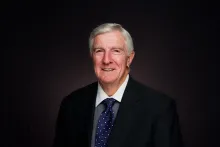
Before his retirement in 2021, Dr. Donald Ward pastored churches in Texas and Louisiana, and taught at Ambassador Bible College in Cincinnati, Ohio. He has also served as chairman of the Council of Elders of the United Church of God. He holds a BS degree; a BA in theology; a MS degree; a doctor’s degree in education from East Texas State University; and has completed 18 hours of graduate theology from SMU.
