


Robin S Webber
This transcript was generated by AI and may contain errors. It is provided to assist those who may not be able to listen to the message.
Want to welcome those that are with us today watching, and or maybe watching this down the line weeks, months, sometimes years, as was mentioned by Dr. Hoover. It is Presidential Weekend. You have to understand that when Dr. Hoover and myself and some of you that are in that age range when we were growing up, that we did not celebrate Presidential Weekend. There was no Presidential Weekend. We celebrated real heroes, dynamic individuals that God gave us. Lincoln, Abraham Lincoln's birthday, that was a state holiday. And there was only one national holiday at that time, and that was George Washington, the father of our country.
Indeed, God blessed us with a man who set the mark, set the mold. Some have almost risen to it. Some have sometimes strayed away from it, and some are still trying to find it. But he was the model, and he was the man that walked away from power, walked away from being ahead of a military, went back to the farm, and ultimately walked away from being a president and went back to the farm.
So God gives us these men, and I want to talk about this today. And today, being in the midst of Presidential Weekend, I would like to make a few appropriate remarks. Now, remember what I just said, a few appropriate remarks, because that's going to be part and parcel of this message. As I do this, I'd like to have our gentlemen pass out the pieces of paper that I've given them.
You do know, as your pastor, that I'm not very good with PowerPoint, so you might consider what is being passed out as a portable PowerPoint. And it's on paper, but we're all going to be going through it together. And I would ask for a moment that—I know it will be tempting to read that rather than listen to me, but we'll be reading it soon enough as we go along, so that we can all stay together. I'd like to share a thought with you, if I could, and it's simply this.
Nations, like people, are full of chapters of life. Some are wonderful, some are challenging, some are thrilling, and all of them, to agree, take us to the depths of our being. And that's life, whether as a family, whether as a person, and whether as a nation, because nations really are, when all said and done, families multiplied many times over. When such chapters do come our way, I have a question, though, for you, and I think of yesterday, in particular, the day before when we had that horrible massacre that occurred in the schools down in Florida.
How do you explain the unexplainable? And how do you make sense out of the senseless? That's a big question. It's a daunting question, and sometimes, rather than moving people towards God, they move away from God, because it's not necessarily the answer that they want at that time. How do you establish your core values of personal existence in the midst of life's steady and sure bombardments and surprises that will come? When such time does come, and it will, if it is not, I'm talking to the young people here, and those that have not yet perhaps had a great life challenge, and or do I say, dare say, tragedy, you had better know what truly composes the fabric of your being.
There's a fabric, and when you think of a fabric, a fabric is something that is knitted and sewn and tied together tight. To withstand the sun, to withstand the wind, to withstand the storm, to withstand the flood, the water. I look back in history, can provide some answers for what lies ahead, and it surrounds this presidential weekend. Before we go a little bit further, let me make it very clear, and I somewhat stated it already, but I'll restate it.
As we do, allow me to state emphatically that I believe that God does raise up leaders to serve His purposes down through the ages. And I do believe that God has raised up leaders here in the United States of America. And sometimes they think that they're serving their purpose, but it's really serving His purpose. At given times, for given reasons, that are only known but to God. Sometimes He raises up what we might call likely vessels. Sometimes He raises up unlikely vessels. But the headlines that these vessels make, whether they're likely or unlikely, we think are being reported down here in the Washington Post or the New York Times or the Wall Street Journal.
But the headlines are actually being made in heaven. God is in charge, and God is sovereign. He is not just simply a first cause. God is sovereign, and He is involved, and He is the great disposer of events. And this is one of the activities that we'll talk about today.
Join me if you would. Let's look at this verse for a moment over in the book of Daniel. And this is Daniel doing some chatting, some talking, with none less than Nebuchadnezzar. And over in Daniel we find this remark about leaders, about rulers, about empires. In Daniel 4 and in verse 25, let's take a look. It says this. Let's actually go up to verse 25. This is where Nebuchadnezzar is being given the interpretation of his dream that he is going to go out for seven years outside of the walls, outside of the realm of humanity.
Then they shall drive you from men, your dwellings shall be with the beasts of the field, and they shall make you eat grass like oxen. And they shall wet you with the dew of heaven, and seven times shall pass over you till you know that the Most High rules in the kingdom of men, and gives it to whomever. It is God that gives. It is God that is in control of history, of humanity, all towards one end to serve his purpose. Again, sometimes when the Bible says something once, you say, well, that is important.
Let's go down to verse 32. And they shall drive you. And again, it is repeated. And then notice verse 32 at the very bottom. Until, keyword, you know that the Most High rules in the kingdom of men, and he gives it to whomever he chooses.
When we look at leadership down through the ages and down through the centuries in the United States of America, we recognize that in our history, there are times that, as it says in Proverbs 17-17, that God will give us, say, a brother given for adversity, given in those times of trouble. You think of a George Washington.
You think of an Abraham Lincoln. You think of, and I'll cross the political divide, you think of an FDR, you think of a Franklin Delano Roosevelt, who are normally, by historians, rated, and if David were here, he would know this, that they kind of shuffle back and forth between, normally now it's Abraham Lincoln that is regarded as our greatest president, and George Washington and FDR go back and forth about every decade.
We recognize there is the founding of the country, the father of the country, we recognize the challenge of the Civil War, and then we recognize the dual challenge of our grandparents' time with the Depression and with World War II and coming out of that victorious. So God does give brothers for adversity. Somebody that has found it, somebody that has a fabric that is prepared for adversity, and also at times He gives us men and women, that events come upon them, that for such a time as now, for such a time as now, the Kingdom has come to them.
Join me if you would, and I, and to anchor, let's go to Isaiah 40 for a moment. Isaiah 40. And again, remember what I asked you to begin with in this message was simply this. How do you make sense out of the senseless? And how do you explain the unexplainable? When all life, when everything has been changed in your life, and life will never quite be the same as it was before. The words of Isaiah speak to you to me on this day, another man, another time, a brother born for adversity, a man who spoke out, speaking God's words.
Comfort, yes, comfort, my people, says your God. Speak comfort to Jerusalem and cry out to her, that her warfare has ended, that her iniquity has pardoned, and for she has received from the Lord's hand double, for all her sins, that it was over, but that there would be a future, that there would be one coming, crying in the wilderness, pointing to the one, to the Savior that would come for all of humanity. About 155 years ago, there was a brother born for adversity, a man that for such a time as now, the kingdom had come, a man that we can draw an example from here on presidential weekend, and he spoke out and gave a message in the midst of an immense struggle known as the American Civil War.
And he strove to make sense out of the senseless, to explain life after incredible tragedy, both for the North and for the South. He had to reach deep. He had to inspire his exhausted countrymen to move beyond the weary moment of frustration into the bright hope of tomorrow.
It's interesting that what he shared on that day only lasted two minutes. I'm trying to get my sermons down to that length. I'm trying to please Mr. Garnett, but I'm not quite there yet. And what he said was only in two minutes. But allow me to share something with you. May I? Within those two minutes was the entirety of his life's work and stated purpose.
For his nation's existence was summed up in less than, you might want to jot this down, 266 words. Because I'm going to give you an assignment at the end of this message. 266 words in a mere 10 sentences. And unlike today, in an imperial presidency that we've had since World War II, Lincoln did write his own speech. He didn't have speech writers. He didn't have a teleprompter.
What many consider to be the greatest speech ever given in American history. I appreciate what Dr. Hoover mentioned about Washington's farewell address, which was actually a written document that went out for those of you that don't know. Probably right up in that pantheon of great speeches would be Dr.
Martin Luther King and the famous I Have a Dream speech. And so here is this speech that he gave. And to recognize that, here's what I want to share with you. You know my background is history, so we're going to have some fun today. We're teaching class. As well as looking at the Bible. And that is simply this. This message was not only to honor the dead, but the beauty of this speech and the majesty and the immensity, it was to honor the living that life had to go on. Those that remained alive after the Western Hemisphere's greatest battle. Let's share something here for a moment, if we may, and be very honest.
You know, we talk about our parents, my parents' generation. We call them the best generation. I think there's great people in every generation, but we know how Tom Brokaw coined that phrase. You and I today are, in our world, we are used to these battles that take place in the Middle East, and we just really honor and respect our veterans that are over there doing their part. But you and I have not been exposed to massive warfare on our continent. Most of us have not grown up where the whole, whole world is at war.
The whole world is at war, as the whole of the United States back in the 1860s was at war. And so it's a completely different thing. And what I want to share with you in this, if you want to take some notes here today, it's simply this.
The majesty of what we're going to look at, it's how he includes. It's the inclusion of life and death and purpose that has been breathed into this document that is in your hands, that has inspired six human generations since. So today what we're going to do is, the title of this message is simply this.
I wrote an article on it many, many years ago, about 15, 17 years ago. And here's the title of the message if you want to jot it down. Two minutes. Two minutes dedicated to eternity. Two minutes not simply come and gone in a farm field in Pennsylvania, but only your own two minutes of what holds you together.
For if that which does not make sense has come into your life and you're still looking for answers, or you cannot yet explain the unexplainable that has come into your life and or will yet come into your life, I hope that this message will indeed be a blessing. So what we're going to do is we're going to combine the story of our nation as Americans, and we're going to combine that with the story of a holy nation, that's you and me, as Peter said.
Peter describes it in his epistle. Let's ask ourselves for a moment what what were the events that were leading up to that cold November day in autumn when Lincoln was invited for the commemoration of this national battlefield. There's a lot behind it. Just four months before, great bands of regiments on both sides, the north, the south, the blue, the gray. They were massive armies moving all around the border state of Virginia and Maryland. Massive thousands and thousands and thousands of men. And they had lost track of one another. They knew that they were out there, but they had not come into contact yet for that spark.
Robert E. Lee had moved up from the south, and what Robert E. Lee was trying to do was not to conquer the north. That was impossible. There were so many more northerners, and it was so much more industrial than the south. But what he wanted to do was to go over into the north, and he wanted to deliver a knockout battle that would make the Yankees move back and sue for peace and to leave the south alone.
He just needed one battle, and so he was looking for that engagement. Well, you know, and I know, that armies, they move on their tummies. They need to have food, don't they? So we always think about that. But they also need to have shoes, and the army needs shoes to move on. And it was heard by those that are in the south that there was a storage of shoes, a warehousing of shoes in this little town in Pennsylvania. Kind of a crossroads, no place, really.
Its name was Gettysburg. And so what happened then was that as the southerners went in to do that, they were spotted. This was on July 1st, which is going to lead up to July 4th. Think about it in a moment. July 1st. And they were spotted. And all of a sudden, there began to be a spark, there began to be a clash.
Union soldiers came in. The spark had been lit. And by the next day, the next day, there were thousands and thousands and thousands of soldiers on each side in engagement. And to recognize that they had finally found one another, at that point, there was no turning back. Curriers had been sent out in every direction for reinforcements. By the second day, July 2nd, 85,000 Union troops, you think about that, and 65,000 Confederate troops were at one another, knocking one another, trying to give one another a death blow.
To their one-time fellow countrymen. I was reading this this morning and going over it again, and tears almost came to my eyes. I'm thinking of this. Here, their grandfathers, their great-grandfathers, July 4th, just around the bend, they had all been fighting for the same cause. They had been fighting the British to establish something that had never been in human history, other than in very small enclaves in Italy called republics. They fought for that. They had this bond.
Now here, brother was fighting brother, cousin fighting cousin, sometimes states divided, if you're in Kentucky or Missouri, some of the border states, and they're fighting one another, and they're at one another. And here they were in this farm field, and to recognize what was going on, and then to understand what happened here, which is very important, that on the third day, the southern military leadership misread the Norse intention.
They thought that they were weak in a spot, and so you will know this story. They decided to do what is called historically picket's charge. 13,000 men coming out of the woods in a field a mile wide, and they moved across that farm field towards their foes' elevated position. Bruce Canton in the American Heritage Picture History of the Civil War, page 344, captures the moment. Let's go in and literally be there for a moment. As the Confederate entry came on steadily and quietly, nearing the awful climax of the war's greatest battle, Union artillery firers shook their ranks with deadly accuracy, and then both sides exploded in a tremendous clash of musketry.
He goes on to describe an eyewitness account as to how the battle noise was strange and terrible. It's a sound that came from thousands of human throats, like a vast, mournful roar. Out of the 13,000 that went into that charge, within minutes, 6,500 of them were either wounded, killed, or captured. In that war, between the North and the South, in the farm fields of Pennsylvania, there would be 51,000 casualties. 8,000 men would die.
A staggering one-third of all the people that were in that battle would either be wounded or die. The North had won, but at such a cost, and the South would never recover.
Are you with me so far? We've been in the battle. Leading up to, of all things, when you place the story of Gettysburg, three days before July 4th, our national holiday, the birth of our country. Brother fighting brother. Thousands dying. Now, four months later, comes Abraham Lincoln, to give voice to that vast, mournful roar of battle that went up. How do you explain that? How do you make sense out of that? To recognize, when you study history, that the... No, everybody's always fighting the last war, with the last war's intent, and the equipment, the guns, the cannons. They had advanced beyond the tactical maneuvers of an army. He was asked to make a few appropriate remarks. That's why I began this message with it. A few appropriate remarks. He would not even be, quote-unquote, he was not on the marquee that day. It seems as if, basically, he was thought of as an afterthought. Oh, we better have the president there. There was a former senator who was a great orator that was given the prime light to, back in that day, oratory. They would go on for an hour and a half, two to two and a half hours. It was the entertainment of the day. That man would try to do his best. And so, the actual official invitation to him was simply this, Mr. President, please come, and if you would, please give a few appropriate remarks.
The other man's would be in two hours, his would be in two minutes. We've already described that. Here's one thing that I want to share with you, and what is very important for us to understand as Christians. There is a legend, a legend just as much as George Washington's teeth being wooden, they were not wooden. That's a whole other story, not this sermon. We'll have a whole sermon on George Washington's teeth. No.
The legend is that the Gettysburg Address was written on the back of an envelope on the train on the way to Gettysburg.
No, it was not. That's legend. There were historians that found three different drafts, three different drafts of this message. It was crafted. It was thought about. Every word for those of you that words are in your business, every word counts, especially when you're only invited to give a few remarks. The only thing that was added on the stage, you might want to jot this down of interest, and you see it in front of you there at the end, when he added, and this was at podium time, when he said, under God, under God. And it's interesting because he knew that it would take God's help to bring this nation together. I would suggest, friends here in Los Angeles and those that are listening today, that Abraham Lincoln, while he may not have been a great church-going man, was a Bible-reading man of his time. I would not be surprised that if his eyes fell upon Proverbs 29 and verse 18, which says, where there is no vision, people perish. Where there is no vision, where there is no hope. You know, it's amazing that people can go on literally a month, literally a month without water. They can go days without food. They can go literally minutes, minutes, without air. But you cannot go on with hope. Let's look at now, take the piece of paper that you have in front of you. We're going to do a quick examination.
Lincoln's intended thrust was to move those moans from the cry of death to the collective cries of the birth of freedom. William Sapphire, speechwriter for past presidents, wrote a marvelous book, which I would hardly encourage for those of you, that are speaking, for those of you that are writing, for you that are giving messages here at church. It's called, Lind Me Your Ear. And on page 49 and 50, Mr. Sapphire gives great thought to the construction of this national treasure. It's interesting, I know all of us have often heard, well, you know, the Gettysburg Address is in two minutes. But a lot of us don't really recognize that it is stamped with an incredible spiritual framework. It is stamped with a thought, you might want to jot this down, it is stamped with the thought of birth, of death, and of resurrection. It is stamped with not being stuck in the past, no matter what has come wrought to a nation, a village, a school, like this week, and or a church. Let's just go through it for a moment, because we'll see what happens here. Four score and seven years ago, and so that very beginning, you know, think of the Gettysburg Address, let's look up here a second, I need to see your eyeballs. Can you imagine the Gettysburg Address beginning? Eighty-seven years ago, that would not have the same sense, would it? It would not have the solemnity and the biblical proportion and the godly touch that was needed to bind an entire nation together. Four score and seven years ago, notice, our fathers brought forth, we are speaking of birth, fathers have children, and fathers brought forth on this continent a new nation. Something totally new, something had never been seen in human history. No king, no counts, no vicounts, no marquees, no dukes.
It's not who your daddy was, but where you were headed. It was about freedom in a way that had never been understood to any individual. Then notice, conceived, again, the birth statement, conceived in liberty and dedicated to the proposition, notice again, that all men are created equal. Again, the birth statement. And you and I, quite honestly, understand that that has had to be something that we've had to come to understand, magnify, and spread to all people that are Americans. In these last 200 years. Now, we are engaged in a great civil war. This is 1863, the war is going to go two more years. In a great civil war, testing weather, and it's a test, whether that nation or any nation so conceived and dedicated can long endure. The test is here. It's one thing to have a revolution. Stay with me a second. Sometimes you see this in church life. It's one thing to have a revolution or it's one thing to have a separation. And when the storm comes, there he says, let's get out of the storm. And everybody is so happy that they're out of the storm until, are you with me? Until they see who's holding the umbrella.
And the one that's holding the umbrella then becomes the storm. And so they move again and they again are happy until they see who's holding the umbrella. And they feel life is unfair, that God has passed them by. So we notice this, whether it's in national life, whether it's in religious life, whether it's in personal life. It says, we are met on a great battlefield of that war. We have come to dedicate a portion of that field as a final resting place. So he now speaks of death, of a resting place. For those who have here have gave their lives. Notice that the nation might live, it's not over. They gave their lives. See, there's a connectivity in this message between life and death. Desperation, frustration in the moment. But to recognize that it is not the sunset, but the dawn. For those who, again, gave their lives, death, notice that this nation might live, and it is altogether fitting and proper that we should do this. See, the dedication was for this national cemetery. You go to a cemetery, quote-unquote, to visit the dead. But in a larger sense, now he magnifies it. In a larger sense, we cannot dedicate, we cannot consecrate, we cannot hallow this ground. Now what Lincoln does is he brings in, again, the solemnity of consecration, of holiness, of separation that only God can pour out. The brave men, living and dead, who struggled here, have consecrated it far above our poor power to add or to detract. The world will little note, nor long remember, what we say here. But it can never forget what they did here. It is for us the living, rather. The living, the living. Life must go on. There is a purpose that is being worked out here below, and I do not know what you're going through right now, you do not necessarily know what I'm going through. But a Christian never just simply looks at the sunset. He understands that there is a dawn. He understands that even through adversity there is an opening, there is a blessing, there is a door, and we will not walk through that door alone. It is for us, then, the living, rather, to be dedicated here, notice now, notice, to the unfinished work. The grave is not an end in itself. These men that died, it is not an end in itself. The unfinished work which would fought here have thus far so nobly advanced. Now he begins, there is something beyond the grave. There is something beyond this battle. He has moved, are you with me? In this sequence, he has gone from birth, birth, and life, to death. And now there is a speaking of resurrection. It is rather for us to be here dedicated to that great task remaining before us, that from these honored dead, again the dead, we take increased devotion to that cause for which they gave notice the last full measure of devotion. That we are here highly resolved that these dead shall not have died in vain. Just like those young schoolchildren, those high school students that died the other day, that our nation and our people will learn from it, so that we do not have to continue to read the headlines or hear the headlines of the massacre of the innocents.
To be resolved that these dead shall not have died in vain, that this nation, here is the insert at the end, on that podium, under God, shall notice have a new birth of freedom. A second birth. Isn't that what you and I are given? Isn't that what Jesus spoke to Nicodemus about in John 3? How can a man be born again? A second birth, a resurrection, a new creation, and that government of the people, by the people, for the people, shall not perish from the earth.
There's one other thing that you want to see in all of this, and I'll just mention it here. I'll let you analyze it later. If you have your piece of paper there, here's what I want you to do. Just write the word dedicate.
That'll save me about 10 minutes explaining it to you. All of this, the life, the death, the birth, the life, the death, and the resurrection. It's all tied in by one word, dedication. The word dedication is used six times. Ladies, think about this for a moment. How do you sew fabric? You have a needle, don't you? That's old-fashioned. Maybe you have a machine, or maybe you just go to Target, just joking. You have a needle.
There has to be a thread. The word that the Gettysburg Address is threaded by, that brings the fabric of birth and death and resurrection together. To bring together the lives of those that have preceded us and those that we that are yet living. Think of us as a people, us as a holy nation, we that sing onward Christian soldiers, those that have gone before us, that we are threaded by this word, dedication. That's what we do at baptism. We take a vow before God that we are going to be dedicated.
We just ordained two individuals here today. I had a long talk with them as their pastor. We talked about dedication. We talked about dedication. And to recognize that each and every one of us are to be dedicated to this cause, towards God the Father, towards Jesus Christ. And to recognize that we'll go through these stages of life, these seasons of existence, of a birth, of a newness in the way of life. And then sometimes things will happen and we'll think, well, this wasn't supposed to happen. I wasn't supposed to go through the valley of the shadow of death.
But to recognize that there's something beyond that. Lincoln recognized that. Let me share something with you for a moment. You say, well, you know, but here's something I want to share with you. And some of you, I don't know if they're still teaching you this in school or not. So I'll have all the students look up here. How many of you are going to college or below right now? Can I see a show of hands? Okay, good. As we say in the Marine Corps, listen up.
Here we go. Right, Mr. Helgi? Listen up. You say, well, this guy must have been, you know, extraterrestrial. Abraham Lincoln has got that picture, you know, got the beard. No. He was a man. He was so ordinary in that day and age. He was a frontiersman. He was born in Kentucky. He was raised in the West, which at that time was in Indiana and Illinois. He was a common person, but he used what God gave him to a fullest extent. You know, one time Lincoln said, you know, God must really love the common man because he made so many of them. Doesn't that sound like 1 Corinthians where it says, not many wise, not many noble, or called?
And to recognize what Lincoln went through. You see, you say, well, you know, he must have really had a way with words. No, he lived it, brethren. He knew what failure was. He knew what it was to have a door slammed in his face. Failure upon failure upon failure. And he, of all people, understood the aspect of rebirth. He failed in business at age 22, ran for the legislature and defeated at age 23, failed in business at age 24. He was elected to the legislature at age 25. His sweetheart died at age 26. He had a nervous breakdown at age 27.
And Lincoln always suffered to one degree or another from depression. He was defeated for speaker at age 29. He was defeated for elector at age 31. Is that it? No, there's more. He was defeated for Congress at age 34, elected to Congress at age 37, defeated for Congress at age 39, defeated for Senate at age 46, defeated for Vice President at age 47, defeated for Senate age 49, elected President of these United States at age 51.
And with all that, would be assassinated by a bullet at Ford's Theatre in 1865. See, you can't really help people until you yourself kind of understand what God is doing with us as the common man and that failures are part and parcel of this. You know, have you ever asked yourself, have you looked at the Gettysburg Address? Have you ever asked yourself why Peter was so effective on Pentecost Day as he stood out amongst the apostles?
And what was that connection that he had when the men of Israel said, our hope is cast out? They thought, oh no, we've done it. We really did kill the Son of God. We killed Messiah. What was that connectivity?
The reason why he was able to connect with those thousands of men in that square was he was speaking as a dying man to dying men. He knew what he had done to his master. He knew that he had run out of the Garden of Gethsemane. He knew that he was the one that had said, if all abandon you, I will not. He was the one that was in the square that night as Jesus was being led into a palace or to a jail. And they locked eyeballs, as it says in Luke. And he knew, and he knew that he knew that he had denied Jesus Christ three times before the cockroat crawl.
So when he got up on Pentecost, now full of the Holy Spirit, people said, this is the real deal. This is the real deal. This is somebody that knows what he's talking about. Lincoln, like Peter, knew what he was talking about when it comes to this aspect.
What kind of a speech did this give? What kind of a hope did it offer? Let me share a thought with you. It's simply this. You don't always know what your words are going to do in this lifetime. I see many fine mothers and fathers out here. I see grandparents. I see uncles. I see spiritual uncles and spiritual aunts. I see people that have experience. They have words. Some of us have gone through the seasons of life, whether it be a spring or summer, an autumn, and for some of us, early in winter.
I'd still be late autumn. Never underestimate what your words will have as an impact on others. Lincoln, after he came down those two minutes, and you see that page in front of you, all the people that were around him? That's an actual photograph.
He was very depressed about his speech. He didn't think it was going to go anywhere. I say to you, and your impact with other people as a Christian, as one that is in the way and a follower of Jesus Christ, never underestimate your impact on one human being by the words that you share. A husband to a wife, parents to a child, grandparents. Some of us, our parents or grandparents, are gone, and so we seek out those that are older amongst us. Choose your words. What does it say in the Proverbs? Words that are spoken with wisdom or like apples of gold. And sometimes you don't know what happens down the line. I have a thought with you, being one that loves history. The nation had enough tough problems after the Civil War with Reconstruction. Abraham Lincoln had said that a general once went to Abraham Lincoln and said, Well, Mr. President, what are we going to do now that the South is defeated? And Abraham Lincoln said, we will act as if they never left.
But he died. And the Radical Republicans inaugurated what is called the Reconstruction. And the South did not really rise for another hundred years as a part of our nation. But I want to share a story with you because Lincoln's words went beyond that in the spirit of reconciliation of a new birth and a new horizon. I'd like to share a story with you and then we're going to go back into the Bible. Walter Lippmann put it this way, The final test of a leader is that he leaves behind in other men the conviction and the will to carry on. I want to tell you a wonderful story that some of you will maybe know about. Jeffrey Ward on page 412 in the Civil War and Illustrated History picks up the pieces from 1863 and 1865 at the end of the war. In 1913, the federal government held a 50th anniversary reunion at Gettysburg. Thousands of old veterans came to be a part of what one called the Radiant Fellowship of the Fallen.
This is kind of what got to me this morning. The climax was a reenactment of Pickett's Charge. This is in 1913. Thousands of spectators gathered to watch the Union veterans take their positions on Cemetery Ridge and waited as their old adversaries emerged from the woods of Seminary Ridge and would once again advance to a reenactment of Pickett's Charge. One Union veteran said, We could not see rifles or bayonets. We could only see kings and crutches. We soon could distinguish the more agile ones, aiding those less able to make their places in the ranks.
As they neared the Northern Line, in this reenactment, they broke into one final defiant rebel yell. And at the sound, after half a century of silence, a moan and a sigh, a gigantic gasp of unbelief, rose from the Union on Cemetery Ridge.
It was then said one observer that the Yankees, unable to restrain themselves any longer, burst from behind the stone wall and flung themselves upon their former enemies, not in mortal combat, but united in brotherly love and affection.
Did Abraham Lincoln, in two minutes of time, and words wisely stated, words of birth and death and new beginnings, to carry on that work that the dead had died for?
Fifty years later, there was an embrace. Let me begin to conclude by simply saying this, brethren. The work of the church, the work of the Ecclesiastes, those that are called out, not just a corporation, not just an organization, but those that have surrendered their life to God the Father through Jesus Christ. Those that, like the elements of this speech, embrace a life, embrace a birth, a new birth, embrace that we will go through the valley of the shadow of death. Embrace that our Master, the captain of our salvation, is no longer in the grave. But the light came through that tomb, and he lives, and he is, with our Father above. And he has called us also to be agents of reconciliation. You and I have a right tomorrow. Lincoln painted it in his way, moving towards the future. You and I are dedicated. That's why we're here today on the Sabbath, because we're dedicated. And during these public appearance campaigns, our presenters are going to be out there, and they are dedicated to move hearts and to move minds.
As we look at all of this that is around us, that beyond this, there is a purpose for what is going on.
You and I believe in a right tomorrow. We believe in the rebirth of humanity and the bonds of brotherly love and affection. All we say points to one galvanizing hopeful conclusion. And in a sense, you might say that this is the Gettysburg Address. This is the hope for tomorrow. This is what empowers you, empowers me, through the challenges, to make sense of that which is not sensible. To take tragedy, to take the lemons that are thrown to us in life and turn them into lemonade. To take that which is sour, to take that which is unknown, to take that which we feel for the moment is unfair, and to give it to God. Knowing that He holds you, He holds me, and He holds this whole world in the palm of His hands. We look to that bright tomorrow. You might think of Revelation 21, 1-5, as the Gettysburg Address. Our future, beyond death, beyond grave, beyond lives that have sometimes senselessly been given.
Allow me just to read it to you and allow it to sink into your mind and your heart for a moment. Now I saw a new heaven and a new earth, for the first heaven and the first earth had passed away. Also there was no more sea, no more buffer, no more space, no more distance, no more gulf, between humans and humans and humans and God. And then I, John, saw the holy city, New Jerusalem, coming down out of heaven from God, prepared as a bride adorned for her husband. And I saw a loud voice from heaven saying, Behold, the tabernacle of God is with men, and He will dwell with them, and they shall be His people. And God Himself will be with them and be their God, and God will wipe away every tear from their eyes, and there shall be no more death, nor sorrow, nor crying. There shall be no more pain, for the former things have now passed away. Then He who sat on the throne said, Behold, I make all things new. And He said to me, Write, for these words are faithful and true. You might want to jot this down. This Gettysburg Address, the biblical one, 150 words, nine sentences.
You and I, in what we believe, the revelation, the grace that has come to you and me, is to recognize that humanity is not moving towards ultimate despair, destruction, and annihilation. But there is a destiny. There is a God above, as Nebuchadnezzar was informed by Daniel, who is sovereign and who will intervene and give this entire world a new hope. Let's just think about this for a moment, because when we look at Gettysburg, here's what I'd like to share with you. Back in 1982, maybe some of you were there, I gave a message in the auditorium during the Feast of Tabernacles, and it was called Valley Forge, a state of mind. Many similar lessons. Today I want to leave you with this thought that Gettysburg, the Gettysburg Address, is a state of mind. It's a state of heart. It's something that we always need to carry with us. Action item! Brethren, I always say, well, Mr. Pastor, Mr. Elder, Mr. Speaker, give us something to do. It's like back in high school, in junior high, I used to teach. Assignment just before the bell rings. Could you sit down and write out in 266 words of what you are all about? I'd like to encourage you to take a break sometime soon. I'm going to do this. Susan, make sure I do this. Take a break, sometime soon, and with pencil and paper. Create your own two minutes, dedicated to eternity. Now, Mr. Weber, why would you ask us to do that? Perhaps it's the Apostle Peter's fault. I will use the New Living Translation. But in your hearts, set apart Christ as Lord. Set apart. Not when you are on a train headed for Gettysburg. Not on the back of an envelope, just before the situation arises. Always be ready to give an answer to everyone who asks you to give the reason for the hope that you have. 1 Peter 3 and verse 15.
Again, such answers are not written on the back of an envelope in a moment's notice. But are chiseled by the hand and by the Spirit of God, chiseled in our hearts. One day, one thought, one word, one need, one deed at a time. The Gettysburg Address. And, as Abraham Lincoln said, a few thoughts.
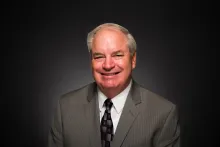
Robin Webber was born in Chicago, Illinois, in 1951, but has lived most of his life in California. He has been a part of the Church of God community since 1963. He attended Ambassador College in Pasadena from 1969-1973. He majored in theology and history.
Mr. Webber's interest remains in the study of history, socio-economics and literature. Over the years, he has offered his services to museums as a docent to share his enthusiasm and passions regarding these areas of expertise.
When time permits, he loves to go mountain biking on nearby ranch land and meet his wife as she hikes toward him.
